New Matilda: Australia’s Money Helps Kill, Intimidate And Torture

from our good friends at

New Matilda.com

NM INVESTIGATES

23 Mar 2012

Our Money Helps Kill, Intimidate And Torture

By Marni Cordell

Bob Carr and Stephen Smith

Australia plays a key role in training and funding elite Indonesian counter-terror unit Detachment 88 – but wants to distance itself from the unit’s violent reputation, reports Marni Cordell

Bob Carr and Stephen Smith with

their Indonesian counterparts.

There’s been a terror threat in Jakarta. A group of hardliners claim they intend to bomb the city’s transport system, just days before the UK prime minister is scheduled to arrive for a state visit. Indonesia’s counter terror agencies scramble to respond to the critical incident as the population goes into lockdown.

I’m sitting in the Control Room at the Jakarta Centre for Law Enforcement Co-operation (JCLEC) alongside international police trainers Bob Milton and David Gray.

On the screens in front of us, Indonesian police are acting out roles in this imagined terrorism scenario — and Milton and Gray are the puppet-masters.

Inside the JCLEC Control Room. Photo: Marni Cordell

“Basically the scenario develops into a more and more complicated problem,” explains Milton, a former Metropolitan Police commander from the UK.

“We try to make it as real as possible. We’ll have things such as pictures, audio, taped phone conversations, anything that we can try and get the information to them in a more interesting way.”

“We then challenge the students and ask for quite a lot of detail about how they are going to respond, and how they are going to deal with it.”

Fake terror scenarios like this one are a regular part of the immersive training that goes on at the Australian-funded police training centre.

JCLEC was set up in 2004 as a result of a bilateral agreement between Indonesia and Australia to strengthen Indonesia’s counter-terror effort in the wake of the Bali Bombings.

I visited the centre last week as part of an investigation into Australia’s funding and training of Indonesia’s crack anti-terror squad, Detachment 88 — the unit responsible for capturing or killing most of Indonesia’s terrorism kingpins since the 2002 Bali attack.

Detachment 88 employs a controversial brand of policing in which suspects are shot dead rather than arrested — like a soldier would shoot an enemy combatant. The high profile counter-terror raid in Bali last Sunday, in which five suspected terrorists were killed and the police were hailed internationally as heroes, was just the latest in a long line of lethal operations.

The unit is funded and trained by Australia and while the Australian Government might not endorse their paramilitary-style tactics, it’s been willing to turn a blind eye because Detachment 88 has been extremely effective at disrupting Indonesia’s extensive terror network.

JCLEC itself is deep within the grounds of the Indonesian National Police Academy, in the city of Semarang in Central Java. When I arrive at the centre I’m met by AFP federal agent Brian Thomson, a friendly, middle-aged cop from Canberra who is nine months into a two-year stint here. I’m the first Australian journalist he has hosted in that time.

JCLEC is touted as an international police training centre but in fact its students are over 90 per cent Indonesian — 9 per cent of whom are Detachment 88. The centre hosts trainers from Indonesia and across the globe, predominantly from Australia, Europe, and the UK.

Students undertake computer-based training courses – this one tests their knowledge of the difference between intelligence and information. Photo: Marni Cordell

Its core funding for more than 130 staff on six hectares of well maintained grounds comes directly from the Australian Federal Police’s own budget.

The self-contained centre — complete with student accommodation, lap pool and gym — couldn’t stand in greater contrast to stories that abound in Jakarta about Detachment 88’s operations.

JCLEC’s shtick is about “learning and understanding through shared experience” — and teaching best practice terror investigation techniques and proper use of the judicial process. Detachment 88, an elite and highly skilled unit with unique powers of surveillance in Indonesia, seems to operate above the law.

As I reported earlier this month, there is growing evidence to suggest what was once solely a counter-terror unit is now moving into counter-separatist operations. Activists in West Papua claim the squad is being deployed to hunt down civilians aligned with the independence movement in a growing campaign of intimidation.

According to Eric Sonindemi, a participant in last October’s Third Papuan People’s Congress, says Detachment 88 personnel were involved in the deadly attack on Congress in which six people were killed and many others wounded.

“Most of the security forces were in plain clothes, but they weren’t really concealing their weapons — they were sort of showing off,” Sonindemi told me when I met with him in Jakarta. “Detachment 88 was there,” he said, explaining that he “saw their equipment and riot shields”.

“Hundreds of people were detained [by police] that night and many of them were beaten in detention,” Sonindemi said. “I spoke to one person who had a gash in his head, a broken nose and bruises on his face. He had been beaten with the butt of a rifle by a policeman.”

“He was subsequently released and never charged with any crime.”

So exactly how closely does Australia work with the deadly unit?

According to a Jakarta-based security analyst who asked not to be named, “There was a big push after the first Bali Bombing, to the point where Detachment 88 actually had Australians with them on [counter-terror] operations.”

“It’s been a long time since that’s happened,” the analyst continued. “The AFP says that sometimes Detachment 88 doesn’t even share information with them any longer. There’s a real pride in doing things themselves now without relying on the Australians.”

But a diplomatic source in Jakarta confirmed that the relationship remains extremely close — and that the AFP continues to work with the Indonesian National Police, of which Detachment 88 is a part, at head office in Jakarta.

Australian Federal Police agent Brian Thomson at JCLEC, with an Indonesian colleague. Photo: Marni Cordell

Details on our financial support for the unit are harder to come by. The Australian government committed $36.8 million over the first four years of JCLEC. Now Thomson tells me the Australia’s support for JCLEC comes out of the AFP budget, which continues to provide “roughly the same amount” of funding to the centre. We also assist the unit directly — although just what that assistance entails is a closely guarded secret.

“I’ve pursued that question through senate estimates, through questions on notice, I’ve had DFAT briefings, and I can’t get any clarity about the role of Australian support of the Indonesian military and police and specifically whether our contribution benefits Detachment 88,” Greens senator and spokesperson on West Papua Richard Di Natale told NM.

“And it’s very clear that Detachment 88 has been involved in some of the violence that has occurred in the region.”

Details from the Indonesian side are just as shady.

Although some of Detachment 88’s terror raids have been simulcast on television in Indonesia, scratch below the surface and it’s difficult to get any real detail on the unit, says Usman Hamid, advisor to the International Center for Transitional Justice.

“The accountability of Detachment 88 is very low,” Hamid tells me when I meet him in a hotel lobby in Jakarta where he is meeting with other experts to prepare a response to the draft national security bill.

“Detachment 88 has special allocation of the budget and international funding — which has never been explained to the Indonesian public clearly, or even to the parliament for that matter.”

“We hear vague amounts but it’s not under the state budget.”

“It should be accounted appropriately,” Hamid told NM. “To the Indonesian parliament, to the Indonesian public, and of course to the Australian parliament and public … to make sure that the budget Australia gave is really being used for the right purpose.”

As Brian Thomson walks me through the official JCLEC Power Point presentation, I ask how Australia can be sure that the training taught at the centre is also being “used for the right purpose” — how do we know it isn’t being used to crack down on civilian dissent?

He’s silent for some time before asking me to repeat the question, and then ultimately refusing to answer it — handballing to his Indonesian counterpart, Dwi Priyatno, who refers me to the Indonesian law on terrorism, and back to the public affairs branch of the Indonesian police.

I also ask specifically about separatism in Indonesia and whether techniques to quash independence movements are ever discussed at the Australian-funded centre. Thomson again gets nervous.

“I can’t really answer that because my job here as an executive director is to be involved in running the centre, so what’s actually discussed in the classroom, I can’t give full [details],” he says.

“Although separatism…

“Yeah…

“No…

“Not separatism.

“When you say separatism, in what regard are you referring to it?”

Back in Australia my inquiries about Detachment 88’s operations in Papua and their move toward policing separatism have been met with an almost uniform response. Here’s what I received from the AFP head office in Canberra: Australia has no mandate to tell the Indonesian Police how to run their business. And yes, we will continue to provide “capacity building assistance”.

Meanwhile, Eric Sonindemi says he remains traumatised by the police and military attack on the Third Papuan People’s Congress. He clearly remembers the sound of gunfire, he tells me, and now jumps when he hears loud noises. He is sure he is being monitored by the police. “I’ve been threatened by the police before,” he says, “but this is the first time I’ve feared for my life.”

Other Papuans I met in Jakarta told similar stories — of constant surveillance by the security forces, phone tapping and intimidation. They told me that fear is part of their daily lives.

Australian officials may well seek to disclaim any responsibility for the behaviour of the Indonesian police and particularly from the activities of Detachment 88. Given the close relationship between the AFP and the unit, however, it’s hard not to conclude that Australia is directly contributing to this climate of oppression.

This is the second article in an NM investigation of Detachment 88 and Australia’s role in the Indonesian counter-terror effort. Read the first article here.

West Papua: Senator Richard Di Natale questions Foreign Minister Carr

Video of Question Time in the Australian Senate on Tuesday March 20, 2012, where Senator Di Natale questioned Foreign Minister Carr about his meeting with the Indonesian Foreign Minister.

He asked Senator Carr whether he had raised West Papua in this meeting, and if not, when the Government planned to do so.

The video includes Senator Carr’s response.

[youtube http://youtu.be/v-MD9ak3ORg]

Federal parliament yesterday (Australia)
http://parlinfo.aph.gov.au/parlInfo/search/display/display.w3p;query=Id%3A%22chamber%2Fhansards%2Febe16d5f-1452-4285-9104-171295b6d0c4%2F0029%22

THE SENATE
PROOF
QUESTIONS WITHOUT NOTICE
West Papua
QUESTION
Tuesday, 20 March 2012
BY AUTHORITY OF THE SENATE

PDF: http://parlinfo.aph.gov.au/parlInfo/genpdf/chamber/hansards/ebe16d5f-1452-4285-9104-171295b6d0c4/0029/hansard_frag.pdf;fileType=application%2Fpdf


Senator DI NATALE (Victoria) (14:52): Mr President, my question is to the Minister for Foreign Affairs, Senator Bob Carr. Minister, last week you met with your counterpart from Indonesia.

Honourable senators interjecting—

The PRESIDENT: Order!

Senator Bob Brown: I rise on a point of order. As you know, it is impossible to hear Senator Di Natale up this end of the chamber. I am sure that the minister cannot hear the question, so he will not be able to answer.

The PRESIDENT: Senator Brown, that is a valid point of order. I had called for order. I had called, in particular, two members of the Senate to order so that Senator Di Natale can be heard.

Senator DI NATALE: I might begin again. My question is for the Minister for Foreign Affairs, Senator Bob Carr. Minister, last week you met with your counterpart from Indonesia, Marty Natalegawa, and the defence ministers of both nations. Can you inform the Senate as to whether the issue of West Papua was raised as part of those discussions? If not, when do you plan to raise the issue of West Papua with the Indonesian government?

Senator BOB CARR (New South Wales—Minister for Foreign Affairs) (14:53): Mr President, it was raised. First of all it was raised by me, when I assured the Indonesian foreign minister that Australia—both sides of Australian politics—fully recognised Indonesian sovereignty over the Papuan provinces. I reminded him that that was recognised in the Lombok treaty, signed by the Howard government with Indonesia in 2006. I underlined that I understood the case that all the governments of the world recognise Indonesian sovereignty. It would be a reckless Australian indeed who wanted to associate himself with a small separatist group which threatens the territorial integrity of Indonesia and that would produce a reaction among Indonesians towards this country. It would be reckless indeed.

I can say this: the Indonesian foreign minister nominated to me the responsiveness of the Indonesian government to oft-expressed Australian concerns about human rights in Papua. Before I could raise the subject, as I was fully intending to, the Indonesian foreign minister nominated that they have a clear responsibility to see that their sovereignty is upheld in respect of human rights standards. I was impressed by that. It reflects the fact that the previous Australian governments—I know it is the case with this Labor government and I assume it is the case with a coalition government—have raised these concerns with Indonesians, and it reflects the fact that Indonesians have listened.

I again would warn any member of the Senate against foolishly talking up references to separatism in respect of the Papuan provinces. That is reckless and it is not in Australia’s interests.

Senator DI NATALE (Victoria) (14:55): Mr President, I ask a supplementary question. It does relate to the Lombok treaty and I need to remind the foreign minister—I understand he is new in his role—that the Joint Standing Committee on Treaties report of 6 December made a bipartisan recommendation:

The Committee recommends that the Australian Government encourage the Indonesian Government to allow greater access for the media and human rights monitors in Papua.

If this is still the government’s position, what has Senator Carr done to further this aim?

Senator BOB CARR (New South Wales—Minister for Foreign Affairs) (14:56): I can assure the Senate that the Australian embassy in Jakarta will continue to raise matters of human rights in respect of the Papuan provinces, and will do so in respect of the recent sentencing of five men in Papua province to three years imprisonment for subversion. Australia has a strong and consistent record of upholding the right of persons peacefully to express their political views freely. Australian officials in Jakarta will raise our concerns over these sentences. But we will do so as a friend of Indonesia, absolutely explicit and unabashed about asserting Indonesian sovereignty over the Papuan provinces. The Lombok treaty—I refer again to the fact that the Lombok treaty was signed in November 2006, coming into force in 2008—is based on such a recognition: support for the sovereignty, territorial integrity, national unity and political independence of each other. Similar language is used in the preamble.

Senator DI NATALE (Victoria) (14:57): Mr President, I ask a further supplementary question, which also relates to the JSCOT report, which I remind the foreign minister is about what the Australian government, not the Indonesian government, has agreed to do. Recommendation 2 says:

… increase transparency in defence cooperation agreements to provide assurance that Australian resources do not directly or indirectly support human rights abuses in Indonesia.

Again I ask the foreign minister: what steps will you take in your role as foreign minister to ensure this recommendation is applied and that transparency of Australia’s role— (Time expired)

Senator BOB CARR (New South Wales—Minister for Foreign Affairs) (14:58): In those full and frank exchanges last Thursday with our Indonesian counterparts, the defence minister and I canvassed Papua and the Indonesian foreign minister referred again to the progress being made by Indonesia in shifting responsibility for law and order in the Papuan provinces from the military to the police. President Yudhoyono—a great friend of Australia’s, by the way—has committed his government to raising the living standards of the people of Papua and reinvigorating special autonomy. Australia believes that this is the best path—the best means—to achieving a safe and prosperous future for the Papuan people. We will give support through our aid programs. We are the biggest aid donor to Indonesia, and a recognition of that is reflected in the Lowy Institute poll, which I recommend members of the Senate read, which says that Australia is held in high standing by the people of Indonesia. We will continue to work on these great tasks.

Kontras: court ruling against Forkorus far from human rights principles and spirit of fair trial

The court ruling against Forkorus CS
Still Far from the human rights principles and the spirit of fair trial

The Commission for the Disappeared and victims of violence (KontraS) has regretted over the verdict of the judges in the District Court of Jayapura, West Papua, which sentenced Forkorus Yaboisembut, S. Pd, Edison Kladeus Waromi and three others, Dominikus Surabut, August M. Sananai Kraar dan Selpius Bobii in jail for 3 years on 16th March 2012. Despite each of the sentence is lighter than indictment of the prosecutor for five years in jail, it is still far from the principle of a fair trial and not socializing with the idea to build a Peaceful Papua through the dialogue.

Indonesia, as a democratic country and adopted a number of international instruments for human rights, the government is suppose to solve the problems in Papua more wisely, in the particular case of the verdict of the treason charged to Forkorus Cs. The court is not supposed to be conducted as there is another way around which will more effective and dignified based on the human rights instruments such as through the dialogue that will socialize the case so far.

The treason charged to Forkorus Cs, in fact, is considered too extreme as no one has used violence or violates any of the national rules and regulations during the congress of Papuan People III that held in 17 to 19 October 2012. What Forkorus Cs has conducted is a part of freedom of expression in peaceful manner which stated in Universal Declaration on Human rights article 19, Civil and political rights convention article 19 and 20, and also in other international rules and regulations. From the view of the domestic regulation framework, the guaranty of the freedom of expression is also stated in national regulations such as in 1945 Constitution, Law no 39 in 1999 and Law no 12 in 2005 that related to human rights which ratified in civil and political rights covenant. It is stated by defendants’ lawyers under their defence which is known as Bring democracy to the court and struggling peace for Papuan People.

Based on the result of the investigation and monitoring of the national human rights commission, the allegation of human rights abuses were committed by the security forces (police and military), in the forms of excessive force, violence, torture and other cruel treatments. However, the fact-finding mission was never followed up by the legal basis either by the police or national human rights commission.
By observing the sentences read by the panel judges which consisted of Jack Johanis Octavianus, SH as chief justice and four other members of judge, I Ketut Nyoman Swarta, SH.MH, George Mambrasar, SH.MH, Orpa Martina, SH, Willem Marco, it has raised a number of problematic notes that need to be questioned based on the information collected by the coalition of civil society organizations, which dedicated to enforce the law and human rights in Papua such as:

Firstly, the sentence of the panel judges show inconsistency in case of dealing with evidences related to the treason. The judges argued that the defendants have convincing and legally proven by law related to the articles of treason and proven to conduct an experiment.
Secondly, no credible witnesses have been brought to the court. While only one witness who comes from the society, seven other witnesses are coming from the police who did not see directly what happened in the field. So, of course they against the defendants and moreover, another five witnesses who come from the society also against defendants too during their testimonies of the court hearing. Those five people who testified in the court are also the participants of the demonstration that arrested and violated by the police during the process of interrogation. Their witnesses are not supposed to be in any consideration during the hearing.

Thirdly, during the hearing, the judges were able to present only one evidence or banner, while there have to be mentioned 69 evidences that the sentence referred to.

Fourthly, Gustav Kawer, one of the lawyers was criminalized because he was assessed as person who disturb the hearing.
KontraS supported the measurement taking by the lawyer who would file an appeal over the judgement since the hearing is not matching with the human rights principle and fair trial. She has submitted questions to the government regarding its commitments to solve problems in Papua through peace process, considering that the way which the government criminalized and implemented the article of treason would make the peace discourse further in Papua. The agenda to push the peace process in Papua is supposed to be fitted within the policy conducted by the government such as to stop the implementation of treason articles indiscriminately and to free from arbitrary arrest to who have not committed any violence or violation during the demonstration.

Jakarta, 16 Maret 2012
Badan Pekerja,

Indria Fernida
Wakil Koordinator

Contact Person: 08161466341 (Indria Fernida)

“Enough Is Enough!” Testimonies of Papuan Women Victims of Violence and Human Rights Violations 1963–2009

http://ictj.org/publication/enough-enough-testimonies-papuan-women-victims-violence-and-human-rights-violations

March 14, 2012
ICTJ, the Women Commission, and the Women Working Group of Papuan People Assembly

“We women of Papua have been bruised, cornered, besieged from all directions. We are not safe at home, and even less so outside the home. The burden we bear to feed our children is too heavy. The history of the Papuan people is covered in blood, and women are no exception as victims of the violence of blind military actions. We have experienced rape and sexual abuse in detention, in the grasslands, while seeking refuge, no matter where we were when the army and police conducted operations in the name of security.”

In 2009–2010, ICTJ, the Women Commission, and the Women Working Group of Papuan People Assembly provided support to Papuan women in a project to document gender-based violence and human rights violations that occurred between 1963 and 2009. This documentation effort aims to understand different patterns of violence, including abuses committed by security forces and resulting from efforts to seize natural resources in Papua, as well as violence women have experienced in their own households since the army took control of the region in 1963. Of the regions in Indonesia, Papua—on the verge of becoming independent when Soehato gained power—experienced some of the highest rates of atrocities committed under the regime. And recent crackdowns in Papua indicate the government is still adopting a heavy-handed security approach.

The women in Papua worked on this collection of stories of violence and abuse over three months, interviewing 261 people (243 women and 18 men). The report finds that a range of factors within Papua—violence employed by security forces, a culture of discrimination against women, and lack of political will to change policies among others—have meant the victims are still neglected and none of the effects of violence have been addressed. “Change cannot be postponed any longer,” the women conclude.

Thousands across Papua demand UN step up to protect Papuan people: PHOTO AND VIDEO REPORT

Ban Ki-moon with Indonesia President Susilo Ba...
Ban Ki-moon with Indonesia President Susilo Bambang Yudhoyono (Photo credit: Wikipedia)

PHOTO AND VIDEO REPORT

from the West Papua Media Editorial team, and local sources across Papua

March 21, 2012

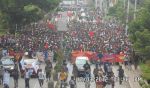
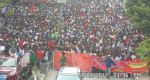
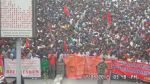
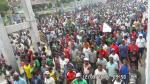
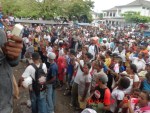
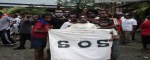
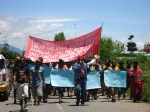
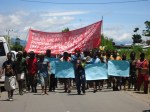
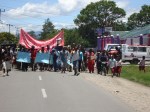
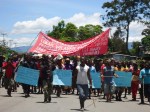
Rallies held across West Papua, Indonesia, and Australia have drawn tens of thousands of people on to the streets calling on UN Secretary-General Ban Ki-Moon to do more to protect West Papuans to Indonesian state violence, and to allow them exercise their universal human rights to self-determination.

Despite significant threats of violence prior to the rallies by Indonesian security forces against peaceful unarmed protestors, the mass mobilisations across West Papua significantly outnumbered security forces and were peaceful.  In some centres, the police only sent a handful of undercover intelligence agents to monitor the situation.

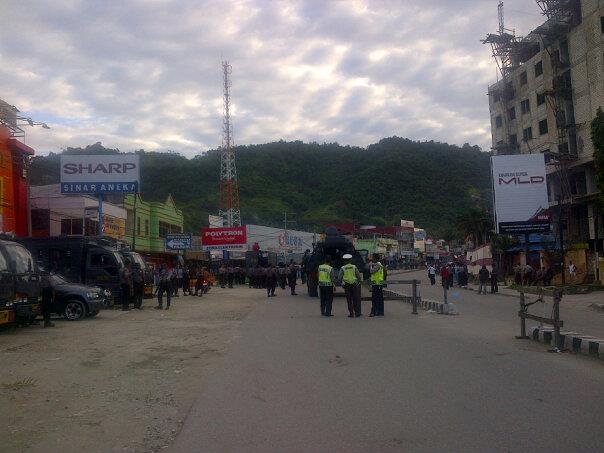
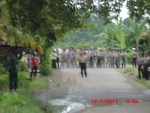
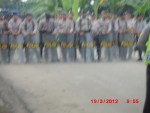
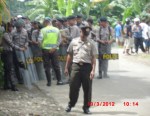
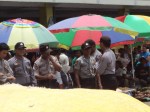
Security forces blocking access to Jayapura (photo Matias Murib)

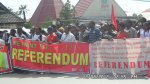
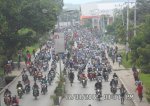
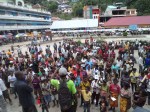
In Jayapura, over 5000 demonstrators marched from Taman Imbi and joined with a long march of several thousand people.  Security forces blocked access to the centre of Jayapura with heavy weaponry, but the rallies avoided provocation.  Jayapura was reported to be a ghost town as the rallies paralysed normal business and movement.

[youtube http://youtu.be/1Y0jMhuygXE] [youtube http://youtu.be/Zjz3Vj4Mv3A] [youtube http://youtu.be/xNgwCGiqB6E] [youtube http://youtu.be/lStemYrVRIo] [youtube http://youtu.be/IcoGo4fXRBY]

Speakers in Jayapura demanded that the UN Secretary-General listen to the people of West Papua and tabled seven key demand on the UN.  Buchtar Tabuni, from the West Papua National Committee (KNPB) told the crowd that the UN must take responsibility for its role in the sham 1969 Act of Free Choice handover of West Papua to Indonesia, actions that violated international law.

“Ban Ki-Moon and SBY have to know the wishes of the sovereign independence of Papua on the land itself.  KNPB will mediate the West Papuan people so they can determine their political choices through a mechanism that is democratic, peaceful, dignified and final in accordance with the principles and standards of international law”, said  Tabuni.

Jayapura

Herman Wainggai, a West Papuan  the West Papuan independence advocate based in the United States explained at the solidarity rally in Melbourne, Australia, “Our troubles began in New York in 1962, and I hope they will end there soon. We ask the United Nations to host talks between the Indonesian Republic and the Federated Republic of West Papua, just as the UN did between the Indonesians and the Dutch”

Ban Ki-Moon was visiting Indonesia to participate in  The Jakarta International Defence Dialogue, hosted by the Indonesian Ministry of Defence on 21 March 2012, a move widely seen by human rights observers as giving legitimacy to Indonesian militarist objectives over West Papua and beyond.

West Papuan activists called on Mr Ban to use the opportunity to press Indonesia on human rights in Papua and its consistent denial of basic freedoms and rights to West Papuan people, including rights to life and of freedom of expression, and freedom from arbitrary detention.

“We would like Mr Ban Ki-moon to attend to our defence while he’s in Jakarta” said Herman Wainggai,

“The Universal Declaration of Human Rights establishes the right of all individuals to freedom of opinion and expression and the right to peaceful assembly and association. Also,  Indonesia is a signatory to International Covenant on Civil and Political Rights (ICCPR), which guarantees the rights to freedom of expression and peaceful assembly and Indonesia’s constitution also protects these rights,” Wainggai told West Papua Media.

“So,  it would be appropriate for the Secretary-General to negotiate the release of all political prisoners in Indonesia while he is visiting the new ‘Peacekeeping’ Centre in West Java,” said Wainggai.

Widespread Mass Actions

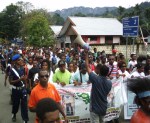
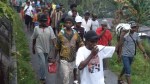
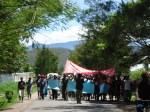
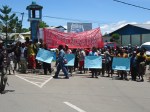
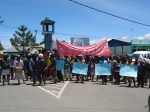
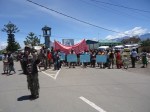
The rallies across Papua drew tens of thousands of people in total in Wamena, Biak, Serui, Yapen, Sorong, Nabire, Jayapura and Fak-Fak.  Security forces engaged in their standard procedures of intimidation and disruption at all rallies, but protesters maintained non-violence discipline at each area.

On Yapen island, close to 6000 people in total held two long marches to support the demands of the day, all under threat of arrest.  Local police had refused to issue a permit for the rallies to go ahead, claiming the rallies would upset the security and integrity of Indonesia.  After a week of pamphleteering and socialising the rallies, police had no choice but to allow the rally to go ahead.  The rally began in the village of Mantembu, where former political prisoner Yawen Wayeni was brutally disembowelled and filmed by Brimob police in a video leaked on Youtube in 2010.

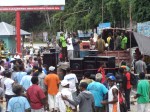
Mantembu, Yapen Island

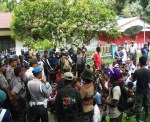
The same Brimob unit on Monday attempted to block the long march from leaving Mantembu, using over 50 police to block the narrow road, and attempted to seize all Morning Star flags.  Negotiations ensued, led by Reverend Jhon Pairire and FRWP Doberay Governor David Abon, who got agreement from police for the rally to continue to Serui city.  Police continued to intimidate Papuans all day, but Morning Star flags still appeared throughout the day despite Police.

Serui, Yapen Island

Manokwari saw more than 7000 people from across Papuan society and resistance raise the Morning Star flag and conduct long marches all over town after prayer, eventually settling down to listen to orations from a wide range of speakers.  Speakers called for the freeing of all political prisoners in Papua in Indonesian prisons, including the President and the Prime Minister of the Federal Republic of West Papua.  Brimob officers tried to seize the Morning Star flags early unsuccessfully, but soon stood aback training their weapons on the crowd, who studiously ignored the provocative intimidation according to stringers for West Papua Media.

Manokwari

In Sorong, our stringers reported that almost 1000 people took to the streets in a festive atmosphere.  Organisers claimed that few security forces turned up other than about ten plain clothes intelligence agents.  “It is clear that this drastically changed the atmosphere, it must be because of international pressure,” said our stringer by SMS.

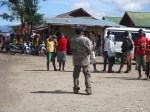
On the West Coast in Fak-Fak, almost 1000 people took part in prayers and listened to speeches in the main market square, with little interference by security forces present.

Fak-Fak

In Jayapura, stringers for West Papua Media reported a wide range of colourful, festive and dramatic demonstrations for Papuan aspirations, including the release of almost 300 balloons painted with banned Morning Star flags and the UN flag, which drifted across town and out to sea.  This tactic has been used repeatedly as a tactic for distributed symbolic resistance in both Papua and Maluku for years.  Isolated gunfire was heard when the balloons passed over military barracks, according to local sources, believed to be Indonesian soldiers attempting to shoot down the balloons.

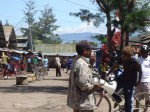
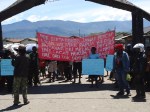
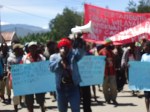
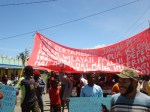
And in Wamena, in the Baliem Valley, a thousand people joined in a rally and march to support the call for the UN to take action by sending peacekeeping force to protect Papuan people against Indonesian security forces.  Stringers for West Papua Media report that few security forces were in overt attendance, but there was an understanding that troops were close by at all times.  The Baliem Valley and West Papuan highland people have borne the brunt of Indonesian violence since the occupation began, with sweeps against civilians by the Australian funded Detachment 88 counter terrorism group and Indonesian army still ongoing in Tingginambut, Mulia and the outer areas of the Baliem Valley.

Wamena

More demonstrations are planned in coming weeks.

westpapuamedia

Create a website or blog at WordPress.com

Up ↑