THE MOMENTUM BUILDS: Thousands shout out support for Free West Papua at East Coast Blues & Roots Festival

Press Release – Wednesday April 11, 2012
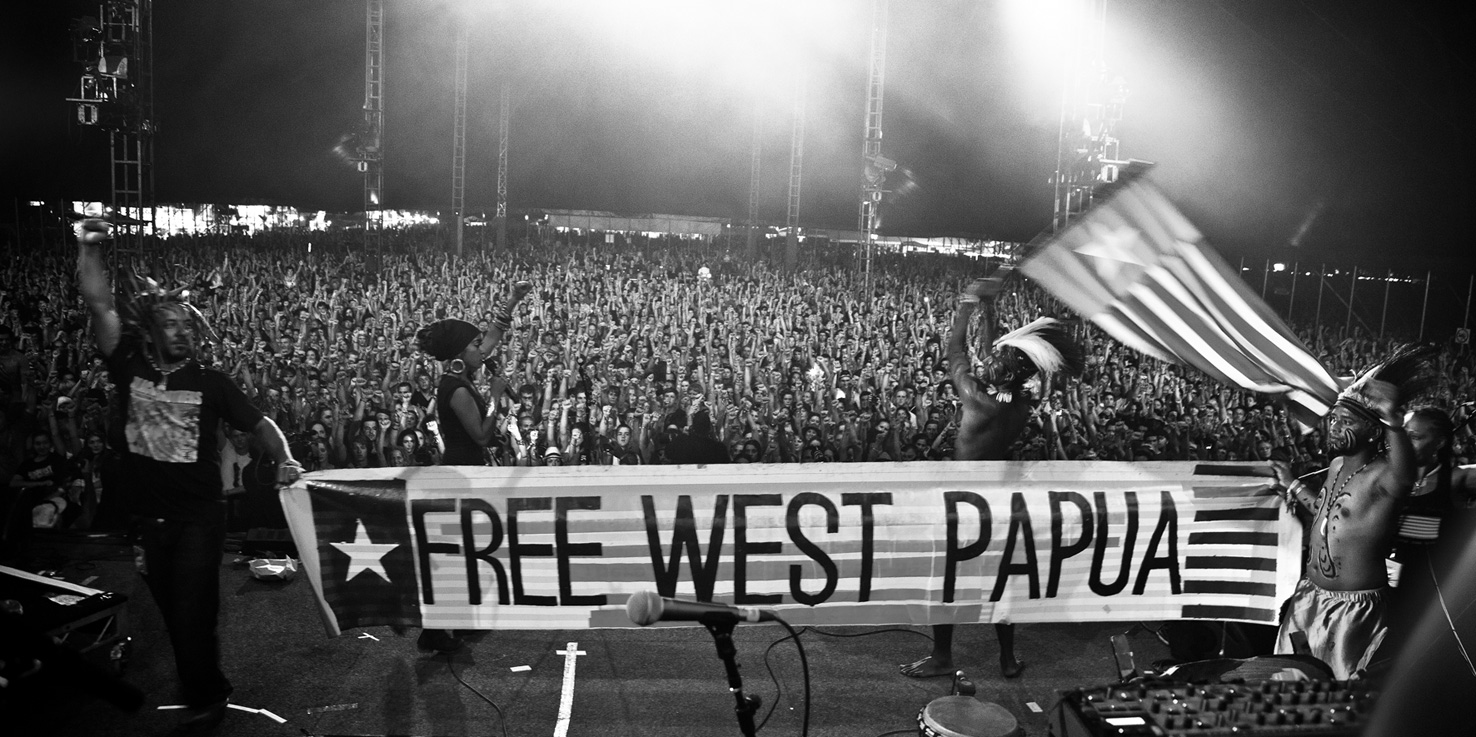
As momentum for the Free West Papua campaign continues to grow and gain attention throughout the international community, Australians continue to show mounting support for their fellow human beings and closest neighbours, West Papua. Another historic showing of undeniable support for human rights and justice in West Papua came at Blue King Brown‘s East Coast Blues and Roots Festival performance on Sunday 8th April, 2012 where thousands threw up their fists in a passionate display of solidarity and unanimity that the issues facing West Papua need to be promptly addressed by the Australian Government and the international community and that human rights is deserved to all people and we as nation have a responsibility to do whatever we can to ensure that is what’s happening.
It is through signing the petition and your sharing and reposting of images like this that we as a community can help expose the dark truths behind the oppression of West Papua and no longer allow these human rights abuses to be hidden in the darkness, our mutual knowledge on the issues is a light that has bravely begun to shine through, and it is only with your support that we will continue to see that light shine brighter and eventually, the unhindered Rize of The Morning Star for a FREE WEST PAPUA.
RSF: JOURNALIST KILLED AS GUNMEN ATTACK PLANE AT PAPUA PROVINCE AIRPORT

Reporters Without Borders

PUBLISHED ON WEDNESDAY 11 APRIL 2012.

Reporters Without Borders offers its condolences to the family and friends of Leiron Kogoya, a journalist with the newspapers Pasific Post and Papua Pos Nabire, part of the Pacific Post group, who was killed in an attack by gunmen on a plane at Mulia airport in the province of Papua three days ago.

“Although the journalist did not appear to be the target of the attack, it illustrates the insecurity that prevails in the region, where at least two other journalists were killed late last year,” the press freedom organization said.

“Covering the Papua region is highly risky for journalists. Leiron Kogoya was among those courageous reporters who strive to keep the world informed about the region, which has been the scene of violent clashes. Our thoughts go out to his family and friends.”

“We expect the authorities to shed light on the attack. Contradictory information about the identity of those behind the shooting said to have been provided by security forces to journalists indicates that an independent investigation must be carried out as soon as possible.”

The plane, a Twin Otter of the Indonesian airline Trigana Air, landed at Mulia at about 8 am when at least five gunmen opened fire. The pilot and co-pilot, who were both hit, lost control of the aircraft, which then crashed into one of the terminal buildings. Four people were wounded. Kogoya, was fatally shot in the neck.

The 35-year-old reporter was flying to Mulia in the Puncak Jaya district to cover local elections in the provincial capital, Jayapura.

Photo by: Agus Fakaubun

The news website westpapuamedia.info quoted the head of public relations for the Papua police, Commander Yohanes Nugroho Wicaksono, as saying the gunmen were hiding in the hills 50 metres from the airport. It said police had not yet been able to identify the perpetrators or the type of guns they used.

According to military intelligence, the separatist group Free Papua Movement (Organisasi Papua Merdeka, or OPM, in Indonesian) was behind the attack, while local police said they had no information about the identity of the attackers.

Indonesia is ranked 146th of 179 countries in the 2011-2012 world press freedom index compiled by Reporters Without Borders.

Video Report: Thousands in Jayapura demonstrate in support of “New Guinea Council: First Steps” conference in Netherlands

Benny Wenda at the IPWP launch Русский: Бенни ...
Benny Wenda at the IPWP launch

from West Papua Media sources

Demonstrations were held in Jayapura on April 5 in support of a groundbreaking conference held in The Hague, The Netherlands, to examine  pathways to the reinstatement of the New Guinea Council or Nieuw-Guinea Raad, the original Parliament of West Papua from 1961 until Indonesia’s invasion.

Jayapura was again brought to a standstill by the demonstration organised by the West Papua National Committee (KNPB), where several thousand people gathered hear speeches and to voice their solidarity with the “Nieuw-Guinea Raad: the First Steps” Conference.

Indonesian security forces were in attendance in large numbers at the rally, but no act of violence or provocation were reported by rally organisers.

In The Hague, speakers at the conference organised by the International Parliamentarians for West Papua (IPWP) and held at the Dutch Parliament, included exiled UK-based independence figure Benny Wenda, Dutch Parliamentarians including Harry van Bommel, Cees van der Staaij, and Wim Kortenoeven.  International Lawyers for West Papua (IPWP) Co-ordinator and international human rights lawyer Jennifer Robinson also spoke, demanding The Netherlands honour its “sacred trust” of its promise of independence for the West Papuan people, and assist West Papuan to fulfil their human right to self-determination.

The New Guinea Council (Nieuw-Guinea Raad) was established on April 5 1961 whilst under Dutch administration as the concept of a more democratic mode of administration started to develop, as a body that was to be the basis for a independent West Papuan parliament.  According to the International Parliamentarians for West Papua, “The establishment of regional councils came from the requirement that the Charter of the United Nations imposed on the Netherlands: that the interests of the inhabitants of Dutch New Guinea had to be paramount.”
“The Netherlands was to respect the right to self-rule and had to take the political aspirations of the indigenous people into account. They were also meant to support the Papuan people with the gradual development of their own political institutions.  There are documents. We are not speaking of vague promises, but we are speaking of real firm commitments for the independence of the West Papuan people,” explained a spokesperson for IPWP.

“Unfortunately by signing the New York Agreement (1962) the Dutch governments abandoned the West Papuan people,” the spokesperson said.

Footage from the demonstrations in Papua:

This slideshow requires JavaScript.

Presentations at the conference in The Netherlands:

Police issue ultimatum to Buchtar Tabuni

Bintang Papua, 6 April, 2012

Despite the threat of resistance from the KNPB in response to a summons from the police to its chairperson, Buchtar Tabuni,  the police chief, Drs BL Tobing said that they will continue to issue the summons  the chairperson of the KNPB to take responsibility for the demonstrations.

‘We will give him until two or three weeks after Easter to respond to our summons. If he fails to respond, we will have to use force to bring him here.’

He said that the summons had been issued because the demonstrations were anarchic and the particpants had been carrying traditional weapons such as spears  and bows-and-arrows and took place outside the Abepura Post Office and in Taman Imbi on Tuesday 20 March and Monday 2 April.

According to the chief of police, traditional weapons were only to be carried  on ritual occasions

He said that the KNPB had broken its promise about the demonstration.  He also said that the KNPB was trying to influence public opinion and had adopted the position of rejecting a police summons.

KNPB will not respond to police summons

Bintang Papua, 3 April 2012

The insistence by the chief of police in Papua that Buchtar Tabuni, the chairperson of KNPB – the National Committee of West Papua – be held responsible for the KNPB organising two demonstrations instead of just one has led to a response from the KNPB.

The chairperson of the KNPB, Mako Tabuni, said that the organisation will not respond to the summons from the police, whether or not they intend to arrest Buchtar Tabuni, saying that if Buchtar is arrested, they will take strong action again the police.

Speaking at a press conference on Tuesday, 3 April, Mako said that there was no foundation whatever to what the police chief said.

He said that they had been forced to hold their demonstration in two places, in Abepura and in Taman Imbi because the police had failed to acknowledge the organisation’s notification to the police about the forthcoming demonstration.

‘Now, they even want to take proceedings against us.’

He also said that the fact that they intended to carry traditional weapons was simply because they were being used for cultural purposes, as the cultural attributes of the Papuan  people.

‘The demonstration is an action regarding our people’s future, and if the police complain that it caused traffic congestion,  then we think that the police should behave more professionally. We know that demonstrations take place in other parts of the country, such as in Java and Makasar which have been going on for days and causing traffic jams because they are quite legal. This is a time of demonstrations.(a reference apparently to the many demonstrations currently taking place across Indonesia in protest against the increase in the price of petrol).

‘If we are to be taken to court because we hold demonstrations, then we have to accept that we are not living in a democracy.

‘If we are not allowed to demonstrate, then we will resort o other ways in our calls for a referendum because Indonesia is holding on to West Papua as the result of a process that was illegal.’  [Here the reference is to the so-called act of free choice in 1969.]

He also complained about the media coverage which he said, focussed on things like traffic jams, shops being closed or children being sent home from school, without mentioning the purpose of the demonstration.

‘So if we are denied the space to demonstrate,  we will have to resort to other measures .’

He warned the police to consider the consequences of acting like a colonial power, adding that they had no intention of responding to the summons from the police.

He also said that the claim that a journalist was killed during the KNPB demonstration was quite untrue. and was just a trick to denigrate the intentions of the KNPB  whenever they organise demonstrations. and an attempt to damage the good relations which the KNPB has had with the local press.for many years.

[Abridged in translation by TAPOL]

Create a website or blog at WordPress.com

Up ↑
