West Papua Report
This is the 91st in a series of monthly reports that focus on developments affecting Papuans. This series is produced by the non-profit West Papua Advocacy Team (WPAT) drawing on media accounts, other NGO assessments, and analysis and reporting from sources within West Papua. This report is co-published with the East Timor and Indonesia Action Network (ETAN). Back issues are posted online at http://etan.org/issues/wpapua/default.htm Questions regarding this report can be addressed to Edmund McWilliams at edmcw@msn.com. If you wish to receive the report via e-mail, send a note toetan@etan.org.
Summary: A new operation by security forces in West Papua’s central highland region
has targeted civilians with destruction of a church, houses and other buildings. Human rights organizations are calling for an investigation of security force brutality associated with the October 16-19 Papuan Congress. Continued repression in West Papua and the Yudhoyono administration’s defense of the perpetrators of that repression as well as the impunity regularly accorded the perpetrators points to the Jakarta’s ultimate responsibility for the violence. The decade-old Special Autonomy policy in West Papua constitutes a strategy for subjugation of Papuans in their own homeland.
Contents:
Security Forces Again Target Civilians in Papuan Central Highlands
 |
|
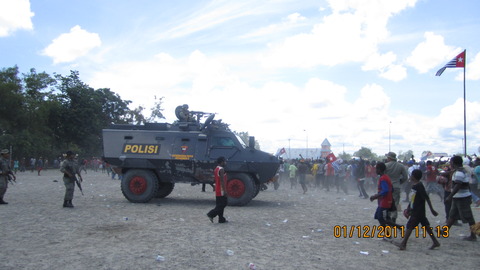
| POLRI GEGANA anti-terrorism troops attacking peaceful flag raisers, Taokou Village, East Paniai, December 1 (West Papua Media) |
|
West Papua Media reports that a major offensive by Indonesian security forces in West Papua’s Central Highlands (Puncak Jaya) was launched on December 1. Special forces of the militarized police (Brimob) attacked the village of Wandenggobak on December 3, burned a church, an unknown number of houses and village guard houses. Initial reports suggest some civilian casualties, but the number of Papuan civilians killed and injured is not known.
According to West Papua Media sources, the assault on the village was in reprisal for the killing of two Brimob personnel in earlier fighting with forces of Goliat Tabuni, a local leader of the Papua independence movement.
The latest “sweeping operation” reportedly coincided with a December 1 peaceful demonstration by a large number of Papuans celebrating the 50th anniversary of the first raising of the Papuan independence flag at the district center of Tingginambut. National police spokesman Maj. Gen. Saud Usman Nasution says hundreds of troops have been deployed in Puncak Jaya.
West Papua Media notes that the Brimob unit involved (the “anti terrorist” Gegana Brimob) has received Australian training and weaponry obtained from Australia.
 |
| About 110 residents of Berap and Genyem villages, near Lake Sentani in Papua, have been forced to flee to the forest after Indonesian Police terrorized the village. WestPapuaMedia |
New Reports on Security Force Attack on Papuan Congress, Call for Accountability
The November 29 Jakarta Globe reported that the Institute for Human Rights Study and Advocacy (Elsham) and the Communion of Churches in Papua (PGGP) said that at least 51 people had been tortured by members of the military and police during and after the October 16-19 Papuan Congress (see West Papua Report November 2011).
Congress participants testified that they had been “beaten and kicked repeatedly by security forces both at the congress site and while being transported to police headquarters. Some participants said they were beaten at the police station.”
These accounts echoed victim testimony reported elsewhere. The ELSHAM and PGGP report broke new ground, however, noting that security forces also looted and vandalized a monastery.
The Rev. Wellem Maury of the PGGP said the National Commission on Human Rights (Komnas HAM) should assume responsibility for the investigation and specifically form a fact-finding team to investigate allegations of human rights abuses, torture and excessive use of force. “Komnas HAM must also report its findings to the Coordinating Ministry for Politics, Legal and Security Affairs so there is an open and fair trial,” he said.
Brutal Repression in West Papua: A Product of Rogue Security Forces or Yudhoyono Administration Policy?
The injustice of the brutal assault on peaceful Papuan civilians at the Papuan Congress on October 19 has been compounded by exceedingly light sentences for the perpetrators of the abuses, including the death of at least three dissenters and the beating/torture of scores of others. A security force-led investigation produced official reprimands for 13 district police officers, four Mobil Brigade (Brimob) officers and one district police chief, while five Jayapura Police officers were given seven-day detentions.
|
The silence of the President regarding the October 19 assault, the impunity accorded the perpetrators, and the defense of their actions by senior Yudhoyono administration officials underscore the President’s direct responsibility.
|
Any impact of these minimal sanctions has been mitigated by comments by key security leaders. National Police chief Gen. Timur Pradopo told the House of Representatives that some police officers had taken the wrong approach during the third Papuan People’s Congress. However, he defended the measures taken saying “what we did [at Abepura] was part of law enforcement.” Coordinating Political, Legal and Security Affairs Minister Djoko Suyanto, at the same House hearing echoed Timur’s statement. “I hereby defend my colleague from the police. I think it’s impossible for officers [military and police] to commit violence for no reason – there must be a logical explanation for their anarchist deeds.” The spokesman for President Yudhoyono Julian Aldrin Pasha also has defended the assault, telling the Jakarta Post: “In principle, we have dealt with the Papua issue properly.” He added that the police were justified in forcibly dispersing the Third Papuan People’s Congress in Abepura when it found that it was an act of treason.
Most tellingly, President Yudhoyono himself was dismissive of concerns about human rights violations arising from the October 19 assault, even when those concerns are raised by a foreign Head of State. President Obama, during their November Bali meeting, according to U.S. government sources, raised the October 19 assault. Yudhoyono told mediathat said he responded to the U.S. leader by contending that Indonesian forces were conducting legitimate operations against an ”insurgency” and that Indonesian forces came under attack from separatists. ”If there are members who have violated the laws, gross violations of human rights, then they will go before the law,” he said. ”I told him personally, there is no impunity, no immunity.” Apparently Yudhoyono public silence specifically regarding the October 19 extended to his evasive response to President Obama’s direct question.
WPAT Comment: International reaction to the October 19 assault, mostly from human rights organizations, but also from some international parliamentarians such as U.S. Representative Eni Faleomavaega (see West Papua Report November 2011), condemned the Indonesian security forces as responsible for violence against peaceful dissenters. Such international opprobrium directed at security forces abuses over the years has been strong and often has identified specific units and officers as perpetrators of these rights violations. But such criticism may be misdirected. The silence of the President regarding the October 19 assault, the impunity accorded the perpetrators, and the defense of their actions by senior Yudhoyono administration officials underscore the President’s direct responsibility, not only for the assault, but for the climate of repression that assures such abuses will continue. The Yudhoyono administration itself, and President Yudhoyono himself, should stand in the dock for these crimes.
Where Are Indonesia’s Indigenous Voices in the Climate Change Debate?
A November 30 Jakarta Globe article by Andrew D. Kaspar underscored the importance of annual international climate change conference now meeting in Durban, South Africa. While much of the coverage in the run-up to the conference has focused on the failure of many developed nations, notably the U.S., to live up to commitments made in this area, another key issue is the extent to which perspectives of the indigenous peoples are (and are not) reflected in the deliberations.
Kaspar writes that a key element of any climate change strategy is Reduced Emissions from Deforestation and Forest Degradation (REDD), which is intended to offer payments to encourage forest preservation to prevent the release of carbon dioxide stored in the trees. Kaspar points out that REDD is seen as a particularly potent means of emissions reductions because the vast majority of Indonesia’s emissions are attributed to deforestation.
United Nations Secretary General Ban Ki-moon speaking in mid-November at the launch Indonesia’s UN Office for REDD Coordination made point that “Making REDD a success …will require the commitment and cooperation of all stakeholders. We must ensure that all have a voice.”
Up to now, Indonesia has accorded indigenous stakeholders little say in the fate of the forests that provide sustenance and shelter for many of them. This is particularly true in West Papua where Papuans’ objections to plans for a vast commercial plantation in the Manukwari area have been ignored. Papuan protest over decades of illegal logging either run by or protected by security forces and destruction of vast swaths of sago and mangrove by the Freeport mining operation also have been ignored.
Special Autonomy: A Strategy for Subjugation
“Special Autonomy,” the Indonesian Government’s strategy for addressing the myriad problems confronting the Papuan people, is now ten years old. Inaugurated by then-President Megawati in 2001, the plan was intended to address decades of failed development and the absence of critical health, education and other services which have impoverished and marginalized the Papuan people since West Papua’s coercive annexation by Indonesia in 1969.
The Papuan people have resoundingly rejected Special Autonomy, most notably in massive, peaceful demonstrations in June of 2010 (see West Papua Report July 2010).
While most independent analyses have consistently described “special autonomy” as a failed approach, criticism of the plan has largely focused on Jakarta’s hapless implementation of the policy. But a closer analysis of Special Autonomy suggests a more sinister reading of the plan’s impact and real intent.
Over the past decade the plight of Papuans has remained bleak. The poverty level, especially in non-urban areas where most Papuan live, is particularly revealing. The percentage of Papuans identified as living in poverty in the two West Papuan provinces in 2010 are among the highest in Southeast Asia.
|
Special autonomy funds continue to flow into West Papua in a manner that benefits the transmigrant population. Special Autonomy has disadvantaged Papuans systematically and comprises in effect a strategy for subjugation of Papuans in their own homeland.
|
According to the Indonesian statistical office (see BPS Nasional), the poverty level is 36.80% in Papua Province and 34.88% in West Papua Province.
Most Papuans live in rural areas and when poverty levels for non-urban populations are separated out the marginalization and suffering of Papuans emerge as especially acute. In the villages of Papua Province the poverty level is 46.02%, but only 5.55% of those living in towns (home to most non-Papuan migrants), The dichotomy between village dwellers (largely Papuans) and towns (largely migrants) in West Papua Province is similar. In villages, 43.38% live in poverty, while in towns only 5.73%.do so.
One long time observer of developments in West Papua (whose identity is not revealed for reasons of his security) argues that the combination of Special Autonomy and Jakarta’s decentralization policy (dividing up the region into increasing numbers of new administrative entities/districts) has been a “disaster” leading to ever greater marginalization of Papuans. He argues: “New districts have been formed without any real base/guarantee that public services will be improved or at least consolidated,” and that as a result, “new districts are much worse of than before.”
Many of the staff appointed to administer the new districts live outside the new districts, “hardly showing up where they should be working daily,” he told the West Papua Report. Moreover, the Jakarta central government has pressed the newly created districts to seek their own sources of financial income “opening the door wide for all kind of devastating investments without any critical reflection as to the impact on local indigenous communities such as the Merauke Integrated Food and Energy Estate.”
In reality, a large portion of the Special Autonomy funds flowing to West Papua has been devoted to infrastructure development and expansion of services in the towns to meet the needs of government-sponsored migrants (transmigrants) from other parts of Indonesia. The Ministry of Transmigration and Labor announced in late November plans to build three “new transmigration towns” in West Papua: Senggi in Keerom District, Muting and Salor in Merauke District (see p.6 Bintang Papua, November 29).
Special Autonomy funding of projects and services for migrants appear to have aggravated the marginalization of Papuans demographically in their own lands. Papuans constituted only 49.55% of the population of West Papuaaccording to 2010 Indonesian statistics. Population growth rates according to these same statistics for dire for Papuans with at only 1.84% annual growth for Papuans and 10.82 annual growth for non-Papuans.
The reality on the ground in West Papua is grinding poverty for many Papuans and a persistent dearth of critical services in rural areas where most Papuans live. Meanwhile, special autonomy funds continue to flow into West Papua in a manner that benefits the transmigrant population. Special Autonomy has disadvantaged Papuans systematically and comprises in effect a strategy for subjugation of Papuans in their own homeland.
Peaceful Papuans Celebrate 50th Anniversary of Raising of Papuan National Flag
Bintang Papua reported that thousands of Papuans peacefully gathered at the the tomb of Theys Hijo Eluay at Sentani, District of Jayapura, to celebrate the 50th anniversary of Papua’s independence on 1 December. Theys Eluay was murdered by Indonesian Special Forces personnel (Kopassus) in 2001.
At the gathering, the co-coordinator of the 50th anniversary committee, Jack Wanggai read out a series of demands which expressed support for international monitored negotiations on the future of West Papua and a referendum of the Papuan people who for decades have been denied the right of self-determination. At the gathering there were also calls for the Indonesian government to immediately withdraw army and police troops from Papua and to release political prisoners in West Papua.
Wanggai also noted the Papuans rejection of the Indonesian government’s latest initiative to evade an internationally facilitated, senior level dialogue i.e., the creation of the special organization known as UP4B – Unit for the Acceleration of Development in Papua and West Papua (see West Papua Report November 2011 for background on this unit and its leadership).
While the event was under way, troops conducted patrols along the roads, as well as in the vicinity of residential houses and shops. These activities by the security forces failed deter the people who completed their program peacefully.





 West Papua Media Alerts