Tempo: All West Papua Province’s Lawmakers Declared as Corruption Suspect

FYI

(West Papua Media comment:  these actions should be seen as an indictment of Jakarta’s failed Special Autonomy policies.  The DPRD office holders are restricted to those who are  members of Indonesia-wide political parties, and are heavily skewed toward military business interests.  A high proportion of members of the DPRP are not ethnically Papuan, and those who are, are involved in major Indonesian business ventures)

also: Big Budget, Big Leaks

Tempo Magazine
No. 50/XI/August 10-16, 2011

Law

All Suspects Together

All members of the West Papua DPRD were named as suspects in
corruption of the province’s funding. The state funds that should have
been used as capital for one of the province’s own businesses was
instead distributed to serve political interests. Governance in West
Papua is now threatened with coming to a complete standstill.

A Plenary session of the West Papua Provincial House of
Representatives (DPRD) was suddenly called for Thursday two weeks ago.
Although all the members were not present, the sitting was marked by a
tense atmosphere. Not surprisingly, as the theme of the discussion was
a very serious matter concerning the future fates of all those
attending.

The Papua State Prosecutor’s Office had named 44 members of the
parliament as suspects over corruption of Rp22 billion of West Papua
Provincial Income and Expenditure Budgets (APBD) for 2010 and 2011.
The announcement made by Deputy Chief State Prosecutor Suhardjo Tjatjo
rocked Papua. In the history of this nation, this is the first time
ever all the members of a parliament have been named graft suspects.

Not just the public, but the West Papua DPRD members themselves
admitted they were shaken when the release first appeared two weeks
ago. “I have never been questioned, so how come I am suddenly declared
a suspect?” said DPRD Speaker Johan Yoseph Auri. The Golkar Party
politician accused the investigation of the case of being loaded with
political interests. “I’m sure the prosecutor doesn’t have any strong
evidence in this corruption case,” he asserted boldly.

Johan admits he did accept the cash concerned. As did all his
parliamentary colleagues. But, he said: “It was a loan that was to be
repaid in three years.” Johan says he borrowed the cash from the
province-owned PT Papua Doberai Mandiri because he was under pressure
to meet his constituents’ requests.

Every day, he said, groups come to DPRD members’ offices claiming to
be constituents from various parts of Papua. They come asking for
donations for this and that and to lodge proposals for all kinds of
activities. “I have no other income, so I’m forced to look for loans,”
Johan explained.

Disastrously, those loans were not obtained from a bank, but rather
from a state-owned business that was not supposed to be involved in
borrowing and lending its shareholders cash. PT Doberai, for instance,
is a company set up by the West Papua government to look after
investment in this, Indonesia’s youngest province.

It was difficult to get other DPRD members to explain to us why they
now have the status of suspects. The plenary session, said John
Fathie—another Golkar politician—had decided that all its members were
forbidden to talk to the media. Explanations were only to be offered
by the DPRD speaker. Several members denied they had received any
money. “I already owe my bank money, so it would be impossible for me
to look for another loan,” declared PNI Marhaenisme politician Yance
Yomaki.

The difficulty is that the Papua Attorney General’s Office is fully
convinced that these people’s representatives have already done as
they liked by ‘feasting’ on the state funds to which they had no
right. Deputy Head of the State Prosecutor’s Office (AGO), Suhardjo
Tjatjo laid out to Tempo just how this case had begun, from its
investigation through to the conclusions reached and all the suspects
being determined.

Tjatjo said this was an old case whose status could only recently be
raised to that of an investigation once the AGO was convinced that
none of the money that had been claimed to be loans had been returned.
“There was no accountability for this expenditure,” he added.

Now, it so happened that Rp22 billion was cleared to be paid out at
the request of West Papua Provincial Secretary, Marthen Luther
Rumadas. Rp15 billion of that came from the 2010 APBD and the rest
from the 2011 one. “The business is under my authority,” he said
defensively.

The funds ought to have been allocated as additional capital for PT
Papua Doberai Mandiri. This provincial government-owned company is
active in very wide-ranging fields: drilling for oil and gas, non-oil
and gas exploration, as well as the acceleration of infrastructure
development, including netting new investors, both domestic and
foreign.

PT Doberai was set up around the same time as the formation of the new
province in 2009. West Irian Jaya regency was then elevated to the
status of West Papua province, with Manokwari as its capital. At its
establishment on 18 May 2009, the provincial government, that had
obtained an injection of special autonomy funds of Rp1.7 trillion,
invested Rp100 billion to buy shares in the new company.

A year later, all the shares in the province-owned business were taken
over by the West Papua government, until full control of it rested in
the hands of the provincial secretary. While that was happening, the
province treasury injected a further Rp25 billion in capital into it.
“That was when the games began,” said Tjatjo.

As the one having control of the business, Rumadas has also become a
suspect. He is accused of handing out state funds to DPRD members on
very spurious grounds: to cover their additional living expenses.

Rumadas was discovered to have issued a letter on 17 September 2010
concerning lending PT Doberai another Rp15 billion. Johan Auri gave
his written agreement to lending out this money to DPRD members.

The problem was that his letter was issued several hours after the
money had been transferred. “This meant that the money that had been
deposited then had to be hurriedly paid out,” said Tjatjo. The AGO
looked into this odd occurrence. It was also revealed that PT Papua
Doberai Mandiri’s CEO Mamad Suhadi at one point apparently refused
Rumadas’s request to pay out the money that had just been transferred.

When Rumadas had summoned him to his office, Mamad verbally declined
to comply. “Sorry, Sir, making such payouts would be a mistake,” said
Mamad, as imitated by Tjatjo. When Mamad refused to follow Rumadas’s
instruction, the Head of the West Papua Province Financial Bureau M.
Sirait was sitting next to Rumadas and later confirmed Mamad’s
statement to the prosecutor.

Rumadas paid no attention to Mamad’s objections. The money was still
paid out. Several weeks later another instruction was issued to
disburse a further Rp7 billion. The grounds were the same: loans to
the DPRD members. The AGO considered this corruption because the
members could not possibly pay back their loans in the set time,
namely July this year.

Rumadas does not reject the series of events, the results of the
prosecutors’ investigation. But he rejects claims that the loans were
deliberately given out to enrich DPRD members. Because of the loan
clause, Rumadas says, the DPRD members were required to return the
money they had borrowed.

Strangely, when he was pressed to explain why the loan money had been
taken from the company’s coffers and whether he knew what the loans
were for, Rumadas shook his head. “I didn’t know what they wanted the
loans for,” he admitted.

Tjatjo also admitted that the DPRD members were not told they had been
made suspects as the request for permission to question them submitted
to the Minister of Home Affairs had not yet had a response. Under
criminal procedure law, Tjatjo explained, if permission is not
forthcoming by one month after a request letter is sent, his office
may then continue its investigation and use compulsion to summon
suspects.

Last Friday, when we asked Home Affairs Minister Gamawan Fauzi for
confirmation of the request letter, he said he had not yet received
it. “Once I have received the request, I’ll certainly agree to it.
It’s just to uphold the law,” Gamawan told Tempo.

However, Gamawan does hope the AGO doesn’t have clear proof that the
DPRD members were involved in corruption, so the case won’t need to be
pursued further. He added that governance of West Papua could come to
a standstill if all the members of its parliament were detained.
“There is still an opportunity not to take this further,” he said.

Tjatjo realizes the consequences if the legal process continues.
Governance in West Papua could stall and many policies could not get
implemented, as all DPRD members would likely be non-active. The
current total confusion could get even worse, remembering that West
Papua is also due to hold the direct election of its governor in
September of this year.

But, Tjatjo added, the AGO has no other choice as, whatever else
happens, the law must be enforced. Especially as the evidence in this
case is so glaringly obvious. “If necessary, I will summon them using
compulsion,” he warned.

Bagja Hidayat (Jakarta), Jerry Omona (Jayapura)

——————

Tempo Magazine
No. 50/XI/August 10-16, 2011

Law

Big Budget, Big Leaks

The riots that recently spread in Papua have caused the government to
reevaluate the special autonomy status for the area. Last Thursday
President Susilo Bambang Yudhoyono discussed the issue when he met the
heads of the nations’s top institutions at the State Palace.

“Special autonomy is not just a matter of budget, but also concerns
policy,” commented Regional Representatives Assembly Speaker Irman
Gusman after the meeting. Irman said special autonomy that is focused
only on meeting its budget has been shown to be ineffective. An audit
by the Supreme Audit Agency (BPK) did indeed confirm what Irman said.

In its report last April, the BPK uncovered suspected budget misuse
throughout the period 2002-2010 of special autonomy in Papua. Of the
total Rp19 trillion of special autonomy funding for improvement of
infrastructure and health services, Rp4.2 trillion had been likely
misused.

Not all the autonomy funding since 2002 was examined. Because the
total general autonomy funding for Papua and West Papua provinces
already disbursed by 2010 amounted to Rp28.8 trillion.

The misuse in the sample checked covered various things: expenditure
that could not be accounted for, expenditure not in accordance with
submitted programs, overpayments, and fictive programs. The report
says, for instance, that Rp1.85 trillion of autonomy funding for the
period 2008-2010 was put on term deposit in Bank Mandiri Jayapura and
Bank Papua.

The Rp53 billion in interest from this was then not credited to the
account of the special autonomy fund. The Papua provincial government
has explained that the money stashed away as term deposits did not
come from the special autonomy fund. It was reserve funds, the
interest on which was then used to subsidize village development at
Rp100 million per village.

The BPK does not accept that. “Because special autonomy funding is
intended to accelerate development, cash management via term deposits
is then inappropriate,” reads the report that BPK member Rizal Djalil
presented to parliament.

That report concludes that leaks have clearly occurred in the absence
of any clear regulations on the use and accountability for the
jumbo-sized cash largesse. When reporting these findings, Rizal said
that to date the use of the autonomy funds only needed verbal
agreement between the governor plus a regent and a mayor within Papua.
It it is not surprising then that the BPK later uncovered fictive
expenditure. “I’m sure, from our sample investigation, the nation has
suffered a loss of Rp319 billion,” said Rizal.

Under Papua’s Special Autonomy Law, a budget of 2 percent of the
National General Allocation Fund is to be disbursed for improvement of
infrastructure and health services there, so that, in 25 years’
time—beginning from 2002—there will no longer be any transportation
problems in the area. Everything will be connected by land, sea, or
air.

But the reality is very different. The funds seem to vanish and not
make their way down—let alone get disbursed—to those at the bottom.
Corruption has spread into a number of areas. The money that ought to
be used to build facilities is instead grabbed everywhere, as with the
money of provincial government-owned businesses corruptly taken by
members of the West Papua provincial parliament.

Almost every year, for instance, hospital staff in Jayapura or Abepura
go on strike over their miniscule allowances. In turn, other hospitals
are forced to turn away patients because of lack of medicines to treat
them.

Irman says the current chaos in the management of autonomy funds is a
result of weak control and supervision. Accordingly, it will later
become not just a matter of being unclear where the money went, as the
area concerned will then become continually afflicted by chaos. “Later
the autonomy funding must no longer be dropped there just like that.
The programs for its use must be clear and supervision tight,” Irman
stressed.

BHD, Munawwaroh

The legal road for West Papua: a dead-end?

The legal road for West Papua: a dead-end?


Jason MacLeod[1] and Brian Martin[2]


Legal actions might assist the West Papuan struggle for freedom, but this approach is extremely difficult and entails significant risks. Using the courts plays to the opponents’ strengths: it may not do much to erode Indonesian rule in West Papua, and risks reinforcing it. Priority needs to be put on nonviolent strategies involving large numbers of ordinary people, particularly inside West Papua.

Risks of a legal strategy

Firstly, using legal channels requires considerable money and resources and thus restricts involvement by ordinary people. Even with high profile pro-bono support, any legal case will be extremely expensive. Although West Papua is rich in natural resources, the movement is short on cash. The Indonesian government will do all it can to delay and derail the case going to court, both in Indonesia and internationally. If the case does make its way to the courts, the Indonesian government will spare no expense in fighting it. Legal battles are not won solely by money, but it definitely helps. In court, the movement will be fighting an opponent with more money and resources.

Secondly, a legal strategy favours the powerful. In terms of access to people of influence on the world stage, the Indonesian government has more power than the movement. Government power is not the only kind of power operating, but it is worth factoring the Indonesian government’s considerable international influence into an assessment of whether to pursue legal actions or how such a strategy might be strengthened.

Thirdly, there are technical legal issues. There is a risk that the case might never be heard simply because the court accepts objections such as that the plaintiffs are mischievous and or the court does not have jurisdiction. Even if the case does get to an international court there is no guarantee the challenge will be successful. A failure to win the case, even on technical grounds, could undermine the cause for self-determination by giving a legal stamp of approval to the Act of Free Choice.

Fourthly, even if the case is successful, there is no guarantee of any subsequent political change. This is the lesson from many other struggles relying on courts and official bodies.

Consider the United Nations. There have been numerous resolutions by the UN General Assembly and Human Rights Commission condemning the Indonesian government’s invasion of East Timor and the subsequent human rights violations committed under the occupation. All were ignored by the Indonesian government, some for decades.

In the 1990s, the International Court of Justice was asked to rule on the legality of nuclear weapons under international law. The court gave an opinion, some parts of which supported the goals of anti-nuclear campaigners. However, no government with nuclear weapons took any substantial action, such as moving to disarm, in response to the court opinions.

The situation is similar in West Papua. The Indonesian government’s occupation is clearly illegal, as Saltford[3] and Drooglever[4] have shown convincingly. The Indonesian Government will be unlikely to give up its rule of West Papua just because an international court rules the occupation illegal.

Finally, a legal strategy could act as a dampener on dissent inside West Papua. It could reinforce the belief that Papuans themselves don’t have to actively struggle for their own liberation, because powerful outsiders will save them.

Courts are examples of “official channels” – and they do not work well when dealing with powerful perpetrators, such as governments. People often believe that official channels provide justice, yet they heavily favour those with more money and power. Official channels are usually very slow, can be expensive, and restrict opportunities for non-experts to participate. Issues are taken out of the public domain and moved it to more restrictive arenas, such as courts, that are usually less sympathetic. Even when official channels come up with good recommendations, governments often do not act on them.[5]

The case of West Papua is essentially about power politics and vested economic interests. Therefore, winning in the court of public opinion (in other words building a powerful social movement) and raising the political and economic costs of the Indonesian government’s continued occupation will be more decisive than a legal victory. However, the two strategies could be complementary.


Strengthening a legal case through building a people’s movement

In the past 25 years, international boundaries have been dramatically redrawn and numerous countries have become independent. On 9 July 2011, South Sudan became the world’s newest state. Before that Kosovo and East Timor became independent. During the late 1980s and early 1990s several republics of the former Soviet Union also became independent. The overwhelming majority – with the exception of Romania – did so through nonviolent means. Some, like Estonia, Latvia and Lithuania, won national liberation even though half their population was made up of Russian immigrants. What was decisive about all these movements was that they undermined the occupiers’ legitimacy and disrupted their rule. That outcome can be achieved through violent or nonviolent action.

By nonviolent action we mean sustained, unarmed and extra-parliamentary collective action in the pursuit of political and social goals. Nonviolent action has been used in dozens of countries. Also called people power or civil resistance, nonviolent campaigns have ousted dictators, resisted coups and been effective in challenging racism, exploitation and other injustices.[6]

The history of the international movement against nuclear weapons shows that governments have been most constrained when protest is vigorous. When protest has waned, military races have accelerated.[7]

Recent research into  self-determination struggles waged between 1900 and 2006 shows that struggles for independence or national liberation and territory are very difficult to win, even more difficult than removing a dictator like Suharto or Mubarak. Chenoweth and Stephan compared whether armed or nonviolent struggle was more likely to produce self-determination outcomes (like independence). They found that violent and nonviolent struggles had roughly equal chances of succeeding – about 25%.[8]

With equal odds of success, nonviolent struggle is definitely more desirable: it causes less loss of life, allows for greater participation of ordinary people, and lays the basis for a free and open society after independence. In contrast armed struggle results in higher casualties, less participation and a greater likelihood of post-independence repression. Mixing armed and nonviolent struggle tends to contaminate the gains won by nonviolent struggle.

So what helps these movements succeed? Specifically, what might improve the prospects of the West Papuan freedom movement? Here are some possibilities that could be part of a nonviolent struggle.

  1. Make the violence of the Indonesian government and the nonviolent resistance of the Papuans visible to transnational networks that mobilise on behalf of Papuans.
  2. Expose the failure of governance in West Papua by withdrawing support for, or co-opting, state institutions like the Majelis Rakyat Papua (MRP), Dewan Perwakilan Rakyat Papua (DPRP – the two Provincial parliaments in Papua Province and Papua Barat Province), local parliaments (DPRD – Dewan Perwakilan Rakyat Daerah) and the civil service.
  3. Use nonviolent sanctions to impose economic and reputational costs on transnational corporations in West Papua.
  4. Take the struggle to mainstream Indonesia and the societies of the Indonesian government’s elite allies, for example Australian and British governments and corporations.
  5. Coordinate with transnational activist networks to alter the Indonesian government’s willingness to maintain the occupation and to affect its capability to do so.

When it comes to challenging the Indonesian government’s legitimacy in West Papua, it is also vitally important that local Papuan and transnational solidarity movements continue to expose not only the historical denial of self-determination but also the ongoing failure of governance. This includes collecting and publicising the testimonies of surviving participants in the Act of Free Choice, participating in strikes, boycotts, noncooperation with Special Autonomy, establishing autonomous cultural, religious, economic and political institutions and other forms of mass based nonviolent challenges to Indonesian rule. Student and youth groups in particular have taken many initiatives; other groups can become more active, including churches, members of the MRP, members of the Papuan civil service, teachers, health workers, Papuan workers in resource extractive industries – and people like those gathered here today.

A legal strategy has the potential to strengthen the case that Indonesian rule in West Papua is totally illegitimate, but only if, at the same time, Papuans themselves are actively refusing to cooperate with, and nonviolently disrupting, Indonesian rule in West Papua. Faced with an adverse legal opinion, but without sustained and widespread protest, the Indonesian government will simply and legitimately point out that Papuans are participating in elections, that local Papuan politicians are in the positions of Governor and Bupati, that the MRP, provincial and local parliaments represent Papuan interests, and that there is a large Papuan civil service running the country.

A legal strategy without a powerful people’s movement is like a bird of paradise with only one wing. It looks appealing but it won’t fly.


[1] Solidarity activist, civil resistance educator and doctoral candidate at the School of Politics and International Studies at the University of Queensland.

[2] Professor of Social Sciences, University of Wollongong, Australia, http://www.bmartin.cc/.

[4] Pieter Drooglever, An Act of Free Choice: Decolonisation and the Right to Self-Determination in West Papua, Oxford: Oneworld Publications (2009)

[5] Brian Martin, Justice Ignited: The Dynamics of Backfire, Lanham, MD: Rowman & Littlefield (2007); “Backfire materials,” http://www.bmartin.cc/pubs/backfire.html.

[6] Kurt Schock, Unarmed Insurrections: People Power in Nondemocracies, Minneapolis: University of Minnesota Press (2005); Gene Sharp, The Politics of Nonviolent Action, Boston: Porter Sargent (1973); Adam Roberts and Timothy Garton-Ash, Civil Resistance and Power Politics: The Experiment of Nonviolent Action from Gandhi to the Present, Oxford: Oxford University Press (2009).

[7] Lawrence S. Wittner, The Struggle against the Bomb (3 volumes), Stanford, CA: Stanford University Press, 1993–2003).

[8] Erica Chenoweth and Maria Stephan, Why Civil Resistance Works: The Strategic Logic of Nonviolent Conflict, New York, NY: Columbia University Press (2011).

BBC: US Firm Freeport Struggles To Escape Its Past In Papua

August 8, 2011By Karishma Vaswani BBC News, JakartaThe US mining firm Freeport McMoRan has been accused of everything from polluting the environment to funding repression in its four decades working in the Indonesian province of Papua. A recent spate of strikes by workers has brought all those uncomfortable allegations back to the surface.

“Ask any Papuan on the street what they think of Freeport, and they will tell you that the firm is a thief,” said Neles Tebay, a Papuan pastor and co-ordinator of the Papua Peace Network which campaigns for more rights for local people.

“It is in the interests of the Indonesian government that Freeport stays in Papua because it pays so much money to the state.”

For decades, a small number of Papuans have fought an armed struggle for independence from Indonesia.

But Neles Tebay believes the US mining firm plays a crucial role in that struggle: “Papua will never become independent as long as Freeport is in Papua.”

Yet Freeport says it provides vital jobs and wealth to the people of Papua. It is a decades-old row.

Massive profits

In the mid-1960s, Indonesia was undergoing a political transformation – and facing potential economic collapse. The government led by General Suharto was desperate to gain legitimacy with the international investment community – a hard task when Indonesia was seen as a risky market.

Suharto got the legitimacy he was looking for in 1967 – when Freeport became the first foreign company to sign a contract with the new government. In exchange, Freeport got access to exploration and mining rights for one of the most resource rich areas in the world.

In 1988, Freeport literally struck gold, finding one of the largest known deposits of gold and copper in the world at Grasberg in Papua.

Today, Freeport is one of Indonesia’s biggest tax-payers. In the last five years the firm says it has paid about $8bn (£5bn) in taxes, dividends and royalties to the Indonesian government. In the second quarter of this year alone, the company saw its profits double to $1.4bn.

But all of that money has yet to buy Freeport the reputation it needs in Papua. Thousands of Papuan workers walked out last month complaining about their wages, which they say are a fraction of what their international counterparts get.

Most Papuans believe that a contract Freeport signed with the Indonesian government in 1967 is invalid, because it was signed two years before Papua was officially incorporated into Indonesia by a controversial referendum.

The company says it signed a new 30-year contract with the Indonesian government in 1991, with provisions for two 10-year extensions.

But Papuans dispute the length of the deal, and the number of extensions Freeport has been able to get from the Indonesian government. Critics say Suharto wrote a blank cheque for Freeport, allowing the company to operate in any way it chose with little regard for consequences.

“The initial contract started in 1967, and was meant to end in 1997,” said Singgih Wigado, director of the Indonesian Coal Society.

“But in 1991, Suharto’s government renewed it – and then extended it for another 30 years, so now it ends in 2021. But Freeport is also entitled to two extensions during this period – of 10 years each. So Freeport’s contract really only ends in 2041.”

‘Law unto themselves’

By then, environmentalists allege that Freeport will have not only ripped all of the mineral wealth from Papua’s soil but it will also have destroyed the local waterways and killed off the marine life in the rivers nearest to the mine.

The lobby group Indonesian Forum for the Environment accuses Freeport of dumping hazardous waste into rivers.

“We’ve seen no improvements in their operations. The local communities are suffering because of Freeport’s presence in Papua,” said the group’s Pius Ginting.

But Freeport disputes the claims, saying that it uses a river near the mine to transport waste and natural sediments to a large deposition area. This method, the company says, was chosen because studies showed it was the most feasible way of disposing of the waste, and the environmental impact caused by its waste material is reversible.

In a statement, the company argued that the current arrangement with the government was fair, and has resulted in significant benefits.

Some of those significant benefits include providing employment to scores of Indonesian police who are mandated by Indonesian law to protect the Grasberg mine. This used to be the job of the Indonesian military, who are still sometimes asked to provide extra support for the mine by the police.

Freeport estimates that it spent $14m on security-related expenses in 2010.

But human rights groups say Freeport is effectively financing the Indonesian military in Papua, and is turning a blind eye to the soldiers’ alleged human rights abuses in the province.

Andreas Harsono of Human Rights Watch says there are about 3,000 troops in the area, some of whom “tend to act as a law unto themselves”.

“They sometimes go beyond their duties of providing security to Freeport – and are also believed to be involved in illegal alcohol sales and prostitution,” he says.

The Indonesian military has consistently denied any wrongdoing in Papua.

Freeport defends its use of police and soldiers to guard the Grasberg mine, saying it is mandated under Indonesian law. Freeport has never been implicated in any human rights abuses allegedly committed by the Indonesian military in Papua.

Nevertheless, the company remains hugely controversial in the restive province.

“Freeport is a symbol of everything that is wrong with Papua,” said pastor Neles Tebay.

“Indigenous Papuans want to feel like they have control over their own future – and that means a right to safeguard their natural wealth.”

The BBC has requested to travel to Papua and visit the Grasberg mine, but access has so far been denied by Freeport.

Empty promises whitewash Freeport’s rights, responsibility record

 http://etanaction.blogspot.com/2011/08/empty-promises-whitewash-freeports.html

Special for ETAN‘s  Blog

by David Webster

What does a mining company need to do to get a top score for “corporate social responsibility”?

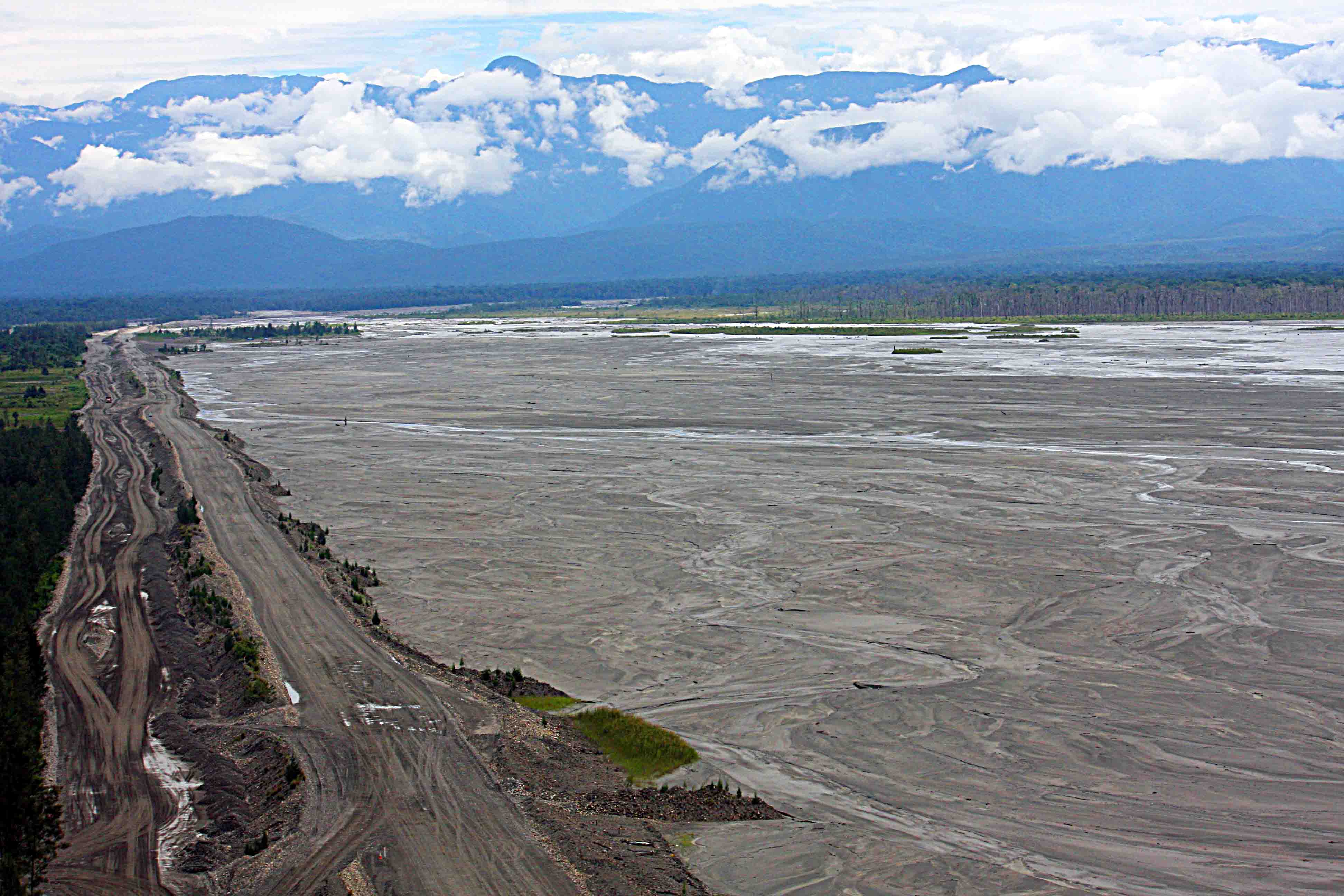
Freeport's contribution to Papua's welfare - Riverine tailings pollution

To judge by the recent “100 Best Corporate Citizens List”, all it takes to finesse a long and controversial record of human rights abuses is to come up with a piece of high-minded rhetoric, then carry on as usual.

Human rights advocates and those who have studied the record of Freeport McMoran in West Papua were startled to learn that Corporate Responsibility Magazine had named Freeport as the 24th-best corporate citizen in America (click for the full list). More startling still, the company scored well based mainly on a sixth-place ranking in the human rights category.

How is this possible? Well, the survey’s methodology seems to pay no heed to human rights performance. Only human rights rhetoric matters. And in that, Freeport excels. A strong written policy on human rights declares: “Freeport-McMoRan does not tolerate human rights transgressions.” It points to rights risks in West Papua, Peru, and the Democratic Republic of Congo, and adds that PT Freeport Indonesia policy is to “notify the direct commanders of the perpetrators” in cases where human rights allegations are made against Indonesian security forces. Since reputable human rights groups suggest that the top ranks of the security forces are implicated in widespread human rights violations in West Papua, this is hardly striking at the root of the problem.

As local people have pointed out, and researchers have confirmed, Freeport’s performance is a far cry from the written policies. The main trouble is intimate ties to Indonesian security forces.

Security forces may be implicated in the murder of American citizens near the Freeportmine, as Eben Kirksey and Andreas Harsono have reported.

Violence around the mine is used by security forces to target and scapegoat local people. In 2005, the New York Times revealed thatFreeport paid the security forces more than $10 million in 2001 and 2002. Payments are now made “in-kind” rather than in cash. The local Amugme people have long protestedFreeport seizure of their lands. Pictures of Freeport’s Grasberg mine from space (left) show the scale and environmental impact in the mountains that are home to the Amungme.

And lest all of this be hailed as “old news,” the Amungme filed a lawsuit last year sayingFreeport had taken their lands illegally. Meanwhile, the Indonesian army’s presence around Freeport, and the company’s close ties to Indonesian security forces, were reinforced this year. The continuing alliance between Freeport Indonesia and the Indonesian security forces is likely to exacerbate, rather than improve, the human rights situation.

None of these reports are taken in to account in the “100 Best Corporate Citizens List.” All the human rights indicators measure “human rights disclosure” and the sole source, according to the methodology details, comes from “Company public disclosures” – a corporation’s own information about itself.

The methodology, in other words, measures promises, not performance. There are parallels to the debate over whether companies accused of operating sweatshops overseas can be trusted to police themselves, or should accept independent monitoring. Thus the list cites the voluntary “Sullivan principles” first created under the Reagan administration and welcomed by companies resisting demands to divest from apartheid South Africa. AndFreeport boasts of adherence to the Voluntary Principles on Security and Human Rights, launched by the British and American governments in 2000.

The key word here is “voluntary.” As with the mining industry globally and with businesses jumping on the corporate social responsibility (CSR) bandwagon more generally, companies are happy to promise good performance, as long as no one will be looking over their shoulders.

So perhaps it’s no surprise to learn that Corporate Responsibility Magazine is in fact published on behalf of the Corporate Responsibility Officers Association, a body made up of many of the companies being judged, and steered by such firms as Domtar and KPMG.Freeport is listed as a “recent member” of the CROA. It’s advanced in the listings – it was ranked 83rd in 2010.

The problem here isn’t just the “corporate social responsibility” methodology, but the entire concept of “CSR”. It can all too often be used by companies to buy their way out of “corporate social irresponsibility.”

Freeport is no champion of the best values of corporate citizenship: For human rights activists, it’s long been a poster child for corporate irresponsibility. A list of good corporate citizens with Freeport winning laurels demonstrates more than flaws in the study. As George Monbiot has written of climate change credits, the lists offer corporations a new form of medieval European Catholic “indulgences,” forgiveness for any form of offence. Jeff Ballinger recently pointed out on this blog that companies like Nike are wrapping themselves in the CSR garment to burnish their corporate images, despite continuing disregard for many labor rights. Freeport, too, is now having itself measured for a fine CSR wardrobe.

—-

David Webster is an assistant professor of International Studies at the University of Regina inSaskatchewan, Canada. He is a former coordinator with the East Timor Alert Network/Canada.

see also

West Papua Report (monthly)

ETAN/WPAT: Statement on the operations of the Freeport McMoran Mine in West Papua, to the U.S. Senate hearing on Extracting Natural Resources: Corporate Responsibility and the Rule of Law

New West Papua Project REPORT LAUNCH at the University of Sydney

CPACS_WPP_TNI-in-Papua_Report_Launch_flyer

Flyer Attached: Please join us as we launch the latest report from the West Papua Project at the Centre for Peace and Conflict Studies, The University of Sydney

Anatomy of an Occupation: The Indonesian Military in West Papua
By Jim Elmslie, Camellia Webb-Gannon and Peter King

REPORT LAUNCH

with Mark Davis from Dateline

Tuesday August 16, 18:00 – 19:30

Macleay Museum, The University of Sydney


Create a website or blog at WordPress.com

Up ↑