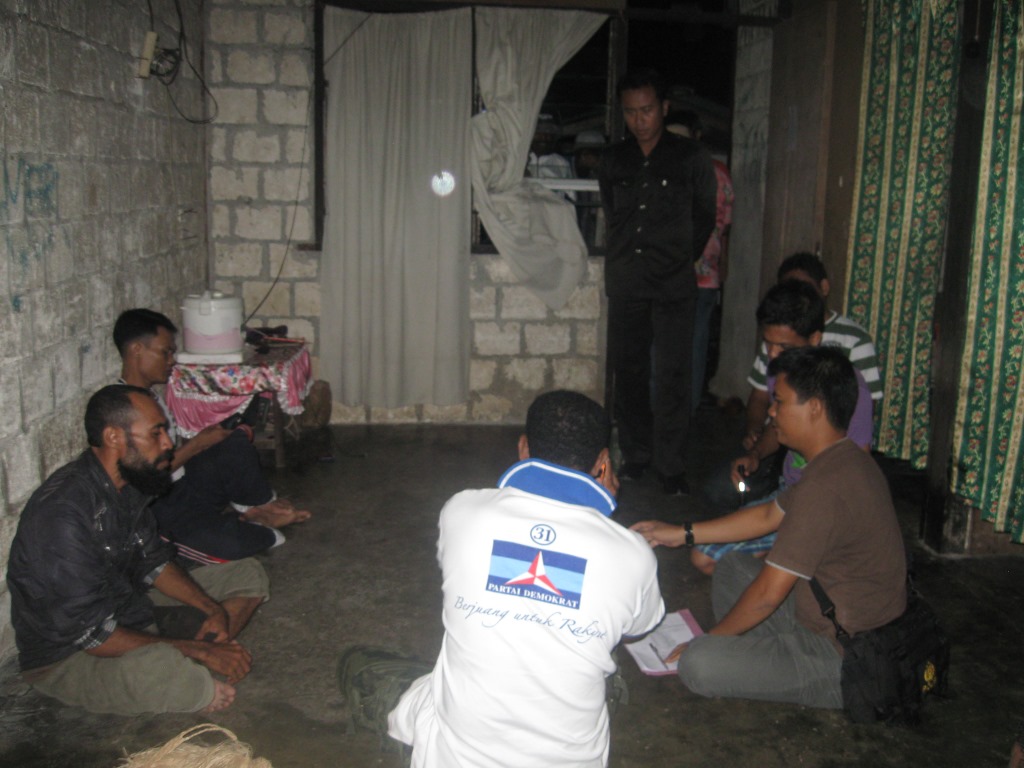
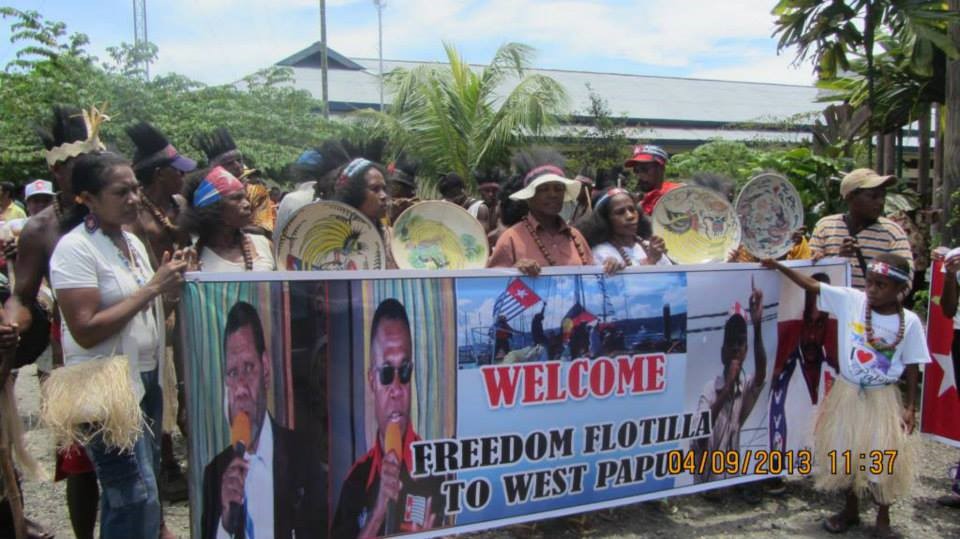
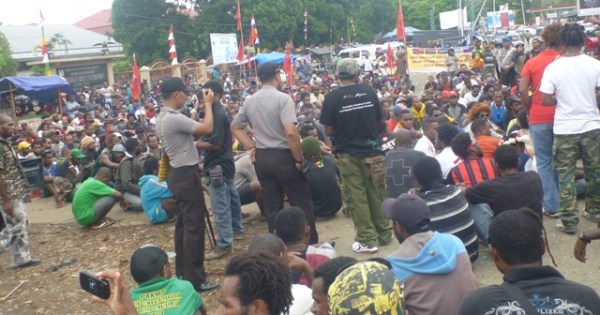
Chairman of the West Papua National Parliament, Bucthar Tabuni, and Chairman of the West Papua National Committee, Victor F Yeimo (Photo: Private)
PAPUA, Jayapura – recently, suarapapua.com journalist Oktovianus Pogau, had the opportunity to interview with Bucthar Tabuni, the Chairman of the West Papua National Parliament (,). In this interview Tabuni speaks about the criminalization of peaceful struggle of West Papua National Committee (KNPB), by the Police force in Papua.
Follow the interview below.
What is the security forces attitude towards KNPB?
I see that the security force fears even more if KNPB exist in the Land of Papua. This is because of the mass and the base of KNPB is firmly rooted. Indeed, during my leadership, the strength that we have built with the people is serious. So, at this time the security forces were escorting us to matters that did not enter our minds, and tried to destroy the struggle for peace that was pushed by us.
I hope this does not become an obstacle for KNPB to further progress and develop into the future. If there’s any issue, then it should be coordinated with PNWP as the political body of the Papuan people. And we are ready to be responsible to the people, as well as to the KNPB board itself.
How’s the leadership of the new chief of Police (Kapolda), Tito Karnavian?
For Kapolda Papua at present, I think we just stay in an intensive communication, however my only regret is related to imprisonment of KNPB activists in Wamena Jayapura, Biak and Timika, that is being dragged on without a clear legal process.
I officially conveyed to the Chief of Police, I will still guarantee security throughout Papua when orders (are made) to release political prisoners, abolish the lists of wanted-persons (DPOs) of KNPB activists, and open a space for democracy, but also demands that have not been fulfilled.
I hope, all of these (demands) can be fulfilled soon. If it has not been answered, I will make a mention of the demands to the public and the police chief, but I’m (still) waiting for a response to the demands.
What was Kapolda’s Response?
His response was good, but not optimal. For example, legal issues with some KNPB members being detained should be settled with the Police, but his officers eventually put (a formal) submission to the Attorney General, so the legal process at court is protracted, and we are very disappointed for now.
The Papua issue needs communication. If it’s ignored, it will cause disappointment, and the violence will never disappear. If there is to be anything at all, then it should be communicated. Pak Kapolda responded well, but not optimal. And until now I’m still waiting.
KNPB accused of masterminding violence in Papua?
Officials still have a biased stigma towards the KNPB, starting from being considered as actors of violence, all the way to being the perpetrators of violence in Papua. I argue that, during my leadership, the peaceful campaign of the struggle by peaceful demonstrations have always been promoted.
KNPB are people’s media, so it would be inappropriate if we called masterminds of violence. KNPB also never ordered the people of Papua, nor a member of KNPB throughout Papua, to struggle with violent means.
Even if there is (violence), that cannot be generalised or all associated together. In the society, there are good people, some are evil, there are few that listen to advice, and some that are not willing to hear the advice, and it’s a normal thing, and it happens everywhere, including in KNPB today.
Although Kapolda asked us not to do violence, one needs to know that lots of those acts are carried out by TPN/OPM (Tentara Pembebasan Nasional or National Liberation Army). And this is outside of civil society, but if its in town I would guarantee safety. I do not have the right to intervene on TPN/OPM actions. My civic leadership is in the town. TPN/OPM field of operation is different from my field.
What is the condition of KNPB activists detained in Wamena, Timika and other places?
They all regret, because the legal process that is underway has not been proven as a legal case. If they obtain or store sharp tools, then almost everyone in Papua, including immigrants, also obtain (these tools) such as knives and other sharp instruments.
The cases of KNPB members in Wamena is seen (to be premeditated) that the authorities already have strategies to arrest them. Why do officers go check sharp instruments only at KNPB activists home, while many immigrants who also own and store those things that are mentioned?
The question is, those things are there, but what are they used for, who is harmed, how many victims? - there are no legal facts. This is why I asked that Kapolda must release them, but he hasn’t reacted to my demands.
The detainees until now regret, because without fair (or truthful) evidence and legal facts, they still undergo jail terms. A question from me, why didn’t the police force arrest knife-sellers or sharp instruments in the market? Of course this is weird.
How’s the assistance from Counsel (legal assistance)?
I thank the council for their assistance in assisting the KNPB activists in various prisons in Papua, but there is no assistance given to the case that happened in Wamena.
I see that the counsel hesitates in giving their assistance; we are able to facilitate with fund and provide them with accommodation. However, it is acceptable if they are busy. I plead for the judge and the prosecutor to work in conjunction together and help me with all the decisions to hopefully free all of them.
According to the charges that were made, there are many political aspects in comparison with those of law. Hence, various approaches have to be done in order to silence the struggle of West Papuans, and that include punishing detainees. Police and Army forces (Polri & TNI) will always find gaps and use that to perform ongoing injustices to the struggle in Papua. Therefore, an exceptional consideration is needed.
KNPB is regarded as Highlanders?
I’m shocked when I heard that statement. KNPB originates from Papua and we have Regional Parliaments called Parlemen Rakyat Daerah (PRD) in Biak, Manokwari, Wamena and Merauke, and they are all representative of West Papua.
I believe that this opinion is from people that don’t understand what consolidation is. I can also say that that opinion comes from people that don’t do field work but just voicing their thoughts. We have been working together (around Papua) for six years.
Don’t look just at KNPB, but the important thing is to see the agenda we have been working on. Supposing that the agenda makes sense and is rational, why don’t we gain the support from others? We are just normal human beings but if this agenda can grant West Papua an Independence, it has to be supported, especially by those who mock KNPB.
Message for KNPB Activists?
Suppose you are keeping sharp weapons in your homes, it’s wise to throw them away or to avoid or keep away from them. Let alone the outsiders to have them. It has been several days since the silence of KNPB, it doesn’t mean that KNPB withdraws and is scared of the coloniser.
The current situation is uncertain so that we choose to be silent and to be patient. Let’s stay calm and plan for our new strategy to rise again. Do not worry about the tactics sets by the enemy, we have to think and plan for other approaches.
Message for the People of West Papua?
Independence is not something that we can achieve in an instant. West Papuans, don’t get bored, don’t be lazy and don’t give up the fight. There is no struggle that does not bear an outcome, everything does. We just have to wait for right time.
Hence, I call out to every West Papuan to work together, to be committed in what we are doing to keep up the fight in order for West Papuan to be free from Indonesian Colonialism. By doing so, not only we keep the fighting spirit alive but we also honour all the sacrifices of the late Arnold Ap, Thomas Wainggai, Kelly Kwalik, Mako Tabuni, Victor Kogoya, Hubertus Mabel, and all West Papua Independence activists that were killed by the Indonesian Military.
Markus Yenu was arrested at the side of the road in from of Daniel Sakwatorey’s house (former political prisoner in Papua, 2008) at Sanggeng Manokwari West Papua. The arrest was by Manokwari’s Criminal Police Unit at 11.32am West Papua time, on the order of Manokwari’s Criminal Police AKP. KRISTIAN SAWAKI. The Manokwari Criminal Police officers were driving a black Inova with the number plate DS.9977.
According to Markus Yenu’s evidence (he’s the Executive Governor of the West Papua National Authority District 2 Manokwari) after he was arrested and taken to the police station at Manokwari, he was immediately taken to an interrogation room and asked to give information about a peaceful demonstration on the 17th January 2013 during which the morning star flag was flown. There were various sized flags flown, and also biased political speeches from several leaders from the Free Papua movement who were inciting people to overthrow the legitimate government.
Markus Yenu also gave evidence that when he was in the interrogation room at the Manokwari Police Station he was visited by Kombes (Pol) Yakobus Marzuki former chief of police in 2008 and now Director of Papuan Police Intelligence. Marzuki told Yenu:
Comprehensive data from the Police indicated Markus Yenu was involved with provoking the acts of arson and destruction that three police officers faced on the 5th December 2012 following the shooting of Thimotius Ap.
In the near future police plan to meet with Kesbangpol to get rid of all organisations that don’t support the Ideology of a United Republic of Indonesia (NKRI)
Eight people are already dead, but police and TNI will be pursuing and removing any subversive groups both in the forest and the city.
Whereas for Markus Yenu there was an order from police headquarters to disable him.
According to Yenu, the Director of Papuan Police Intelligence said many other things indicating a threat to human rights and democracy activists in Papua.
Yenu said that, ‘After me, the police will arrest another six people who have been identified as suspects
Written up Pacific Scoop from Social Media Reports by West Papua Media
March 6, 2013
Markus Yenu, Manokwari Governor of the West Papua National Authority (National Federated Republic of West Papua), was forced to appear at Manokwari Police Sector HQ today (March 6) for questioning over makar (treason) charges relating to the organising of a peaceful mass demonstration almost two months ago.
The executive governor of the West Papua National Authority area 2, Markus Yenu, and the chairman of Solidaritas Pemuda Melanesia Papua Barat, Abraham Wainasiri, lead a peaceful rally at Manokwari on January 17. Image: WPM
Yenu has not yet been released, and no further information has yet been received about his status – whether he will be charged or released.
West Papua Media has contacted police in Manokwari without reply and the Papua Police Criminal Investigation chief in Jayapura – who claims to know nothing about Yenu’s whereabouts.
On January 17, a crowd of peaceful protesters calling for a referendum on the future of Indonesian-ruled West Papua assembled at a rally point in Manokwari.
The crowd – including students and workers – moved towards the Banyan Tree at UNIPA Manokwari together with the protest coordinator, Alex Nekemen, and speakers, among them Silas Ayemi, the area secretary of Bintuni WPNA),; Abraham Waynarisy (SH chairman Solidaritas Pemuda Melanesia Papua Barat SPMPB) and the pro-independence group KNPB.
Political speeches were made accompanied by slogans of “Papua Merdeka” (“Free Papua”) along the way.
The crowd marched around the city of Manokwari towards an open field.
In front of the office of the State Attorney of the Republic of Indonesia, Markus Yenu openly questioned bout the detainees after a an incident on December 14 – Melkianus Bleskadit, Rev. Dance Yenu and 5 students from UNIPA Manokwari who have been held by police for almost four months without charge.
Edmund McWilliams is a retired U.S. Foreign Service Officer who served as the Political Counselor at the U.S. Embassy in Jakarta 1996-1999. He received the American Foreign Service Association’s Christian Herter Award for creative dissent by a senior foreign service official. He is a member of the West Papua Advocacy Team and a consultant with the East Timor and Indonesia Action Network (ETAN).
In a December 5, 2012 lecture at Stanford University’s International Policy Studies program ( revised January 22, 2013), the respected Southeast Asia analyst Sidney Jones discussed the Indonesian government’s unwillingness, thus far, to categorize the Papuan “ethno-nationalists/separatists” as “terrorists.” Jones identifies these Papuan “ethno-nationalists” and “separatists” as the armed Papuan opposition, Operasi Papua Merdeka (OPM) and what she describes as “an extremist faction of KNPB, the West Papua National Committee, a militant pro-independence organization.” Jones cites various incidents of violence in West Papua that she claims were committed by these “ethno-nationalists and separatists.”
The authors of violence in the Indonesian archipelago, especially violence with complex motives, are never so clear cut as her lecture implies. This is especially true of West Papua where police-military rivalries over access to resources and sources of extortion monies is well known.
Her analysis focuses on the different approaches employed against the West Papuan “ethno-nationalists/separatists” and against Islamic militants (“jihadists”) by prosecutors and the security forces (police, military and Detachment 88). Jones contends that “the discrepancy between the way the two groups are treated by the legal system is untenable.” She considers two alternatives: One would be to employ anti-terrorism law in West Papua, and the other would entail moving away from the use of anti-terror law against “jihadists.” She argues extensively against the latter approach of “pulling back from the use of the anti-terror law.”
Jones contends that pressure for use of the anti-terror law against “ethno-nationalists/separatists” is growing among Islamic observers. In particular, she cites Harits Abu Ulya, director of the Community of Ideological Islamic Analysts (CIIA): “If the government is consistent, then it should acknowledge that attacks motivated by ethno-nationalism and separatism be considered terrorism because they are carried out by an organization with a political vision that uses terrorism to influence the security environment and challenge(s) the sovereignty of the state. Why aren’t we seeing forces being sent en masse to cleanse Papua of separatism?”
Jones’ argument warrants a more detailed critique than space here allows, but even a brief review reveals a number of problems.
Jones summarily credits recent violent acts in West Papua to the “ethno-nationalists and separatists.” This is surprising insofar as Jones is a highly regarded observer of the Indonesian political scene with a deep human rights background. She knows, or should know, that the authors of violence in the Indonesian archipelago — especially violence with complex motives — are never so clear cut as her lecture implies. This is especially true of West Papua where police-military rivalries over access to resources and sources of extortion monies is well known. Jones should know also that military, police and intelligence agencies, have long played the role of provocateur, orchestrating acts of violence which advance agendas that are invariably obscure.
Jones cites what she claims is recent “ethno-nationalist” pressure on the giant Freeport McMoRan mining operation. She ignores the reality that such pressure in the past has frequently been orchestrated by the military, specifically the Indonesian Special Forces (Kopassus). To be fair, Jones alludes to this complexity but largely dismisses it. Her analysis similarly ignores the reality that the Indonesian state has long blocked international monitoring of such security force skullduggery and manipulation of the security environment in West Papua by restricting travel by international journalists, human rights researchers and others to and within the region.
Jones also fails to acknowledge the reality, widely noted in international and local human rights circles, that the Indonesian government has long sought to smear peaceful dissent in West Papua as “separatist.” Jakarta, through the aegis of a corrupt court system and often criminal state security forces, has repeatedly employed the “separatist” label to arrest and prosecute or detain peaceful political dissenters, such as those who display the Papuan morning star flag. Courts regularly resort to charges of treason that date to the Dutch colonial era and widely used by the Suharto dictatorship to intimidate dissidents. Jones’ call for Indonesia to define “separatism” as “terrorism” would deepen Jakarta’s targeting of peaceful dissent and the intimidation of Papuans generally. Use of the anti-terror law would enable the police to detain “separatist” suspects, including those engaging in peaceful protest, for a week rather than 48 hours. The law also empowers the police to employ electronic surveillance. Ongoing efforts would strengthen the anti-terror law to give the police even broader powers to limit the freedom of speech and assembly.
The argument to employ the “terrorist” label against “ethno-nationalist and separatist” groups and individuals in West Papua could have direct legal implications for international solidarity movements.
Jones claim that the West Papua Nationalist Committee (KNPB) is a “extremist,” is without substantiation. Criminal activity by some alleged members of the KNPB is generally not well corroborated and usually reflects efforts by the State to undermine the organization. The KNPB, and many other Papuan organizations and individuals are indeed ever more strongly pressing for Papuan rights, importantly including the long-denied Papuan right to self determination. But these efforts are largely nonviolent.
In recent years, this struggle has found growing support within the international community. Employing the “terrorist” label against “ethno-nationalist and separatist” groups and individuals in West Papua could have direct legal implications for international solidarity movements. In the U.S., groups or individuals who advocate on behalf of groups designated by the U.S. government as “terrorists” are subject to criminal prosecution. Given the close relations among governments, including those of the U.S. and Australia and Indonesia’s security forces, Indonesian government labeling dissidents in West Papua as “terrorist” could have dire implications for the solidarity network. How long would it be before the U.S. and other governments themselves begin to label various Papuan groups and individuals as ‘”terrorist.” U.S. and other international groups acting in solidarity with Papuans seeking to attain their rights could be criminally targeted and charged.
In sum, the Jones analysis is hobbled by the very term “terrorism” which is so poorly defined international law and procedure as to threaten and intimidate even those groups and individuals engaged in peaceful dissent.
In a final note, Sidney Jones, who was the Asia Director for Human Rights Watch from 1989 to 2002, should at a minimum explicitly reject the call by Harits Abu Ulya that she cites in her lecture for the Indonesian government “to cleanse Papua of separatism.” Such rhetoric gives license to the kind of atrocities already visited on the people of the Indonesian archipelago, including Timor-Leste, for far too long.
Well over 1000 people engaged in a colourful and vibrant demonstration calling for West Papuan independence on Manokwari on January 17, despite Indonesian police banning the march and the display of the Morning Star Papuan Independence flag.
Amid worries of a security crackdown and violence from Indonesian security forces, organisers of the rally reported a generally peaceful event, with participants well-disciplined against reacting over severe intimidation tactics, preferring instead to use music, drumming and free expression to get their message across.
Organised by activists from the former Federated Republic of West Papua, the Manokwari protest saw several groups of singers, dancers and drummers converged at the Sanggeng sports stadium, marching 7 kilometres to the church at Elim Kwawi over four hours. They were shadowed at all times by at least police to secure the action is over 200 police personnel, 2 truckloads of soldiers, 8 armed motorcyclists, and an extra truckload of elite Dalmas Riot Police (a unit that includes personnel from the Detachment 88 anti-terror group funded by Australia).
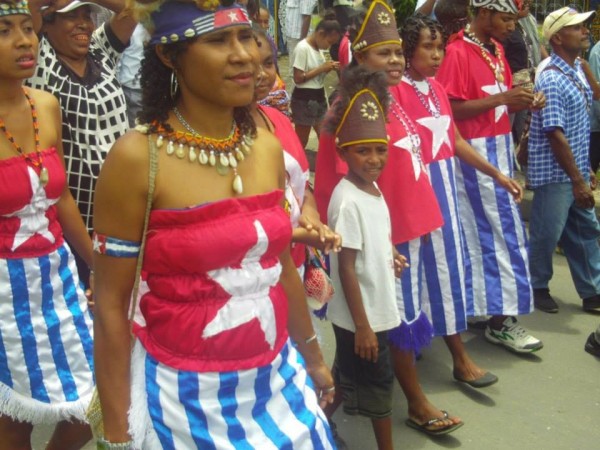
To the shouts of “Merdeka!” (Freedom!), and accompanied by 4 groups of drummers and 2 flute bands, over 100 banned Morning Star flags were flown during the march, held high by mama-mama, youth, children and students. Sources at the march reported to West Papua Media that spirits were high amongst participants due to the music and dancing.
This slideshow requires JavaScript.
Speaking from Washington DC, Herman Wainggai, FRWP’s representative to the United Nations, said in a statement that “Over the years, peaceful demonstrators in West Papua have been terrorized, imprisoned and killed by Indonesian military police. Edison Waromi, one of West Papua’s human rights defenders, has been imprisoned for more than 14 years, and we were imprisoned together for two of those years. West Papuan activists Edison Kendi and Yan Maniamboy currently are threatened with 20 years in prison for organizing a nonviolent rally in support of the United Nations’ InternationalDay of the World’s Indigenous People in New York in August 2012.”
Wainggai repeated the demand “that Indonesia immediately and unconditionally free all West Papuan political prisoners and end its military occupation of West Papua. We also request that the UN Special Rapporteur, who is scheduled to be in Indonesia in January, visit West Papua and meet with imprisoned political leaders of the Federated Republic of West Papua, such as President Forkorus Yaboisembut, Prime Minister Edison Waromi, and others.”
International solidarity actions were held outside the Indonesian Embassy to the United States in Washington DC, and also in the Solomon Islands, and Melbourne, Australia.
Rexy Roses, from the new Solomon Islands for West Papua solidarity group, called upon the Indonesian government to immediately release West Papua and Malukan political prisoners, and to respect their rights to free expression.
“More than 50 years of tyranny and immeasurable human rights abuses suffered by the Indigenous people of West Papua at the hands of the occupying Indonesian Military forces is more than too much to bear, it is time now time for dialogue and negotiations to end violence in West Papua and to allow for a peaceful referendum. This year 2013 is going to be a very challenging year and we will make sure that the cries of the indigenous Melanesian people of West Papua be heard in every corners of Melanesia, the Pacific and beyond, it is time for change, together lets stand for the change we want to see in West Papua and Maluku, ” Rexy stated.
Police attempt to provoke trouble
Organisers of the rally had notified Indonesian Police of their rally but the Chief of Police in Manokwari forbade the rally from going ahead, contrary to the rights of peaceful expression guaranteed to West Papuan people under the now discredited (but still active) Special Autonomy legislation of 2001. However, according to reports from witnesses and our stringers, police stood by and allowed participants to gather, instead focussing their attention on the seizure of Morning Star Flags.
Upon an attempt to formally raise the Morning Star on flagpoles, police moved in and attempted to seize flags, however organisers led by West Papua National Authority Executive Governor of Region II Manokwari Markus Yenu negotiated with police, who allowed the mass to continue after receiving assurances that no flag raising would occur again. However, outside Biryosi petrol station, police seized flags from a young man, escalating into a tense situation due to the hostility between individual police officers and the youth.
According to West Papua Media’s stringer at the protest, ” the journey became increasingly tense as Police officers began intimidation by beginning to walk ahead (faster) than the rear of the masses,” whilst in riot gear, using a common riot police tactic of dispersal.
“The Massa (collective group) felt that a scenario was being created by Indonesian police to disrupting the peaceful demonstration and provoke violence. This situation occurred precisely around Copal Sanggeng Manokwari. However our koorlap (Koordinator Lapangan or field coordinator) were able to ensure massa discipline and not be provoked by friction generated by these police officers,” one field coordinator, who cannot be named, told West Papua Media.
The Rally dispersed peacefully around 3.30 pm local time after speeches by West Papua National Authority, Federated Republic of West Papua, and other activists, followed by prayers, with no reports of further intimidation of participants from security forces.
In Yapen meanwhile, security force intimidation and the arrest of seven activists on January 16 in Mantembu village by an Indonesian Army (TNI) unit, prevented the planned demonstration from taking place in Serui town. Reports received by West Papua Media from human rights sources early in the day described a tense atmosphere with several hundred heavily armed police and army patrolling key protest gathering point. Unconfirmed reports claimed that a joint police and army unit blockaded roads outside Mantembu village and threatened violence on any potential protest participants.
Names of 23 Papuan political prisoners submitted to Komnas HAM
3 December 2001
Solidarity for Humanitarian and Human Rights Violations has submitted information regarding 23 political prisoners to Komnas HAM (the National Human Rights Commission).
Earlier, Komnas HAM planned to set up a team to resolve the cases of political detainees and convicted political prisoners in Papua. The spokesman for SKP Papua, Mathius Murib, said that information regarding the prisoners, including their arrest, the time they have spent in custody and their conditions in prison was submitted. He said that in many cases, there was no legal basis for their being charged for treason and that their imprisonment was in violation of their human rights
“We have supplied data relating to a number of prisoners being held in prisons in Papua. Detailing how many prisoners there are and for how many years they have been held. Altogether, we have submitted such information regarding 23 political prisoners. We greatly appreciate this support and the action.”
Earlier on, Komnas HAM planned to set up a team to resolve the cases of political detainees and convicted political prisoners in Papua. The purpose was to review the status of those being held in prison. This would include considering a reduction in the length of their sentences.
Komnas HAM is seeking Clemency for Papuan Political Prisoners
4 December 2012
Komnas HAM, the National Human Rights Commission intends to struggle to ensure that all political detainees and convicted political prisoners in Papua are granted clemency or a reduction in sentence.
The chairman of Monitoring and Investigating Human Rights Violations, Natalius Pigai, said that Komnas HAM plans to set up a special team next January to identify the cases of political detainees and convicted political prisoners in Papua, together with the Ministry of Law and Human Rights.
“This special team will also be entrusted with the task of granting clemency or reduction of sentences for political detainees and convicted political prisoners in Papua. We will be undertaking this in collaboration with the Ministry of Law and Human Rights,” said Natalius.
He went on to say that this special team would do everything possible to improve the general environment and facilities in all the prisons in Papua. This will include ensuring that every tapol/napol receives whatever healthcare is required.
Law and Human Rights Ministry to check status of around 20 Papuan political prisoners
4 December 2012
The Ministry of Law and Human Rights plans to check the status of around twenty political prisoners in Papua. This decision follows their intention to resolve the cases of political detainees and convicted political prisoners.
A spokesman of the Ministry of Law and Human Rights, Martua Batubara, said that those who are serving sentences will be given remissions (a reduction of sentence) in accordance with the law.
As for the Komnas HAM, it can only make recommendations.
“We intend to check in the prisons as well as to check with the Ministry of Law and Human Rights to find out which prisoners are serving sentences and which are prisoners whose cases are still being processed. We don’t know which prisoners they are talking about (gap with question mark perhaps indicating something that is illegible) or whether it is true that Komnas HAM only has the authority to investigate and then make recommendations to the authorities in charge of the prisoners.”
Previously, Solidarity for Humanitarian and Human Rights Violations in Papua submitted information about 23 political prisoners to Komnas HAM. This was done to complete the information available to Komnas HAM, following a plan to set up a team to resolve the cases of political detainees and convicted political prisoners in Papua. The purpose is for there to be a review of the status of all those who are currently being held in detention. This would also include seeking a reduction in the sentences now being served by all those who are currently being held in prison in Papua.
Indonesian Special Forces officers have redoubled their efforts to hunt down non-violent womens’ and environmental rights activist Fanny Kogoya, after a failed attempt to capture her and Papuan student activists from the West Papua National Committee at a university dormitory on Tuesday night.
Fanny Kogoya was also elected the head of the Papua desk for the Indonesian branch of Friends of the Earth (WAHLI) on June 13, the day before her close friend Mako Tabuni, former KNPB leader,was extrajudicially executed by Detachment 88 troops in Jayapura.
Kogoya, also a women’s rights defender from the grassroots Papuan women’s network TIKI, has been been placed on a Papua wide wanted persons list (Daftar Pencarian Orang or DPO) by the Australian-trained and funded Detachment 88 anti-terror investigators. This is despite Kogoya having resigned from pro-independence activities, according to established credible sources in Jayapura. Kogoya is also accused by police of having knowledge of the whereabouts of activists from the pro-independence civil resistance group, West Papua National Committee (KNPB).
KNPB activists are in hiding after being ruthlessly hunted by security forces, in order to break the back of the civil resistance movement against Indonesian brutality in occupied West Papua. This harassment campaign has gained significant pace ahead of planned Papua-wide mobilisations against Indonesian colonial violence on October 23 – rallies widely expected to be subject to major Indonesian state violence.
The latest crackdown has seen brutal intelligence gathering techniques employed by security forces, including officers identified by witnesses as being from Detachment 88, arbitrarily targeting for beatings, kidnappings, arrests and torture on students and civilians from the highland tribes of Yakuhimo and Dani people – seen by many observers as the backbone of the KNPB effort to use civil power to defeat Indonesian state violence.
Confirmed reports from human rights activists in Jayapura have described heavily armed plain clothes officers – believed by witnesses to be members of either Kopassus or Detachment 88 – violently threatening highland students and civilians in a bid to hunt down members and associates of the KNPB.
Raids on student accommodation around Abepura and Jayapura have intensified ahead of a planned mass mobilisation across Papua on October 23rd by KNPB, which is calling for an end to these illustrated acts of Indonesian state violence – a move seen as makar (subversion) by the new Papua Police chief Tito Karnavian , the former head of the Australian- funded Detachment 88.
Attempts to contact Karnavian or his Papua Police spokespeople for comment for this article have been so far rebuffed and unsuccessful.
Additionally, witnesses and survivors have described a chronology of what is being described as a “fishing operation” by Indonesian intelligence officers. Attempts to capture Fanny Kogoya had been ongoing for several days, with police Avanzas permanently stationed outside houses and haunts of both Kogoya and her extended family and friends.
According to a detailed and disturbing testimony provided by Yakuhimo man and citizen media worker Simson Yohame to independent human rights monitors in Jayapura, the officers have heavily monitored highland students in the greater Jayapura area in a bid to isolate KNPB activists from their base.
Yohame, a friend of Kogoya, was himself kidnapped and tortured by suspected Detachment 88 officers on October 9 after accidentally leaving his motorbike helmet at a Javanese restaurant in Waena, near Abepura. He had been tailed for several days by intelligence officers, who suspected his friendship with Fanny would lead them to their quarry.
Upon leaving the restaurant, he was set upon by plain clothes police intelligence agents, whom he believed to be Detachment 88 officers. They bundled him in to the back of a black police Avanza car, whilst soldiers who were stationed outside the Yakuhimo regencies student dormitory at Waena stood guard. An intelligence officer from Makassar hit him repeatedly with a butt of a pistol, and other officers punched him systematically in the chest using a silat (traditional Javanese martial arts favoured by Kopassus) technique that can easily cause cardiac arrest.
He described being taken in a six car high speed convoy, initially to the back of an unknown facility close to the Jayapura police headquarters, before being subjected to psychological torture on a drive around the greater Jayapura area, and was hypnotized to disorientation. Yohame described the brutal interrogations where he was threatened with knives, swords and cocked and loaded firearms by Detachment 88, according to his testimony. Interrogators also subjected him to psyops by playing loud torture music and sound on headphones they held on his head, while they were sticking knives and pistols into his body.
Giving fascinating if chilling insight, Yohame has detailed the processes that Intel attempted to use to turn him to spy on his friend Fanny. He refused eventually, but not before documenting the techniques utilized.
After the torture, the Detachment 88 officers allegedly moved onto “Stage 3” as Yohame described it, a combination of the classic good cop / bad cop routine. “They (intel) began to ask me the core question: ‘Do you know Fanny Kogoya? This picture is FK, FK stay close to you. You do not deny it. If you deny we will kill you.’”
“I asked why are you looking for FK? Intel said to me that ‘because the cases of murder that Mako Tabuni was doing involved FK. FK participated in designing all events Mako and comrades were doing’. Yohame reported the police as saying.
The police continued: ‘FK loves the money Mako and his friends had over the years. FK is the girlfriend of Danny Wenda. Wenda is now the number 1 Papua Police DPO’,” the interrogators said.
The interrogators then changed tactics, offering a payment. “In addition, if you (SY) can inform on where FK is, we will pay you (SY) Rp 10 million for initial operations,”. They demanded the locations of Danny Wenda, the Chairman of KNPB, Victor Yeimo, Tinus Yohame, Buktar Tabuni, Victor Yeimo, Assa Asso, and also fellow Yakuhimo clansmen allegedly involved in KNPB, alternatively offering payment, and threatening to kill him if he denied knowledge of their whereabouts. Yohame was then trained in demonstration and civil resistance disruption and sabotage techniques, and fieldwork techniques employed by intelligence informants.
Yohame described how his tasking had traumatised him greatly, and he refused internally to carry out the actions. After his release having agreed to be an Indonesian agent, he was secretly informing Fanny Kogoya about the massive operation in effect to capture her and warning her to move outside the town to avoid arrest or disappearance.
Fanny Kogoya, who like other civil society activists on the DPO list is constantly moving from house to house, has so far eluded capture due to the diligence of the now underground non-violent independence movement in Papua.
—
For the whole night of October 12, a Cenderawasih University (UNCEN) dormitory in Waena was under siege by a large group of plain clothes armed and masked security forces, who surrounded the dormitories. During the night, the police overran the dormitories in their search for Fanny Kogoya, according to witnesses.
Three students who living at the UNCEN hostel – UL (32), IK (36), and PK (22) – said they had been beaten and terrorized by the police. “Police pry the door and entered. They say ‘we find the DPO who live here,’” the students explained in the human rights report. “They say the name of FK and Danny Wenda (DW).”
The Yakuhimo students at the dormitory were angered by the event, but held a peace blockade outside the gates of the Uncen campus in Waena, independent sources at the campus told West Papua Media. No reports were received of any forced dispersal, however tension is high and all West Papuan students are in fear that that they could be arrested or disappeared at any moment, according to human rights sources.
Yakuhimo students and supporters blockade outside Uncen Waena after the Detachment 88 raids, October 12 (West Papua Media)
These actions came after a campaign of arrests from late September of at least eight people in the highland town of Wamena after police targeted homes and offices of KNPB members, accusing them of involvement in bombings and terrorism, despite KNPB being committed to non-violent civil resistance tactics.
In a statement, UK based human rights group Tapol said that “The targeting of KNPB activists appears to have intensified after the killing of the KNPB leader Mako Tabuni, on 14 June 2012. Officers of Indonesia’s counter-terrorism unit, Special Detachment 88 (Densus 88), funded and trained by Australia, the US and the UK, are thought to have been involved in the killing of Mako Tabuni and the arrest of the KNPB members in Wamena.”
Tapol has called for Indonesian authorities to “end the campaign of terror, intimidation and violence against human rights defenders and political activists, particularly members of KNPB,” and to guarantee the safety of Fanny Kogoya, Viktor Yeimo, and others who have been targeted.
Tapol has also called on Jakarta to “end the deployment of Densus 88 to Papua, investigate all allegations of human rights violations by Densus 88 officers and other security forces personnel and bring those responsible to justice.”
Whilst tension remains high during the crackdown, KNPB activists have also warned their members not to be taken in by SMS messages that are being spread by intelligence personnel attempting to incite violence and horizontal conflict. Activists have circulated a list of mobile numbers that are responsible, and are urging all recipients to document any numbers that continue to spread these messages.
Many people have reported to West Papua Media of an upsurge in Special Forces activity, even around those who are not active on Papuan independence issues. There has been a significant increase on the presence of intelligence officers on the street. Selfius Bobii, the former Front Pepera leader serving out a three sentence at Abepura prison on a treason conviction for his role in the 3rd Papuan People’s Congress of October 2011, still maintains close and effective communications with a network of activists throughout Papua.
In an SMS sent to West Papua Media, Bobii described how the TNI “have stooped to making themselves out to be civilians, to carry out undercover operations in order muffle the independence aspirations.”
“Some are posing as Bakso (Beef offal noodles) Sellers on roadsides, some are posing as motorbike repair people and so on,” Bobii said.
Bobii described the following factual account: On 11 Oct at 2303 hours in Nabire, Yance Agapa was heading home and was given a lift by an ojek (motorbike taxi) rider to the front of the Indonesian Air Force Quarters in front of the ‘Glory’ internet cafe. When they arrived at Malompo he gave the driver Rp20000 (approx. AUD$2) who hurriedly put it into the pocket of the black jacket he was wearing. Then a pistol fell out of his jacket. Yance startled in fright to which the driver responded “Brother don’t be frightened because I’m from Ambon but my mother is from Sentani. I’ll tell you straight, I’m a member of DENSUS 88 sent from Central to get the government program happening. So let our people from the community know to be careful using hire motorbikes. “
West Papua Media has independently verified this account.
KNPB activists, most living underground currently, have expressed significant fears for their safety and survival from the crackdown. Yohame begged in his testimony, “the condition of our current times is so dire, (we need) all my friends and the international support groups to be able to monitor our current situation. Virtually all KNPB activists are threatened at this time. “
It is unclear whether these intensified crackdown tactics will work on those close to DPO suspects to give up not just Fanny Kogoya, but other non-violent activists who are simply attempting to raise their universal human rights of self-determination and freedom of expression.
Certainly these hunting parties have confirmed one thing: that Australian trained counter-terrorism troops are without any doubt being used to suppress peaceful political activity, outside their legal mandate of counter-terrorism. This should be deeply concerning for Australia in its quest for advocating internationally the Rule of Law – and at the moment that it has just taken up a position on the UN Security Council it might prove to be an inconvenient turning of a blind eye.
The OPM’s general coordinator, Lambert Pekikir has announced that three regions in Papua are ready to fly the Morning Star flag on 1 July, the anniversary of the OPM’s military wing, the TPN.
The flag flying will last for three days, along with fireworks. He said that the three regions are Wamena, Keerom and Yapen Waropen. People in Wamena are from the mountains, the people Yapen Waropen are coastal people, while those from valleys and lowland areas live in Keerom.
OPM troops along with civilian sympathisers will take part in the flag-flying. ‘There will be ceremonies as well, attended by the general public and those struggling for an independent Papua.
‘Our military forces are well prepared for these events and if the TNI and police respond with violence, we are ready,’ he said.
Meanwhile, the police have issued an ultimatum urging that there is no flag flying. ‘The Morning Star flag is not a flag of the Indonesian Republic or a regional symbol, and anyone who unfurls that flag anywhere in Papua will be seen as having violated the law and will face the consequences in accord with the laws in force in Indonesia.’
The army spokesman, Yohannes Nugroho Wicaksono called on people not to fly the flag. ‘In the interest of security and order throughout the area of Papua, we urging people not to be provoked by those who are planning this event.’
Activities undertaken by the police in anticipation of the flag flying on 1 July include intensifying police patrols and sweepings in all police regions. He said that the police have been ordered to act professionally.’
The chairman of Commission A of the DPRP, the Papuan legislative assembly, Ruben Magai, has called on all the people not to be provoked by unnecessary issues in advance of the TPN anniversary. He hoped that people will continue to engage in their everyday activities, while calling on the security forces not to use violence. ‘The persuasive approach must be prioritised. The best thing would be for all those concerned to sit down and talk, to as to find out what each sides wants.
Jayapura: In response to the announcement by the TNI/OPM Revolution Co-ordinator, Lamberth Pekikir, that they intend to fly the Kejora – Morning Star – flag on 1 July, the anniversary of the OPM and also when Indonesia’s President, Susilo Bambang Yudhoyono visits West Papua on 25 June, the police chief of Papua, Inspector-General Bighman Lumban Tobing said that the police force would take firm action.
He said that the general situation in Papua is general speaking ‘conducive’ though there have been some security disturbances recently in Puncak Jaya by elements who intend to break away from the NKRI – Unitary Republic of Indonesia.
The police chief said that all components in society including the media are responsible for keeping the situation in Papua conducive.As the hosts of the National Raimuna Xth event [which the president will attend]; we are jointly responsible for maintaining a conducive atmosphere, ensuring that the news from Papua will be about tranquillity in the area.
The chief of police also said that they would take firm action against any group that attempts to cause security disturbances in Papua. He said: ‘I will arrest and take firm action against any group that intends to cause disturbances in this place. ‘
He said that there were no plans to bring in additional troops and they will rely on the organic TNI troops and the police force now in Papua to keep order. He repeated his conviction that all components of society will ensure that the National Raimuna event will proceed smoothly.
The Raimuna event will take place in Waena and will last from 25 June till 1 July and will be officially opened by President Susilo Bambang Yudhoyono,
Ten thousand members of the youth organisation Pramuka all 16 – 20 years old and of Pandega, 21-25 years old [the Indonesian boy scouts movement] from PNG, Malaysia, Singapore and Brunei will also be taking part.
Jayapura: Following the death of a sympathiser of the KNPB, the deputy chairman of the organisaation Mako Tabuni said that such a thing is part of the risk of the KNPB’s struggle for a referendum. ‘ We do not regard such things as a violation of human rights but as part of the risk of our struggle,’ he said.
He said that they recognise that loss of life and loss of property are inevitable.
He said that with regard to the latest victim, they were not intending to seek justice from Indonesia ‘because none of the victims which we have suffered has resulted in justice for the Papuan people.’
With regard to reports alleging that skirmishes said to have been caused by the KNPB masses and in which one student and one member of the security forces were injured and one young man died, he said that he would take responsibility if the police try to prove this.
In a press release issued by the KNPB, the organisation made the following demands:
1. The Indonesian government should recognise the political right of the Papuan people to determine their own future by means of a referendum because the process of annexation following the New York Agreement of 16 August 1962 violated the principles and standards of international law and universal human rights.
2. As from 1 May 2012, the Papuan people herewith declare that the presence of the Republic of Indonesia on Papuan soil is illegal and the Papuan people only recognise the national parliamentary administration of West Papua.
3. The Dutch people, the Indonesian people and the United Nations must accept responsibility for the hand over of of the administration of the West New Guinea Council/West Papua to the Government of Indonesia on 3 May 1962, without the consent of the Papuan people who were the ones involved in the dispute.
4. The Papuan people are ready to struggle for their right to self-determination by all means possible.
5. That the Papuan people should not become panic-stricken in the present situation.
Surrendering their lives to God, they remain calm when they face trouble
It was during the week of Christ’s sufferings that Forkorus Yaboisembut was found guilty of treason and sentenced to three years imprisonment. His wife, Beata Yaboisembut was at his side throughout the trial. Dressed in dark brown trousers and a blouse, she sat in the courtroom, calmly following the proceedings. She accepted the result with a feeling of relief.
‘Bapak was always telling us to keep calm. We should not feel troubled and feel grateful that our children are already grown up and can understand what is going on. And please remember that this is the week of suffering and we must all think about the sufferings of our Lord.
Lord Jesus suffered much more than this for our sins. And you must be willing to accept my sentence, said Forkorus’. As a mother and as his wife, she expressed her belief in him.
She first met her husband when they were studying together at the Taruna Bakhti Waene College. They were among the first generation of students at the college and graduated in 1975.After graduating, they were both sent to isolated places in West Papua. Mama Beata was sent to Wamena and Forkorus was sent to Sarmi. In 1976, they decided to get married in Jayapura and after getting married, they each returned to their jobs. Mama Beata was given a job at the Oksibil YPPK primary school and worked there for three years. She was then sent to Sobron, after the kampung where she was working was attacked.
After her husband became active in the Papuan Customary Council (DAP), Mama Beata saw this as a huge responsibility that was to be borne by him.’Bapak is an Ondoafi, part of our tradition and enjoying the trust of the people. He is greatly respected and loved by the people, just like us, his wife and our children.’
He was the third of six siblings. His two brothers are not with him in Sobron. Forkorus also has two younger brothers and a sister who all live in Nabire.
After being elected as the Chairman of DAP, Beata realised that he no longer belonged just to her but belonged to all the Papuan people. ‘This is why Bapak has always told his children to stand on their own feet.’
As his wife, she realised that his election as the chairman of DAP would have many consequences for herself and for their children which is why he has always stressed the importance of their living their own lives independently.
Fortunately, only two of their children are still studying at Cenderawasih University while their oldest daughter is an expert in civil technology, and the sons have completed their studies in architecture. ‘The youngest is now at sixth grade while his older brother should have graduated last month on 15 March. But never mind, as Bapak is now on trial, his needs are our priority.’ Her daughter’s husband has to rely on the wage he earns as a teacher. As for her own husband, he has not been earning anything since last year.
‘I was not there to see Bapak when he was arrested because I had just returned from Sobron.’ She was preparing food for the [Third Papuan People’s] Congress but before anyone could start eating, the security forces destroyed everything that they had prepared.
When she and the other women heard gunshots and saw tear gas bombs exploding, they ran to the mountains around the Zakeus Field. ‘People can be arrested at any time and I was told never to get worried. On that day,’ she said ‘I tried to keep calm and to find my way home to Bapak so that I could be together with him at all of the court hearings while keeping calm.’
‘Forkorus has always told our children to focus on their education and not to follow him on his chosen path. But the children are always deeply concerned about what is happening to him and they always accompany me when I visit him in prison. I know that they readily accept what is happening to their father. Maybe this is the path chosen by our Lord for this country of ours,’ she said.
During the trial, Bapak stayed overnight at the lodgings of their daughter who lives in Waena. It is a small room, 3 x 4 meters, where the three of them slept. Their home in the kampung is being looked after by Mama. The youngest daughter frequently goes back and forth to visit their grandmother. Because their home in Sobron is 80 kilometres from Abepura, Mama decided to stay with her daughter so that it would be easier for her to visit her husband.
She said that during the time she has been attending the court hearings, neither she nor the children have experienced any terror or intimidation. ‘And Bapak is always telling us to keep calm.’
She visits her husband three times a week, on Monday, Wednesday and Saturday. ‘We are only given 15 minutes to sit together, side by side.
That is quite enough for me,’ she says, ‘because I know that the Lord is there with him.’
She is still busy teaching grade 1 and 2 children at the primary school in Sobron. When she visits her husband, she takes him food and clean clothes. ‘As he is not alone in the prison, I always take food for the other prisoners as well.’
She says that her husband is not fussy about the food she brings, as long as she cooks it. She takes him porridge, vegetables and fish and on special occasions, she cooks him some meat. Ever since he has been in prison, Forkorus has never asked her to bring anything. ‘In fact, when I meet him, he always has a present for me, as well as giving me his dirty clothes to be washed,’ she said, with a laugh.
She can also visit him on Sundays but only to take part in a service together. She is not allowed to take anything except a Bible. They have services twice a day, once in the morning at 8am for the Protestants and once in the evening for the Catholics.
Mama always arrives at 7am to say prayers together with her husband.
Sometimes he asks her to stay for another prayer, after her visit to him has ended. so that she too can receive the body and blood of the Lord, Jesus Christ during the Holy Eucharist as she has continued to be a Catholic.
Mama Beata is the third of six brothers and sisters from Kampung Yuruf Keerom where the majority of the people are Catholics. In December, she will be 59 years old. Because of unsatisfactory conditions in the kampung, the people have been forced to move frequently. Only one of her sisters is still living in Yuruf while one of her brothers died in Vanimo. The two other brothers are living in Vanimo.
‘Prayer is the source of our strength. Everything we achieve, all our happiness and sadness are part of our lives and my family leaves everything to the one who gives life, to the Lord God Creator of all,’ she said, when she was asked what her future plans for her family were.
This is the first in a series of articles by Suara Perempuan Papua commissioned by TAPOL on the impact of the Papua conflict on women
The insistence by the chief of police in Papua that Buchtar Tabuni, the chairperson of KNPB – the National Committee of West Papua – be held responsible for the KNPB organising two demonstrations instead of just one has led to a response from the KNPB.
The chairperson of the KNPB, Mako Tabuni, said that the organisation will not respond to the summons from the police, whether or not they intend to arrest Buchtar Tabuni, saying that if Buchtar is arrested, they will take strong action again the police.
Speaking at a press conference on Tuesday, 3 April, Mako said that there was no foundation whatever to what the police chief said.
He said that they had been forced to hold their demonstration in two places, in Abepura and in Taman Imbi because the police had failed to acknowledge the organisation’s notification to the police about the forthcoming demonstration.
‘Now, they even want to take proceedings against us.’
He also said that the fact that they intended to carry traditional weapons was simply because they were being used for cultural purposes, as the cultural attributes of the Papuan people.
‘The demonstration is an action regarding our people’s future, and if the police complain that it caused traffic congestion, then we think that the police should behave more professionally. We know that demonstrations take place in other parts of the country, such as in Java and Makasar which have been going on for days and causing traffic jams because they are quite legal. This is a time of demonstrations.(a reference apparently to the many demonstrations currently taking place across Indonesia in protest against the increase in the price of petrol).
‘If we are to be taken to court because we hold demonstrations, then we have to accept that we are not living in a democracy.
‘If we are not allowed to demonstrate, then we will resort o other ways in our calls for a referendum because Indonesia is holding on to West Papua as the result of a process that was illegal.’ [Here the reference is to the so-called act of free choice in 1969.]
He also complained about the media coverage which he said, focussed on things like traffic jams, shops being closed or children being sent home from school, without mentioning the purpose of the demonstration.
‘So if we are denied the space to demonstrate, we will have to resort to other measures .’
He warned the police to consider the consequences of acting like a colonial power, adding that they had no intention of responding to the summons from the police.
He also said that the claim that a journalist was killed during the KNPB demonstration was quite untrue. and was just a trick to denigrate the intentions of the KNPB whenever they organise demonstrations. and an attempt to damage the good relations which the KNPB has had with the local press.for many years.
Jayapura: Activities that are conducted by people, such as freedom of
assembly and the expression of opinion or aspirations such as pro-independence for West Papua (‘M’) which are being promoted by some
West Papuan people are guaranteed under the law, said the Chief of
Police Police-General Drs Timur Pradopo, speaking after participating
in a dialogue with stakeholders about accelerating development in West Papua at the office of the governor of Papua.
He went on to say that if this freedom of assembly and talking about
independence aspirations are done in ways that violate the law, it is the responsibility of the police to enforce the law. Nevertheless,
before the law is enforced, certain steps need to be taken. If, for
example, the persons who assemble wish to present their views, it is up to the police at the local level (Polsek) or the regional level (Polres), backed by the regional police chief along with the rest of society and religious leaders, to take action for their protection but they should not act in violation of the law.
‘This is what is always done by police officers in Papua (Polda, Polres, Polsek), so as to safeguard the activities of each side.’
He said any violation of the law will be dealt with by the police. And furthermore, action will be taken against police officers who violate the law, such as maltreating people in the community.
He went on to say that if anyone feels that they have been harmed by the presence of the police, this should immediately be reported, along with facts and data, and there will be a response from Polsek, Polres, Polda or even the chief of police (Kapolri) will deal with the matter when the law has been violated.
‘No one is immune, including police officers.’
Asked whether there could be an increase in the number of police, taking into account the current security situation in Papua, the police chief said that there is no plan in the coming days for the number of police to be increased But what is being done is enforcement of the law.
‘It is the task of the police to preserve a situation of security in
Papua and this should be done in a proper way in order to ensure that
the plans for development and activities by the people can proceed smoothly.
[COMMENT: A shift towards greater leniency seems to be in the air]
Papuan Leaders take a sit in floor of Papuan Police Prison. From left to right each of them; Edsison Waromi SH (Prime Minister), Forkorus Yaboisembut S.Pd ( President Republic Federal State of West Papua), Dominikus Surabut ( Aktivist)), Gad Wenda (Aktivist ), Agus Senandy Kraar (Aktivist ) and Selpius Bobii (Chair of Orginizing Commettee of Third National Papua Congress). (Photo: West Papua Media)
30 November 2011
Exclusive interview by Alex Rayfield (New Matilda) with West Papua Media
The President of the Federal Republic of West Papua may be behind bars, he may have been savagely beaten by the Indonesian police, but he has not been silenced. From his 5×4 meter cell in the bowels of the Jayapura Police Station – quarters he shares with five other Papuans also charged with rebellion against the Indonesian state – Forkorus Yaboisembut recently issued a rousing call to action smuggled out of prison.
“To all the Papuan people” Yaboisembut writes, “don’t be afraid to celebrate December 1st, whether you do so simply, or as part of large gatherings. Do not be afraid because we, the Papuan people, do not intend to destroy any country; we only wish to defend our political rights.”
Our interview, the first – clandestine – interview with Western media, may be constrained by time and space, but I can picture the tribal elder from previous meetings. He is a quietly spoken man, late in years but strong and alert. He walks tall, sits up straight and dresses neatly in long dark pants; polished slip-on shoes and patterned but subdued crisply ironed business shirts. His short hair and longish grey beard gives him the look of an Old Testament prophet, grandfatherly if you like.
It is painful to think that he when he was arrested on October 19 he was tortured so badly that he could barely sit down – or stand. Dominikus Surabut, from the West Papua Council of Customary Tribal Chiefs, who was detained with the man who is now the President of the Federal Republic of West Papua and who was also badly tortured, tells me that when Mr Yaboisembut was arrested the Police beat him mercilessly with a rifle butt, raining blows down on his head and crashing their weapons into his solar plexus. In a widely published Indonesian language account of the arrest, a religious leader said that an Indonesian soldier was ready to shot him dead but was urged not to by a policeman.
West Papuan’s political rights, Mr Yaboisembut says, are inalienable. “Whether you take the United Nations founding document, the International Covenant on Civil and Political Rights, the International Covenant on Economic, Social and Political Rights or even the Indonesian Constitution as your starting point, Papuans have the right to self-determination.”
Forkorus Yaboisembut S.Pd and , Edison Waromi,SH
“The preamble to the 1945 Indonesian Constitution mentions expressly, that independence is the right of all Nations, and because of this colonialism must be swept away, it is consistent with the principles of justice and humanity. Consequently, the people of Papua cannot be blamed in accordance with any law for wanting to celebrate their national day.”
These ideas, the same ideas that inspired Indonesians to liberate themselves from Dutch rule, are igniting the imagination of entire generation who yearn to be free. What makes Mr Yaboisembut’s ideas even more extraordinary is that he is urging an insurrection that grounded in what he calls “human dignity”.
“December the first 2011, is the fiftieth anniversary of when Papuans first raised the Morning Star flag. It is our golden anniversary, the year of God’s liberation” he says evoking the images of the ancient Jewish custom of Jubilee – of freeing captives and erasing debts. “It must be celebrated in an atmosphere of peace, safety and calm”.
“To Papuans, I therefore say, do not carry out acts of terror, intimidation or commit violence of any kind towards anyone, for whatever reason, whether they are Papuan or migrants.
“Do not be afraid,” Mr Yaboisembut repeats, “God is with us.”
Papuan leaders are standing infront; Forkorus Yaboisembut S.Pd, Edsison Waromi SH .behind Dominikus Surabut, Gad Wenda, Agus Senandy Kraar and Selpius Bobii (Photos: West Papua Media)
“The roots of our oppression is political” says Mr Selphius Bobii, Chair of the Committee of the Third Papuan Congress, who also shares a cell with Mr Yaboisembut and Surabut. “The annexation of our country by Indonesia and the acquiescence of the international community has resulted in state sanctioned human rights violations and creeping genocide.”
Those arrested on October 19 in the wake of the Third Papuan Congress are not backing down from the declaration of independence. “We are committed to using people power, diplomacy and the law to achieve our rights” Bobii tells me.
Dominikus Surabut says that he and the other prisoners are refusing to sign police statements charging them with “rebellion” (makar) under sections 106 and 110 of the Indonesian Criminal Code.
“We have done nothing wrong” Surabut says. “We have a political right to declare independence. We do not seek to destroy Indonesia or any other country. On the contrary, it is the Indonesia state that has attacked us.”
How can it be, they rhetorically ask, that the Indonesian police get written warnings for killing Papuans when Papuan activists nonviolently exercising their rights to freedom of expression are beaten and jailed?
Is this the same country that Obama and Gillard lauded for being a beacon of democracy?
In a widely published letter in support of Papuan political prisoners Human Rights Watch says that the articles under which the six Papuan political prisoners arrested after the Third Papuan Congress have been charged “are a legacy from the Dutch colonial era”. Charging nonviolent activists with rebellion is “in violation of the Indonesian Constitution, Articles 28(e) and 28(f) which respectively afford “the right to the freedom of association and expression of opinion,” and “the right to communicate and obtain information for the development of his/her personal life and his/her social environment, and shall have the right to seek, acquire, possess, keep, process and convey information by using all available channels.”
The charge of rebellion is also inconsistent with Indonesia’s international obligations under the International Covenant on Civil and Political Rights (ICCPR) which Indonesia ratified in 2006, a point which the jailed Papuan leaders make repeatedly to me. Besides, the Papuan leaders sigh, we have been left with no other option. “Special Autonomy has totally failed and even the MRP, a state institution convened a meeting which came up with eleven recommendations, one of which was to hold the Third Papuan Congress.”
Outside their police cell, in the streets of the cities and towns of West Papua, in the cloud covered mountains and on the coconut palm fringed coasts a new political consensus is emerging. This consensus has been forged not through endless meetings of the Diaspora, nor in stillborn discussions with political elites in Jakarta, nor in the conference halls of NGO deliberations, but in the furnace of political action. It is simply this: that West Papua must be free.
After the Congress three overlapping political groupings have emerged: the Papuan Peace Network who is calling for political dialogue, the West Papua National Committee who demands a referendum, and the Papua Congress leaders (supported by a loose alliance made up of the West Papua National Authority, the Council of Customary Papuan Chiefs, the Presidium Dewan Papua, and the West Papua National Coalition for Liberation).
The killings of nonviolent Papuans by the Indonesian police and military on October 19 have divided ordinary Indonesians, flushing out ultra-nationalists and their racist discourse, and outraging political moderates longing for a different kind of future than the one left to them by former dictator Suharto.
Inside Papua the massacre appears to be having a unifying effect, although Papuan politics remains complex affair. The West Papua National Committee who opposed the Congress later marched in support of the six political prisoners. Father Neles Tebay, respected intellectual and leader of the Papua Peace Network has intensified the demand for political dialogue. It is a call that has been supported by Yaboisembut and others. “All Papuans, wherever they are must respect the dialogue process democratically initiated through the Papuan Peace Conference and the Papuan Peace Network” wrote Mr Yaboisembut in a message smuggled out of prison.
Whether the Indonesian police and military act in a similarly dignified manner, or not, remains to be seen.
As I write this a long-term Papuan human rights activist sends me this message: “there’s an increase of military patrol of soldiers around Jayapura Township.” Some put the numbers as high as forty thousand. Reports are filtering in of troop surges in Sorong, Paniai (where gunshots have been heard), the border region and Jayapura.
“The atmosphere here is quiet but eerie” my friend writes. We are all waiting to see what December 1 will bring.
As the 1st of December looms, two new short documentaries published by West Papua Media take a look at the recent wave of unprecedented political and industrial action and state repression in the lead up to the 50th anniversary of West Papuan Independence.
The Third Papuan People’s Congress
PLEASE NOTE: FOOTAGE FROM TIMECODE 04:59 – 05:43, OF PAPUAN GUERRILLAS FROM TPN/OPM RAISING THE MORNING STAR FLAG IS INDICATED AS FILE FOOTAGE FROM “FORGOTTEN BIRD OF PARADISE”, AND IS USED PURELY FOR HISTORICALLY ILLUSTRATIVE PURPOSES. THIS FOOTAGE WAS SHOT IN 2008 IN THE HIGHLANDS OF PAPUA AND DOES NOT INDICATE, IMPLY OR ILLUSTRATE ANY ARMED PRO-INDEPENDENCE PRESENCE AT THE THIRD PAPUAN PEOPLE’S CONGRESS, WHICH IS FACTUALLY CONFIRMED AS BEING A PEACEFUL, NON-VIOLENT ASSEMBLY, WITH NO WEAPONS OF ANY SORT PRESENT BEFORE, DURING, OR AFTER PROCEEDINGS, OTHER THAN WEAPONS USED AND BELONGING TO INDONESIAN SECURITY FORCES. PUBLIC OR PRIVATE MISREPRESENTATION OF THIS FACT WILL BE CONSIDERED DEFAMATION AND LEGALLY ENFORCED.
Credits
Production: traverser11 and Nick Chesterfield
Music: Airi Ingram and Ak Rockefeller
Script: Nick Chesterfield and Mark Davis
Video Supplied by: West Papua Media, Tapol/Down to Earth, Dominic Brown; ABC Lateline, SBS, TV Papoes, Metro TV Papua Freeport Miners Strike
Video from the three month long strike at Freeport Mine in West Papua, police repression and actions in solidarity with the miners. Produced by traverser11 with music by Airi Ingram.
Credits
Production: traverser11 and Nick Chesterfield
Music: Airi Ingram and Ak Rockefeller
Video supplied by: SPSI Freeport (miners Unions), West Papua Media, Lococonut, Theagapaipho, WPACTION Network, Yerry Nikholas, Beni Pakage
and public domain content from: Al Jazeera English, Reuters
[RE: AHRC-UAU-041-2011: INDONESIA: Manokwari court sentences two Papuan activists in flawed trial]
———————————————————————
INDONESIA: Manokwari Court acquits four Papuan students but sentences one more student with rebellion
ISSUES: Freedom of expression, Indigenous Peoples, Independence of Judges and Lawyers
———————————————————————
Dear friends,
The Asian Human Rights Commission (AHRC) has received updated information from the Institute for Research, Recognition and Development of Legal Aid (LP3BH) in West Papua regarding the sentencing of another Papuan student and the acquittal of four others in relation to their involvement in a peaceful protest on 14 December 2010. While the AHRC welcomes the acquittal of four of the seven victims brought before court the sentencing of the other three presents a violation of their right to freedom of expression. Concerns over the imprisonment of Mr. Bleskadit and the application of the rebellion charge against peaceful protesters in other cases in West Papua remain.
UPDATED INFORMATION:
In the urgent appeal on 23 June 2011 (AHRC-UAC-117-2011), the AHRC raised concerns about the rebellion charges against seven people, for organizing and participating in a peaceful protest and the raising of a West Papuan flag that symbolizes self determination. At the correctional facility, they were ill-treated and denied medical care for weeks resulting in serious health conditions. (photo: Melki Bleskadit in court, source:LP3BH)
On 18 August 2011, the Manokwari district court sentenced Melki Bleskadit (also known as Melkianus Bleskadit) to two years imprisonment. On 23 August 2011, Mr. Yenu was sentenced to seven months and 16 days imprisonment. The AHRC learned that the verdicts were declared based on a flawed process and issued an update AHRC-UAU-041-2011.
On 27 September 2011, the judges panel acquitted four of the five other Papuan students. According to the Manokwari court’s decision No: 84/Pid.B/2011/PN.Mkw, Mr Alex Duwiri and Mr John Wilson Wader were not guilty of acts of rebellion under article 106 jo, (in conjunction with) Article 55 and 56 of the criminal code. The Courts decision No. : 85/Pid.B/2011/PN.Mkw under the same charges declared Mr Panehas Serongon alias Panehas Sarongon and Mr Yance Sekenyap as not guilty. However, according to the latter decision, Mr Jhon Raweyai alias Joni was proven guilty for participating in the rebellion crime, and was sentenced to 9 (nine) months and 17 (seventeen) days imprisonment, most of which has by now already been served during pretrial detention.
The AHRC is of the opinion that the conduct of any peaceful protest is protected by the Indonesian Constitution and international human rights law applicable to Indonesia. Laying criminal charges against the protesters based on the content of the opinion shared violates the victim’s right to freedom of expression in this case. The relevant articles in the Indonesian Criminal Code that originates from the Dutch colonial period have to be reviewed and their further application halted. The AHRC has noted that several steps taken by the authorities have in the recent past aggravated tensions including the stigmatization many indigenous Papuans including activists as rebels. Many are charged and sentenced in flawed processes that lack impartiality and professional standards of judicial conduct, such as in the case of Mr. Bleskadit and Mr. Yenu. The perpetrators of such rights violations are rarely held accountable, which prolongs the use of the courts for political interests. In the cases of Mr Bleskadit and Mr. Yenu, no information regarding accountability actions against the perpetrators are known.
The court held four of the victims not guilty after they had spent approximately nine months in prison without proper access to medical care. Indonesian law entitles the victims to compensation for the deprivation of their liberty during detention and the health conditions they had to endure.
The AHRC has received reports from further sources that the security institutions in Manokwari and West Papua had earlier planned to undertake systematic efforts during 1-14 December 2011 to intentionally create a situation that would allow for the arrest of and criminal charges against protesters. According to the reports received this operation was planned to justify the ongoing stigmatization of indigenous Papuans with the view to scale up security operations. The AHRC urges an immediate investigation into these serious allegations to avoid repetition.
SUGGESTED ACTION:
Please write letters to the authorities listed below asking them to intervene in the case immediately to ensure that all allegations of institutional misconduct leading to wrongful deprivation of the victims liberty is investigated, that the victims are compensated and Mr. Bleskadit is released from his political imprisonment. All legal process must to be conducted in accordance with international norms.
Please be informed that the AHRC is sending letters on this case to to the Special Rapporteur on the promotion and protection of the right to freedom of opinion and expression, the Special Rapporteur on the rights of indigenous people, and the Special Rapporteur on the independence of judges and lawyers.
To support this appeal, please click here:
SAMPLE LETTER:
Dear ___________,
INDONESIA: Manokwari Court acquits four Papuan students but sentences one more student with rebellion
Name of victim: Jhon Raweyai, Penehas Serongan, Yance Sekeyab, Alex Duwiri, John Wilson Wader, Melki Bleskadit and Daniel Yenu Names of alleged perpetrators: Police members, including guards of detention cell of Manokwari district police who arrested, detained and examined the victims, the prosecutor who examined this case Date of incident: December 2010-September 2011 Place of incident: Manokwari, West Papua, Indonesia
I am writing to voice my deep concern regarding the conviction and sentencing of Jhon Raweyai at the Manokwari district court on 27 September 2011 and the ongoing imprisonment of Mr. Bleskadit for their involvement in a peaceful protest on 14 December 2010.
I know that on 14 December 2010, seven people were charged with rebellion after they had conducted a peaceful protest following a flag raising event. At the correctional facility, they were ill-treated and denied medical care for weeks resulting in serious health conditions.
Furthermore, I know that the Manokwari district court issued the verdict that two of the victims, Melki Bleskadit (also known as Melkianus Bleskadit) and Daniel Yenu, were guilty of acts of rebellion. On 18 August 2011, the verdict against Mr. Bleskadit was declared and he was sentenced to two years imprisonment. On 23 August 2011, Mr. Yenu was convicted to seven months and 16 days imprisonment. I am also aware that the verdicts were declared based on flawed process. Meanwhile, the other accused are still undergoing the trial process.
I was informed that on 27 September 2011, the judges panel acquitted four of the five other Papuan students. According to the Manokwari court’s decision No: 84/Pid.B/2011/PN.Mkw, Mr Alex Duwiri and Mr John Wilson Wader were not guilty of acts of rebellion under article 106 jo, (in conjunction with) Article 55 and 56 of the criminal code. The Courts decision No. : 85/Pid.B/2011/PN.Mkw under the same charges declared Mr Panehas Serongon als. Panehas Sarongon and Mr Yance Sekenyap as not guilty. However, according to the latter decision, Mr Jhon Raweyai als. Joni was proven guilty for participating in the rebellion crime, and was sentenced to 9 (nine) months and 17 (seventeen) days imprisonment, most of which has by now already been served during detention.
I am aware that the conduct of any peaceful protest is protected by the Indonesian Constitution and international human rights law applicable to Indonesia. Laying criminal charges against the protesters based on the content of the opinion shared by them violates the victim’s right to freedom of expression in this case. The relevant articles in the Indonesian Criminal Code that originated from the Dutch colonial period have to be reviewed and their further application halted. I am also aware that several steps taken by the authorities have in the recent past aggravated tensions including the stigmatization many indigenous Papuans including activists as rebels. Many are charged and sentenced in flawed processes that lack impartiality and professional standards of judicial conduct, such as in the case of Mr. Bleskadit and Mr. Yenu. The perpetrators of such rights violations are hardly held accountable, which prolongs the instrumentalisation of courts for political interests. In the cases of Mr Bleskadit and Mr. Yenu, no information regarding accountability processes against the perpetrators are known.
I am also concerned that the court held four of the victims as not guilty after they had spent approximately nine months in prison without proper access to medical care. Indonesian law entitles the victims to a compensation for the deprivation of their liberty during detention and the health conditions they had to endure.
I was shocked to hear about further reports that alleged that security operation were planned by some authorities in order to artificially create conditions that would allow the police to charge activists in various places of West Papua as rebels in order to maintain stigmatization and with the view to scale up security operations. Since many of the steps taken by authorities in recent years seem to aggravate the conflict in West Papua, I am very concerned about the approach of Indonesian institutions in West Papua.
Yours sincerely,
—————- PLEASE SEND YOUR LETTERS TO:
1. Mr. Susilo Bambang Yudhoyono
The President of Indonesia
Jl. Veteran No. 16
Jakarta Pusat
INDONESIA
Tel: +62 21 3863777 / 3503088
Fax: +62 21 3442223
2. Head of Indonesian Police
Markas Besar Kepolisian Indonesia
Jl. Trunojoyo No. 3
Kebayoran Baru
South Jakarta 12110
INDONESIA
Tel.: +62 21 3848537 / 7260306 / 7218010
Fax: +62 21 7220669
Email: info@polri.go.id
3. The Minister of Law and Human Rights of the Republic of Indonesia
Jl. H.R. Rasuna Said Kav. 6-7
Kuningan, Jakarta 12940
INDONESIA
Tel: +62 21 5253006, 5253889, 5264280
Fax: +62 21 5253095
4. Mr. Basrief Arief
The Attorney General of Indonesia
Jl. Sultan Hasanudin No. 1
Kebayoran Baru, Jakarta 12160
INDONESIA
Tel.: +62 21 7221337, 7397602.
Fax: + 62 21 7250213
5. Head of Papua Regional Police
Jl. Dr. Sam Ratulangi No. 8
Jayapura
INDONESIA
Tel.: + 62 967 531834
6. Head of Division of Profession and Security of Papua Regional Police
Jl. Dr. Sam Ratulangi No. 8
Jayapura
INDONESIA
Tel.: + 62 967 531834
7. Head of National Commission on Human Rights of Indonesia
Jalan Latuharhary No.4-B,
Jakarta 10310
INDONESIA
Tel.: +62 21 392 5227-30
Fax: +62 21 392 5227
E-mail: info@komnas.go.id
8. Chairman of the National Police Commission (Kompolnas)
Jl. Tirtayasa VII No. 20 Komplek PTIK Jakarta Selatan
INDONESIA
Tel: +62 21 739 2352
Fax: +62 21 739 2317
Thank you.
Urgent Appeals Programme
Asian Human Rights Commission (ua@ahrc.asia)
A national reconciliation team of the West Papuan people consisting of a number of organisations that have been outspoken in their views about the problems of the indigenous Papuan people as well as the policies of the government in Papua have announced that they will be convening the Third Grand Papuan Congress.
Speaking at a press conference at the office of Dewan Adat Papua, DAP,the Papuan Customary Council, Selpius Bobii, chairman of the team, accompanied by Forkorus Yaboisembut., the chairman of DAP, said that they were making
preparations to hold the Congress from 16 – 19 October 2011.
The theme of the Congress will be: ‘Affirming the basic rights of the indigenous Papuan people for the present and the future’. The Congress will to seek to take the Papuan people forward towards turning the Land of Papua into a paradise on earth, such as the Papuan people experienced before coming into contact with outsiders.
As part of the preparations of the Congress, the organising committee plan to meet the Indonesian President ‘This meeting is planned in order to officially inform him of plans to hold the Third Papuan People’s Congress.’ The DPRP, the Provincial Papuan Assembly will also attend this meeting, as representatives of the Papuan people. Selpius stressed that they would be meeting the President only to inform him of their plans. ‘Whatever attitude the government adopts, the Congress will go ahead,’ said Forkorus.
The Congress is the most senior body entitled to take decisions for the indigenous people. ‘All organisations of whatever kind, customary councils, ethnic groups as well as other organisations will be able to present their own agendas.’ The KNPB, the National Committee of the Papuan People, said that they plan to bring about changes that take will them forward to a Free Papua – Papua Merdeka.
The committee also urged the Indonesian government to implement the decisions of the grand meeting of the MRP – the Majelis Rakyat Papua - together with the indigenous Papuan people held on 9-10 June 2010 and to implement the pledge of the DPRP with regard to the Special Autonomy Law, involving the communities living in the Land of Papua as well as the provincial, regional and district assemblies.
Dance Yanu has been sentenced to seven months and 16 days by a judge at the Manokwari court after being found guilty of makar (subversion).
Reporting the verdict, one of the defence lawyers, Simon Riziard Banundi, said that they were not convinced about the court’s verdict. ’We members of the defence team cannot accept the verdict passed by the judges. There is every reason to doubt their decision.’
Banundi said that his client should be released because the court failed to prove that he was guilty of makar (Rebellion or Subversion charges). The defendant’s colleague Melkianus Bleskadit has been found guilty of makar.
In a previous hearing at the court, the prosecutor asked for a sentence of five years. Dance Yenu was arrested together with Melkianus Bleskadit as they were unfurling a flag on the anniversary of Melanesian independence day on 14 December 2010.
Melkianus Bleskadit was sentenced yesterday in Manokwari court to two
years for his role when the 14-star flag was raised.
A day earlier, the prosecutor asked for him to be sentenced to five
years. The prosecutor has announced that he will mount an appeal against
the verdict.
In a report made public by the human rights lawyer Yan Christian
Warimnussy it was stated that Melkianus was arrested along with Dance
Yenu for flying the 14-star flag to mark the anniversary of independence
for ‘West Melanesia ‘ on 14 December 2010.
In a comment on the verdict, Yan Christian Warinussy who was also a
member of the defence team, said that while the judges had taken a good
decision by limiting the punishment to the criminal element of the
incident, indicating that he was not willing to go as far as the
prosecutor, in the end his client had been given a much higher sentence.
According to past experience involving the case of Jacob Wanggai and his
colleagues, the judges had passed a shorter sentence which was
subsequently increased at the request of the prosecutor, resulting in a
far higher sentence.
He also said that the defendant had been held in a cell of the Manokwari
prosecutor at the Manokwari prison in breach of the law. He said that
both the judge as well as the chief prosecutor had obstructed his
client’s release to the moment when the high court judge could decide on
extending the period of the appeals detention which should have ended
on 19 August.
The three hours of freedom that his client should have enjoyed had been
denied him by the decisions of the prosecutor and the judge. Moreover,
there was a show of force when a company of police security officers as
well special intelligence personnel stood on guard round Bleskadit at
the office of the prosecutor. He said that the the lack of
professionalism by both of these institutions had resulted in his client
being deprived of his basic rights.
Social Media across West Papua is abuzz with declarations of relief and pride for the successful and peaceful mass mobilisations called by the West Papua National Committee (KNPB) to support the “West Papua: Road to Freedom” conference in in Oxford UK, on August 2. The Photo Galleries below demonstrate unequivocally the scale of Papuan opposition to Indonesian rule.
Despite threats of heavy-handed Indonesian security force actions preventing free expression, attempts by the army to blocakade demonstrators, and unexplained act of violence suspected by many to be the work of Special Forces prior to mobilsations, tens of thousands of people across Papua took to the streets to demand their universal human rights to self -determination and a Referendum on the future of Papua. Though vibrant and very loud, the rallies across Papua reportedly proceeded without any violence or provocations from security forces or proxies.
Bukhtar Tabuni, Chairman of KNPB, said “My appeal to all West Papuans living in jungle, in prison, in various parts of Papua and those living in exile that today all West Papuans must show their solidarity to support the KTT ILWP in Oxford. This event is important because it will conclude whether “Act of Free Choice” in 1969 was illegal and because the UN involved in the transfer of West Papua, it is an international issue.”
Terrianus Yoku, President National Congress West Papua National Authority said, “WPNA fully supports the rally organised by KNPB and appeal for international advocacy to monitor the current situation because it’s very volatile and unsafe.”
In Jayapura, the Rally coordinator from KNPB, Bernard Tabuni, explained that by mid afternoon the marchers paralysed Abepura, with traffic jammed, shops and schools closed and the marchers stretching for well over a kilometre with around 15,000 demonstrators. The marchers were painted with mud on their body and also painted with stylised depictions of the banned Morning Star flag, thereby upholding the agreement with security forces that no flags would be flown. The marchers were exuberantly singing and chanting, playing traditional instruments along the route, joined in the Long March by over 30 trucks, 20 station wagons, 17 Kijangs, 400 motorbikes of people joined the long march.”
With its roots in ancient Papuan traditions, demonstrators had planned several marches, called Long Marches, to converge on the DPRP – the focal point for the day’s events. Troops from the TNI and Brimob riot police attempted to blockade one Abepura-bound Long March at Waena, but demonstrators outwitted the security forces by getting into vehicles and driving around them. Exuberant scenes of yelling and singing greeted the procession of vehicles as they joined the main body at Abepura.
Daniel Wenda, secretary of KNPB, mentioned that four TNI truckloads of red and white uniformed Barisan Merah Putih (Pro-Indonesian militia) also organised a rally outside DPRD office in Jayapura. Slogans on the banners stated “Reject the ILWP Summit” (KTT ILWP), “Don’t lie to the people”, “Detain all corruptors.” and also “anti-Corruptor”. Observers i Papua have taken the BMP slogans with mirth and irony given that their chief, Ramses Ohee, is regularly the beneficiary of corrupt dealings, has extensive illegal business interests, and receives significant funding from the notoriously corrupt Kopassus special forces.
“This demonstration is aimed to attract attention and counter our main rally but we will not be provoked”, said Daniel Wenda.
Bernard Tabuni reported that undercover military intelligence officers were amongst the demonstrators, and four truckloads of fully armed security forces were following behind the marchers. TNI and Kopassus were also amongst the bystanders with cameras recording every movement.
A screening of a live internet stream from the Road to Freedom conference in Oxford was planned to be held at the grave of Theys Eluay on Tuesday night, but there are conflicting reports on the success of this.
A carload of armed BMP members appeared at the KNPB Secretariat in Waena late on Tuesday evening. According to Daniel Wenda, the militiamen – a mix of Javanese and older Papuan men – attempted to gain entry, allegedly to abduct Mako Tabuni, KNPB Vice Chairman. Tabuni was quickly bundled by KNPB security to a safe location.
In Wamena in the Baliem Valley, almost 17,000 people to a mass gathering that saw scenes of exuberance, singing and dancing. After several hours of speeches and music, demonstrators peacefully dispersed.
In Sarmi, Yakuhimo and Keerom, reports are filtering out that flagraising ceremonies were held successfully without incident.
The slideshow below shows the August 2 actions in (in this order) Abepura, Waena and Wamena; and also those of the weak counter-demonstration of Barisan Merah Putih militias funded by the Indonesian special forces, Kopassus, that was held close to the DPRP, or (Papua Province People’s Representative Council).
Information has just been received from credible sources in Serui, West Papua, that Indonesian Army (TNI) soldiers are occupying the village of Mantembu in preparation for the arrest of Reverend Terrianus Israel Yoku, the Chairman of the National Congress of West Papua National Authority.
According to witnesses in Mantembu, 30 armed soldiers from KODIM Serui entered Mantembu at around 9.30am asking the whereabouts of the President of Papua – meaning Chairman of national Kongress WPNA, Terry Yoku. The witnesses described via SMS that the soldiers are wearing full combat equipment complete with rifles, and ammunition. People in the village are very scared.
The West Papua National Authority is a key sector within the West Papuan resistance movement, and is styled as a Transitional Government. It has played a leading role in the mass non-violent resistance movement across Papua. Together with KNPB, this week it boycotted the Indonesian-sponsored dialogue process of Neles Tebay and LIPI.
Currently, the Indonesian Army are also attempting to capture the head of the TPN-PB armed resistance in Tingginambut, Puncak Jaya.
Mantembu is the area from which the late ex-political prisoner Yawan Wayeni came. Wayeni’s death was captured on a Youtube video in 2009 after having been bayoneted and disembowelled by Brimob troops in a case that provoked international outrage, although no-one has been held to account for his treatment or death.
Jayapura: According to the police, the arrest of five activists who were attending the commemoration of 1 July, OPM Day, was because they had mobilised people but had done so without having the necessary permit.
”They were not praying at the time they were disbanded,’ said a police officer. ‘If they want to pray, they can go to any place but they don’t need to gather lots of people together nor do they need to unfurl banners,’ said police chief of Jayapura, AKBP Imam Sietiawan.
He said that the five activists, Marthen Goo, Herman Katmo, Bovit, Yulian and Sakarias Tamikai, had rallied people together without having the necessary permission to do so from the police.
‘When they saw this, my men arrested the five and took them to the police station, interrogated them for a while, and later that day, we sent them home.’ He said that a permit from the police is necessary if you want to rally people. He said that 20 or 30 people were holding up banners, although they said that they were only going to go to the grave of Theys Eluay to say prayers.
Asked about notification that had been given by the committee, he said that there was no notification about gathering together a lot of people in Abepura. ‘It would be okay in Sentani. If they want to carry out these activities, please go ahead and do so. But they shouldn’t all gather together and wave banners. That’s not right. That is what is not allowed,’ he said.
Bintang Papua, 30 June 2011
An announcement on Thursday about the selection of students at the
state university led to a demonstration being held by students who also
blocked off the Cenderawasih university campus in Waena. The entry to
the campus was blocked off while a small bonfire was burning in the
middles of the road. The demo was organised by the chairman of the
Students Association of Tolikara, supported by students of the faculty
of law at the university.
Speeches were made and leaflets were stuck on the walls, with demands to
the rector of the university.
One of the leaflets said: ‘Why is it that year after year, indigenous
Papuans account for less than 20 percent of the total while the other 80
percent are non-Papuans?
‘We are asking the rector to account for this, bearing in mind an
earlier promise that Papuans would account for 80 percent,’ said Terius
Wakor, co-ordinator of the action. This was a promise made by the rector
of UNCEN, Prof Dr B Kambuya.
‘We indigenous Papuan students feel very disappointed about this
because the rector promised that priority would be given to indigenous
Papuans with 80 percent of the places. Yet what has happened is that
only 5 percent of the Papuans were accepted into the university.’
Another of the students, Thomas CH Syufi, who also took part in the
demo, said: ‘We as representatives of the Executive Board of the
Students, the BEM of the Faculty of Law, strongly support the views of
our colleagues.’
Following the announcement about the students who were selected, he said
that they hoped that the rector would take account of the views of the
indigenous Papuan students, in view of what the rector promised last
year. ‘We very much hope that the rector will take some action with
regard to the Papuan students who did not pass the selection test. He
suggested that there should be another round of testing for a second
group of students to be accepted to the university.
Meanwhile the deputy rector said that while no promises had been made,
there had been a commitment to increase the percentage of indigenous
Papuan students. He said that at this level (the SNMPTN), it was
difficult to have an effect on the selection of students. He told
Bintang Papua that not enough Papuans were available from the IPS, and
very few had registered with the IPA programme.
[Apologies for not knowing what these initials stand for. TAPOL]
Buchtar Tabuni, a Papuan political prisoner now being held in Jayapura, has complained that some Papuan political prisoners are not being given enough attention by NGOs and religious organisations. They are focusing most of their attention on particular political prisoners while others are being neglected.
‘ The NGOs have so far failed to give proper attention to some of us political prisoners, while paying attention to certain prisoners, in partiulcar’ said Buchtar Tabuni. He expressed this opinion on Monday, 20 June at the Narcotics Prison in Doyo Baru, Sentani, Jayapura, where he is being held.
‘Sometimes they pay us no attention at all, even though we are also political prisoners, he said. ‘
‘This is happening not only in Jayapura but also elsewhere in Papua. Almost all our colleagues have the same experience., he said. He thought that this problem should be discussed to ensure that NGOs and religious organisations play a role in all this.
He said that he regretted the attitude of the NGOs. Local as well as international NGOs are doing a lot of campaigning about convicted prisoners and political prisoners in Papua but they are not paying enough attention to most of us.’ Buchtar himself is apparently quite unwell and is suffering from malaria.
He said that he hoped that more attention would be paid to all the convicted prisoners (napi) as well as all the political prisoners, including not only those in Jayapura but elsewhere in Papua too. ‘We should all get proper attention,’ he said. (ALDP)
PLEASE SUPPORT THE WORK OF WEST PAPUA MEDIA TO CONTINUE INVESTIGATING AND HOLDING HUMAN RIGHTS ABUSERS TO ACCOUNT, AND TO END IMPUNITY IN PAPUA.
YOUR DONATIONS SUPPORT A FREE AND INDEPENDENT MEDIA IN PAPUA. WE ARE ENTIRELY NON-PROFIT AND RELY ON YOUR SUPPORT TO CONTINUE OUR WORK.
Follow Us On Twitter and Facebook
Papuans Behind Bars
http://www.papuansbehindbars.org , a new project to document the cases of West Papuan Political prisoners. That site has profiles of current and former political prisoners and releases monthly news updates on arrests, trials etc