Sorong Police arrest Papuan customary leaders at Freedom Flotilla ceremony

West Papua Media

August 29, 2013

Indonesian police in Sorong, West Papua, yesterday arrested four leading Papuan customary leaders for organising a welcome celebration and prayer for the safe arrival of the Aboriginal-led Freedom Flotilla, currently sailing from Australia.

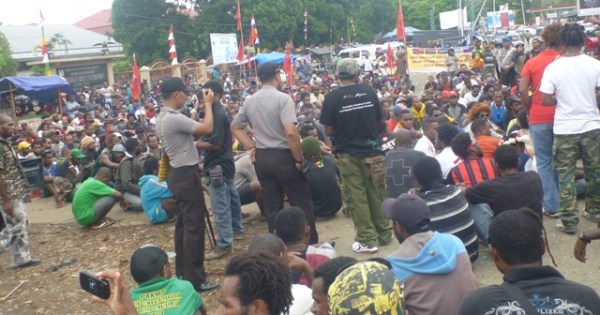
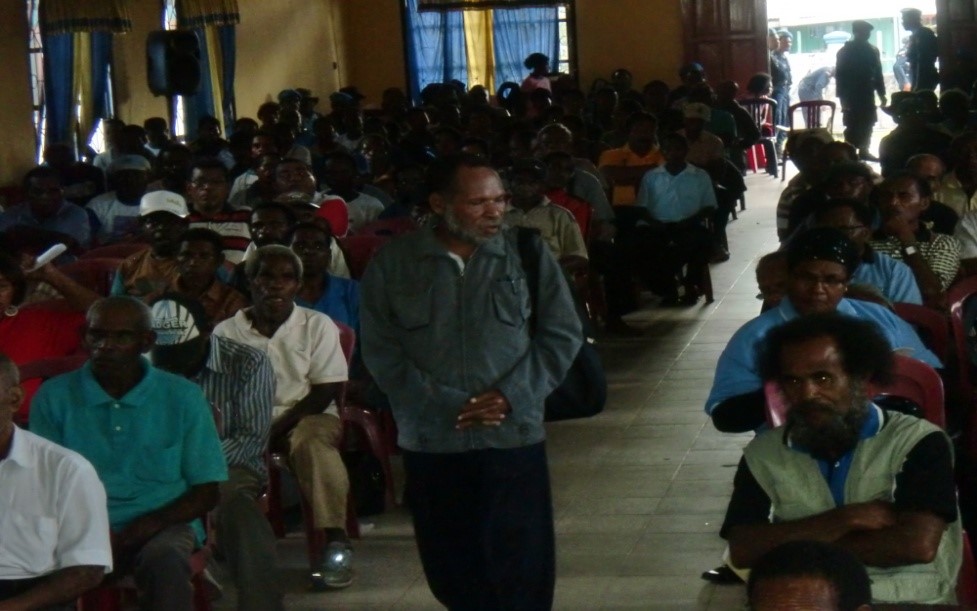
2000 people gathered in Sorong for prayers for the West Papua Freedom Flotilla (Photo: NFRPB/WPM sources)
2000 people gathered in Sorong for prayers for the West Papua Freedom Flotilla. *note – men in blue berets are from Petapa, West Papua’s community security / police force guarding West Papuan civilians against Indonesian police violence. (Photo: NFRPB/WPM sources)

The four were arrested after over 200 armed police surrounded a peaceful prayer gathering at Marantha Church in central Sorong yesterday afternoon, after thousands of local people joined with religious and adat (customary) leaders, and leaders of the self-declared National Federated Republic of West Papua (NFRPB) alternative government, to  express their solidarity with the aims of the Freedom Flotilla.  The Freedom Flotilla is  a journey being conducted with Aboriginal and West Papuan elders and Australian activists to highlight internationally the human rights situation in West Papua and is currently enroute sailing from Australia to West Papua.

Internationally renowned environmental defender, researcher and customary leader, NFRPB Sorong secretary Yohanis Goram,  was arrested together with  Apolos Sewa (Vice chair of Dewan Adat Papua, Greater Sorong),  Amandus Mirino (NFRPB State Secretariat senior worker), and  Samuel Klasjok (NFRPB’s alternative Chief of Police (Security) for  region 3, Doberay).  Sorong Police Chief Harry Goldenhad met with the organisers of the gathering, and initially “approved the activities with the proviso that they did not disturb the peace, and maintained security,” according to witnesses statements provided by established credible sources to West Papua Media.

sorong freedom flotilla congregation police
Police surrounding event just prior to arrests of organisers (Photo: NFRPB/WPM sources)

Over 2000 people had gathered for the solidarity event that spilled outside the large church compound.

About 45 minutes after the prayer meeting had finished, as participants were preparing for a press conference with local media including such as Radar Sorong, West Papua Post, and Fajar Papua, Police Chief Goldenhad took ten heavily armed officers into the church and arrested the four activists.

According to local sources who spoke with police and activists, Based on information collected on site, the arrests were made in connection with the unfurling of the Morning Star, Aboriginal, and Torres Straits flags inside the church.
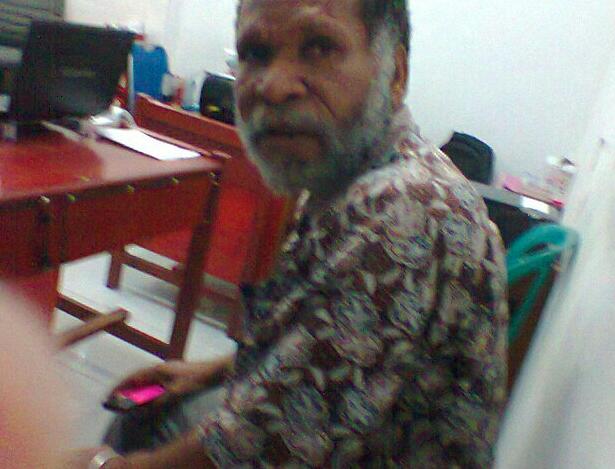
Apolos Sewa in the Police interrogation room (Photo: West Papua Media)
Apolos Sewa in Police interrogation room (Photo: West Papua Media)

The four activists are still being held at Sorong Police headquarters according to local sources, and their condition is unknown.  However grave fears are held for their safety, as these are the first West Papuans to be arrested over a connection to the Freedom Flotilla, which has attracted significant international media interest, and ignited major controversy and comment from Indonesian and Australian government ministers.

International human rights organisations have reacted quickly to the arrests, with Amnesty International (AI) in London expressing concern about the arrests of the four Papuan political activists.  AI’s Indonesia and Timor-Leste Campaigner, Josef Benedict said that AI “believes they have been arrested and detained solely for their peaceful political activism and call for their immediate and unconditional release.”
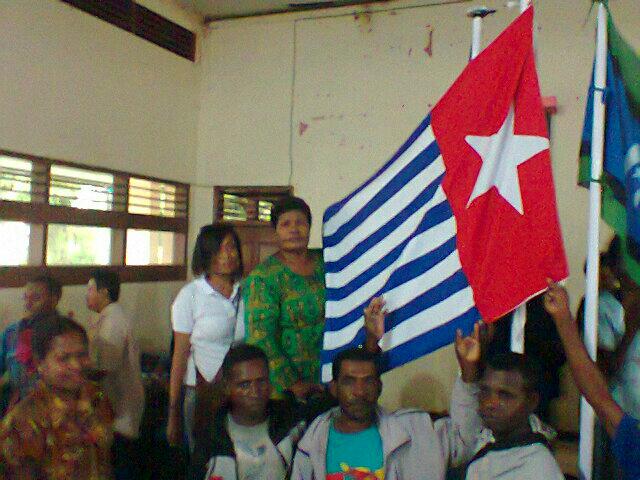

Activists raise the banned West Papuan Morning Star flag during the ceremony, prompting the arrests of the organisers under makar (treason) provisions Photo: West Papua Media sources)
Activists raise the banned West Papuan Morning Star flag together with the Aboriginal and Torres Strait Islands flags, during the Flotilla ceremony, prompting the arrests of the organisers under makar (treason) provisions Photo: West Papua Media sources)

textsecure-1571866598-1 “Amnesty International calls on the Indonesian authorities to respect the rights of Papuans to freedom of expression and peaceful assembly which are guaranteed in Article 19 and Article 21 of the International Covenant on Civil and Political Rights (ICCPR), to which Indonesia is a state party. Our organisation is concerned that the Indonesian government has consistently failed to make a distinction between violent armed groups and peaceful activists, and between peaceful expression of opinion and acts of physical violence, ” Benedict told West Papua Media by email.

textsecure-1857961604-1Activists on board the  Freedom Flotilla have reacted with dismay at the news of their supporters being targeted inside West Papua, but say this highlights the daily denial of Freedom of Expression for Papuan people, that originally motivated their plans for direct action.
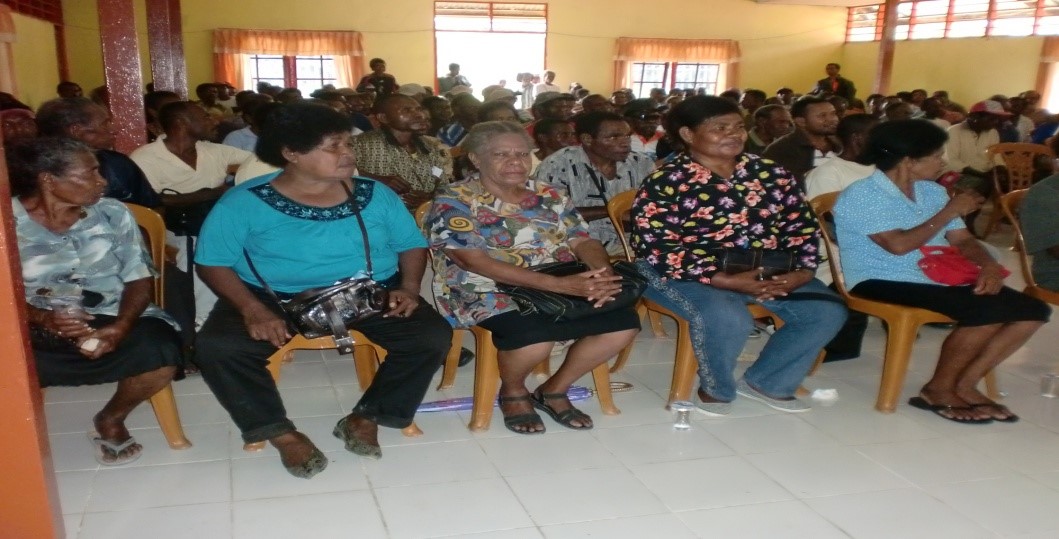
sorong freedom flotilla congregation  2
The Maranatha Church in Sorong during the prayer service (Photo: NFRPB/WPM sources)

Ronny Kareni, the spokesperson for the Freedom Flotilla said “It is shocking and yet not surprising, but completely unacceptable in this day and age that peaceful demonstrations of basic freedom of expression is censored in such an extreme way. We demand the immediate release of the 4 prisoners in Sorong.”

Kareni explained, “The asorong freedom flotilla congregation  1rrests yesterday of the four Papuan leaders are a reflection of the reality that there is no space for democracy in Papua and West Papua Province under the Indonesian occupation, and yet foreign governments are complicit to these ongoing abuses. The Freedom Flotilla to West Papua is aiming to highlight this entrenched long-term brutality that is demonstrated by these arrests.
Arabunna elder, Uncle Kevin Buzzacott, the elder who inspired the journey, said in a statement to West Papua Media, “Indonesian government – you must immediately release those 4 prisoners and not to harm them in any way. They need to be released and not to be harmed because they have not committed a crime. We felt very sad when we seen it in the news today. We are waiting for the other mob to turn up here on Horne Island so we can work out how to respond a bit more but for now we need to ask all Australians to take a firm position on this issue, to be strong for Human Rights in West Papua. They are hurting them everyday, for years and regardless of the Freedom Flotilla this is happening, but we having a go, tryin’ to get the World to see, to look and listen and take a stand for these people. The Papuans have had it rough for too long with Indonesia there and this can’t keep going on. The prisoners must be released immediately”.

Izzy Brown, one of the organisers of the Freedom Flotilla said: “We are dismayed to hear that the peaceful act of prayer has resulted in such extreme actions by the police and military in West Papua, highlighting once more the lack of basic human rights and freedoms that we in Australia take for granted every day. We need immediate international pressure to be placed on the Indonesian government to ensure that no harm comes to these good people who have simply undertaken to express themselves in a democratic way.:

Kareni sums up the feeling of Flotilla members: “This is the time Australia, to stand up for people who are being militarily controlled and attacked for simply trying to have a voice.”

West Papua Media, with local sources

MRP Recommendation on Jakarta-Papua Dialogue must be followed up

Bintang Papua
24 August 2013Jayapura: The Deputy Director of the Alliance of Democracy for Papua (ALDP), Yuman Corona, has called on all Papuans at home and abroad to press for the implementation of the recommendation by the Majelis Rakyat  Papua (Papuan People’s Council) that  the correct way to solve the Papuan problem is by means of dialogue between Jakarta and Papua.

‘At a plenary session held on 12 August 2013, the MRP said that Special Autonomy for Papua (OTSUS) has  been a failure and there should be a dialogue between Jakarta and Papua. ‘

As has already been reported, the MRP called on the President, the Governor of Papua and the Governor of West Papua to carry  this recommendation forward. The MRP recommendation stated that Dialogue should occur within the next sixty days.

In this connection, the ALDP, as part of civil society in Papua, made the following points:

1. The MRP which is the representative body of the Papuan people as stipulated in Law 21/2001, must be consistent and focus on the recommendation it adopted at its plenary sessions for a dialogue to take place.

2.  Fully supports the policy and  position adopted by the MRP which needs to be publicised to all the Papuan people.

The DPRP (Legislative Assembly of West Papua ) and the DPR PB (Legislative Assembly of Papua) ‘should both support the MRP recommendation  and keep in close communication with the MPR. and convene plenary sessions in order to set up a PANSUS (Special Committee) for the Jakarta-Papua Dialogue.

It  further called on the Governor of Papua and the Governor of West Papua to fully support the  recommendation of the MRP and maintain close communications with the MRP (Papua) and the MRPB (West Papua) in order to work out their strategy  and to make the question of Dialogue their top priority.

Furthermore, the President of the Republic of Indonesia should fully support  the recommendation of the MRP for Dialogue as the way to solve the problem of West Papua in accordance with what he said in his State Address on 16 August  2011 regarding the resolution of the question of Papua and should set up a special committee in preparation for the Jakarta-Papua Dialogue and hold talks with various elements in Papua and Jakarta.

Furthermore, the DPR RI (National Parliament ) and the DPD RI (Assembly of Regional  Representatives)  should express their full support for the recommendation of the MRP as the way to resolve the Papuan issue. Commission 1 of Parliament should discuss this matter with the various political groups and commissions  to declare their support for Jakarta-Papua Dialogue in order to resolve the Papuan issue.

Finally, he said: ‘Why do we (ALDP) support the idea of dialogue between Jakarta and Papua? Because this is the way to solve the problem without resorting to the use of violence. It is our vision to promote justice and a democratic process  in Papua  The MRP which is a legal institution  must act to find the best possible solution for Papua.’

[Translated by TAPOL]

Banned West Papuan Morning Star flags raised rejecting Merah Putih, on Indonesian independence day

by West Papua Media Eds
News Analysis
August 25, 2013
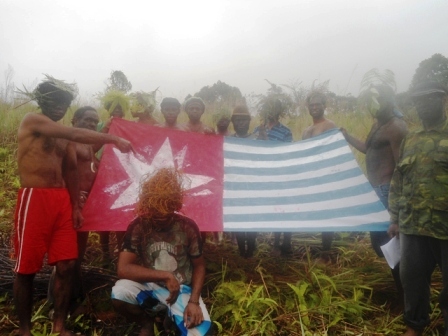
In a risky and symbolic act of defiance, unidentified West Papuan pro-independence activists raised the banned symbol of West Papuan liberation, the Morning Star flag, atop a foggy Mount Syclop, Sentani near Jayapura during the Indonesian Independence day on August 17 this year “as a form of celebration and rejection of the presence of Indonesian Papua, ” according to involved activists who spoke with West Papua Media (WPM) stringers.
West Papuan Flag Raising on August 17, 2013, atop Mount Syclop outside  Sentani, rejecting Indonesian independence celebrations. (Photo: supplied directly to West Papua Media)
West Papuan Flag Raising on August 17, 2013, atop Mount Syclop outside Sentani, rejecting Indonesian independence celebrations. (Photo: supplied directly to West Papua Media)

The flagraisings came amid a tit-for-tat psychological operations campaign ahead of August 17 by Indonesian occupation forces to raise the Merah Putih (Red/White) Indonesian national flag on prominent landmarks across Papua, and increase demands on Papuans to fly it publicly demonstrate their loyalty to Indonesia, according to a wide variety of human rights and church sources in Papua.

Organisers told WPM the act, on a mountain that could be seen from most the Papuan capital Jayapura, was about questioning the legitimacy of Indonesian occupiers to claim that all Papuans supported integration with Indonesia, and Jakarta’s claim that “Papua returned to the embrace of the Homeland.”
“Any person who was born and raised in Papua has been brought up with (the official line of the) ‘Victorious Political Integration in the NKRI, (and has) of course heard the above phrase repeatedly. This phrase has become a powerful force in the politics of integration. The Indonesian government and military believed and are so convinced that the political integration of West Papua is “absolute” they cannot answer the questions that the people of Papua ask,” the activists told WPM.
They continued their statement: “On behalf of the Nature of Papua, on behalf of the bones of revolutionary heroes who have gone before us, on our behalf and on behalf of our children, we strongly reject the claims of an Indonesian Papua.  Indonesian historians were so convinced that West Papua was breathing into the territory of several ancient empires of Srivijaya, Majapahit, Sultanate of Tidore, until the time of the Dutch East Indies. Indonesia believes it is the absolute truth, the validity of its claims of West Papua as an integral part of Indonesia. But on the other hand, shame records that the history that Indonesian historians were not able to show the valid, complete and accurate data to prove the truth of what they believe it.”
“As a form of resistance we Papuans assert our Independence of the illegal Indonesian colonial occupation of our land Papua, then we burn the flag and hoisted the flag of our “Morning Star” in the mountain region Syclop,” said the activists to WPM’s stringer.
“We do this not for Indonesian attention , nor to requested positions, (those) certain positions in the country’s NKRI (colonial) bureaucracy…. (but as) a form of resistance against colonial occupation of Indonesia (who are) illegally on our land.  That we demand and fight for “Self-determination” through an international mechanism that is Referendum,” the flag raisers said.
West Papuan Flag Raising on August 17, 2013, atop Mount Syclop outside  Sentani, rejecting Indonesian independence celebrations. (Photo: supplied directly to West Papua Media)
West Papuan Flag Raising on August 17, 2013, atop Mount Syclop outside Sentani, rejecting Indonesian independence celebrations. (Photo: supplied directly to West Papua Media)
Although traditionally raised on December 1 –  the anniversary of the 1961 thwarted declaration of West Papua’s independence from the Dutch, and the first flying of the flag –  activists claim that it was flown atop Mount Syclop to “remind Indonesia that the people of West Papua(n) nation (have) rejected the (Indonesian) pro-independence and did not participate in the anniversary celebrations.”
Indonesian colonial forces regularly attempt to enforce compulsory celebrations of Indonesia’s independence day by West Papuan people, an act many Papuans believe is designed to suppress Papuan cultural identity.
Flag raising is seen by Indonesia as a deeply political act that determines the degree of a citizen’s loyalty to the nation.  Failure to display the Merah Putih was regularly used throughout Indonesian history as a justification to extreme political violence, for example the killings of close to 2 million Indonesians during the 1965-1969 bloodbath in the first days of former dictator Suharto’s New Order regime, and the scorched-earth campaign on East TImor ending in 1999 when Indonesian security forces and militias murdered well over 180,000 civilians.  Civilians in Military operations areas (whether declared or not) across Indonesia and its colonies are regularly warned by security forces to display the Red and white in order to avoid sweep operations targeting their homes.  Public buildings are draped in it, private businesses are threatened by security forces if they fail to display it, and school children are bedecked in Red and White uniforms and forced to salute the flag daily.
Display of any cultural symbols or expression in opposition to the Merah Putih are interpreted by Jakarta as acts of makar (treason, subversion or rebellion) instead of acts of free expression guaranteed under the Indonesian Constitution.  However, Article 6 of Government Regulation 77/2007, prohibits the display of the Morning Star, the South Maluku Republic Benang Raja flag in Ambon and the Crescent Moon flag in Aceh – despite the provision of the law in the Indonesian Criminal Code (KUHP) being been declared unconstitutional for prohibiting free expression, by the Indonesian Constitutional Court.
Indonesian security forces, since their invasion of West Papua, have imprisoned thousands of people for their involvement in raising the banned Morning Star flag, and have violently broken up almost every display of the Morning Star, resulting in thousands of deaths over the last 50 years.  Each December 1 –  traditionally the anniversary of West Papua’s thwarted declaration of independence in 1961, Over 90% of the current 56 political prisoners in Papuan gaols are imprisoned under makar for non-violent acts involving the Morning Star flag, including most famously Filep Karma, one of Papua’s longest serving political prisoners, who was gaoled for 15 years for his role in organising the December 1, 2004 flagraising in Abepura.
Tito Karnavian's so-called Puncak Jaya summit Indonesian flag raising ceremony to conquer Papua.  Note the flat ground on the Grasberg mine site where the ceremony was held, and the several hundred metres of Papua's highest mountain Nemangkawi looming above the alleged "summit ceremony"  (Photo: POLRI)
Tito Karnavian’s so-called Puncak Jaya summit Indonesian flag raising ceremony to conquer Papua. Note the flat ground on the Grasberg mine site where the ceremony was held, and the several hundred metres of Papua’s highest mountain Nemangkawi looming above the alleged “summit ceremony” (Photo: POLRI)


On August 14, Indonesia’s colonial police chief in Papua Tito Karnavian (the former commander of the notorious Detachment 88 “Counter-terror” death squad supported by Australia,the US and UK), drove a group of Indonesian police, military,and management of the giant Freeport McMoRan Grasberg mine in heated luxury four-wheel drives, claiming they held a ceremony atop Papua’s highest peak, the 4844-metre high Nemangkawi (known by the Indonesians as Puncak Jaya), in order to raise Indonesia’s flag of conquest over Papua.  Participants in the ceremony claiming to be Papuans were families of senior Freeport employees,  an Indonesian army unit known as the “Pasukan Koteka Papua” and soldiers wearing blackface make-up. However the ceremony did not occur at the peak of Nemagkawi, rather in the grounds of the Grasberg mine site some 800 metres below the peak.  The Merah Putih still does not fly atop the famous summit (one of the “Seven Summits”), according to independent sources in TImika contacted by WPM.

Papua’s banned Morning Star flag, flown by climber Christian Welponer of South-Tyrol in Italy, from the top of the highest mountain of West Papua in late 2011, one of the “Seven Summits” (screen grab C. Welponer/ WPM file)
On December 1 2011, Christian Welponer, a world famous mountaineer from the autonomous South Tyrol region of the Italian-Austrian Alpine border regions, released a video of him raising the Morning Star flag atop Nemangkawi.  The act was deeply significant to West Papuan people, who sustained many casualties from Indonesian state violence inflicted on peaceful ceremonies across Papua that day.  The act infuriated Indonesian officials in the Freeport surrounds, who failed to prevent Welponer from carrying out the symbolic solidarity action.
WestPapuaMedia with local sources

Mixed success for Papuan Cultural parades despite pre-emptive arrests across Papua

Special Wrap-up report by West Papua Media, with local sources.

(Apologies for delay in posting as WPM was chasing hi-res photo essays from outlying regions.  This will be a separate item as soon as we get hold of them.)

August 26, 2013

Scores of non-violent activists from the West Papua National Committee (KNPB) were arrested across Papua over the last two weeks, when Indonesian Police carried out pre-emptive sweeps ahead of a day of mobilisation on August 15, a day intended to celebrate Papuan cultural identity and demand rights to free expression be respected.

Organisers across Papua claimed varying degrees of success in holding the cultural parades, hailing the assertion of Papuan cultural identity in the face of a “deliberate campaign of cultural suppression by the Indonesian colonial security forces” as a “moral victory that would show that West Papuan people are not going to die quietly,”  according to sources who spoke with West Papua Media (WPM).

The parades were organised by West Papuan activists on the anniversary of the contentious New York Agreement – that began the process of Indonesian colonisation of Papua – to demonstrate against ongoing the threats to the survival of Papuan culture.  The parades  were also celebrating the opening of the new Free West Papua Campaign office in The Hague in The Netherlands under the coordination of Oridek Ap (the exiled son of executed West Papuan musician and cultural hero Arnold Ap).

Despite Police being widely reported by Indonesian colonial media stating they would allow the parades to go ahead, activists and stringers for WPM reported from across the country of waves of arrests – or detentions as described by Indonesian security forces – and intimidation that prevented several of the parades from occurring.

Nevertheless, the events went ahead in Jayapura, Wamena and Biak, with  much smaller gatherings unconfirmed across the rest of the country.

Papuans villagers  arrested and searched, detained in Aula Fakfak Police for interrogation (photo: Alex Tethool / Jubi / Fakfak)
Papuans villagers arrested and searched, detained in Aula Fakfak Police for interrogation (photo: Alex Tethool / Jubi / Fakfak)

In the west coast town of FakFak, police arrested several dozen people on August 13, according to reports from Tabloid Jubi, and human rights sources.   Jubi reported that officers intercepted two trucks carrying dozens of villagers as they were preparing to attend the Cultural Parade on the 15th.  Police commandeered the trucks to  the police headquarters in Fakfak, detaining and interrogating the villagers – including large numbers of women and children –  in the Police Hall.  Police refused to explain their actions to Papuan media, according to local observers.  Unconfirmed reports from Fakfak say the majority of villagers were released, but the date of their release, or the ability for them to continue their participation in the cultural parades is still unknown.

Jayapura

In Jayapura, KNPB Chairman Agus Kosai was arrested by Police as he and other KNPB members attempted to move a sound system from his village near Sentani (about 12km outside Jayapura) to the gravesite of slain independence hero Theys Eluay in Waena.  KNPB treasurer Toni Kobak and National Spokesperson Wim Medlama were also arrested with 13 other KNPB members.  Police interrogated them but later released them, ordering them home after seizing their banners and equipment.

Refusing to be intimidated, the released KNPB members then ignored the Police directive, made new rally materials and proceeded with the planned Cultural Parades regardless in Jayapura.

This slideshow requires JavaScript.

Thousands of local people turned out in Jayapura to showcase Papua’s vibrant indigenous cultural diversity, reflecting and representing Papuan cultures from every corner of the country.   The day itself had been planned as a deeply symbolic act of cultural resistance through survival, drawing on the actions of slain ethnomusicologist Arnold Ap in a nonviolent assertion of Papuan sovereignty resisting  Indonesian colonisation and control of Papuan lives.

Indonesian Police surveille activists during the Papuan Cultural Parade, August 15, 2013
Indonesian Police surveille activists during the Papuan Cultural Parade, Jayapura, August 15, 2013 (Photo: West Papua Media / YS)

Illustrating this attempt at control, many acts of cultural expression such as banned dances, banned songs, and banned displays of cultural heritage were actively monitored by heavily armed Indonesian Police, however the sheer number of participants prevented further arrests.

Coordinator of the Peace Demonstration Warpo Sampari Wetipo, told the crowd from a stage mounted atop a Kijang car, “we in KNPB are standing with the people of Papua, despite the Indonesian military’s terror by prohibiting any peaceful demonstration and action, we do continue to fight without fear, to demand the right of self-determination for us, the people of West Papua.”

Buchtar Tabuni, West Papua Parliament Chairman, and revolving door political prisoner currently between arrests, reminded the crowd that they were gathered to “Declare to the world that the people of Papua are demanding the recognition of their right of self-determination with fairness and dignity.”  By demonstrating their cultural resistance, Tabuni said that West Papuan people were asserting their identity “as a community of the Melanesian family, that Papuans are not part of the people of Indonesia or Malay.”

Reports from the Jayapura rally suggested that police were initially prepared to utilise force against the participants after they defied the order to go home.  Significant military hardware was deployed, with security forces surrounding the thousands of people gathered at Theys’ gravesite with Armoured personnel carriers, water cannon, tear gas trucks and several Barracuda armoured assault vehicles.

According to reports filed to WPM, activists had prepared unspecified “unique” methods of non-violent de-arresting techniques should the need arise, though it is unclear whether the Indonesian security forces were prepared to respect the nonviolence of the day.

The rally had been tightly safeguarded by KNPB members, who kept the participants separated from security forces and plain clothes special forces personnel with a simple rope line, thus preventing any agents provocateur from provoking police to create a scenario of violence.  in Papua.   Buchtar Tabuni told the crowd at the end of the rally, “the security forces to help secure us, and also I just want to explain that from yesterday until last night we kept guard patrol, to keep track of things that we do not want to happen and also it helps security deposit until the day’s activities, ”

In Wamena, KNPB activists reported that police and members of the Indonesian army were also being proactive in prevention of the parades, with banner seizures and an active show of force.  According to local sources, almost the entire KODIM 756 Wim Ane Sili (lit. “House of the Sound of War” in Dani language) Battalion (up to 1000 soldiers) surround the protest field at Sinapuk,

This massive “show force” was responsible for thousands of people being forced to stay away from the Cultural gathering, according to KNPB Wamena spokesperson Mr Mabel.  The gathering was peaceful but was only attended by several hundred people.

In Biak, local members of the KNPB organised a smaller demonstration passing the site of the infamous Biak Massacre, which recently commemorated its 15th anniversary on July 6.  Hundreds of people marched from the old market and Terminal Pasar Darfuar ending up at a traditional meeting house (pendopo adat Sorido), to support the opening of The Hague Free West Papua office.  Apollos Sroyer, Biak KNPB Chairman, told WPM’s correspondent “The parade was also planned as an expression of welcome to the arrival of messengers from the Melanesian Spearhead Groups (MSG) in the near future to West Papua.”

Sroyer also expressed “gratitude to those MSG members who have expressed their support of the right of self-determination of the people of West Papua,” without mentioning the official rejection of the bid for Observer Status for West Papua by the MSG, widely seen as a betrayal of Melanesian solidarity by many across the Pacific.

WestPapuaMedia, with local sources

Commitment of the MSG regarding West Papua to be put to the Test

Opinion / Analysis

By Selpius Bobii

Abepura Prison, 28 June 2013 |

After more than 50 years of struggle, finally the voice of the Papuan nation has been formally discussed in the 19th Summit of the MSG which took place from 17-23 June 2013 in Noumea, New Caledonia.  As the community of the nation of Papua we are most appreciative to the leaders of the MSG and particularly to the Kanak and Socialist National Liberation Front (FLNKS) as the host of the forum that officially invited a delegation from West Papua.

This is the first time an opportunity has been given by MSG to representative groups from both West Papua and Indonesia to convey their respective viewpoints within an MSG Forum. The West Papuan viewpoint was conveyed by Dr John Otto Ondawame of the WPNCL whilst the Indonesian viewpoint was conveyed by the Indonesian delegation led by Maikel Manufandu. The decision of the MSG Forum in handling the issue of Papua and in particular Papua’s application for membership is taken as a realisation of Melanesian solidarity and an upholding of the worth of all Melanesian peoples. The Forum’s decisions as recorded in the MSG Communique reflect decisions by the MSG leadership that West Papua is indeed recognized by MSG as a part of the Melanesian ethnic group and as part of the wider Melanesian family cannot be overlooked or forgotten.

The Indonesian representatives at the MSG Forum were faced with unanimity of heart and resolve by the MSG leadership to support the struggle for the liberation of West Papua. The resolutions of the MSG Summit amount to an implicit statement to other nations of the world of the importance of the West Papua issue such that it would be discussed at length by other nations of the region. This signifies that the nations of the Melanesian region are treating most seriously the humanitarian issues in Papua together with issue of self-determination for Papua in the hope of saving the people of West Papua from this humanitarian emergency.

Even though the decision of the leadership of MSG Summit is something so very pleasing to the people of West Papua, we nevertheless still have concerns that the status of the application for membership by West Papua will not be finalised by the MSG before receipt of the report of the visit to Jakarta and West Papua by the delegation of MSG member Foreign Ministers. Will the nations of the Melanesia region be able to act consistently with their statements of commitment on 21 June 2013 as stated in the MSG Communique regarding West Papua? That commitment is indeed going to be severely tested in the coming months as the State of Indonesia is extremely cunning in its political rhetoric and will be doing whatever it can to ensure West Papua’s application for membership with the MSG (as represented by WPNCL) is cancelled.

The visit by the MSG member Foreign Ministers will clearly have one of two consequences. Either the visit by the delegation will be beneficial for West Papua or conversely the visit could result in West Papua being sacrificed at enormous loss to the people of Papua. The latter may occur if the MSG delegation feels trapped and/or is tricked by the dirty politics of the State of Indonesia (RI). If the MSG delegation members are tricked or trapped by the unilateral rhetoric of RI and/or are tempted by the various ‘offers’ that RI will undoubtedly make, then it may occur that the report of the delegation that visits Jakarta and Papua may be at a tangent to what was its purpose. It will not in that case be objective or just and may conclude that all is ‘just fine’ in West Papua. An outcome which would result in West Papua’s application for MSG membership being rejected and which would be advantageous for RI but absolutely disastrous for the people of West Papua.

The commitment of the MSG leadership as stated in the Communique needs now to be realised through real and positive steps that need to be taken by the MSG Forum including:

  1. West Papua should have been confirmed as a permanent member of the MSG without needing to wait for the report from the delegation of MSG member Foreign Ministers if indeed MSG is truly concerned about the humanitarian emergency in West Papua. However we indeed hope that the MSG leadership will continue to defend West Papua becoming a member of MSG following the visit of the delegation of MSG member Foreign Ministers regardless of what is reported back from that visit.
  2. The taking of real and positive steps immediately by the MSG to mediate negotiations between the nations of West Papua and Indonesia to thoroughly deal with the problems and to arrive at solutions that uphold the dignity of the people.
  3. MSG leadership taking the issue of Papua to the United Nations (PBB) through one or more of the following channels :a)     The UN Committee for Decolonisation for West Papua with the re-registering of West Papua

    b)    The MSG advocating to have the issue of Papua on the agenda at the coming session of UN

    Then  MSG putting forward a motion within a UN forum to determine the legal and political status of West Papua leading to either the independence of the nation of West Papua being recognised or alternatively there being held a referendum.

    c)     The MSG Forum through legal channels mounting a challenge against the annexation of the independence of the nation of Papua into the Republic of Indonesia and/or the so-called ‘Act of Free Choice’ of 1969.

The community of the nation of West Papua and those in international solidarity will be closely following the realisation of the commitment of the MSG leadership and meanwhile will continue our efforts to become recognised as a full official member of the MSG.  With the hope that through MSG West Papua will be able to continue to struggle for the return of our rights as the first-born in the land of Papua and for the sovereignty of West Papua to be legally recognised.  Rights that were unlawfully denied us when Papua was immorally and illegally annexed into Indonesia.

Ideally the sovereign independence of the nation of Papua would be acknowledged at this time by the MSG Forum and that MSG would then lobby other nations at the UN for the recognition of Papua’s independence leading to the return of powers of governance. This way being the ‘shorter road’ which delivers an accurate and effective outcome. Rather than having to fight for our self-determination through a repeated referendum which may not give a clear determination and which is a much longer process that requires significant material resources, time and effort and human victims that will not be small in number.

The decision of the MSG at the 19th Summit was one of wisdom that upholds the values of justice, human rights, truth, honesty, democracy, peace and also the value of the Melanesian ethnic group. These values must not be neglected or overlooked due to offers of any kind by the State of Indonesia and/or its allies. The nation of West Papua dearly hopes that the leadership of MSG will maintain their initial commitment to the people of Papua as stated in June 2013. That the MSG Forum together with the nation of West Papua and the support of the international community in solidarity will continue to struggle for the recognition of the full and free sovereignty of Papua and its liberation from the colonial domination of RI and its allies.

Points 20-21 in the MSG Communique regarding the West Papuan issue are extremely special, meaningful and symbolic.  What will be most wonderful indeed is if the MSG final decision gives realisation to these hopes as a result of their very real and positive actions to rescue the nation of Papua from discrimination, marginalisation, becoming a minority and ultimately genocide of the ethnic West Papuan race.

We hope that the international community including both other nations and international entities/organisations, will give moral and material support to the leadership of MSG such that their commitment as stated in June remains steady. So that they are not manipulated and tricked by the political, security related and economic manoeuvres of the State of Indonesia and its allies intended to bring down the application of West Papua to the MSG and to cut across efforts by the MSG to help the people of West Papua. To help their fellow Melanesians who are presently in a state of crisis and a humanitarian emergency that is most horrifying in its consequences. A situation that has and continues to be hidden from the rest of the world.

The MSG Forum is the door that leads to access to the formal processes of the UN. So wherever people of the Papuan nation may be around the world, together with those of the international community in solidarity with us, we hope that you will be fully supportive of these efforts by the MSG whether directly or indirectly. So that MSG can stand strong in accordance with their commitments at the 19th Summit and fight for the self determination of the nation of Papua which is in accordance with the founding preamble of MSG.

Let us close our ranks and strengthen our position and capacity within the representative body of the WPNCL, so that WPNCL can represent West Papua towards a successful decision of the MSG that will bring an end to the present problems in West Papua. WPNCL cannot go this alone as through a forum of the highest order the nation of Papua at the III Papuan National Congress on 19 October 2011 in Abepura, declared the restoration of the sovereign independence of the nation of Papua in the State of West Papua and as a legal basis was established the State of the Federal Republic of West Papua. At that time the highest mandate of the nation community of Papua was given and that lies with the State of the Federal Republic of West Papua.

There is a need as soon as possible for a gathering of West Papua in the form of a West Papuan ‘National Evaluation’ or ‘West Papuan Internal Dialogue’ to arrive at a compromise or political internal consensus for West Papua. Such that moving forward there will no voice heard that is not in accordance with that arrived at and no claims or counter claims as to ‘ownership’ of the struggle. Such that there may be a mutual understanding and recognition of each others’ positions. The time has now come that there is a most critical need for all components of the Papuan struggle to unite and to divide the roles, then stepping forward together to bring into reality our longing for the nation of Papua, of West Papua, to become indeed fully sovereign.

Let’s work together to uphold those supreme values of truth, justice, honesty, human rights, democracy, self-worth and peace as the most glorious of human actions/works, even though in doing so we may face risks and difficult consequences in the realization of those values. For surely this is far nobler than to dedicate our all to the fulfilment of our own personal interests or our group’s interests and especially by means that are not upholding of humanitarian values. ‘The rescuing of human souls that have been shackled by the tyranny of oppression is indeed the highest law.’

Unity without limits! Struggle until victorious!

Selpius Bobii is the General Chairperson of  Front PEPERA West Papua and is a Papuan Freedom Political Prisoner in the Abepura Prison, Jayapura, West Papua.


Create a website or blog at WordPress.com

Up ↑