This is the 94th in a series of monthly reports that focus on developments affecting Papuans. This series is produced by the non-profit West Papua Advocacy Team (WPAT) drawing on media accounts, other NGO assessments, and analysis and reporting from sources within West Papua. This report is co-published with the East Timor and Indonesia Action Network (ETAN). Back issues are posted online at http://www.etan.org/issues/wpapua/default.htm Questions regarding this report can be addressed to Edmund McWilliams at edmcw@msn.com. If you wish to receive the report via e-mail, send a note to etan@etan.org.Summary: The trial of five Papuans who led a peaceful demonstration in October 2011 demanding Papuans’ right to self determination has begun. There has been no prosecution of security forces who brutally attacked that demonstration, killing at least three peaceful demonstrators and beating scores more. The U.S. State Department called on the Indonesian authorities to ensure due process for those indicted and urged that Indonesia respect its international legal obligations related to the trial. Human Rights Watch, for its part, called for the release of the five Papuans who are being tried under an archaic “subversion” provision of the criminal code. WPAT presents an exclusive report on efforts by the Indonesian special forces, Kopassus, to organize a propaganda campaign on West Papua. The campaign targets the U.S. and other governments for purportedly seeking to exert influence there. In its annual report, Human Rights Watch describes a worsening environment for
human rights in West Papua. Reporters without Borders, in another global review, notes the growing threat to journalists in West Papua. The Asian Human Rights Commission reports on new Indonesian security force torture of Papuan civilians. The Indonesian government is colluding with Interpol in an effort to arrest prominent Papuan dissident Benny Wenda. Indonesian joins a number of repressive regimes attempting to use Interpol to silence critics. Jakarta has announced plans for a massive road building scheme in West Papua which will facilitate developers access to virgin forest areas. A revealing report by the Jakarta Globe explores the prevalence of illiteracy among Papuan children, even in urban areas, and notes the central government’s persistent failure to provide educational services to Papuans. The Government has again announced plans to create a new Papuan province, a step which will further divert funds from essential services for Papuans.
Contents
Prosecution of Peaceful Dissent Again Targets Papuans
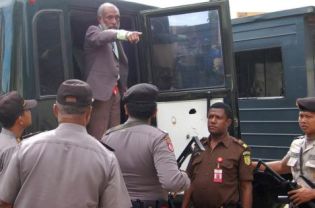
The trial of six West Papuan leaders who played the leading roles in the October 16-19, 2011 convening of the Third Papuan National Congress (see November 2011 West Papua Report ) began January 30 in Jayapura. The trial was adjourned shortly after it began and will resume on February 8. Over 300 people were initially detained as the Papuan Congress concluded 19 October 2011. An assault on the entirely peaceful gathering by Indonesian security forces led to the death of at least three participants and the beating of many more. No security forces have been prosecuted for that assault.
Six people have been detained since October 19, 2011; five of the six face charges of subversion under Section 106 paragraph 53 and 55 of the Indonesian Criminal Code. The use of these charges to suppress peaceful dissent date back to the Dutch colonial times and have frequently been employed by the Dutch, the Suharto dictatorship and even successive democratic regimes. The provisions violate Indonesia’s obligations under the International Covenant on Civil and Political Rights and the Covenant on Economic, Social and Cultural Rights as well as the Universal Declaration of Human Rights.
The six detainees are: Forkorus Yaboisembut, Dominikus Surabut, Edison Waromi, Selphius Bobii, Agus Sananay, and Gat Wenda. Five of the six are charged with subversion: Wenda is only charged with carrying a concealed weapon.
The United States State Department publicly called on Indonesia to “ensure due process” and to observe its “international legal obligations for those indicted.” The U.S. also urged Indonesia to “work with the indigenous Papuan population to address their grievances, resolve conflicts peacefully and support development in the Papuan provinces.”
The United States “recognizes and respects the territorial integrity of Indonesia within its current borders, which include the provinces of Papua and West Papua,” the spokesperson added.
Human Rights Watch (HRW) has demanded that Indonesia drop the charges against the five Papuans. The New York-based rights group said Indonesian security forces had used “excessive force” including batons and firearms to break up a pro-independence assembly in the provincial capital Jayapura last October, killing at least three people and injuring more than 90. HRW noted the injustice that while eight police officers were let off with written warnings for disciplinary infractions, the five Papuan leaders are charged with treason. “The Indonesian government should show its commitment to peaceful expression by dropping the charges against these five Papuan activists,” the group’s Asia deputy director Elaine Pearson said in a statement. “It’s appalling that a modern democratic nation like Indonesia continues to lock up people for organizing a demonstration and expressing controversial views,” she added. Pursuing the trial would “only deepen the resentment that many Papuans feel against the government”, Pearson said.
HRW also urged Indonesia to release at least 15 other Papuans, including independence leader Filep Karma, and about 60 others mostly Maluku activists, over “peaceful acts of free expression.” Rights groups accuse Indonesia of gross human rights abuses in Papua, a Melanesian-majority region rich in natural resources where poorly armed rebels have been fighting for independence for decades. Jakarta denies the allegations but severely limits access by foreign media or aid workers into the remote eastern province to conduct independent inquiries.
More than 100 people are currently imprisoned in Indonesia for peacefully promoting separatism in Indonesia, most of them from Papua or the eastern Maluku islands, according to Human Rights Watch.
*******************
WPAT EXCLUSIVE: Kopassus Organizes Propaganda Offensive Targeting U.S. and Other International Interests Regarding West Papua
Indonesia’s Special Forces (Kopassus) organized a week-long training program for two dozen bloggers and journalists at their headquarters in Jakarta late November, 2011. Trainees were warned about alleged foreign interference in West Papua, including by the U.S. and other governments. According to its website, the Indonesian Association of Citizen Reporters (Persatuan Pewarta Warga Indonesia, PPWI ), jointly organized the training with Kopassus Group III/Sandhi Yudha or the ‘Secret War’ group. The group has a section called the ‘Papua Desk.’
The PPWI website shows Kopassus group commander Col. Izak Pangemanan shaking hands with Wilson Lalengke, PPWI chairman. According to some trainees’ Facebook accounts and the syllabus, the training included several components including one about separatism in West Papua. A trainee Facebook account showed Kopassus had also recently sent around 250 officers to Papua.
Mahar Prastowo, a PPWI deputy chairman, played a central role by liaising with Kopassus for the program, where he gave a talk about Papua, saying that he had approached Forkorus Yaboisembut, the chairman of the Papua Customary Council, and Buchtar Tabuni, the chairman of the West Papua National Committee.
Trainees came from Java, Sumatra, Kalimantan and Sulawesi, but included no Papuans. The training program was intended to counter international news reporting about West Papua which is seen as critical of Jakarta policy and Indonesian military conduct in West Papua.
At the training, Mahar Prastowo contended that the United States is stirring unrest in West Papua. He cited President Barack Obama’s decision to deploy 2500 marines to Darwin, Australia. Prastowo also said there is a “paradigm shift” in suppressing independence movement in Papua. He encouraged the PPWI trainees to get involved in the information war. On his Twitter feed (@maharprastowo), he criticized mining giant Freeport McMoRan which he said had taken out most of the gold and copper from Papua’s Grasberg mine, while only giving Indonesia only one percent of the income.
Prastowo told the trainees to help create “a common enemy” of the Papuans and the Indonesians. Prastowo described this common enemy as “ABDA,” representing American, British, Dutch and Australian interests. Trainees were encouraged to use their Twitter, Facebook and blogs to fight “foreign agents in Papua. On his Facebook account “Mahar Writerpreneur,” he uploaded a cartoon of four Caucasian men, supposedly to represent ABDA, eating resources from the Grasberg mine.
PPWI chairman Wilson Lalengke has issued 100 PPWI press cards for Kopassus officers. The training program was mainly financed by the Ministry of Defense. In addition to the training assistance, Kopassus will help bloggers and journalists cover Papua by providing logistical support to include transportation.
Prastowo’s blog indicates that he has some sort of an association to the Jakarta-based Islam Defenders Front (Front Pembela Islam, FPI). He posted some FPI announcements. The hardline FPI for years has engaged in thuggish attacks on businesses and others it does not approve of. The FPI is believed to have official backing.
In late December, FPI chairman Habib Rizieq Shihab and Islamist politician Muhammad al-Khaththath visited the Ministry of Defense, demanding the ministry to take stern actions against “Papuan separatist.” They also threatened to wage jihad in Papua.
Another Facebook account says that PPWI is also planning to publish a tabloid in West Papua.
***************
Human Right Watch Annual Report Describes Worsening Rights Environment in West Papua
In its annual review of human rights observance and violation around the world, Human Rights Watch focused significantly on developments in West Papua. West Papua related excerpts follow:
- In August internal military documents – mainly from Kopassus, Indonesia’s special forces -were made public, exposing how the Indonesian military monitors peaceful activists, politicians, and religious clergy in Papua. The documents show the deep military paranoia in Papua that conflates peaceful political expression with criminal activity. Several of those named in the documents as targets have faced arrest, imprisonment, harassment, or other forms of violence.
- Access to Papua in 2011 remained tightly controlled. Few foreign journalists and human rights researchers can visit independently without close monitoring of their activities. Since October the vice president’s office has set up the Unit to Accelerate Development in Papua and West Papua, which is focused on economic development. Its board members include some veterans of peace talk over Aceh.
- In July over 500 representatives of Papuan civil society met at a peace conference in Jayapura, organized by a government-funded peace-initiative network.
- Violence in Papua worsened in July and August with several unrelated attacks in which more than two dozen people were killed or seriously injured. Seventeen people were killed in Puncak Jaya in July when two rival political camps clashed in an election dispute.
- In Puncak Jaya there has been a long insurgency between the Free Papua Organization (OPM) and the Indonesian military. The OPM commander in Puncak Jaya claimed responsibility for several attacks against the Indonesian military in July, including one in which an Indonesian military chopper was shot down, injuring seven soldiers and killing one.
- In October security forces used excessive violence when arresting more than 300 Papuans involved in a three-day Papuan Congress. At least three men were killed and more than 90 were injured. Six Papuan leaders were charged with treason.
International Journalists Underscore Security Targeting of Journalists in West Papua
Reporters Without Borders released its Press Freedom Index 2011-2012 on near the end of January, in which Indonesia dropped 29 places from a year earlier to 146th. The reason for Indonesia’s slip in the ranks, according to the organization, was largely due to cases of journalists in West Papua being killed, kidnapped and assaulted.
Bambang Eka Cahya Widodo, chairman of Indonesia’s Elections Supervisory Board (Bawaslu), told media that journalists were sometimes targeted because of their election coverage. He cited the case of a journalist in Merauke, Papua, who was stabbed while reporting on an electoral dispute there last year.
WPAT Comment: The United Nations, foreign officials and human rights organizations have long been critical of Indonesia’s ongoing efforts to prevent international monitoring of human rights violations in West Papua. The measures employed by Jakarta include restrictions on travel to and within West Papua by international journalists, human rights monitors and humanitarian agencies. The International Committee of the Red Cross remain banned from re-opening its offices in West Papua. But perhaps the most insidious tactic employed by Jakarta is the targeting of Indonesian journalists and human rights workers by Indonesian security forces. Reporters Without Borders has performed an important service in drawing attention to security force intimidation, brutalization and murder of Indonesian journalists.
Military Officers Arbitrarily Arrest and Torture Civilians Based on False Claims of Rebel Activity
The Asian Human Rights Commission, January 26, issued an urgent appeal ( Urgent Appeal Case: AHRC-UAC-005-2012) regarding the Indonesian military’s brutalization of a dozen Papuans, including three local activists, in Kurulu, West Papua, in early November 2011. The assault on these civilians was related to unsubstantiated claims of rebel activity in the area. In an appeal to the international community, the AHRC noted that civilians are “frequently victimized based on arbitrary allegations of rebellion, and subsequently tortured.”
The incident followed a false allegation initially passed to a pro-Jakarta militia of a meeting between the Papuan armed resistance OPM and villagers from Umpagalo village in Kurulu district. Local military personnel of the 176/ Kurulu military headquarters reacted to the unsubstantiated report by going to Umpagalo at around 11pm. “They beat three local activists, Melianus Wantik, Edo Doga and Markus Walilo, as well as nine villagers, Pilipus Wantik, Wilem Kosy, Elius Dabi, Lamber Dabi, Othi Logo, Nilik Hiluka, Hukum Logo, Martinus Mabel and Saulus Logo, then stabbed them with bayonets for two hours, forced them to crawl and doused them with water for one hour. The officers also humiliated, beat with wood sticks, kicked and stepped on them with their boots, pointed their guns and threatened that they would cut their heads, and shot at them four times.”
The troops then transported the victims to the 176 military headquarters and after several hours delay, they were released without charges. The victims? colleagues complained to the Kurulu sector police following the incident, but the police refused to process the complaint claiming there was no substantial evidence to prove the allegations. More importantly, the police have no capacity to investigate or prosecute military personnel under terms of the law on military courts (Law No. 31 of 1997).
The AHRC observed that security force use of torture against indigenous Papuans is widespread, often targeting persons suspected of supporting independence movements. “Such suspicions are often leveled arbitrarily against members of the indigenous community and result in stigmatisation.” AHRC added: “according to the law on military courts, members of the military that commit crimes against civilians, such as extrajudicial killings or torture, can only be held accountable by military justice systems. Military courts are not open to the public, are notorious for only giving lenient punishments, and show a clear lack of impartiality.” AHRC called for a joint investigation of the incident by the Indonesian military (TNI) and the National Human Rights Commission (Komnas HAM).
Interpol Lends Its Resources to Indonesian Efforts to Silence Dissident
Interpol has issued a “red notice” for Benny Wenda, a prominent Papuan dissident who has been granted asylum in the U.K. on political grounds.
The Interpol action against Wenda is similar to other actions targeting prominent dissidents legally living outside their home countries. The Interpol alert system is increasingly being employed to serve the interests of often repressive regimes seeking to silence their critics.
A lawsuit alleging that some oppressive regimes are using Interpol’s alert system to harass or detain opponents is being planned by rights activists and lawyers in the United Kingdom. Campaigners say that some government fabricate criminal charges against those who have taken refuge in other countries and then seek their arrest through Interpol “red notices.”
The notices are meant to alert member police forces that an Interpol member state has issued an arrest warrant, but some countries will take seize suspects based on the “red notice” alone. There are about 26,000 outstanding.
Trans-Papua Road Planned
According to the Jakarta Post, Indonesia’s Public Works Ministry is allocating Rp 3.6 trillion (US$399 million) to build a “Trans-Papua Highway.” Planned road construction would be among the largest undertaken in Indonesia. he aim of the Trans-Papua Highway is purportedly to connect isolated areas in Papua’s central highlands to Wamena, Habema, Kenyam, and Batas Batu, as well as the Asmat regency on the south coast. The plan would also include two other road projects within the “Master Plan for Acceleration and Expansion of Indonesian Economic Development” (MP3EI), involving roads linking Timika in the Mimika regency and Enarotali in the Paniai regency, and those linking Merauke with Tanah Merah in the Bouven Digoel regency. Government spokespersons claim that the government aims to build 70 percent of a total of 3,100 kilometers of national road in Papua and West Papua by 2014.
WPAT COMMENT: Such massive road development poses both positive and negative consequences. Improved access to markets for local farmers and industries could be a boon to isolated Papuan villages and towns. Papuans generally will also benefit from improved access to essential services and employment opportunities often lacking in rural areas of West Papua. On the other hand, such road development also expands the opportunity for illegal enterprises, particularly illegal logging operations, to exploit Papuan natural resources. The Suharto dictatorship often boasted of “road development” in occupied East Timor. In fact, road network expansion was largely aimed at facilitating military access to exploitable resources and expanding military operations into the hinterlands.
Jakarta Abuses Papuans Through Denial of Essential Services
The failure of the Indonesian government to provide essential health services to the Papuan population of West Papua has been repeatedly documented and, arguably, leaves the Jakarta government open to charges of ethnic genocide. This calculated, malign neglect in the area of basic health services extends to provision for education. A revealing January 31 Jakarta Globe report notes that Papua’s illiteracy rate among those aged 15 years and under was 32 percent, the highest in the nation, according to data from the Central Statistics Agency (BPS) in 2010. That figure has increased steadily since 2007, when it was 25 percent, going up to 28 percent in 2008 and 30 in 2009.
The Globe report, by Banjir Ambarita and Mary Anugrah Rasita, underscores that the Jakarta government’s failure to educate young Papuans is not only a problem in remote rural areas. The reporters visited a state elementary school in Jayapura (Port Numbay) and found extensive illiteracy. Nella Manaku, headmaster of Holtekamp Elementary School acknowledged that 50 percent of the students there could neither read nor write. The reporters observed that many fifth- and sixth-grade students were just at able to be taught how to write.
The headmaster blamed the high illiteracy rate on a lack of teachers at saying that were just five instructors for the more than 100 students. Moreover, “Three of them are permanent and the others are contract teachers, but they rarely show up for work,” he said. He explained that he had repeatedly applied to the Jayapura Education Agency for more teachers, but to no avail. “For several years now we’ve been asking for help, but there’s never been a response from the authorities,” he said. Kayus Bahabol, a provincial legislator, told the Globe that the high illiteracy rate was not the only issue the school was dealing with. “Educational facilities here are badly lacking…. Livestock wander all over the place and leaving their droppings everywhere,” he said.
Kenius Kogoya, another provincial legislator, said the Holtekamp case was just the tip of the iceberg. “If things can get this bad at a school in Jayapura, a major city, imagine what it’s like at schools in rural areas,” he said. “The government always likes to claim that regional autonomy has been a blessing for development in Papua, but this is highly questionable.”
Arief Rachman, an education expert who chairs the National Commission for UNESCO, agreed that the low level of development in the province was the main culprit for the high illiteracy rate. Darmaningtyas, an education expert from the Taman Siswa school network, told the Globe that the problem of teacher shortages was a long-standing one in Papua. He urged the government to give priority to infrastructure development to improve the distribution of books and other school supplies across Papua, “because right now we lack the channels to get the appropriate reading materials to the students there.”
Plans Advance to Create Central Papua Province
Media reports reveal that the Indonesian government is moving forward with plans to create a new province in the western portion of the island of New Guinea controlled by Indonesia. According to a January 20 report in the Cenderawasih Pos Jakarta the central government is moving forward with the creation of “Central Papua” sometime in 2012. The province will have 10 districts: Supiori, Biak Numfor, Yapen Islands, Waropen, Nabire, Dogiyai, Deiyai, Intan Jaya, Paniai and Mimika.
The formation of a new province re-opens a contentious legal and political debate over the division of the land Papuans consider “West Papua” into two entities, Papua and West Papua a decade ago. That division was described as illegal by the Indonesian courts but inexplicably was allowed to stand as a fait accompli. Many Papuans have resisted the division of Papuan territory, arguing that the action fails to take into account their political aspirations, in particular, their pursuit of self determination. Moreover, Papuans and many observers have argued that the creation of new administrative subdivisions absorb funds that are critically needed to provide essential services in the areas of medical care, education and social/cultural development. Rather, they argue, creation of new administrative entities amounts to top-down development which favors creation of massive new “development” undertakings which advantage corporate interests, usually to the grave disadvantage of local development.
Creation of such new administrative entities also creates “perches” for the expansion of the security force establishment, further diverting funds and broadening and deepening the militarization of Papuan lands.
Back issues of West Papua Report




 West Papua Media Alerts