AJI has urged press to monitor rights violations in Papua

JUBI, 11 February 2011
The chairman of the Alliance of Independent Journalists (AJI) in
Jayapura, Victor Mambor, has called on the press in Papua to regularly
monitor cases of human rights violations in Papua.

‘Reports written in the media about these violations are helpful to
organisations that fight for the rights of the victims of violations,’
he said, during a speech at a workshop on the Papuan perspective
regarding human rights violations.

He stressed the importance of the role of the press in reporting the
human rights situation in Papua because this can help reduce acts of
repression against the civilian population.

‘Reports about human rights in Papua are only available from NGOs active
in the field, and these are frequently quoted in reports that appear in
the media,’ said Mambor. He also stressed the importance in ensuring
that these published reports are accurate and credible. It was also
important, he said, for journalists to provide the appropriate
references so as to make it easier for others to investigate the
violations that occur.

Bintang Papua: DPRP member calls for end to separatist stigma

Bintang Papua, 9 February 2011

[Abridged in translation by TAPOL]

STOP SILENCING PAPUANS WITH THE SEPARATIST STIGMA

The chairman of Commission A of the provincial legislative assembly, the DPRP, Ruben Magai, has called on the police chief to stop using political stigmatisation when conducting operations in Papua. Such statements, he said, result in scaring the indigenous Papuan people and trying to silence them.

These remarks followed a recent statement by a police officer [lower down, it is clear that the statement was made by the police chief] alleging that the OPM is present in the region of Degeuwo, on the border between Paniai and Nabire,. where security disturbances have recently occurred.

Regardless of whether the police have firm evidence, such statements are a form of character assassination, in a region that is known to have abundant natural resources where investors would be keen to invest, with the backing of the security apparatus.

‘This kind of thing is very bad and should be corrected,’ he said. ‘It is as if all the security disturbances are the work of separatists and have nothing to do with injustice. When the term separatism is used in Papua, it is clearly directed against the Papuans who live in the area.’

He warned of a high-level conspiracy by people in authority. All this makes the indigenous Papuans harbour feelings of hostility towards those who make such baseless statements. The term NKRI (Unitary State of the Republic of Indonesia) should not be the exclusive property of people in officialdom. People throughout the territory , including those living in the interior, should be able to speak loud and clear about the NKRI.

But at a time when the state is engaged in a number of questionable activities, including acts of violence against the population in the interior as well as making all kinds of baseless accusations, such things can only spread a feeling of insecurity and anxiety for isolated communities in the interior who know very little about what is going on. ‘What they do know is that they are suffering from injustice as well as the consequences of development which have destroyed their natural resources.’

They are living without any guarantees for security in their old age, which is something that should be taken into consideration, he said.

The age-long problems will remain unresolved as long as the security forces pursue the approach of violence and intimidation, he said.


The Alliance of Intellectuals is also disappointed by the chief of police

Similar views have been expressed by the Alliance of Intellectuals of Suku Wolani Moni, who regret the statement made by the chief of police to the effect that the OPM has a base in Degeuwo.

An Alliance deputy chairmen, Tobias Bagubau, said that a week ago the chief of police promised that they would put an end to illegal logging in Degeuwo. ‘As a representative of the Wolani Moni people, I regret the police chief’s statement to the effect that the OPM is based in Degeuwo whereas in fact there are no OPM members in Degeuwo.’

He said that he thinks the police chief is playing a new game of distracting attention from all the unresolved problems. ‘Please stop making such allegations about the OPM in Degeuwo. What we want is for the problem of illegal mining to be halted,’ he said.

He said that he can’t stop wondering why the police chief is always making such statements which can only lead to widespread feelings of dissatisfaction and result in insecurity for the state.

‘If the OPM is indeed here, they should be arrested. After all, there are plenty of members of the security forces based here,’ he said.

INDIGENOUS PAPUANS IN INTAN JAYA REJECT MINING OPERATIONS IN AGISIGA

JUBI, 10 February 2011

There are now reports that illegal mining is under way not only in the
Degeuwo Estuary but also in the Dogabu Estuary, in the district of
Intan Jaya, Papua.

The illegal mining is being carried out by groups that are unknown to
the local community or the local government.

‘The mining operations are being carried out without a licence from the
local government,’ said Agustinus Tapani, secretary of the Intan Jaya
Traditional Council. He said that the local community is the rightful
owner of the land and they firmly reject the presence of any companies or businesses in their area. ‘In any case, they have never agreed to surrender their land, nor have they issued any licences to others to operate there.’

Agus Tapani said that a number of mining operators are excavating
minerals and coal in West Papua, including in Degeuwo without licences either from the government or from the local communities. ‘Law No 4/2009 makes the position clear. Yet, many companies have bypassed these authorised mechanisms which have been laid down by the government,’ he said.

Speaking on behalf of the local DAP, Tapani said that all companies must abide by the provisions of the regulations. He called on the company now operating in Degeuwo to end their operations because the community in Intan Jaya is suffering as a result of these mining operations.

Agus Tapani who is also the secretary of the KNPI in Intan Jaya warned all companies which come to Papua and partiularly to Intan Jaya district to realise that they need to pass through three stages, the traditional community, the churches and the government.. The presence of mining companies in Agisiga can initiate a process that will damage the lifestyles of the entire community in Intan Jaya. He also called on the executive and legislative bodies to pay attention to this problem.

Although the identity of the company now operating in Intan Jaya is not known, JUBI understands that PT Freeport Indonesia is involved in explorations in a number of districts, including Sugapa, Ugimba, Mindau, Pogapa and the Dogabu Estuary, through its subsidiary company PT Mine Serve International.


JUBI on deplorable human rights situation in West Papua

JUBI, 8 February 2011

The National Human Rights Commission [Komnas HAM] in Papua has called on the Indonesian government to take responsibility for a number of human
rights violations that have occurred in West Papua.

‘It is for the government to resolve these problems,’ said Matius Murib,’ who insisted that the government must take responsibility for this situation. He said that if the government fails to do anything, the number of violations will continue to increase. ‘There is no other way out of the problem,’ he said. It was, he said a matter for the central and also the provincial governments.

He said he has the impression that the state has simply washed its hands of the issue. Nothing is being done about it. The evidence is, he said, that the provincial government has issued no special regulation to strengthen the hands of the local Komnas HAM. There was a need for a regulation that would strengthen the legal position of Komnas HAM.

———————–

JUBI 8 February 2011

KontraS, the Commission for the Disappeared and the Victims of Violence,
has raised the issue of the formation of a Commission on Truth and Reconciliation and a Human Rights Court in Papua.

Speaking on behalf of the Commission, Harry Maturbongs said that these two bodies should be set up in accordance with the Special Autonomy Law for Papua, 21/2001.

He also said that people were still waiting for the solution to a number of past serious human rights violations, such as the Wasior case and the case of the assault on an ammunition dump several years ago.

[Apologies for the brevity of these translations, but the printouts are almost illegible. Tapol]

VIDEO: More Indonesian brutality against Civilians in Kapeso, 2009

WARNING: This video contains disturbing images of extreme brutality and will be disturbing to most viewers.  Please complain to the Indonesian security forces if you do not wish to see this.

Indonesian military brutality and torture of West Papuan civilians is revealed in a video released today exclusively by West Papua Media.

The footage shows troops from Indonesia’s elite counter-terrorism unit Detachment 88, who receive Australian and US military training, engaged in a raid in late May 2009 on the Papuan village of Kampung Bagusa, at Kapeso airstrip in Mamberamo regency.

The footage, filmed by a Detachment 88 officer on his mobile phone, shows the immediate aftermath of the raid. The bodies of at least five dead villagers are visible on the ground and there is sporadic gunfire clearly heard.

The incident occurred at the end of a month long occupation of the remote airstrip by an local religious group, and was transformed into a demonstration of widespread pro-independence sentiment by an off-shoot of the TPN or National Liberation Army. Local military and police commanders sent troops to clear the airstrip, including the elite Detachment 88 force. Negotiations between local people and security forces broke down in confused circumstances, and security forces attacked all present. The aftermath of this operation is depicted in the video.

The footage shows Detachment 88 troops urgently taking cover behind desks in a pendopo (traditional ceremonial shelter) whilst under alleged attack. Curiously, whilst troops are allegedly being shot at by unknown shooters off camera, the solider continues to narrate calmly and film proceedings whilst he is standing up, exposed to alleged fire. This does raise the possibility that the entire proceedings are staged for the benefit of the camera.

Disturbing scenes at the end of the footage appear to show two Papuan children tied up and being forced at gunpoint to crawl along the floor by the Indonesian military. The footage continues to show them in apparent pain while the soldiers taunt them.

To date, no satisfactory transparent investigation has occurred of the events surrounding the Kapeso occupation and subsequent shooting of civilians by security forces. West Papua is routinely closed by the Indonesian government to International Media and Human Rights Observers.

Regardless of the circumstances of alleged armed provocations, Indonesian security forces are again displaying excessive force to civilians and non-combatants and in particular to children. Indonesia has ratified the Convention on the Rights of the Child, but has so far refused to ratify the Convention’s Optional Protocol on the involvement of children in armed conflict.

The footage is sure to raise further questions about the activities of the Indonesian military in West Papua, as well the involvement of the Australian military in training and arming those seen in this footage. The video was passed to West Papua Media via a member of the Indonesian security forces who stated that the circulation of this form of ‘trophy footage’ is rampant amongst troops operating in the region.

PLEASE NOTE:  There is a translation error in the subtitles in this footage which is quite critical.  At approximately 00:54 (seconds), where soldiers are pursuing West Papuan people, the dialogue is incorrect.

From a correspondent:
“”jangan dibunuh” is translated as “don’t get killed” but should be “don’t kill them”. It’s common to issue orders in passive register like that. It is followed by “diborgol” ie “handcuff them”. It’s a big difference, since it is suggestive of how often extra-judicial killings do take place – the soldiers on scene have to be reminded to NOT kill the prisoners. “

The video can be viewed at the following link: http://www.youtube.com/watch?v=VD0eFA4scTo
or watching below:

For all media enquiries please contact Nick Chesterfield at West Papua Media on wpmedia_admin@riseup.net or +61409268978

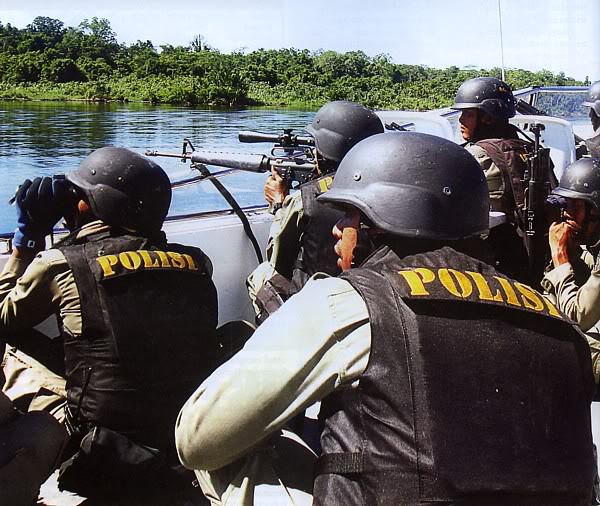
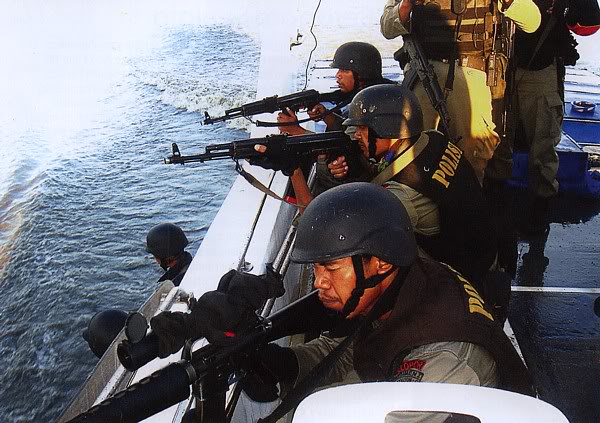
An Indonesian BRIMOB source today (Feb 9) sent West Papua Media these images of personnel from the Pelopor taskforce depicted in the footage above on their way via speedboat to conduct the operation to retake the airfield.  The individual officer in the foreground of the upper image has been identified as the cameraman and narrator of the footage.

West Papua Media apologises for the low-quality of the footage due to it being filmed on mobile phone in low resolution

A higher quality version of the footage is available to media upon application under strict conditions; unfortunately YouTube automatically loses quality during upload.  Please contact West Papua Media for arrangements

Create a website or blog at WordPress.com

Up ↑