Paper by Maire Leadbeater given at the Dynamics of Civil Engagement Conference 27 February, 2012 Southern Cross University, Queensland.
——————————————————————————————————————–
“Dynamics of Civil Engagement Conference: Southern Cross University” Southern Cross Univeristy: 27 February, 2012
Pulling together: Solidarity Work and western aid to the Indonesian police and military.
Not long ago video of a talk given by American investigative journalist, Alan Nairn had me transfixed in front of my computer screen. Alan was one of the journalists who was present at the time of the
Santa Cruz massacre in Dili, East Timor in 1991. The Indonesian military beat Alan severely on that day, which seems to have left him with an undying commitment to expose the crimes of the Indonesian Special Services (Kopassus) and to ferret out crucial information about American support for the Indonesian military.
I think it is worthwhile to summarise some of Alan’s analysis about East Timor’s liberation, the fall of Suharto and the power of the United States in world affairs. He sees the Santa Cruz events as pivotal. First to remind you of what was happening in East Timor just over 20 years ago: the Timorese resistance was trying to come to terms with a bitter let-down –they had been anticipating a parliamentary delegation from Portugal, and were gearing up to use this chance to tell their story and ask for international support. But the delegation was cancelled. Then on 28 October a young student Sebastiao Gomes was killed by armed militia after he sought shelter in the
Motael Church.
Two weeks later on 12 November 1991 following Sebastiao’s memorial mass, a funeral procession proceeded to the cemetery. As their numbers swelled, the emboldened participants began to unfurl pro-independence banners, and to shout ‘Viva Timor-Leste’. They knew that what they were doing was incredibly dangerous but they proceeded anyway under the eyes of the military, and because they chose to keep going, Nairn says, history was changed.
When they reached the cemetery the military simply blocked their escape route, raised their rifles and opened live fire on the demonstrators. Soldiers chased down those who tried to escape and shot them in the back. A list of 271 victims was compiled but the full number of the dead is almost certainly higher as many ‘disappeared’.
What made this event different to all the other massacres that took place was that on this occasion the word got out and the world did take notice. New Zealand lost one of its own – a wonderful young man called
Kamal Bamadhaj, an Indonesian speaker who was there to help his fellow activists as they met with members of the clandestine resistance.
The Santa Cruz massacre and the death of Kamal jolted the New Zealand solidarity movement and it exposed the moral bankruptcy of the New Zealand Government’s East Timor policy – in a nutshell Government sought to appear outraged at the loss of its citizen while at the same time pursuing careful diplomacy aimed at preserving good relations with Indonesia.
In the United States, as Alan Nairn related , the massacre was the catalyst for the formation of the highly effective US East Timor Action Network (ETAN) which is still going like a ball of fire today alongside the more recent West Papua Advocacy Team (WPAT).
ETAN set about lobbying the US Congress about US military funding and within a year they had succeeded in bringing to an end the military aid under the
International Military Education and Training programme (IMET). It took a few years longer before the solidarity network was able to expose other defence funding under JCET Joint Combined Exchange and Training, but this training was also suspended in 1998, not long before Suharto’s fall from power.
In 1998 the students led mass demonstrations calling on Suharto to step down. The military did not gun them down. Why was this? Nairn is convinced based on his interviews with such figures as Admiral Sudono, Suharto’s Security Minister, that the Indonesian soldiers did not open fire on the students on the streets of Jakarta because they feared ‘another Dili’ . Jakarta had established that the US had a limit on its tolerance for violence. Of course it was forced to learn the lesson again a year later when its military laid siege to East Timor after it had voted for independence.
Obviously the solidarity movement can only claim a small part of the credit for East Timor’s liberation. The political and economic upheaval in Indonesia, the growing sympathy of democratic-minded Indonesians and of course the steadfastness of the Timorese resistance must all be factored in. But if solidarity activists had not exposed western hypocrisy in training and supplying the Indonesian military with weapons, there might have been a different outcome.
Interviewed in September 1999 at the height of the crisis in East Timor, Noam Chomsky said: ‘The US government will do something positive- more accurately it will stop doing something horribly negative – with regard to East Timor only if public pressure makes it essential to do so by raising the social costs of continuing to abet the massacre.”
Globally there were massive demonstrations, tens of thousands demonstrated across Australia, human chains encircled the embassies of the UN Security Council members. In Portugal people wore mourning white, and hundreds of Timorese and Portuguese traveled to Spain to demonstrate at the nearest Indonesian Embassy. On 9 September traffic stopped in Lisbon, as thousands got out of their cars to stand in the road to observe a nationwide 3 minute silence.
Then President Clinton delivered his eleventh hour ultimatum to Indonesia: end the violence or invite the international community ‘to help’.
Nairn also pointed out for an American audience, that in the United States in the twenty-first century demonstrators do not get shot. The United States uses its guns, drones and troops against other countries to preserve its interests but at home a civil liberties framework usually prevails. Demonstrators may face tear gas or even arrest but they won’t be killed. The deaths happen elsewhere at the business end of the guns supplied by the United States.
In this part of the world I believe we also have power. If we want to understand how important our region and our governments are to the United States, the official cables released by Wikileaks are very helpful. We know that the
ANZUS Treaty is defunct, and New Zealand will not be reversing its no nuclear warships ban, but that hasn’t really stopped ongoing defence and military cooperation between our three nations.
Instead of ANZUS meetings Australia and the US now hold AUSMIN meetings. When Kevin Rudd hosted that meeting last year he said it marked the 60th anniversary of the ANZUS Treaty and described the meeting as ‘the premier forum for advancing Australia-US cooperation in the Asia-Pacific region and globally.’.
From the Wikileaks cables you can trace New Zealand’s secretive restoration of defence and intelligence ties over 2008 and 2009 and also how US officials upped the pressure as they prepared for an AUSMIN meeting.
So we are definitely part of the same club, even if New Zealand’s actual military and intelligence contribution to the US led may seem small in comparison with Australia. We are part of the Five Eyes or UKUSA intelligence community and we have our own satellite spy base at Waihopai, an integral part of the global intelligence network feeding intelligence to the US National Security Agency (NSA).
Indonesia has had an important place in US strategic plans since Suharto took power in 1965. From that time Indonesia opened up its economy to western investment. US spokespeople talk about the importance of the constructive partnership with the country which has the world’s largest Muslim population, holding it up as an example of moderate Islam and a supporter in combating terrorism and extremism. Indonesia a leading member of the ASEAN group of pro-western nations, and key to US plans to extend its presence in the Asia-Pacific. Now that the cold war is over ASEAN is no longer a bulwark against communist expansion, but it is still held up a political, economic and security counterbalance to the influence of China
It is of course also true that Indonesia offers New Zealand and Australia important trade and investment opportunities. Indonesia ranks as New Zealand’s eighth largest export market, mainly for our meat and dairy products. We have signed an agreement with Indonesia called a Trade and Investment Framework and we import products such as crude oil and timber from Indonesia The balance of trade is in our favour. New Zealand’s Super Fund and some other Crown Financial Institutes invest in Freeport McMoran and in Rio Tinto, Freeport’s joint venture partner.
It isn’t easy to persuade our Governments to put at risk these kinds of perceived or real advantages, but as Alan Nairn pointed out it can be done. The fact that we are closely allied with the United States imposes constraints on our Governments, but they don’t always dance to America’s tune. The most obvious and important New Zealand example being our 1985 refusal to accept port visits from nuclear capable warships.
If Australia or New Zealand did take a stand – whether supporting a referendum, a mediated dialogue process or suspending their defence ties, it would have a significant impact.
When I read letters from the New Zealand or Australian Foreign Minister it is clear that they are following a similar script. These are the phrases that appear in the letters received by our respective solidarity groups:
‘The Australian Government has long supported Indonesia’s territorial integrity, including its sovereignty over the Papua provinces.’ ‘The New Zealand Government is committed to the peaceful development of Papua as part of Indonesia, where the human rights of all citizens are respected and upheld.’ And there is usually a reference to support for ‘the full implementation of the 2001 Special Autonomy Law’.
New Zealand ‘upholds human rights’ by ‘quiet diplomacy’ and ‘constructive engagement’ through aid. In bilateral meetings behind closed doors New Zealand Ministers raise human rights concerns with their Indonesian counterparts. These exchanges can be pointed, but frequently they are amount to little more than ritual expressions that require minimal response from the Indonesian side. At its worst this ‘quiet diplomacy’ is a blatant exercise in collusion
This hasn’t gone unnoticed in West Papua.
Forkorus Yaboisembut, was appointed President of the ‘Republic of West Papua’ at the October 19 Congress and now he and four colleagues are on trial for makar or treason. He is scathing of this refusal of the countries like Australia and New Zealand to confront the issue of self-determination, suggesting that a focus on human rights alone is to define the Papuan people as ‘merely the colonial possession of a foreign power’.
The Indonesian authorities impose tight restrictions on media visits to West Papua, but a new kind of citizen journalism is now asserting itself.and the real state of affairs is becoming better known. ‘You tube’ videos circulate after atrocities to tell the story as no words can. Shocking videos circulated after the events on October 19 when the Jayapura Congress was forcibly dispersed by the security forces. A visiting West Papuan leader showed footage to some of our parliamentarians recently – I thought they would be appalled by the sight of heavily armed police opening fire from aloft their armoured vehicles, but they were also shaken at the sight of civilians being rounded up and forced into crouching postures as they were herded into the middle of the soccer field.
Those events were closely followed by an 8000 strong strike at the Freeport McMoran mine, during which two of the striking workers were killed by the security forces. The news of the strike spread round the world through union and occupy movement circles. In New Zealand a popular glossy magazine, Metro, devoted a long features article to the story of the mine, the strike and New Zealand’s investment in it. In August last year Australian academics and media exposed leaked Kopassus documents detailing the network of spies and informers that support Indonesia’s iron control.
Gradually Indonesia’s giant agribusiness proposal for the Merauke district is also becoming known. The Indonesian President has grand ambitions for the up to 1.6 million hectares project which he hopes will feed Indonesia, and then feed the world. The proposed crops such as corn sugar, rice and palm oil will destroy the fragile ecology, displace the local people and bring vast numbers of new migrant. Indigenous West Papuans are already believed to be a minority in their own land, so it is hardly surprising if a sense of now or never desperation is driving this latest wave of activism.
Are we managing to lever any change?
It is hard to believe that the officials in the Foreign Affairs and Defence Ministries of Australia and New Zealand have not given some thought to the possibility that a West Papua is at boiling point and that their uncritical support for Indonesia may blow up in their faces. After all they were caught wrong-footed by the firestorm in East Timor in 1999.
I have witnessed a few tiny cracks in the last year:
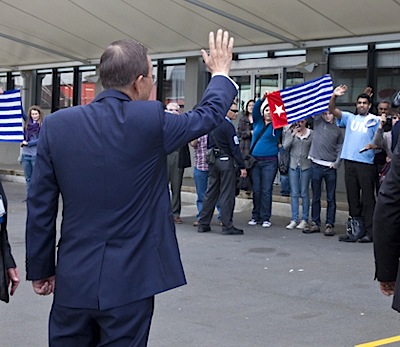
When the Pacific Island Forum met in Auckland New Zealand activists were joined by West Papuan leaders and supportive MPs from the Mana and Green Parties. We ensured that the West Papua issue was under the noses of the Forum Heads of Government. The UN Secretary-General Ban Ki Moon was a guest at the Forum and addressed a public meeting during his time in Auckland. Subsequently a journalist questioned him about our very visible West Papua lobby. He came dangerously close to talking about self-determination: ‘whether you are an independent state or a non-self-governing territory or whatever, the human rights is inalienable and a fundamental principle of the United Nations’. He subsequently clarified that he did not state that West Papua should be placed on the agenda of the Decolonisation Committee, any such call would not be his to make as that was a matter for Member States.
The New Zealand Foreign Minister, Murray McCully is being forced to confront the West Papua issue more often. In August 2010 a very graphic video depiction of the torture of two Papuan farmers was circulating just as Mr McCully was scheduled to meet in Jakarta with his counterpart Marty Natalegawa, so questions were asked. At the time of the Forum, Mr McCully did not make time to meet West Papuan representatives personally but he did instruct his officials to meet with John Ondawame and Rex Rumakiek, and I understand a similar meeting with West Papuan representatives also took place in New York.
I am hoping that this might be an echo of the small shift to acceptance of dialogue or constructive communication on the part of the Indonesian President, Susilo Bambang Yudhoyono. The President’s meetings with outspoken Church leaders in recent months seems a potentially hopeful sign, and will have been noted by western governments.
Over the past twelve years that IHRC has been working on West Papua we have tried hard to find the points of leverage that might prompt our Government take effective West Papua action. Obviously we have not made any amazing breakthroughs, and disappointingly there have steps backward such as the Government’s restoration of military training ties in early 2007. But I think there is some evidence at the very least that officials and politicians are worried., and perhaps we can again draw some lessons from our history of activism on East Timor.
When I probed back through declassified government documents relating to East Timor I found that the officials had been weighing up what we activists were doing and saying. I was surprised to find that we had had more influence than we knew at the time.
To give one example, in March 1995 a military training visit of five Indonesian officers was postponed as the NZ Defence Attache explained:
‘The reason for the postponement is due to increasing interest among the New Zealand public over recent matters in East Timor. In addition to general public interest in all regional and international affairs there is in New Zealand a small but sophisticated and well co-ordinated lobby, sympathetic to the claims of East Timorese exiles, who seek any opportunity to generate anti-Indonesian feeling. It was therefore thought unwise to risk exposing the visitors to the possibility of becoming the focus of media campaigns, demonstrations, petitions etc. at this time.’
Deputy Secretary of Foreign Affairs Neil Walter held a damage control meeting with the Indonesian Ambassador and wrote:
On military contacts/exchanges/exercises, I said this was a matter on which both sides needed to work closely together…It wouldn’t do the relationship any good to present the anti-Indonesian school of thought with large tailor-made pegs on which to hang further protests. Careful management was needed.
So I want to focus finally on New Zealand’s direct relationship with the Indonesian security forces.: the training support we offer to the Indonesian military and a Pilot training programme to the police in West Papua.
New Zealand’s military training for Indonesia largely consists of bilateral officer exchanges: each year an Indonesian officer attends the NZDF Command and Staff College to participate in the Senior Staff Course while New Zealand Defence Force officers attend courses in Indonesia. Recently there has been mention of New Zealand increasing its defence ties with Indonesia by extending the training currently offered to Indonesian officers and hosting higher level visits of Indonesian personnel. Our Government defends this programme on the grounds that engagement with the Indonesian military will promote positive reform, but there is no evidence to support this claim. On the other hand the record shows that New Zealand officials and the New Zealand Minister of Defence at the time (Phil Goff) took the initiative to get the defence relationship resumed, because they considered that this would be in New Zealand’s interests.
A New Zealand Defence Attache commented before defence ties were reestablished: ‘at the moment the New Zealand Indonesia relationship resembled a ‘three-legged stool’ with one leg (ie the defence aspect) missing. In spite of the many reforms that had taken place in recent years, the TNI was still a major force in Indonesian life; without engagement with TNI we could not hope to build a full relationship.’
As far as I know the New Zealand’s police training does not involve improving the lethal or the punitive skills of the officers involved. In fact the community policing model is all about conflict avoidance and working with communities, a positive model of police work. The problem with this training is that we are talking about engaging with the forces of repression. While I believe many of those involved in providing the training sincerely hope their efforts will benefit the West Papuan people and Indonesian civilians, there is limited objective evidence to support this outcome. The risk is always that the New Zealand aid will be co-opted to support Indonesia’s anti-self-determination agenda. After studying the documentation, including reports released under the Official Information Act I believe that this is happening..
The West Papua project: ‘Community Policing: Conflict Resolution in Papua and West Papua provinces’ had ambitious aims: ‘ The project’s purpose was described as enhancing adherence to human rights standards by the INP in the two Papua provinces. ‘ The primary objective of the Project was to contribute to changing the military mind-set of the INP. Anticipated outcomes of the Project were described as ( i) improving human rights (ii) improving security; and (iii) reducing poverty.’
The project began following a request from the Police Area Commander General Tommy Yacobus, in Jayapura in 2006, . Early in 2007 thirty two West Papuan police (only 10 of them indigenous Papuans) attended a workshop in Jayapura at which participants were told how New Zealand police try to build community relations and anticipate and prevent conflict.
The Ministry memos reveal that Jayapura Police Chief had instructions from the National Police Chief to ‘get back the confidence of the community’ following the March 2006 riots. The Police Chief, told the Second Secretary that he wanted to increase the percentage of indigenous Papuans within POLDA Papua which was currently at 4%.,
In late 2010, New Zealand Embassy officials were advised (the name of the Indonesian official they met has been blacked out) that some 1500 Papuan police were recruited in 2009. This would help, the New Zealanders were told, ‘in increasing the effectiveness of policing because of the importance of good information and an understanding of adapt (customary) law and traditions. Police also had a network of informants in every village which allowed for reports of trouble to flow through to Wamena, despite the isolation of many communities, poor roads and absence of communications infrastructure in many areas.’
It is not surprising that West Papuans don’t always welcome the recruitment of indigenous police officers. I am told that the Police have a rigorous interrogation process for potential recruits which ensures that anyone joining up must deny or hide any connection however remote to those who support independence.
The records show, that the Community Policing Initiative had an impact on the Wellington-Jakarta relationship. By September 2008 when New Zealand Embassy representatives visited West Papua they found that Community Policing Initiative had ‘emerged as the centerpiece of New Zealand’s engagement in Papua and West Papua.’
: “In the past Embassy visits to the two provinces have been confined to information gathering. This time it was very different – we had something concrete to offer. That was reflected in the warm reception accorded to us. The NZAID-funded, NZ Police Community Policing (CP) project is now the centerpiece of New Zealand’s constructive engagement approach with Indonesia on the Papua issue. It demonstrates New Zealand is serious in its desire to make a real difference on the ground in the two provinces.”
In fact the Indonesian officials were so pleased with the New Zealanders that an article about the visit appeared in the Papua Pos headed Selandia Baru Menentang OPM or New Zealand opposes OPM. New Zealand officials reassured their hosts that they did not support separatism, but the write up took things a step further. The diplomats wryly recorded later that the article misrepresented the discussions, and their ‘alleged commendation of TNI’.
In 2010 the New Zealand Police commissioned an independent review of its Community Policing programme. When I combed through the lengthy report, I had a growing sense of unease. The first criteria evaluated was ‘strategic relevance’ and the project matched up well, since ‘it is supporting the decentralization efforts of central government through autonomy laws (Otsus).’
‘The Project has strengthened the relationship between the Indonesian and New Zealand police: NZ Police is the only foreign agency that has been permitted to deliver CP training in Papua and West Papua provinces, and NZ Police is the only foreign agency permitted to use serving NZ Police Officers for Project activities in these provinces.’ But who benefits from this close relationship?
The evaluation team struggled with assessing the effectiveness of the project, partly for reasons to do with the lack of before and after data. But they cite a few ‘solid examples’:
“an INP officer said he had employed the skills and approach taught by NZ Police during the training to resolve political unrest in his area, where Papuan nationalists were planning to raise the morning star (the applicable sentence for doing so is 25 years imprisonment). The fact that the training provided a practical tool to assist the INP officer to successfully resolve this issue is a highly effective result for the Project.’
There is nothing to suggest that the NZ Police discussed the right to free expression, let alone any suggestion that they even considered that ‘nationalists’ might have a legitimate claim to genuine self-determination.
The report also looked at risk management and addressed the possibility of personal security risk for the NZ trainers ‘given political stirrings on the ground in Indonesian Papua’ and the ‘risk that NGOs might criticise the Project if training were followed by INP-perpetrated human rights abuses.’ The report says that these risks did not materialise.
This is a bit disappointing since the Indonesia Human Rights Committee has been raising concerns about the police training project since 2008. Our statements have become stronger as we have learnt more about the project. We tie our criticism to human rights reports and other evidence of ongoing police brutality in West Papua, but we concede that we don’t have any evidence that an officer who has participated in New Zealand training has been implicated in a documented instance of abuse.
More recently, Green MP Catherine Delahunty has also voiced her concerns: ‘the road to hell can be paved with good intentions. These policemen appeared to have no context for operating in West Päpua, their focus was on crimes like robbery and alcohol and they made no comment on the lack of democratic freedoms or the need for the West Papuan police to stop colluding with the military in the human rights abuses’
When I visited West Papua in late 2010 I made a point of talking about the police programme, and especially among younger activists, the response to the training was decidedly negative. New Zealand Embassy representatives were in West Papua around the same time, and they also met with civil society representatives, as well as the Governor of Papua, politicians and UN officials. They highlighted the ‘community policing project as a flagship in the province.’ It seems the diplomats did hear some negative feedback about the actions of the police in West Papua and New Zealand engagement, but they rated the overall response to the project as positive.
At the moment, despite the earlier hype, and talk of a second phase, the Community Policing Project has been on pause for two years. From my point of view this is good news. I am just hoping it is because of concerns about violence in West Papua and not because the New Zealand aid budget is being pared down.
I should emphasise that I support New Zealand expenditure on humanitarian aid in West Papua, in fact one of my objections to the military and police training is that it probably edges out constructive programmes. New Zealand offers post-graduate scholarships to up to 50 Indonesian applicants each year. The scheme prioritises students from Eastern Indonesia including West Papua. But a response to a parliamentary question reveals that only two indigenous Papuans were granted post-graduate scholarships in the 2007-2010 period.
I want to emulate Alan Nairn by finishing on a positive note. I believe he is right, solidarity actions can be effective even if we don’t know in advance which actions will be effective. There is a strong case for solidarity work focused on ending military ties and I believe we should widen that to include the police training programmes.
At the elite level Australia, New Zealand, the United States, Britain and Indonesia are tied together in a range of intelligence and defence networks. I believe we could all increase our efficiency and our effectiveness if we did more to work on joint campaigns, and if we shared more research information with each other
Over the years many Papuan leaders have raised the possibility that New Zealand could help to facilitate a peace dialogue for West Papua – drawing on the successful process mediated by New Zealand which helped to resolve the crisis in Bougainville. We weren’t really a neutral party with respect to that conflict either, but we were able to be effective and that also gives me some hope.
Leadbeater, M. (2006). Negligent neighbour : New Zealand’s complicity in the invasion and occupation of Timor-Leste. Nelson, N.Z., Craig Potton Publishing.





 West Papua Media Alerts
