Kontras: SBY must prioritiser the Papuan problem and stop the Escalation of Violence

THE PRESIDENT MUST GIVE PRIORITY TO REACHING A DIGNIFIED SOLUTION TO THE PAPUAN PROBLEM AND TO PREVENTING THE ESCALATION OF VIOLENCE IN PAPUA

There are fears that the prospects for peace in the land of Papua will become increasingly difficult for three reasons. The first is the escalation in the level of violence that has been disrupting the situation in Papua. The second is the total lack of accountability regarding security operations in Papua by the TNI, the Indonesian army, and Polri, the police force., and the third is the ambivalence in the President’s attitude towards the Papuan problem. If nothing is done
about these three problems, it can lead to activities that would be counter-productive for achieving a dignified solution to the Papuan situation.

The first problem, the latest in the occurrence of acts of violence in Papua, happened on Sunday, 21 August when a man named Das Komba, 30 years old, was found dead, having been murdered near his garden. Prior to this, there was information that the TNI in Arso would be holding training exercises near this man’s garden. Two women who usually garden nearby had met several people who were thought to be members of the TNI somewhere near the garden. This led to people in the vicinity becoming very fearful and feeling very unsafe. The killing came on top of a spate of incidents of violence and killings [altogether nine during August] that have occurred in Papua, particularly in the wake of the Papuan Peace Conference .

The second problem relates to the deployment of TNI forces and the role of Polri in Papua. The deployment of troops is not related to any political decision by the President or the Indonesian parliament, the DPR RI, but was promoted by the TNI. Such a political move should be accompanied by a clear mechanism for accountability as provided for in our laws. It is therefore abundantly clear that the security operations by the TNI are illegal and are in breach of the regulations. The government should have learnt from past experience in Aceh and Timor-Leste that the security approach never solves problems but only
intensifies the issues, making any solution even more difficult.

The illegal use of TNI forces also provides more evidence of the weak role of Polri in taking charge of security in Papua. Polri is increasingly showing that it lacks confidence in itself and its incapacity to take charge of security, in accordance with its mandate as stipulated in the Law on Polri. The government should be providing as much support as possible for the role of Polri in safeguarding security for the general pubic with the use of persuasive methods.

Aother problem that is no less important is the recent leak of Kopassus operational documents which drew attention to the huge role of intelligence and to the clarification of the TNI’s active role in pursuing the security approach in Papua.

The third problem relates to the attitude of the government, in particular the ambivalence of the President.  In a series of interviews, the President has spoken about achieving wellbeing for Papua.   But on the other hand, security continues to be the main approach and is not accompanied by any overall correction to security operations that do not promote the safety and sense of security of the people in general.

We therefore make the following demands:

1. The President of Indonesia should hold dialogue with the Papuan people representing all the interests of the Papuan people . This should be done in a dignified manner and should respect basic human rights.

2. The President of Indonesia should adopt a firm attitude to stop all the polemics going on among his ministers and pursue a single policy for Papua. The policy should be directed towards a model for solving the conflict and not just consist of speculations and stigmas.

3. The government should put an end to the continuing acts of violence and killings that have been occurring in Papua and make an evaluation of the presence and deployment of TNI forces, while maximising the role of Polri as the ones who are responsible for security.

4. All sides should play an active part in halting all forms of violence which can only have a negative impact on the peace process which is what the general public wants to happen.

Jakarta, 23 August 2011

Kontras: Commission for the Disappeared and the Victims of Violence

How the Papuan people Continue to Unite in Resistance: Victor Yeimo Interview

http://hidupbiasa.blogspot.com/2011/08/how-papuan-people-continue-to-unite-in.html

[This Interview with Papuan activist Victor Yeimo was published on the
Kontinum website, because of a feeling that little information and
perspectives from the Papuan struggle is available in Indonesia, and so
people outside Papua are not aware of the what is actually going on
there. The original, in Indonesian, can be found at
http://kontinum.org/2011/08/wawancara_victor_papua/%5D

We see Papua’s problems as coming from a combination of problems with
the state and corporations, military violence, ecological damage,
genocide and extinction of indigenous cultures. The Papuan issue is also
a national issue for Indonesia, and one which is not yet resolved. Many
indigenous people are killed and tortured in order to legitimise the
destruction of Papua’s natural riches by the world’s giant companies
together with their closest partners: government.

Constitutional reasons, together with the logic of national unity and a
narrow nationalist view of ‘Indonesianness’ are used to legitimise
repression and oppression of the Papuan people and their land.

But amidst a climate of repression that doesn’t seem to subside, the
Papuan people struggle on, ever-bravely. To get to know the situation
and viewpoint of the resistance movement in Papua, Kontinum interviewed
Victor Yeimo, spokesperson of the West Papua National Committee (KNPB),
one of the people’s organisations that continues the active struggle in
the land of Papua:

Bearing in mind that there is very little and quite selective news about
the Papuan situation and the people’s struggle in the media, could you
explain for all our readers what is the latest situation in Papua?
Human rights violations of civilians by the Indonesian military and
police are still taking place. Global investment has ballooned after the
ACFTA agreement (ASEAN-China Free Trade Agreement), where President
Susilo Bambang Yudhoyono had given instructions to police and military
commanders to use investment as a means of pacifying Papua (see Jurnal
Nasional, 16 May 2011, page 10). China is the home of the majority of
global investors, and the Papuan Provincial Body for Capital Investment
(Badan Penanaman Modal) has reported that there has been a 28% increase
in investment in Papua in the last 6 months.

There have also been cases of malpractice where Indonesia’s bureaucratic
elite have interfered with the governance of Papua. Corruption,
collusion and nepotism have increased due to the central government’s
inconsistency around laws and regulations.

Aside from that, Freeport workers have risen up and have gone on strike
(tabloidjubi.com will have news updates).

Illegal business from the police and military is also on the rise, such
as illegal logging, ,gold panning, bringing sex workers from outside
Papua, dealing in the wood of the eaglewood tree, and so on. Meanwhile
military repression to silence the democracy movement has been getting
more intense, and uses labels such as separatist, terrorist,
trouble-maker and so on.

What do the Papua people think about these situations, and how have they
reacted to them?
The people do not have much power, due to the military strength in
Papua. Meanwhile the government is seducing the people with trillions of
rupiah of foreign direct investment in their ancestral lands, and so in
the end there are many people that do not want to join organised
resistance movements.

The people continue to problematise the history of Papua’s integration
in the unified Indonesian state, which has always been manipulated by
the United States, Indonesia and the Netherlands. Because of that the
people still continue to unite in resistance.

Apart from the problems of history and culture, what is making the
Papuan people refuse Jakarta’s influence in their everyday lives and
want self-determination?
Because Jakarta’s approach is militaristic, exploitative, deceitful and
marginalising. From the beginning right up to the present day Jakarta
has regarded Papuans as second-class people, people close to animals.
And then the next thing they do is that they violate the arrangements
that they themselves have made. They are just not consistent in their
regulations and policy. Policy is also biassed in favour of incomers to
Papua. So the people prefer to think about sorting things out for
themselves. Many Papuans, as a result of all they have gone through,
believe that Indonesia’s sole aim in West Papua is to wipe out the
Papuan people and take control of the territory.

How have government, the bourgeoisie and Indonesian politicians viewed
the Papuan people’s struggle, and what has been their reaction?
They continue to be suspicious of all civil activists that operate in a
legal or democratic way. Indonesia also uses its military force and
criminal law to kill off west Papua’s peaceful movement. They also use
‘divide and conquer’ techniques to destroy the unity and solidarity of
the Papuan people’s resistance. Jakarta has poured a lot of money into
the military, police and intelligence organisations in order to make
Papua secure. Many Papuans have been recruited by enticing them with
money to join the ranks of Barisan Merah Putih (Red and White Front: a
militant Indonesian nationalist civil organisation). Many cases of abuse
by members of the military police have not been brought to justice, and
the perpetrators have even been rewarded with new jobs and promotions.

How have the Papuan people got involved in the struggle for freedom in
Papua? What kinds of resistance have developed?
Papuans take a peaceful and dignified approach, organising
demonstrations, prayer sessions, seminars, writing books or reporting
repression on the Internet. There are also some traditional militant
groups in the national Liberation army – Free Papua Movement (TPN-OPM)
who refer to themselves as a West Papuan military. They continue to use
guerilla tactics to chase the Indonesian army out of their areas.

What is the reaction of Papuan people towards the ‘separatist’ label
that is put on every movement that emerges in Papua?
We’re aware that we aren’t separatists, because the people on the
contrary consider Indonesia to be the separatists, as Indonesia arrived
in 1962 whereas the Papuan state was given independence in 1961.

The people regard this label as one imposed by the people in power, who
are anti-democratic and anti-human rights, as it is stated in the
Indonesian basic law set down in 1945 that colonisation should be erased
across the whole world. The people see this label as something imposed
by the military, to promote their own interests of expanding the
territory under military control in order to profit from securitization
projects. In books, speeches seminars etc. the people continue to state
that we are not separatists, because this land belongs to the Papuans,
it dot belong to Indonesia, the US, Britain or any other country.

How do you see the general Indonesian population’s understanding of, and
response to, the Papuan problem?
Much of Indonesian society doesn’t understand the problems of Papua.
Maybe people have been influenced by the opinion of those in power,
because of the propaganda they spread on TV and in newspapers, that
Papuans are poor, and so on. But actually we’re rich, only Indonesia
keeps marginalising the Papuan people’s rights. The Indonesian people,
with their blinkered nationalism, see the Papuan movements as being
against those in power. But they are also being treated in the same way
by our exploitative, greedy, gun-crazed, corrupt and chauvinist leadership.

For the majority of the Indonesian population, there are very few who
know just how the Indonesian leadership invaded, took over and then
annexed Papua, which was granted independence in 1961, through
agreements to establish Papua’s political status that were devised by
the US, Britain and the Netherlands, without involving the Papuan
people. Most people in Indonesia are still blind to the problems of
Papua and still ignorant of how Papuans have suffered, and so still take
the side of our cruel leaders.

Can you tell us about your organisation, KNPB?
West Papua National committee (KNPB) is a West Papuan people’s medium.
KNPB exists in different places throuout the land of Papua, and also has
consulates in the Indonesian cities of Jakarta and Manado. KNPB was set
up in 2008 with Buchtar Tabuni as chair and Victor Yeimo as General
Secretary. Towards the end of 2006 Buchtar was arrested and condemned to
3 years in prison and Victor undertook the everyday tasks. In August
2009 Victor was arrested and condemned to 3 years in prison. Now the
organisation is operating with Mako Tabuni as Chair I of KNPB, Buchtar
still as General Chair, and Victor Yeimo as International Spokesperson.

KNPB always encourages Papuans to see themselves as historically,
culturally and geographically different to Indonesians. Can you explain
what is the position of KNPB comrades regarding this?
We locate our struggle with the Papuan people. Whatever the people want,
that’s what we fight for. The historical, geographical and cultural
factors are actually like you said. We see that Indonesia’s involvement
in West Papua is no more than a story of protracted repression. This
territory is still like a protectorate. Whatever the people wish for,
that’s what KNPB will mediate as a focus for the struggle, using sincere
means.

What is KNPB’s vision of the “right to self-determination”, in
connection with the Papuan struggle?
Papuans do not regard the test of public opinion that took place in 1969
as final. The people continue to demand the right to determine their own
future. Many Papuans have died as a result of demanding these rights.
Therefore KNPB fights for a referendum as a decisive solution to the
Papuan conflict. This is so that the people can decide whether they want
to continue as part of Indonesia, or if they want independence. In
KNPB’s role as media, it continues to make demands to international
bodies and also appeals to the will of Jakarta so that the people are
given their democratic right to choose their future. Of course we need
the reinforcement of international solidarity, and to this end there is
a group of international lawyers working to investigate the status of
Papua and resolve it through international law.

What sort of Papua do the Papuan people themselves want?
A Papua that is free of all forms of repression: Indonesian
neocolonialism, neoliberalism/ global capitalism and militarism.

How do Freeport and the other corporations that have established
themselves in the land of Papua react to the people’s struggle there?
Freeport collaborates with the Indonesian leadership. They both look
after their economic and political interests in the same way. That means
that they label anyone who doesn’t accept the presence of these
corporations as separatists and terrorists. Freeport takes a line
opposing the Papuan people’s struggle, because in their view it will
harm their capital investments and vital assets.

What is their connection with the Indonesian government and bourgeoisie?
Freeport continues to deceive Indonesia and the Papuan people, but
Freeport wants Indonesia to continue as guarddog of its assets. So
Freeport keeps paying the military and Indonesian bourgeoisie to ensure
guaranteed security and legal favour. Papuans get nothing meaningful
from this arrangement.

What are the priority needs right now for friends involved in the
struggle for freedom in Papua?
-We really need the solidarity of oppressed people wherever they might
be, including people in Indonesia, to work together to chase all forms
of repression out of Papua.
-We really need solidarity from friends in the national press to take
the side of the Papuan people in their reportage.
-We really need consolidation at the national level to shape a
definitive solution for the Papuan people.
-We need some means of production that can be used to protect ourselves
against the ongoing siege of repression in the land of the bird of paradise.

What sort of solidarity do the Papuan people need? And what can friends
from outside Papua do to help the Papuan people’s struggle?
-We would like it if the Papuan issue was regularly discussed by friends
outside Papua.
-We would wish for some sort of national consolidation to discuss and
establish strategy and tactics for a joint resistance.
-We also need advocacy, economic and political information and reading
material that could help us be active in the field.

Thank-you, and respectful greetings to all Papuans in struggle.

KomnasHAM-Papua condemns recent violence and makes recommendations

Bintang Papua. 15 August 2011

Jayapura: Komnas HAM, the National Human Rights Commission has condemned the brutal actions by unidentified people against innocent civilians as well as members of the security forces.that have occurred since June in
the province of Papua.

The chairman of Komnas HAM’s office in Papua, Julles R.A Onggen SH, together with other members of the commission called a press conference to discuss the security situation in Papua. They said that the significant increase in acts of violence was very worrying indeed, particular because of its impact on the need to safeguard peace in Papua.

They made the following points and recommendations:

First, they strongly condemned the many acts of violence perpetrated by unidentified persons towards the civilian population and members of the
armed forces acting in the course of their duties.

Second, they called on the police to take action speedily and objectively in accordance with the laws in force regarding acts of violence, while at the same time not forgetting to use the cultural approach in accordance with the terms of special autonomy to minimise these acts of violence.

Third, the Commission has set up a joint team consisting of the Komnas HAM, the DPRP, the provincial government of Papua, local governments, the churches and NGOs to investigate these acts of violence, each making their own specific contribution.

Fourth, it called upon all sections of the community to remain calm, not to be provoked, to live peacefully together, respecting each other in order to safeguard security.

Fifth, to request the military commander of Kodam XVII to clarify the issue of the KINGMI Church and it will set up a team to investigate the matter.

Sixth, in accordance with the provisions of article 34 of the Constitution, the Commission will seek the commitment of the national government as well as local governments to provide social security for the dispossessed, the poor, the street children and the unemployed people.

Seventh: in connection with the sixth point, to call upon the provincial government to put this into practice in accordance with the special autonomy law.

Other points dealt with the recognition of collective rights, including the need for peace, for development and for a healthy and clean environment. The provincial government should also ensure that civil and political rights are safeguarded, such as the right to compensation for those whose rights have been violated, freedom of thought and freedom of religion.

It also called on the provincial government to safeguard people’s economic, political and social rights, freedom from fear and impoverishment and from racial discrimination, the right to get a job with a decent wage.

Acts of violence are damaging the Papuan people, says DPD member

Bintang Papua, 8 August. 2011

Sofia Popy Maipauw, a member of the DPD, the Council of Regional
Representatives, said that the recent upsurge in acts of violence that
have been occurring in the Land of Papua can be very damaging for the
Papuan people and called on those who are responsible for all this
violence to stop.

She said she doesn’t want to mention any names but insists that all
those involved in violence should stop. The incident in Ilaga, district
of Puncak Jaya and the Nafri incident in Jayapura have been very
harmful for indigenous Papuan people. These incidents have had damaging
consequences for the economy. People living in the kampungs are afraid
to come to the markets to sell their products, which can result in an
increase in the price of these products, she told journalists in Jayapura.

She went on to say that the indigenous Papuan people are much weaker
economically than other people in the province which means that these
acts of violence can be very burdensome for them.

‘I would like to know what the state intelligence agency, BIN, has been
doing all this time. The recent shootings in Papua are not the first
time such things have happened. They keep on happening but no action has
been taken against those responsible,’ she said.

She said that in November last year, a similar incident occurred in
Nafri but no one has been arrested and held to account for this
incident. Incidents like this, she said, give the Papuan people a very
bad reputation. Such stigmas must end so that Papuans can feel
comfortable as part of Indonesia.

She went on to say that SBY, the president, should not keep silent about
problems in Papua but should take action to prevent these incidents from
occurring and ensure that these incidents are dealt with seriously. She
said that this was a huge challenge for the new chief of police who
should take action regardless of who is involved. ‘The acting governor
of Papua should take responsibility for safeguarding the forthcoming
local elections. He should cooperate with the Elections Commission (KPU)
of the province of Papua to deal with any violations that occur during
the elections,’ she said.

Empty promises whitewash Freeport’s rights, responsibility record

 http://etanaction.blogspot.com/2011/08/empty-promises-whitewash-freeports.html

Special for ETAN‘s  Blog

by David Webster

What does a mining company need to do to get a top score for “corporate social responsibility”?

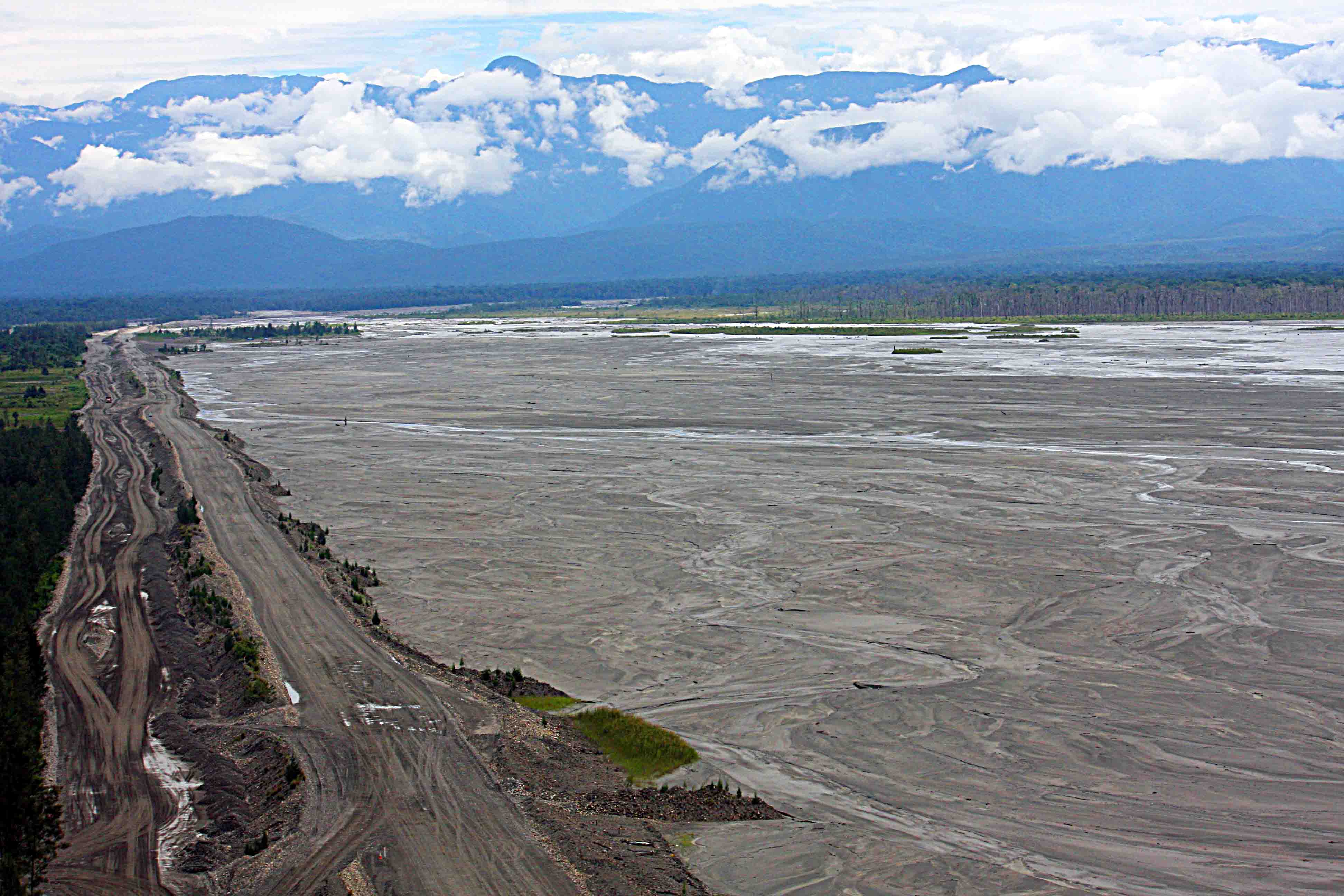
Freeport's contribution to Papua's welfare - Riverine tailings pollution

To judge by the recent “100 Best Corporate Citizens List”, all it takes to finesse a long and controversial record of human rights abuses is to come up with a piece of high-minded rhetoric, then carry on as usual.

Human rights advocates and those who have studied the record of Freeport McMoran in West Papua were startled to learn that Corporate Responsibility Magazine had named Freeport as the 24th-best corporate citizen in America (click for the full list). More startling still, the company scored well based mainly on a sixth-place ranking in the human rights category.

How is this possible? Well, the survey’s methodology seems to pay no heed to human rights performance. Only human rights rhetoric matters. And in that, Freeport excels. A strong written policy on human rights declares: “Freeport-McMoRan does not tolerate human rights transgressions.” It points to rights risks in West Papua, Peru, and the Democratic Republic of Congo, and adds that PT Freeport Indonesia policy is to “notify the direct commanders of the perpetrators” in cases where human rights allegations are made against Indonesian security forces. Since reputable human rights groups suggest that the top ranks of the security forces are implicated in widespread human rights violations in West Papua, this is hardly striking at the root of the problem.

As local people have pointed out, and researchers have confirmed, Freeport’s performance is a far cry from the written policies. The main trouble is intimate ties to Indonesian security forces.

Security forces may be implicated in the murder of American citizens near the Freeportmine, as Eben Kirksey and Andreas Harsono have reported.

Violence around the mine is used by security forces to target and scapegoat local people. In 2005, the New York Times revealed thatFreeport paid the security forces more than $10 million in 2001 and 2002. Payments are now made “in-kind” rather than in cash. The local Amugme people have long protestedFreeport seizure of their lands. Pictures of Freeport’s Grasberg mine from space (left) show the scale and environmental impact in the mountains that are home to the Amungme.

And lest all of this be hailed as “old news,” the Amungme filed a lawsuit last year sayingFreeport had taken their lands illegally. Meanwhile, the Indonesian army’s presence around Freeport, and the company’s close ties to Indonesian security forces, were reinforced this year. The continuing alliance between Freeport Indonesia and the Indonesian security forces is likely to exacerbate, rather than improve, the human rights situation.

None of these reports are taken in to account in the “100 Best Corporate Citizens List.” All the human rights indicators measure “human rights disclosure” and the sole source, according to the methodology details, comes from “Company public disclosures” – a corporation’s own information about itself.

The methodology, in other words, measures promises, not performance. There are parallels to the debate over whether companies accused of operating sweatshops overseas can be trusted to police themselves, or should accept independent monitoring. Thus the list cites the voluntary “Sullivan principles” first created under the Reagan administration and welcomed by companies resisting demands to divest from apartheid South Africa. AndFreeport boasts of adherence to the Voluntary Principles on Security and Human Rights, launched by the British and American governments in 2000.

The key word here is “voluntary.” As with the mining industry globally and with businesses jumping on the corporate social responsibility (CSR) bandwagon more generally, companies are happy to promise good performance, as long as no one will be looking over their shoulders.

So perhaps it’s no surprise to learn that Corporate Responsibility Magazine is in fact published on behalf of the Corporate Responsibility Officers Association, a body made up of many of the companies being judged, and steered by such firms as Domtar and KPMG.Freeport is listed as a “recent member” of the CROA. It’s advanced in the listings – it was ranked 83rd in 2010.

The problem here isn’t just the “corporate social responsibility” methodology, but the entire concept of “CSR”. It can all too often be used by companies to buy their way out of “corporate social irresponsibility.”

Freeport is no champion of the best values of corporate citizenship: For human rights activists, it’s long been a poster child for corporate irresponsibility. A list of good corporate citizens with Freeport winning laurels demonstrates more than flaws in the study. As George Monbiot has written of climate change credits, the lists offer corporations a new form of medieval European Catholic “indulgences,” forgiveness for any form of offence. Jeff Ballinger recently pointed out on this blog that companies like Nike are wrapping themselves in the CSR garment to burnish their corporate images, despite continuing disregard for many labor rights. Freeport, too, is now having itself measured for a fine CSR wardrobe.

—-

David Webster is an assistant professor of International Studies at the University of Regina inSaskatchewan, Canada. He is a former coordinator with the East Timor Alert Network/Canada.

see also

West Papua Report (monthly)

ETAN/WPAT: Statement on the operations of the Freeport McMoran Mine in West Papua, to the U.S. Senate hearing on Extracting Natural Resources: Corporate Responsibility and the Rule of Law

Create a website or blog at WordPress.com

Up ↑