Video Testimony of Torture Victim Tunaliwor Kiwo

Video Testimony of Kiwo

(Subtitle – English)

From Dewan Adat Papua via EngageMedia.org

In this video West Papuan farmer Tunaliwor Kiwo recounts the details of his torture by Indonesian soldiers on May 30 2010. Indonesian soldiers arrested Kiwo and his neighbor Telangga Gire on May 30 in Papua’s Puncak Jaya regency. This video was shot on October 23, 2010 and released by the Papuan Customary Council. Kiwo describes the torture he suffered for 2 days before escaping from the soldiers on June 2.


Related content

* News Item Transcript of Kiwo’s Torture Testimony (English)
* Video Torture of Tingginambut men (Papua) – English Subtitles
* Video Video Testimony of Kiwo (Subtitle – Bahasa Indonesia)
* News Item Transcript: Tunaliwor Kiwo Testimony (Bahasa Indonesia)
* Video Kiwo Testimony, High-res, no subtitles

Full Description

After the public release of the torture video the Indonesian government promised to investigate but now claims it cannot identify the perpetrators and is dragging it’s feet on taking action.

In the 10-minute torture video previously released to the public on October 18, soldiers are seen kicking Kiwo’s face and chest, burning his face with a cigarette, applying burning wood to his penis, and placing a knife to Gire’s neck. Indonesia is party to the UN Convention Against Torture and has strict obligations to promptly investigate and prosecute all incidents of torture and to ensuire that victims and witnesses are protected against all ill-treatment or intimidation as a consequence of any complaint or evidence given.

Copyright 2009, by the Contributing Authors. Cite/attribute Resource. dewanadatpapua. (2010, November 19). Video Testimony of Kiwo (Subtitle – English). Retrieved November 23, 2010, from EngageMedia Web site: http://www.engagemedia.org/Members/dewanadatpapua/videos/kiwotestimony_en.

This work is licensed under a Creative Commons License

Indonesian soldiers receive 5 month prison sentences for torture that shocked the world; human rights groups label trial a ‘farce’

AFP
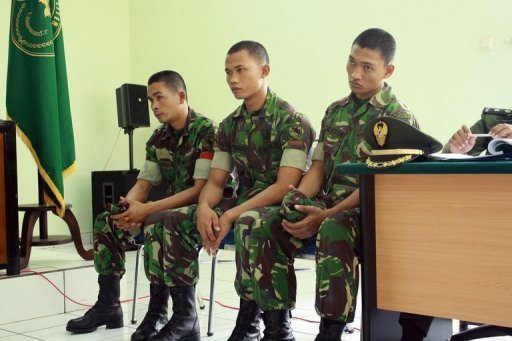
Indonesia on Thursday sentenced four soldiers to between five and seven months in jail for “minor disciplinary infringements”, after they were filmed abusing Papuan civilians.

The soldiers sentenced were not those filmed burning an elderly Papuan man’s genitals, but ones captured kicking a group of villagers around the head. The soldiers involved in the more horrific footage have not been located, leading to human rights groups demanding an international enquiry into allegations of widespread torture across West Papua.

A military tribunal gave three privates five months each for breaching the military code of conduct and their platoon commander seven months for allowing the abuse to occur.

“The defendants kicked the detainees’ heads and backs and hit their heads with helmets,” chief judge Lieutenant-Colonel Adil Karokaro told the tribunal in Papua provincial capital, Jayapura.

The sentences were heavier than military prosecutors’ recommendation of three months.

Critics of the Indonesian military say the case would never have gone to court had a video of the abuse, which occurred in the Punjak Jaya area of Papua in March, not appeared online.

Human rights workers labelled the trial a farce after senior military officials said it would deal with soldiers involved in the gruesome and far more serious torture of two Papuan detainees in May.

A video of the May incident also found its way to human rights workers, who released it online ahead of visits to Jakarta by the leaders of Australia and the United States, two key backers of the Indonesian military.

Indonesian President Susilo Bambang Yudhoyono promised “no immunity” for the perpetrators but no charges have been laid.

Human rights activists accuse the Indonesian military of killings, murder, torture and abuse of Papua’s ethnic Melanesian majority.

Papuan separatists have fought a low-intensity war for independence for decades, claiming that a vote by a small group of tribal elders which ceded the massive territory to Indonesia in the 1960s was a sham.

Peaceful Papuan political activists are regularly given lengthy jail terms for crimes such as possessing outlawed rebel flags. One such person is Filep Karma, currently serving a 15 year jail sentence for his part in a peaceful flagraising ceremony.

PAPUA STUDENTS: Freeport should close; US must be hed responsible for Crimes Against Humanity

image

image

image

PAPUA STUDENTS ALLIANCE (AMP)


PRESS RELEASE

Freeport McMoRan copper and Gold should be closed down and the United States should be held responsible for crimes against humanity and against the environment in Papua.


(JAKARTA, 09 November 2010) – The history of Papua is a history manipulated by the political and economic interests of other countries, especially the United States which eventually encouraged Indonesia to carry out the annexation of West Papua.  The political process that occurred prior to the implementation of the 1969 Act of Free Choice is a process in which the ideological interests of the world played an important role in the process of the history of Papua.  The Capitalist Bloc (the West) led by the United States and the Socialist Bloc led by the Soviet Union played a major political part in the political bargaining which led to the decisions concerning the political fate of the Papuan people up until today.

On the one hand there was the United States which played a role in cutting off political access of the Dutch Government to its colony in West Papua and in encouraging the Netherlands to accept a project of political diplomacy drafted by American diplomat, Elsworth Buncker, which resulted in the so-called Buncker plan in which important political concepts were drawn in relation to the right to self-determination of the West Papua people.  The Buncker plan was at the origin of the famous document known as the New York Agreement (NYA) signed by the Dutch and the Indonesians, under the auspices of the United Nations, which established the technical principles regarding the implementation of a process of consultation of the people on their right to self-determination.  This so-called Act of Free choice (Pepera) took place in 1969 and it was unfair, undemocratic and highly discriminatory towards the people of Papua.

In addition to playing the role of political diplomacy in the Western Block, the United States was also acting out of personal economic interests in order to safeguard its access to the natural resources in West Papua, an area extremely rich in natural gas, mining deposits, minerals, petroleum, forest products, fishery, plantations  and a number of other economic resources which proved to  be very profitable for the interests of the exploitation of foreign capital, especially for the United States, in Papua.  Evidently, the economic interest is Freeport McMoran Gold & Copper, with its basis in New Orleans, one of the largest mining company in the United States, a company which would later cause great problems concerning the political rights of the People of West Papua.  The political intervention of the United States and its behavior towards the Netherlands resulted in an insignificant political support from the Dutch with regard to protecting the right to self-determination of the people of West Papua.   Also the backing by the United States of the clique within the Indonesian army between 1965 and 1966 which facilitated the coming to being of the New Order authoritarian militaristic regime under the leadership of General Suharto, had as a direct result the annexation of West Papua, turning it into a colonized area for economic purposes, as well as a killing field where gross human rights violations were and still are perpetrated by the Indonesian army, an area fully controlled by the United States and the economic interests of the capitalists.

It is common knowledge that the Freeport company funds the Indonesian military with billions of rupiahs to secure the exploration area of PT. Freeport. In a report from the New York Times entitled “The Cost of Gold, The Hidden Payroll: Below a Mountain of Wealth, a River of Waste” (27 Dec 2005)  it is clearly described how much dirty money is received by high-ranking Indonesian military.

Over the past 32 years of control over Papua by the militaristic regime of Suharto, there have been numerous cases of violations of human rights as a result of many Military Operations conducted in Papua.  This situation did not stop after the period of reform in Indonesia in 1998. Regime change was not accompanied by fundamental changes to the system in Indonesia. Evidence of continuous gross human rights violations by the Indonesian military forces up until today can be seen, as two torture videos were circulated on the Internet some time ago.  These two films depicting scenes of torture were published by the Asian Human Rights Commission (AHRC), based in Bangkok, through the Youtube site. A few days later, after meetings with President Yudhoyono at the State Palace, Co-ordinating Minister for Political, Legal and Security Affairs, Djoko Suyanto, confirmed in front of reporters that gross acts of torture had indeed been perpetrated by members of the military, on two civilians who were suspected of being members of the Free Papua Movement (OPM) in the District of Puncak Jaya, Papua. These cases of torture were committed by the Indonesian army, which has long established ties with the American Government in the field of military cooperation.

Considering the complexity of the problems in which Papua finds itself today, where there is no recognition of the democratic rights of the people of Papua, the Papuan Students Alliance states its position as follows:

1. Freeport McMoRan copper and Gold in the land of Papua should be closed down immediately and the United States should be held responsible for crimes against humanity and against the environment in Papua.

2. We demand that the Government of the United States, the United Nations and Indonesia be held accountable for the political conspiracy surrounding the 1969 so-called Act of Free choice, which was in effect a miscarriage of justice and morality, an act full of intimidation and manipulation.

3. We strongly call on the termination of the bilateral military cooperation between the United States and Indonesia.

4. We demand that there be a thorough and comprehensive resolution of all cases of human rights abuses.

5. We demand the withdrawal of the organic and non-organic military troops from Papua.

6. We demand the implementation of the right to self-determination or a referendum for the nation of Papua.

We raise these issues in our statement to the American government, Indonesia, the United Nations and all parties associated with the dark history of the Papuan people to date, so that they may address these matters of concern in an urgent manner.


Jakarta, 9 November 2010

General Coordinator

Rinto Kogoya


Action PR

Okto: 082112808445


British taxpayers money used to sponsor degree course attended by members of TNI

A letter sent from the UK Foreign Office to human rights group Tapol has revealed that British taxpayers money is being used to sponsor a Master’s degree course in Defence and Security Management, attended by members of the TNI. This revelation comes hot on the heels of footage showing TNI members attacking villagers in West Papua, amid reports of widespread abuse by them in the province.

Foreign and Commonwealth Office
South East Asia Pacific Team
King Charles Street London SW1A 2AH
1 November 2010
Dear Mrs Budiardjo,
Thank you for your letter of 19 October to the Foreign Secretary about Papua. We are aware of the incident referred to in your letter and have seen some excerpts of the video footage.

We immediately raised our concerns about this case with the Indonesian authorities, in London with Ambassador Thamrin and in Jakarta with the President’s Foreign Policy Adviser. We have expressed our hope that there would be a full and transparent investigation into the incident and that those responsible would be held accountable.
We have encouraged the Indonesian Government to respond constructively to allegations of human rights abuses, and welcome the Indonesian military’s admission of wrongdoing in this case. We hope that details of the investigation will be made available to the international community.
We continue to stress to the Government of Indonesia that if there is credible evidence of wrongdoing, it should be investigated and those responsible brought to justice.
We believe that the best way to encourage further progress within the Indonesian armed forces is through constructive engagement and the delivery of appropriate training. This has included regular Indonesian placements on MOD flagship courses (e.g. Royal College of Defence Studies, Advanced Command and Staff College), regional training focused on Peace Support Operations and maritime/border security, including an annual Exclusive Economic Zone monitoring course, ship visits and senior level engagement.
The Ministry of Defence (MoD) sponsors a Master’s degree course in Defence and Security Management, delivered by Cranfield University, at the Defence University in Jakarta. This course has been very successful over the last 4 years and many of the students are from members of the TNI. The MoD also supports development of the TNI in human rights by offering training in the Law of Armed Conflict.
Yours sincerely
N Atmore
Indonesia Desk Sout East Asia Pacific Group

IHRC: Freeport must show respect for Komnas HAM

Press Release by the Indonesian Human Rights Committee for Social Justice (IHRC)

A forum which was to be mediated by the National Human Rights Commission 
- Komnas HAM - involving four customary clans which form part of the 
Amungme people, along with the copper-and-gold company Freeport, which 
should have taken place on 18-19 October 2010 could not take place as 
planned because Freeport showed ill-will towards the event and said that 
it would not attend. The company simply sent the convenors a letter on 
18 October suggesting that the event should be postponed till 15 
November 2010.

At a meeting which took place on 19 October, Freeport only sent members 
of their staff, so Komnas HAM  decided to re-schedule  the mediation 
forum till 27 October at 9am, at its office.

In view of these developments, the IHRC wishes to state the following:

Freeport has shown disrespect and ill-will towards an institution of the 
Indonesian Republic, namely Komnas HAM, as well as disrespect for the 
legal system of this country.

Freeport has shown ill-will and disrespect for the dignity of the elders 
of the Amungme and Kamoro people and towards the directors of Lemasa and 
Lemasko, the bodies that represent those who hold customary rights over 
the land that is being used by Freeport.

Komnas HAM should act seriously and speedily in its efforts to resolve 
the dispute between Freeport and the Amungme and Kamoro people by 
convening a Mediation Forum on 26 October to be attended by the 
leadership of Freeport and the leadership of Komnas HAM, in order to be 
able to reach a peaceful, democratic and dignified resolution that 
ensures justice for the victims. If the mediation forum on 26 October is 
a failure, the Amungme people who live in mountains and the Kamoro 
people who live along the coast will organise a peaceful mass action 
which will take the form of a boycott of all the products of Freeport.

Jakarta, 26 Octoebr 2010
Executive Committee of IHCS

Gunawan, Secretary-General

Ecoline Situmorang, Chairperson


Create a website or blog at WordPress.com

Up ↑