SIGHTS AND SOUNDS FROM THE FREEPORT DISPUTE

by Lococonut

via our partners at EngageMedia.org

A snippet of footage and chatters around the Freeport strike in West Papua. The Freeport workers’ union says it is a matter of simple “revenue transparency”, the international trade union says the dispute “has nothing to do with” West Papua politics, and a worker recorded in his video testimony that the walk-out was something “important” and worth keeping.

 05:36
video information
produced by Lococonut
produced Nov 04, 2011
FULL DESCRIPTION

The Geneva-based International Federation of Chemical, Energy, Mine and General Workers’ Unions (ICEM), its Australian affiliated group Australia’s Construction, Forestry, Mining and Energy Union (CFMEU) and the Freeport Indonesia Workers’ Union, SP KEP SPSI, met in Jakarta from October 30 to November 2, 2011.

In this video, SP KEP SPSI was represented by Airan Koibur, ICEM was represented by Information and Campaign OfficerDick Blin, and Wayne McAndrew spoke for the CFMEU.

Freeport strike: Police accused of siding with Freeport. Union given one-day ultimatum

Bintang Papua, 31 October 2011
[Abridged in translation by TAPOL]Timika: The actions taken by the police in Mimika have created the impression that the police are siding with Freeport-Indonesia, said a commissioner of Komnas HAM, the National Human Rights Commission, Ridha Saleh. In an interview with Kompas, he said that the police have warned that firm measures are being planned against the strike and the blockade set up by Freeport workers if  the blockade is not lifted within two days.

‘The measures being planned by the police reinforce the impression that, along with the money being paid by Freeport to the security forces, they are siding with the company,’ he said.

Ridha said that there was nothing unconstitutional about the strike and therefore workers should not be dispersed. The police in Mimika are going too far, he said. These measures would also  damage the negotiations now under way between the two sides  which are currently proceeding well.

‘We intend to talk to the police and ask them to abandon these measures. We also intend to speak to the national chief of police and the chief of police in Papua.’

The strike which started on 15 September is intended to persuade the company to pay attention to the welfare of the workers. The increase in wages offered by the company is not acceptable, in view of  terrain in which they work and the risks involved.

Police ultimatum to the workers:

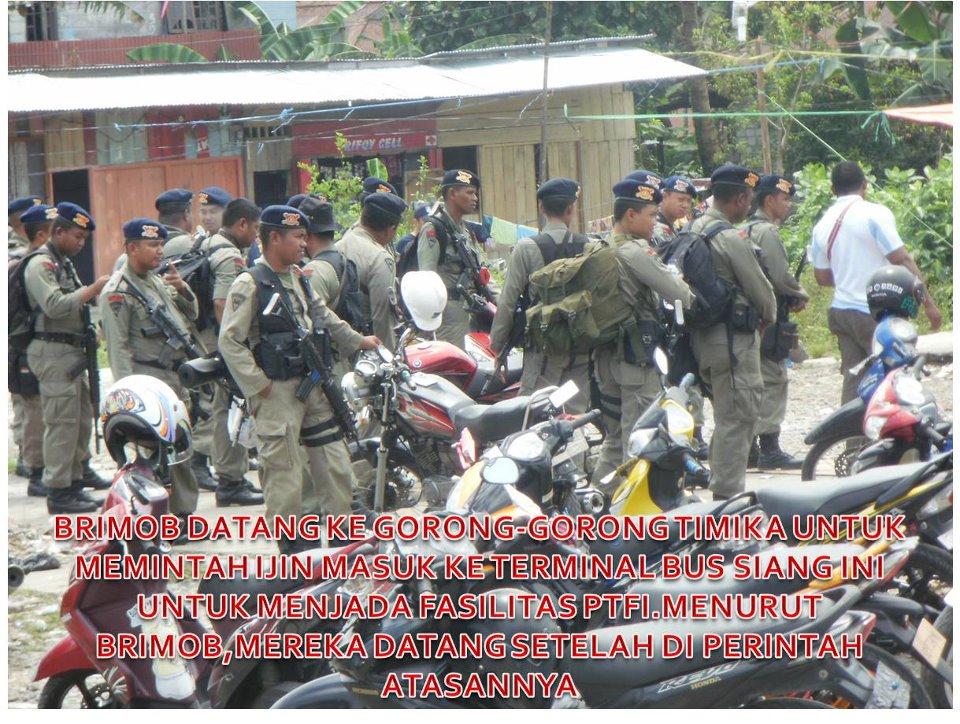
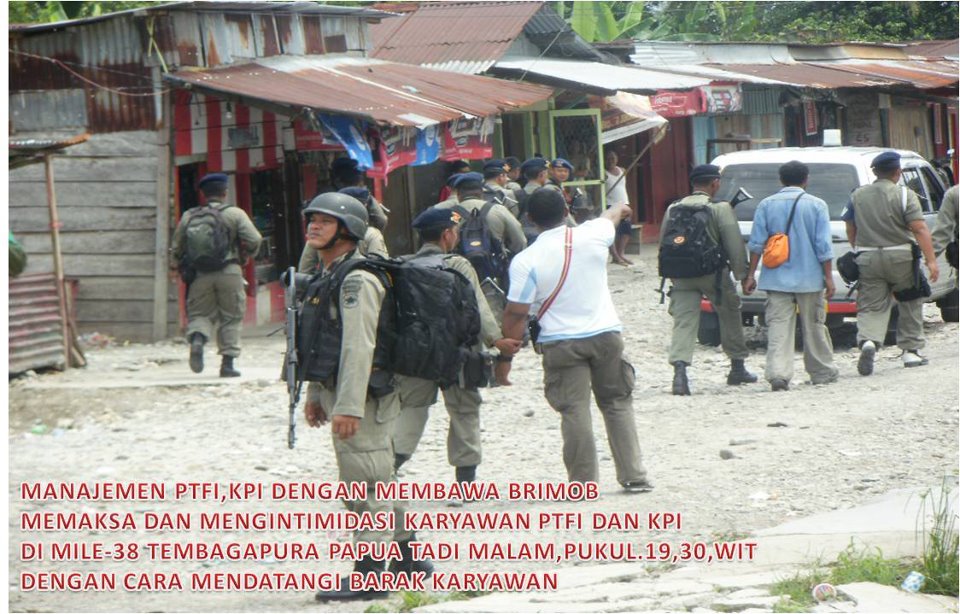
The executive of the Freeport branch of the trade union, the SPSI, have been given an ultimatum by the police in Mimika, not to spread the strike to Mile 28, Mile 27 and Gorong-Gorong. The ultimatum was contained in a letter dated 30 October, along with a request to open access  which has been blocked by strikers. The police along with other security forces have given an ultimatum of only 24 hours, starting from the moment this request is made, for the strikers to conform with the regulations in force. ‘If this does not happen, the police will take firm action in accordance with the regulations in force,’ the letter from the police says.

The SPSI was also told to co-ordinate with the strikers  and ensure that the laws in force are not violated.

According to the police, the basis for these measures is the Criminal Code, Law 9/1998 on Freedom of Expression and Law 13/2003 on Labour Relations.

The chief of police in Mimika has also said that conditions  in the vicinity of Freeport-Indonesia are becoming less and less conducive  as a result of the strike which is, according to the police, being conducted in violation of the earlier notification given by the trade union.

According to the police, a number of anarchic actions have occurred in violation of strike regulations. Moreover, the workers have started holding demonstrations  without having informed the police, blocking access to a ‘vital national asset’ and disturbing the public order. [The police ultimatum goes on  mention a long list of laws and regulations which are deemed to have been violated by the strikers.]

The police ultimatum to the SPSI has also been sent to the governor of Papua, the chairman of the Mimika DPRP, the commander of the Cenderawasih Military Command, the President-Director of Freeport and other relevant agencies.

Journalists protest over reporter beaten up in Freeport mine clash

Tabloidjubi, with PMC

Leo WandagauLeo Wandagau … wounded in a separate Freeport mine clash when security forces opened fire. He died later in Timika District Hospital. Photo: Jubi

Pacific Scoop:
Report – By a special correspondent in Timika

Dozens of journalists have demonstrated in Manokwari to protest in solidarity with a colleague who was allegedly beaten up by workers of  Freeport-McMoran during a clash in Timika, Papua, as tension worsens at the giant Grasberg copper mine.

Duma Tato Sanda, a journalist working for Cahaya  Papua, suffered from bruises and swelling  in his cheeks, lips and his waist and was punched in the chest.

Sally Pelu, coordinator of the Papuan People’s Solidarity Action for Press Freedom, said:  “Journalists are continually being subjected to acts  of violence and there is no guarantee that we can do our work of  gathering information freely.”

The journalists condemned the violence used against their colleague and called on the DPR, the central legislative council, to support the right of journalists  to conduct their work freely.

The journalists met a member of the DPRP West Papua, Jaxat, who apologised for the fact that many members of the DPRP were absent, because they were involved in other activities.

According to reports, Duma also lost his camera, handphone and motor-bike which were all seized by Freeport workers.

“They beat me , grabbed my camera and took my motorbike,” said Duma.

Trucks burned
When he was attacked he was gathering information about the burning of three trucks belonging to Freeport which had been set on fire by Freeport workers.

The trouble occurred after people heard that three of  their colleagues had been shot dead during a demonstration.

“I said that I was a journalist but nevertheless they beat me and threw stones at me.  Luckily, someone came by on a motorbike otherwise I could have been killed from being beaten by so many people.”

He wadded that he was later chased by about ten people – “my sandals fell off while some people pelted me with stones”.

Johannes Samuel Nussy, the chairman of the Timika Community of  Journalists, also condemned the acts of violence against Duma and said that another journalist working from Radar Timika, Syahrul was also attacked by Freeport  workers in Gorong-Gorong, Timika and was bruised in his face.

“They beat me because they didn’t want journalists to be there.” he said.

Freeport ‘relationship’
According to  Nussy, some journalists in Timika have formed a relationship with Freeport.

“They [the protesting workers] see the work of journalists as  something threatening. They say we are defending Freeport, which is not true. We hope that the workers trade union can urge their colleagues
not to see journalists as a threat.”

The independent Papuan tabloid Jubi reported that Leo Wandagau, victim of a separate clash between security forces and Freeport workers in Gorong-gorong Terminal on October 10 died on Saturday in Timika. He was shot by security member during the riot.

Wandagau was shot in his back (see picture) and treated in Timika District Hospital. Beside Wandagau there are several others who were also wounded in that clash. They are Melkias Rumbiak (36), Ahmad Mustofa,  42; Yunus Nguvuluduan; Charry Suripto, 35; Philiton Kogoya, 34; Alios Komba, 26; and Rudolf Rumbino.

The Workers Union (PUK-SP-KEP-SPSI-PTFI) told Jubinews by email that the family of Wandagau had not given any approval for autopsy.

They said Wandagau looked alright and not in critical condition in the video shot when he was admitted to hospital.

There might be other causes on his death, the family stated which was quoted by the union in their email.

The Freeport mine management did not release any explanation over the shootings.

Spokesman Ramdani Sirait  said nothing about the incident until Jubi reported the news.  (Reported by Victor Mambor, translated for the PMC by Sony Ambudi)

Media freedom report
Meanwhile, Pacific Scoop editor David Robie, who is director of the Pacific Media Centre, today spoke to Radio Australia’s Pacific Beat about the threats to media in West Papua.

A new Pacific media freedom report by the centre’s Pacific Journalism Reviewsays repression in the province has now also reached the news media.

It adds that violence against journalists in West Papua has replaced censorship in Fiji as the most urgent media freedom issue in the region.

“We made a particular feature of West Papua, although, of course, there are major sections in the report that deal elsewhere with Fiji and Vanuatu, in particular, that are ongoing freedom concerns,” Dr Robie said.

The report was co-authored by Pacific Media Watch editor Alex Perrottet and Dr Robie with assistance by West Papua Media’s editor Nick Chesterfield and other journalists, including Giff Johnson, Bob Howarth and Nic Maclellan.

Source: The alternative Papuan tabloid and news portal Jubi.

Pacific media freedom report on West Papua

West Papua new Pacific media black spot

Journalists assaulted in Freeport mine strike

Journalist covering events around Freeport is beaten and injured

JUBI,  13 October 2011Dozens of journalists demonstrated in Manokwari to protest against the beating of a colleague, Duma Tato Sanda, a journalist working for Cahaya Papua, who was beaten up by workers of Freeport during a clash in Timika.and suffered from bruises and swelling  in his cheeks, lips and his waist and was punched in the chest.

Sally Pelu, co-ordinator of the Papuan Peoples Solidarity Action for Press Freedom, said ‘Journalists are continually being subjected to acts of violence and there is no guarantee that we can do our work of gathering information freely.’

The journalists condemned the violence used against their colleague and called on the DPR, the central legislative council, to support the right of journalists  to conduct their work freely.

The journalists met a member of the DPRP West Papua, Jaxat who apologised for the fact that many members of the DPRP were absent, because they were involved in other activities.

According to reports, Duma also lost his camera, handphone and motor-bike which were all seized by Freeport workers. ‘They beat me , grabbed my camera and took my motor-bike,’ said Duma.

When he was attacked he was gathering information about the burning of three trucks belonging to Freeport which had been set on fire by Freeport workers. The trouble occurred after people heard that three of their colleagues had been shot dead during a demonstration. ‘I said that I was a journalist but nevertheless they beat me and threw stones at me. Luckily, someone came by on a motor-bike otherwise I could have been killed from being beaten by so many people.’

He went on to say that he was later chased by about ten people, ‘my sandals fell off while some people pelted me with stones.’

Johannes Samuel Nussy, the chairman of the Timika Community of Journalists, also condemned the acts of violence against Duma and said that another journalist working from Radar Timika, Syahrul was also attacked by Freeport  workers in Gorong-Gorong, Timika and was bruised in his face. He said: ‘They beat me because they didn’t want journalists to be there,’

According to  Johannes, some journalists in Timika have formed a relationship with Freeport. ‘They see the work of journalists as something threatening.. They say we are defending Freeport, which is not true. We hope that the workers trade union can urge their colleagues  not to see journalists as a threat.’

DAP chairman calls for the withdrawal of police and army from around Freeport

JUBI, 13 October 2011In connection with the shooting dead of Petrus Ayamiseba  who worked at the catering department for workers at Freeport, the Dewan Adat Papua  has declared that  it is essential to withdraw army and police troops from area around the Freeport mine.

Speaking on behalf of DAP, Dewan Adat Papua, Forkorus Yaboisembut said that the chief of the Indonesian police, the chief of police in Papua and the commnder of the XVII Cenderawasih Command should withdraw all their troopa who are currently deployed in the vicinity of the mine. He said that it was important for the police and the security forces to stop exerting pressure on the company. They should also be ordered to stop exerting pressure on the workers.

‘The security forces should stop interfering in any way with the company,’ he said. ‘The two sides involved in a dispute must find a solution together. If they are subjected to pressure, the dispute will never be solved,’ he said.

He also said that the Indonesian govrnment should urge the company to provide a clarification about its  revenues. ‘If the government can convince the company to review the wages that they  pay to the workers, the dispute can be speedily resolved,’ he said.

Meanwhile, the lawyer, Yan Christian Warinussy said that the shooting of Petrus Ayamiseba was a gross violation of human rights, and he hoped that the Papua branch of the National Human Rights Commission would speedily hold a meeting with  the chief of police in Papua, Police Inspector-General  Bigman Lukkaman Tobing to press for this shooting incident to be resolved in the human rights court. He said that if this does not happen,  the police will claim that this was nothing more than a criminal act.

He want on to say that the shooting to death was a breach of Law 39/1998 regarding safeguarding actions undertaken by the people.

Warinussy also said that  the company should halt all their provocative actions. ‘The company and the workers should sit down together to discuss the rights of the workers.’

Warinussy said that he was currently in Timika and was carrying out his own investigations and he said that he would be having a meeting with the chief of police in Mimika and with the company. The results would be conveyed to the chairman of the  Papuan branch of the National Human Rights Commission. Matius Murib.

Petrus Ayamiseba who was 36 years old died when he was struck by a burning rod of tin belonging to the police while he was taking part in a demonstration at the Gorong-Gorong Terminal.

During the incident, another person was also killed, namely  Jamil, a member of Brimob.

Create a website or blog at WordPress.com

Up ↑