FORKORUS’ AND FOUR OTHERS’ SENTENCE VIOLATES HUMAN RIGHTS LAW

Joint Press release from TAPOL, the Asian Human Rights Commission, the Faith-Based Network on West Papua, Franciscans International, and the West Papua Netzwerk

FORKORUS’ AND FOUR OTHERS’ SENTENCE VIOLATES HUMAN RIGHTS LAW

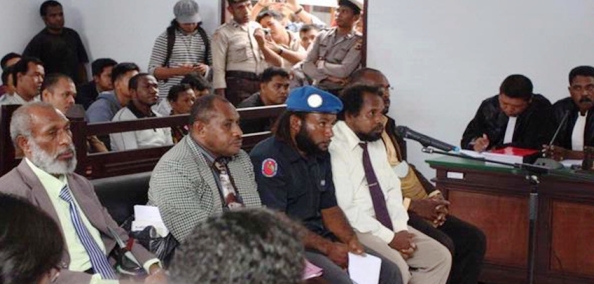
16 March 2012 – The Jayapura state court today found five Papuan leaders guilty of treason, sentencing them each to three years imprisonment. TAPOL, the Asian Human Rights Commission, the Faith-Based Network on West Papua, Franciscans International, and the West Papua Netzwerk seriously regret the verdict and question the fairness of the trial proceedings. The verdict is another example of the severe restrictions by the Indonesian authorities on the right to freedom of expression of the Papuans. We call upon Indonesian President Susilo Bambang Yudhoyono to order that all convictions which do not reflect international legal standards be overturned and the prisoners be immediately released.

Today’s verdict represents a setback in the relationship between Jakarta and Papua, suggesting that Indonesian authorities still see arrest and detention as the best ways to respond to expressions of Papuan aspirations. As a country widely applauded for its burgeoning democracy, Indonesia should be promoting peaceful political activity, not punishing it.

Forkorus Yaboisembut, Edison Waromi, Selpius Bobii, Dominikus Surabut and August Kraar were arrested in October 2011 for their roles in the Third Papuan People’s Congress, a peaceful gathering at which the leaders declared that Papua has been independent since 1961. As the gathering began to disperse, security forces fired shots into the crowd and carried out mass arrests and beatings. Three people were shot dead.

While the leaders of the Congress now face three years in jail for their peaceful actions, those responsible for the violent response to the Congress received a slap on the wrist, and investigations to determine who was responsible for the killings have led to neither justice nor accountability.

The five men were convicted of treason under Article 106 of the Indonesian Criminal Code. While the treason laws are intended to prosecute serious crimes against the state, alleged members of the armed resistance are rarely if ever brought to trial in Papuan courts; they are beaten, tortured or shot. Article 106 is instead used to charge those engaged in peaceful actions such as raising the Papuan national ‘Morning Star’ flag or organising and attending public events at which Papua rights and aspirations are asserted.

The denial made by the Coordinating Minister for Law and Human Rights of any political prisoners this month shows a lack of commitment to uphold human rights norms that are applicable to Indonesia according to international law, including that the peaceful expression of political opinions cannot be persecuted.

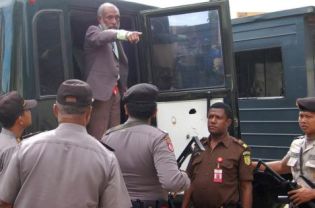
There are serious doubts about the fairness of the trial proceedings. Armed members of the security forces maintained a heavy presence during the trial sessions, and one of the senior lawyers for the defence, Gustav Kawer, is being threatened with prosecution, in violation of his right under Indonesian law and international standards to carry out his professional duties in defending clients in court. There have also been questions about the independence of the judges, who were reportedly visited by senior military, police and government officials just one hour before the trial began.

According to TAPOL’s data, the five men will join at least 27 other Papuan political prisoners currently in jail for treason under article 106. All those detained for peaceful political activities should be immediately and unconditionally released.

ENDS

Contacts:

Paul Barber, TAPOL, +44 7747 301 739

Treason trials hand down guilty verdict on Congress leaders: reports

from West Papua Media sources in Jayapura

March 16, 2012

Papuan leaders accused of treason on trial in Jayapura, January 30, 2012

(Jayapura):  Hundreds of security forces are on the streets around Jaypura, West Papua, in a show of force as an Indonesian court found five Congress leaders guilty of Makar (treason), and sentenced the defendants each to three years in prison.

The five defendants, Forkorus Yaboisembut, Edison Waromi, Selfius Bobii, Dominikus Sorabut, and Agus Kraar, were leaders and organisers of the Third Papuan People’s Congress held on October 19 2011, which was brutally broken up by Indonesian security forces after Forkorus  – the Chairman of the Papuan Tribal Council elected as President of the Federated Republic of West Papua – unilaterally reaffirmed West Papua’s independence from Indonesia.

Today’s hearing at the Jayapura Class 1A District Court, the 15th hearing in a trial described by international observers of “descending into farce”, closed after the panel of judges led by Jack Johan Oktavianus declared that the defendants had committed treason under Article 106 of the Indonesian Criminal Code.

During the trial, several Indonesian Brimob paramilitary police officers who opened fire on the Congress gathering, admitted they had no proof that the accused had committed treason before they opened fire on unarmed civilians.

No member of the Indonesian security forces, who during the breakup of Congress were filmed committing acts of brutality and violence on unarmed civilians, were criminally charged and so far have not receive any sanction for the unprovoked attack.

On March 14, another defendant from the Third Papuan Peoples’, Gat Wenda, was also found guilty of makar charges, but was sentence to five months gaol, less time he has already served since his arrest.

Lawyers for the defendants, themselves under threat of prosecution and harassment by Indonesian security forces for their advocacy for the accused, have planned to appeal the decisions, saying “we think this decision is a disaster.”

In SMS messages sent from the legal team to West Papua Media, senior lawyer Olga Hamadi said “we think the judgement from the full bench is out of tune with what actually happened.  We will appeal this to the High Court”.

Gustaf Kawer, another senior member of the legal team, also told West Papua Media via SMS that “the judges considered ambiguous and inconsistent testimony.  (Yet) there is evidence of free expression and democracy that was ruled,” Kawar said, referring to the democratic rights and obligations adhered to by the Congress leaders.

A massive show of military hardware has caused major fear on the streets of Jayapura, with most poeple staying away from demonstrations for fear of an imminent military crackdown.  600 Heavily armed Brimob riot police and 300 Indonesian army soldiers are surrounding the streets around the court, backed up by several water cannon, 13 Barracuda armoured vehicles, and seven Army Panzers (assault vehicles).

Security forces today have, according to local civil resistance sources, used this show of force to actively prevent supporters of the accused to attend court.

The atmosphere has been described as highly tense with Papuan supporters of the convicted men outraged, but terrified, according to SMS messages from sources on the ground.

westpapuamedia

This is a developing situation – please stay tuned.

HRW: Five Papuans Convicted for Peaceful Protest

English: Human Rights Watch logo Русский: Лого...
Image via Wikipedia

For Immediate Release

From HUMAN RIGHTS WATCH

Indonesia: Five Papuans Convicted for Peaceful Protest
Amend Treason Law to Uphold Free Speech

(New York, March 16, 2012) – The Indonesian government should drop the politically motivated treason charges against five Papuan activists who were convicted on March 16, 2012, and order their release, Human Rights Watch said today.

The district court in Jayapura, the Papuan provincial capital, convicted the five men and sentenced them to three years in prison for statements made at a Papuan People’s Congress in October 2011. The demonstration was brutally suppressed by the authorities, leaving at least three people dead. The five men convicted on March 16 are Selpius Bobii, a social media activist, August Sananay Kraar, a civil servant, Dominikus Sorabut, a filmmaker, Edison Waromi, a former political prisoner, and Forkorus Yaboisembut, a Papuan tribal leader.

“If the Indonesian government wants to make an example out of these people, then it should free them as a symbol of its commitment to free expression,” said Elaine Pearson, deputy Asia director at Human Rights Watch. “Instead, the legacy of the Papuan Congress crackdown will be five unjust convictions, while those responsible for the violence go unpunished.”

On October 19, 2011, in Jayapura, Indonesian security forces used excessive force to break up a three-day People’s Congress demonstration supporting independence for Papua, Human Rights Watch said. After Yaboisembut, one of the leaders, read aloud the 1961 Papua Declaration of Independence, police and the army fired warning shots to disperse the approximately 1,000 Papuans gathered. The security forces then used batons and in some instances firearms against the demonstrators, killing at least three and injuring more than 90 others. Witnesses said that demonstrators had been struck on the head and several suffered gunshot wounds.

Following the incident, 17 police officers, including the Jayapura police chief, Imam Setiawan and seven of his subordinates, were given written warnings for committing a disciplinary infraction by not giving priority to the protection of civilians. However, no other action was taken against police or military personnel for possible misuse of force.

The trial of the five activists raised serious due process concerns, Human Rights Watch said. During the trial, the defense told the court that police questioned their clients in the first 24 hours of arrest without the presence of lawyers. The defense also alleged that the men were beaten by police while in custody. Police allegedly kicked Yaboisembut in the chest and beat his head with a rifle butt. Sorabut testified that the police beat him on his head with a pistol and struck his body repeatedly with an M-16 assault rifle. Kraar said he was hit by police twice on the head with a pistol.

Human Rights Watch renewed its call for the Indonesian government to release all political prisoners and allow human rights organizations and foreign journalists unimpeded access to Papua.

The Indonesian Criminal Code should be amended to ensure that no one is prosecuted for treason for exercising their rights to peaceful protest protected under the Indonesian constitution and international law, Human Rights Watch said. The constitution, in article 28(e), states, “Every person shall have the right to the freedom of association and expression of opinion.” Article 28(f) provides, “Every person shall have the right to communicate and obtain information for the development of his/her personal life and his/her social environment, and shall have the right to seek, acquire, possess, keep, process, and convey information by using all available channels.” The International Covenant on Civil and Political Rights, which Indonesia ratified in 2006, similarly protects the rights to free expression and peaceful assembly.

Human Rights Watch takes no position on claims to self-determination in Papua. Consistent with international law, however, Human Rights Watch supports the right of everyone, including independence supporters, to express their political views peacefully without fear of arrest or other forms of reprisal.

“Throwing activists in prison on charges of treason will just reinforce Papuans’ beliefs that the Indonesian government uses the law for political purposes,” Pearson said. “And while the government is busy prosecuting peaceful protesters, it seems to have had no time to investigate adequately the violence against them.”

To read the October 28, 2011 Human Rights Watch news release, “Indonesia: Independent Investigation Needed Into Papua Violence,” please visit:
http://www.hrw.org/news/2011/10/28/indonesia-independent-investigation-needed-papua-violence

To read Human Rights Watch’s report on political prisoners in Indonesia, please visit:
http://www.hrw.org/reports/2010/06/23/prosecuting-political-aspiration-0

For more Human Rights Watch reporting on Indonesia, please visit:
http://www.hrw.org/asia/indonesia


Indonesian police conduct armed sweep of treason defendants in their cells

from WestPapuaMedia sources in Jayapura

Monday February 20, 2012

Extraordinary scenes occurred at Abepura prison in West Papua on Saturday night when heavily armed police stormed the cells of non-violent Papuan leaders currently on trial for treason.

The unusual and heavy handed security sweep was carried out between 9-10 pm on Sunday night and involved 3 truckloads of armed Dalmas anti-riot paramilitary police; 2 truckloads of Brimob police, and a detachment of the fully armed prison anti-riot officers.

Forokorus Yaboisembut (Jakarta Globe)

The cells of a number of West Papuan political prisoners were turned over in the sweep, and all prisoners possessions were removed, including pens, paper, files, books, letters, plates, drinking glasses, cutlery knives, guitars, and music tapes, including lawyer-client privileged communications and defence notes.  Mobile phones were not found however, according to sources at the prison.

It is believed the targets were  five leaders of the Third Papuan People’s Congress that peacefully declared independence from Indonesia on October 19, 2010, sparking a brutal and bloody crackdown by Indonesian occupation forces.

Forkorus Yobeisembut, and Edison Waromi, the President and Prime Minister respectively of the Federated Republic of West Papua, together with Selpius Bobbi, Dominikus Sorabut, and Agus Kraar are all on trial for treason charges.  The hearing on Friday had to be suspended after the prisoners refused to return into the courtroom due to concerns of the conduct of witness cross-examinations.  The trial was adjourned to February 21.

Reliable sources close to the accused Congress leaders have told West Papua Media that the raids relate to rumours circulating that the five defendants will be broken apart and moved to separate prisons away from Papua. These rumours have been propagated by unknown parties, however regular prison transfers are a common tactic by the Indonesian state on Papuan political prisoners.  The Indonesian Attorney-General and the Prosecutors office have repeatedly stated publicly that the trial and prisoners would be moved from Papua if any unrest occurs, but there is significant local Papuan resistance to such a move.

Local observers also have suggested that the bizarre raids had occurred after police objected to the defendants conduct in court and sought to reassert the “authority of state” by behaving unpredictably.

According to a series of urgent text messages sent to various advocates, the head of the prison at Abepura opened up the political prisoners section to normal criminals allowing them to mix freely.  This is often a tactic utilised by prison authorities to effect violence on prisoners without prison guards having to commit the abuse personally.  The political prisoners source told West Papua Media that in a disturbingly strange move, the prison chief then invited the political prisoners to sit without resistance with in a room together with hardened murderers, robbers and rapists, many of whom are from other parts of Indonesia.

Prison authorities did not reply to any requests for clarification from West Papua Media about the events at Abepura.

Statement from 5 Makar accused at KP3 treason trial

STATEMENT BY FIVE PAPUANS WHO WENT ON TRIAL IN JAYAPURA ON 30 JANUARY 2011[This hand-written statement is signed by the five Papuans who went on trial in Jayapura on 30 January 2012, and is translated in full by
Carmel Budiardjo, TAPOL]

Fully understanding and conscious of our basic human rights as Papuans of the negroid race, part of the Melanesian race who live in the land of the country of West Papua, inheritors from our ancestors, we herewith firmly declare  that WE FIRMLY REJECT THE TREASON TRIAL AND OTHER SUCH TRIALS that has been mounted against the five of us, and we speak on behalf our colleagues and the entire nation of the Papuan people of the Nation of West Papua.

We call for an understanding of this declaration, a declaration of independence, in accordance with the principles of PUBLIC INTERNATIONAL LAW, a law which should be lawfully accepted. And in this case, this declaration will bring us substantial  happiness if it gains the recognition of the international community.

In order to gain substantial and dignified recognition from the international community, we have requested our international team of lawyers to  notify and register  our legal status along with the question of the annexation of the TERRITORY OF THE STATE OF WEST PAPUA at the International Court, with the Secretary-General  of the United Nations, Amnesty International and all member states of the United Nations, as well as other competent authorities.

We herewith categorically state that we are not prepared to make any statements or answer any questions that are based on the laws and accusations of treason by  the Unitary State of the Republic of Indonesia, during the current trial for treason. It is very clear indeed that this is a matter between two nations and two states, that is to say, between the Papuan nation and the Indonesian nation, between the Federal State of West Papua  and the Unitary State of the Republic of Indonesia.

The following are the reasons for our rejection of the trial for treason or any such trial:

[NB: The copy of the statement which we have received jumps at this point from page 2 to page 4 which suggests that the copy we have is incomplete.]

1.    Our struggle and the struggle of those who have gone before us and the nation of West Papua  and all members of the Papuan people up to the present day is a struggle for the restoration of independence and sovereignty of the Papuan Nation as one of our most basic political rights.

2.    Bearing in mind that the Unitary State of the Republic of Indonesia annexed and continues to annex, the people and nation of the Papuan people since the TRIKORA command which was proclaimed by the former president of Indonesia, President Sukarno on 19 December 1961 in the city of Jogyakarta and which was followed up by  the Indonesian military, from 1962 to the present day, by a variety of measures aimed at preserving the annexation.

3.    Our struggle is not aimed as damaging or destroying any country in the world.

4.    We do not intend to damage or destroy the Unitary State of the Republic of Indonesia.

5.    We feel that our dignity has been defiled, that our basic political  rights have been violated in our country, West Papua, which we inherited from our ancestors.

6.    No one, for whatever reason, has the right to make accusations against us or to convict us in a treason trial or any such trial. This is because we have become the subjects of our own laws  as citizens of the nation and state of the Federal Republic of West Papua.

7.    Based on the values of basic human rights, of democracy and the following universal laws:

a. The  first article in the Preamble to the1945 Constitution  of the Republic of Indonesia.
b. Article15 of the Universal Declaration of Human Rights of the United Nations adopted on 10 December, 1948.
c. Article 1, para 1 of the Covenant on Civil and Political Rights adopted as UN Resolution 2200 (xxi) which has been in force since 23 March 1976,.
d. The Declaration on Granting of Independence to Colonial Countries and Peoples in UN Resolution 1514 (xv) on 14 December 1960.
e. The basic principles of decolonisation , namely possidetis juris and the legal succession of the state to the colonial territories  of the  Dutch East Indies (Dutch Papua) since 19 October 1961.
f. ILO Convention No. 169, 1989 on the Rights of Indigenous and Tribal People.
g. The UN Declaration on the basic rights of indigenous peoples of 13 September 2007.
h. The Papuan Independence Manifesto of 19 October 1961 adopted by the Papuan National Committee.
i.  Stipulations adopted by the Grand Congress (MUBES) of the Papuan people in 2000.
j. The Eleven Recommendations of the Second  Papuan Peoples’ Congress and Indigenous Papuan People  in 2010.
k. The decisions of the Second Papuan Peoples Congress in 2000.
l.  The decisions of the Third Papuan Peoples Congress of 2011.

8.    The Statement by the Indigenous Papuan People and the Papuan people is a truth based on analytical and practical categories. The analytical category means that the indigenous P apuan people are the Papuan nation, a negroid race of the Melanesian race, located in the South Pacific. Whereas the practical category is a political statement which was enunciated in the Manifesto of Papuan Independence of the Papuan National Committee on 19 October 1961 in Hollandia, the State of West Papua.

9.     We democratically restored the independence and sovereignty of the Papuan people on 19 October 2011, at the Third Papuan Peoples  Congress with the establishment of the Federal Republic of West Papua  which was announced by the DECLARATION OF THE PAPUAN NATION IN THE STATE OF WEST PAPUA.

10.    The government of the Republic of Indonesia and the governments of all other members of the United Nations, should without discrimination recognise and respect the democratic processes of the Papuan people at the Third Papuan Peoples Congress on 19 October 2011 in the form of the Declaration of the West Papuan Nation and State.

11.     The application of the treason law against the Papuan people must be categorised as a violation of the basic and legal political rights of the Papuan nation.

We hereby call on to the Honourable Judges in this forum to annul the trial held in order to accuse us of TREASON and make similar charges against us. The solution to the independence of the Papuan nation which is our most basic political right must be sought by means of international mechanisms between the Federal Republic of West Papua and the Unitary State of the Republic of Indonesia, mediated by the United Nations.

In order to regulate the transfer  of sovereign powers from the Unitary State of the Republic of Indonesia to the Federal Republic of West Papua, we intend to initiate a new phase of cooperation  based on the principles of democracy,  justice, peace, mutual respect and dignity. As is customary between independent and sovereign nations and states on Planet Earth.

Herewith our statement of REJECTION OF THE TRIAL BEING HELD TO ACCUSE  US OF TREASON AND SIMILAR CHARGES.

Jayapura, 30 January 2012

Signed:

1. Forkorus Yaboisembut, President of the Federal State of West Papua.
2. Edison G. Waromi, SH, Prime Minister of the Federal State of West Papua.
3. Agust M. Sananai Kraar, SIP,human rights activist/staff
4. Selpius Bobii, activist/staff
5. Dominikus Subarat, activist/staff

Create a website or blog at WordPress.com

Up ↑