HRW: Indonesia: Explain Transfer of Imprisoned Activists

Human Rights Watch logo
Image via Wikipedia

http://www.hrw.org/en/news/2010/12/10/indonesia-explain-transfer-imprisoned-activists

Release All Political Prisoners
December 10, 2010

“Prisoners have rights too, and ignoring those rights is no way to celebrate Human Rights Day. The authorities should explain why Filep Karma and Buchtar Tabuni have been thrown in a police lock-up and denied access to lawyers.”

Elaine Pearson, deputy Asia director at Human Rights Watch


(New York) – The Indonesian authorities should immediately allow two Papuan political prisoners and three others to fairly contest their transfer from prison to a police headquarters and permit them access to their lawyers, Human Rights Watch said today. Filep Karma, 51, and Buchtar Tabuni, 31, have been held at the Jayapura police station in West Papua since being brought there a day after a riot at Abepura prison on December 3, 2010.

On international Human Rights Day, Human Rights Watch also reiterated its call for the Indonesian government to free immediately the more than 130 Papuan and Moluccan activists imprisoned for peacefully voicing political views, and to reform laws and policies to protect freedom of expression.

“Prisoners have rights too, and ignoring those rights is no way to celebrate Human Rights Day,” said Elaine Pearson, deputy Asia director at Human Rights Watch. “The authorities should explain why Filep Karma and Buchtar Tabuni have been thrown in a police lock-up and denied access to lawyers.”

The Jayapura police chief, Commissionaire Imam Setiawan, told the media that the police had “secured” Karma and Tabuni at the Jayapura police station for provoking a riot that occurred at Abepura prison following an attempted prison break on December 3 in which a prisoner was shot and killed. Karma and Tabuni informed Federika Korain of the United Papuan People’s Democracy Forum (FORDEM) that they were transferred to the police station without being told that they had committed an offense.

Under the United Nations Standard Minimum Rules for the Treatment of Prisoners, “[N]o prisoner shall be punished unless he has been informed of the offense alleged against him and given a proper opportunity of presenting his defense.”

Since being taken to the police station, Karma and Tabuni have requested access to their legal counsel but have been refused. On December 8, Karma’s lawyer, Harry Masturbongs, came to the station but was not allowed to meet with his client. The police have also refused to let Karma’s family visit him.

According to the UN Body of Principles for the Protection of All Persons under Any Form of Detention or Imprisonment, an “imprisoned person shall be entitled to communicate and consult with his legal counsel.” The rights of an “imprisoned person to be visited by and to consult and communicate, without delay or censorship and in full confidentiality, with his legal counsel may not be suspended or restricted save in exceptional circumstances, to be specified by law or lawful regulations, when it is considered indispensable by a judicial or other authority in order to maintain security and good order.”

On December 9, Indonesian President Susilo Bambang Yudhoyono opened the third Bali Democracy Forum, which is aimed at promoting regional international cooperation to foster democracy and political development among countries in Asia. President Yudhoyono said in his opening speech, “There are a lot of variants of democracy but there must be universal values and spirits within the democracy itself.” Human Rights Watch called on the Indonesian government to respect the basic right to free expression, as laid out in the International Covenant on Civil and Political Rights, which Indonesia ratified in 2006.

“Holding political prisoners is embarrassing and totally out-of-step with the image of a modern democratic state that Indonesia is trying to project,” Pearson said. “President Yudhoyono should show his commitment to basic rights by freeing people imprisoned for the peaceful expression of their political views, including Filep Karma and Buchtar Tabuni.”

Background

Filep Karma, age 51, has been in Abepura prison for six years. In May 2005, the Abepura district court found him guilty of treason for organizing a Papuan independence rally on December 1, 2004, and sentenced him to 15 years in prison.

Buchtar Tabuni, age 31, is a leader of the West Papua National Committee, a Papuan independence organization that has grown more radical since his imprisonment. He was arrested in Jayapura on December 3, 2008, for organizing protests against the shooting of his relative, Opinus Tabuni. He was sentenced to three years’ imprisonment under article 160 of the Criminal Code for “inciting hatred” against the Indonesian government.

Human Rights Watch has documented beatings in Abepura prison in 2008 and 2009 that led to investigations into prison conditions by the National Human Rights Commission and the removal of the previous prison warden.

Human Rights Watch’s June 2010 report, Prosecuting Political Aspiration, describes the mistreatment of individuals serving prison sentences for peaceful acts of free expression in Papua and the Moluccas Islands, including Filep Karma and Buchtar Tabuni.

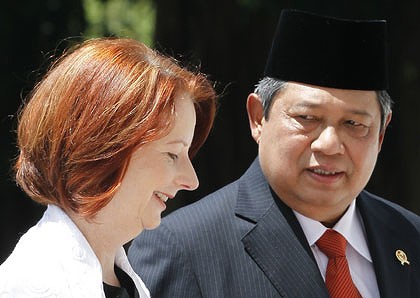
Australia must make a stand for West Papua

Article in the Sydney Morning Herald

As YouTube evidence of Indonesian soldiers burning the genitals of the West Papuan Tunaliwor Kiwo received its 50,000th viewer, the Indonesian military (TNI) was exposed holding a cynical mock trial to try to cover up systemic violence.

Julia Gillard was red-faced. When in Indonesia with Barack Obama last month, she had praised President Susilo Bambang Yudhoyono’s quick response and the coming trial. Soldiers from another, lesser ”abuse case” were then paraded and given soft sentences, while Kiwo’s torturers remain on active duty.

Despite the Australian embassy in Jakarta telling Indonesian officials of Australia’s “unhappiness with the military’s investigation”, the blatant contempt shown for Gillard and her officials creates little confidence.

Gillard bit her tongue again this week. ”The President of Indonesia,” she said, ”has made it absolutely clear he wants to see any wrongdoers brought to justice on this matter.”


Where’s the solidarity that lifted East Timor out of the geopolitical rubbish bin and into the minds of mainstream Aussies? In 1999 East Timor held a United Nations referendum, due in part to international and Australian pressure, and the Indonesian military tortured, raped and scorched its way back to Java.

In that year in West Papua I discovered the best kept secret in the Asia-Pacific region. Hiking among the highland farms of the Dani people, I heard stories of dispossession, detention, torture and murder. Yale University suggests that since the Indonesian military invaded in 1962-63, it has killed 400,000 West Papuans yet few Australians know anything about these killing fields.

I had lived and travelled on and off in Indonesia for 15 years but never heard even a whisper from West Papua. I departed shocked by the locals’ stories and with a growing suspicion that we were being lied to. The Australian government has always known what’s happening there but has chosen placation over human dignity and moral leadership.

Back in Australia, it was as if this province of 2.6 million had been erased. Why the silence? Where are the churches, students and humanitarian groups who fought for East Timor? Where are the unions who boycotted the Dutch in Indonesia and the regime in South Africa? Where are the conservatives who beat their chests after John Howard ”saved East Timor”?

History offers a clue. When General Suharto took power in Indonesia in 1965-66, he opened the floodgates to Western resource companies. Every Australian government since Menzies kowtowed to this murderous bully, partially to ward off the feared disintegration of this 18,000-island republic, but mainly to gain access to Indonesia’s vast natural resources.

The first Western company to do business with Suharto was the Freeport goldmine in West Papua. Partly owned by Australia’s Rio Tinto, it is the largest gold and copper mine in the world and Indonesia’s biggest taxpayer. Yet West Papuans live in poverty, experiencing the worst health, education and development levels in Indonesia.

Freeport’s $4 billion profit last year didn’t come easily. Dr Damien Kingsbury of Deakin University says the local Amungme people ”have been kicked out, they’ve been given a token payment and if they’ve protested, they’ve been shot”.

None of this would have been possible without Freeport’s paid protection from the TNI, which gets two-thirds of its military budget from its own private businesses. This conflict of interest is at the heart of the military’s ongoing human rights abuses. How can it serve the country while serving itself? West Papua has necessarily become a resource cash cow, a military fiefdom 3000 kilometres from Jakarta, full of tribally divided, uneducated farmers, sitting atop a new El Dorado.

Despite journalists still being banned, West Papua is no longer the secret it was in 1999. Gillard should not be placated by Indonesia’s mock trial of torturers nor train them, in the form of Kopassus. We should work with Jakarta to reform the military and open up West Papua to international scrutiny. It’s time for Australia to step up for our tortured and murdered neighbours to the north.

Charlie Hill-Smith is the writer-director of Strange Birds in Paradise – A West Papuan Story, which is nominated for four AFI Awards including best documentary.

HRW to Indonesia: Stop Stalling on Investigating Torture Video Episode

Human Rights Watch logo
Image via Wikipedia

http://www.hrw.org/node/94430

HUMAN RIGHTS WATCH
For Immediate Release

Indonesia: Stop Stalling on Investigating Torture Video Episode
Papuan Farmer Describes Days of Abuse by Soldiers

(New York, November 22, 2010) – The Indonesian government should use the newly available video testimony of a torture victim to mount a thorough, impartial, and transparent investigation into the episode, Human Rights Watch said today. The torture of Tunaliwor Kiwo, a Papuan farmer, and his neighbor, was recorded with a mobile phone on May 30, 2010, and the video came to light in October. Kiwo recounted the details of his torture in videotaped testimony only made public in recent days.

Soldiers arrested Kiwo and Telangga Gire on May 30 in Papua’s Puncak Jaya regency. In a 10-minute video of the torture session, soldiers are seen kicking Kiwo’s face and chest, burning his face with a cigarette, applying burning wood to his penis, and placing a knife to Gire’s neck. In the newly available videotaped testimony, Kiwo describes that torture and details other forms of torture he suffered for two more days before he escaped from the soldiers on June 2. Soldiers also tortured Gire, who was finally released after interventions by his wife and mother. The government has promised to investigate, but claims it cannot identify the perpetrators.

“Once again, the authorities are sitting on their hands rather than fulfilling their obligations and proactively identifying and prosecuting the soldiers responsible,” said Phil Robertson, deputy director of Human Rights Watch’s Asia division. “Kiwo has shown tremendous bravery in coming forward – he deserves justice and protection from retaliation, not another half-hearted army investigation and cover-up.”

Indonesia is a party in the United Nations Convention Against Torture and has strict obligations to investigate and prosecute promptly all incidents of torture and to ensure that victims and witnesses are protected against all ill-treatment or intimidation as a consequence of filing a complaint or giving evidence.

Kiwo said in his testimony that he and Gire had been riding a motorcycle from their hometown, Tingginambut, to Mulia, the capital of Puncak Jaya, when soldiers stopped them at a military checkpoint in Kwanggok Nalime, Yogorini. Kiwo said that soldiers seized and hit them, bound their arms with rope, dragged them to the back of the army post, and tied their feet with barbed wire. He said the soldiers tortured him for three days, beating him with their hands and sticks, crushing his toes with pliers, suffocating him with plastic bags, burning his genitals and other body parts, cutting his face and head and smearing the wounds with chilies, and using other forms of abuse.

Kiwo’s videotaped testimony with subtitles in English and Indonesian can be viewed on the Engage Media website.

“The Indonesian government at the highest levels should guarantee that Tunaliwor Kiwo and Telangga Gire will be protected from retaliation and considered witnesses to crimes,” Robertson said. “The testimony of these two men will be critically important in prosecuting the soldiers who tortured them, so protecting them needs to be a top priority.”

The October media coverage of the May 30 torture video prompted President Susilo Bambang Yudhoyono to hold a limited cabinet meeting on October 22, after which the coordinating security minister, Marshall Djoko Suyanto, admitted that the video showed Indonesian soldiers torturing Papuan villagers. Yudhoyono reportedly ordered the military to investigate immediately, but the government has provided no information about the progress of the investigation.

The National Commission on Human Rights (Komnas HAM) estimates that as many as 50 civilians have been killed in the area since the Indonesian military and police began military operations there last year.

Representatives of the Papuan Customary Council provided the video of Kiwo’s testimony to the National Commission on Human Rights on November 5. The Commission set up a team to investigate the torture episode as well as other human rights abuses alleged to have occurred in Puncak Jaya. The Commission has scheduled a trip to Papua to investigate further, though an earlier visit in late October to investigate the Kiwo-Gire torture video was frustrated by a lack of access and cooperation from military and local officials.

Unexpectedly, Maj. Gen. Hotma Marbun, the Indonesian military commander in Papua, was removed from his post on November 12. It was announced as a “routine transfer” even though Marbun had only been in Papua since January. Human Rights Watch has no information indicating that this transfer is punitive or connected in any way with the torture video. His replacement, Brig. Gen. Erfi Triassunu, should ensure that investigations in the torture case are carried out thoroughly and impartially, and that army officials under his command fully cooperate, Human Rights Watch said.

“Changing military commanders will not root out impunity,” Robertson said. “The victims deserve justice. The Indonesian military and police in Papua should fully cooperate with investigators from the National Commission on Human Rights.”

To view the videotaped testimony of Tunaliwor Kiwo, please visit:

Home

To read the October 2010 Human Rights Watch news release “Indonesia: Investigate Torture Video From Papua,” please visit:
http://www.hrw.org/en/news/2010/10/20/indonesia-investigate-torture-video-papua

To read the June 2010 Human Rights Watch report “Prosecuting Political Aspiration: Indonesia’s Political Prisoners,” please visit:
http://www.hrw.org/en/reports/2010/06/23/prosecuting-political-aspiration-0

For more information, please contact:
In Jakarta, Elaine Pearson (English): +1-646-291-7169 (mobile); or +62-812-8222-3591 (mobile)
In Bangkok, Phil Robertson (English, Thai): +66-850-608-406 (mobile)
In Washington, DC, Sophie Richardson (English, Mandarin): +1-202-612-4341; or +1-917-721-7473 (mobile)

Appendix: Confusion over two different torture videos from Papua

March 17, 2010 video
On November 5, 2010, the Jayapura military tribunal opened the trial against Master Pvt. Sahminan Husain Lubis, Pvt. Second Class Joko Sulistiono, Pvt. Second Class Di Purwanto, and their commander Second Lt. Cosmos N. of the Kostrad 753 battalion on the charge of “disobeying orders.” Cosmos led a 12-person unit to man a checkpoint in Kolome village, Illu district, Puncak Jaya. Many international and national reporters, and some Indonesian officials, mistakenly believed the trial was to focus on the torture of Kiwo-Gire as captured in the video of May 30, 2010.

During the trial, it became clear that the case involved a different incident of torture also caught on video but filmed on March 17, 2010. In the proceedings, the soldiers admitted the torture depicted in the video. According to Cosmos, the incident happened when his team conducted a routine patrol. He said he received intelligence information suggesting that there was an AK-47 and Mauser weapons stockpile in Gurage village.

The team entered the village and separated the men and women. One by one, they questioned all the men, and when they did not receive responses they considered acceptable, the soldiers began kicking and punching the villagers. Second Pvt. Ishak used a Nokia N-70 mobile phone to record the interrogations and beatings. He told the court that Cosmos had ordered him to do so.

Observers at the trial reported to Human Rights Watch that a judge, Lt. Col. CHK Adil Karo Karo, told Ishak, “You’re stupid. Knowing how sensitive it was, why did you keep recording it anyway?” It was a quick trial with only two sessions for hearings and not a single external witness was summoned by the court. On November 12, the Jayapura military tribunal found Cosmos and the three privates guilty of “disobeying orders.” Cosmos was sentenced to seven months. The three privates were sentenced to five months each.

May 30, 2010 video
The May 30, 2010 video showed a number of soldiers with two bound Papuan men lying on a dirt road. An electronic analysis of the video showed that it was taken at 1:30 p.m. A Puncak Jaya-based official of the Papuan Customary Council reported in August 2010 that two men had been tortured on the afternoon of May 30: Tunaliwor Kiwo and Telangga Gire. Moribnak had managed to interview Gire in July. Moribnak wrote that the torture had probably taken place in Yogorini village, Tingginambut district, Puncak Jaya regency. It allegedly involved members of Kostrad 753rd battalion. Given government restrictions on international organizations entering these areas, Human Rights Watch has not been able to independently confirm the actual location where the torture took place or the identity of the unit of the soldiers.

Kiwo escaped from the soldiers on June 2, and the soldiers released Gire after his mother and his wife had pleaded for his life.

Human Rights Watch issued a statement on October 20, calling on the Indonesian government to investigate the incident seriously.

Torture trial exposed as a ‘grand deception’ – Indonesian Government caught lying to US and Australian Governments

Article from The Age

A MILITARY trial into abuses by soldiers in Papua, trumpeted by Indonesia’s President Susilo Bambang Yudhoyono as evidence of the country’s commitment to human rights ahead of Julia Gillard’s visit, has proven to be a grand deception.

The trial of four soldiers began on Friday in Jayapura, the capital of Papua province, amid assurances from the Indonesian government and military that those appearing were involved in the torture of two Papuan men depicted in a graphic video.

But when the trial started, it became apparent that the four defendants had nothing to do with the incident depicted in the video, which took place in Papua on May 30. Instead, they were four soldiers involved in another incident, in March, which was also captured on video. While disturbing – it involves soldiers kicking and hitting detained Papuans – the abuses in the March incident are milder than the genital burning torture in the May video.

Dubbed the ”red herring trial” by The Jakarta Post, human rights advocates said the deception proved the matter must be investigated by Indonesia’s human rights body and the perpetrators tried in Indonesia’s Human Rights Court.

Papuan activists said the ”farcical” military tribunal hearing was a deliberate strategy to deflect international condemnation ahead of the visits of Ms Gillard, who travelled to Jakarta last week, and US President Barack Obama, who arrives tomorrow.

A day before Ms Gillard’s visit, Dr Yudhoyono announced the trial was to take place and urged Ms Gillard not to raise the topic when they spoke. ”There’s no need to pressure Indonesia. We have conducted an investigation and are ready for a trial or anything that is required to uphold justice and discipline,” he said.

But at the weekend, Lieutenant Colonel Susilo, spokesman for TNI’s military command in Papua, admitted the soldiers before the tribunal had nothing to do with the torture.

”It is difficult for us to investigate the perpetrators in the second video because they did not show any attribute or uniform,” he said. ”So what we could do was working on the first video. We could recognise their units and faces easily. ”

Ms Gillard’s office and the Department of Foreign Affairs declined to comment.

Create a website or blog at WordPress.com

Up ↑
