BRINGING AN END TO THE CONFLICT IN PAPUA THROUGH JAKARTA-PAPUA DIALOGUE

Opinion / Analysis

By: Selpius Bobii

December 31, 2013

Peace is critical to the continuation of life for human beings, though we find it hard to achieve in even our everyday lives. West Papuan Nehemia Yarinap stated that “Christ Jesus came to bring peace to the earth, however the characteristics of humans are such that they sometimes fail to reach peace and truth due to acting in the interests of political economics, oppressing other nations of peoples in the name of peace. At this time in the modern world, there are  powerful nations oppressing and usurping the rights of other nations.” Yarinap’s points to the annexation of the sovereign independence of the nation of Papua into the Republic of Indonesia, commenting “ to realise peace and justice in Papua so many have sacrificed themselves and continue to sacrifice their lives just as Jesus Christ sacrificed himself to bring peace to humans on this earth….. Christmas reminds all people about peace and speaks to us that those characteristics that oppress other nations must change.”(1)

The dynasty of tyranny of Indonesia is now firmly established in Papua. In all areas of life  the Indonesian State has firmly established those pillars that ensure the continuation of Indonesia’s oppression, even in religion. Indonesia has to that end consistently brought  pressure to bear on those key Papuan figures in the churches who have continued to speak openly about the realities of discrimination, marginalisation, injustices and humanitarian atrocities that are occurring against the indigenous people of Papua. There have been accusations made that those such church persons too are themselves involved directly in the politics of Papua. Accusations that are particularly of recent times aimed at weakening the case for dialogue between Jakarta and Papua which has been encouraged by particular church figures.  If the Church also becomes a pillar of support for this dynasty of oppression by Indonesia, then the church itself will in so doing lose both its very foundation as well as its direction.  In that instance the church would be torn from its very roots and mission as handed down by Jesus Christ, being to save the world.  The church in Papua  must stand strong as a beacon of hope to the people and not become a partner of the State of Indonesia in the colonial domination of the indigenous people of Papua.

The Papuan Writer Usman Yogobi stated that “ The countenance of the Church in the land of Papua is such  that it has become  a partner for the Indonesian Government, with some reverends, bishops, pastors, pilgrims and monks supporting the colonial domination of the land of Papua. ‘Papua the Zone of Peace’ as declared in 2002 has never been realised, with the reality being quite the opposite – Papua has become a region of humanitarian disaster!

The term ‘Zone of Peace’ which arose from leaders of the different religions in Papua in 2002, has even been adopted recently by the Indonesian Military Commander in Papua (XVII) and the Head of Papuan Provincial Police. They have used the term in speech, letters or on banners, whilst in practice the Indonesian military and police have continued to carry out acts of violence and human atrocities against the indigenous people of Papua” stated Yogobi. The Church in Papua needs to learn and better understand its mission as handed down by Christ Jesus, being to bring salvation to the world. The salvation of souls is not just a matter of becoming oriented with the hereafter, but rather it’s about saving lives on this earth.

The law of the church prohibits representatives of the church being practically involved in politics, however at the same time it’s important to understand that the very teachings of the churches stress the importance of the church being involved in a real way in the life of the people. There is no such thing as evangelisation without social involvement; no such thing as mission without the struggle for justice. The church has a moral responsibility to be socially involved and to fight for justice and for respect of the dignity of humanity.

Dialogue between Jakarta and Papua which is being urged by the Peace Network of Papua – coordinated by the Catholic Priest Neles Kebadabi Tebay (Pr) – is a part of the involvement of the church in the upholding of justice and the respect of humanity dignity. If the church only speaks of justice and criticises human rights violations but does nothing to point to a way to bring an end to the conflict in Papua, then the human rights violations in Papua will continue without ceasing. Rather the church needs to itself open a way or point to a way forward.  Dialogue between Jakarta and Papua is a way of enabling such discussion as required to deal with  the many problems so as to find a dignified solution to the Papuan issue.

So let’s work together to lead the way to bringing about dialogue between Jakarta and Papua to find a solution that upholds the dignity of all.  Indeed there are more than one way to bring about an end to the problems in Papua and it is important that other approaches being made are also continued such as the legal approach and the United Nations decolonisation approach.  And as we struggle let’s always remember that the Struggle of Papua does not use violence or physical force but rather our means are always peaceful. As wherever violence is used there are inevitably human victims lost and indeed Indonesia has and continues to kill Papuans by a range of violent means. Over this more than 50 years endless innocent victims have been killed as a result of Indonesia’s actions in Papua. There’s been enough killing by Indonesia. Let’s bring an end to this cruel colonial domination using strictly peaceful means.

Indonesia and Papua really need to be enlivened to bring this about and its important we leave any narrow thinking paradigms. As the consequence of such is but to extend this conflict and more fallen victims, which are not small in number. Let’s take this never-ending conflict between Papua and Indonesia to the table and carry out unconditional peaceful dialogue as between two equal parties, facilitated by a neutral third party and in a third and neutral location. The international community including the USA has previously expressed its support for the path of dialogue between Jakarta and Papua; and it is the Writer’s conviction that all those who seriously uphold the values of the human rights, democracy, truth, justice, honesty and peace will also support a peaceful and dignified approach to finding a solution to bring an end to the problems in Papua. So let’s all work together to make dialogue between Jakarta and Papua a reality!

The Indonesian President Susilo Bambang Yudhoyono  has numerous times stated in speeches that the problems of Papua will be brought to an end in a peaceful and dignified way. Also is recalled the words of the Head of the Council of Presidential Advisors Dr Hasibuan in January 2013, that the President had promised to arrange dialogue between Jakarta and Papua during the year 2013. However that promise has not yet been fulfilled.  A ‘promise’ is as something that is owed and must be paid and President SBY needs to fulfil that promise. It is dearly hoped that before President SBY’s term as president comes to a close on 20 October 2014 that this very extended conflict between Indonesia and Papua can be brought to an end through peaceful and dignified means and that it might become the hope of all parties to make that a reality.

Footnote

  1. 1.        The Bible of the Christian Religion  talks about the ‘Garden of Eden’ that radiated the glory of God and where there was peace and prosperity.  Where there were no wild beasts but rather all creatures lived together in peace. Then it is written, that peace was destroyed by the wrong of the first humans and therein began anarchy on the earth. Humans in all places seek after that peace which the Bible speaks of. Yet we see in the world that powerful humans prey on those weaker than themselves. The rich get richer and the misery of the poor becomes greater.

Selpius Bobii is the  General Chairperson of Front PEPERA & is a Papuan Freedom Political Detainee in Abepura Prison, Jayapura


Bobii: Indonesian Armed Forces, the main Anti-Peace Agents in Papua

By Selpius Bobii  writing from Abepura State Prison, Jayapura

 Opinion

December 24, 2013

Every religion teaches values of goodness and kindness and has teachings that are intended to create happiness and peace on this earth and in eternity.  We hear so many people speak of the importance of peace, but the reality is that it’s not that simple to realise peace in our everyday lives. In the Papuan province of Indonesia it feels like peace is so far from becoming a reality for the indigenous people who live there.

Of late the Cenderawasih XVII Military Commander in West Papua has been coining the phrase “Peace is beautiful” and yet at the same time the Indonesian Armed Forces continue to be the number one culprit committing acts of violence and humanitarian atrocities against the indigenous people of Papua.  Behind the mask of these sweet words the Armed Forces are clearly acting very much against the creation of peace in Papua.

 Peace can be realised in a place when every person, every group, every faction, respects the rights of others; and this extends to nations and tribes. Where each is able to exercise their rights and at the same time fulfils their obligations towards others. It seems however in Papua that the realisation of peace is something that’s incredibly difficult to achieve, with the root cause of that being the lack of recognition of the very basic political rights of the people of Papua by all three Indonesia, the USA and the United Nations (UN).

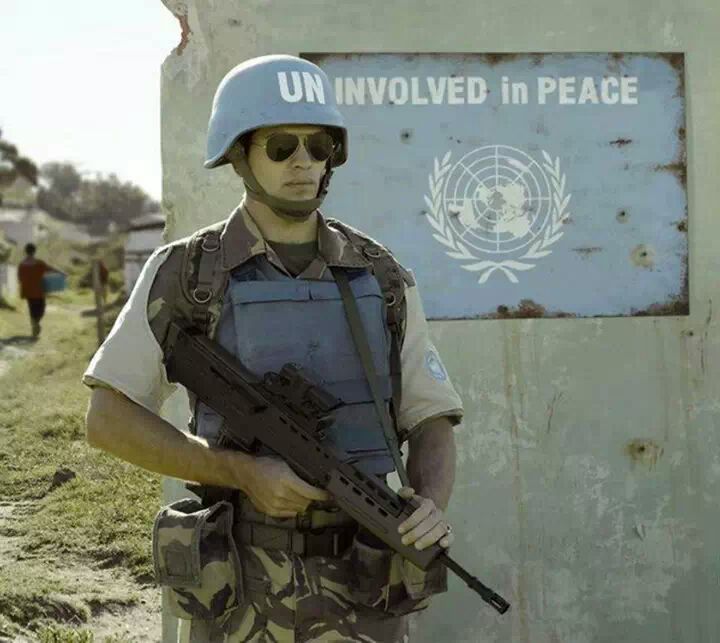
(UN)involved in Papua's desire for Peace; very involved in its atrocities (Photo: Public domain)
(UN)involved in Papua’s desire for Peace; very involved in its atrocities (Photo: Public domain)

With the USA and UN’s active support throughout the entire process of annexation of Papua into Indonesia in the 1960’s, they indeed played a part in the actions of violence and atrocities against the indigenous people of Papua.  They achieved their goal of making Papua into ‘the kitchen of the world’, opening it to the many international companies that have been stripping Papua of its rich natural resources ever since. It was not to end at the annexation of Papua, as they have continued these last more than 50 years to support Indonesia’s hold on Papua which in turn keeps the door open for exploitation of the land.  There have been various forms of aid and in particular joint programs in security and defence, which of course are critical to Indonesia’s continued domination of Papua.

The Indonesian Armed Forces have by intention made Papua into a centre of conflict, but for what end?  In so doing they create a situation where the indigenous people can be paralysed, can be annihilated and the world just keeps quiet, with Indonesia saying they are dealing with the conflict. The result?  Papua remains permanently part of Indonesia and its natural resources can be exploited with ease by international parties.

Let’s not be fooled that the partnerships going on between Indonesia and other nations of the world in the areas of security and defence are aimed at peace building and protecting the people of the region as claimed. Nothing could be further from the truth! The reality is they have quite the opposite goal! The Indonesian Armed Forces are the main agents intentionally creating violence, bondage and theft of natural resources, discrimination, marginalisation, injustice, terror, intimidation and humanitarian atrocities against the indigenous peoples of the land of Papua. Their military and civilian operations both overt and covert are intended to slowly but surely annihilate ethnic Papuans.

The many forms of both visible and hidden violence and humanitarian atrocities undertaken by the state of Indonesia against indigenous Papuans are intended to stifle the political aspirations of Papuans for independence and at the same time annihilate the people. In the face of this continued violence against their people the indigenous peoples of Papua continue to express their opposition to the many human rights violations by peaceful and dignified means, primarily by means of peaceful demonstration. Yet even the narrowest space for a voice calling for democracy has been blocked by the Armed Forces in recent times, especially by the Provincial level of Indonesian Police.  The Provincial Police are known for their practice of taking advantage of occasions when there are peaceful demonstrations to create conflict and to terrorise, torture, kill, arrest and imprison Papuans who struggle peacefully for change.  Indonesia’s Armed Forces are constantly manipulating activities of the Struggle to create incidents of violence. Nevertheless Papuans continue to struggle peacefully in keeping with their decision at the 2000 2nd National Papuan Congress.

And so in the midst of all this, now it is Christmas. Where all parties in Papua hear of the message of ‘the coming of the King of Peace’.  A message that reminds humanity that Jesus Christ came to bring peace to this earth.  A message that starts to have real meaning only when entire communities of humans make space to allow for peace in their hearts.  To that end let’s all prepare our hearts with simplicity, faithfulness, honesty and love for one another. We are each one of us reminded by the message of Christmas.

It is dearly hoped that the message of Christmas will also touch hearts and bring awareness to those who are committing the many forms of violence against indigenous Papuans. That there might be a commitment to bring an end to all forms of oppression towards indigenous Papuans and to enter into dialogue between Jakarta and Papua with a neutral facilitator. To reach that end we need to be ready and willing to humble our hearts, to be faithful, honest and to act in love. Only in that way can we bring peace to the land of Papua.  We are all called to bring an end to the latent conflicts in Papua and to create peace, no matter who we are and wherever we may be.

Peace and joy at Christmas to all and throughout 2014!

Footnote:

  1. 1.       The Dutch previously tried to prepare Papua to become an independent nation whilst still under their control, with those preparations reaching a peak on 1 December 1961. However less than a month later on 19 December 1961 Indonesia by a political and military invasion marked by what’s known as Trikora (a three prong command which demanded the dismantlement of the “puppet” Papuan state created by the Dutch; the raising of the Indonesian Red and White flag over Papua; and preparation for a general mobilisation in Papua) succeeded in annexing Papua into the Indonesian Republic.

Selpius Bobii is the  General Chairperson of Front PEPERA & is a Papuan Freedom Political Detainee imprisoned in  Abepura State Prison, Jayapura, Papua, for another Christmas.


POLICE ACCUSED OF USING OTHER PRISONERS FOR THE ILL-TREATMENT OF YASON NGELIA

From our partners at Tabloid Jubi

by Benny Mawel

December 15, 2013


Aksi Pengalangan Dana Pegobatan Yazon
Raising money for treatment for Yazon Ngelia (Photo:Jubi/Mawel)


Jayapura,15/11— The Student Representation Council of the Politics and Civil Faculty at Cenderawasih University (DPM-FISIP-UNCEN) harshly condemns the parties responsiblefor  the imprisonment of Yason Ngelia, Chairman of the Executive Student Body (BEM) of the FISIP department, in Jayapura. Yason’s current condition brings a flood of disappointment as he is not in a good (physical) state as a result of the imprisonment.

The parties responsible for the imprisonment of Yason are the Papuan Governor and the Papua People Assembly.  The Cenderawasih University, with the involvement of 29 lecturers, have written an academic draft of the Special Autonomy Plus for Papua (or called for a Special Autonomy Papuan Government (for Papuans to run the provincial government). However, an individual student has reported he was physically abused by Yason which led to his arrest.

The recognition of the abuse against the student is the reason police have detained Yason, which led to the refusal of the students’ draft Otsus Plus.  Yason’s struggles to protect Papuan People from murder is systematically criminalised by the government through the acts of the police.

“The rector does not yet appear to be handling this problem,” said Septi Medoga, the head of the Student Representation Council of FISIP at Cenderawasih University to a reporter in front of the university gate in Waena-Abepura in Jayapura. (12/12)

The individual who claimed to be a victim of abuse from Yason, according to Septi, has never wanted to meet with members of BEM FISIP who want to solve this problem internally. “The student doesn’t want to meet with us.” He said.

Until today, according to Septi, Yason’s physical condition is declining rapidly as a result of his incarceration. “The police are using three other prisoners to beat Yason. His right temple has ruptured, his cheeks are bruised, his bones are broken and his back has been kicked hard,” said Septi, who spoke with Yason when he visited him in jail. This beating occurred on 20th November 2013 in the detention room of the police station in Jayapura.

Yason’s condition is rapidly deteriorating and he has not yet received any medical treatment. “We assess this to be neglect from the police, the e university, and of those who claim to be a victim of abuse from Yason, those who have dragged him behind bars” said Septi.

Because of this situation, Septi has taken the initiative to lead his friends to raise funds for the medical treatment Yason needs. “We will give the funds raised to Yason to give him the medical treatment he needs.” Early demonstrations occurred in front of the Cenderawasih University gates on Thursday. (12/12)

The fundraising will go from Monday (16/12) and will be placed at various central locations, like Expo taxi terminal, Abe Circle, and other universities in Jayapura.

The right to medical treatment is a fundamental human right for Yason, regardless of his status as a suspect. Septi is urging the Papua Emergency Health Unit (UP2KP) to take a step towards helping Yason. “We ask for Dr Alo Giyai to lend a hand to check Yason’s condition” he said.

When we asked about Yason’s release, Septi claims the head of BEM FISIP should be freed today, but the reason why not is still unclear. “The power of the law to send a letter of suspending the detention on 24th November, then until today there is still no reply from the police” he said.

Meanwhile, Pontius, the coordinator of fundraising for Yason’s medical treatment, hopes his activist friends from GEMPAR will stop demonstrations demanding for Yason’s freedom by blocking the gates of the universities, because this will slow down the process for his release. “Friends, please demonstrate without blocking the gates to campus, if they are kept shut, Yason’s release will take longer” he said.

This is definitely an internal problem that only the rector has no intention of solving a problem as trivial as this. “I am amazed with us having this institution. This institution has the authority to solve this problem alone, however the rector is hiding from it” said Pontius.

Editor : Victor Mambor

Translated by West Papua Media Translation team

Warinussy: More makar cases in Papua

Comment by Yan Christian Warinussy, senior lawyer in West Papua, recipient of the John Humphreys Freedom Award, 2005
December 13, 2013

The latest treason verdict against seven West Papuans is yet another example of the serious human rights situation in West Papuan, in particular with regard to the right to freedom of expression. The seven men were headed by Isak Kalaiban.

Based on the facts revealed during the course of the trial, it is clear that there was a plan between the accused to freely give expression to their views in a way that is based on the rule of law.
This occurred on 1 May 2013 after Isak and his colleagues brought the families of the accused together on the previous day at their home  in Aimas-Sorong. While they were meeting together,  a police patrol in Sorong began to opened fire at the group of people, as a result of which four people were killed or wounded.
At the trial, the men were charged with treason (makar)  by the court in Sorong before a panel of judges headed by Maria Magdalena Sitanggung.
None of the witnesses questioned at the trial said anything about what had taken place on the day before, 30 April.
For the legal team defending the accused, the question is who indeed is it that perpetrated treason in view of the fact that none of the witnesses who appeared in the trial knew anything about the men who were being charged.
This is yet another case in which the accused were charged under Articles 106, 108  and 110 to prevent people in Sorong from giving free expression to their rights to freedom of expression and freedom of assembly  as provided for by Law 39/1999 on Human Rights and the Universal Declaration of Human Rights.
Translated by Carmel Budiardjo

A Tale of a Flag

Opinion/Analysis
by Sri Lestari Wahyuningroem
1 December 2013
This is a tale about a flag named Bintang Kejora, or Morning Star.

As with other flags ever created, it symbolises identity and conveys particular messages the creator would like other people who see it to understand.

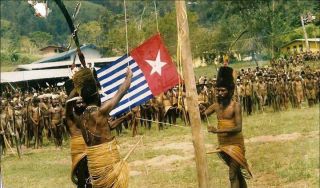
Morning Star flag being raised by Yali tribesman (supplied)

But unlike other flags, the Morning Star flag is different. Its creation rendered the power outside of it to repress the identity and message it wants to convey. It conversed sovereignty into sufferings, as more and more human bodies, the West Papuans, have to be ill-treated or persecuted of being accused of committing wrong to the Indonesia state.

What is right, human rights, then turned out to be very wrong for the power that rule the territory. Unlike other flags ever raised in other areas in Indonesia, such as the Yogyakarta Kraton flag, the raising of Morning Star is subversive to the very fundamental base of Indonesia’s territorial unitary state, or Negara Kesatuan Republik Indonesia (NKRI).

December the 1st, each year, marked the conversion of the flag. Fifty three years ago, the Dutch who colonized the territory called Dutch New Guinea gave the recognition to the flag to raise together with the Netherlands’ national flag, and marked the commitment for the Dutch to prepare the transition for independence. The flag raised high to the sky but only lasted for two years, before Indonesia state banned it. And so it has never been up again, to tell the world about peace and sovereignty. Every West Papuan who tried to raise it will bear the consequences of loosing his lives either in prison or in grave. Or perhaps in none of those places when both life and body are unknown their whereabouts such as tens to hundreds of West Papuans that went missing after military tanks and personnel crushed a gathering of the flag raising led by Filep Karma in Biak, 1998.

It was a Papuan named Thom Beanal, with ninety-nine other Papuans, who loudly state that the day when the flag was first raised, 1st of December, is the day of West Papuan independence. He said it in front of Habibie, Soeharto’s  successor as the President of the Republic of Indonesia. A scholar, Richard Chauvel, notes that the perception of the flag’s raising on that particular date in the then new political transition in Indonesia gave a new meaning for a nationalist identity of the West Papuans, and convey a message for a new hope for independence (Chauvel, 2005).

In 2001, the then President Abdurrahman Wahid, allowed the flag to rise again that year. The Papuans were overwhelmed with joy and new hopes, despite of the facts of their self-proclaimed leader Theys Eluay were jailed by Indonesia’s authority (which then released and murdered in the same year).

The next story is again dark and dishearten.  The Bintang Kejora has again conversed from a symbol for sovereignty any human need to continue his/her life, into a symbol of the oppressed body, the body full of sins of being itself and thus eligible to be destroyed by the power that rule over it. Every body and soul, who wish to see this piece of cloth with a picture of morning star perform its symbol of sovereignty, will add to more stories of grievances. At the same time, this flag has become more and more strongly wave up in every Papuan’s heart, as hopes for sovereign souls and nation becomes stronger each day.

At the flip side of the coin, the flag is more and more threatening for Indonesian authority. Every years before and during 1st December the central government overly reacted to their own insecurity by deploying thousands of military and police personnel to Papua. It’s for the sake of the security of the Indonesian power, indeed, not for the West Papuans, by showing off power and brutally suppresses anyone who has the intention to raise the flag.  Anyone.

This year, since the last few weeks before 1st of December, already 33 activists members of Komite Nasional Papua Barat (KNPB or National Committee for West Papua) has been arrested and local media Tabloid Jubi reported intimidation against four of its journalists. Amnesty International reported the strong indication of torture and other forms of ill-treatment they have in detention, and extrajudicial killing against some of the activists (Amnesty International, 2013). The last few days when I’m writing this, already several shootings were reported in some areas in Papua.

No willingness for any peace dialogue by the Indonesian government has ever expressed. Instead, the choice is always by force and new promises. But no beautiful promises from the central government can ever compensate every injured and destroyed body of the West Papuans who gave their lives to see the flag up in the sky all these times. Not even a promise of a new special autonomy scheme called ‘Otsus Plus’, nor the recent decision by Indonesian parliament to dissolve Papua into another 33 districts and three new provinces. A small numbers of local elites, unfortunately, would trade their souls with such promises, abandoning justice and dignity the rest of the West Papuan people have been struggled and sacrifice all these time.

Justice, dignity, and sovereignty. These are the message every soul in Papua wish to convey through the recognition of the Morning Star flag.

Sri Lestari Wahyuningroem is a Political Scientist and ANU PhD candidate, and has been a teacher and researcher at University of Indonesia, and has been involved in social activism for issues on gender, democracy, human rights and post conflict.  She is also currently a researcher in transitional justice in Indonesian democratisation.


Create a website or blog at WordPress.com

Up ↑