Selpius Bobii: The Annihilation of Indigenous West Papuans: A Challenge and a Hope

(Apologies for the delay in posting due to significant funding shortfall and time over-commitments from WPM team)

Opinion

By Selpius Bobii

Abepura, 25 March 2013

This article presents a challenge to all who have a heart for, and who are working without reward, to save the ethnic people of West Papua which are now heading towards annihilation. This article in particular considers the question as to whether there is truly annihilation occurring of the indigenous West Papuan people. (The term Papua or West Papua below are taken to include both the Papuan and West Papuan Provinces).

Are Ethnic West Papuans really being annihilated?

The indigenous community of West Papua is currently made up of 248 tribes (according to works of a Research Team published in 2008) inhabiting the land of West Papua.  Whilst east Papua is the well known nation of Papua New Guinea (PNG).  There have been findings that some tribes of Papua have already become extinct whilst others that are still surviving are now heading towards extinction.  The most disturbing finding (references below) from researchers at both Yale University in USA and Sydney University, Australia, have concluded that what is occurring in Papua is in fact genocide, with the primary actors being the Indonesian military (TNI) and Police (POLRI).

Military Operations

The main means of annihilation are overt and covert military operations carried out by the Republic of Indonesia (NKRI) continually since the military invasion in 1962 – an invasion that was intended to actualise the declaration of TRIKORA (being to dismantle the State of Papua), by the then President Sukarno.

There have been three major stages of military operations applied in Papua. The first was preceded by the sending of military troops illegally to Papua in 1962, at a time when Papua was still under administration of the Dutch Government – events Papuans state to have been a military invasion. The first stage of ongoing military operations occurred following the surrender of the administration of Papua from the Dutch to NKRI in 1963, and continued until 1969.  NKRI used a number of names for this stage of their military operations including ‘Operation Annihilation, Operation Ox I (using the name for wild ox of Java ‘banteng’),Operation Ox II, Operation Red Eagle, Operation White Eagle, Operation Wolf and Operation Dragon.

After NKRI had successfully invaded Papua, it continued its military operations with strategies and tactics that were to become most decisive in this stage of history.  This second stage of military operations were known as (as translated) Operation Authority (1970-1974), Operation Erode (1977), Operation Aware(1979), Operation Sweep Clean (1981-1984). (See article ‘ The Existence of TNI and Military Violence in Papua from 1963-2005’)).  Officially (Papua was designated as a ) Military Operations Area (referred to as Daerah Operasi Militer ‘DOM’) was in effect from 1978 to 5 October 1998.  Withdrawal of this status in Papua was encouraged by the Reformation (Reformasi movement) in 1998, with DOM status legally withdrawn on 5 October 1998, however there was a continuation of ‘de-facto’ DOM status which has continued until today.

The third stage which started with the Reformation in 1998 and which has continued to run concurrently with the second stage until this date, has involved a number of specific operations that have been carried out. These have become known as:

  • Bloody Biak (06 July 1998),
  • Bloody Nabire (2000),
  • Bloody Abepura (6-7 December 2000),
  • Bloody Wamena (6 October 2002),
  • Waspier (13 June 2001),
  • Bloody Kiama
  • Bloody Padang Bullen (20 October 2011).

At the date of writing military operations are continuing in Puncak Jaya, Puncak, Wamena and Paniai together with other covert operations throughout the land of Papua.

Numbers of deaths resulting from Military Operations

According to scientific research carried out by Yale University in the USA, it has been estimated that between 1963 and 1969 that more than 10,000 indigenous Papuans were slaughtered by the TNI and/or Indonesian Police.  From 1971, and throughout the period with which the Military Operations Area was officially in effect (1978-1998), the extent of the large numbers of indigenous Papuans killed (can never) accurately be known,  as the processes (and) numbers killed were not recorded by the armed forces. Whilst the community to date has never been allowed ‘the space’ to be able to gather and publish the data (ie space from intimidation and fear of “known ramifications” or military retribution).  Military operations during this time have included bombings, shootings, kidnapping, murder, forced disappearances, detention and imprisonment, torture, rape, theft and killing of domestic livestock, destruction of crops/vegetable gardens (which are peoples’ source of survival), burning of homes to the ground, burning of churches, killing by poisoning of food and water, and others.

There have been killings carried out in sadistic ways such as on victims whilst still alive, having their body parts chopped off with a short machete/chopping knife or axe; or victims being sliced up with razors or knives then then the open flesh being filled with chilly water; males and females being forced to have sex before their torturers then the males genitals being cut off and the their wives forced to eat them, following which they are both killed; being killed by being suspended (strung up) until dead; being thrown alive into deep chasms where there is no way out; being tied up and placed alive into a sack then thrown into the sea, a lake or river; being buried in the earth alive; iron bars being heated in a fire then inserted into the anus, the mouth, or into the female internally through the genitals.

Introduced diseases

Diseases that have been taken to Papua by unmedicated new settlers has also played a role in accelerating the rate of death of Papuans since the annexation of Papua into NKRI. Those introduced diseases include TB, Tapeworm infections, Typhoid, Cholera, Hepatitis, venereal diseases, HIV/AIDS and others. In the previous era prior to new settlers arriving these diseases were unknown by our ancestors. These types of infections / diseases spread quickly after infected persons arrive due to inadequate health services and the absence of availability of health equipment and infrastructure in the Papuan villages. Even when there is health equipment in the remote villages so often the staff are half-hearted about health services for Papuans and health problems arising from the spread of these introduced diseases are not properly attended to. If newcomers are not treated immediately on arrival these diseases spread ferociously amongst the indigenous population that has not had time to develop resistance to them, and in this environment of poor health services that frequently leads to death.

Alcohol related deaths

Consumption of alcohol is also playing a role in the annihilation of indigenous Papuans. The Writer once noticed on a carton in a shop the notice (as translated) “This stock especially for Papuans”. Why is there separate alcohol stock for Papuans? Many indigenous Papuans have died as an immediate result of alcohol consumption. Is there something mixed into the alcohol that which can cause quick death? Is it in fact ethanol (100% alcohol) that is being sold for Papuans’ consumption? Apart from many deaths related to alcohol, many social problems are also being created within families as a result of excessive drinking and many alcohol related crimes have occurred. The national government has on a number of occasions run campaigns to prohibit the excessive consumption of alcohol but at the same time they’ve been giving permits to proprietors to import and sell alcohol in shops and bars (with no limits imposed). Clearly there is tax income generated from these sales for the government. However the tax made by the government on these unregulated sales is far outweighed by the costs of the impact of excessive alcohol consumption on the community. This can destroy young peoples’ futures, quite apart from the sudden deaths it often causes. There is a locally made type of alcohol that is known as ‘Milo’ that could if regulated well by working with the local community, have much less destructive effects on our people. However as the government really doesn’t have a heart to break this chain of excessive production and distribution of alcohol, so this is yet another instance – though be it indirect – of the government contributing to the increased death rate of the indigenous Papuan race.

Government ‘Family Planning’ Programs

Another factor effecting the population growth of ethnic Papuans is the government’s Family Planning Program.  As Papuans have now become a minority in the land of our ancestors and our numbers are known to be decreasing, what then is the purpose of the government restricting the birth rate of indigenous Papuan families? Their family planning program teaches that ‘2 children is better’ but to Papuans this is absolutely not acceptable. Why should indigenous Papuans that have such a wide expanse of land and so much natural wealth yet be forced to join this program? We believe this is but another aspect of NKRI’s attempts though indirect, to bring about the decline of the Papuan indigenous population.

Loss of lands and natural resources

A further factor contributing to the decrease in the population of indigenous West Papuans is that of welfare as related to lost access to land and natural resources. Indeed financial problems of ethnic groups living in urban areas are a very real determining factor contributing to the annihilation of some ethnic West Papuan tribes.  This is the result of their land and natural resources being taken over by new immigrants, and whether by means of sale or theft, the end result is the same: being that people from those urban areas become without land and without natural resources, the two factors which have throughout time been their source of life.  Indeed this can cause depression, stress, deep psychological problems, poor nutrition, sickness and finally death. At the time of writing there are indigenous tribes from two regions in particular considered to be at high risk in this regard as they have sold the lands of their ancestors to newcomers. These are in Jayapura city and the wider the Jayapura local government area and secondly in the Merauke city area. Their children and grandchildren will have no lands of their own and this will have really serious consequences for the continued existence of these tribes.

Transmigration effects

The fourth category of determining factors contributing to the annihilation of the indigenous West Papuan race is transmigration. The previous Governor of the Papuan Province in 2010 stated that the total of migration to Papua was already high enough, but it nevertheless continued to grow at 5% each year whilst according to him the ‘normal’ rate of increase should have been 1% p.a.. Based on the provincial government’s figures from their Statistics Centre (BPS) as published in early 2011 for the entire Province of West Papua, the total indigenous Papuan population was 51.67% of the total population, numbering 760,000 in the whole of Papua. (See: www.kompas.com, Tuesday 11/01/2011). Jim Elmslie in his book ‘West Papua Demographic Transition and the 2010 Indonesia Census: Slow motion genocide or not? (Centre for Peace and Conflict Studies, Sydney University) found:

  • that the indigenous population had grown from 887,000 in 1971 to 1,505,405 in the year 2000 (an average rate of 1.84% increase p.a).;
  • Whilst the non-indigenous population in Papua had grown from 36.000 in 1971 to 708,425 (with an increase rate of 10.82% p.a.).
  • By 2010 the indigenous Papuan population was 1,730,336 (47.89%) whilst the population of non-indigenous Papuans was 1,882,517   (52.10%), a total population of 3,612,853.

In his book Elmslie estimated that by the year 2020 that the total population in Papua will reach 7,287,463 comprised of indigenous Papuans at 2,112,681 (28%) and non-indigenous Papuans at 5,174,782 (71.01%). According to Elmslie the variance of the rate of increase in indigenous Papuans compared to non-indigenous persons , is the result of firstly human rights violations and secondly and more primarily, the effect of transmigration. (See www.majalahselangkah.com/old/papua-30-persen-pendatang-70-persen-mari-refleksi/) original:(www.sydney.edu.au/arts/peaceconflict/docs/workingpapers/westpapuademographicsin2010/census.pdf).
The jump from 36,000 persons in 1971 to 708,425 in 2000, then to 1,852,297 is truly startling. This current level of migration flow can be attributed to the attraction of the Special Autonomy program in Papua, together with the continually increasing divisions of Papua into more provinces, regencies (which creates new major towns as administrative centres), districts and grouped villages.  As long as the government continues to create more divisions of the land, the massive flow of migrants into Papua will continue to increase.

We need to at the same time look closely at the indigenous Papuan figures which from 887,000 persons in 1971 to 1,505,405 in 2000 and 1.760.557 in 2010, show an increase of a mere 255,152 in the 10 year period 2000 to 2010. On the basis of these numbers researchers have calculated that indigenous Papuans are becoming an increasing minority, and at this rate by the year 2030 indigenous Papuans as a race will have become died out.

It needs to be emphasized that these are conservative estimates of the rate of annihilation of indigenous Papuans. The accuracy of the Centre of Statistics (BPS) figures really can’t be taken as certain from the Writer’s perspective.  To date there has been no news that the heads of all the villages throughout Papua have indeed worked together with the Heads of their Districts to ensure names provided are in fact correct, to ensure names of those already deceased have been treated correctly, and to ensure no names have been fictitiously created to get some financial assistance, or rice under a poverty program, or other assistance under the (Australian funded) Village Development program (called ‘Respek’); or perhaps for reasons related to the choice of regional leaders in the elections. The Writer is absolutely certain that if there had been carried out a credible population census that was honest and accurate, that the total of indigenous Papuans in 2010 would surely be less that that provided by the Centre for Statistics (BPS), and conversely the total of non-indigenous would should even greater numbers. As virtually every time, every week there are passenger ships land or planes land in Papua, there are yet more new migrants arriving in the land of Papua. In his book ‘ The Papuan Way : Latent Conflict Dynamics and Reflections of 10 years of Special Autonomy in Papua’, Antonius Ayorbaba stated that the rate of migration to Papua was actually 6.39% and that the population census data for Papua was in truth 30% indigenous Papuans and 70% migrants (See: tabloidjubi.com, 12 January 2012). These figures are starkly different to that data reported by the government.

If we compare the even perhaps overstated BPS figures of the indigenous Papuan population with that of Papua New Guinea (PNG) we see that in 1971 the numbers on PNG at roughly 900,000 weren’t much different to West Papua at 887,000. Whilst by 2010 the PNG indigenous population had soared to 6.7 million compared to Papua’s 1,760,557.  Whether from being killed or having died of ill health, or not able to be born due to the living conditions that Papuans are under, based on the fact that in 1971 their relative numbers were so close, Papuans take this massive relative difference of some 4 million in 2010 to indicate the number of souls lost through the process of annihilation happening in West Papua over that 10 year period.

Conclusion

The Writer is of no doubt that there indeed is occurring a slow but certain process of annihilation of indigenous Papuans in the land of West Papua.

On 15 August 1962 the United Nations mediated the ‘New York Agreement’ between Indonesia and the Dutch in New York bringing about the annexation of Papua into NKRI,  an annexation which was fully supported by the USA and U.N due to their own economic interests.  The people of Papua were not a party to the agreement nor even was there a single Papuan present at the time that agreement was signed.  This was followed by the morally and legally flawed ‘Act of Free Choice’ where a mere 1025 Papuans were required to choose on behalf of the entire Papuan population whether to remain part of Indonesia or not, a process that involved threats to their families and extreme intimidation by NKRI.

For the last 50 years NKRI has tried to divide and conquer Papua following their five Principle Ideology of ‘Pancasila’.  Meanwhile the people of Papua have continued to struggle against NKRI to regain their sovereignty, and have applied an entirely different ideology referred to as the ‘Mambruk’ Ideology {after Mambruk (lit. trans “Bird Of Peace”, the Victoria Crown Pigeon which is a symbol of the Free Papua Movement – WPM}.  Even the very ideologies of the Indonesians and Papuans are at conflict. The end result of this problematic history has been the present consequence occurring in Papua which is a human-made humanitarian disaster. A humanitarian emergency that is horrifying indeed though hidden from the world and not yet acknowledged by the world as even serious.

To act and save the indigenous Papuan race in West Papua from being totally annihilated, the organisation ‘Front PEPERA WEST PAPUA’ stresses that the following needs to occur as a matter of urgency:

1). U.N or another third neutral party needs to immediately mediate consultations on an equal basis between NKRI and the nation (the community) of Papua and to do so without conditions and with the goal of looking for a solution.

2). The International Community whether as individuals, organisations, government or non-government, need to encourage the U.N to mediate in these consultations between NKRI and the Papuan indigenous people.

3) The International Community and the U.N need to pressure NKRI to be involved in dialogue/consultations with the people of Papua as mediated by UN or another third neutral party and in accordance with international standards.

For actioning by all parties involved in this humanitarian crisis.

‘Unity without Limits, Struggle until Victorious!’

By Selpius A. Bobii


Selpius Bobii is the General Chairperson of Front Pepera (The United Front of the Struggle of the People of Papua)  and is currently one of the “Jayapura Five”, Political Prisoners held in Abepura Prison, Jayapura, West Papua.  The five (Bobii, Forkorus Yaboisembut, Edison Waromi, Dominikus Sorabut and Agus Kraar) were found guilty in an opaque and predetermined trial of  Treason (Makar) charges, laid after the violent Indonesian security force crackdown on the Third Papuan People’s Congress  in October 2011.

(EDITED BY WPM FOR CLARITY)


STATE VIOLENCE WHICH PARALYSES COMMUNITIES IS INTENSIFYING IN THE LAND OF PAPUA: Press Release by KINGMI Church and Papuan Alliance of Baptist Churches

PRESS RELEASE

LEADERSHIP WORKING FORUM OF PAPUAN CHURCHES

STATE VIOLENCE WHICH PARALYSES COMMUNITIES IS INTENSIFYING IN THE LAND OF PAPUA

As leaders of churches in the Land of Papua, we are deeply concerned about the state violence which is occurring in our  sacred motherland. This is clear proof of the fact that the government and the security forces  have failed to provide protection for the indigenous Papua people. These concerns of ours have already  been conveyed by our communities in the following statements:

(a)    The eleven recommendations made by the Consultation of the Papuan People’s Council (MRP) and the Indigenous Papuan Communities on 9-10 June 2010;

(b)   The Joint Communique of Church Leaders on 10 January 2011;

(c)    The Theological Declaration of Church Leaders  on 26 January 2011, and

(d)   The Prophetic Message by Papuan Church Leaders to the President of Indonesia on 16 December 2011, in Cikeas, Jakarta.

Similar concerns have been expressed by member countries of the United Nations (the USA, the United Kingdom, Switzerland, Canada, Norway, South Korea, Japan, France, Germany, Mexico, New Zealand, Australia Spain and Italy) on the occasion of the 23 May 2012 session  of the Human Rights Council (UPR) in Geneva, Switzerland.

Based on the above facts, we believe that the Indonesian Government and the security forces  are part of the problem of violence which has been created by the State, preserved by the state and allowed to continue in order to legitimise yet more acts of violence in the Land of Papua and to take advantage thereof in order to strengthen the security forces.

We regard these developments as a reflection of [Generative Politics] which was described in an article by Nugroho published by The Jakarta Post on 10 July, 2012. According to Nugroho, generative politics are political views and considerations which have paralysed and worsened the situation of Papuan communities and which have been pursued  in accordance with the policies  of the Indonesian Government for the past fifty years.

Herewith is a list of several incidents of violence that have systematically and structurally been perpetrated as a reflection of the generative politics mentioned above:

  1. On 2 March 2013, a priest named Yunus Gobay (male, 55 years old) was tortured and mal-treated and after being released, he paid ransom money to the police forces in the Police Command Post in the town of Enarotali, Paniai.
  2. The shooting incident in Sinak, District of Paniai, Tinginambut, Puncak Jaya on 21 February 2013 and the shooting incident  in Udaugi on the border of the District  of Delyai on 31 January 2013 when a number of civilians and members of the security forces were killed, which in our opinion happened  because of the neglect of the unlawful sale of weapons.
  3. On 15 February 2013, Dago Ronald Gobay (male, 30 years  old) was arrested  in Depepre, district of Jayapura by the police and while being interrogated was tortured in the office of police intelligence in Jayapura.
  4. The attempt by the government and the security forces to forcibly disband a religious ceremony which was being held on the 4th anniversary of National Committee of West Papua (KNPB) on 19 November, 2012 in the STAKIN ASSEMBLY HALL, Sentani, on which occasion the security forces were under the command of the Police Chief of Jayapura, AKBP Roycke Harry Langgie and the deputy of the District Head (Bupati) of the District of Jayapura, Robert Djoenso D, SH.
  5. The unlawful murder of Mako Musa Tabuni, first chairman of the NKPB on 14 July 2012 in Perumnas, Jayapura.
  6. The murder of TPN/OPM General  Kelly Kwalik by police from Densus 88 and a member of the Indonesian army (TNI) on 16 December 2009 in the town of Timika, and on the same day and month in 2012  another Papuan Hubertus Mabel was murdered  by police of Densus 88 in Kuruku, the town of Wamena.
  7. Ferdinand Pakage was tortured in Abepura Prison by Herbert Toam, a warder at Abepura Prison, on 22 September 2008, as a result of which he was permanently blinded in the right eye.
  8. The torture and murder of Yawan Wayeni on 13 August 2009 by the police chief in Serui, AKBP Imam Setiawan.
  9. Two incidents of gross violations of human rights  in Wasior in 2001 and in Wamena on 4 April  2003, the latter of which is related to the assault on an ammunitions dump; this incident has been investigated by Komnas HAM (National Commission of Human Rights), but the results of which have not been forwarded by the Attorney General to the Human Rights Court for a verdict.

These are just a few of the cases which are evidence of crimes which have been perpetrated by the Indonesian state and the security forces in a systematic, well-structured, widely-based  and prolonged way and which are reflective of the generative politics (paralysis, destructive, eliminating) which, according to Nugroho in his Jakarta Post article of  10 July 2012, have been perpetrated by the Unitary State of the Republic of Indonesia in the Land of Papua for the past fifty years, since 1961.

Bearing in mind all the very disturbing facts given above and the living experiences of the indigenous Papuan people, we church leaders in the Land of Papua, make the following recommendations:

Firstly, the Indonesian Government and the security forces should return to the original aspirations of this country by investigating and  putting an end to  the unlawful sale of weapons and ammunition which is happening in the Land of Papua.

Secondly, the Indonesian Government should speedily take cognisance of the prophetic messages from the Church, the eleven recommendations of the MRP on 9-10 June 2010 and the Appeal by members of the UN Human Rights Commission at its session  23 May 2012.

Thirdly, we believe that the Indonesian Government is responding in a very discriminatory way to the aspirations of the Papuan people for peaceful dialogue.  We therefore press the Indonesian Government to enter unconditionally into a dialogue based on the principle of equality between Indonesia and West Papua, with mediation by a neutral party, which is what happened in the dialogue between GAM (Gerakan Aceh Merdeka – the Aceh Liberation Movement) in Aceh.

Fourthly, the Indonesian Government should unconditionally release all political prisoners in Papua and should allow  a visit to Papua by the Special Rapporteur  of the United Nations, as well as by foreign journalists and human rights defenders. And it should forthwith end all its efforts to criminalise the political struggle of the Papuan people for self-determination.

Fifthly, the shooting to death of members of the TNI as well as civilians which occurred in the district of  Sinak, Puncak Jaya and in the district of Tingginambut, Puncak Jaya on 21 February 2013 should be regarded  as a separate incident. It was in no way connected to the election of the bupati (district chief) of the district of Puncak. This violent incident  is part and parcel of  state policy to build the necessary infrastructure for the TNI and Polri (the police) in the mountainous interior in order to establish the Puncak Jaya 1714 military command, to increase the budget for the security forces and  to criminalise the peaceful struggle of the Papuan people at the international level.

Sixthly, the Chief of Police in Papua, Inspector-General (pol) Drs M  Tito Karnavian, MA, has failed to investigate who it was who perpetrated acts of violence in the Land of Papua and has created the impression that he is allowing the illegal sale of weapons to go ahead. We urge the chief of police in Papua to implement the statement made by the chief of police, Inspector-General Bekto Suprapto in December 2010 that those who are responsible for the entry into West Papua of illegal weapons will be investigated.

Seventhly. we call on all Papuan communities and all components in society to study the laws in force regarding the TNI and Polri, in order to be able to control criminal actions as well as the policy of the Indonesian government and security forces  in the Land of Papua.

Port Numbay (Jayapura), 6 March 2013

Chairman of the Synod of KINGMI Church, Papua:

The Rev. Dr Benny Giay.

Chairman of the Executive Board of the Alliances of Baptist Churches in Papua:

Socratez Sofyan Yoman

End of translation by TAPOL


Forkorus regrets the death of Indonesian soldiers and civilians

[Our sincere apologies for not posting a translation this item of news on the day it was received. Tapol – and WPM] 1 March 2013


Jayapura: Forkorus Yaboisembut, President of the Federal Republic of West Papua, speaking at a press conference, expressed his profound regret regarding the incident in Tingginambut, Puncak Jaya  which resulted in the deaths of eight members of the Indonesian army, the TNI, and four civilians which occurred on 22 February 2013.

Whoever it may have been who was responsible for these deaths, it is deeply regrettable. A shooting incident like this can only result in other killings in West Papua , something that has been happening ever since West Papua was annexed by Indonesia in 1962.

‘We mourn the deaths of the soldiers, along with their families, because members of the Indonesian army as well as civilians were the victims . Things like this can happen again tomorrow, next week or next year, when members of the TPN/OPM can be the victims.This kind of thing goes on happening, when victims fall from both sides. Isn’t there a better way, more humane, something more peaceful, moves that are in keeping with our sense of justice, to resolve the basic issue here in the Land of Papua?’

Forkorus said he regretted the fact that the Indonesian government persist in their policy of a semi-military approach, and the continuation of limited or widespread military operations in an attempt to destroy the state of Papua, ever since the declaration of the Trikora Command by President Sukarno, the first president of the Republic of Indonesia  on 19 December, 1961.

Forkorus, who is also chairman of DAP, the Council of Traditional People, accused the Indonesian authorities of being deaf to the appeals for efforts to find a solution to the political and legal status of West Papua by means of dialogue, taking account of the terms of reference set down by the Papuan people at the Second  Congress of the Papuan People in 2000.

Indonesian leaders continue to pursue the policy of military operations, intel operations, attempts to deal with security  and to conduct programmes of economic development and welfare, in an attempt to prevent West Papua from becoming an independent country.

He stressed that Papua must get its political independence while recognising that this is a matter regarding which there is a difference of opinion with the Indonesian government.

H went on to say: ‘We will continue to press the Indonesian government to take the peaceful and democratic way as the guiding principle of dialogue or negotiations with the Papuan people.’

At the Third Congress of the Papuan People they restored their independence based on   the de facto establishment of West Papua. ‘Furthermore, on two occasions we sent pre-negotiation teams to Jakarta , the first in August 2012 , and the second in October 2012, as a follow-up. Despite the fact that there was no response from the Indonesian government, we were hoping that they would acknowledge receipt of our message and our presentation of material for pre-negotiation moves and the conditions under which the negotiations should be held.

‘In 2013, we will continue to take the same approach, so as not to be regarded as trying to sell a cat inside the sack of negotiations. If there is no response from these moves which have been taken in accordance with the principles of decency, peace and democracy, the NFRPB will call for international intervention , as we wait for the process of negotiation to begin.’

‘We sincerely hope that the Indonesian Government will not proceed with its attempts to destroy the state of Papua as was indicated in the Trikora Command, because such an approach can only lead to there being many more victims on both sides along with the intensification of human rights violations of many types. Enough! Enough!’

[Translation by TAPOL]

Yoman rejects the Use of violence

The following is a translation of a statement issued by Socrates Sofyan Yoman on Sunday, 3 March 2012
Jayapura: The chairman of the Alliance of Baptist Churches in Papua, Socrates Sofyan Yoman declared that he does not agree with the act of violence committed at the end of last month in the District of Sinak, Puncak Jaya.During this action, eight members of the TNI, the Indonesian National Army  and four civilians were shot dead by members of the TPN/OPM (military wing of the OPM) while several other people were injured.

Socrates reiterated that as a church leader that he was absolutely opposed to acts of violence.

‘We must engage in a peaceful struggle ,’ he said, speaking at the launching of his book titled: ‘OTSUS in Papua has Failed’

He went on to say that it was not about whether this violence was committed by Goliat Tabuni or anyone else . ‘There have been many acts of violence in Papua since 2004  and none of these incidents have been investigated and nothing is known about who was responsible for the violence. ‘It is said that the are large numbers of intelligence officers  but nothing is known about these incidents. Is this some kind of project that is being defended or what is it all about?’

He said that the only way to deal with all the problems in the most easterly province of  Indonesia  is by means of mutually respectful dialogue, mediated by a third party.

He went on the call on young Papuans, men and women to get on with their education so as to be able to improve their standard of living, to be able to read and write, to become intellectuals, anthropologists , sociologists, scientists. Pursuing education will bring about a major change for the whole population, he said.

His book on OTSUS (Special Autonomy) is 408 pages long and has five chapters, which among others explain the background to  OTSUS which is seen by Indonesia as the political solution for Papua.It also deals with the problem of the obliteration of the indigenous people, crimes committed by the state apparatus, the case of human rights violations on 19 October 2011 as well as the shooting dead of Mako Tabuni on 14 June 2012.

Published by Cenderawasih Press, it is the latest of a number of books written by Yoman.

Yoman was born on 15 December 1969 and is a highly vocal church leader. He also teaches as a number of colleges, including the Theology College in Jayapura.  In October 2011, he had discussions with members of staff of the Secretary-General of the United Nations.

‘I will launch my latest book on 6 March, he said, adding that Papuans were not a nation of slaves.

[Translated by TAPOL]

Thousands flee in fear of heavy civilian casualties as TNI begin Highlands reprisal offensive

Major Reprisals begin with house to house searches, village and church burnings in Tingginambut by Indonesian Security Forces after TPN shoot dead 8 Indonesian special forces soldiers.

from the West Papua Media investigative team*

February 28, 2013

EXCLUSIVE: Special Investigative Report

Local communities around Sinak, Gurage, Mulia and Tingginambut in Puncak Jaya regency have felt the first effects of Indonesian military reprisals, after West Papuan independence guerrillas under General Goliat Tabuni confirmed that they had killed eight Indonesian special forces soldiers and four non-Papuan civilians on February 21 in two separate incidents.

The shootings were carried out after Kopassus officers continued to build military posts on a local sacred burial site, despite being requested not to by both community representatives and emissaries from the West Papua National Liberation Army (Tentara Pembebasan Nasional Papua Barat  – TPN-PB) under Tabuni.  TPN spokespeople have said that the shootings were done “to assert West Papuan sovereignty against Indonesian colonial occupation”, and to assert West Papuan cultural rights to defend their customary practices against ongoing military brutality.

A spokesman for the Goliat Tabuni’s TPN-OPM command, Nikolas Tabuni, told West Papua Media in a statement that the killings were not without cause.

“Prior to the incident TNI had wanted to make a military post in the region of Tingginambut and the TPN OPM had sent a letter to the TNI asking them not to’ go ahead with the military post construction at Tingginambut.   As that is an area of which the land is formally claimed to be owned by the TPN OPM, and as it is also a sacred area under indigenous customary law of the indigenous community of that area. However TNI disregarded the request (in principle) and continued with the construction. As a result TPN OPM carried out the shooting on 21 February,” the statement read.
Nikolas Tabuni also denied statements from the Indonesian President and Police that the shootings were connected with Indonesian election campaigns in Papua.  “This shooting had absolutely nothing to do with the election of the Bupati (Regency leader) for the region of Ilaga in the Regency of Puncak Jaya in the Province of Papua, and had nothing to do with the general election of the Provincial Governor. The shooting was purely concerned with Papuan independence and the activities of the TNI in West Papua.”

Evidence of collective punishment emerges

Despite an effective information blockade imposed by thousands of Indonesian army (TNI) troops and Police, and unchallenged by a compliant Jakarta-based colonial media, detailed reports are beginning to filter through from independent sources in the area of the military offensive, painting a vastly different picture to that reported by Indonesian and international media since the shooting of the Kopassus soldiers.

TNI_puncak_jaya
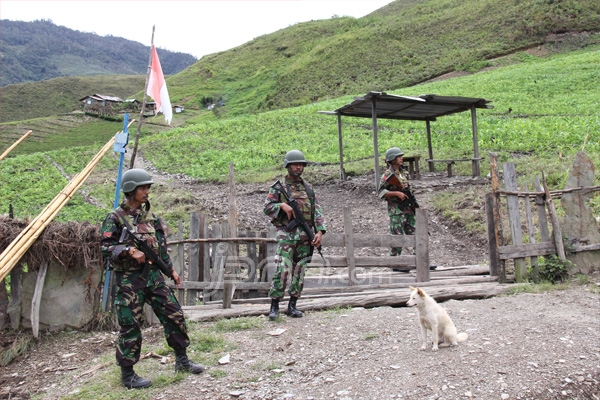
TNI soldiers manning checkpoint near Sinak, Puncak Jaya (Photo: jpnn.com/ malanesia.com)

At least 1000 members of various Indonesian security forces are currently occupying and laying siege to entire communities around Puncak Jaya, with thousands more troops being sent in from other centres in Papua, according to local church, human rights, and  sources in contact with West Papua Media stringers across the conflict area.

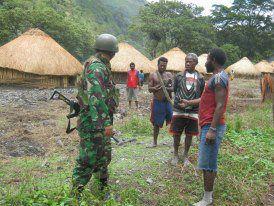
TNI 753 Btn interrogating locals in Sinak (photo: Malanesia.com)

According to these sources, the villages of Tingginambut, Trugi and Nelekom have been occupied by TNI forces since Sunday February 24, with villagers being forced to give all their food and houses to soldiers, and being subject to arbitrary and harsh interrogations.  TPN sources have also stated that troops are using the villages as strategic hamlets to prepare for a hunt and destroy mission to flush out the forces of Tabuni, who have claimed they are well prepared for guerrilla defence.

In Nambut and Gurake (Gurage) villages in Sinak District, security forces began to carry out house to house sweeping operations on February 26, and in villages in  Tingginambut, Puncak Jaya.  According to our sources, the TNI Commander in the area has commanded “that the sweeping operation is to be continued until the culprits from last Thursdays killings are arrested”.  The TNI have stated to local people they “need to see 11 persons sentenced,” according to the reliable source.

Two civilians were said to be arrested on February 27, according to Indonesian military reports, however independent sources could not confirm if any other civilians have been arrested.

As of February 26, at least 18 houses have been burned to the ground, 5 GIDI churches razed, 2 schools and a library have been destroyed by the combined Police/TNI forces in Tingginambut, according to reliable church sources who have safely relayed data from witnesses to West Papua Media stringers.   Witnesses have also reported that soldiers are deliberately burning and destroying food gardens and shooting livestock, including over one hundred pigs.  There are fears of a major humanitarian disaster unfolding with the reports of the destruction of food gardens and livestock, an act of collective punishment on a civilian population.

Thousands of people from the surrounding villages have fled to the high mountains and according to church sources, the entire community populations have fled throughout the area of Gurake, Sinak, Tinggi Neri, Trugi and Nelekom.  Exact numbers are not currently known but local sources indicate that several thousand people, mainly subsistence farmers, live in the area.

Human rights workers have also reported from Mulia in Puncak Jaya that townspeople are greeting news of the offensive with panic and preparing to flee.

Reports are difficult to verify as the only media personnel allowed into the operations area are those with approval from the Indonesian army, and very few of these journalist have actually ventured into the area.  Stringers for West Papua Media in Puncak Jaya and the Baliem Valley have reported that independent journalists and human rights workers have been prevented from travelling into the area by a de facto Military Operations Area being applied across the entire highlands, including the regional centre of Wamena.

Civilians are staying off the streets as reliable local sources report a massive combat army and police show of force, including house to house searches.  On the morning of February 28, witnesses have reported to West Papua Media stringers that 8 Brimob trucks have left

Troops patrolling Wamena - February 25 (photo: supplied)
Troops patrolling Wamena – February 25 (photo: supplied)

Wamena heading to Puncak Jaya this morning, with large numbers of troops patrolling the streets across Wamena also..

Thousands more troops flooding in to attempt to destroy Tabuni’s TPN.

Thousands of heavily armed combat soldiers from Battalions 751 (Jayapura), 753 (Nabire) , and supported by the Wamena 756 Batallion, are reportedly being flown into Tingginambut over the next few days from several centres across Papua.  They are joining together with over 1000 extra Brimob paramilitary police (in addition to the at least 1000 Polda Papua police already in the highlands), and allegedly several units of the notorious Australian-funded Detachment 88 anti-terror commando, to hunt for Tabuni’s forces.  Several media reports in Indonesia are also claiming a Kostrad (Strategic Reserve) battalion is being deployed from outside Papua, though this has not been independently confirmed.

Local sources have reported that each TNI platoon is accompanied by a platoon of police, as the operation is officially under control of the Police as a “law enforcement” operation.  However, the witnesses have reported that the TNI are clearly in command.   TNI spokespeople in Jakarta have told Indonesian media outlets that there is no plan to increase non-organic troop presence in the area, but local sources are reporting a vastly different story.

West Papua Media sources in Wamena observing the airport have confirmed that two TNI Puma Helicopters are involved in the operation constantly ferrying troops between Wamena and Tingginambut, and stopping only for refuelling and crew changes.  Three Hercules c130H aircraft have each made 3 drops to Wamena then the troops have entered by road from Wamena.   Observers in Nabire have also noted daily departures of three trucks of troops from the notorious Battalion 753 Nabire, to the west of the highlands to reinforce the offensive in Tingginambut.

Human rights and church sources in Puncak Jaya and internationally have expressed deep concern about the potential for heavy civilian casualties to occur with the intensified military campaign, given extra impetus after the Indonesian President, General Susilo Bambang Yudoyhono, called for firm action on Tabuni.

Multiple narratives from Jakarta

The exact circumstances of the deaths of the eight Kopassus special forces soldiers are now mired in claim and counter-claim, with soldiers’ personal accounts of the attack conflicting with the official narrative picked up by Jakarta media.  What is confirmed is that the eight commandos – Sertu (Chief Sergeant) Udine, Sertu Frans, Sertu Romadhon, Pratu (Private 1st class) Mustofa, Sertu Edy, Praka (Chief Private) Jojon, Praka Wempi and Sertu Mudin – were killed by a cascading attack led by guerrillas of Goliat Tabuni’s TPN group as they went to the Sinak airstrip to collect cellular monitoring equipment designed to track international phone communications in the area.

However, one survivor of the attack testified in the Jakarta Post that his group was attacked by men, women and children all carrying spears, machetes and knives.  According to the TNI survivors as relayed to JP, the platoon of Kopassus was unarmed at the time of the attack, which happened as the soldiers were installing and moving communications monitoring equipment.

Troops in Tingginambut after being shot at in helicopter by TPN, Feb 24 (Photo: TNI)
Troops in Tingginambut after being shot at in helicopter by TPN, Feb 21 (Photo: TNI)

TPN forces also opened fire on a Puma helicopter that was evacuating the wounded commandos, lightly injuring three helicopter crew.

West Papua Media sources have provided a highly credible and technical but unconfirmed report that two “very large weapons” that were being moved into Sinak, and went missing during the raid by TPN.  According to our sources, there is “extreme concern from the TNI around this particular issue.”

“Apparently they have been trying to find out the whereabouts of these weapons, which suggests they might be too heavy to quickly and easily move,” explained the source.  Further investigation is still required, but credible observers in the area believe that these heavy weapons may be artillery pieces – the presence of which in Puncak Jaya represents a serious and dangerous escalation of TNI hardware to be used against civilians.  West Papua Media believes any confirmed presence of artillery is connected with the TNI’s stated aim to destroy Goliat Tabuni’s group, but any use of these weapons will place a large number of civilians at risk.  It is not the first time the TNI have used artillery against West Papuan civilians: the Bloody Wamena massacres of 2000 and 2003, as well as the aerial bombardment campaigns in the 1977 and 1984.

Indonesian outrage fuels civil society questions on Papuan motivations for resistance

The killings of the soldiers have generated outrage in Jakarta, with nationalist politicians calling for cordon and destroy missions in what human rights observers have said amount to collective civilian punishment by an occupying force.

Sjafrie Sjamsoeddin – indicted as a war criminal

Indonesian Deputy Defence Minister Lieutenant-General (LG) (Rtd) Sjafrie Sjamsoeddin – indicted as a war criminal by the UN for his role in East Timor – on Friday ordered the TNI to conduct heavy “tactical actions” in order to prevent the shooting from occurring again.  “The tactical action includes to chase, apprehend and destroy,” the deputy minister said here on Friday.  He said the latest shootings by the separatist rebels did not affect TNI`s strategic policies in Papua. TNI so far did not have a plan to send more troops to Papua, he added.

However SBY also claimed in an interview with MetroTV that “no violence” would be used to solve the situation.  The situation on the ground has illustrated that security forces have no interest in making SBY’s words truthful.

Despite  the nationalist rhetoric, there are many in Indonesia who are seeing this as a wake up call to end Jakarta’s use of state violence against civilians in Papua as it default policy.

The Indonesian Regional Representatives Council, or DPD, called for a necessary cessation of military operations to end the prolonged violence in Indonesia’s easternmost provinces, according to a report in the Jakarta Post on Wednesday.

The presence of the non-organic personnel from TNI special forces cause animosity among Papuan groups, who have launched attacks against them, according to the report.  “If Jakarta wants to end violence, the militaristic approach has to stop, and all non-garrison troops from the military elite forces must be withdrawn from the two provinces because their presence and their irregular operations have triggered attacks on garrison troops and innocent civilians,” DPD deputy chairman Laode Ida said on Tuesday.

A coalition of Papuan human rights groups urged the National Commission on Human Rights (Komnas HAM) to conduct a thorough investigation into the soldiers’ killings, saying the presence of Komnas HAM could prevent human rights violations that occurred during TNI sweep operations after shooting incidents, according to a report in the Jakarta Globe.

“We encourage law enforcers to be professional in carrying out their tasks. They must ensure that their attempts to find the perpetrators do not turn into seeking revenge against all Papuans,” Ferry Marisan from the Institute for Policy Research and Advocacy (Elsam) said in Jayapura on Monday.

The TNI has loudly complained in Indonesian media of hurt feelings about the loss of its soldiers, with the National Human Rights Commission (Komnas HAM) leaders have been forced to apologise for “insensitive” remarks saying killing soldiers is not a human rights abuse.   But not all observers are showing sympathy for the loss of the soldiers lives, pointing to the fact that the military are occupying Papuan land against the wishes of the local people.

“One has to remember that soldiers who were shot were Kopassus special forces who have been involved in ongoing human rights abuses right across Puncak Jaya, including village burnings, collective arrests and punishment, burning of villages, and acts of torture.  Many observers suspect these soldiers were part of units involved in conducting many OTK (Unknown persons) shootings blamed on West Papuans,” a long time human rights worker in the highlands told West Papua Media by email.  “These are not innocence, nor babes in the woods; Kopassus are the original wolves in the forest.”

Still, other observers believe the actions point to an assertion of tribal identity, as a complex motivator behind the declaration of Papuan sovereignty inherent in the armed resistance against Indonesia’s militarist policy in the highlands.  An Australian church worker who worked for many years with highland communities in Puncak Jaya made the observation to West Papua Media that this was not simply an act of resistance to Indonesian colonisation, but an assertion of traditional and indigenous Papuan law and cultural survival against the onslaught of an occupying colonial army.

“This must be looked at from another perspective that is relevant.  As many indigenous communities including Australian Aboriginal Peoples and traditional highland Papuan people, observe around the world, if outsiders came into their sacred lands, they would also feel compelled at whatever cost to themselves to spear the outsider to compensate (violations of) their traditional law if they belonged to the clan that was legally responsible (under customary law) to guard that site,”  she explained.

“Indigenous Law is simply not negotiable on things like that. Things have only changed in Australia because non-Indigenous systems have for years now in Australia been locking up those indigenous peoples who have acted to maintain their law,” the former church worker explained.

“As I understand the TNI despite warnings were acting in a way that broke the Papuans’ traditional laws regarding adat (Customary law), and as the TPN are still holding strong to their traditional laws, so they acted in accordance with the laws they are living by. I can’t see any difference at that level as Melanesian peoples separated historically but only a short distance of water. The difference is that the TPN OPM represent groups that have not yet been overcome by the laws of a colonising power whereas RI does not recognise the traditional Papuan customary laws,” she said

A prominent Papuan human rights activist, Yasons Sambon, has reported that the killings are causing many military families to reconsider  their support for the Indonesian colonial occupation of Papua.  In an interview with the wife of one of the eight soldiers killed at Sinak, recorded on February 23 after the soldiers funeral in a car by the old market in Sentani, the widow called for Indonesia to abandon its occupation of Papua.

Funeral of Sentani based Kopassus officer killed in SInak incident, Feb 24. (supplied)

The wife of an Indonesian soldier from Sentani said in a regretful tone, “SBY would be better off giving independence to the people of Papua if it meant our husbands wouldn’t become victims. Our husbands have been murdered. What will be my fate, and the fate of my children, now that my husband has been murdered? We want to hold onto our husbands but they also have a duty to the country. They are murdered and it’s the women and children who become victims, because if they aren’t at work, then what will we eat?”

“It’s better if independence is given to the people of Papua so that we can be safe,” she said.

*from the West Papua Media Editorial team, with additional reporting from stringers in Wamena, Tingginambut, Jayapura, Nabire and sources in Jakarta.

Create a website or blog at WordPress.com

Up ↑