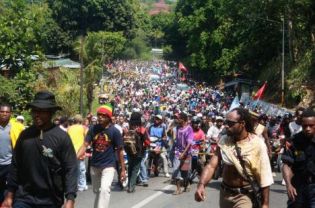
Thousands of Papuans march in a rally in Jayapura on July 8, 2010 to urge the provincial parliament to demand a referendum on self-determination, and reject the region's special autonomy within Indonesia. (AFP Photo/Banjir Ambarita)
Hundreds of Papuans have protested in Jayapura rejecting the region’s special autonomy within Indonesia and demanding a referendum on self-determination.
Carrying a wooden coffin covered with a black cloth which said “Special Autonomy is Dead in Papua,” more than 1000 activists, students and church leaders protested on Wednesday in front of the provincial parliament, witnesses said.
“Independence for Papua, reject special autonomy,” they shouted.
“Indonesia the coloniser, Indonesia the oppressor, Indonesia the robber.”
They also called for the upper house of tribal leaders called the Papua People’s Assembly (MRP) to be disbanded.
“The MRP had done nothing to improve the welfare of Papuans. Our people are poor in their own land,” protest coordinator Selpius Bobi said.
“We reject special autonomy as that is the Indonesian government’s policy which has never supported the natives. We want a referendum that will allow us to determine our own fate,” he added.
Papua’s special autonomy status, introduced in 2001 after the fall of former president Suharto’s military dictatorship, has seen powers including control of most tax revenue from natural resources devolved to the provincial government.
However many Papuans say it has failed to improve their rights and activists accuse the Indonesian military of acting with brutal impunity against the indigenous Melanesian majority in the far-eastern region.
A court martial jailed three Indonesian soldiers on Monday for up to 10 months for abuse and insubordination after graphic video footage showed them torturing civilians in Papua.
The sentences were criticised by the United States and rights campaigners as too lenient.
Foreign media and aid workers are not allowed into Papua and West Papua provinces to investigate allegations of human rights abuses against the indigenous people.
Papua has been the scene of a low-level insurgency for decades and despite Indonesia’s vast security presence in the region, Jakarta remains extremely sensitive about any sign of separatism.
More Than 100 Political Prisoners Held for Protesting Peacefully
(New York, January 25, 2011) – The Indonesian government should ensure
that soldiers responsible for abuses are appropriately prosecuted and
punished, Human Rights Watch said today in its World Report 2011. The
January 24, 2011 verdict in a Papua military tribunal of eight to ten
months imprisonment for soldiers who engaged in torture was woefully
inadequate, Human Rights Watch said.
The 649-page report, Human Rights Watch’s 21st annual review of human
rights practices around the globe, summarizes major human rights
trends in more than 90 countries and territories worldwide. Over the
past 12 years, Indonesia, the report says, has made great strides in
becoming a stable, democratic country with a strong civil society and
independent media, but serious human rights concerns remain.
“Senior officials must both talk the talk and walk the walk on human
rights,” said Elaine Pearson, deputy Asia director at Human Rights
Watch. “The military should stop shielding its officers from
prosecution, and the government needs to hold abusers accountable.”
In July 2010, the US government lifted its ban on military assistance
to Kopassus, Indonesia’s elite special forces, despite continuing
concerns about its human rights record. Strong evidence of security
force involvement in torture emerged in 2010. Defense Minister Purnomo
Yusgiantoro pledged to suspend soldiers credibly accused of serious
human rights abuses, to discharge those convicted of abuse, and to
cooperate with their prosecution. But only a handful of cases made it
to military tribunals, and the charges did not reflect the gravity of
the abuses committed.
In October, a 10-minute cell phone video came to light that showed
Indonesian soldiers interrogating and brutally torturing two Papuan
men, Tunaliwor Kiwo and Telangga Gire. In the video, Kiwo screams as a
piece of burning wood is repeatedly jabbed at his genitals. After
pressure from foreign governments, the military finally held a
tribunal in Jayapura, Papua, in January. But it is only tried three of
six soldiers in the video – Second Sgt. Irwan Rizkiyanto, First Pvt.
Jackson Agu, and First Pvt. Thamrin Mahamiri of the Army’s Strategic
and Reserve Command (Kostrad) 753rd battalion – on military
discipline charges, rather than for torture. The three were sentenced
to ten months, nine months, and eight months respectively. Military
prosecutors only sought sentences of up to 12 months rather than the
maximum 30 months as allowed under the military criminal code.
Another torture case captured on video in 2010 involved several
soldiers kicking and beating villagers in Papua. Four soldiers from
the same Kostrad 753rd battalion were tried on military disciplinary
grounds and were sentenced only to five to seven months in prison. The
convictions are on appeal before the Surabaya high military tribunal.
These two cases were unusual in that the ill-treatment was captured on
video, but for years Human Rights Watch has documented serious human
rights violations in Papua for which soldiers have never been held to
account. Human Rights Watch called on the US to publicly clarify its
relationship with the Kostrad 753rd battalion and the individuals
involved in this incident, in order to ensure compliance with the
Leahy law.
“Rather than cooperating with civilian authorities and suspending the
soldiers involved as soon as the video appeared, the Indonesian
government has dragged its feet and reluctantly done the bare minimum
to try and make this go away,” said Pearson. “This is not the new and
improved army that the defense minister promised, but the same old
military impunity we’ve seen for decades in Indonesia.”
The government did little to curb attacks and discrimination against
religious, sexual, and ethnic minorities during 2010. On several
occasions, militant Islamic groups mobilized large groups of private
citizens and attacked places of worship of religious minorities.
Police frequently failed to arrest the perpetrators of the violence.
While Indonesia has vibrant media, throughout 2010 Indonesian
authorities invoked harsh laws to prosecute individuals who raised
controversial issues, chilling peaceful expression. Indonesia’s
criminal libel, slander, and “insult” laws prohibit deliberately
“insulting” a public official and intentionally publicizing statements
that harm another person’s reputation, even if those statements are
true. For instance, in early 2010, Tukijo, a farmer from Yogyakarta,
was sentenced to six months’ probation and a three-month suspended
prison sentence for criminal defamation after he argued with a local
official regarding a land assessment.
The government has imprisoned more than 100 activists from the
Moluccas and Papua for rebellion for peacefully voicing political
views, holding demonstrations, and raising separatist flags. In
August, the authorities arrested 21 Southern Moluccas activists in
Ambon and Saparua and charged them with treason for planning to fly
balloons and Southern Moluccas Republic flags during a visit by
President Susilo Bambang Yudhoyono.
The country’s political prisoners include Filep Karma, 51, a Papuan
civil servant imprisoned for organizing a Papuan independence rally on
December 1, 2004, and Buchtar Tabuni, 31, a leader of the West Papua
National Committee, a Papuan independence organization that has grown
more radical since his imprisonment.
Government restrictions on access to Papua by foreign human rights
monitors and journalists imposed when Indonesia took over Papua in
1969 remained in place in 2010.
“By keeping the foreign media and rights organizations out of Papua,
the Indonesian government is all but admitting that serious abuses
persist,” Pearson said. “Ending those restrictions would be a first
step in reversing Papua’s downward spiral.”
For more information, please contact:
In Perth, Elaine Pearson (English): +61-415-489-428 (mobile)
In Washington, DC, Sophie Richardson (English, Mandarin):
+1-917-721-7473 (mobile)
In Jakarta, Andreas Harsono (English, Bahasa Indonesia):
+62-815-950-9000 (mobile)
The Australian Greens have called for the Government to cut all military
ties with Indonesia in response to light jail terms handed down
yesterday to Indonesian soldiers who tortured two Papuan men.
Greens legal affairs spokesperson Senator Scott Ludlam said the conduct
of the Indonesian government and the farcical trial of the three
soldiers involved showed a “total lack of respect for human rights”.
“What we have here is an open and shut case of severe torture, with
video evidence, and the soldiers responsible will spend, at most, 10
months in prison and then continue their careers in the Indonesian army
– they won’t even be discharged. It is a disgrace – an absolute
disgrace,” said Senator Ludlam.
“There is no ambiguity here. A video of the torture shows the soldiers
burn one man’s genitals, suffocate him with a plastic bag and hold a
knife to his throat. One of the victims said he was beaten for two days,
held over a fire and had chillies rubbed into his wounds,” he said.
“First the Indonesian authorities claimed their soldiers were not
responsible, and then charged them with ‘disobeying orders’. It was a
pathetic response from a government that couldn’t care less about the
human rights of the Papuan people.”
Senator Ludlam said the Australian Government must cut military and
para-military ties with Indonesia.
“Why are we helping to train and arm these soldiers? Why do we fund the Indonesian National Police when its Detachment 88, a so-called
counter-terrorism unit, has been linked to a series of human rights
abuses?” said Senator Ludlam. “While human rights abuses, while torture
continues in Papua and Maluku, we can not fund and train the people
responsible.”
Indonesia: Stop Stalling on Investigating Torture Video Episode Papuan Farmer Describes Days of Abuse by Soldiers
(New York, November 22, 2010) – The Indonesian government should use the newly available video testimony of a torture victim to mount a thorough, impartial, and transparent investigation into the episode, Human Rights Watch said today. The torture of Tunaliwor Kiwo, a Papuan farmer, and his neighbor, was recorded with a mobile phone on May 30, 2010, and the video came to light in October. Kiwo recounted the details of his torture in videotaped testimony only made public in recent days.
Soldiers arrested Kiwo and Telangga Gire on May 30 in Papua’s Puncak Jaya regency. In a 10-minute video of the torture session, soldiers are seen kicking Kiwo’s face and chest, burning his face with a cigarette, applying burning wood to his penis, and placing a knife to Gire’s neck. In the newly available videotaped testimony, Kiwo describes that torture and details other forms of torture he suffered for two more days before he escaped from the soldiers on June 2. Soldiers also tortured Gire, who was finally released after interventions by his wife and mother. The government has promised to investigate, but claims it cannot identify the perpetrators.
“Once again, the authorities are sitting on their hands rather than fulfilling their obligations and proactively identifying and prosecuting the soldiers responsible,” said Phil Robertson, deputy director of Human Rights Watch’s Asia division. “Kiwo has shown tremendous bravery in coming forward – he deserves justice and protection from retaliation, not another half-hearted army investigation and cover-up.”
Indonesia is a party in the United Nations Convention Against Torture and has strict obligations to investigate and prosecute promptly all incidents of torture and to ensure that victims and witnesses are protected against all ill-treatment or intimidation as a consequence of filing a complaint or giving evidence.
Kiwo said in his testimony that he and Gire had been riding a motorcycle from their hometown, Tingginambut, to Mulia, the capital of Puncak Jaya, when soldiers stopped them at a military checkpoint in Kwanggok Nalime, Yogorini. Kiwo said that soldiers seized and hit them, bound their arms with rope, dragged them to the back of the army post, and tied their feet with barbed wire. He said the soldiers tortured him for three days, beating him with their hands and sticks, crushing his toes with pliers, suffocating him with plastic bags, burning his genitals and other body parts, cutting his face and head and smearing the wounds with chilies, and using other forms of abuse.
Kiwo’s videotaped testimony with subtitles in English and Indonesian can be viewed on the Engage Media website.
“The Indonesian government at the highest levels should guarantee that Tunaliwor Kiwo and Telangga Gire will be protected from retaliation and considered witnesses to crimes,” Robertson said. “The testimony of these two men will be critically important in prosecuting the soldiers who tortured them, so protecting them needs to be a top priority.”
The October media coverage of the May 30 torture video prompted President Susilo Bambang Yudhoyono to hold a limited cabinet meeting on October 22, after which the coordinating security minister, Marshall Djoko Suyanto, admitted that the video showed Indonesian soldiers torturing Papuan villagers. Yudhoyono reportedly ordered the military to investigate immediately, but the government has provided no information about the progress of the investigation.
The National Commission on Human Rights (Komnas HAM) estimates that as many as 50 civilians have been killed in the area since the Indonesian military and police began military operations there last year.
Representatives of the Papuan Customary Council provided the video of Kiwo’s testimony to the National Commission on Human Rights on November 5. The Commission set up a team to investigate the torture episode as well as other human rights abuses alleged to have occurred in Puncak Jaya. The Commission has scheduled a trip to Papua to investigate further, though an earlier visit in late October to investigate the Kiwo-Gire torture video was frustrated by a lack of access and cooperation from military and local officials.
Unexpectedly, Maj. Gen. Hotma Marbun, the Indonesian military commander in Papua, was removed from his post on November 12. It was announced as a “routine transfer” even though Marbun had only been in Papua since January. Human Rights Watch has no information indicating that this transfer is punitive or connected in any way with the torture video. His replacement, Brig. Gen. Erfi Triassunu, should ensure that investigations in the torture case are carried out thoroughly and impartially, and that army officials under his command fully cooperate, Human Rights Watch said.
“Changing military commanders will not root out impunity,” Robertson said. “The victims deserve justice. The Indonesian military and police in Papua should fully cooperate with investigators from the National Commission on Human Rights.”
To view the videotaped testimony of Tunaliwor Kiwo, please visit:
For more information, please contact:
In Jakarta, Elaine Pearson (English): +1-646-291-7169 (mobile); or +62-812-8222-3591 (mobile)
In Bangkok, Phil Robertson (English, Thai): +66-850-608-406 (mobile)
In Washington, DC, Sophie Richardson (English, Mandarin): +1-202-612-4341; or +1-917-721-7473 (mobile)
Appendix: Confusion over two different torture videos from Papua
March 17, 2010 video
On November 5, 2010, the Jayapura military tribunal opened the trial against Master Pvt. Sahminan Husain Lubis, Pvt. Second Class Joko Sulistiono, Pvt. Second Class Di Purwanto, and their commander Second Lt. Cosmos N. of the Kostrad 753 battalion on the charge of “disobeying orders.” Cosmos led a 12-person unit to man a checkpoint in Kolome village, Illu district, Puncak Jaya. Many international and national reporters, and some Indonesian officials, mistakenly believed the trial was to focus on the torture of Kiwo-Gire as captured in the video of May 30, 2010.
During the trial, it became clear that the case involved a different incident of torture also caught on video but filmed on March 17, 2010. In the proceedings, the soldiers admitted the torture depicted in the video. According to Cosmos, the incident happened when his team conducted a routine patrol. He said he received intelligence information suggesting that there was an AK-47 and Mauser weapons stockpile in Gurage village.
The team entered the village and separated the men and women. One by one, they questioned all the men, and when they did not receive responses they considered acceptable, the soldiers began kicking and punching the villagers. Second Pvt. Ishak used a Nokia N-70 mobile phone to record the interrogations and beatings. He told the court that Cosmos had ordered him to do so.
Observers at the trial reported to Human Rights Watch that a judge, Lt. Col. CHK Adil Karo Karo, told Ishak, “You’re stupid. Knowing how sensitive it was, why did you keep recording it anyway?” It was a quick trial with only two sessions for hearings and not a single external witness was summoned by the court. On November 12, the Jayapura military tribunal found Cosmos and the three privates guilty of “disobeying orders.” Cosmos was sentenced to seven months. The three privates were sentenced to five months each.
May 30, 2010 video
The May 30, 2010 video showed a number of soldiers with two bound Papuan men lying on a dirt road. An electronic analysis of the video showed that it was taken at 1:30 p.m. A Puncak Jaya-based official of the Papuan Customary Council reported in August 2010 that two men had been tortured on the afternoon of May 30: Tunaliwor Kiwo and Telangga Gire. Moribnak had managed to interview Gire in July. Moribnak wrote that the torture had probably taken place in Yogorini village, Tingginambut district, Puncak Jaya regency. It allegedly involved members of Kostrad 753rd battalion. Given government restrictions on international organizations entering these areas, Human Rights Watch has not been able to independently confirm the actual location where the torture took place or the identity of the unit of the soldiers.
Kiwo escaped from the soldiers on June 2, and the soldiers released Gire after his mother and his wife had pleaded for his life.
Human Rights Watch issued a statement on October 20, calling on the Indonesian government to investigate the incident seriously.
A letter sent from the UK Foreign Office to human rights group Tapol has revealed that British taxpayers money is being used to sponsor a Master’s degree course in Defence and Security Management, attended by members of the TNI. This revelation comes hot on the heels of footage showing TNI members attacking villagers in West Papua, amid reports of widespread abuse by them in the province.
We immediately raised our concerns about this case with the Indonesian authorities, in London with Ambassador Thamrin and in Jakarta with the President’s Foreign Policy Adviser. We have expressed our hope that there would be a full and transparent investigation into the incident and that those responsible would be held accountable.
We have encouraged the Indonesian Government to respond constructively to allegations of human rights abuses, and welcome the Indonesian military’s admission of wrongdoing in this case. We hope that details of the investigation will be made available to the international community.
We continue to stress to the Government of Indonesia that if there is credible evidence of wrongdoing, it should be investigated and those responsible brought to justice.
We believe that the best way to encourage further progress within the Indonesian armed forces is through constructive engagement and the delivery of appropriate training. This has included regular Indonesian placements on MOD flagship courses (e.g. Royal College of Defence Studies, Advanced Command and Staff College), regional training focused on Peace Support Operations and maritime/border security, including an annual Exclusive Economic Zone monitoring course, ship visits and senior level engagement.
The Ministry of Defence (MoD) sponsors a Master’s degree course in Defence and Security Management, delivered by Cranfield University, at the Defence University in Jakarta. This course has been very successful over the last 4 years and many of the students are from members of the TNI. The MoD also supports development of the TNI in human rights by offering training in the Law of Armed Conflict.
Yours sincerely
N Atmore
Indonesia Desk Sout East Asia Pacific Group




 West Papua Media Alerts