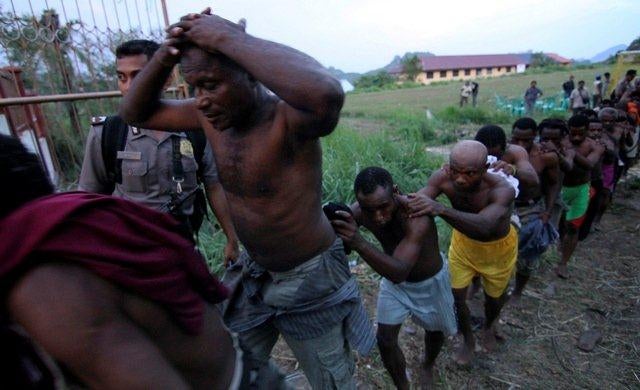
Prison warders beat and kick more than forty prisoners

JUBI, 10 May 2012

At least 42 prisoners – both political and criminal – have been beaten by warders in Abepura Prison where they are being held,  with these beatings occurring on 30 April.

According to information from the Justice, Peace and Creation Secretariat (SKPKC) in Jayapura, the prisoners who were beaten included Selfius Bobii, Luis Kossay, Terianus Tabuni, Wayus Hubi, Markus Dubi, Stenly Palondong, Alfian Palendeng, Erens Apromis, Octo Ikinia and Fredy Marsyom.

Some of them were beaten until they were black and blue all over. Selsius Bobii said he had ben slapped, hit and kicked all over his body. He was then dragged into the prison office. Luis Kossay said that he had been struck by a bludgeon, by iron rods and beaten with a rope and while being beaten he was kicked and then dragged out of his cell, dragged 200 metres and thrown into the yard. In the yard, his fingers and toes were stamped on by warders with their heavy boots. After suffering all this, he was ordered to remain in a half-squatting position for an hour.Three other prisoners were subjected to the same painful treatment and the rest were also beaten and kicked without mercy.

These acts of maltreatment occurred on 30 April and began when Selpius Bobii and some other prisoners asked the warders not to lock their cell doors because they wanted to practise singing some songs for their co prisoners. However, he was ordered out of his cell and taken to stand before the security official  who refused to grant him permission to do this. Selpius tried to explain that they wanted to rehearse some songs to be recorded later on, but permission was refused. and he was ordered to return to his cell.

Selpius said later that the previous warder, Ayurbaba, had given them permission to do these things and had allowed the prisoners to have recreational activities. When the new chief warder Liberty Sinijak heard this going on, he came out and started shouting at Selpius. In response Selpius shouted back, saying that the warders were doing nothing to help the prisoners but only trying to crush them.

The chief warder shouted back and ordered Selpius into the isolation wing. When the other prisoners in their cells heard all this shouting, they started calling out to the warders to stop maltreating Selpius.

‘Saying that there are no political prisoners in Papua is a Lie’

Bintang Papua, 7 March 2012Following a statement that has just been made by Amir Syamsuddin, the Minister for Law and Human Rights claiming that there are no political prisoners (tapol/napol) in Papua, various human rights groups as well as Mama Yosepha, the Director of  the Human Rights and Anti-Violence Foundation, and Markus Haluk, a well-known Papuan human rights activist, have responded.

Mama Yosepha and Markus Haluk said: ‘This statement by the Minister for Law and Human Rights shows the extent of the lies being made in public, which came after the dialogue organised by Amnesty International  last November. The Minister said that there were no political prisoners in Papua, only criminal prisoners. This is in line with the racist policies that are used against the Papuan people,’ said Markus Haluk.

Mama Yosepha and Markus Haluk said: ‘We are well aware of the denials and lies continually being spread by the Indonesian government through the Minister for Law and Human Rights. This is happening systematically in relation to the true facts that are known to the Papuan people. Since late 2011, five political prisoners have been on trial, Forkorus and his four colleagues, who are facing the charge of makar – treason – in connection with the declaration made by the Federal Republic of West Papua in October 2011 on Zakheus Square, Jayapura. In addition, from 2008 – 2010, sixteen political prisoners have been in custody in Manokwari while in Fak-Fak there are as many as sixteen prisoners, as well as fifteen in Nabire, four in Mamberamo Raya, one in Biak who is being held in  Abepura prison, and of all these, four are convicted prisoners, plus another six in Timika , which means that from 2008 to the present there have been 67 political prisoners.’

Markus went on to say that there are around ten political prisoners being held in connection with the assault on the ammunition dump in Wamena in 2003 who are now in  custody in Nabire and Biak prisons,while Filep Karma has been in custody since 2004, having been sentenced to fifteen years  and is being held in Abepura Prison, which brings the total since 2008 to seventy-two tapols and napols (tapol refers to detainees, while napol refers to convicted prisoners).

The fact that there are political prisoners in  Papua  was officially acknowledged by the head of  the Papua office of the Ministry of Law and Human Rights, Drs Daniel Biantong in 2010, when he produced a list of 25 persons registered as tapol and napol throughout Papua.

‘The demands for sentencing have varied from eleven months to life imprisonment. This can be broken down as follows: one person for eleven months, two persons for three years, three persons for five years, one person for six years, one person for ten years and one person for fourteen years, as well as three persons who  were sentenced to fifteen years, five who were sentenced to seventeen years, four to twenty years, while two were given life sentences. In all these cases, the prisoners were charged with makar under Article 106 of the Criminal Code,’ he said.

If we go farther back, said Markus,  following the dialogue held on 26 February 1999 during the presidency of B.J.Habibie , all political prisoners who were then being held in Papua were released. However, one year later, in 2000, many Papuan leaders  and ordinary Papuans were arrested and put on trial for makar, and this has been going on up to the present day.

Mama Yosepha,  said: ‘We human rights activists in Papua  have been firmly insisting that there are tapols and napols in Papua, and they are not criminal prisoners. We urge on the Indonesian government to stop spreading lies  and making racist remarks, like talking about murders, arrests and detentions with regard to Papuan leaders and ordinary Papuans here in the Land of Papua. Instead they should release Papuan leaders such as Forkorus Yaboisembut and Edison Waromi as well as the three others with them and lift the makar charges that are being made against all five of them.’

She went on to say: ‘Bearing in mind the statement made by the Minister for Law and Human Rights last  year and then on 5 March 2012, and bearing in mind too that Indonesia is now a Democratic State,what should happen is that the Indonesian government should release all the political prisoners who are now being held throughout Papua  as well as outside Papua.’

She went on to add: ‘We urge the Indonesian government to allow complete access for diplomats, journalists, human rights workers, members of Senates and congresses [around the world] to visit Papua.’

HRW:: Indonesia – Drop Charges Against Papuan Activists

English: Human Rights Watch logo Русский: Лого...

Free Political Prisoners, Amend Treason Law to Uphold Free Speech

JANUARY 29, 2012
  • Police arrest attendees of the Third Papuan People
    Congress in Jayapura, Indonesia‘s Papua province on
     October 19, 2011.  © 2011 Reuters
The Indonesian government should show its commitment to peaceful expression by dropping the charges against these five Papuan activists. It’s appalling that a modern democratic nation like Indonesia continues to lock up people for organizing a demonstration and expressing controversial views.
Elaine Pearson, deputy Asia director

(New York) – The Indonesian government should drop charges against five Papuan activists who are being prosecuted for peacefully expressing their political views, Human Rights Watch said today. On January 30, 2012, the district court in Jayapura, the Papua provincial capital, will begin the treason (makar) trial of five leaders of the Papuan People’s Congress, which the authorities forcibly dispersed last October.

“The Indonesian government should show its commitment to peaceful expression by dropping the charges against these five Papuan activists,” said Elaine Pearson, deputy Asia director at Human Rights Watch. “It’s appalling that a modern democratic nation like Indonesia continues to lock up people for organizing a demonstration and expressing controversial views.”

On October 19, 2011, Indonesian security forces, using excessive force, broke up a three-day Papuan People’s Congress gathering in Jayapura, Human Rights Watch said. After one of the leaders read the 1961 Papua Declaration of Independence out loud, police and the army fired warning shots to disperse the approximately 1,000 Papuans gathered for the peaceful demonstration supporting independence for Papua. The security forces then used batons and in some instances firearms against the demonstrators, killing at least three and injuring more than 90 others. Witnesses said that demonstrators had been struck on the head and several suffered gunshot wounds.

Following the incident, eight police officers, including the Jayapura police chief, Imam Setiawan, were given written warnings for committing a disciplinary infraction by not giving priority to the protection of civilians. However, no other action was taken against police or military personnel for possible misuse of force.

Five of the activists– Forkorus Yaboisembut, Edison Waromi, August Makbrowen Senay, Dominikus Sorabut, and Selpius Bobii – were charged with treason under article 106 of the Indonesian Criminal Code and have been held in police detention since October 19. Another Papuan, Gat Wenda, a member of the Penjaga Tanah Papua, orPepta (Papua Land Guard), which provided security at the Congress, will be tried separately on charges of possessing a sharp weapon.

At least 15 Papuans have been convicted of treason for peaceful political activities. They include Filep Karma, a civil servant who has been imprisoned since December 2004. About 60 other people throughout Indonesia, mostly activists from the Moluccas Islands, are also imprisoned on charges related to peaceful acts of free expression. Human Rights Watch renewed its call for the Indonesian government to release all political prisoners and allow human rights organizations and foreign journalists unimpeded access to visit Papua.

The Indonesian Criminal Code should be amended to ensure that no one is prosecuted for treason for exercising their rights to peaceful protest protected under the Indonesian constitution and international law, Human Rights Watch said. The constitution in article 28(e) states, “Every person shall have the right to the freedom of association and expression of opinion.” Article 28(f) provides, “Every person shall have the right to communicate and obtain information for the development of his/her personal life and his/her social environment, and shall have the right to seek, acquire, possess, keep, process, and convey information by using all available channels.” The International Covenant on Civil and Political Rights, which Indonesia ratified in 2006, similarly protects the rights to free expression and peaceful assembly.

Human Rights Watch takes no position on claims to self-determination in Indonesia. Consistent with international law, however, Human Rights Watch supports the right of everyone, including independence supporters, to express their political views peacefully without fear of arrest or other forms of reprisal.

“The Indonesian government should be prosecuting the people responsible for the ugly and unnecessary crackdown that left three Papuans dead, not those who read out a 1961 independence statement,” Pearson said. “Pursuing this trial will only deepen the resentment that many Papuans feel against the government.”

AMNESTY: PAPUAN ACTIVIST IMPRISONED FOR PEACEFUL POLITICAL ACTIVITIES

PUBLIC STATEMENT

25 August 2011

Index: ASA 21/ 027 /2011

I ndonesia Papuan activist imprisoned for peaceful political activities

Papuan activist Melkianus Bleskadit has been imprisoned in West Papua province for his involvement in a peaceful protest and for raising an independence flag. His sentence highlights the continuing use of repressive legislation to criminalize peaceful political activities in the province. Amnesty International calls for his immediate and unconditional release.

On 14 December 2010 a group of activists including students took part in a peaceful march in Manokwari, West Papua province, protesting against injustice and human rights violations by the Indonesian security forces against Papuans. The march ended at the Penerangan field in Manokwari where other political activists had gathered to commemorate the anniversary of the independence of “West Melanesia”.

During the ceremony the “14 Star Flag”, a symbol of West Melanesian independence, was raised. The Manokwari Sub-district Public Order Police (Polres) arrested seven political activists: Melkianus Bleskadit; Daniel Yenu, a priest; and five students – Jhon Wilson Wader, Penehas Serongon, Yance Sekenyap, Alex Duwiri and Jhon Raweyai.

All seven men were charged with “rebellion” under Article 106 of the Indonesian Criminal Code which carries a maximum sentence of life imprisonment, and with “incitement” under Article 160.

On 18 August the Manokwari District Court sentenced Melkianus Bleskadit to two years’ imprisonment while Daniel Yenu was sentenced to seven months and 16 days’ imprisonment on 23 August 2011. Daniel Yenu has been released as he has spent more than eight months in detention. The trials of the five students are ongoing.

Daniel Yenu’s lawyer has also raised concerns about his trial. The lawyer alleges that evidence not obtained from the location of the incident was introduced during the trial and that Daniel Yenu was brought before the court on 16 August and forced by the judges to defend the charges against him without the presence of his lawyer, who was preparing a written defence brief.

The International Covenant on Civil and Political Rights (ICCPR), to which Indonesia is a state party, and the Indonesian Constitution guarantee the rights to freedom of expression, opinion, association and peaceful assembly. While the Indonesian government has the duty and the right to maintain public order, it must ensure that any restrictions to freedoms of expression and peaceful assembly are no more than is permitted under international human rights law.

Amnesty International calls on the Indonesian authorities to withdraw government regulation No. 77/2007 that bans the display of regional logos or flags, which are used by separatist organizations. Amnesty International believes that this regulation is contrary to the spirit of the 2001 Special Autonomy Law that granted Papuans the right to express their cultural identity. Furthermore, the ban on waving these flags cannot be considered legitimate grounds for restricting freedoms of expression and association as set out in the ICCPR.

Amnesty International is aware of al least 90 political activists in the provinces of Maluku and Papua who have been imprisoned solely for their peaceful political activities. Amnesty International considers them to be prisoners of conscience and calls for their immediate and unconditional release.

Amnesty International takes no position whatsoever on the political status of any province of Indonesia, including calls for independence. However the organization believes that the right to freedom of expression includes the right to peacefully advocate referendums, independence or any other political solutions that do not involve incitement to discrimination, hostility or violence.

Open Letter – FREE YOUTH ACTIVISTS AND RESPECT HUMAN RIGHTS OF THE PEOPLE OF WEST PAPUA

A Open Letter


To the Government of Indonesia, Indonesian Youth Activists, Indonesian Human Rights Defenders and Organisations, and the People of West Papua. 

RE: FREE YOUTH ACTIVISTS AND RESPECT HUMAN RIGHTS OF THE PEOPLE OF WEST PAPUA

A collection Youth/Human Rights Organisations and Advocates based in Fiji (and across Oceania) are concerned with the continued suppression of witnesses and the media regarding the imprisonment and secret court proceedings surrounding the arrest of 5 youth activists arrested on December 17th 2010 for raising the West Papua Liberation Flag.

Five youth activists Jhon Wenda, George Rawiay, Benha Supanga, Alex Duwe, and Iyance have been charged under Article 106 and 110 of the Indonesian Criminal Code.

Some 200 people took part in a peaceful ceremony outside Manokwari in December 2010, during which the Morning Star flag, a symbol of Papuan independence, was raised in commemoration of the declaration of Papuan independence in 1962.  When the flag was raised, Indonesian Military advanced on the crowd, firing shots and beating people with batons.

We have been advised by colleagues within the West Papua Liberation Movement that the health of these 5 youth activist and safety after been detained since December 2010 is of serious concern. They also noted the media censorship on the case and how many witnesses are afraid to testify because of further repression. We have also been told that a heighten sense of fear has been fueled by the continued presence of a 1000 plus military presence in the province of Manokwari that were ordered into the area.

Human Rights and the protection of activists or defenders of these rights must be respected if we are to allow peace to exist in West Papua. Indonesia as a State signatory to the Universal Declaration of Human Rights and many other Human Rights Instruments should see its role in the protection and advancement of Human Rights, Media Freedom, Civil and Political Rights of all peoples they claim to govern.

Indonesia was re-elected this year into the UN Human Rights Council for the period 2011-2014, which is an inter-governmental body within the UN system made up of 47 States responsible for strengthening the promotion and protection of human rights around the globe. Indonesia’s own human rights record has recently been brought to the forefront and we remind State parties of their obligations to ensure citizens are treated with dignity regardless of ethnicity, age or political opinion.

We urge the Indonesian President and Government of Indonesia, Indonesian Human Rights Organisations and all stakeholders  to intervene and ensure the release of the 5 youth activists and to make a public commitment that there will be no further arrests of individuals purely for the peaceful exercise of their right to freedom of expression, opinion, belief or association.  Specifically, we seek to ensure that laws concerning “rebellion” (Articles 106 and 110 of the Indonesian Criminal Code) are not used against people who have engagedonly in peaceful activities.

As we do not seek to advocate a particular position on the political status ofWest Papua, We believe the right to freedom of expression includes the right to peacefully advocate referenda, independence or other political solutions under a free media.  These rights must be upheld and respected.

Signed 


Peter Waqavonovono

Young Peoples Concerned Network

Suva, Fiji


Sharon Bhagwan-Rolls

FemlinkPacific

Suva, Fiji 


Filomena Tuivanualevu

Youth Coalition Fiji

(Former Ms Fiji) 

Suva, Fiji

Merewalesi Nailatikau

Youth Assembly of the Fiji Islands

(Former Ms South Pacific/Fiji) 


Veena Singh Bryar

FemlinkPacific

Suva, Fiji 


Melei MeleiTuvalu National Youth Council


Samuela Vadei

Western Youth United

Lautoka, Fiji


Felicity Dronavanua

Change Makers Youth Club

Savusavu, Fiji


Siosiua Po’oi Pohiva

 Friendly Islands Human Rights and Democracy Movement Inc

Nukualofa, Tonga 


John Tabeo

Rabi Youth Club

Rabi, Fiji  


Reginald Prasad

DAWG Youth Club

Labasa, Fiji


O A’U ( Oceania Audacities United)

Long Beach, California

‘Amelia Niumeitolu


Kris Prasad

Drodrolagi Movement

Suva, Fiji


Peni Moore

Womens Action for Change

Suva, Fiji


Seona Smiles

Writer

Suva, Fiji


Ester Grace

Soccer Initiatives for Girls

Ba, Fiji


Discombobulated Bubu

Democracy Advocate – Libertarian,

Fiji


Samuel Bird

Malaita Youth Club

Solomon Islands


Dennis Mekai

Vanuaku Youth Club

Santo, Vanuatu


Frank Lagi

Komas Bahai Youth

Honiara, Solomon Islands 


Sepesa Sigatokacake Rasili

Men Fiji

Suva, Fiji


Noelene Nabulivou

Fiji/Australia

Create a website or blog at WordPress.com

Up ↑