
http://www.hrw.org/node/102650

Indonesia: Independent Investigation Needed Into Papua Violence
Ensure Proper Treatment of Detainees
*** To download high-resolution pictures click here: www.hrwnews.org/press/papua_indonesia.zip
(New York, October 28, 2011) – Indonesian President Susilo Bambang Yudhoyono should immediately establish an independent investigation into the deaths of at least three protesters and the ongoing violence in Papua, Human Rights Watch said today.
On October 19, 2011, Indonesian police and the army fired warning shots to disperse approximately 1,000 Papuans gathered for a peaceful pro-independence demonstration in the Papua provincial capital, Jayapura, after one of the leaders read out the 1961 Papua Declaration of Independence. In an ensuing crackdown by the security forces on the demonstrators, at least three people were killed and dozens were injured. Witnesses said several had gunshot wounds.
“Papuans peacefully calling for independence does not justify a deadly crackdown,” said Elaine Pearson, deputy Asia director at Human Rights Watch. “President Yudhoyono has an opportunity to show Papuans that he’s concerned about their rights by seriously investigating these deaths.”
The involvement of security forces in the violence, as well as government denials of any wrongdoing, demonstrate the need for an independent investigation, Human Rights Watch said. While the military announced that the National Police were investigating the incident, the government has already said that the police and military acted appropriately. “The government did not find any abuse of power nor mismanaged approaches by the security officers,” said presidential spokesman, Julian Aldrin Pasha. “Police officers and security forces just accomplished their duties mandated by the state.”
Witnesses told Human Rights Watch that at about 2:30 p.m. on October 19, at the “Third Papuan Congress,” Forkorus Yaboisembut, chairman of the Papuan Customary Council, read out a 1961 Declaration of Independence, and said that he and Edison Waromi, the president of the West Papua National Authority, had been elected by the Congress as president and prime minister respectively of the “Democratic Republic of West Papua.”
About 30 minutes later, the event concluded and the crowd started to disperse, but about 1,000 people remained in the field, talking, and socializing. At approximately 3:30 p.m., the police and military, who had deployed anti-riot trucks and surrounded the field since midnight the night before, began firing military assault weapons over the crowds and into the air.
Witnesses said that most of the people in the field began running. Others stopped and surrendered, putting their hands up. The police then arrested approximately 300 people, ordering them to strip down to their underwear. Witnesses say that security forces pistol-whipped or beat those they arrested with rattan canes and batons, resulting in several injuries.
Many others fled into the woods near the field, with some using a road by a nearby school and military outpost. Witnesses said the police and military forces followed into the woods and there arrested numerous others.
The three reported deaths are:
- Daniel Kadepa, 25, a law student at Sekolah Tinggi Ilmu Hukum Umel Mandiri. A witness said that Kadepa died from gunshot wounds to the head after soldiers fired on him as he was running away.
- Max Asa Yeuw, 35, a member of the Penjaga Tanah Papua (Papua Land Guard or PETAPA).
- Yakobus Samansabra, 53, a member of PETAPA, had bullet wounds to his torso, reportedly in the back.
Several other PETAPA members had gunshot wounds.
Indonesian security forces should abide by the United Nations Basic Principles on the Use of Force and Firearms, Human Rights Watch said. These which call upon law enforcement officials, including members of the armed forces, to apply nonviolent means before resorting to the use of force, to use force only in proportion to the seriousness of the offense, and to use lethal force only when strictly unavoidable, to protect life. The principles also provide that governments shall ensure that arbitrary or abusive use of force and firearms by law enforcement officials is punished as a criminal offense under their law.
Police have since released all of those arrested except for six men, five of whom were charged with treason, and one charged with possession of a sharp weapon:
- Forkorus Yaboisembut, chairman of the Papua Customary Council, probably the most prominent pro-independence leader in Papua. Documents from Indonesia’s special forces, or Kopassus, leaked by Australian media in August, have revealed that Yaboisembut was on the top of the military’s watch list. Kopassus reportedly placed informants around Yaboisembut, including his neighbors and a journalist.
- Edison Waromi, president of the West Papua National Authority.
- Dominikus Surabut, secretary of the Papuan Customary Council in La Pago region.
- Selpius Bobii, a social media activist, who organized the Papuan Congress. He eluded the police crackdown, but surrendered to police on October 20, accompanied by his lawyers and a Papuan journalist.
- August M. Sananay of the West Papua National Authority.
- Gat Wanda, a member of PETAPA, charged with possessing a sharp weapon.
The six men have had access to lawyers. Human Rights Watch has previously documented torture and ill-treatment of political detainees by police and prison guards in Papua, and the failure of the government to hold those responsible to account.
“Past mistreatment of Papuan political prisoners means the safety of these detainees is also at risk,” Pearson said. “Those detained should be treated fairly and have access to Indonesia’s human rights commission and local human rights groups.”
This incident follows a string of violent incidents in Papua since July, including:
· On July 31, a deadly clash between two local Papuan groups in Puncak Jaya, Papua, that claimed 17 lives. Leaders of both groups were planning to run for office for the same political party.
· On August 1, the fatal shooting of three Javanese migrants and an Indonesia soldier, in Nafri, Jayapura. Police later arrested 15 Papuan villagers, including several children, in Horas Skyline village, Jayapura, allegedly beating and kicking the detainees. All but two of those detained have been released without charge.
· On August 3, the fatal shooting of Pvt. Fana Suhandi, a member of the Army 753rd Battalion, as he guarded a military post in Tingginambut in Puncak Jaya. A sniper shot at a military helicopter that had arranged to transport his body from Puncak Jaya.
· On August 22, in Mulia, the capital of Puncak Jaya, the fatal shooting by a sniper of an unarmed motorcycle taxi driver near a post of the Army 753rd battalion. Media reports say the victim may have been an army informer.
· On August 23, Army Capt. Tasman M. Noer was stabbed to death by two men as he rode his motorcycle in broad daylight near his home in Abepura. A witness to the attack was beaten and hospitalized later the same day.
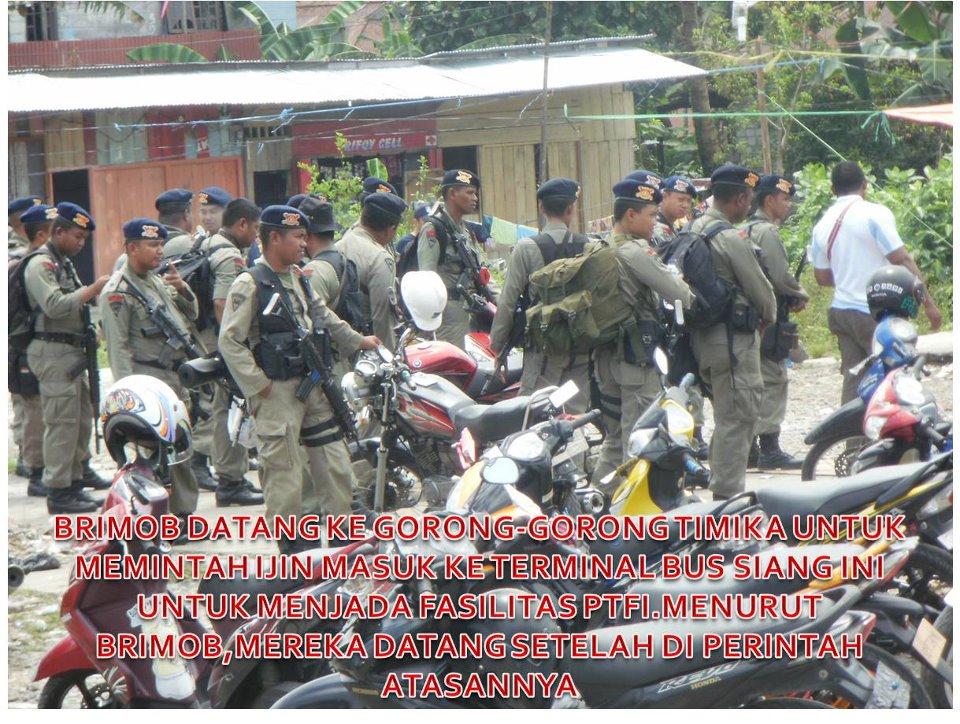
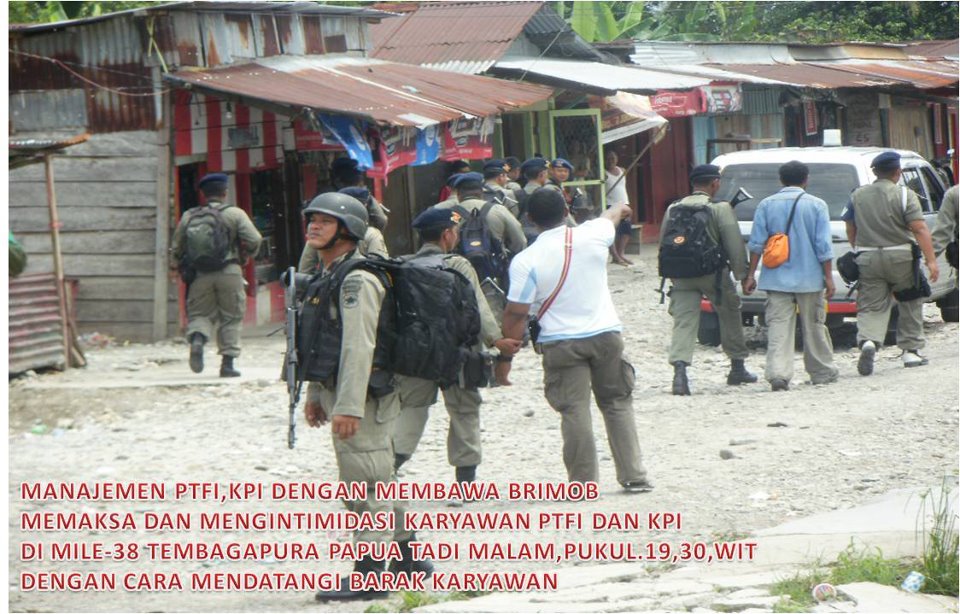
· Since October 10, the killings of at least four people at the Freeport mine site in Timika, southern Papua. More than 2,000 workers stopped work in July and again in September demanding wage increases. Freeport has replaced workers on strike with other miners. On October 10, one of the striking workers was killed by police and several others injured. Several police officers and two journalists were also injured in the melee. Unidentified gunmen shot dead three non-Papuan workers on October 14.
· On October 24, two unidentified men shot dead Mulia police chief, Dominggus Oktavianus Awes, in Mulia, Puncak Jaya. The men seized his pistol and used it to shoot him in the face.
Police investigations into these incidents have lacked transparency, and it has been difficult to gather information about the progress of investigations. Police efforts to hold the killers accountable have been frustrated by a lack of serious investigations, equipment, and manpower. In some areas, police have not gone to the crime scene or collected evidence due to concerns for their safety.
Documenting human rights violations during protests and other events is especially difficult because of restrictions, since 1962, on access to Papua for foreign human rights monitors and journalists. Human Rights Watch called on the Indonesian government to lift these restrictions. Human Rights Watch takes no position on the self-determination of the Papuan people.
“Police and military personnel have also been the victims of violence in Papua,” Pearson said. “But police investigations have been woefully inadequate, and there’s a need for independent investigations into this escalating violence.”
For more Human Rights Watch reporting on Indonesia, please visit:
http://www.hrw.org/asia/indonesia
For more information, please contact:
In London, Brad Adams (English): +44-7908-728333 (mobile); or adamsb@hrw.org
In New York, Elaine Pearson (English): +1-212-216-1213; or +1-646-291-7169 (mobile); or pearsoe@hrw.org
In Washington, DC, John Sifton (English): +1-917-838-9736 (mobile); or siftonj@hrw.org
Related articles
- Theologians & Franciscan Friars about recent post-Congress Indonesian violence affecting their communities (westpapuamedia.info)
- Csw Urges Indonesia to Establish Dialogue With Papuan People Following Brutal Crackdown by Military in West Papua (westpapuamedia.info)
- Imparsial: Urges SBY to speedily resolve the Papua Problem (westpapuamedia.info)
- AWPA: Increasing tension in West Papua (westpapuamedia.info)
- AHRC: One person killed, hundreds arrested and five persons charged with rebellion at Third Papuan People’s Congress (westpapuamedia.info)

 (Hong Kong, October 19, 2011) At around 3pm today the security forces surrounding the Third Papuan People’s Congress in Indonesia opened fire and dispersed the event. Possible casualties are not known as of now. Several persons are reported to have been arrested, including Forkorus Yaboisembut and Edison Waromi, indigenous political leaders.



 West Papua Media Alerts