Bintang Papua: 12 civilians tortured by security forces

Bintang Papua, 6 November 201112 Civilians torture by security forces? Komnas HAM demands clarifications from army commanderTwelve civilians in Kurulu, Jayawijaya are thought to have been tortured by members of the security forces on 2 November 2011 in violation of legal procedures., said Matius Murib, the deputy chairman of Komnas HAM Papua branch, in a statement to Bintang  Papua.

He said that the commander in chief of Cenderawasih Military Command, Major-General Eri Triassunu investigated members of the security forces who are thought to have committed these acts of torture, for them to explain the reasons for the torture to the victims and the general public.

Such behaviour fails to respect human dignity and violates human rights and is not in compliance with calls to put an end to violence in Papua. All parties should choose  the path of peace and dialogue as the way to solve the problems.

The head of public relations of the Cenderawasih military command, Colonel  Ali Hamdan Bogra was asked to confirm that these acts  of torture were perpetrated by members of the TNI security forces but he refused to respond..

Meanwhile, Buchtar Tabuni of the central executive of the KNPB told journalists on 4 November that these acts of  torture  by the TNI had occurred in Kurima Kampung on 2 October 2011

The torture was preceded by cheap provocations from the TNI Battalion 756 saying that a TPN group in Umapagalo Kampung had held a meeting with  the people of Kampung Umapagalo. After hearing about this meeting, the military commander organised a sweeping operation. During this operation, further acts of torture occurred.

According to Bucktar Tabuni, the KNPB sent a report about the torture perpetrated by the TNI, along with photos of the victims  to the central committee of the KNPB as well as sending it to the media.

After listing the names of the twelve victims, the KNPB said that these acts of  violence  were accompanied by screams of abuse and the victims were beaten with wooden truncheons, kicked with heavy army boots and threatened with rifle butts as well as gunshots.

A report of these acts of violence by the TNI against the twelve civilians was then submitted to the police in Kuruku but the police refused to accept it, saying that the operation  had failed to conform with legal procedures.

According to Buchtar and Mako Tabuni, the victims of this incident intend to submit this case to the district court in Wamena.

A spokesperson for Buchtar and Mako declared that the Cenderawasih military commander  should accept responsibility for the actions of his men in Kostrad 755/Kurulu. He said: From now onwards, we will not accept any attacks against the civilian population  in the Land of Papua  because these activities by the Indonesian military are acts of subversion (makar) in which members of the community were attacked by members of the state apparatus without there having been any acts of resistance by the local communities.

AI – Government must act on Komnas HAM’s findings of human rights violations at Papuan Congress

AMNESTY INTERNATIONAL  PUBLIC STATEMENT

8 November 2011

The Indonesian government must immediately act on the Indonesian National Human Rights Commission’s (Komnas HAM) findings that human rights violations were committed by Indonesian security forces at the Third Papuan Peoples’ Congress on 19 October 2011.

The Komnas HAM investigation team found a range of human rights violations allegedly committed by the Indonesian security forces, including opening fire on participants of the peaceful gathering and beating and kicking them. The Commission, which made its findings public on 4 November 2011, has called on the Indonesian National Police chief to investigate these human rights violations.

It was reported on 7 November that the President’s office had rejected the findings of Komnas HAM, stating that the police were still handling the case.

The Indonesian authorities must initiate an independent, thorough and effective investigation into the Commission’s findings. If the investigations find that the security forces committed unlawful killings or torture or other ill-treatment, then those responsible, including persons with command responsibility, must be prosecuted in proceedings which meet international standards of fairness, and victims provided with reparations.

The failure to bring perpetrators of these violations to justice in fair trials will reinforce the perception that the security forces in Papua operate above the law and fuel the ongoing climate of mistrust towards the security forces there.

On the afternoon of 19 October 2011, police and military units violently dispersed participants of the Third Papuan People’s Congress, a peaceful gathering held in Abepura, Papua province. The bodies of Demianus Daniel, Yakobus Samonsabara, and Max Asa Yeuw were found near the Congress area. An estimated 300 participants were arbitrarily arrested at the end of the Congress. Most were released the following day but six have been charged. Five people were charged for “rebellion” and “incitement” under Articles 106, 110 and 160 of the Criminal Code, while one was charged for “possession of weapons” under Emergency Law No. 12/1951.

According to Komnas HAM, the three people who were found dead had gunshot wounds on their bodies. The Commission was not able to confirm whether they were killed by the police or military, and have called for police forensics investigators to examine the bullets. Komnas HAM also found that at least 96 participants had been shot, kicked or beaten by police officers.

Komnas HAM further reported that security forces had raided a Catholic monastery and seminary. They shot at the building and broke the windows when the monks refused to hand over alleged separatists to the police. Many Papuans are now afraid to leave their homes because of the continued security checks and raids. The Commission also raised concerns that security forces had confiscated mobile phones, laptop computers, printers, cameras, cars, motorcycles and millions of rupiah in cash, and called for these items to be returned to the owners.

The Commission stated, contrary to statements by the Indonesian authorities that the Congress was illegal, that the Indonesian Minister of Law, Politics and Security had in fact directed the Director General of Regional Autonomy at the Home Affairs Ministry, to attend the Congress and give the opening speech.

The Commission made a series of recommendations including calling on President Susilo Bambang Yudhoyono to accelerate the dialogue with the Papuan people and to evaluate the deployment of a large security presence in the area.

The Komnas HAM investigation indicates that security forces appear to have violated the rights to life and to freedom from torture and other ill-treatment, both of which are non-derogable under the International Covenant for Civil and Political Rights (ICCPR), to which Indonesia is a state party.

By using unnecessary and excessive force and firearms against the participants, the Indonesian security forces have also violated the Convention against Torture and Other Cruel, Inhuman or Degrading Treatment or Punishment, which Indonesia has also ratified. Moreover, the right of all people in Indonesia to be free from torture and other ill-treatment is guaranteed in the Indonesian Constitution and the 1999 Law on Human Rights.

The actions of the security forces also appear to contravene the UN Basic Principles on the Use of Force and Firearms by Law Enforcement Officials which provide, among other things, that force should be used only as a last resort, in proportion to the threat posed, and should be designed to minimize damage or injury.

West Papua Report November 2011

This is the 90th in a series of monthly reports that focus on developments affecting Papuans. This series is produced by the non-profit West Papua Advocacy Team (WPAT) drawing on media accounts, other NGO assessments, and analysis and reporting from sources within West Papua. This report is co-published with the East Timor and Indonesia Action Network (ETAN). Back issues are posted online at http://etan.org/issues/wpapua/default.htm Questions regarding this report can be addressed to Edmund McWilliams at edmcw@msn.com. If you wish to receive the report via e-mail, send a note to etan@etan.org.

Summary: Indonesian security forces attacked a mass gathering in the Papua capital, Jayapura, and striking workers at the Freeport mine in the southern highlands. At least five people were killed and many more injured in the assaults, which show a renewed pattern of overt violence against peaceful dissent. A brutal and unjustified October 19 attack on thousands of Papuans exercising their rights to assembly and freedom of speech resulted in the death of at least three Papuan civilians, the beating of many, detention of hundreds and arrest of six, reportedly on treason charges. The Obama administration has largely ignored the egregious violation of human rights, instead advancing U.S.-Indonesian military ties. U.S. Secretary of Defense Leon Panetta, who arrived in Indonesia in the immediate wake of the Jayapura attack, avoided criticism of the assault and reaffirmed U.S. support for Indonesia’s territorial integrity, a snub to Papuans quest for self-determination. Panetta also reportedly commended Indonesia’s handling of a weeks-long strike at the U.S.-based Freeport McMoRan mine which has seen eight killings and revealed cash payments by Freeport to the police. Indonesia’s response to the growing crisis in West Papua is to increase the militarization of the territory and to dispatch a special unit that is headed by a notorious former military officer whose record in dealing with Aceh bears ominous implications for the Papuans.

Contents:

Obama Administration Abandons Human Rights Agenda to Advance Military Ties

On October 19, hundreds of Indonesian military and police personnel attacked a peaceful gathering of several thousand Papuans engaged at a congress which had convened to assert Papuans long-denied right to self-determination. The Congress, only the third such event in the last 50 years, sought to exercise rights of free speech and assembly guaranteed by the Indonesian Constitution and international accords, including the International Covenants on Civil and Political Rights and on Economic and Cultural rights and Social rights, the Universal Declaration on Human Rights.
The brutal assault by Indonesian security forces killed at least three Papuans and resulted in the disappearance of others and the detention of approximately 300. At least six leaders were arrested and are expected to be charged with treason. Separate accounts suggest that the number of Papuans killed could be as high as 17 and the number of those detained and beaten while in custody could be as high as 800. Among those arrested were Forkorus Yasboisembut, President of the Papuan Customary Council (DAP). The security force violence and arrests followed the Congress’s declaration of independence for West Papua.

Security forces pursued the peaceful demonstrators, beating participants. One of those killed was reportedly shot in the back. Two other victims were found beaten to death, their bodies dumped behind a police station. An Australian eye witness to the assault, interviewed on Australian television’s ABC on October 28, identified the attacking security forces as including the Indonesian military (TNI), the Indonesian specialized police (BRIMOB), regular police units and the Indonesian “anti-terror” force, Detachment 88. The Detachment 88 team is funded and trained by the U.S. and Australian governments. It has repeatedly been charged with extrajudicial killings and torture.

The Police Commander for Papua publicly defended the assault, as have senior officials in Jakarta who contended that the military operation against civilians was provoked by Congress leaders who sought to declare West Papua’s independence. “The government did not find any abuse of power nor mismanaged approaches by the security officers,” said presidential spokesman, Julian Aldrin Pasha. “Police officers and security forces just accomplished their (as) duties mandated by the state.” Djoko Suyanto, Coordinating Minister for Political Legal and Security Affairs also defended the assault. (See also statements made by the Defense Minister, Purnomo Yusgiantoro: for example, see Made Arya Kencana, Banjir Ambarita and Ulma Haryanto, “ Jakarta Gives US Its Side of Story in Papua Deaths,” The Jakarta Globe, 23 October 2011.

International human rights organizations and some elected officials such as U.S. Congressmember Eni Faleomavaega and Australian Greens Senator Richard Di Natale  immediately and strongly condemned the violence. Faleomavaega urged the release of those detained and specifically raised the assault with U.S. Secretary of State Hillary Clinton when she appeared before the House Foreign Affairs Committee. Senator Di Natale urged dispatch of an investigatory mission to West Papua and that Australia immediately suspend all support for the Indonesian military.

While comments by Faleomavaega and Di Natale echoed the calls of the many international nongovernmental organizations, there was scant word of condemnation from other governments. The silence rendered the international community complicit in the attack.

Particularly egregious, in this regard, was the reaction of the U.S. government. U.S. Ambassador Marciel in Jakarta called for an investigation of the incident. While appropriate, that response was manifestly inadequate. His failure to condemn the assault, conveys to the Indonesian government that use of lethal and military force against peaceful civilians is acceptable.

WPAT Comment: In attempting to understand the rationale for the Obama administration’s abandonment of human rights concerns it is essential to note the presence of U.S. Secretary of Defense Panetta in Jakarta at the time of the assault. Panetta’s visit inaugurated the resumption of full U.S.-Indonesia military to military cooperation. It appears that the Obama administration was not prepared to criticize Indonesian security forces with whom it was announcing a strengthened partnership. This abandonment of principle by the Obama administration is reminiscent of the collusion of previous U.S. administrations in the invasion and occupation of East Timor by the Suharto dictatorship.
see also Tapol, WPAT, ETAN: Indonesian crackdown on Papuan Congress sparks outrage

Indonesia Beefs Up Occupation Forces in West Papua

In the wake of the assault on the Third Papuan Congress (see above), continuing violence associated with police efforts to quell an ongoing strike at Freeport (see below), and the killing of a local police chief in remote Mulia district in the central highlands, the Indonesian government announced the dispatch of hundreds of additional security personnel to augment the existing Indonesian occupation force in West Papua.

The Jakarta Post reported
that provincial police spokesman Wachyono saying that “So far 260 [extra] personnel from the police mobile brigade (Brimob) have landed in Papua province to help maintain security in two districts.” Troops were sent to the Puncak Jaya and Paniai highlands in central Papua, he said, adding that they will join an existing force of 14,000 police and paramilitary troops in Papua.

Wachyono said they were still “hunting” the police chief’s killers. Authorities have said that based on preliminary investigations they are believed to be separatists. (WPAT Comment: the launch of “hunting” indicates that security force sweep operations may be underway. These operations routinely displace large numbers of civilians as their villages and gardens are destroyed.)

Numerous Indonesian non-governmental organizations criticized the dispatch of ever greater numbers of military and police elements to West Papua. “The militarization of West Papua has the clear intent of intimidating Papuan civilians who are courageously pursuing a course of peaceful dissent in defense of their rights, including worker rights and the right to self determination” said Edmund McWilliams, a former senior U.S. diplomat who served in Indonesia. “Jakarta authorities,” he added, continue to employ security forces and thug militias to suppress Papuans’ peaceful resistance to ethnic genocide implicit in Jakarta’s support for transmigration-colonization and its denial of vital services to Papuans.”

Notorious Military General to Head Jakarta’s Conflict Resolution Unit in West Papua

On October 29, the Yudhoyono administration announced formation of a special unit tasked with settling the conflict in West Papua. The “Unit to Accelerate the Development in West Papua and Papua”  (UP4B) was actually formed in September.  In mid-October, Yudhoyono signed a decree, appointing Lt. Gen. (ret) Bambang Darmono to the chairman of UP4B. It will report to a board headed by Vice President Boediono. http://www.thejakartapost.com/news/2011/10/30/sby-s-papua-team-ready-roll.html

The announcement aid that the team will be led by Bambang Darmono, the former commander of military operations in Aceh (2002-2005) and a key Indonesian figure in negotiations that produced the 2005 Memorandum of Understanding (MOU) which ended formal conflict between the Acehnese Freedom Movement (GAM) and Indonesia security forces. Darmono is the former Secretary General of the National Defense Council.

Darmono’s record as commander of Indonesian security forces is replete with credible charges of human rights violations including the execution of seven teenage Acehnese on May 21, 2003, thoroughly reported by Tempo magazine. His troops allegedly also executed Muzakkir Abdullah, an Acehnese peasant in the hamlet of Seumirah, Nisam district, in June 2003. Several Indonesian soldiers abducted him earlier that day. Abdullah’s sister was photographed screaming when she saw his body. The photo by a Reuters photographer won a World Press Photo award. Darmono appeared prominently in a documentary, “The Black Road” by William Nessen, in  which Darmono denied the involvement of his troops in the arrest and torture of a human rights defender. He had admitted that his troops had sometimes became abusive and he arrested some of them for shooting chicken.

In a June 26, 2007 interview with the U.S. Public Broadcasting System, Darmono strongly sided with Javanese transmigrants whose government-sponsored resettlement in Aceh mirrored government-sponsored transmigrant settlement of West Papua.  To many Papuans, like many Acehnese, such government-sponsored transmigrant schemes amount to colonization.  Darmono’s past championing of such policies in Aceh raise concerns for Papuans.  Such concerns are particularly strong given predictions by the “ Papua Road Map Project,” a plan by academics to promote peace in West Papua, that the percentage of non-Papuans living in West Papua will rise from 41 percent in 2005 to 53.5 percent by the end of 2011, rendering Papuans a minority in their own homeland.

The Indonesian government’s failure to carry out key elements of the 2005 MOU, including the failure to establish a promised Human Rights Court for Aceh and a “Commission for Justice and Reconciliation,” according to many as a consequence of military opposition to such steps, led in large measure by Darmono.

The appointment of Darmono to the special unit for West Papua is indicative of the manner in which the Yudhoyono administration intends to “settle” the conflict in West Papua.

Indonesian Security Forces Still on The Take from Freeport
Indonesian security forces in West Papua, notably the police, continue to receive extensive direct payments of cash from Freeport McMoRan. National Police chief Timur Pradopo admitted on October 28  that officers had received close to $10 million annually from Freeport. Prominent Indonesian NGO Imparsial puts the annual figure at $14 million. Pradopa described the payments as “lunch money.”  The payments recall even larger payments made by Freeport to Indonesian military forces over the years which, once revealed, prompted a U.S. Security and Exchange Commission investigation of Freeport and questions as to Freeport’s liability under the U.S. law (the Foreign Corrupt Practices Act).

The revelation of payments to the police has prompted widespread criticism in Indonesia. The respected Indonesian NGO KontraS (Commission for Missing Persons and Victims of Violence) accused the police of a conflict of interest in West Papua. KontraS said that based on its investigations, the police had become involved in ongoing labor disputes that have led to violence and interruptions in Freeport operations (see following item). KontraS cited specific examples of police intimidation, including death threats targeting union organizers. It said Sudiro, SPSI’s chief workplace organizer for Freeport’s Grasberg mine, had reported that Timika Police Chief Denny Siregar called him and made a death threat. KontraS also pointed to instances of police verbal harassment of other union leaders. “From the testimonies collected by KontraS [in Timika] on the sidelines of negotiations between workers and Freeport, the police chief pressured the SPSI leader to comply with the company’s wishes” Kontras investigator Haris Azhar told media on October 28.

Police, according to Haris, also accused the striking workers of treason. “All they did was make demands for their improved welfare. How can the police accuse them of being separatists? It makes no sense,” he said.

KontraS said the presumed reason for the police taking the gold and copper mining company’s side was Freeport’s documented direct payments to police officers based in the area. Haris added that the flood of money to police had created a conflict of interest when its people, nominally public servants, handled cases related to the company. “When there’s a problem between Freeport and their workers, of course they choose to support Freeport,” he said. Haris said Kontras would report its findings to the Coordinating Minister for Politics and Security and the Corruption Eradication Commission (KPK).

U.S. Secretary of Defense Praise for Indonesian Handling of Freeport Strike

The Jakarta Post reported on October 25 that U.S. Secretary of Defense Leon Panetta, visiting Indonesia, had “praised Indonesia’s handling of the strike at Freeport.” The strike has seen at least 8 killings in October and a partial shutdown of mining operations. The protracted struggle for worker rights has also involved police assaults on demonstrators and, according to the respected Indonesian NGO Kontras, police death threats to a union leader and harassment and intimidation targeting other union officials.

The violence has accompanied renewed reports of police receipt of Freeport cash, according to the national police commander as “lunch money.” The lunch money amounted to at least $10 million (see above report). Freeport’s labor difficulties are compounded by growing calls for a renegotiation of Freeport’s contract and by demonstrations targeting its office in Jakarta and its headquarters in Phoenix, Arizona.

Panetta’s exact comments regarding Indonesian “handling” of the strike were not reported and the U.S. Embassy has not provided text for Panetta’s remarks to his Indonesian hosts. Meanwhile the strike, which began in September largely over wage issues, continues.

see also WPAT/ETAN: Statement on Strike at Freeport McMoran’s Mining Operation in West Papua

Back issues of West Papua Report

Papuan youth set alight by Indonesian civil security officers

TAPOL Press release

3 November 2011 – Evidence has emerged of a horrific attack on a Papuan student in the town of Wamena in West Papua‘s central highlands.

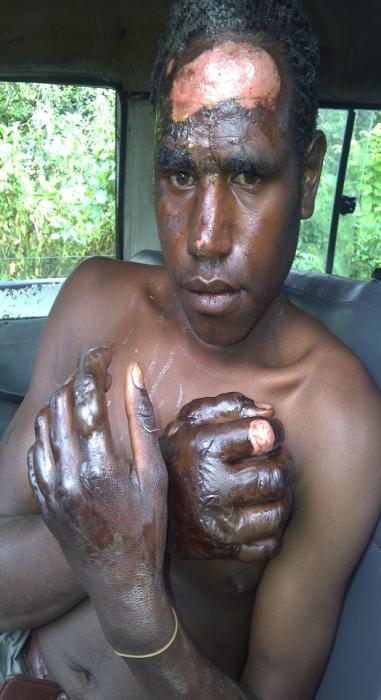
Yusuf Hiluka, set alight by police officer in Wamena on Oct 19 (via TAPOL)

According to a report received by TAPOL, at around 04:45 am on Wednesday 19 October, Yusuf Hiluka, 23, was stopped outside the office of the Regent of Jayawijaya District by two officers from Satpol PP (Satuan Polisi Pamong Praja), the district civil security unit, while making his way from a friend’s house to the Wamena bus terminal.

Without questioning Mr Hiluka, the Satpol PP officers poured glue on his head and set it alight. Mr Hiluka’s head and the back of his neck were engulfed in flames.

Mr Hiluka fled screaming to the nearby police station to seek protection. The perpetrator was detained immediately and held in police detention. An investigation has been conducted, and in accordance with customary law, a payment by the perpetrators to the victim’s family is being arranged.

Mr Hiluka suffered burns to his forehead and hands [1], and according to reports he is still awaiting hospital treatment for his wounds. The motive for this attack is not known, but it is yet another unexplained incident in a series of violent events that have devastated West Papua in recent months. It occurred on the same day that up to six people were killed during the violent dispersal of the Third Papuan Peoples’ Congress by Indonesian security forces in the provincial capital, Jayapura [2].

TAPOL calls on the regional Chief of Police, Inspector General Bekto Suprapto, to recognise the gravity of this cowardly attack, ensure that a thorough independent criminal investigation is carried out and that those responsible are brought to justice. The use of customary law in such cases cannot be deemed sufficient, either in obtaining justice for the victim, in punishing the perpetrator, or in acting as a deterrent against future violations.

ENDS

Contact: Paul Barber +44 (0) 7747 301 739 or paul.barber@tapol.org

Notes:
1. Photos of Mr Hiluka and his injuries are available on request from TAPOL.

2. See TAPOL/WPAT/ETAN press release, ‘Indonesian crackdown on Papuan
Congress sparks outrage’, 20 October 2011, at
http://tapol.gn.apc.org/press/files/pr111020.pdf.

Violent Tactics Backfire In Papua

1 Nov 2011

By Alex Rayfield

waiting

The tough response of the Indonesia armed forces to the Third Papuan People’s congress has strengthened calls for freedom. NM’s West Papua correspondent Alex Rayfield reviews the fallout

If the Indonesian police and military thought shooting live ammunition into a mass gathering of unarmed Papuans would somehow dampen dissent and endear them to Jakarta’s continued rule, they were mistaken. Indiscriminate repression meted out against those gathered at the Third Papuan People’s congress is showing signs of having the opposite effect: widening the circle of dissent inside West Papua and igniting international support outside.

First the Indonesian military and police denied they shot dead peaceful protesters. But that was too difficult to sustain. New Matilda received text messages as soon as the shooting started which were followed by urgent phone calls. Gunfire could be heard in the background.

When it became clear that covering up the shooting would not wash, the Indonesian Chief of Army in West Papua, Erfi Triassunu, admitted opening fire but claimed his troops only fired warning shots. He insisted no one had been hurt. Some of the international media bought the story. With foreign journalists banned from West Papua, some media outlets went to the police and military for confirmation. This is in spite of the fact that West Papua Media, with their extensive network of citizen journalists and local stringers, broke the story, verified it and began filing reports about what happened within a few hours.

A few hours after the shooting, the Indonesian police in West Papua were telling journalists in Jakarta that an attempted coup d’état had taken place and that police had used force to defend the state. The Jayapura Chief of Police, Imam Setiawan, even went as far as saying that members of the Papuan Liberation Army had attacked the Congress.

Setiawan took this line again on Thursday 20 October. In an interview with Bintang Papua, a local Papuan daily, he outlined how he thought police should respond to a gathering of unarmed Papuans expressing their political opinion: “Whoever supports separatism or subversion activity, I will do the same as yesterday. I’ll finish them.”

The language used by Setiawan echoed hard-line nationalists in Jakarta. It follows a deadly trajectory. Cast the Papuans in the worst possible light. Label them as “separatists” — which in Indonesia is the worst kind of criminal, someone who is treasonous, dangerous and violent. From here it was only a short step to imply that those at the Third People’s Congress were using violence to try and seize control of the state. This narrative makes it sound like the police and military were taking evasive action to stop the Papuans storming the Bastille of Indonesian rule. This is pure fantasy.

Initially it was reported that police and the military raided the stage after Forkorus Yaboisembut and Edison Waromi (appointed as President and Prime Minister of the Federal State of West Papua respectively) declared independence. We now know that the attack did not happen until well after the three-day gathering had finished.

After the Declaration of Independence was read around 2.00pm local time, the Congress concluded. The leadership — Yaboisembut, Waromi, Dominikus Surabut, Helena Matuan and a few others left the field to rest in the nearby Sang Surya Catholic Friary in the grounds of the Fajar Timur Theological College where the Congress was being held. Those remaining on Taboria oval (Zaccheus Field) danced the Yospan, a traditional Papuan group dance.

The festivities continued for around 60-90 minutes. We don’t know exactly what the police, military and Brimob soldiers were doing between the time the Declaration was read out and the time the shooting started. Presumably they were discussing what to do. Most likely they consulted commanding officers locally and in Jakarta.

According to Yan Christian Waranussy, a prominent Papuan human rights lawyer, members of the security forces under the command of Police Chief Imam Setiawan arrested Edison Waromi as he drove out of the Fajar Timur grounds on Yakonde Street. Waranussy reports that the police pulled people out of the vehicle and started beating them before pushing them into a police van. Following the arrest of Waromi, Waranussy says the security forces starting firing their weapons into the crowd.

This occurred at around 3.30pm. One of the first killed was 25-year-old Daniel Kadepa, a student at Umel Mandiri Law School. According to those who knew him, Kapeda did not even attend the Congress. He was passing by when the security forces opened fire. Witnesses said that he died from gunshot wounds to the head and back after soldiers fired on him as he was running away.

Video footage obtained by EngageMedia and published by New Matilda shows people hiding in nearby buildings just after the police and military opened fire. In the background you can hear shooting. This is not automatic gunfire. They are single shots. Then there is a pause, followed by more shots. It is as if the shooter is walking around picking people off. There is very little background noise. No screaming or yelling, just an eerie silence … and gunshots.

According to Catholic clergy who witnessed the event, the police, Indonesian military and the the paramilitary Mobile Police Brigade continued discharging their weapons for approximately 25 minutes.

Eyewitnesses report that when the shooting started, Yaboisembut and Surabut were talking and relaxing in the Sang Surya Friary, a few metres from the oval. Then bullets smashed through the window. According to statements obtained by New Matilda people immediately hit the ground and began crawling to safety as the police indiscriminately fired live ammunition and canisters of tear gas into the buildings surrounding the oval.

According to statements obtained by New Matilda, police, military and Brimob personnel ransacked student dormitories, clergy residences and offices. One witness reported an Indonesian security officer yelling “Where are those idiot priests? Why do priests hide criminals?”

Those present also reported security personal using combat knives or bayonets and beating people with truncheons and rifles. At least 300 people were arrested and taken away in army and police trucks where they were detained overnight in the tennis courts at the police station.

We now know that three people were shot dead that day. They are Daniel Kapeda, Max Asa Yeuw, and Yakobus Samansabra. Two others, Matias Maidepa and Yacop Sabonsaba, were allegedly found dead behind the military headquarters in Abepura. According to the Indonesian military sources quoted in the local Papuan press, the victims had been stabbed. In addition, members of the Organising Committee of the Third Papuan Congress allege four other people died, all from gunshot wounds, two from Sorong and two from Wamena.

Six people are still in detention charged with rebellion. According to family members they have all been badly beaten. According to Human Rights Watch and KONTRAS Indonesia (the Commission for the Disappeared and Victims of Violence) those still in detention are:

• Forkorus Yaboisembut, chairman of the Papua Customary Council, probably the most prominent pro-independence leader in Papua. When New Matilda interviewed him in West Papua in 2010 and again in 2011 he was regularly receiving death threats. A few people had even come forward and told the local press that they were offered new motorbikes and other inducements if they would help orchestrate a fatal “accident”.

• Edison Waromi, president of the West Papua National Authority. Edison Waromi’s daughter, Yane, was kidnapped and assaulted by the security forces in 2008.

• Dominikus Surabut, secretary of the Papuan Customary Council in La Pago region.

• Selpius Bobii, a social media activist, who organised the Papuan Congress. He initially eluded the police crackdown, but surrendered to police on October 20, accompanied by his lawyers and a Papuan journalist.

• August M. Sananay of the West Papua National Authority.

• Gat Wanda, a member of PETAPA (Defenders of the Land of Papua, an unarmed civilian defence group), charged with possessing a sharp weapon.

It will take some time before the immediate effect of the repression is made clear, but early signs suggest the use of extreme and deadly violence against nonviolent activists has enlarged the circle of dissent inside West Papua and ignited international support outside.

Certainly Church leaders — both Catholic and Protestant — have expressed their outrage. Neles Tebay, a key Papuan intellectual, defended the role of clergy who provided humanitarian protection for those seeking safety. Tebay, who also gave permission for the Committee to hold the Congress in the Theological College grounds, was quoted as saying that he “rejects the use of all kinds of repression in dealing with the problems. Using violence undermines the dignity of all concerned, above all the dignity of the victims as well as the perpetrators.”

Tebay has repeated his call “for all people of goodwill to jointly press for dialogue, for the sake of peace in Papua”.

Political representatives of the Papuan Provincial Parliament, a group that until now has sided with the government on matters of national security, expressed their dismay. Bintang Papua reported that Yan Mandenas, chairman of the Pikiran Rakyat Group in the Provincial Parliament said “the actions of the security forces in dispersing the Congress exceeded all bounds and … were in violation of the law”.

Similar views were expressed by Ruben Magay, chairman of Commission A on Politics and Law of the Provincial Parliament who reportedly urged the chief of police to withdraw his men because the Congress was already over. Magay said that what happened was clearly “a violation” and that “no one was fighting back”.

And while a large group of hard-line nationalists in Jakarta applauded or condoned police and military action, Effendy Choirie and Lily Chadidjah Wahid, both members of House of Representatives Commission I on information, defense and foreign affairs in Jakarta, warned the government that the mounting tension could lead to the province’s separation from Indonesia. In a clear rebuke of Papuan Police Chief Imam Setiawan, the two legislators added “that the government should not blame the Free Papua Movement (OPM) for the shooting but rather the security personnel in Papua”.

Internationally, things have gotten much worse for Jakarta.

United States Congressman Faleomavaega Eni Hunkin condemned the actions of the security forces. So too has Senator Richard Di Natale from the Australian Greens who has urged the Australian Government to suspend military ties with Indonesia. MP Catherine Delahunty from New Zealand has also called for the New Zealand Government to withdraw its training support for the Indonesian police. This is more than words. The United States, Australian and New Zealand Government all provide money, training and material aid to the Indonesian police and military. In this sense we are beginning to see the early signs of what could become an international withdrawal of legitimacy for continued Indonesian repression in West Papua.

Papuan calls for UN intervention won’t happen, at least not in the foreseeable future. And the movement internally still faces serious challenges. But the Congress, the Declaration of Independence and the subsequent shooting has realigned the political landscape. There are now three main political groups, the Congress, the Papuan Peace Network led by Neles Tebay who is calling for dialogue, and the West Papua National Committee who want the giant US/Australian Freeport Mine closed and a referendum on West Papua’s political status. At a fundamental level there is not a lot of difference between these positions. They all point to the need for a political solution to the Pacific’s longest running conflict.

The Indonesian political elite and security forces can no longer pretend that the problem in Papua is economic. Papuans want political freedoms. The Congress made that abundantly clear. It opened with raising the banned Morning Star flag and singing the banned West Papuan national anthem, Hai Tanah Ku, and closed with a Declaration of Independence.

And it wasn’t as if the military or police was unaware of this depth of feeling. When an open peace conference organised by the Papua Peace Network was held in Jayapura last July, Erfi Triassunu, the local Army Chief, took the podium. In attendance were 800 respected Papuan civil society leaders. Triassunu tried to get the audience — who were mostly Papuan — to chant “peace!” in response to his “Papua!”. But as soon as he called out “Papua!” the crowd responded as one with “Merdeka!” (freedom).

Now the Papuans’ cry for freedom is echoing around the world. And it is the Indonesian police, military and their nationalist political allies in Jakarta who are helping amplify it.

Create a website or blog at WordPress.com

Up ↑