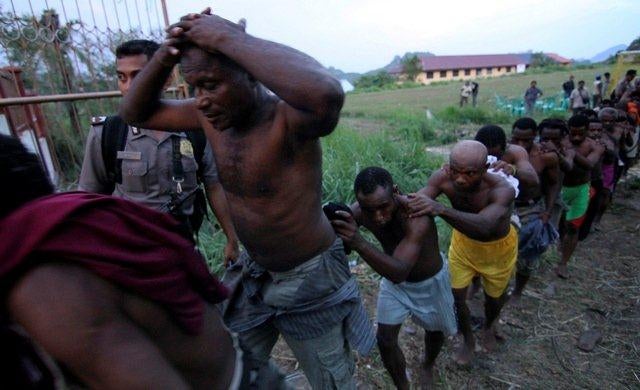
Statement from 5 Makar accused at KP3 treason trial

STATEMENT BY FIVE PAPUANS WHO WENT ON TRIAL IN JAYAPURA ON 30 JANUARY 2011[This hand-written statement is signed by the five Papuans who went on trial in Jayapura on 30 January 2012, and is translated in full by
Carmel Budiardjo, TAPOL]

Fully understanding and conscious of our basic human rights as Papuans of the negroid race, part of the Melanesian race who live in the land of the country of West Papua, inheritors from our ancestors, we herewith firmly declare  that WE FIRMLY REJECT THE TREASON TRIAL AND OTHER SUCH TRIALS that has been mounted against the five of us, and we speak on behalf our colleagues and the entire nation of the Papuan people of the Nation of West Papua.

We call for an understanding of this declaration, a declaration of independence, in accordance with the principles of PUBLIC INTERNATIONAL LAW, a law which should be lawfully accepted. And in this case, this declaration will bring us substantial  happiness if it gains the recognition of the international community.

In order to gain substantial and dignified recognition from the international community, we have requested our international team of lawyers to  notify and register  our legal status along with the question of the annexation of the TERRITORY OF THE STATE OF WEST PAPUA at the International Court, with the Secretary-General  of the United Nations, Amnesty International and all member states of the United Nations, as well as other competent authorities.

We herewith categorically state that we are not prepared to make any statements or answer any questions that are based on the laws and accusations of treason by  the Unitary State of the Republic of Indonesia, during the current trial for treason. It is very clear indeed that this is a matter between two nations and two states, that is to say, between the Papuan nation and the Indonesian nation, between the Federal State of West Papua  and the Unitary State of the Republic of Indonesia.

The following are the reasons for our rejection of the trial for treason or any such trial:

[NB: The copy of the statement which we have received jumps at this point from page 2 to page 4 which suggests that the copy we have is incomplete.]

1.    Our struggle and the struggle of those who have gone before us and the nation of West Papua  and all members of the Papuan people up to the present day is a struggle for the restoration of independence and sovereignty of the Papuan Nation as one of our most basic political rights.

2.    Bearing in mind that the Unitary State of the Republic of Indonesia annexed and continues to annex, the people and nation of the Papuan people since the TRIKORA command which was proclaimed by the former president of Indonesia, President Sukarno on 19 December 1961 in the city of Jogyakarta and which was followed up by  the Indonesian military, from 1962 to the present day, by a variety of measures aimed at preserving the annexation.

3.    Our struggle is not aimed as damaging or destroying any country in the world.

4.    We do not intend to damage or destroy the Unitary State of the Republic of Indonesia.

5.    We feel that our dignity has been defiled, that our basic political  rights have been violated in our country, West Papua, which we inherited from our ancestors.

6.    No one, for whatever reason, has the right to make accusations against us or to convict us in a treason trial or any such trial. This is because we have become the subjects of our own laws  as citizens of the nation and state of the Federal Republic of West Papua.

7.    Based on the values of basic human rights, of democracy and the following universal laws:

a. The  first article in the Preamble to the1945 Constitution  of the Republic of Indonesia.
b. Article15 of the Universal Declaration of Human Rights of the United Nations adopted on 10 December, 1948.
c. Article 1, para 1 of the Covenant on Civil and Political Rights adopted as UN Resolution 2200 (xxi) which has been in force since 23 March 1976,.
d. The Declaration on Granting of Independence to Colonial Countries and Peoples in UN Resolution 1514 (xv) on 14 December 1960.
e. The basic principles of decolonisation , namely possidetis juris and the legal succession of the state to the colonial territories  of the  Dutch East Indies (Dutch Papua) since 19 October 1961.
f. ILO Convention No. 169, 1989 on the Rights of Indigenous and Tribal People.
g. The UN Declaration on the basic rights of indigenous peoples of 13 September 2007.
h. The Papuan Independence Manifesto of 19 October 1961 adopted by the Papuan National Committee.
i.  Stipulations adopted by the Grand Congress (MUBES) of the Papuan people in 2000.
j. The Eleven Recommendations of the Second  Papuan Peoples’ Congress and Indigenous Papuan People  in 2010.
k. The decisions of the Second Papuan Peoples Congress in 2000.
l.  The decisions of the Third Papuan Peoples Congress of 2011.

8.    The Statement by the Indigenous Papuan People and the Papuan people is a truth based on analytical and practical categories. The analytical category means that the indigenous P apuan people are the Papuan nation, a negroid race of the Melanesian race, located in the South Pacific. Whereas the practical category is a political statement which was enunciated in the Manifesto of Papuan Independence of the Papuan National Committee on 19 October 1961 in Hollandia, the State of West Papua.

9.     We democratically restored the independence and sovereignty of the Papuan people on 19 October 2011, at the Third Papuan Peoples  Congress with the establishment of the Federal Republic of West Papua  which was announced by the DECLARATION OF THE PAPUAN NATION IN THE STATE OF WEST PAPUA.

10.    The government of the Republic of Indonesia and the governments of all other members of the United Nations, should without discrimination recognise and respect the democratic processes of the Papuan people at the Third Papuan Peoples Congress on 19 October 2011 in the form of the Declaration of the West Papuan Nation and State.

11.     The application of the treason law against the Papuan people must be categorised as a violation of the basic and legal political rights of the Papuan nation.

We hereby call on to the Honourable Judges in this forum to annul the trial held in order to accuse us of TREASON and make similar charges against us. The solution to the independence of the Papuan nation which is our most basic political right must be sought by means of international mechanisms between the Federal Republic of West Papua and the Unitary State of the Republic of Indonesia, mediated by the United Nations.

In order to regulate the transfer  of sovereign powers from the Unitary State of the Republic of Indonesia to the Federal Republic of West Papua, we intend to initiate a new phase of cooperation  based on the principles of democracy,  justice, peace, mutual respect and dignity. As is customary between independent and sovereign nations and states on Planet Earth.

Herewith our statement of REJECTION OF THE TRIAL BEING HELD TO ACCUSE  US OF TREASON AND SIMILAR CHARGES.

Jayapura, 30 January 2012

Signed:

1. Forkorus Yaboisembut, President of the Federal State of West Papua.
2. Edison G. Waromi, SH, Prime Minister of the Federal State of West Papua.
3. Agust M. Sananai Kraar, SIP,human rights activist/staff
4. Selpius Bobii, activist/staff
5. Dominikus Subarat, activist/staff

Makar accused reject charges, and Indonesian jurisdiction over Papua in adjourned trial (Photo Report)

January 31, 2012

By Nick Chesterfield from West Papua Media with local sources

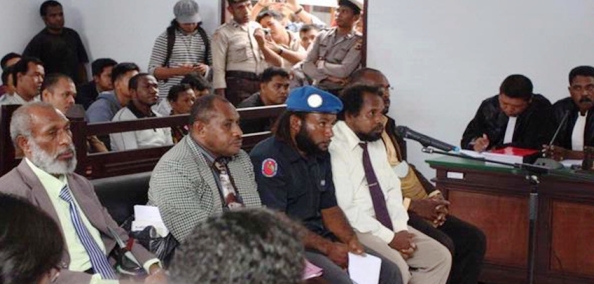
(Jayapura) The treason trial against the leaders of the Third Papuan People’s Congress in Jayapura was adjourned on Monday until February 8, after a short hearing that Indonesian authorities moved at the last moment preventing many supporters from attending.

The five defendants, President of the Federated Republic of West Papua (FRWP)  Forkorus Yaboisembut, Prime Minister Edison Waromi, together with Congress organisers Selpius Bobii, Dominikus Sorabut and Agus Sananay were charged with makar or treason under Article 106 of KUHP (the Indonesian Criminal Code) for their declaration of an independent West Papua at the close of the Third Papuan People’s Congress on October 19 last year.

Papuan leaders accused of treason on trial in Jayapura, January 30, 2012

The historic Congress was violently broken up by Indonesian security forces using live fire and excessive violence, with at least seven people killed, hundreds beaten and tortured, despite official permission for the event to be held.  Indonesian security officers involved were given minor disciplinary sanction, with most perpetrators of violence enjoying complete impunity despite footage of the Indonesian security force violence being broadcast internationally.

Initial reports from witnesses inside the trial early in the day claimed that the team of judges argued with the defence legal team about the need to know the political position of the defendant’s, despite the fact that in a treason trial this would be self-evident.  Yaboisembut and Waromi then fundamentally rejected the charges against them, arguing that their actions were not treason“.

Forkorus Yobeisembut (Jakarta Globe)

According to Forkorus as reported by the Jakarta Post, “What we have been doing is seeking our own independence. Thus, we have cheated no one,”.  Forkorus argued that Indonesian occupation of his homeland was the real issue, and that ”this problem is not the problem of separatism and rebellion or treason”.  Both Forkorus and Waromi said that the issue of Papua should be tried in international courts as the Indonesian state did not have jurisdiction over Papua.

Forkorus Yaboisembut (Jakarta Globe)

in a short statement sent to West Papua Media, the defendant’s legal team said that the judge asked Forkorus and the accused understood the indictment.  “He answered that, yes, he understood what the prosecutors read but did not understand the charges of treason against them.”

“Forkorus then asked for time to read a statement to the assembly to process the rejection of the  law, (the request of) which was then approved by a judge.   Our attorneys will do the rebuttal (exception) to the indictment dated 8th February 2012,” according to the legal team led by Hamadi.

(Photo: Efraim Joteni)

Bintang Papua reported that another one of the lawyers for the accused, Gustaf Kawer,said that up to 32 lawyers from across Papua and Indonesia had offered pro-bono defence of the treason accused.  He said: ‘I am convinced that  the large number of lawyers who are attracted by the case is a good sign  of interest in the need to find a solution to the problem of Papua.’

Forkorus Yaboisembut and Edison Waromi media interview after trial.(Photo: Efraim Joteni)

The Panel of Judges hearing the trial are Chairman of the Jayapura District Court of Class IA, Jayapura, Papua, Jack John Octovianus, SH. MH,;  assisted by I Ketut Nyoman S, SH. MH. Syor Mambrasar, SH. MH. Orpah Marthina, SH. and Willem Marco Erari, SH.

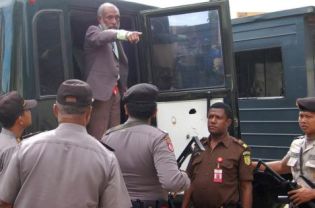
Outside the court hearing, almost 400 hundred heavily armed riot police and a similar number of Army and Kopassus personnel were guarding the courthouse venue from dawn (0600) with close to a dozen armoured assault vehicles, mounted with heavy machine guns, according to participants.

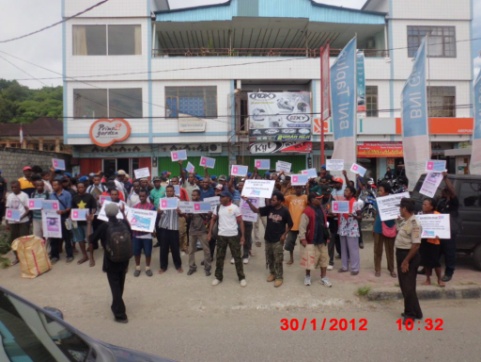
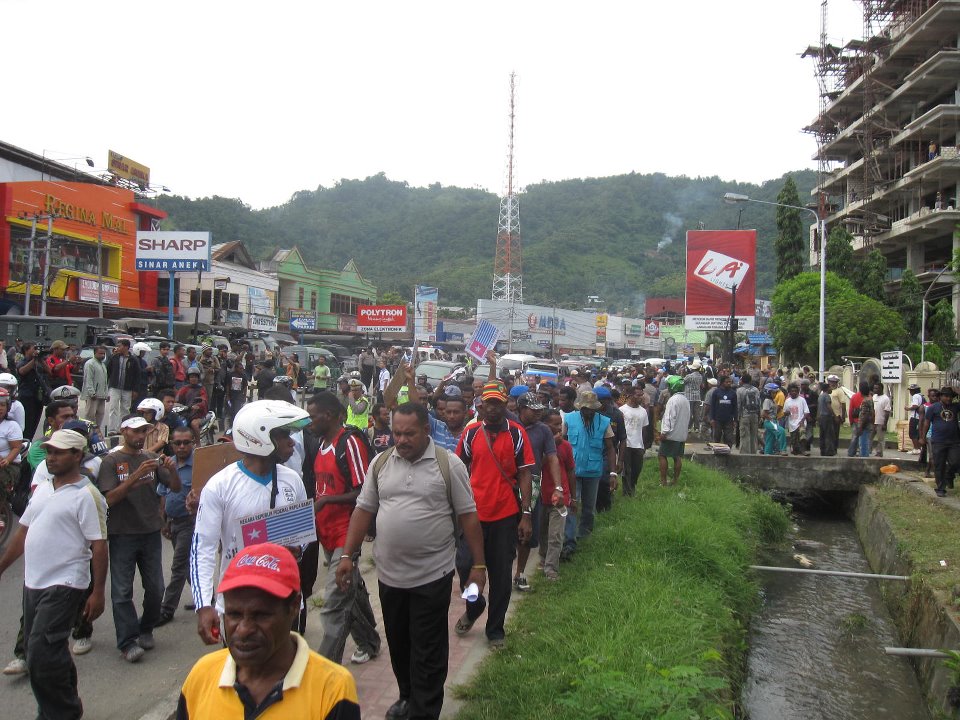
Protest in support of West Papuan leaders in trial for treason (Photo: Efraim Joteni)

Participants in the protest claimed to West Papua Media via SMS that security forces were acting in a heavy-handed manner, describing their actions as “wild and aggressive”.    “This display of armour  makes thousands of ordinary people in Jayapura traumatized and afraid to come to action,” said Jack Wainggai, the spokesman for the Prime Minister of the FRWP, Edison Waromi, on trial for treason today.  Organisers had aimed for several thousand people to attend, but amid heavy  Indonesian security that discouraged solidarity protests by West Papuan supporters of the defendants, only 500-600 braved the heavy armour and “state intimidation” outside the court.

Protest in support of West Papuan leaders in trial for treason (Photo: Efraim Joteni)
Brimob outside makar trial (Photo: West Papua Media)
one of almost a dozen armoured vehicles securing outside court venue Jan 30 2012 Jayapura (Photo: West Papua Media)

Despite promises by Indonesian authorities that the trials would be open, the presiding judges secretly started proceedings at 8.30 am before supporter could arrive.   In a press statement before the trial, Bintang Papua reported that Olga Hamadi of Kontras Papua said, “The five men will face charges under Article 106 of the Criminal Code for subversion. Based on past experience, there are concerns regarding security during the trial which will be open to the public, meaning that anyone wishing to attend the trial will be able to do so.”  Hamadi urged all present to restrain themselves and ensure that conditions surrounding the trial are conducive.

Speculation has mounted amongst local observers that the trial may be moved from Jayapura to metropolitan Indonesia to reduce any potential political flashpoint it will cause amongst pro-independence forces in Papua, with the prosecutor’s office formally warning of such a move should unrest occur.   Conversely though, any shift would create more opportunities for international observers to be present at the trial, a basic condition called for by the defence and international human rights monitors.

After the adjournment, the few hundred that did attend were able to disperse peacefully without an Indonesian security force crackdown, but tension still remains high in Jayapura as armed troops are still deployed on the streets the following day.

Elsewhere in Papua, solidarity actions were held with the treason trials against the Congress leaders.   In Manokwari, orations were held calling for international peacekeepers to be deployed to protect West Papuan people from Indonesian state violence.  Calls were also made in Manokwari  for neutral international mediators for dialogue between Jakarta and the Federated Republic of West Papua.

Westpapuamedia.info

HRW:: Indonesia – Drop Charges Against Papuan Activists

English: Human Rights Watch logo Русский: Лого...

Free Political Prisoners, Amend Treason Law to Uphold Free Speech

JANUARY 29, 2012
  • Police arrest attendees of the Third Papuan People
    Congress in Jayapura, Indonesia‘s Papua province on
     October 19, 2011.  © 2011 Reuters
The Indonesian government should show its commitment to peaceful expression by dropping the charges against these five Papuan activists. It’s appalling that a modern democratic nation like Indonesia continues to lock up people for organizing a demonstration and expressing controversial views.
Elaine Pearson, deputy Asia director

(New York) – The Indonesian government should drop charges against five Papuan activists who are being prosecuted for peacefully expressing their political views, Human Rights Watch said today. On January 30, 2012, the district court in Jayapura, the Papua provincial capital, will begin the treason (makar) trial of five leaders of the Papuan People’s Congress, which the authorities forcibly dispersed last October.

“The Indonesian government should show its commitment to peaceful expression by dropping the charges against these five Papuan activists,” said Elaine Pearson, deputy Asia director at Human Rights Watch. “It’s appalling that a modern democratic nation like Indonesia continues to lock up people for organizing a demonstration and expressing controversial views.”

On October 19, 2011, Indonesian security forces, using excessive force, broke up a three-day Papuan People’s Congress gathering in Jayapura, Human Rights Watch said. After one of the leaders read the 1961 Papua Declaration of Independence out loud, police and the army fired warning shots to disperse the approximately 1,000 Papuans gathered for the peaceful demonstration supporting independence for Papua. The security forces then used batons and in some instances firearms against the demonstrators, killing at least three and injuring more than 90 others. Witnesses said that demonstrators had been struck on the head and several suffered gunshot wounds.

Following the incident, eight police officers, including the Jayapura police chief, Imam Setiawan, were given written warnings for committing a disciplinary infraction by not giving priority to the protection of civilians. However, no other action was taken against police or military personnel for possible misuse of force.

Five of the activists– Forkorus Yaboisembut, Edison Waromi, August Makbrowen Senay, Dominikus Sorabut, and Selpius Bobii – were charged with treason under article 106 of the Indonesian Criminal Code and have been held in police detention since October 19. Another Papuan, Gat Wenda, a member of the Penjaga Tanah Papua, orPepta (Papua Land Guard), which provided security at the Congress, will be tried separately on charges of possessing a sharp weapon.

At least 15 Papuans have been convicted of treason for peaceful political activities. They include Filep Karma, a civil servant who has been imprisoned since December 2004. About 60 other people throughout Indonesia, mostly activists from the Moluccas Islands, are also imprisoned on charges related to peaceful acts of free expression. Human Rights Watch renewed its call for the Indonesian government to release all political prisoners and allow human rights organizations and foreign journalists unimpeded access to visit Papua.

The Indonesian Criminal Code should be amended to ensure that no one is prosecuted for treason for exercising their rights to peaceful protest protected under the Indonesian constitution and international law, Human Rights Watch said. The constitution in article 28(e) states, “Every person shall have the right to the freedom of association and expression of opinion.” Article 28(f) provides, “Every person shall have the right to communicate and obtain information for the development of his/her personal life and his/her social environment, and shall have the right to seek, acquire, possess, keep, process, and convey information by using all available channels.” The International Covenant on Civil and Political Rights, which Indonesia ratified in 2006, similarly protects the rights to free expression and peaceful assembly.

Human Rights Watch takes no position on claims to self-determination in Indonesia. Consistent with international law, however, Human Rights Watch supports the right of everyone, including independence supporters, to express their political views peacefully without fear of arrest or other forms of reprisal.

“The Indonesian government should be prosecuting the people responsible for the ugly and unnecessary crackdown that left three Papuans dead, not those who read out a 1961 independence statement,” Pearson said. “Pursuing this trial will only deepen the resentment that many Papuans feel against the government.”

West Papua : Where is our freedom and justice? Trial on Monday

http://hermanwainggai.blogspot.com/2012/01/west-papua-where-is-our-freedom-and.html

Opinion

by Herman Wainggai

On October 16-19, the Third Papuan Congress held historic meetings in Abepura, Jayapura in which the largest representative majority ever of West Papuans voluntarily united and participated as members of the nascent Federated Republic of West Papua within our civil society. However, on October 19th, while nearing the completion of the public declaration of our independence, the Indonesian military became violent and arrested hundreds of nonviolent West Papuans, including President Forkorus Yaboisembut and Prime Minister Edison Waromi of the Federated Republic of West Papua.

Congressional Hearings on West Papua, September 22, 2010 From left : Salmon Yumame, Forkorus Yaboisembut, Eni Faleomavaega, Edison Waromi and Herman Wainggai

Over the years I have worked alongside many activists and political leaders including Filep Karma, Forkorus Yaboisembut, Jacob Rumbiak and others. For instance, Edison Waromi is a colleague of mine who has spent his life as a nonviolent political activist working for West Papua’s freedom. He has made tremendous sacrifices in his personal life including numerous incarcerations within the substandard conditions of Indonesian prisons in Papua.

Edison’s prison history began in 1989 when he was imprisoned for twelve years; In 2001 he was jailed for six months; and in 2002 we were incarcerated together for two years. For Edison this amounts to 14 1/2 years in the past 23 years of his life. Now he is currently serving another 15 year prison sentence resulting from his arrest in October. The convictions for these political incarcerations are typical iterations of subversion; In the meantime he will continue to serve his 15 year sentence with nary a complaint, even with the awareness that his due process will likely be denied.

My hope is that I will see the day when West Papuans are no longer defined by their repression and victimization, but rather by their strength, courage, and tenacity to fight for justice.

Rallies to support Papuan leaders facing treason trials on Monday

January 28, 2012

by Nick Chesterfield at Westpapuamedia.info with sources

West Papua’s civil resistance movement is believed to be organising major demonstrations to support West Papuan leaders facing treason charges in Indonesia’s courts on Monday, January 30.

Indonesian prosecutors will begin proceedings in Jayapura in the treason trials for the leaders of the Third Papuan People’s Congress (KP3), which decalred independence from Jakarta on October 19 last year, after which Indonessian security forces stormed the venue.  The President of the Federated Republic of West Papua Forkorus Yaboisembut, Prime Minister Edison Waromi, together with Congress organisers Selpius Bobii, Dominikus Sorabut, Agus Sananay and Gat Wenda all face a battery of charges stemming from their involvement in the Third Papuan Peoples Congress, held for only the third time since 1961.

Papuan leaders are standing infront; Forkorus Yaboisembut S.Pd, Edsison Waromi SH .behind Dominikus Surabut, Gad Wenda, Agus Senandy Kraar and Selpius Bobii (Photos: West Papua Media)

Five of the six are charged with treason under Article 106 of KUHP (the Indonesian Criminal Code), and have also been charged under Article 53 for incitement to acts of treason, and Article 55 which states that even attempting to committ an act (in this case treason), even if unproven is the same as committing the act.  Gat Wenda is charged with carrying a concealed weapon. The use of these charges date back to the Dutch colonial times and were used extensively by the Suharto New Order regime to suppress nonviolent dissent.

Their trial will take place at Pengadilan Negeri Klas 1A (State Court 1A), according to a letter dated 17 January (reference 17/PEN.PID/2012/PN). The trial is due to start at 10:00am. The Hon. Jack Johanes Octovianus SH. MH. will be the presiding judge.

Indonesian police and soldiers stormed the Congress venue on October 19 after the independence declaration at the close of the Congress, killing at least 7 people, injuring hundreds and arresting as many as 800 participants. All but the six current detainees were eventually released, but ongoing crackdowns against Papuan nonviolent activists by security forces across Papua intensified in the weeks after the Congress, with several cases of arbitrary arrest and killings.

Papuan human rights activists have alleged, as Video footage of the attack clearly shows, Australian trained Detachment 88 anti-terror troops involved in the attack on unarmed congress participants. Six people were killed and over 300 were arrested.

All detainees were severely beaten by Indonesian police extensively in the weeks following the crackdown, with Yaboisembut sustaining multiple fractures including broken ribs and sternum, and was so badly tortured that he could not stand.

The Institute for Human Rights Study and Advocacy (Elsham) together with the Communion of Churches in Papua (PGGP) reported in said that at least 51 people had been tortured by members of the military and police during and after the Congress. Congress participants testified that they had been “beaten and kicked repeatedly by security forces both at the congress site and while being transported to police headquarters. Some participants said they were beaten at the police station.”

In mid December, when the Indonesian police finally charged the detainees with treason, their legal team rejected this unequivocally. As reported by Bintang Papua, well prior to the Congress the committee sent a letter of notification to the police requesting permission for the congress to be held, and had also sent a letter to the Minister for Legal, Political and Security Affairs Djoko Suyanto, requesting him to be the keynote speaker at the congress. Suyanto agreed and instructed the director-general of the ministry to open the congress, though he never attended.

‘How can this be said to be treason when there have been letters received from the police and the minister?,’ said the lawyers who stressed that all their clients had done was to express their opinions, rights guaranteed under Indonesian Law the Universal Declaration of Human Rights and the Covenant on Civil and Political Rights.

An SMS sent to West Papua Media from the KP3 committee has called for the people of Papua to guard the results of the Third Papuan Congress and to hold the Indonesian state to upholding the due process of law.

There is a high likelihood that the six will not receive a fair trial, according to human rights monitors and the lawyers for the six.

The Papuan detainees have requested international observers, including an Australian Government representative be present at the trial and their lawyers have advised that it is possible. The six are all peaceful protesters who were exercising their right to free speech, according to legal observers.

Demonstrations of prayers, live music and vigils are planned to be held outside the courthouse during the trials, according to West Papua Media stringers on the ground in Jayapura. The KP3 COmmittee have called for people to “maintain an escort for the trial that is peaceful and dignified” and to remain united in the face of security force provocations.

West Papua Media stringers also report that Indonesian security forces have mobilised sigificantly to prevent any “disruption” of the treason trials, expected to be a flashpoint for further crackdown by security forces on peaceful dissent. Significant deployment of military hardware is expected on Monday which may provoke an already tense atmosphere.

West Papua Media will naturally report on any developments as they happen.

westpapuamedia.info

Create a website or blog at WordPress.com

Up ↑