Unconfirmed Reports of 3 Foreigners arrested in Fak-fak, West Papua

from West Papua Media and local sources
March 24, 2012
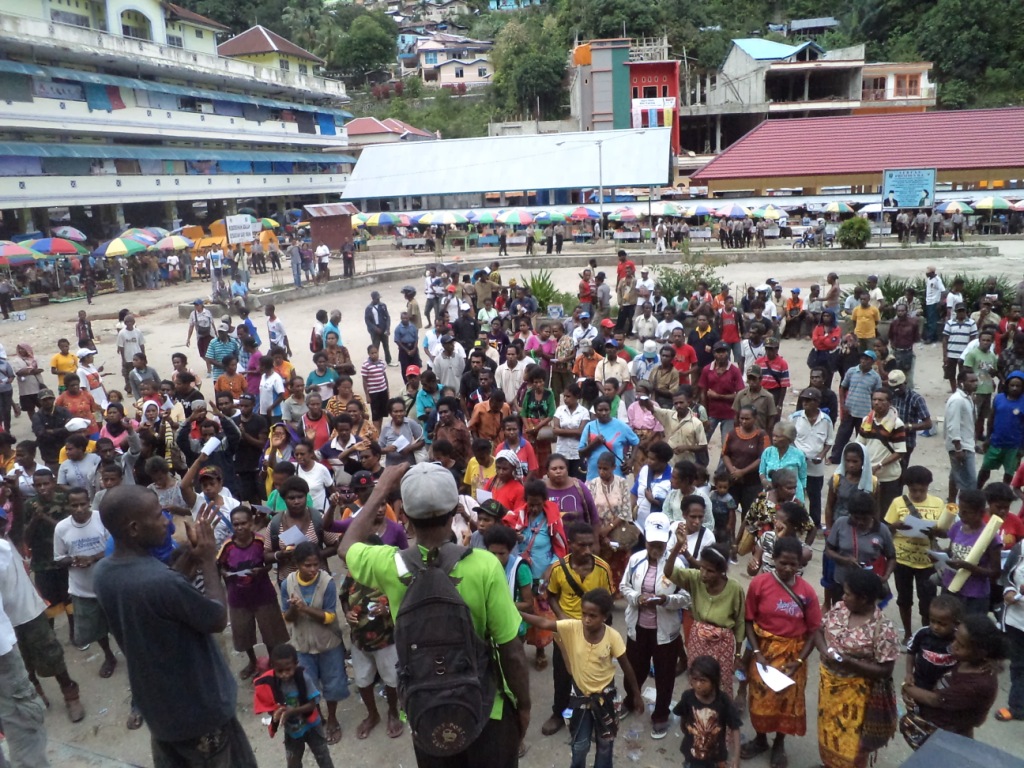
Unconfirmed reports are circulating that three foreigners have been arrested by Indonesian police in the west coast town of Fak-fak, West Papua, for taking photographs at a demonstration on MArch 19.
Rally in Fak-Fak, March 19, 2012
The rallies, which were held across West Papua and Indonesia, were calling on United Nations Secretary general Ban ki-Moon  to advocate for West Papua and pressure Indonesia to end human rights abuses in West Papua.  The UNSG was visiting Jakarta to speak at a Defence Policy expo and hold bilateral meetings with General Susilo Bambang Yudhoyono, the President of Indonesia.
The three men, identified as two British and one Canadian citizens, were taken by police to be interrogated after they were observed by intelligence officers taking photographs at the rally on Monday.
According to local sources, local police have claimed that the arrested men did not have a permit to enter West Papua,  are “part of a foreign interference”.
Foreigners must apply for a Surat Jalan (travel permit) to visit West Papua, and must report to a local police station or military post either daily or weekly.  Foreign journalists and human rights observers are banned by Jakarta from entering the Indonesian colony.  Due to this restriction, any non-Indonesian foreigner with a camera is subjected to surveillance.
Local police in Fak-Fak have not been available for comment.


Sambom: ‘Imprisonment will never silence Papuans’

JUBI, 19 March 2012
A leading Papuan human rights  activist has said that the Indonesian government will never be able to silence the Papuan struggle by putting Papuans behind bars. On the contrary, he said, it has the reverse effect by making people more determined than ever.

Sebby Sambom made these comments in an interview with JUBI in connection with the three-year sentence given to Forkorus Yaboisembut and his four colleagues last week.

‘Indonesia has neither the power nor the legal means to punish Papuans by silencing them with regard to their aspirations for an Independent Papua,’ he said.

He said that whenever Papuans take action, they are brought before the court and given a prison sentence. This is the way the government behaves which is simply unacceptable. Even though Papuans have done nothing wrong, they are thrown into prison.’

He said that any Papuan who takes action faces the prospect of being jailed. People keep on being arrested, put on trial and thrown into prison but this will never silence the Papuan people.

He went on to say that  as the number of Papuans being held behind bars goes on increasing , this will help to alert the international community to get involved in solving the Papuan issue.

‘With all these political prisoners,’ he said, ‘international support will become more positive.’

Sebby said that Forkorus  is a loyal Papuan leader who is very serious about the Papuan struggle. ‘He is doing everything he possibly can to bring an end to our sufferings,’ His attitude was very clear from the remarks he made after the verdict was announced. ‘We were pleased with the verdict and our struggle will continue,’ said Sambom.

Translated by TAPOL

Amnesty: Indonesia – Victims still waiting for truth and justice for past human rights violations

Amnesty International

AMNESTY INTERNATIONAL
PUBLIC STATEMENTIndex: ASA 21/012/2012
24 March 2012

Indonesia: Victims still waiting for truth and justice for past human rights violations

As the world marks the International Day for the Right to the Truth concerning Gross Human Rights Violations and for the Dignity of Victims, in Indonesia victims of serious human rights violations, including unlawful killings, rape and other crimes of sexual violence, enforced disappearance, torture and other ill-treatment continue to call for truth, justice and reparation for past crimes.

Amnesty International today urges the Indonesian Coordinating Minister for Political, Legal and Security Affairs, who is leading a team to resolve past human rights violations, to answer these calls by making the establishment of a National Truth and Reconciliation Commission a key priority.

The Commission should function according to international law and standards, including the Updated Set of principles for the protection and promotion of human rights through action to combat impunity. It should not substitute the responsibility of the criminal justice system in the country to investigate and – if sufficient admissible evidence exists – prosecute those responsible for grave human rights violations and crimes under international law. All victims should be guaranteed access to full reparation including restitution, compensation, rehabilitation, satisfaction and guarantees of non-repetition.      In 2004, the Indonesian Parliament passed the Law on a Truth and Reconciliation Commission (No. 27/2004), which provided for the establishment of a national truth commission with powers to receive complaints, investigate grave human rights violations which occurred in the past and to make recommendations for compensation and/or rehabilitation for victims. In 2006 the Indonesian Constitutional Court struck down the law, after it ruled that an article which provided reparation for victims only after they agreed to an amnesty for the perpetrator was unconstitutional. Amnesty International welcomed this ruling, as amnesties, pardons or similar measures of impunity for the most serious crimes and human rights violations such as unlawful killings, rape and other crimes of sexual violence, enforced disappearance, torture and other ill-treatment are contrary to international law.

Almost six years later, attempts to pass a new law and enact a national truth commission have stalled. Although a new law has been drafted and is scheduled for discussion in Parliament in 2011-2014; to date there has been no progress, with Parliament failing to prioritize debate of the draft in the 2012 legislative programme. The continued failure to debate and pass a new law in Indonesia leaves many victims without an effective mechanism for truth and full and effective reparation.

In May 2011, President Susilo Bambang Yudhoyono established a multi-agency team to devise “the best format to resolve grave human rights violations that occurred in the past”. The team has so far visited victims of such violations in various part of the country, including Talangsari, Tanjong Priok and Kupang. However, it has been criticized by human rights organizations and victims’ groups for failing to develop a concrete strategy to ensure truth, justice and reparation for victims.

All victims of gross human rights violations, crimes against humanity and other crimes under international law have a right to truth. Principle 4 of the Updated Set of principles for the protection and promotion of human rights through action to combat impunity states that “[i]rrespective of any legal proceedings, victims and their families have the imprescriptible right to know the truth about the circumstances in which violations took place and, in the event of death or disappearance, the victims’ fate”.

For victims, this right involves knowing the whole truth about the violations they suffered, including the identity of the perpetrators and the causes, facts and circumstances in which such violations took place. For family members, particularly of those who were killed or disappeared, it involves establishing the fate and whereabouts of their loved ones. Whether individual or collective, the right to truth involves the public acknowledgement of victims’ suffering. Truth commissions are also an important step towards understanding the circumstances that led to past violations, learning from the past to ensure that such crimes will not be committed again, and ensuring that shared experiences are acknowledged and preserved.

In addition to a lack of action at the national level, local attempts to establish truth commissions to deal with specific cases also continue to face delays. In the provinces of Aceh and Papua, civil society organizations are pushing for the establishment of local truth commissions, which are provided for in autonomy laws governing those areas. In Aceh a draft bylaw (qanun) has been on the legislative programme since early 2011 but is yet to be debated in the Aceh regional parliament, while in Papua, to date there has been no progress.

Amnesty International calls on the provincial and central government to prioritize the establishment of local truth commissions to ensure truth, justice and full reparation for victims and their families.

Efforts to deliver truth for victims and their families must form part of a wider framework of accountability for past crimes. Amnesty International calls on the Indonesian authorities to ensure that perpetrators of serious human rights violations are brought to justice in independent courts and in proceedings which meet international standards of fairness. Victims and their families must be provided with full and effective reparation under international law.

Amnesty International further calls on the Indonesian government to ratify the International Convention for the Protection of All Persons from Enforced Disappearance at the earliest opportunity, incorporate its provisions into domestic law and implement it in policy and practice.

Link: http://www.amnesty.org/en/library/info/ASA21/012/2012/en


Kontras: court ruling against Forkorus far from human rights principles and spirit of fair trial

The court ruling against Forkorus CS
Still Far from the human rights principles and the spirit of fair trial

The Commission for the Disappeared and victims of violence (KontraS) has regretted over the verdict of the judges in the District Court of Jayapura, West Papua, which sentenced Forkorus Yaboisembut, S. Pd, Edison Kladeus Waromi and three others, Dominikus Surabut, August M. Sananai Kraar dan Selpius Bobii in jail for 3 years on 16th March 2012. Despite each of the sentence is lighter than indictment of the prosecutor for five years in jail, it is still far from the principle of a fair trial and not socializing with the idea to build a Peaceful Papua through the dialogue.

Indonesia, as a democratic country and adopted a number of international instruments for human rights, the government is suppose to solve the problems in Papua more wisely, in the particular case of the verdict of the treason charged to Forkorus Cs. The court is not supposed to be conducted as there is another way around which will more effective and dignified based on the human rights instruments such as through the dialogue that will socialize the case so far.

The treason charged to Forkorus Cs, in fact, is considered too extreme as no one has used violence or violates any of the national rules and regulations during the congress of Papuan People III that held in 17 to 19 October 2012. What Forkorus Cs has conducted is a part of freedom of expression in peaceful manner which stated in Universal Declaration on Human rights article 19, Civil and political rights convention article 19 and 20, and also in other international rules and regulations. From the view of the domestic regulation framework, the guaranty of the freedom of expression is also stated in national regulations such as in 1945 Constitution, Law no 39 in 1999 and Law no 12 in 2005 that related to human rights which ratified in civil and political rights covenant. It is stated by defendants’ lawyers under their defence which is known as Bring democracy to the court and struggling peace for Papuan People.

Based on the result of the investigation and monitoring of the national human rights commission, the allegation of human rights abuses were committed by the security forces (police and military), in the forms of excessive force, violence, torture and other cruel treatments. However, the fact-finding mission was never followed up by the legal basis either by the police or national human rights commission.
By observing the sentences read by the panel judges which consisted of Jack Johanis Octavianus, SH as chief justice and four other members of judge, I Ketut Nyoman Swarta, SH.MH, George Mambrasar, SH.MH, Orpa Martina, SH, Willem Marco, it has raised a number of problematic notes that need to be questioned based on the information collected by the coalition of civil society organizations, which dedicated to enforce the law and human rights in Papua such as:

Firstly, the sentence of the panel judges show inconsistency in case of dealing with evidences related to the treason. The judges argued that the defendants have convincing and legally proven by law related to the articles of treason and proven to conduct an experiment.
Secondly, no credible witnesses have been brought to the court. While only one witness who comes from the society, seven other witnesses are coming from the police who did not see directly what happened in the field. So, of course they against the defendants and moreover, another five witnesses who come from the society also against defendants too during their testimonies of the court hearing. Those five people who testified in the court are also the participants of the demonstration that arrested and violated by the police during the process of interrogation. Their witnesses are not supposed to be in any consideration during the hearing.

Thirdly, during the hearing, the judges were able to present only one evidence or banner, while there have to be mentioned 69 evidences that the sentence referred to.

Fourthly, Gustav Kawer, one of the lawyers was criminalized because he was assessed as person who disturb the hearing.
KontraS supported the measurement taking by the lawyer who would file an appeal over the judgement since the hearing is not matching with the human rights principle and fair trial. She has submitted questions to the government regarding its commitments to solve problems in Papua through peace process, considering that the way which the government criminalized and implemented the article of treason would make the peace discourse further in Papua. The agenda to push the peace process in Papua is supposed to be fitted within the policy conducted by the government such as to stop the implementation of treason articles indiscriminately and to free from arbitrary arrest to who have not committed any violence or violation during the demonstration.

Jakarta, 16 Maret 2012
Badan Pekerja,

Indria Fernida
Wakil Koordinator

Contact Person: 08161466341 (Indria Fernida)

“Enough Is Enough!” Testimonies of Papuan Women Victims of Violence and Human Rights Violations 1963–2009

http://ictj.org/publication/enough-enough-testimonies-papuan-women-victims-violence-and-human-rights-violations

March 14, 2012
ICTJ, the Women Commission, and the Women Working Group of Papuan People Assembly

“We women of Papua have been bruised, cornered, besieged from all directions. We are not safe at home, and even less so outside the home. The burden we bear to feed our children is too heavy. The history of the Papuan people is covered in blood, and women are no exception as victims of the violence of blind military actions. We have experienced rape and sexual abuse in detention, in the grasslands, while seeking refuge, no matter where we were when the army and police conducted operations in the name of security.”

In 2009–2010, ICTJ, the Women Commission, and the Women Working Group of Papuan People Assembly provided support to Papuan women in a project to document gender-based violence and human rights violations that occurred between 1963 and 2009. This documentation effort aims to understand different patterns of violence, including abuses committed by security forces and resulting from efforts to seize natural resources in Papua, as well as violence women have experienced in their own households since the army took control of the region in 1963. Of the regions in Indonesia, Papua—on the verge of becoming independent when Soehato gained power—experienced some of the highest rates of atrocities committed under the regime. And recent crackdowns in Papua indicate the government is still adopting a heavy-handed security approach.

The women in Papua worked on this collection of stories of violence and abuse over three months, interviewing 261 people (243 women and 18 men). The report finds that a range of factors within Papua—violence employed by security forces, a culture of discrimination against women, and lack of political will to change policies among others—have meant the victims are still neglected and none of the effects of violence have been addressed. “Change cannot be postponed any longer,” the women conclude.

Create a website or blog at WordPress.com

Up ↑