Opinion/ Analysis
by contributors to the “Papuans Behind Bars” Project* (see end of article)
APRIL 16, 2013
An expression of people’s desire for freedom, cries of “Papua Merdeka” continue to ring out through the cities, mountains and forests of West Papua. The struggle is against fifty years of Indonesian rule, which throughout the last half-century has violently tried to subdue Papua, in its attempts to create a unified nation from the 17,000 islands that once made up the Dutch Empire.
Freedom as expressed by the word ‘merdeka’ is primarily a call for political independence, although the word is imbued with the clear hope that a new national sovereignty would also bring a wider liberation. Even when used outside the context of nations, ‘merdeka’ carries a sense of autonomy or self-reliance; from the same Sanskrit root Indonesian also inherited the word mahardika, meaning wisdom or nobility.
Those cries of freedom are also heard from the cells of Papua’s prisons, where its absence is arguably felt more strongly than anywhere else. The struggle for a national liberation suddenly becomes much more personal and immediate when deprived of your own individual liberty, by means of police handcuffs or a judge’s order.
Prison is used as a weapon against the people and their resistance to Indonesia, and over the years thousands of Papuans have found themselves locked away from the world behind prison bars. Many were arrested for expressing their aspirations for liberation, mostly relatively peacefully, but occasionally also for taking up arms. Others were merely unlucky enough to have been in the wrong place at the wrong time and got caught up in the structural violence of a justice system designed to spread intimidation throughout the entire population.
It is not always straightforward to know whether and how to relate to the macro-politics of nation states and aspirations of would-be nation states, and especially for those of us who are not in Papua and who are not forced into an existence defined by ever-present violence, repression, marginalisation and resistance. But by listening to the experiences of people caught up in that system, we can understand and be inspired by the ways that they have found to withstand oppression and create an impulse for their own freedom and that of their friends, families and communities.
Here are some of the stories from Papua Prison Island, tales of some of the individuals who have felt the full force of Indonesia’s law enforcement in recent years, who have been arrested at random or deliberately targeted as activists, who have been tortured or beaten in detention, whose trials were a farce, who have suffered major illnesses with no access to proper healthcare – but who have in many cases kept their strength, their dignity and sense of solidarity intact.
1. Repeated Targets: Buchtar Tabuni and Yusak Pakage
A political prisoner is forever marked out as an enemy of the state. Those who survive the horrors of the prison system and emerge to continue their resistance after being released are particular targets for petty and personalised vengeance. This was the case in 2012, when two former political prisoners who have remained politically active, Buchtar Tabuni and Yusak Pakage, were rearrested and re-condemned, both under ridiculous pretexts.
The story can be traced back to December 2010 when Miron Wetipo, a prisoner who had recently escaped from Abepura prison, was shot dead. News reached the prison and the prisoners’ anger erupted spontaneously. As a riot commenced, two political prisoners stepped in to try to negotiate a resolution. Buchtar Tabuni, the then-leader of the West Papua National Committee (KNPB), was serving three years for organising a demonstration, and Filep Karma fifteen years for raising the Morning Star flag, a banned symbol of West Papua. Their attempts at mediation were ignored and instead they were blamed for starting the riot. Along with three other prisoners they were transferred from the jail to police headquarters for three months, where they were initially denied food and family visits and were at constant risk of violent reprisals from the cops.
Eventually the men were returned to the prison and the story could have ended there. Although Filep Karma’s sentence is set to run for several more years, Buchtar served the rest of his sentence and was released nine months later. He continued to be a prominent activist fighting for independence.
However, almost a year after his release on 6th June 2012, Buchtar Tabuni was arrested again. This piece of news only made minor headlines at the time, as everyone’s attention was focussed on a wave of seemingly-random shooting incidents that was causing panic at the time around Jayapura, as they were occurring nearly every day. After Buchtar’s arrest, the Jayapura police chief said in a press conference that he had been arrested in connection with a string of recent violent incidents, which would seem to imply the that he was accused of being involved in the shootings.
However, when Buchtar’s lawyer was able to see him, he established that the arrest was actually in connection with the prison riot 18 months before. But why should he be arrested suddenly now, if the case could have been brought to trial at any point in the nine months between the riot and Buchtar’s release while he was still in custody?
In fact, it appears that this arrest was part of a new wave of repression against the KNPB, an organisation which had been gaining in momentum across Papua over the past few years, mostly by organising open demonstrations in Papua’s urban centres. It was to become a decisive move against the popular organisation; Victor Yeimo, who took over from Buchtar as KNPB chair, claimed that 21 KNPB members were killed and 55 imprisoned during the course of 2012. Just over a week after Buchtar was arrested, KNPB deputy leader Mako Tabuni would be gunned down by a police marksman as he was buying betel nut on a street corner.
Buchtar’s trial for violent disturbance started in July. It was reported that several KNPB members received threatening text messages not to attend the trial. Yusak Pakage was undeterred, however. He was also a former prisoner, having been sentenced to ten years in prison at the same flag-raising event in 2004 where Filep Karma had also been arrested. In July 2010 he was granted a pardon and released, after which he was involved in the Papuan Street Parliament (Parlamen Jalanan).
Watching the farce of a trial, Yusak’s frustration built up until he kicked over a rubbish bin. Bright red spit from someone who had been chewing betel nut spilled out of the bin and stained the trouser-leg of a public official. Yusak was arrested. While he was being searched, police found that he was carrying a penknife. This became the pretext to charge him under an Emergency Law from 1951, which prohibits carrying weapons.
So for possessing this everyday object Yusak Pakage was sentenced to seven more months in prison. He has said that he believes he was targeted for having previously been a political prisoner, and it would be hard not to see it that way, as it is totally normal to carry not only penknives but also tools such as machetes and bows-and-arrows in Papua.
Having already spent years behind bars does not make prison less of an isolating experience. Yusak Pakage, whose name is known around the world due to Amnesty International having promoted his case as a prisoner of conscience, told a local reporter how he was saddened at how few visitors he received in prison, especially after his sister moved to another city. While he knew local human rights activists were supporting him in other ways, whether out of fear or lack of motivation, they didn’t come to visit.
But prison can also sharpen the sense of solidarity with those facing the same fate. After being released from his eight month sentence, Buchtar Tabuni’s first act was to go to the site of where his friend Mako Tabuni had been killed. A few days later he flew to Wamena to try to negotiate the release of other KNPB members which had been arrested in September, accused of possessing explosives. This trip was followed up by trips to Timika and Biak, where he also visited KNPB members in prison and tried to secure their release.
2. Left to Sicken and Die: Prisoners of the Wamena Arsenal case.
On December 2012, Kanius Murib passed away in Wamena, 59 years old. He had been in prison since 2003, but in the last few months of his life the prison guards allowed his family to care for him, as by that time he was suffering from severe mental illness and failing physical health. Arrested with nine other people and sentenced to life imprisonment, he was the third prisoner from that case to die in custody.
The accusation laid against the men was that they had carried out a raid on the weapons arsenal in a military base in Wamena on 4th April 2003. Not knowing who had carried out the attack, the military went on the rampage, sweeping through surrounding villages, meting out an undiscriminating collective punishment on the whole population, burning entire villages to the ground as they so often do when they take revenge. Several people were killed in these reprisals, and it is likely that many others starved to death in the mountains as they fled their homes.
Kanius Murib’s house was one of those burnt. He was arrested on 6th April. While still in military detention one week later he was dragged three kilometres to Ilekma Village, together with another man, Yapenus Murib. Kanius was handcuffed, Yapenus was pulled by ropes tied around his neck. This torture was more than a human body could take; he died shortly afterwards.
Seven more men were arrested, and also experienced similarly brutal torture. One was able to escape, so together with Kanius Murib seven were left to stand trial. All were convicted of treason and sentenced to between twenty years and life.
In December 2004 the other six men (Apotnalogolik Lokobal, Jafrai Murib, Linus Hiluka, Numbungga Telenggen, Kimanus Wenda and Michael Heselo) were woken up and forced to get in a truck. They were being moved to Gunung Sari Prison on Sulawesi Island, isolated from friends and family by 2000km of ocean. They remained there until 2007, when Michael Heselo fell ill in prison. Before his family could raise funds to come and visit him, he died in prison, aged 35.
Protests broke out in Papua, demanding that the five men remaining in Makassar should be brought back to Papua. The authorities acceded to the request and the prisoners were divided between Nabire and Biak prisons – still a long way from home, but at least they were in Papua. But prison continued to take its toll on the men’s health. In 2011, Kimanus Wenda started experiencing stomach pains and was vomiting all the time, and feared he had a tumour. Jafrai Murib, who would have been no more than 28 or 29 at the time, had a stroke, which left him almost paralysed.
Both men urgently needed medical care, and it is the prison’s responsibility to ensure inmates receive treatment, but the only attention they received was consultations with local doctors. The prison refused to pay for operations, or for their transfer to Jayapura, where better facilities were available.
This happens time and time again. Filep Karma has also had a history of sickness in prison – kidney problems left him in severe pain for some time. After a long campaign to get treatment for him, finally local activists went out on the streets collecting donations so he could be operated on in Jakarta. In this way they managed to pay for the flights for him and his family, and international groups helped to pay the hospital bill. It is a sign of the force of his character, which has brought him through ten years of prison maintaining a stubborn and uncompromising commitment to his principles, that even as the money was being found, Filep was talking of refusing to leave unless another prisoner, Ferdinand Pakage, could also get treated – he even started a hunger strike. Ferdinand Pakage had been blinded in one eye after a beating by a prison guard, and continues to suffer as a result.
For Kimanus and Jefrai, eventually local activists had no other choice but to go out on the streets and collect donations again. For doing what should have been the state’s responsibility, collecting money to care for sick prisoners, fifteen people were arrested on 20th July 2012. One of them was Yusak Pakage, just three days before he would be arrested again in the courtroom incident.
Eventually, after many months, enough donations were collected, in Papua, Jakarta and abroad, and prison authorities gave their permission for Kimanus and Jafrai to be transferred to Jayapura for treatment. In the end Kimanus was diagnosed with a hernia. But even after all that has happened, accessing health-care continues to be a struggle – the latest news is that Jafrai Murib was temporarily denied access to the physiotherapy he needs to recover from the stroke – as punishment for having a mobile phone in his cell.
3. In the mountains where no-one is watching: Prisoners in Wamena Prison
Wamena, where Kanius Murib and the others were arrested, is the main town of Papua’s Central Highlands, which support a higher population than other parts of Papua, but remain inaccessible. No usable road connects this high plateau to the coast, and news still doesn’t reach the outside world so easily. It is in these mountains that most of the bloodiest military operations have taken place in recent years. When prisoners are taken they are usually accused of treason and often given long sentences based on spurious evidence. As lawyers and human rights groups, already overstretched in the lowlands, have not always had the resources to come up here, there is often no-one to support them. Few details about their cases circulate, and it can be difficult to find any information about them. Here’s what we know:
Tenius Murib and Jigi Jigibalom were arrested in a military sweeping operation in November 2003. Still in the early hours of the morning, troops surrounded a house in Bolakme village and opened fire, killing ten people. The two survivors were arrested, tortured and accused of belonging to the Free Papua Movement guerrilla army. One of the accusations was that they had participated in the same raid on the weapons dump described above. They were sentenced to 20 and 15 years respectively.
Dipenus Wenda was arrested with three other men in March 2004, while they were giving out leaflets campaigning for a boycott of Indonesian elections. One of the four, Marius Koyoga, was shot dead while in police custody. The others went on trial for treason. Dipenus Wenda was sentenced to 14 years in prison.
In January 2005, Yusanur Wenda and between six and eight others were arrested in Wunin district (information is so limited we are not even sure how many people were prosecuted in this case). Also accused of belonging to the OPM, they were supposed to have burnt down public buildings and schools. For this Yusunur Wenda was sentenced to 17 years, and the others also received long sentences. Local activists asked at the time why the OPM would be interested in burning schools. But there is another explanation: a week before the arrests even took place, a website called West Papua News had published an account of the burnings. In their story, it was Kopassus special forces and police mobile brigade (Brimob), which had arrived by helicopter, and burnt down not only the public buildings but all the houses in the village as well.
In 2008, nine people were arrested while walking to a funeral in Yalengga village. They had been asked to carry a banned Morning Star flag so that the dead man could be buried beneath the Papuan flag. On the way they were intercepted by soldiers, arrested and tortured. Once again, the charge was treason, this time the sentence eight years. It is believed that these men were not even activists, yet they were condemned under laws intended for major attacks against the integrity of the Indonesian state.
At present, out of all these cases, only six convicted political prisoners remain in Wamena prison. Four are from the Yalengga case: Oskar Hilago, Wiki Meaga, Meki Elosak and Obeth Kosay, as well as Yusanur Wenda and Depenus Wenda. Over the years the others have all managed to escape. Some were among the 42 people who broke out of Wamena prison on 4th June 2012. Another mass escape had taken place in 2009, with 43 people managing to escape. Finally in November 2012, two young men who had allegedly been in possession of OPM documents, saved themselves the perils of Indonesian justice by finding a way to break out before their case came to trial. It seems that the only chance for justice in Wamena is to take it for yourself.
4. Allegiance to the Wrong Flag: Repression Against Symbolic Acts of Resistance
The charge of Makar, or treason, the infamous article 106 of Indonesia’s criminal code has been used as a catch-all to repress Papuan movements. It was the principle charge in all the Central Highlands cases mentioned above. Whether the accusation is a peaceful act of dissent or armed rebellion, the charge is likely to be the same, probably because most of the other criminal accusations which could be brought are seen as lesser crimes. With article 106 it is possible to condemn someone to 20 years in prison, or even life, as in the case of Jafrai Murib.
A flag has become a symbol both of what Indonesia cannot tolerate and the Papuan challenge to Indonesian authority. The Bintang Kejora (Morning Star) was first flown on December 1st 1961 at a point when the Dutch Colonial Government was preparing to hand over power to an independent West Papua, before Indonesia sent its armed forces to claim the area. After Suharto fell a special autonomy package granted by President Gus Dur expressly allowed the flag to be flown as a symbol of Papuan identity, but the military never accepted that policy. The special autonomy still stands in theory, but a Presidential Regulation forbade the Morning Star flag once more in 2007.
Many people have gone to prison because of this particular piece of cloth, or even displaying the symbol on clothing, bags etc. Filep Karma is the most well known, and also the most extreme case, sentenced to fifteen years in prison for raising the flag on December 1st 2004. Actually this was the second time Morning Star flag had landed Filep in prison. The first time came just weeks after Suharto fell, and the people of Biak occupied the port, flying the flag from the water tower. The people held the port for four days, but then the military stormed in. Filep Karma was shot in both legs but survived, one of 150 people arrested that day. For many, the punishment was even more severe: according to local investigators, 139 bodies were loaded onto two navy ships to be dumped at sea.
As he has long been a popular figure in Papuan resistance movements, large demonstrations accompanied both of Filep Karma’s trials. At the trial for the 2004 flag-raising, the reason for the demonstrations was the prosecution’s demand for a five-year sentence, which the crowd felt was extreme. Yet in the end the judge went much further, taking the unusual step of exceeding the prosecution’s demand and condemning him to fifteen years and Yusak Pakage to ten.
The ‘Jayapura Five’ were arrested at the Third Papuan People’s Congress in October 2011. Their act of supposed treason was an act of provocation – or at least they knew the huge risks they were taking when they convened a congress where representatives from all over West Papua would meet to discuss their political future. Unsurprisingly, but bravely, the congress decided to declare independence. The flag was raised, and Forkorus Yaboisembut, leader of the Papuan Customary Council, was declared as President of the Federal Republic of West Papua. Edison Waromi, who had been imprisoned under political charges for twelve years in 1989, and then six months in 2001 and two years in 2002, was chosen as Prime Minister. Another former political prisoner, Selpius Bobii, who had organised the conference was also jailed, as were August Makbrawen Sananay Kraar and film-maker Dominikus Sorabut. They were sentenced to three years in jail.
Also still in prison for raising flags are Darius Kogoya and Timur Wakerkwa, sentenced to three years and two-and-a-half years respectively for raising the Morning Star on 1st May 2012. And there have been many more prisoners in recent years for these symbolic acts of defiance: Septinus Rumere, an activist from Biak in his sixties, simply raised a flag outside his house in 2009 – he was sentenced to six months for treason. The Iba brothers were maybe hoping to get away with raising a flag which merely resembled the Morning Star in Bintuni in 2009, but they were sentenced to between two and three years anyway.
Another case highlights how the cruel reality of the prison system clashes with the ways indigenous people find to assimilate the pressures on their lives and express their desire for liberation. In Demta village, on West Papua’s northern coast, a group of villagers had built a meeting house they called Mammo and started believing in a king. Such messianic beliefs, sometimes known as cargo cults, have emerged in Melanesian cultures ever since they came into contact with colonialists, and can be seen as a reaction to these new patterns of domination. This group made a procession calling for repentance from humanity’s wickedness and obedience to the king. Alongside the flag of the king, the Morning Star was also raised. The next morning, after the Mammo had been burnt down by local Christians, people from the group went to the police to avoid a violent conflict building up. They were arrested and charged with treason. After two months their release was negotiated, even if the charges were not formally dropped.
People organising politically for the rights of indigenous people are also targetted. Edison Kendi and Yan Piet Maniamboi were arrested as organisers of a demonstration to mark World Indigenous People’s Day on Yapen island on 9th August 2012. Their trial was still ongoing as this piece was being written, with rumours that the prosecution is asking for 20 years imprisonment.
There have been no recent cases of people being imprisoned as a direct consequence of defending their land from the resource industries of logging, mining and plantations that are becoming ever-more rampant in West Papua, but the climate of repression is nevertheless opening doors to these industries, as there are plenty of reports from local people who feel too intimidated to taking a public stance against these development projects. After all, if raising a flag in your front garden can be considered treasonous, could not also standing in the way of a priority project for Indonesia’s economic development, such as the MIFEE agribusiness project or the Freeport goldmine?
5. When the law itself is violence, do guilty and innocent continue to mean anything?
While in recent years no long-term prisoners have resulted from the continuing conflict around the massive Freeport goldmine, it was a demonstration against that mine outside a university campus in Jayapura that led to a wave of arrests and intimidation in 2006. Twenty-three people spent an average of five years in jail after that demonstration, but by now most have been released. The exceptions are Luis Gedi and Ferdinand Pakage, who were sentenced to fifteen years each and are still inside, and Echo Berotabui, who succumbed to the despair and killed himself in prison.
On the day of the demo, 16th March 2006, minor clashes broke out, but then the police tried to storm the demo and they misplayed it. Four policemen and one air-force officer were killed that day. Once again, the state’s response was to react with widespread violence targeted against all and sundry. Seventy people were arrested, one or two were killed, and the campus emptied as students fled in panic.
As the weeks went on, the state’s handling of the case continued to be directed indiscriminately, more a thirst for revenge than an attempt to prosecute those who actually engaged in violence during the demonstration. Of the 23 people held and charged, all reported torture. People were forced under torture to make allegations against others. Luis Gedi was picked up on the street and forced to admit to killing policeman Rahman Arizona and to give another name as his accomplice. After being subjected to torture the name that he gave was Ferdinand Pakage. The police went to arrest Ferdinand and then they demanded to know where was the knife that had been used to kill Rahman. They made him go to the campus to try and find it. Then they shot him in the foot, and he told the police the knife was at his house. The police went there and seized his mother’s vegetable knife.
Similar stories continued throughout the trial process, with intimidation and a thirst for vengeance running high, police caring little whether the people they had in the dock were the perpetrators or not.
At one point, when 16 men had already been sentenced, police tried to force one of them, Nelson Rumbiak to appear as a witness for the prosecution in the trial of the remaining seven. When his testimony contradicted the police version of events, the police beat him up. As a response the remaining seven defendants refused to leave the prison to attend the next hearing, and convicted prisoners backed them up by throwing stones at the vehicle that came to take them to court. When another man was later arrested in connection to the same trial, all 23 prisoners wrote to the prison governor, saying that they would not testify for the prosecution, ‘even if they should be shot dead’.
Ferdinand Pakage lost an eye in prison in September 2008, after he was beaten by a guard who was holding his keys. The wound left behind has continued to cause problems over the years.
In the multiplicity of forms of struggle for Papuan independence, acts of violence do occur, but the state’s hysterical response means that ‘guilty’ and ‘innocent’ cease to be distinguishable. Dani Kogoya is believed to be a member of the TPN/OPM guerrilla army, and has been accused of co-ordinating an attack in Nafri near Jayapura, where one military officer and three civilians were killed. He was arrested in September 2012 and is being tried with four other people.
Dani has reportedly admitted his involvement in the killings, and expressed regret. Although that confession was made under duress, it is certainly possible that he was involved. What is definate is that neither he nor those accused of being in his gang will stand any chance of a fair trial. The ground has already been laid out: assuming his guilt a year previously police and military conducted a raid where Dani was supposed to have lived. The local community leader was forced to dig a hole while soldiers threatened him at gunpoint. At least fifteen people were held and tortured or maltreated. Dani’s eight-year-old daughter was reported to have been kidnapped and disappeared for a week. During his own arrest in 2012, Dani Kogoya was shot (police said that he was trying to escape), and his leg needed to be amputated. As the trial commenced, and the prosecution laid out its evidence, none of the witnesses they presented could testify to having seen Dani Kogoya carry out the attack.
Papua’s political prisoners stand almost no chance of receiving proper legal representation as the intimidation of lawyers is intense, claiming they are also committing treason. When the accusations are non-violent acts it is bad enough, but when violence has been involved the stakes are even higher. For example, in the case following the 2006 anti-Freeport demonstration, lawyers received death threats by text message against them and their family, and the house that one of them was staying in was pelted with stones. During Filep Karma’s 2004 trial, a severed dog’s head was left outside his lawyers’ office, alongside a note mentioning them by name.
6. Targeting the KNPB: how the state terrorizes social movements.
Late afternoon on 29th September 2012 at the West Papua National Committee’s (KNPB)Wamena secretariat, riot police and military showed up and arrested the people present. They claimed they had found two ready-assembled bombs on the premises. More raids would take place over the weeks and months to follow, in Wamena and also Timika, Biak and Jayapura, all involving members of the KNPB. Other KNPB members would be placed on the wanted list, effectively forcing them into hiding.
One of these arrests, in Wamena in mid-December was especially tragic. As three men were being arrested, police pressed them to give more names. They forced one of the men, Meki Kogoya, to phone another KNPB activist, Huburtus Mabel, and arrange a meeting for the next day. Being in custody, Meki was unable to turn up for the rendezvous, but the police were there and shot Huburtus Mabel, who died from his wounds and also Natalias Alua, who was left in a coma, but eventually recovered. Once again, they were allegedly trying to resist arrest.
However, beyond the names of the suspects, little information is known about this Wamena case. It is from Timika, where trial proceedings are in course, that there is much more news. It appears that twelve people were arrested early in the morning of October 19th, as the KNPB were preparing to organise public activities over the coming days. The police claimed to the press that they had found metal pipes and powders to be used in bomb-making.
Six of the activists were set free after five days, and the remaining six charged under an emergency law from 1951, which prohibits the carrying of weapons – a different article of the same law as that used to sentence Yusak Pakage for the penknife. Also used in the Wamena and Biak cases, this law is rapidly becoming the state’s preferred strategy for criminalising independence activists.
When the case came to court, the allegations were toned down somewhat. It appears that only one of the six was accused of possessing explosives, which he denies. The explosives in question are a kind commonly used for dynamite fishing – an ecologically destructive practice to be sure, but not an indication that they would be used against people. The others were accused of possessing panah wayar – a kind of barbed arrow used for fishing, and other tools. In Papua, bows and arrows are carried by almost everyone, as they are used for hunting and fishing and are a symbol of cultural identity. As the weapons charges seemed rather flimsy, the charge of treason was also added before the case came to trial.
It seems very strongly that this wave of arrests has been very deliberately planned to neutralise the KNPB. Even more so when coupled with a string of assassinations throughout 2012 and the politically-motivated use of the police wanted list.
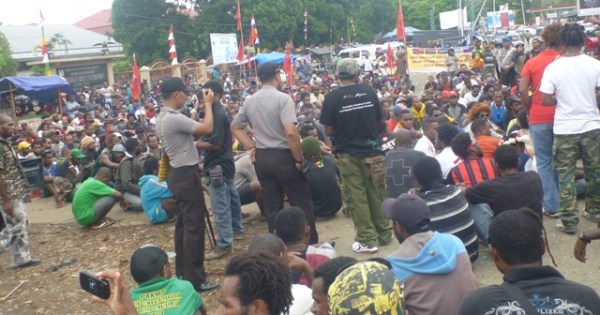
The KNPB is an organisation which, since 2008, has tried to organise big demonstrations in cities across Papua. Their principal call has been for a referendum on independence to replace the flawed UN sponsored ‘Act of Free Choice’ in 1969, and they have closely aligned themselves with international initiatives to mobilise support for the Papuan cause amongst lawyers and parliamentarians. Papuan people responded and many thousands dared to come on the demonstrations, building a rapidly growing movement across West Papua.
To organise openly in this way was a bold step, relocating the focus of the struggle from the forest to the cities. Although many KNPB members see theirs as a revolutionary struggle, they also recognise the need for mass participation, and so there is a desire to focus on more non-violent forms of struggle. KNPB leaders have repeatedly stressed this point.
Actually it appears that there have been a couple of explosions that have taken place in Papua recently. Both were in Wamena – one in an empty police outpost and the other in an empty government building. It’s important to emphasize that these were empty buildings and there were no injuries – and also that those arrested in Wamena are not believed to be charged with causing these explosions. But it is also possible to imagine that some independence activists may end up choosing this kind of clandestine action. Especially as attempts to organise openly using peaceful methods which should be interpreted as legal are met with long prison terms or even police bullets.
Increasingly prominent in the political policing of West Papua is a group called Densus 88. Set up as an anti-terror squad after the 2002 Bali bombings, their focus has mainly been countering Islamic terrorism. There too, the sensationalism that surrounds their attacks on radical Muslims, and the frequency that they shoot-to-kill has raised accusations that they are causing the radicalisation of certain Muslim communities in response. In Papua, they are accused of carrying out assassinations, of activists and non-activists. A sign of their increasing prominence is that the latest chief of police in Papua was promoted to the position after running Densus 88.
In Papua, it is not really clear whether some activists are storing explosives or not, and if so what they intend to do with them. What is certain is that during the course of 2012 it has become much more difficult for groups who want to express their aspirations openly on the streets to do so. In early 2013, prominent Papuan advocate Benny Wenda made a major diplomatic tour around the US, Australia, New Zealand and Pacific Island States. Normally the KNPB would have been out on the streets to show support for his initiatives. But there have been no such demonstrations. It seems that right now, actions like this have become almost impossible.
7. Papua Prison Island
In 2013, the arrests continue: One person arrested and two others on the wanted list for organising a demonstration in Manokwari, four people arrested in Sarmi accused of being OPM members, another seven held near Jayapura and tortured by police demanding to know the whereabouts of independence activists, two of which have been kept in prison. Then there have been a number of cases in Paniai, in the western part of Papua’s highlands: six people were arrested and held for a month before being released for a lack of evidence, two teenagers were also arrested in a separate case and held for two weeks, and there have been two other reported cases of arrest and torture.
And these are only the political cases: with Papuans so extremely economically and socially marginalised in their own land, and with clear evidence of systematic racism in all parts of the state bureaucracy, we can only wonder what might be the stories of those condemned to prison for non-political crimes.
Prison is just one extreme form of how people are deprived of their freedom in West Papua. While some Papuans are being giving jail sentences, others are being cheated out of their ancestral land by plantation companies, forced to flee their villages due to military operations, or simply unable to find a way to make a living when the possibilities for work fall overwhelmingly to migrants from outside Papua. But none of these injustices are isolated. The prison system is one tool the Indonesian state uses to crush opposition and so maintain these patterns of oppression. Many of those held captive have been denied their personal liberty as punishment for seeking a wider liberation.
Meanwhile Indonesia’s latest strategy is to pacify Papua with promises of development programs, organised unilaterally from Jakarta, whilst glossing over the structural causes of oppression – for example ministers have denied that there are any political prisoners in Papua, only criminals. But economic development without freedom cannot bring peace, merely intimidate people into coercive obedience. It is encouraging that so many in Papua, including many prisoners, refuse to be intimidated.
—Much of the information for this article came from http://www.papuansbehindbars.org , a new project to document the cases of West Papuan Political prisoners. That site has profiles of current and former political prisoners and releases monthly news updates on arrests, trials etc. However, this is an opinion piece which does not represent the position of the Papuans Behind Bars project—



 West Papua Media Alerts