Filep Karma referred to Jakarta hospital with a suspected colonic tumour: NKRI refuses to pay

from West Papua Media’s correspondent at Abepura Prison (with Eds)

April 16, 2012

Filep Karma referred to Cikini hospital in Jakarta

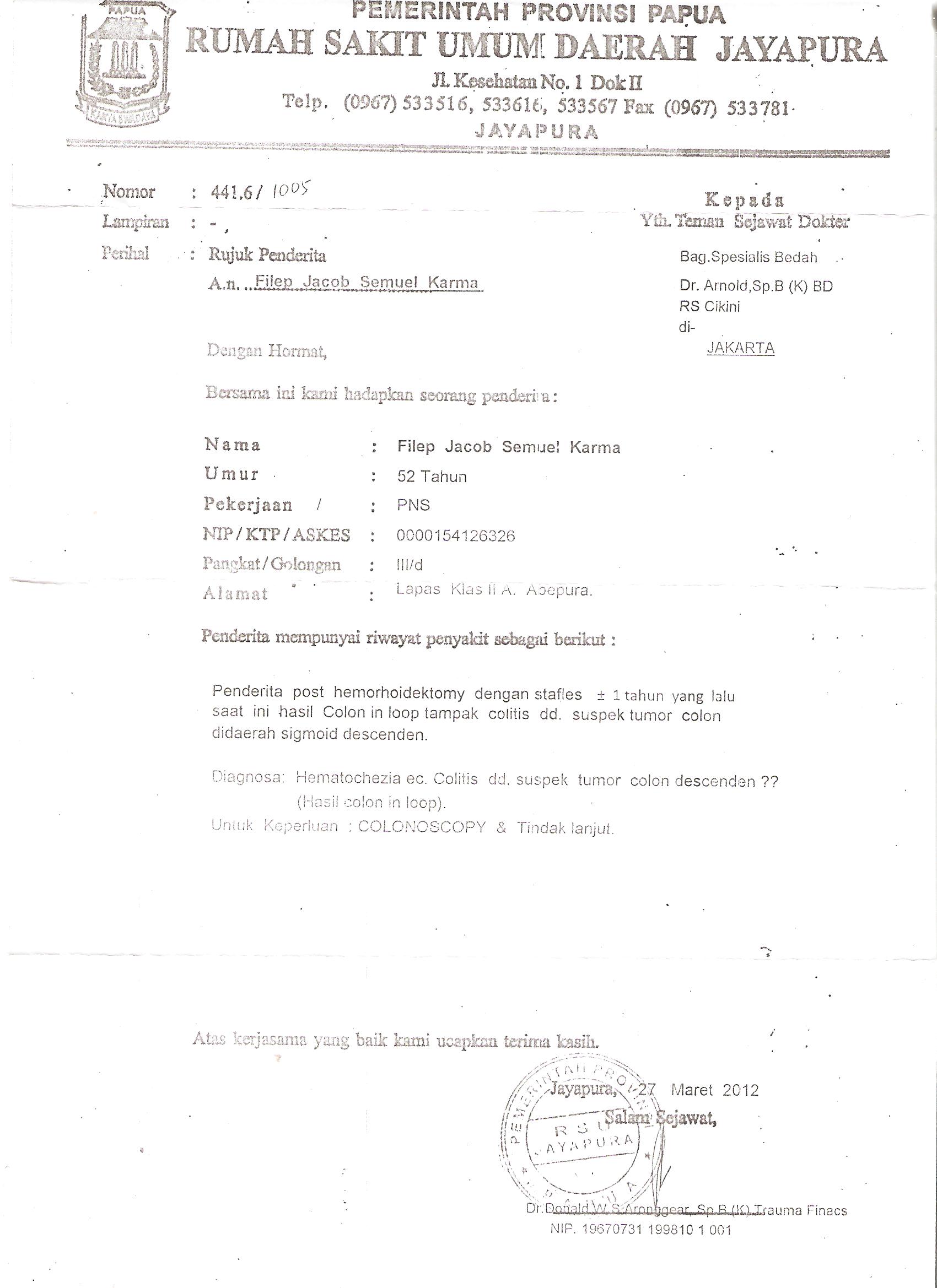
Papuan political prisoner Filep Karma, in prison for 7 years on treason charges after raising the banned Morning Star independence flag, has been referred to Cikini hospital in Jakarta for three months to undergo medical treatment.

However he must undergo treatment in Jakarta, because Dock 2 hospital in Jayapura lacks colonoscopy equipment to diagnose the condition of Filep Karma. Healthcare in Papua is poorly funded and supplied, if at all, and health workers are rarely paid properly.

Hospitalised in Jayapura’s Dok 2 hospital since 2008, FIlep Karma has been gaoled in atrocious conditions and subjected to early routine torture by Indonesian security forces and prison officers, including beatings causing internal injuries.  His health has been declining since 2008 due to numerous hunger strikes and illness caused by prison conditions in Abepura prison.

Karma has been complaining of a lump in his gut over the last 3 years. Since an operation was performed on 2 November 2011, Karma has continued to pass significant blood in his stools.
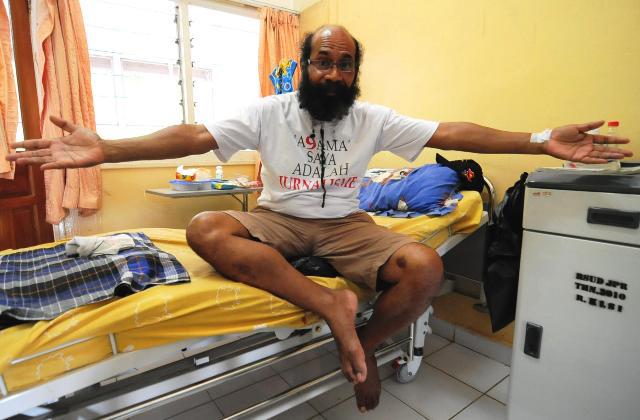
Karma has been referred by the Dok 2 Head of Trauma to the Department of Surgery Specialist, Dr D. Arnold, Sp.B (K) BD, in Cikini. Filep had already been undergoing treatment in Jakarta separately for his prostrate. On 13 April 2012, Dr Hidayathu Samawi, the general practitioner in Abepura prison, called Karma to his rooms. Dr Hidayathu said that Karma must provide a letter of permission from the family to consent to the treatment of Jakarta, and the Letter to commit the family to bear the full cost of treatment and transport to Jakarta.

Karma in this case ask for the Abepura Prison to issue a letter that the prisons are not able to bear the cost of treatment in Jakarta, but Dr. Hidayathu said that the prison would not certify its refusal to bear the cost of treatment in Jakarta.

During prison visiting hours at Abepura, Filep Karma told West Papua Media’s correspondent, “I was detained by the State of Indonesia, for 15 years, why are they unable to bear the cost of my treatment in Jakarta.  My case in July 2010, it was the same, treatment not covered by the State.  Abepura prison officials alone cannot issue a statement that they can’t afford the cost to Jakarta, yet I hardly have the foundation (strength) to have resort to outside solidarity as my only choice to help me for medical expenses to Jakarta,” said Karma.

The Indonesian government has an obligation to provide adequate healthcare to political prisoners.  According to Amnesty International, under Indonesian Government Regulation No. 32/1999 on Terms and Procedures on the Implementation of Prisoners’ Rights in Prisons, all medical costs for treatment of a prisoner at a hospital must be borne by the state, also in accordance with the UN Body of Principles for the Protection of All Persons under Any Form of Detention or Imprisonment (Principle 24) .

In late February, in response to a petition filed by Freedom Now, the United Nations Working Group on Arbitrary Detention issued its opinion that the Government of Indonesia is in violation of international law by detaining Filep Karma. Amongst many other international voices, the Working Group called on the Government of Indonesia to immediately release the human rights advocate.

westpapuamedia

Image

While the military accuse the OPM of recent shootings, others call for investigations

{This article delicately skirts around the facts of inconsistencies on the military and police versions of the Trigana Air shootings.  It is widely suspected that the “unknown persons” responsible for the shootings – as is mainly the case in Papua – are not the OPM at all, but military sniper units.  see https://westpapuamedia.info/2012/04/09/doubts-grow-of-opm-responsibility-for-puncak-jaya-aircraft-shooting/ }
Bintang Papua, 13 April 2012

According to a statement by the commander of the Cenderawasih  military command, the OPM -Organisasi Papua Merdeka – was responsible for the recent shooting of the Trigana plane at the Mulia Airport, Puncak Jaya. This means that it is necessary for the OPM to be involved in trying to identify  the basic problems surrounding the acts of violence in Puncak Jaya.

The co-ordinator of the Jaringan Damai Papua, JDP, (Papuan Peace Network), Dr Neles Tebay said it is necessary to involve the OPM, not only in order to bring to an end events that have been occurring recently as well as in the past, but also to seek a way of preventing such events from happening again. He was speaking following a meeting between the OPM and the government, and insisted that agreements that had been reached at that meeting should be adhered to.

‘A strategic solution  can be put in place for the long term, bearing in mind that responses to events up to now have been re-active; for instance, when distubances occur, troops are deployed and after tranquillity  has been restored, the troops are pulled back. That might be a good way to tackle things but is it only for the short term,’  he said.

He pointed out that the recent shooting in Puncak Jaya was the second time that shots had been fired. The first time was when a TNI helicopter was shot at, though on that first occasion, the plane shot at was a commercial plane.’

‘Such incidents have been occurring frequently in the recent past, which means that if the government wants to solve the problems in Puncak Jaya , it should recognise the fact that previous problems have not been solved.’

In view of this, the JDP offers two solutions to end the shootings in the region. In the short term, this would mean restoring peace and tranquillity to the area, but the second solution would require the involvement of various stakeholders, including the central government, the provincial government, the TNI and the police, bearing in mind that the military commander has already declared that the OPM was responsible.

The JDP co-ordinator said that these shooting incidents have been occurring at a time when no dialogue is taking place while also taking into account the fact that not only civilians but also members of the security forces have been among the victims.

‘Moreover, there has been no transparency  on the side of the security forces about the results of their investigations. Were projectiles involved and if so, what kind of projectiles. Such things have never been explained to the general public.’

Dr Tebay also said that these shooting incidents had delayed local elections which are under way. ‘If these incidents are not resolved, it could also cause delays in the supply of essential goods for the population,’ he said.

Violence should not be answered with violence.

A member of the Papuan Customary Council, Fadel Alhamid said that violence should not be answered by violence as this can only result in yet more violence. He said that nothing was yet known about who was responsible for the  initial violence; was it the TPN/OPM or unidentified persons?  This only goes to show that the security approach is not the right way to improve the situation in Puncak Jaya. ‘In response to acts of violence, sweepings occur, but such operations spread fear  among the people, who then flee their homes and go into the forests. A more persuasive approach is needed, and this requires the collaboration of all elements in society.’

This means involving political bodies, the churches, customary groups all  of which should be actively involved, bearing in mind that the security approach has a direct impact on the civilian population. If everyone gets together, it should be possible to work out who was responsible for the shooting.

He went on to say that the security forces should carry out its investigations in greater depth so as to discover those elements that are behind the shootings.If it turns out to have been the OPM, there is a way out of the problem. But if unidentified persons are involved, we must be able to find out who they are, what their interests are in  Puncak Jaya and in the Central Highlands such as in Timika, while similar investigations should be conducted with regard to the TPN/OPM.

[Slightly  abridged translation by TAPOL]

THE MOMENTUM BUILDS: Thousands shout out support for Free West Papua at East Coast Blues & Roots Festival

Press Release – Wednesday April 11, 2012
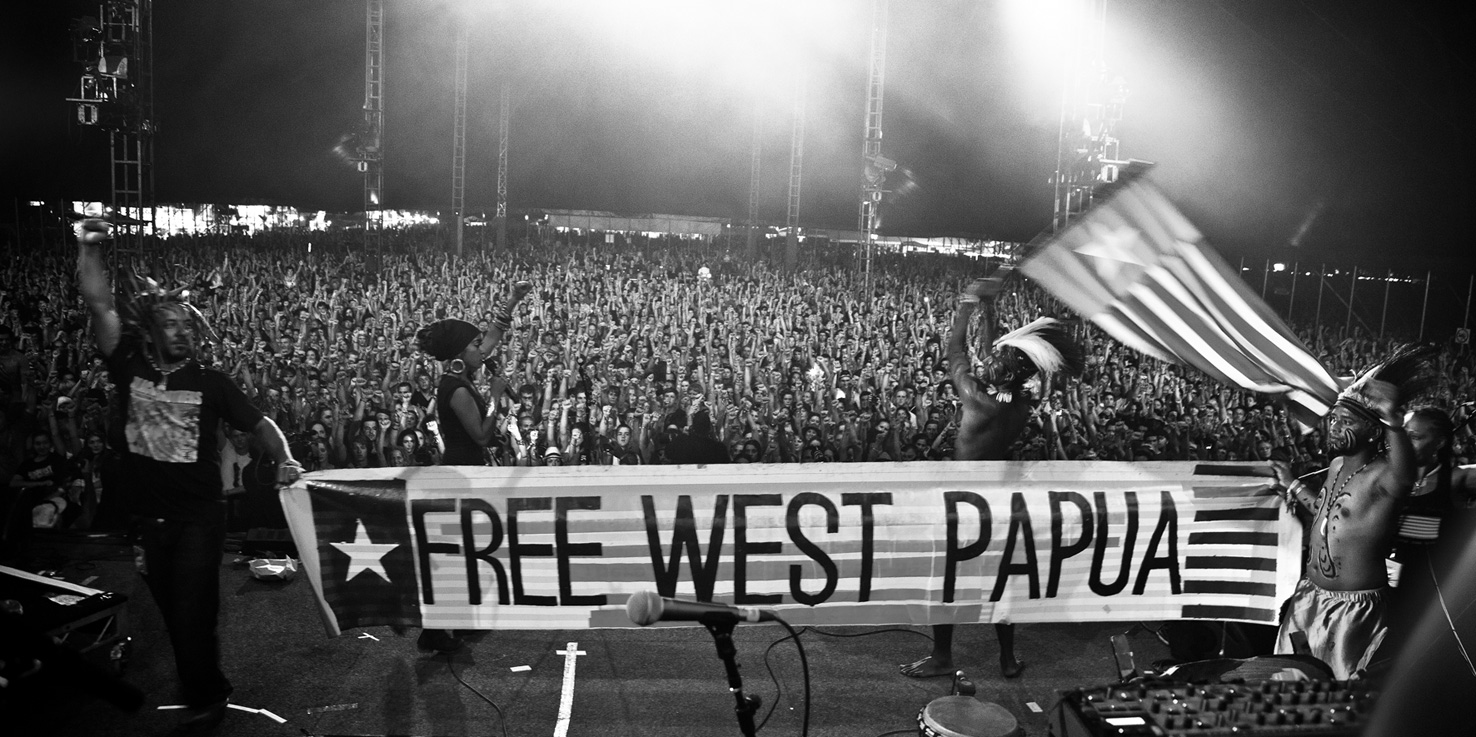
As momentum for the Free West Papua campaign continues to grow and gain attention throughout the international community, Australians continue to show mounting support for their fellow human beings and closest neighbours, West Papua. Another historic showing of undeniable support for human rights and justice in West Papua came at Blue King Brown‘s East Coast Blues and Roots Festival performance on Sunday 8th April, 2012 where thousands threw up their fists in a passionate display of solidarity and unanimity that the issues facing West Papua need to be promptly addressed by the Australian Government and the international community and that human rights is deserved to all people and we as nation have a responsibility to do whatever we can to ensure that is what’s happening.
It is through signing the petition and your sharing and reposting of images like this that we as a community can help expose the dark truths behind the oppression of West Papua and no longer allow these human rights abuses to be hidden in the darkness, our mutual knowledge on the issues is a light that has bravely begun to shine through, and it is only with your support that we will continue to see that light shine brighter and eventually, the unhindered Rize of The Morning Star for a FREE WEST PAPUA.

RSF: JOURNALIST KILLED AS GUNMEN ATTACK PLANE AT PAPUA PROVINCE AIRPORT

Reporters Without Borders

PUBLISHED ON WEDNESDAY 11 APRIL 2012.

Reporters Without Borders offers its condolences to the family and friends of Leiron Kogoya, a journalist with the newspapers Pasific Post and Papua Pos Nabire, part of the Pacific Post group, who was killed in an attack by gunmen on a plane at Mulia airport in the province of Papua three days ago.

“Although the journalist did not appear to be the target of the attack, it illustrates the insecurity that prevails in the region, where at least two other journalists were killed late last year,” the press freedom organization said.

“Covering the Papua region is highly risky for journalists. Leiron Kogoya was among those courageous reporters who strive to keep the world informed about the region, which has been the scene of violent clashes. Our thoughts go out to his family and friends.”

“We expect the authorities to shed light on the attack. Contradictory information about the identity of those behind the shooting said to have been provided by security forces to journalists indicates that an independent investigation must be carried out as soon as possible.”

The plane, a Twin Otter of the Indonesian airline Trigana Air, landed at Mulia at about 8 am when at least five gunmen opened fire. The pilot and co-pilot, who were both hit, lost control of the aircraft, which then crashed into one of the terminal buildings. Four people were wounded. Kogoya, was fatally shot in the neck.

The 35-year-old reporter was flying to Mulia in the Puncak Jaya district to cover local elections in the provincial capital, Jayapura.

Photo by: Agus Fakaubun

The news website westpapuamedia.info quoted the head of public relations for the Papua police, Commander Yohanes Nugroho Wicaksono, as saying the gunmen were hiding in the hills 50 metres from the airport. It said police had not yet been able to identify the perpetrators or the type of guns they used.

According to military intelligence, the separatist group Free Papua Movement (Organisasi Papua Merdeka, or OPM, in Indonesian) was behind the attack, while local police said they had no information about the identity of the attackers.

Indonesia is ranked 146th of 179 countries in the 2011-2012 world press freedom index compiled by Reporters Without Borders.

Video Report: Thousands in Jayapura demonstrate in support of “New Guinea Council: First Steps” conference in Netherlands

Benny Wenda at the IPWP launch Русский: Бенни ...
Benny Wenda at the IPWP launch

from West Papua Media sources

Demonstrations were held in Jayapura on April 5 in support of a groundbreaking conference held in The Hague, The Netherlands, to examine  pathways to the reinstatement of the New Guinea Council or Nieuw-Guinea Raad, the original Parliament of West Papua from 1961 until Indonesia’s invasion.

Jayapura was again brought to a standstill by the demonstration organised by the West Papua National Committee (KNPB), where several thousand people gathered hear speeches and to voice their solidarity with the “Nieuw-Guinea Raad: the First Steps” Conference.

Indonesian security forces were in attendance in large numbers at the rally, but no act of violence or provocation were reported by rally organisers.

In The Hague, speakers at the conference organised by the International Parliamentarians for West Papua (IPWP) and held at the Dutch Parliament, included exiled UK-based independence figure Benny Wenda, Dutch Parliamentarians including Harry van Bommel, Cees van der Staaij, and Wim Kortenoeven.  International Lawyers for West Papua (IPWP) Co-ordinator and international human rights lawyer Jennifer Robinson also spoke, demanding The Netherlands honour its “sacred trust” of its promise of independence for the West Papuan people, and assist West Papuan to fulfil their human right to self-determination.

The New Guinea Council (Nieuw-Guinea Raad) was established on April 5 1961 whilst under Dutch administration as the concept of a more democratic mode of administration started to develop, as a body that was to be the basis for a independent West Papuan parliament.  According to the International Parliamentarians for West Papua, “The establishment of regional councils came from the requirement that the Charter of the United Nations imposed on the Netherlands: that the interests of the inhabitants of Dutch New Guinea had to be paramount.”
“The Netherlands was to respect the right to self-rule and had to take the political aspirations of the indigenous people into account. They were also meant to support the Papuan people with the gradual development of their own political institutions.  There are documents. We are not speaking of vague promises, but we are speaking of real firm commitments for the independence of the West Papuan people,” explained a spokesperson for IPWP.

“Unfortunately by signing the New York Agreement (1962) the Dutch governments abandoned the West Papuan people,” the spokesperson said.

Footage from the demonstrations in Papua:

This slideshow requires JavaScript.

Presentations at the conference in The Netherlands:

Create a website or blog at WordPress.com

Up ↑