JUBI: Defining “orang asli” in Papua

The following item is from the newspaper JUBI and was published earlier this month (apologies for not having the precise date).

BPS criteria regarding orang asli Papua is strongly rejected

In connection with the criteria that were used by the Central Bureau of Statistics (Biro Pusat Statistik, BPS) for West Papua in the publication of its data about the census which was held some time ago, DAP (Dewan Adat Papua – Papuan Traditional Counsel) regards the criteria as incorrect.

He said: ‘Those said to be OAP – orang asli Papua- indigenous Papuans – are persons whose father and mother are OAP, because in accordance with the word ‘asli’, it must mean that there has been no inter-marriage whatsoever,’ said Forkorus Yaboisembut, the chairman of DAP.

He said that according to DAP, the status of OAP includes only two
criteria, which is that both the father and mother are orang asli
Papua, or the father is OAP but the mother is from outside. Persons who mother is OAP but whose father is not, cannot be said to be OAP.

According to Forkorus: ‘Their lives would also need to be considered to
see whether they have struggled and done anything in favour of Papuan interests. A referendum could not be held about the future of Papua if they were not to vote for independence,’ he said. ‘It was very clear that someone cannot be declared to be OAP without the knowledge of DAP, bearing in mind that DAP occupies the position of the protector of Papuan traditional rights in Papua.’

For the first time last year, the BPS produced six criteria for determining who is OAP, as follows:

1. Persons whose father and mother are both OAP.
2. Persons whose father but not the mother is OAP.
3. The mother is an OAP but not the father.
4. Neither parent is an OAP but they have been acknowledged as OAP.
5. Neither parent is Papuan but they have been recognised according to ‘marga’ or ‘keret’ as OAP.
6. The person has been domiciled in Papua for 35 years.

According to this definition, the number of Papuans in the province of
Papua Barat (West Papua) was given as being 51,.67 percent, of the total population of 760,000.

In view of all this, DAP hopes that the BPS will speedily correct their
data, because it is not possible for instance to say that an OAP can
include people who have lived in the province for a very long time.

JUBI on deplorable human rights situation in West Papua

JUBI, 8 February 2011

The National Human Rights Commission [Komnas HAM] in Papua has called on the Indonesian government to take responsibility for a number of human
rights violations that have occurred in West Papua.

‘It is for the government to resolve these problems,’ said Matius Murib,’ who insisted that the government must take responsibility for this situation. He said that if the government fails to do anything, the number of violations will continue to increase. ‘There is no other way out of the problem,’ he said. It was, he said a matter for the central and also the provincial governments.

He said he has the impression that the state has simply washed its hands of the issue. Nothing is being done about it. The evidence is, he said, that the provincial government has issued no special regulation to strengthen the hands of the local Komnas HAM. There was a need for a regulation that would strengthen the legal position of Komnas HAM.

———————–

JUBI 8 February 2011

KontraS, the Commission for the Disappeared and the Victims of Violence,
has raised the issue of the formation of a Commission on Truth and Reconciliation and a Human Rights Court in Papua.

Speaking on behalf of the Commission, Harry Maturbongs said that these two bodies should be set up in accordance with the Special Autonomy Law for Papua, 21/2001.

He also said that people were still waiting for the solution to a number of past serious human rights violations, such as the Wasior case and the case of the assault on an ammunition dump several years ago.

[Apologies for the brevity of these translations, but the printouts are almost illegible. Tapol]

AFP: Papuans Rally for Independence from Indonesia

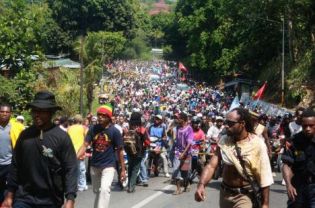
Thousands of Papuans march in a rally in Jayapura on July 8, 2010 to urge the provincial parliament to demand a referendum on self-determination, and reject the region's special autonomy within Indonesia. (AFP Photo/Banjir Ambarita)

Hundreds of Papuans have protested in Jayapura rejecting the region’s special autonomy within Indonesia and demanding a referendum on self-determination.

Carrying a wooden coffin covered with a black cloth which said “Special Autonomy is Dead in Papua,” more than 1000 activists, students and church leaders protested on Wednesday in front of the provincial parliament, witnesses said.

“Independence for Papua, reject special autonomy,” they shouted.

“Indonesia the coloniser, Indonesia the oppressor, Indonesia the robber.”

They also called for the upper house of tribal leaders called the Papua People’s Assembly (MRP) to be disbanded.

“The MRP had done nothing to improve the welfare of Papuans. Our people are poor in their own land,” protest coordinator Selpius Bobi said.

“We reject special autonomy as that is the Indonesian government’s policy which has never supported the natives. We want a referendum that will allow us to determine our own fate,” he added.

Papua’s special autonomy status, introduced in 2001 after the fall of former president Suharto’s military dictatorship, has seen powers including control of most tax revenue from natural resources devolved to the provincial government.

However many Papuans say it has failed to improve their rights and activists accuse the Indonesian military of acting with brutal impunity against the indigenous Melanesian majority in the far-eastern region.

A court martial jailed three Indonesian soldiers on Monday for up to 10 months for abuse and insubordination after graphic video footage showed them torturing civilians in Papua.

The sentences were criticised by the United States and rights campaigners as too lenient.

Foreign media and aid workers are not allowed into Papua and West Papua provinces to investigate allegations of human rights abuses against the indigenous people.

Papua has been the scene of a low-level insurgency for decades and despite Indonesia’s vast security presence in the region, Jakarta remains extremely sensitive about any sign of separatism.

Indonesia has sent mixed messages about its willingness to loosen its grip on Papua, offering talks with separatist rebels on the one hand while jailing and killing their leaders on the other.
© 2011 AFP

HRW: Indonesia: Hold Abusers From Military Accountable

Human Rights Watch logo
Image via Wikipedia

Human Rights Watch (New York)

January 25, 2011

For Immediate Release

Indonesia: Hold Abusers From Military Accountable

More Than 100 Political Prisoners Held for Protesting Peacefully

(New York, January 25, 2011) – The Indonesian government should ensure
that soldiers responsible for abuses are appropriately prosecuted and
punished, Human Rights Watch said today in its World Report 2011. The
January 24, 2011 verdict in a Papua military tribunal of eight to ten
months imprisonment for soldiers who engaged in torture was woefully
inadequate, Human Rights Watch said.

The 649-page report, Human Rights Watch’s 21st annual review of human
rights practices around the globe, summarizes major human rights
trends in more than 90 countries and territories worldwide. Over the
past 12 years, Indonesia, the report says, has made great strides in
becoming a stable, democratic country with a strong civil society and
independent media, but serious human rights concerns remain.

“Senior officials must both talk the talk and walk the walk on human
rights,” said Elaine Pearson, deputy Asia director at Human Rights
Watch. “The military should stop shielding its officers from
prosecution, and the government needs to hold abusers accountable.”

In July 2010, the US government lifted its ban on military assistance
to Kopassus, Indonesia’s elite special forces, despite continuing
concerns about its human rights record. Strong evidence of security
force involvement in torture emerged in 2010. Defense Minister Purnomo
Yusgiantoro pledged to suspend soldiers credibly accused of serious
human rights abuses, to discharge those convicted of abuse, and to
cooperate with their prosecution. But only a handful of cases made it
to military tribunals, and the charges did not reflect the gravity of
the abuses committed.

In October, a 10-minute cell phone video came to light that showed
Indonesian soldiers interrogating and brutally torturing two Papuan
men, Tunaliwor Kiwo and Telangga Gire. In the video, Kiwo screams as a
piece of burning wood is repeatedly jabbed at his genitals. After
pressure from foreign governments, the military finally held a
tribunal in Jayapura, Papua, in January. But it is only tried three of
six soldiers in the video – Second Sgt. Irwan Rizkiyanto, First Pvt.
Jackson Agu, and First Pvt. Thamrin Mahamiri of the Army’s Strategic
and Reserve Command (Kostrad) 753rd battalion – on military
discipline charges, rather than for torture. The three were sentenced
to ten months, nine months, and eight months respectively. Military
prosecutors only sought sentences of up to 12 months rather than the
maximum 30 months as allowed under the military criminal code.

Another torture case captured on video in 2010 involved several
soldiers kicking and beating villagers in Papua. Four soldiers from
the same Kostrad 753rd battalion were tried on military disciplinary
grounds and were sentenced only to five to seven months in prison. The
convictions are on appeal before the Surabaya high military tribunal.

These two cases were unusual in that the ill-treatment was captured on
video, but for years Human Rights Watch has documented serious human
rights violations in Papua for which soldiers have never been held to
account. Human Rights Watch called on the US to publicly clarify its
relationship with the Kostrad 753rd battalion and the individuals
involved in this incident, in order to ensure compliance with the
Leahy law.

“Rather than cooperating with civilian authorities and suspending the
soldiers involved as soon as the video appeared, the Indonesian
government has dragged its feet and reluctantly done the bare minimum
to try and make this go away,” said Pearson. “This is not the new and
improved army that the defense minister promised, but the same old
military impunity we’ve seen for decades in Indonesia.”

The government did little to curb attacks and discrimination against
religious, sexual, and ethnic minorities during 2010. On several
occasions, militant Islamic groups mobilized large groups of private
citizens and attacked places of worship of religious minorities.
Police frequently failed to arrest the perpetrators of the violence.

While Indonesia has vibrant media, throughout 2010 Indonesian
authorities invoked harsh laws to prosecute individuals who raised
controversial issues, chilling peaceful expression. Indonesia’s
criminal libel, slander, and “insult” laws prohibit deliberately
“insulting” a public official and intentionally publicizing statements
that harm another person’s reputation, even if those statements are
true. For instance, in early 2010, Tukijo, a farmer from Yogyakarta,
was sentenced to six months’ probation and a three-month suspended
prison sentence for criminal defamation after he argued with a local
official regarding a land assessment.

The government has imprisoned more than 100 activists from the
Moluccas and Papua for rebellion for peacefully voicing political
views, holding demonstrations, and raising separatist flags. In
August, the authorities arrested 21 Southern Moluccas activists in
Ambon and Saparua and charged them with treason for planning to fly
balloons and Southern Moluccas Republic flags during a visit by
President Susilo Bambang Yudhoyono.

The country’s political prisoners include Filep Karma, 51, a Papuan
civil servant imprisoned for organizing a Papuan independence rally on
December 1, 2004, and Buchtar Tabuni, 31, a leader of the West Papua
National Committee, a Papuan independence organization that has grown
more radical since his imprisonment.

Government restrictions on access to Papua by foreign human rights
monitors and journalists imposed when Indonesia took over Papua in
1969 remained in place in 2010.

“By keeping the foreign media and rights organizations out of Papua,
the Indonesian government is all but admitting that serious abuses
persist,” Pearson said. “Ending those restrictions would be a first
step in reversing Papua’s downward spiral.”

To read Human Rights Watch’s World Report 2011 chapter on Indonesia,
please visit:
http://www.hrw.org/en/world-report-2011/indonesia

To read the Human Rights Watch World Report 2011, please visit:
http://www.hrw.org/en/world-report-2011

For more information, please contact:
In Perth, Elaine Pearson (English): +61-415-489-428 (mobile)
In Washington, DC, Sophie Richardson (English, Mandarin):
+1-917-721-7473 (mobile)
In Jakarta, Andreas Harsono (English, Bahasa Indonesia):
+62-815-950-9000 (mobile)

Indonesian Civil Society: Open letter to SBY Raising Concern and Offering Solution:: One-Year Human Rights Promotion in Papua 2010

OPEN LETTER

Raising Concern and Offer Solution::

One-Year Human Rights Promotion in Papua 2010

To the attention of

President Republic of Indonesia,

Susilo Bambang Yudhoyono

In Jakarta

Dear Mr. President,

We are writing this letter to you to raise our concern over human rights conditions in Papua. We are confirmed that lacking of protection and recognition of Papuans’ rights have led to abusive and violent practice against Papuans. This pratice has persistently cause death to Papuans and left trauma for them and their family. This practice clearly does not reflect the spirit of this country’s constitution to protect whole citizens.

We have recorded that there have been some big issues this year that attract public attention. The issues such as footage violent action against civilians by military in Tinggi Nambut Papua,[1] violence against civilians in Bolakme,[2] ethnic conflict between Papuan highlanders and Yoka people,[3] shooting civilians in Nafri[4], shooting against prisoners in Tanah Hitam,[5] civilians shot dead in Boroway,[6] arrest and detention of Filep Karma and  Buchtar Tabuni[7] and the rally of returning special autonomy. Other cases relating to social, economy and culture which potentially bring negative impact on Papuans and destroy Papuan values such as MIFEE in Merauke,[8] Dagewo case in Paniai[9],  the transfer of local land in Lereh for palm oil plantation, Freeport case,[10] and many illegal logging cases.

Bsaed on our observation and data collected, the problems mentioned above happen because of the following reasons:

First, government still stigmatisize any Papua groups and individual as separatist as they do resistance against government. Government uses ‘stigmatization of separatist” as powerful  strategy to silence Papuans demand and freedom of expression and weaken the critical thinking from Papuans who often criticise the govermnent policy. This strategy is partially successful as it silences resistant movement but in the other side it gives more energy and spirit for more resistance. Also, this unpopular strategy has planted the seeds of hostility and mistrust among Papuans against Indonesia.

Second, Jakarta still plays dominant role in the issue of any policies and their implementations in Papua. Jakarta, as the central power, is still unable to trust any process of development in Papua although Papua has been given special autonomy to manage themselves. MIFEE case, violence against civilians in Bolakme, Tingginambut-Puncak Jaya and Freeport cases are example on how central government still exercise their absolute authority which potentially destroy basic rights of Papua. Central govermnet just interest in investment without considering the basic rights of Papuans and their values

Third, Papua is still considered as conflict area. Therefore, security approach is dominant. Huge number of troops are deployed  every year to Papua to secure the border area and investor’s assets. Ironically, the security approach has caused fear and revive the past trauma. People in the border feel fear when they go to bush and forest to hunting, gardening as they might be arrested as being suspected as members of Papua freedom movement (OPM)/ National Freedom Army (TPN).

Fourth, The massive deployment of troops which is to secure investors’ assest has caused human right violations and fear. The rights of people are neglected and intimidation is done when the locals demand their rights and speak critically.

Fifth, Economic problems are still strongly perceived as the main problems in Papua. Therefore, huge amount of money and investment is needed to build Papua to improve their economy. RESPEK ( strategic plan for rural development) program is one example where the program emphasize infrastructure development rather than human resources development. Moreover, suspection among the locals is rising over the use and management of special autonomy fund used for RESPEK program. Also, no efective supervision has led to corruption

Sixth, the policy issued by govermnet and its implementation actually repair the impact not solve the basic problems which has been persisting so long. It is crucial that any policy has ‘solving-problems’ elements. If not, the problems will never be solved.

Based on the description above, we urge Mr. President to take immediate action by ordering central government and localgovernment to do the following:

First, hold peaceful dialog as an effective means to solve the problems in Papua. The dialog Jakarta-Papua which has been initiated by Papua Peace Network Team needs to be supported. The dialog should involved all elements: government, customary community, religious leaders, academics and civil groups.

Second, stop all stigmatization against Papuans and place them a citizens who have rights to be protected by the state. Constitutions guarantee freedom of expression and this should also be applied to Papuans. Some articles in state criminal law and government regulation No. 77 year 2007 about treason and subversion need to be amended as it limits the freedom of expression

Third, revise or redesign security approach to be human rights-based approach as it will recognise the rights of Papuans and protect Papuans from violent acts. The deployment of troops need to be adjusted to the need of the local area and real threat as to save state budget of defense

Fourth, police should exercise their professionalism in keeping the order and promote human rights. The professionalism is shown by giving protection so people feel secure and peaceful in doing their activities. This is important to bring back trust from the people.

Fifth, push the policy that promote human rights and provide justice to the victims of human rights abuses. Government has to take immediate action to establish human rights court and reconciliation and truth commission in Papua as mandated by special autonomy law

Sixth, central government needs to revise public-service related policy because the existing policy does not provide and touch the basic rights of Papuans. There are three public service issues that needs to taken into consideration: education, health and economy where these three areas are directed to empowernment, affirmative action and protection

Seventh, Policies issued for Papua need to have recognition of human rights elements. This is so because all existing policies basically emphasize on economic and welfare problems.

Eighth, governor, Papua legislative (DPRP) and Papua People’s Assembly (MRP) should build good coordination and reponsive to the problems of human rights abuses in Papua. Lack of initiatives and good will from these institutions show that they actually do not have commitment to promote human rights in Papua and potentially increase mistrust among Papuans.

We write this open letter with the hope that immediate action to be taken to solve the problems in Papua. Thanks

Jayapura, 05 January 2010

Institutions support this open letter

Papua Based Institution

Foker LSM Papua, ALDP, Elsham Papua, SKP-KPC, KPKC Sinode GKI Papua, LBH Jayapura, JAPH-HAM Wamena

Jakarta Based Institution

Imparsial, Kontras Jakarta, HRWG, PRAXIS

CC :

1.  Menkopulhukan RI

2.  Menkokesra RI

3.  Menteri Dalam Negeri RI

4.  Menteri Luar Negeri RI

5.  Menteri Pertahanan RI

6.  Panglima TNI

7.  Kapolri

8.  Jaksa Agung RI

9. Ketua DPR-RI

10. Anggota DPD Provinsi Papua

11.  Gubernur Provinsi Papua

12. Gubernur Provinsi Papua Barat

13. Ketua DPRP

14. Ketua MRP

15. Kedutaan Asing

16. lembaga Internasional

17. Jaringan kerja Papua


[1] This video was initially released by Hongkong Based Human Rights group, AHRC and made public through youtube. In the video, it shows that military tortures civilians suspected as members of Papua free movement group. But in fact, the victim is a reverend. Government then response to the incident immediately by forming fact-finding team. Ministry of politics, law and human rights finally acknowledges in the press release that it is true that military has done such a barbaric act. The perpetrators of the torture were finally on trial and sentenced respectively 5 months and 7 months. This very minimum sentence indicates a failure of states to provide justice to the victim

[2] An ambush against military in Yugam, Bolakme, Jayawijaya district on 1 december 2010. This incident has caused two civilians die

[3]This incident took place on 17 November 2010, 35 houses burned and 3 got injured. The highlanders damage the houses in Yoka as they are angered by a song composed by a Yoka man which insult the highlanders. It is also suspected that third party plays role in fueling the conflict. Local government has facilitated a dialog and they have agreed to cease their hostility. .

[4] Group of unknown men shoot civilians in Nafri, Abepura on 28 November 2010. One was dead and 4 seriously injured. The perpetrators are not identified yet.

[5]Friday on 3 December 2010 around 12.00, 4 prisoners and one detainee escape from prison. Miron Wetipo, one of the prisoners is shot dead when trying to escape. One of the prisoner is finally caught while the other three escape.

[6] Rahmat Faisal, an employee at mobile phone counter,  found dead by Oktafinaus Yerisitow. The victim was suspected being shot around 13.00 on 13 December 2010

[7] Filep Karma and Buchtar Tabuni were detained as they are suspected as the mastermind of riot in the prison after the death of Wiron Wetipo, a man shot dead while trying to escape from prison. Actually, Filep Karma and Buchtar Tabuni just ask head of law and human rights department about the reason why Wetipo was shot dead

[8]Merauke Integrated Food and Energy Estate (MIFEE) is a joint program between local and national government. This program will place Merauke as global agriculture industry. The program is promising which says that in 2030 Indonesia will have additional reserved food such as rice of 1.95 million ton, corn 2.02 ton, and many other food reservation. Also, Merauke will have income of IDR 124.2 million per capita per year in 2030. The program will bring more people from Java to work in the industry. Sadly, the program has taken people’s land.

[9]Illegal mining in Degowo has happened since 2001 where local do the mining without outside intervention. But since 2003, intervention comes and backed up by military and police. As more outsiders come and do the mining, the locals are moved out and can no longer do traditional mining as they used to do. They are even forced to release their land to investors who are interested in the gold mining. Moreover, prostitutes are brought by investors and military to Degowo to entertain the locals.

[10] Freeport case is the longest and massive exploitation of natural resources in Papua. Although there have been many efforts initiated by Freeport to bring back trust of Papua such as giving Cooperate Social Responsibility (CSR) but the problems and mistrust remain

Create a website or blog at WordPress.com

Up ↑