
Currently, the Papuan Natural Resource Management and Environment Agency (BAPESDALH) has refused to give PT Nabire Baru a permit to continue developing oil palm plantations around Kampung Sima and Wami, Yaur District. That means that there are currently 1,800 employees who have been abandoned with no wages or anything to live off. The Papuan BAPESDALH has written at least twice to PT Nabire Baru. In its second letter dated October 2012, as in the previous letter, the oil palm company was requested to carry out an Environmental Impact Assessment (AMDAL) immediately. Until that occurs, the company may not proceed with its operations3.
We were able to produce this general overview based on reports we received in Wami and Sima. I also visited the company’s premises themselves. I approached several people to discuss the situation and also entered the company’s work area, even though it was tightly guarded by police officers from the Nabire Police Mobile Brigade (Brimob) who were stationed both at the access road and around the company’s premises. In the interviews, local people and company employees related their respective struggles with the company.
Some effects of PT Nabire Baru’s operations include converting the forest vegetation into oil palm, a deterioration in the quality of surface water, air quality and noise. Locally temperatures have increased, changing the microclimate, environmental health, an increase in population as the workforce increased, and disruption to local security. According to these informants, these negative impacts are only recently being widely realised, and they intend to re-analyse the situation by taking the data to the community to observe the actual current situation.
In the meeting several indigenous leaders from the Yerisiam people, and also human rights activist Gunawan Inggeruhi, said that people in Wami and Sima were always divided according to whether they were pro- or contra- the company. We always hear opinions that are coloured by verbal arguments and push and shove between people. Some people openly oppose the oil palm industry “They have been working for two years. What’s more, our forest was destroyed before an environmental impact assessment (AMDAL) was completed. Why are they only carrying out the AMDAL two years later? Why so long?” one resident asked.
Other residents are more inclined to submit to the company’s plans – since the forest has already gone, oil palm can now be accepted. Human rights activist and Yerisiam intellectual Gunawan Inggeruhi believes that since PT Nabire Baru first arrived, they have been seen to ignore the indigenous people’s [land] rights. “Don’t start all these programs when it is not the time to do so, while the issue of people’s land rights has also still not been resolved.” Complete payments for ancestral land have still yet to be made in both Wami and Sima. Local people are complaining about the company’s actions: “The company is also bringing people from outside Papua to work there. Meanwhile, the company is not paying adequate attention to us as the local indigenous landowners, as was stipulated in the original agreement to develop education and healthcare.” “Now we have a school building but no teachers. A healthcare building exists, but there are no staff to run it. That is how PT Nabire Baru has deceived us.”
Several points came out of their reports, as follows:
A. The location of PT. Nabire Baru’s operations in Nabire Regency, Papua: PT. Nabire Baru’s operations are located in Wami and Yaro districts in Nabire Regency, and also in Sima district. The amount of forest which will be used is 32,000 hectares, on which they intend to plant four million palm trees. Two million saplings are already ready to be planted out and workers are placing two million more into pots. Another 8000 hectares will be planted with palm trees in Sima District. When the company arrived, it built a school building, but as of 2014 there were no teachers.
According to the Yerisiam people’s traditional leader, the Sima area is sacred land. However it is now being converted to an oil palm plantation: “We feel that our relationship with our nature and forest has been destroyed by this company. Sago trees, our forest like the mother which gave us life, forest birds, all are no longer to be seen, and we also feel the loss of plants that were good to eat and that ensured a cool environment. “
B. Number of workers: 1800 people were employed in December 2012. However, by 2014 this number had increased to 1900 according to company managers. There are more non-Papuans amongst the workforce than ethnic Papuans. Some of the non-local workers are not long-term inhabitants of the area, but were brought there from outside Papua by the company’s owner. Those who are fully involved in the company tend to be the non-Papuans. Indigenous Papuans, on the other hand, are distinctly less active in their work for the company. A situation like this means that the Nabire local government’s desire to provide economic security for the people has been proved a failure. The author of this study believes that the company and government are deliberately marginalising indigenous landowners in Wami and Sima.
C. Employees’ Situation: Employee’s pay situation: Daily pay for a worker is 63400 Rupiah. They receive their monthly wages in two fortnightly instalments. If in those two weeks, the employee is absent from work, their wage is reduced in line with the number of days they were absent. When the field supervisor (Ard. Yafet Magai) was asked about this, he said that local people were frequently absent from work, meaning that the company would always reduce their wages. Because of that, the wages received by non-Papuans were always much higher than those of the Papuans, who often missed work. That is the situation regarding wages between Papuans and non-Papuans. However, no employee wages have been paid since January 2013. Workers have not been working since January 20134
Worker’s health condition: According to the head of the local clinic and othe medical staff in Wanggar, two main ailments are affecting workers, as follows:
1. Malaria, workers are suffering from the tertiane and tropicana strains. Patients are sickening because of insufficient rest and an irregular eating pattern. This group of patients can be helped by medical staff as fast as possible, usually recovering after a week or two.
2. Pulmonary infections (violent coughing which produces phlegm). This group of patients takes some time to get better, even though their body maintains its strength.
D. The company becomes a threat for the people of Nabire: Nabire Regency comprises 81 villages and 14 sub-districts. The principle commodities according to data from the Papuan branch of the National Statistics Agency in the farming and related services sector are cocoa, coffee, cloves, and cashew nuts, and there is also some corn and cassava. This data reveals an aspect of why local conditions in Nabire are not appropriate for oil palm plantations.
According to Benyamin Karet, the second assistant to the Nabire Regional Secretary in December 2012: the land for oil palm which is being disputed, is actually in the former forestry concession of PT Jati Dharma Indah (JDI). JDI are still claiming that this land belongs to them until their forest management permit (HPH) expires in 2017. If the two companies both try to claim the land, it is certain that in the end it is the local community that will feel the effect. Such a situation also means that the local government must have engineered the process to get permits for PT Nabire Baru
From the perspective of environmental impacts: International NGOs such as Greenpeace and Friends of the Earth have campaigned a lot around how oil palm plantations always produce land conflicts which result in the loss of life. This is connected with irregularities in the permit process which are based on corruption. Examples of cases are in Mesuji, Lampung province in Sumatra, or in Papua in Keerom, Merauke and Lereh near Sentani.
From the economic perspective: Oil palm plantations in Wami and Yaro are not certain to bring economic security to local people, because company owners tend to employ workers from other areas, meaning that the desire to create economic security for the local community is sometimes only an empty promise. It is plain to see how transmigrants in the land of Papua are able to supply the cities’ needs, especially for fruit and vegetables, but also for other requirements. Many of them are even being recruited as workers on oil palm plantations. Meanwhile indigenous Papuans’ levels of adaptation and economic security are stagnating as they are further marginalised. Government plans for assimilation and technology transfer do not take place smoothly and according to plan.
1. Community Landowners’ opposition in 2007
Wanggar Pantai tribal leader Alex Raiky and other indigenous leaders in Wanggar Pantai, who are also supported by other indigenous people in Yaro district, have made clear that a letter about planting oil palm on the ancestral land of the people of Wate, dated 16th April 2007 and addressed to the leadership of PT Jati Dharma Indah, was an endorsement. However it should not be regarded as a guarantee of cooperation between the Wate ethnic group and PT Harvest Raya. That statement was conveyed to the Nabire Regency head via the head of the Forestry and Plantation service, Ir Marlan Pinem, in a meeting between the Wate people and PT Jati Dharma Indah in the meeting room of the Forestry and Plantation Service on Monday (17/9/2007), and the indigenous people were supported by the head of Yaro District Stefen Elbe.
Jumali, PT. Jati Dharma Indah’s division head, said in that meeting that the company that was planning to develop oil palm in the area at that time [PT Harvest Raya] was a joint venture between JDI and a Korean investor. The investment capital would come from the foreign investor and JDI’s involvement was due to the forest management permit they held. This permit would expire in 2017. Because of this, Jumali explained, if indigenous landowners were to reject that investor, the company would not make further plans and would withdraw from Nabire. A similar sentiment was conveyed by the head of the Nabire Forestry and Plantation Service, Marlan Pinem, who said that if the indigenous community rejected an investor in Nabire Regency, that company would not be able to start a business in the area. Pinem gave an example from his own experience, that previously PT Gudang Garam had wanted to invest in the Nifasi Area, and had even already brought heavy machinery to the area, but in the end had left because the indigenous community had opposed the company.
The statement from the Wate indigenous people, which was signed by indigenous community leaders from Wanggar Pantai Nicanor Money (indigenous head of Wanggar Pantai), Adrianus Money (head of Neighbourhood Unit (RT) 2), Yosius Way (head of Neighbourhood Unit 1) and Safter Money (Wanggar Pantai village head), who all stated that they all opposed any kind of cooperation with JDI, the company with the forestry permit. The reason was that as long as JDI had been working on their land the company had never given them any kind of contribution that would guarantee the neighbouring indigenous community’s continued livelihood and economic security. In the three-way meeting the indigenous people made clear that this rejection did not only come from the Wate ethnic group in Yaro, but also indigenous groups in Sima and living in the SP B transmigration zone in Wanggar. The head of the forestry service Marlan Pinem promised that their rejection would be dealt with in a way which reflected the community’s aspirations. He could say that because the right to make decisions lay with the forestry and plantation service at the Papuan Provincial level. Because of that attitude, PT JDI did not continue to work or develop the new company. Even though their forest management concession has yet to expire, PT JDI has not carried out any work in the Nabire area since 2010.
nb 1,7
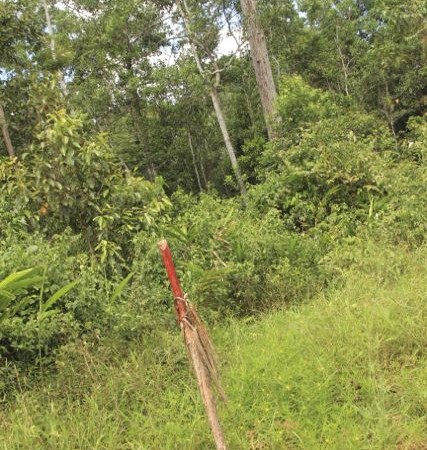
2. Wate and Yerisiam Community opposition in 2012 and 2014 Opposition also came from the Papua Provincial Administration in the form of two letters from the BAPESDALH office to PT Nabire Baru. As in the first letter, in the second letter dated October 2012, the oil palm company was requested to carry out an Environmental Impact Assessment immediately. Until this occurred, the company was forbidden from continuing work. However, direct field observations show that the company has already taken over the indigenous land, by clearing 32,000 hectares of land. The development of oil palm from 2012 to 2014 can be seen in the photos accompanying this report.
The plans of several companies to invest in the oil palm sector has been opposed by the people of Nabire. This includes PT Nabire Baru – the Yerisiam and Wate ethnic groups have staged several peaceful actions in Nabire to demonstrate their opposition. Even though the people expressed their opposition, the company continued work regardless: felling the forest, clearing the land and preparing two million oil palm saplings to be planted on 32,000 hectares around Kampung Wami, and another 8000 Hectares around Kampung Sima. Conculsion
I have written this investigative report based on the Yerisiam and Wate community’s complaints and opposition to oil palm companies in District Wami and Sima, in Nabire Regency. Workers expressed a range of complaints, as did those concerned about the environment, including the Church. The reason was that there are two companies which both claim the same area.
The two companies in question are PT Jati Dharma Indah (JDI) who’s forestry concession is only set to expire in 2017, and PT Nabire Baru which has already started work, resulting in 2 million oil palm seedlings ready to be planted out. The process finding a settlement for local indigenous landowners has also not been concluded. The indigenous People of Nabire strongly oppose the game that is being played between the two companies, the Nabire Regency government and the Papuan Provincial Government. For this reason, the indigenous community is worried, to the point of trauma, about the attitude and behaviour of the various vested interests which are driving this horizontal and vertical conflict.
With the situation as it is, it is essential that the various parties, including the two companies and the provincial and regional governments, sit down together with the indigenous people of Nabire Regency and discuss possible resolutions to the problem, before conflict breaks out in the city. That’s what I think!!!
Author: Pastoral staff of Timika Diocese, Papua
[awasmifee note: PT Nabire Baru is a subsidiary of Carson Cumberbatch, a Sri Lankan company, via its plantations business The Goodhope Company. Other linked subsidiary companies involved in Nabire are PT Sariwana Unggal Mandiri and PT Sariwana Adi Perkasa]
Footnotes
1 Interview with Oktovianus Douw (Supervisor) and head of the company’s field leadership Yafet Magai in Kampung Yaro, and Human Rights Activist Gunawan Inggeruhi in Nabire City on 13th March 2014
2 Interview with Fr. S. P. Hanebora, 13th March 2014
3 Tabloid Jubi, 23 January 2013
4 See Jubi 23 January 2013: The Papuan Provincial Natural Resource and Environmental Management Agency (BAPESDALH) will not issue a permit to PT Nabire Baru (PT NB) to continue developing an oil palm plantation in Kampung Sima and Wami, Yaur District, Nabire Regency. The result will be as many as 1500 workers left without work.
One of PT NB’s workers Matias Iyai, said that the company had stopped working some time ago. “We are not working any more,” he said when met in Nabire on Wednesday (23/1).
Matias Iyai cited an explaination from the company leadership, that they were waiting for a decision from the Papuan Provincial Governor. This decision was conneted with the lack of environmental certification in the form of an Environmental Impact Assessment (AMDAL). “They say it’s an administratve matter. But I don’t know if that’s true or not. What is clear is that we keep demanding our rights , because our wages have not been paid” said Matias Iyai.
1500 workers are suffering right now because the company stopped working. They haven’t got what is owed to them, on top of which it is difficult to find new work. “Regarding our rights, we weren’t paid approriately for the hard work we did each day. Previously we were paid 65,000 Rupiah. Then that was cut back to 63,000 Rupiah,” he said.
Workers once held a demonstration at PT Nabire Baru’s offices to demand an explaination why daily pay was only paid out twice monthly. However, at that time the leadership did not give a constructive response. “All this time we’ve been working like slaves. The pay wasn’t all that much. Which means that many people have left, they don’t want to work for this oil palm company any more,” Iyai said.
The Papuan Provincial BAPESDAHL ( Papuan Natural Resource Management and Environment Agency) office has sent letters to PT Nabire Baru. In its second letter in October 2012 (as it had in the first), the company was asked to carry out an environmental assessment immediately. Until it did, the company must stop all work.
The people of Nabire have challenged the plans of several oil palm investors. That inclues PT Nabire Baru, which the Yerisiam and Wate ethnic groups have opposed by holding several peacceful actions in Nabire. The leader of the Yerisiam ethnic group, Fr. S.P.Hanebora has even had to fly to Jakarta to look for support from NGOs, the government and the House of Representatives.
Despite the community opposition, the company has continued its operations, clearing the forest and prepaaring 2 million oil palm saplings to plant in an area of 32,000 hectares in Kampung Wami and in Sima around 8000 hectares.




 West Papua Media Alerts