Buchtar Tabuni complains to police chief about his treatment

LETTER OF COMPLAINT FROM BUCHTAR TABUNI TO THE CHIEF OF POLICE IN PAPUA

Police Isolation Cell, 18 January, 2011

To:
Police-General Bekto Suprapto,

With respect,

With regard to my detention in a police isolation cell for almost two
months, I wish to raise the following problems with the Chief of Police
in Papua:

1. Will the police in Papua explain what my status is, whether I am a
detainee (tapol) or a convicted political prisoner (narapidana). If I am
being held as a detainee in connection with the riot that occurred in
Abepura Prison on 3 December 2010, I ask to be given an arrest warrant
by the police for the period that I have been held in a police isolation
cell . And whether what I myself did together with Filep Karma at the
time of the riot was not in fact an attempt to calm things down while
trying to be a link between the prison officers and the prisoners who
were involved in the riot. If my status is that of a narapidana, I
hereby ask to be transferred to Abepura Prison Class IIA. This is
because being held in an isolation cell by the police in Papua has had
the following very damaging consequences for me:

a) My father, Jen Tabuni, who was 54 years old, passed away on
Sunday, 9 January 2011 in Papani Kampung, in the Papuan interior. The
cause of death was that, after hearing that I had been taken from a
police cell and thinking that I had been kidnapped, he suffered a
stroke, fainted and died. This was because there was no information
about my whereabouts after I had been separated and placed in an
isolation cell by the Papuan police, without any clear reason being
given for this;

b) Ever since being separated and held in an isolation cell of the
Papuan Police, I have not received any edible food and on some
occasions, I have not been given any food and drink at all, as a result
of which I have been drinking the water in the tub in the bathroom. The
lack of decent food and drink has given me serious gastric problems;

c) My body is turning yellow and I often feel giddy when I stand up.
This is because of the lack of sunlight, the lack of vegetables and
because the vegetables I do eat are boiled as a result of which I am
anaemic as well as suffering from gastritis which means that my health
is deteriorating.

2. If the police here in Papua fail to respond speedily to my
complaints, I will go on hunger strike until my complaints are dealt with.

Letter of complaint from:

Buchtar Tabuni

Papuan political prisoner

Buchtar Tabuni

AFP: Papuans Rally for Independence from Indonesia

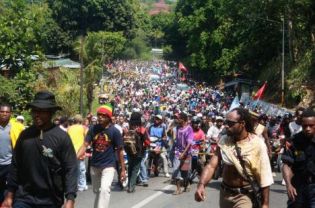
Thousands of Papuans march in a rally in Jayapura on July 8, 2010 to urge the provincial parliament to demand a referendum on self-determination, and reject the region's special autonomy within Indonesia. (AFP Photo/Banjir Ambarita)

Hundreds of Papuans have protested in Jayapura rejecting the region’s special autonomy within Indonesia and demanding a referendum on self-determination.

Carrying a wooden coffin covered with a black cloth which said “Special Autonomy is Dead in Papua,” more than 1000 activists, students and church leaders protested on Wednesday in front of the provincial parliament, witnesses said.

“Independence for Papua, reject special autonomy,” they shouted.

“Indonesia the coloniser, Indonesia the oppressor, Indonesia the robber.”

They also called for the upper house of tribal leaders called the Papua People’s Assembly (MRP) to be disbanded.

“The MRP had done nothing to improve the welfare of Papuans. Our people are poor in their own land,” protest coordinator Selpius Bobi said.

“We reject special autonomy as that is the Indonesian government’s policy which has never supported the natives. We want a referendum that will allow us to determine our own fate,” he added.

Papua’s special autonomy status, introduced in 2001 after the fall of former president Suharto’s military dictatorship, has seen powers including control of most tax revenue from natural resources devolved to the provincial government.

However many Papuans say it has failed to improve their rights and activists accuse the Indonesian military of acting with brutal impunity against the indigenous Melanesian majority in the far-eastern region.

A court martial jailed three Indonesian soldiers on Monday for up to 10 months for abuse and insubordination after graphic video footage showed them torturing civilians in Papua.

The sentences were criticised by the United States and rights campaigners as too lenient.

Foreign media and aid workers are not allowed into Papua and West Papua provinces to investigate allegations of human rights abuses against the indigenous people.

Papua has been the scene of a low-level insurgency for decades and despite Indonesia’s vast security presence in the region, Jakarta remains extremely sensitive about any sign of separatism.

Indonesia has sent mixed messages about its willingness to loosen its grip on Papua, offering talks with separatist rebels on the one hand while jailing and killing their leaders on the other.
© 2011 AFP

AWPA: West Papua 2010 Chronology of events

The Australia West Papua Association has produced a very useful chronology of all key events that occurred in West Papua in 2010.  The full document can be accessed here: West Papua 2010 Chronology of events,

The introduction is reprinted below:

Human rights situation in West Papua[1]

The human rights situation in West Papua continued to deteriorate in 2010. One incident in particular highlighted the worsening human rights situation and that was the shocking video footage of West Papuans being tortured by Indonesian soldiers. The video showed several men in military fatigues torturing two Papuans. The soldiers in the video threaten the two men with sharp weapons and pressed a burning bamboo stick against one of the men’s genitals. The torture of the men prompted a wave of international criticism with human rights organisations around the world condemning the actions  of the Indonesian military.  This incident was not an isolated incident and in further evidence of  human rights abuses another report  accused the police of burning down the village of Bigiragi in the Puncak Jaya district.  The report said that 16 Mobile Brigade officers had burned the village to the ground on October 11. The report said that at least 29 homes were destroyed in the incident leaving at least 150 people homeless

Military operations in Puncak Jaya

A number of  military operation took place in the Puncak Jaya region in 2010 and in fact security operations have been ongoing in the Puncak Jaya region for years . Security forces  conduct regular sweeps  (military operations) in the area to pursue members of the Free Papua Movement (OPM).  Many reports have pointed out the the security forces have great difficulty distinguishing  between what the term separatists  and the general public. These operations leave the local people traumatised and in fear for their lives.  In a report in Bintang Papua (29 June)  The local chief of police admitted that “the OPM  are all over the place including in the town of Mulia, mingling with the community. He said that because the features of the mountain people are almost the same as other people in the area, ‘it is making it very difficult for us to differentiate  between who is OPM and who is just an ordinary member of the community”. This statement raises great concerns that civilians are in danger of being targeted as members of the OPM. During these military operations villages have been destroyed as well as  gardens and livestock. In September  the House of Representatives (DPR) Law Commission deputy chairman, Tjatur Sapto Edy lamented the military operations in the Puncak Jaya Regency following a report by the  National Commission for Human Rights (Komnas HAM). Tjatur said there should be no more military operations and such approaches  are no longer suitable in a democracy. A report by Komnas HAM’s Papua chapter revealed 29 cases of rights abuses occurred in Puncak Jaya regency from 2004-2010, including the torture and rape of villagers in March 2010 by law enforcers.

In September  an article in the the SMH alleged that Indonesia’s elite counter-terrorism unit, Detachment 88, brutalised a group of separatists, repeatedly beating them in detention. Australia helps fund Detachment 88.  The report also said the Australian Government had sent an official to the Indonesian province of Maluku to investigate the  claims but an Australian embassy official denied there was an investigation going on although an embassy officer had visited Maluku as part of a regular program of provincial visits.

Leaked Kopassus report

In November investigative journalist Alan Nairn released a secret report by a Kopassus task force which shows a list of West Papuans engaged in human rights work are a target of the Indonesian Special Force Group, Kopassus. The list includes members of civil society organisations, church groups , activists, students and  members of the MRP.  The report can be found on his blog at

http://www.allannairn.com/2010/11/breaking-news-secret-files-show.html

In December cables released by WikiLeaks in relation to West Papuan human rights confirmed what NGOs  have been telling their governments for years, that it is the Indonesian military that are one of the main problems in West Papua.

The cables revealed that US diplomats blame the government in Jakarta for unrest in West Papua due to neglect, corruption and human rights abuses.  That Indonesian military commanders have been accused of illegal logging operations and drug smuggling from West Papua into Papua New Guinea, and also that a lifting of the US ban on training with Kopassus was made a condition of Obama’s  visit to Jakarta.

Also in December the coordinator of the Commission for Missing Persons and Victims of Violence (Kontras), a major Indonesian human rights group accused the National Police of being the state institution guilty of committing the highest number of acts of violence against the public in 2010.  In the Jakarta Post (7/12/10) , the Papua chapter of the National Commission for Human Rights (Komnas HAM) reported a 70 percent increase in the number of cases of violence in Papua, most of which were allegedly committed by security officers. The Jakarta-based Legal Aid Foundation  in another report said Indonesian law enforcers routinely torture suspects and convicts to extract confessions or obtain information. The groups report found beatings, intimidation and rape are so commonplace they are considered the norm. It also found that few victims believe they have the right to lodge complaints.

West Papua suffered from a number of natural disasters in 2010 including a 7.1magnitude earthquake  that occurred of the northern coast of Papua in June,  destroying a number of  villages with loss of life on Yapen island.  In October the town of Wasior was hit by flash  floods  causing severe damage leaving over 158 people dead, 145 persons missing and thousands left homeless. There was some debate if the cause of the floods was due to deforestation in the surrounding areas or was due to  unusually heavy rainfall

Political prisoners

It is difficult to known the exact number of political prisoners who are in jail in West Papua because of the difficulty of access and restrictions on the gathering of information in the territory. In Amnesty’s  International Report for  2010, it states

“At least 114 people were detained for peacefully expressing their views. The overwhelming majority were peaceful political activists who were sentenced to terms of imprisonment for raising prohibited pro independence flags in Maluku or Papua”.

And in an  extract from Human Rights Watch World Report for 2010, in relation to West Papua.  “Indonesian authorities have responded to a longstanding, low-level armed separatist insurgency in the provinces of Papua and West Papua with a strong troop presence and often harsh and disproportionate responses to non-violent dissent or criticism. Human Rights Watch has long expressed concerns over anti-separatist sweeps by the police, which often result in individuals who peacefully express support for independence being arrested and detained on charges of treason or rebellion (makar).

West Papua -one of our nearest neighbours

West Papua is one of our nearest neighbours and the West Papuan people face great challenges including  ongoing human rights abuses, the exploitation of their natural resources with little or no benefit to themselves, the danger of becoming a minority in their own land as the result of migrants arriving daily and a  HIV/AIDS epidemic.

The Australian Government has  always been concerned about instability in the region to our north but as events in 2010 have shown, it is the Indonesian military which  are causing the instability in West Papua. The recent reports of the torture of West Papuans by the Indonesian security forces and the information from the WikiLeaks cables about US concerns at the activities of the TNI in relation to West Papua, aptly show this.

Recommendations.

The Australian West Papua Association  (Sydney)

urges the Australian Government to re- think its policy of ties with the  Indonesian military until such time that Indonesian military  personnel involved in past human rights abuses are brought to justice and the culture of the Indonesian military becomes of an  acceptable standard to both the Australian people and Australian military. In the short term we urge the Government to put a moratorium on the training, funding and any ties between  the Australian military,  Detachment 88 and the special forces unit Kopassus, until a full inquiry is held into the activities of these units in relation to human rights abuses in the archipelago.

urges the Australian Government to sent a fact finding mission to West Papua to not only investigate the human rights situation in the territory but to see how Australia can  help the West Papuan people in capacity building in the fields of health  and education. We thank the Australian Government for the funding it has already given to aid  projects in West Papua but urge more aid-funding to support health programs and medical organizations (local and international) working on the ground in West Papua and in the long term to support the training of the West Papuan people themselves as health professionals.

There are a number of Indigenous  human rights NGOs in West Papua and the Australian Government can  strengthen  the  human rights situation in West Papua by supporting these organisations  with financial aid,  capacity building and education.

We recommended that human rights defenders working in human rights organisations in West Papua be funded to attend human rights courses in Australia and the region.. There are a number of programs in Australia which can  advance human rights and empower civil society in West Papua through education, training and capacity building. These programs are suitable for individual human rights defenders and community advocates.

We also call on the Australian Government to urge the Indonesian President to release all West Papuan political prisoners as a sign of good faith to the West Papuan people.

The problems in West Papua won’t be solved by Jakarta  deploying more troops to the region or conducting more military operations. What the West Papuans are asking for is dialogue between Jakarta  and West Papuan representatives.  AWPA calls on the Australian Government to urge the Indonesian Government to dialogue with representatives of the West Papuan people to solve the issues of concern held by the West Papuan people.


[1] AWPA (Sydney) uses the name “West Papua” to refer to the whole of the western half of the Island of New Guinea. However, “West Papua” at this time is divided into two provinces, Papua and West Papua.

Press Release issued by the Papuan People’s Coalition for Truth (KRPBK)

Press Release issued by the Papuan People’s Coalition for Truth (KRPBK)
[Received by TAPOL on 12 January 2011]

OTSUS (Special Autonomy) is a catastrophe, which is the most appropriate
word to to describe the role f the Indonesian Republic in binding
together Papua and Jakarta with their offerings to quell the the Papuan
people’s calls for MERDEKA.

We all know that since the enactment of OTSUS, the blood of the Papuan
people has been shed more than ever before, in all corners, in the
mountains, the valleys, along the coasts and in the cities.The
aspirations of the people have been stifled by legalistic measures that
have put the rights of the people behind bars. The stigma of separatism
is being increasingly stoked up and linked to the struggling Papuan
people. The Papuan people are being marginalised in their own homeland.

We still remember 15 August 2005 when the entire people came out onto
the streets throughout the territory of the Land of Papua, calling for
OTSUS to be handed back to the Indonesian government, but the fact is
that the Indonesian government doesn’t care about this. OTSUS continues
to be imposed by force with a series of actions that are destroying the
lives of the indigenous Papuan people. One such action was the
establishment of the MRP (Majelis Rakyat Papua) which was said to be
the cultural representative of the Papuan people, but was deliberately
created as a toothless institution.

On 8 – 9 June 2010, the Papuan people held a Grand Assembly (MUBES)
which adopted eleven recommendations as their solemn and most important
agreement. We all agreed that these eleven recommendations were born
out of the desperation of the Papuan people because of the tricks by
Jakarta.

On 17 July 2010, mustering all their forces, the Papuan people came out
onto the streets to hand back OTSUS and to demand that the Indonesian
government immediately implement the eleven recommendations of MUBES.

But the government has been struck by forgetfulness. Official agencies
such as the provincial assembly (DPRP) and the governors have simply
ignored these demands. In order to safeguard their hold over the Land of
Papua, an OTSUS Evaluation Committee was set up which has been rejected
by the people. An Indonesian-style agency, the Lembaga Masyarakat Adat,
was set up as a counter-weight to the Dewan Adat Papua (Traditional
Council of Papua). A committee for the recruitment of members of the
MPR was set up under the control of the Kesbangpol (a government agency
the name of which we cannot identify) to recruit members of the MRP.
These measures were taken to safeguard the election of the governors and
deputy governors of the provinces of Papua and West Papua, bearing in
mind that it will be up to the MRP to decide who are chosen to become
the governors and deputy governors.

The recruitment of the members of the MRP , based on a special
regulation, is now in progress in various parts of the territory and
will be completed shortly.

On 10 January 2011, a ministerial meeting was held in Jakarta to set up
two MRPs and on 18 January, the recruitment of the members of the MRPs
will be finalised, their names will be made public and they will be
sworn in on 31 January 2011.

All these facts show clearly that the Indonesian government, the DPRP
and the governors of the provinces of Papua and West Papua have violated
the wishes of the Papuan people. OTSUS, the offering made by Jakarta to
the Papuan people, has been rejected by the Papuan people who demand
that their political status should be established as a sovereign nation
and state.There can be no compromise this for would only lead the
Papuan people to many long years of suffering in their own homeland.

As the people of this homeland, what more can we do to continue with our
resistance? The only word is RESIST!

The Papuan People’s Coalition for Truth (KRPBK) demand the following:

1. That the establishment of the second MRP should be halted because
this does not conform with the wishes of the Papuan people who have
already rejected OTSUS.

2. To call on donor countries to immediately end their contributions to
OTSUS funds via the Indonesian government because OTSUS has failed.

3. The DPRP should immediately convene a plenary session to decide on
its response to the eleven recommendations made public by MUBES on 8 – 9
June 2010.

4. That the Lembaga Masyarakant Adat created by the government should be
dissolved because it does not represent the indigenous peoples in the
seven traditional regions of the Land of Papua.

5. That the Papuan conflict should be resolved immediately by granting
the Papuan people the right to self-determination.

The eight components of the KRPBK are:

Osama Usman Yogobi. KRPBK

Musye Weror, Students Council of UNCEN

Marthen Agapa, Coordinator of Parjal

Jack Wanggai, National Authority of West Papua

Simon Alua, chairmaan of AMPTPI.

Petrus Rumbiak, Papuan Youth

Alius Asao, SHDRP

Selpius Bobii,chairman of the Pepera Front

DAP leader rejects police moves to question him

Bintang Papua, 11 January 2011

Forkorus Yaboisembut, the chairman of the Papuan Indigenous Council, DAP
has reported that two members of the police force came to visit him at
2pm the previous day, saying that they wanted to take him to Jayapura
police headquarters to question him about a case of bribery in
connection with attempts to kill him some time ago.

Speaking by phone to Bintang Papua, Forkorus said that he was confused
by the police officers’ visit because, according to him, the case they
wished to discuss had been resolved in a collegial fashion within the
kampung. He said that there had been some misunderstandings between
himself and some of his grandchildren but the matter had been resolved
peacefully in November 2010. If the police now intend to investigate the
matter, this would be quite wrong because the matter had already been
resolved within the family.

‘There is no need for the police to investigate the matter,’ said
Forkorus, ‘because I have already told the media that the matter has
been resolved.’ He said that the money involved had already been
returned to its rightful owners within the family. The incident had
occurred when one of his grandchildren, under the influence of drink,
had made threatening remarks against him.

The local chief of police has denied that they had made any attempt to
take Forkorus in for questioning.

Create a website or blog at WordPress.com

Up ↑
