Deforestation of the Nabire Region continues from HPH to the oil palm plantation (Part 1)

by Sin Nombre (Mongabay-Indonesia),  

May 29, 2013

https://i0.wp.com/www.mongabay.co.id/wp-content/uploads/2013/05/Hutan-hutan-keramat-Nabire-yang-dibongkar.jpg
Nabire sacred forests are dismantled (photo: Mongabay Indonesia)

Approximately 55 kilometres on the West of Nabire region of Papua Province unfolds a large amount of forest that is owned by a large tribe called the Yerisiam. This tribe has 4 (four) sub tribes namely Wauha, Akaba, Karoba and Sarakwari. The area with tens of thousands hectares is situated at the shoreline of Cenderawasih Bay.

Apart from the sea, the forest has been the source of life for these four tribes from which they obtain sago, traditional medicine and it’s their hunting ground. There is also a sacred place believe to be the resting place of the spirits of their forefathers.

The situation changed since 1990-1991 when HPH (Forest Concession) Company, PT Sesco entered Wanggar and Yaro districts and took bars of Merbau wood. The chairperson of the Cooperative Society, Yunus Kegou, said that the company ended its operation in 2000 and left many broken promises.

“At that time, the company hadn’t paid Rp.40 million which is approximately A$3900 with the count of Rp.1000 per cubic meter with is equivalent to A$0.95. The request from the local which are 4 motors, 4 chainsaws and 1 vehicle for the locals to use hasn’t been paid till present,” said Kegou.

In 2003, three companies entered and established in this area, namely PT. Pakartioga, PT. Junindo and PT. Kalimanis (PT Jati Dharma Indah).  Allegedly, these companies changed their names from PT. Sesco to PT. Pakartioga, and the HPH (forest concession holder) to the name PT. Junindo, and PT Jati Dharma Indah (JDI) to the the name PT. Kalimanis.  In the HPH permit, the operating period of JDI ends on 2017, with the permit of operation on the West and East of the Nabire Region  – a huge part of Cenderawasih Bay.

The presence of all these companies left many opaque stories. Their social responsibilities are negative, labourers were imported, and the experiences with transmigrant and the outsiders created conflicts not only with in the civilians but with the companies as well.

Erens Rumbobiar, the Chief of Makimi village situated on the eastern side of Nabire town, said that the conflicts with the locals occurred several times, and were the logging companies fault at that time.  One of the cases that stimulated conflict was when Jordan and Paulus Ha’o permitted logging company PT. Barito to chop down the trees and turn them into logs, not knowing that the area is a customary land of Sefnat Monei.  The conflict almost ended up in physical attacks (according to Customary Law) so the matter was taken to Didimus Warai’s residence,  who as the Chief of Wate’s tribe, solved it. People that were present at that time represented their clan which were Utrech Inggeruhi, Simon Hanebora as a witness for Sefnat Monei, Nikanor Monei and Jordan Ha’o.

In 2007, JDI that had been permitted to operate till 2017 invited PT Harvest Raya Company from Korea to start the oil palm plantation in the region. The locals refused PT Harvest Raya because it is thought to be threatening their future and future of their generations. However, this refusal produced polemic within the Monei clan whereby Sefnat Monei as the owner of the customary land refused, but his children allowed the exploitation of the land to be carried out.

This time, PT. Nabire Baru (NB), another oil palm company entered and settled in two of the villages in Yaur District of Nabire Region namely Sima and Wami village. This concession is located with the Northern side bordered by the ocean of Cenderawasih Bay, and the Southern side bordered by the JDI production forest and Wami village.  The western side borders the road connecting Nabire – Wasior and also PT. Sariwarna Adiperkasa HPH, and the Eastern side of the area borders the production forest, Jaya Mukti village, and Wanggar River.

The company is said by local villagers to be building communication with the local people in the area which led up to a thanksgiving at the early 2010. Traditional prayer was carried out as a start of the business and the compensation of the land was agreed as Rp.6, 000,000,000 which is equivalent to A$600,000. This agreement is said to be completed without the involvement of JDI.

Afterwards, several individuals persuaded Nabire Regional Government to issue new permits.  After the thanksgiving, the people demanded the government solve the HPH land issue so it doesn’t interfere with the oil palm plantation. Eventually local people were driven by few individuals sign a petition on a piece of white cloth, and took it to the Parliament office in Nabire with the hopes that the issue of the location is solved.

The reason was that JDI has long left the area and there was no communication with the indigenous people even though the permit HPH is still valid.  At that time, Benyamin Karet the Setda (Regional Secretariat) for Nabire Region, said that the status of the area of 17,000 hectares was problematic because it’s still owned by PHP JDI.  That area itself had not been plotted for oil palm plantation, but driven by the persuasion of the indigenous people, Nabire Regional Government issued a permit in the form of the Regent’s decision.  The principle of the cultivation permit is that the funding is issued by an Investor’s Agency on 21 of September 2010.

Nabire Regent Isaias Douw, said the indigenous people admitted that the location is safe and can be used NB.  “There had been a conversation between the company and the indigenous people and had been an agreement with the locals. Therefore, we issued a permit to the investor because the locals demanded,” he said.

However, the Regional Government knew there would be a problem with JDI, they therefore asked the locals and NB to solve the problematic location with the companies PHP. At that time, the activists blamed NB and JDI as if they deliberately stirred up the conflict in deceiving the locals of taking merbau wood from their area.

NB Consultant, PT Widya Cipta Buana, led by Iwan Setyawan, at the public consultation analysis in regards to the environmental impact (AMDAL) in early May 2013, explained in Sima Village that the company “is based on the Environmental Act, Government’s rules and policies, and even the rules and policies of the Minister of Environment Number 16 and 17 of 2012 concerning the Guidelines for community involvement in the EIA (Environment Impact Assessment), and an environment permit process. “From the legal perspective, the company has feasibility to carry out the activities”.

NB started the business in 2011 and recruited more than 1250 labours. In 2012, the company applied for the extension of the permit (which was granted via the) Regent’s decree number 71 2012 dated 24th of July 2012 about extending the location permit. The trees were then chopped down and turn into logs, and were taken out of Nabire, when the owner of the land protested.

The data collected by Mongabay, shows from the permit of 17,000 hectares, the area that was cultivated were 12.438,77 hectares including the conduit and the path in the garden and the cultivated area of 10.758.00 hectares. The rest include 1.851.88 hectares of the beach, 1.957.38 hectares of the river, 688,32 hectares of hills and the sacred places, 63,69 hectares of sago plantation and the nursery of 224,82 hectares. In 2013, the plan to cultivate is approximately 2.500 hectares, 4.500 hectares will be in 2014 and around 3.428 hectares will be in 2015. The factory will be built around 2015 with the processing capacity of 90 tonnes an hour.

Mr Kim, the owner of the company, claimed that he has been given the permit for 200,000 hectares of land and 20 other companies in Nabire Region and the surroundings, including several gold companies in Topo and Batu Bara area at the Eastern part of Nabire. Kim didn’t mention the details of all the companies that he owns.

To Be Continued…

 Translated by West Papua Media

Unconfirmed reports: Riots in Nabire leave 2 shot after truck crash kills schoolboy

West Papua Media

January 6, 2013

Tensions flared into a riot in Nabire on Friday, January 4, after a truck travelling at high speed ploughed into a family group injuring several people and killing a young school boy, drove off from the scene, according to credible but unconfirmed reports from human rights sources in Nabire.

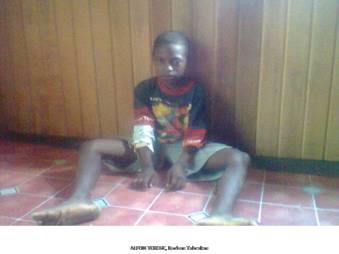
Peter Wakei, a Grade 5 elementary school student, was reportedly buried on Saturday after succumbing from serious head injuries from the collision at 10 am local time on Friday, according to family members spoken to by local human rights activists.  Schoolboy Alfon Tegeke (12, below) was lightly injured from the crash and treated in hospital, with the dead boy’s older brother Anton Wakei (32), the District Head of West Mapia, remains in a critical condition in Nabire hospital.

Indonesian Police were accused by community members of failing to search for the truck driver, according to witnesses, who reported that community members then mounted their own search for the truck driver at the Coral Market on sundown.

A heavily armed unit of Indonesian police confronted the Papuan community members in the market, and opened fire without warning on the group at 1830 local time, hitting two civilians with live bullets.  Apedus Wakei (31), was shot in the buttocks, while John Tekege (26) was shot in the thigh, and were taken to Nabire district hospital in a serious but stable condition, according to reports from Napas (National Papua Solidarity) sources in Nabire.

Police then arrested seven more community members and held them overnight without charge.  The seven detainees were released the following morning after the Nabire Police Chief met with members of the victim’s families together with the new Dogiyai Regent in order to defuse the tense situation in Nabire.  The inflamed situation has since returned to safe conditions after the intensive community negotiations, according to local human rights activists.

Kimanus Wenda’s tumour operation

andreasharsono.net
22 March 2012

[Translated by TAPOL] 

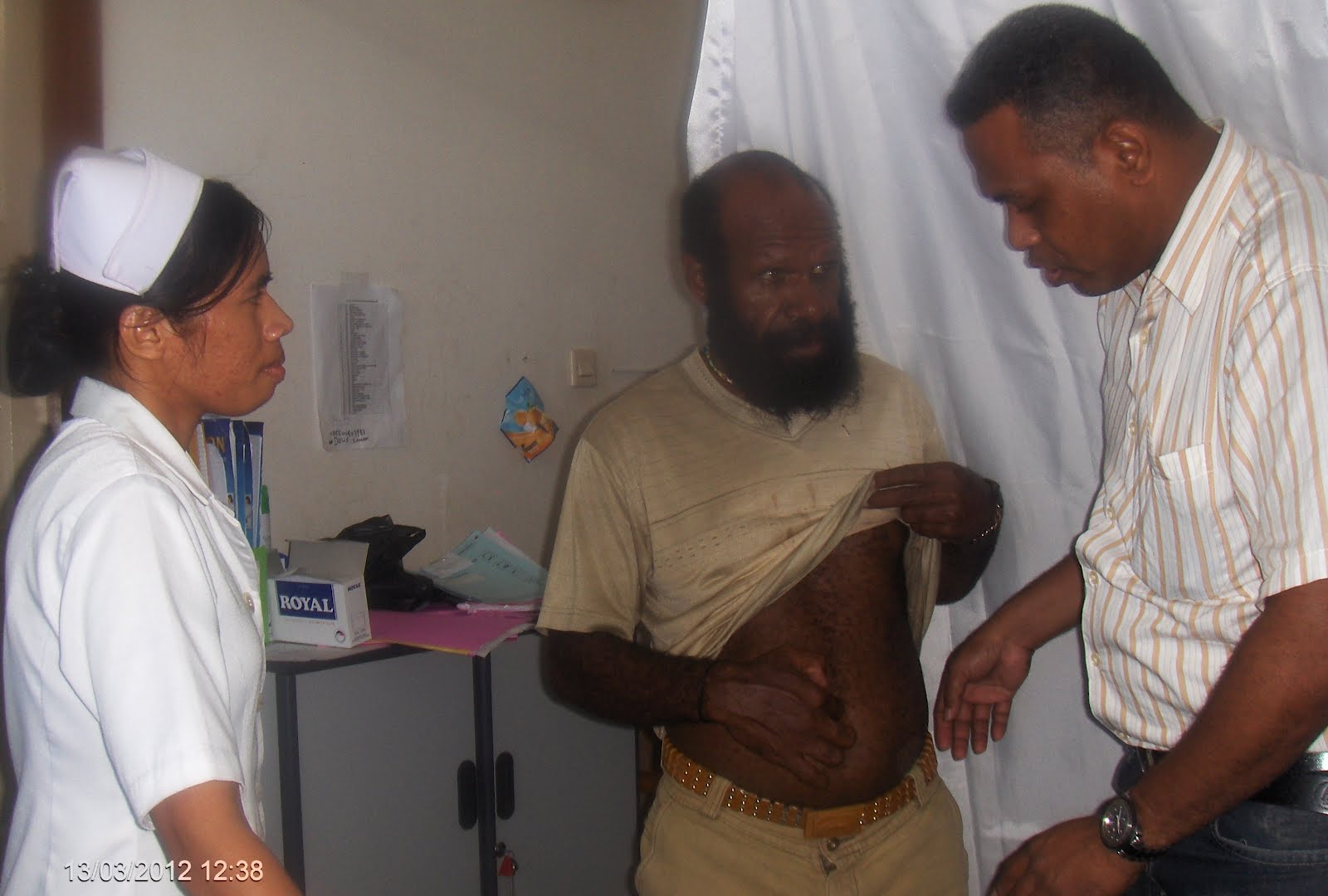
Papuan detainee Kimanus Wenda being examined by the doctor at Dian Harapan Hospital in Waena, Jayapura. ©Peneas Lokbere

KIMANUS WENDA, a prisoner usually detained in Nabire prison had an operation to remove a tumour from his stomach at Dian Harapan Hospital, Waena Jayapura on 14 March 2012.  Wenda is detained for treason (makar) and is serving a 20 year prison sentence.

According to Peneas Lokbere from United for Truth (Bersatu Untuk Kebenaran), an organisation which provides support for political prisoners in Papua, the operation began at 10:00 and lasted for two hours.

“After the operation he was transferred to the inpatient ward. The procedure went well without any obstacles,” said Lokbere.  A growth and a hernia were operated on, and he was given six stitches.

Wenda was hospitalised until Saturday 17 March 2012. On Satuday, Dr Trajanus Lauretius said that Kimanus could go “home” to the jail in Abepura, but that every Tuesday he needs a check-up at the Dian Harapan Hospital.

Lokbere took Wenda to Abepura jail on Saturday afternoon. On Sunday Lokbere came back to bring his medication.   According to Lokbere, Kimanus Wenda said that two staff from the jail came into his cell.  All his belongings – including his clothes and medicines – were turned upside down with no clear reason.  He was offended by being treated in such an impolite manner while he was just recovering from an operation.

Kimanus Wenda is actually listed as a prisoner at Nabire jail.  However he cannot return to Nabire at present because he needs to recover properly first and have the stitches removed from his stomach.

According to the Asian Human Rights Commission, Kimanus Wenda started
to complain of feeling ill in 2010, and was vomiting frequently.  The doctor at Nabire prison examined him and said that he needed to be examined in Jayapura.   However, the Ministry for Justice and Human Rights said that they could not pay for an operation in Jayapura.  They claimed they didn’t have the money to cover the costs of the operation.

An official of Nabire jail disagreed that Wenda was ill.  The proof?  Kimanus Wenda could still play volleyball in the prison field in Nabire.  His obstructive behaviour prompted Peneas Lokbere to gather funds for Wenda’s operation. Various non-governmental organisations have contributed to the cost of the journey, transfer between the Nabire and Abepura prisons, and the medication for Kimanus Wenda.

According to the Facebook page of TAPOL, an organisation which provides support for political prisoners, their internet fundraising campaign using the gofundme.com website raised £2,000, [which included £1,040 in direct donations and an anonymous private donation of £1,000 – TAPOL]. They channelled the funds through Peneas Lokbere and friends in Jayapura.

At present, Lokbere is monitoring Kimanus Wenda’s recovery in Abepura prison.  Once he recovers and the stitches are out, Wenda will return to Nabire prison.  According to Indonesian law, the Indonesian government is responsible for providing prisoners with healthcare.

However, the problem of budgets is often used by the Ministry for Justice and Human Rights as an excuse for not complying with this regulation.

Ironically, the Indonesian government has also banned the International Committee of the Red Cross (ICRC) from working in Papua since March 2009, despite the fact that ICRC often helps the families of prisoners to visit the detainees.  The ICRC also usually gives support for medication for prisoners, no matter who they are.

Peneas Lokbere and TAPOL are now collecting funds for an operation for Jefrai Murib who is currently in Biak prison.   Jefrai Murib is suspected of having suffered a stroke on 19 December 2011.  The left side of his body and his left arm and leg have lost all sensation. Murib has been examined at the Biak General Hospital, where the doctor’s diagnosis was that he needs to be examined at the General Hospital in Jayapura.

http://www.andreasharsono.net/2012/03/operasi-tumor-kimanus-wenda.html

Amnesty: URGENT ACTION FEARS FOR SAFETY of Human rights defender Yones Douw

AI has released an Urgent Action Update for Yones Douw. (5 August 2011)
The original Urgent Action concerning Yones was Issued on the 17 June 2011and is below the present one.


————————————

http://www.amnesty.org/en/library/asset/ASA21/023/2011/en/95040490-098a-445d-81e2-20f94150781e/asa210232011en.html

DOCUMENT – INDONESIA: FURTHER INFORMATION: FEARS FOR SAFETY OF INDONESIAN RIGHTS ACTIVIST

FU UA: 188/11 Index: ASA 21/023/2011 Indonesia Date: 5 August 2011

URGENT ACTION

fears for safety of indonesian rights activist

Human rights defender Yones Douw has received medical treatment after he was beaten by military officers on 15 June. However, he continues to fear for his safety and the safety of his family after he received information that he is under surveillance by members of the Indonesian security forces.

On 1 July Yones Douw travelled to Jayapura, Papua province in Indonesia, to seek medical assistance for the injuries he sustained while monitoring a demonstration on 15 June. X-rays revealed a blood clot in his head and a fracture to his hand. He is still receiving medical treatment for these injuries and continues to feel pain at the back of his head and in his hand. He also suffers from frequent headaches.
While he was travelling to Jayapura for treatment, Yones Douw received information that a senior police officer in Nabire had contacted police intelligence officers in the district by SMS asking “Has Yones left Nabire, please check and keep a close eye on him”. On 15 July he was informed by a credible source that the Nabire District Police Station had ordered officers to monitor Yones Douw’s movements in Nabire. Since then Yones Douw has seen strangers waiting in the vicinity of his house and heard motorcyclists revving their engines as they pass by. Human rights groups have raised concerns in the past about individuals and groups being hired to intimidate human rights defenders, minority groups and others. Yones Douw fears for his safety, and the safety of his family.

Yones Douw was beaten while monitoring a demonstration calling for accountability for the stabbing and killing of Papuan Derek Adii on 14 May, reportedly by military officers. To Amnesty International’s knowledge there has been no investigation into the death of Derek Adii.
Please continue to write in English, Indonesian or your own language:
Urge the authorities to take immediate action to ensure the safety of Yones Douw, in accordance with his wishes;
Call for an immediate, effective and impartial investigation into the unnecessary and excessive use of force used against Yones Douw, with the results made public and those responsible brought to justice in fair trials;
Call on the authorities to initiate an independent investigation into the possible unlawful killing of Derek Adii, and ensure that, should the allegations be verified, those responsible be brought to justice in fair trials and the victims receive reparations;
Call on the authorities to ensure that all members of the police and military are made aware of the legitimate role of human rights defenders and their responsibility to protect them, as set out in the UN Declaration on Human Rights Defenders.
P LEASE SEND APPEALS BEFORE 16 SEPTEMBER 2011 TO :
Minister of Justice and Human Rights
Patrialis Akbar
Ministry of Justice and Human Rights
Jl. H.R. Rasuna Said Kav No. 4-5
Kuningan, Jakarta Selatan 12950
Indonesia
Fax: +62 21 525 3095
Salutation: Dear Minister
Papua Police Chief
Inspector General Bekto Suprapto
Papua Regional Head of Police (Kapolda)
Jl. Samratulangi No. 8 Jayapura,
Papua, Indonesia
Fax: +62 967 533763
Salutation: Dear Kapolda
And copies to:
Chairperson National Human Rights Commission (Komnas HAM)
Ifdhal Kasim
Jl Latuharhary
No.4 Menteng Jakarta Pusat
10310, Indonesia
Fax: +62 21 39 25 227
Also send copies to diplomatic representatives accredited to your country.
Please check with your section office if sending appeals after the above date. This is the first update of UA 188/11. Further information: www.amnesty.org/en/library/info/ASA21/014/2011/en
———————————————————————————————————————————-

DOCUMENT – INDONESIA: PAPUAN ACTIVIST AT RISK FOLLOWING BEATING

UA: 188/11 Index: ASA 21/014/2011 Indonesia Date: 17 June 2011 Date: 17 June 2011
URGENT ACTION

PAPUAN ACTIVIST AT RISK FOLLOWING BEATING
Yones Douw , a human rights activist in the Indonesian province of Papua , was beaten by military officers on 15 June and has been denied medical treatment . He fears for his health and safety , as he has previously been detained and assaulted as a result of his human rights activities.
A protest took place at the 1705 District Military Command (Kodim) base in Nabire, Papua province, on the morning of 15 June, to call for accountability for the stabbing and killing of Papuan Derek Adii on 14 May 2011, reportedly by military officers from the 1705 District Military Command. At about 9am on 15 June, Yones Douw, a 42-year-old human rights activist, heard that a protest, which included family members of Derek Adii, was about to take place, and he went to the base to monitor it. Thirty minutes after he arrived, a group of protesters turned up in three trucks, broke into the front entrance of the base and started to shatter the windows and throw objects. Yones Douw immediately rushed into the base to calm the protesters.

In response, the military fired shots into the air and started hitting the protesters. Yones Douw was struck on the head with pieces of wood many times. He also sustained injuries on his shoulder and wrists from the beatings. As he was beaten he heard the military threaten to shoot the protesters saying “these animals should be taught a lesson”. A military officer also hit the father of Derek Adii, Damas Adii, with a piece of wood. After the beatings, Yones Douw travelled to the Siriwini hospital for treatment and to obtain a medical report, but was told by medical staff that he required a letter from the police before they could treat him. He then decided to go home and is still suffering from the injuries. He fears for his health and safety.
Yones Douw is a respected human rights activist in Papua and has been documenting human rights violations by the police and military over the last decade.


PLEASE WRITE IMMEDIATELY in Indonesia n , English or your own language:
Urging the authorities to take immediate action to ensure the safety of Yones Douw, in accordance with his wishes, and ensure his immediate access to medical care;
Calling for an immediate, effective and impartial investigation into the beatings and the threats against Yones Douw, with the results made public and those responsible brought to justice in fair trials;
Calling on the authorities to initiate an independent investigation into the possible unlawful killing of Derek Adii, and ensure that, should the allegations be verified, those responsible be brought to justice in fair trials and the victims receive reparations; and
Calling on the authorities to ensure that all members of the police and military are made aware of the legitimate role of human rights defenders and their responsibility to protect them, as set out in the UN Declaration on Human Rights Defenders.
PLEASE SEND APPEALS BEFORE 29 JULY 2011 TO :
Minister of Justice and Human Rights
Patrialis Akbar
Ministry of Justice and Human Rights
Jl. H.R. Rasuna Said Kav No. 4-5
Kuningan, Jakarta Selatan 12950
Indonesia
Fax: +62 21 525 3095
Salutation: Dear Minister
Chairperson National Human Rights Commission (Komnas HAM)
Ifdhal Kasim
Jl Latuharhary
No.4 Menteng Jakarta Pusat
10310, Indonesia
Fax: +62 21 39 25 227
Salutation: Dear Ifdhal Kasim
Papua Police Chief
Inspektur Jenderal Bekto Suprapto
Papua Regional Head of Police (Kapolda)
Jl. Samratulangi No. 8 Jayapura,
Papua, Indonesia
Fax: +62 967 533763
Salutation: Dear Kapolda
Also send copies to diplomatic representatives accredited to your country. Please check with your section office if sending appeals after the above date.
URGENT ACTION
PAPUAN ACTIVIST AT RISK FOLLOWING BEATING

ADDITIONAL INFORMATION

In January 2009, police officers kicked and punched Yones Douw during his arrest, after he attempted to intervene to stop clashes between police and demonstrators in Nabire. He and seven other demonstrators were denied access to the outside world and he was deprived of food and drinking water during his one day detention.
In recent years, there have been a number of cases of intimidation and attacks against human rights defenders and journalists in Indonesia, and human rights defenders are regularly intimidated and harassed in Papua. International human rights observers, non-governmental organizations and journalists are severely restricted in their work there.
Amnesty International continues to receive credible reports of human rights violations by the security forces in Indonesia, including torture and other ill-treatment and the unnecessary and excessive use of force. There are often no independent investigations into allegations of human rights violations, and those responsible are rarely brought to account before an independent court. In January 2011 three soldiers who had been filmed kicking and abusing Papuans were sentenced by a Military Court to between eight and 10 months’ imprisonment for disobeying orders. The fact that the victims were not able to testify because of the lack of adequate safety guarantees raised serious concerns about the trial process. Amnesty International believes that the civilian courts are much more likely to ensure both prosecutions for crimes involving human rights violations and protection for witnesses than the military system, which is unlikely to be impartial and independent.
While Amnesty International acknowledges the difficulties faced by security forces in Indonesia, especially when confronted with violence, the power to use force given to security forces is restricted by relevant international human rights law and standards, the basis of which is the right to life. The Indonesian authorities must ensure prompt, independent and impartial investigations into all credible allegations of human rights violations by the security forces. Those found responsible, including persons with command responsibility, should be prosecuted in proceedings which meet international standards of fairness, and victims provided with reparations.
UA: 188/11 Index: ASA 21/014/2011 Issue Date: 17 June 2011

‘If You Mess With Us You’re Dead’

via NewMatilda.com

By Jason MacLeod

indo soldier in west papua

There was nothing clandestine about the beating of human rights activist Yones Douw in West Papua last week. Jason MacLeod reports on the latest in a long pattern of public violence by the Indonesian military

“You can mess with the police,” said the Indonesian soldiers, “but if you try it with us, you’re dead.”

According to witnesses that was what was said to Yones Douw, a 42-year-old Papuan human rights defender as he was beaten with lumps of wood by soldiers from Kodim 1705, Nabire’s District Military Command in the Indonesian province of Papua. Immediately after the beating Douw went to the local Siriwini hospital but was refused treatment. Local staff demanded a letter from the police before they would treat his wounds. Douw now fears for his safety and has gone into hiding.

The incident occurred on the 15 June. Douw, a church worker with the Kingmi Church’s Bureau of Justice and Peace in Nabire, heard that a protest was going to take place at the 1705 District Military Command (Kodim) base in Nabire, Papua province, and he went to the base to monitor it. Thirty minutes after he arrived, a group of protesters turned up in three trucks, broke into the front entrance of the base and started to shatter the windows and throw objects. Douw immediately rushed into the base to calm the protesters.

In response, the military fired shots into the air and started hitting the protesters. Douw was struck on the head with pieces of wood many times. He also sustained injuries on his shoulder and wrists from the beatings. The protesters fled the scene, pursued by members of Kodim 1705 and armed troops from neighbouring Battalion 753. This is what gave Douw time to escape.

Yones Douw was not the accidental victim of some random act of violence. And the protesters he was defending were not some random mob of outraged Papuans or an attack by the Papuan Liberation Army, Papua’s lingering guerrilla force. The attack on the Nabire District Military Command was an expression of a grief stricken family angered at the senseless killing of one of their own. The family wanted to hold the military accountable for the killing of Derek Adii, a man who was beaten to death by soldiers a few weeks earlier.

In mid-May Douw, a chronicler of human rights violations in the troubled Paniai region for some years now, published a report that was picked up by Jubi, West Papua’s only independent news service. Douw’s report detailed the killing of Derek Adii on 14 May 2011. Adii, a 26-year-old Nabire man had just completed his application to join Papua’s burgeoning civil service.

According to Douw’s report, Adii was boarding the crowded passenger vessel KM Labobar at Nabire’s dock when he was beaten by six members of the military. One of the soldiers allegedly pulled out a bayonet and stabbed Adii in the head. The six men then threw his body overboard. Adii died at the scene.

Douw believes he was beaten by the military for retribution — not only for reporting Adii’s killing but also for continuing to shine a spotlight on human rights abuses in West Papua, an area the Indonesian police and military are trying to close off from international scrutiny by locking out journalists and even diplomats.

The circumstances surrounding Adii’s very public murder and Douw’s public beating in the front yard of a military base located on a main road in the middle of a town is typical of the patterns of human rights abuses in West Papua. Australian National University scholar and former Director of the Catholic Office of Justice and Peace in West Papua, Br Budi Hernawan OFM who is studying torture in West Papua, says that torture and human rights abuses in Papua are a kind of “public spectacle”.

In the 400 odd cases of torture that Hernawan has studied it is mostly poor and innocent Papuan civilians are rounded up and publicly abused. The perpetrators are nearly always the Indonesian military and police. It is classic state terror, the purpose of which is to violently pacify the population, to enforce the security apparatus’ control over human bodies and the body politic — and to intimidate and silence Papuan dissent.

It is a script that Yones Douw has refused to buy into. In the meantime other Papuans have stepped into Douw’s shoes. They are now chronicling the military’s attack on him and sending reports out to a domestic and international network in the same way that Douw has been ceaselessly reporting on the human rights abuses of others.

Create a website or blog at WordPress.com

Up ↑