Tempo: Papua MIFEE Project Faces Criticism

http://www.tempointeractive.com/hg/nasional/2011/08/15/brk,20110815-351921,uk.html

TEMPO InteractiveJakarta:The Merauke Integrated Food and Energy Estate (MIFEE) Program has been accused of disenfranchising local farmers in Papua. Berry N. Furqon, director of the Indonesian Forum for the Environment (Walhi), said that more than 100,000 ha of forest had been cut down for the project, including the sago forest on which the locals depend upon.

Abet Nego Tarigan, executive director of Sawit Watch, called on the United Nations to cancel the project. Abet said the MIFEE could endanger Indonesia as it allows companies rather than farmers to control the food supply.
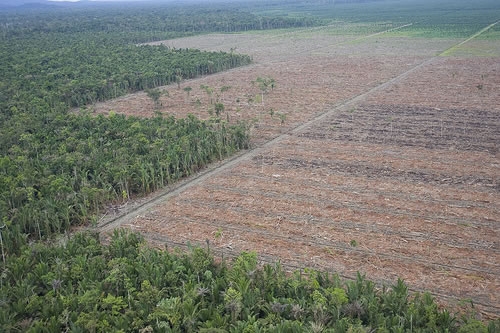
The MIFEE project was inaugurated by Agriculture Minister Suswono on August 11 last year. The program sees plantations in Merauke managed by companies that also manage the local farmers. One million ha, divided in five clusters, has been allocated for the program.

As many as 32 companies have obtained principle licenses and will operate in a range of plantation sectors, namely palm oil, sugar cane and corn among others. Companies that have invested in the program include Wilmar, Sinarmas, Bakrie Sumatera Plantation, Medco, Bangun Cipta Sarana and Artha Graha.

NUR ROCHMI

————————————–

2) Indonesia Turns Back on Papua Food Bowl Plan
Faisal Maliki Baskoro | August 15, 2011

After two years with little progress, the government is considering shifting the location of its planned food estate to East Kalimantan from Papua because of the availability of land.

Suswono, the agriculture minister, on Monday said there was 200,000 hectares of land in East Kalimantan that could be used as an agriculture cluster. Under its plan, the Merauke Food Industrial Estate would have about 2 million hectares.

“The principle of the food estate is finding enough land for an agricultural zone. It doesn’t have to be in Papua,” he said. “[The East Kalimantan site] may not as big as Merauke, but it is more feasible. It has been two years since we floated the plan, but there has been no progress at all.”

Suswono said land clearance regulations were partly to blame for the slow progress.

“The construction of the Merauke food estate was obstructed by lack of regulation to clear necessary land,’’ Suswono said.

The government annually imports 2 million tons each of rice and soybean, and the nation needs to be able to feed its people without importing food, he said.

He said the government and potential investors would seek suitable areas for producing the two crops.

“The land in East Kalimantan is good for planting rice,” he said. To grow soybean, the ministry would need at least 500,000 hectares, and the government was still looking for land in Kalimantan.

While East Kalimantan has 200,000 hectares of land free, the West Kalimantan administration said it could provide 100,000 hectares of land, he said.

Suswono said farmland would not interfere with the preservation of forests. “We will be using open land, and probably convert production forests to farms. We will also empower local people to get involved in the program.”

Ecosystem in Merauke must be preserved, says agricultural expert


JUBI, 11 August 2011
The District of Merauke has a very rich ecosystem  which needs to be  preserved and protected. The problem is that when forests are cleared, this damages much of the ecosystem and virtually destroys it.
Drs Sudirman, an agricultural expert at the provincial administration of Merauke district, speaking during a technical guidance event  in Wasur, said that as the  population increases, land will be cleared everywhere  which will have a very damaging impact on the ecosystem in forested regions.
‘One example: When forests were cleared to make way for the MIFEE (Merauke Integrated Food and Energy Estate) project, recently, a significant part of the ecosystem was lost and much of is it already dead. It is the responsibility of everyone concerned  to think about the best way to deal with this problem so as to ensure that the ecosystem is not damaged.’ he said.
He said that the TH Wasur region in particular has a large number of species which means that it is the responsibility of everyone, including the original inhabitants of the district, to play their part in preserving  the ecosystem.

Indonesia food security project threatens Papuan way of life – activists

http://www.trust.org/alertnet/news/indonesia-food-security-project-threatens-papuan-way-of-life-activists

Source: Alertnet // Thin Lei Win

05 Aug 2011 14:07

NOTE: West Papua Media proudly provided fixing services for Reuters AlertNet for this article and further investigations.  

A member of the Koroway tribe walks up a ladder to his house at a forest nearMerauke city in Indonesia’s Papua province in this May 18, 2010 handout photo. REUTERS/Suntono-Indonesia statistic agency/Handout

By Thin Lei Win

BANGKOK (AlertNet) – Indigenous Papuans are at risk of further marginalisation and the forests and ecosystems on which they rely face destruction due to an ambitious food security project by the Indonesian government, activists say.

Under MIFEE (Merauke Integrated Food and Energy Estate) plans, 1.63 million hectares of forest which forms the basis of life for some 200,000 indigenous people in the Merauke area would be used to grow rice, palm oil, soya bean and corn among other crops.

Indonesia is seen as a key player in the fight against climate change and is under intense international pressure to curb its rapid deforestation rate and destruction of carbon-rich peatlands.

Activists accuse the authorities of not sufficiently consulting the Malind Anim people about the project, which they say pose a double threat to local Papuans. Not only would they lose their customary lands, but they would also face an influx of migrants from the rest of Indonesia — further marginalising communities that feel disenfranchised by what they say is the government’s exploitation of natural resources at their expense.

“If this project goes ahead, it means we will lose everything – we will lose our land, our culture, our livelihood, our food,” Rosa Moiwend, a Papuan activist whose family still lives in Merauke, told AlertNet.

The transition from forest to farm and plantation land would have a “tremendous” impact on natural ecosystems, Carlo Nainggolan from Indonesian rights group Sawit Watch, said.

“Indigenous people who have made use of natural forests to meet necessities of life will experience a dramatically decreased quality of life and well-being,” he said.

Department of Agriculture officials did not respond to a request for comment.

STRAINED TIES

Papua, two provinces on the west half of New Guinea island, has long suffered strained ties with Indonesia which took over the area from Dutch colonial rule in 1963. And this week, thousands of indigenous Papuans them marched on the parliament in the capital of Papua, demanding a referendum on independence from the archipelago.

Despite being home to a mine with the world’s largest gold and recoverable copper reserves, Papua is one of the least developed regions in Indonesia. According to the United Nations, 40 percent of Papuans live below the poverty line of $1.25 a day, compared to the national average of 18 percent.

Both the central and regional governments have hailed MIFEE as the answer not only to Indonesia’s growing concerns about food shortages but as a source of exports.

The project is expected to produce close to 2 million tonnes of rice, almost 1 million tonnes of corn, 2.5 million tonnes of sugar and close to 1 million tonnes of crude palm oil, according to local media reports.

However, activists point out that the staple food for Papuans is sago, a starch derived from sago palm, not rice. And they say there has been discontent in some areas where compensation from companies clearing and managing the land was deemed insufficient.

Despite a recent government pledge to resolve land tenure conflicts and protect the rights of people in forest-based communities, activists say most locals remain in the dark about the project.

“People from the village, when asked about MIFEE project replied, ‘MIFEE is a car that frequently crosses the road that reads MIFEE (on the body of the car)’,” Sawit Watch’s Nainggolan said.

LOSING A WAY OF LIVING

The massive scale of the project and nature of the indigenous people’s skills – many make a living hunting and gathering rather than farming – means a huge workforce is likely to be imported from outside Papua, activists say.

Sawit Watch estimate that some 5 million workers were needed to work the land, or four labourers per hectare. Yet, based on the 2009 census, the number of people native to Merauke was 195,577, Nainggolan said.

The low levels of education, knowledge and Indonesian language skills also mean indigenous Papuans are likely to be only involved in MIFEE as low-skilled labourers despite the loss of their land and livelihoods, he said.

Moiwend summed up the anger felt by activists.

“If the Indonesian government says that we are a part of them, that we are their brothers and sisters like they say, why do they do this project?,” she said. “They don’t want us to live in our own land. They want to kill us with this project.”

PT Rajawali to establish sugar factory in Merauke

JUBI, 16 July 2011 PT Rajawali is planning to establish a sugar factory in two areas in Merauke, Malind district, in Kampung Kaligi and Kampung Domde. The government has already agreed to hand over 37,500 hectares for this purpose. The company is waiting for an agreement on the release of forestry land which is expected to be issued by the Director of Panology (?).

This is likely to happen in August this year. The project manager of PT Rajawali, Abdul Wahab, told JUBI that they were waiting for the AMDAL license. Speaking for the company, Abdul said they had carried out tests on 200 hectares and this will be followed by the hand over of 1,000 hectares. Abdul said that laboratory tests have not yet been conducted because the sugar cane must have grown for at least one year, but he said that, considering the results of the seedling tests, the prospects are very good indeed.

Tests in the nursery have indicated that from one hectare of seedlings, the sugar cane can cover an area of seven hectares. Asked about the work force, Abdul said that their priority would be to employ indigenous people. He said that for the initial tests, local people had been employed for planting the seeds and other jobs. He said that they were urging the company to commence its operations as soon as possible.

Cabinet minister visits Merauke to promote the MIFEE project

JUBI: 27 June 2011

On his first visit to Merauke to see preparations for MIFEE, the Merauke Integrated Food and Energy Estate, Marie Pangestu, the Minister of Industry and Trade said that the customary rights of the local community should be dealt with first, by issuing certificates, in connection with the MIFEE project that is being developed in the district of Merauke. The land which will be used for planting must be suitable for whatever crops are to be grown there.

The minister was speaking to journalists after flying over the land that will be used for the MIFEE project.

‘I have been closely following the discussions and reports about this projects which have been taking place at the centre. And now, I have come to see things for myself at close range and I have come to the conclusion that the land is very suitable indeed for agricultural production. ‘

He also said that he had received a short account from the Merauke governmental chief about the plans being made for the project, as well as measures for its implementation and land usage. Companies planning to invest can now go ahead to acquire the necessary licences and start planting their crops.

He went on to say that it was now necessary to build the necessary infrastructure, in particular harbours to support the project once it gets underway. For instance, he said, investors who intend to establish palm oil plantations will need harbours of their own.

[COMMENT: The central government will clearly be investing huge sums of money to promote the interests of companies planning to invest in MIFEE. Not at all clear what is meant by issuing certificates to the local communities whose customary rights to the land will be sacrificed as investors are invited to grab their land with little regard for the loss of their livelihoods based on hunting and fishing. No mention either about whether the rightful owners of the land will be granted any compensation for the loss of their land and the destruction of their livelihoods. TAPOL]

Create a website or blog at WordPress.com

Up ↑
