A large gathering of people, mostly women, took place in Kampung Matara in the District of Semangga, Merauke to publicise the widespread occurrence of domestic violence.Several of the women present wondered what happens to complaints made by women about the domestic violence they have suffered because as things stand at the moment, they have no idea about how these complaints are handled. Some of them wanted to know the telephone number of Engelberta, a well-known Papuan woman activist, so that they can phone her and inform her about having experienced domestic violence.
Such incidents are clearly a serious violation of human rights as laid down in a number of international conventions …. [part of the text is missing at this point].
One participant said that the victims of such violence are mainly women and children. There are incidents when men are the victims but they can be counted on the fingers of one hand.
Engelberta said that the violence in most cases takes the form of physical or psychological violence. The latter refers to situations for instance where there is absolutely no communication between men and women. ‘This must not be allowed to continue, she said.
She stressed the importance of people reporting incidents of violence when they occur. ‘We must put an end to this discrimination against women. Whenever anyone commits an act of violence and behaves as if they can take the law into their own hands, the matter should be reported to the police. It is the responsibility of the police to take anyone alleged to have committed an act of violence into custody for investigation.
She urged parents to pay close attention to what happens to their children at school or when they are playing together in the streets. These are situations, she said, when many acts of sexual abuse occur. She mentioned in particular a recent incident when a young boy was sexually abused by an elderly person.
During the discussion, the head of the District of Semangga, Recky Samkakai said that no one, in particular women, should be afraid of reporting incidents when they have personally experienced an act of violence. Such occurrences should be reported to the local police in order for the case to be handled in accordance with the law.
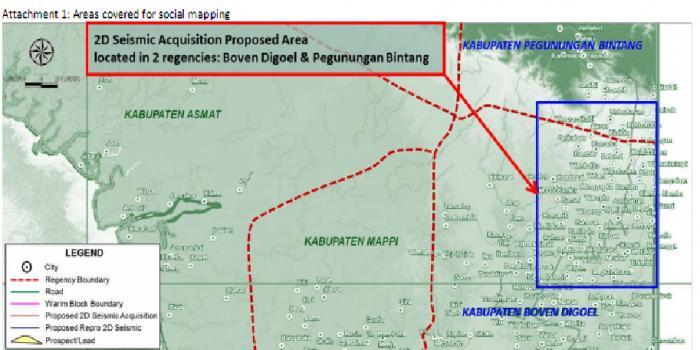
It is not just plantations – oil and gas companies are also threatening to turn Southern West Papua into an industrial landscape. ConocoPhillips is planning to restart exploration (seismic testing) in the Warim block in the near future, a remote forest area mostly located in Boven Digoel regency, several hundred kilometres inland from Merauke. The Forum to Care for Papua’s Natural Resources drew attention to this latest threat in a recent press release, summarised in this article from Majalah Selangkah:
Forum to Care for Papua’s Natural Resources Opposes ConocoPhillips’ Papuan Operations
The Forum to Care for Papua’s Natural Resources has stated its clear opposition to ConocoPhillips commencing operations in West Papua. In a press release issued in Yogyakarta, 31 August 2013 the forum explained various past, present and potential future impacts that arise when giant corporations move in and start operations anywhere in the land of Papua.
If ConocoPhillips moves in, they say, this will only aggravate symptoms of social breakdown and environmental damage, as such corporations are only interested in their own profits, and do not care about the environment and Papuan indigenous people.
As with other corporations in Papua, they claim that ConocoPhillips will only destroy the land which was used for extraction, destroy agricultural land, convert forest into an industrial area and reducing the land available for hunting and gathering peoples. In the long term, mining (including oil and gas exploitation) is a main contributor to turning land into wasteland, which is then almost impossible to restore.
According to the forum, mining in West Papua has caused land, water and air pollution such as dust, poisonous gases and noise. Coastal fish enclosures and coral reefs have been destroyed, floods and landslides have wiped out biodiversity. Acidic water flows into rivers and eventually to the sea, where it has destroyed coastal and marine ecosystems and resources. Mining causes various health problems, and local infrastructure such as roads are severely damaged. Mining also means new migrants move in to the area, either working for the company or starting their own business in the mining area.
They also say that mining creates symptoms of social distress such as prostitution, strong alcohol, gambling, and billiards. Land conflicts can occur, bringing with them a shift in socio-cultural values. Food sources such as forest gardens are polluted or damaged, meaning harvests fail. These are just some examples of the complex problems which the Papuan people in general suffer.
An Overview of ConocoPhillips
ConocoPhillips, according to data collected by the Forum to Care for Papua’s Natural Resources, is the third biggest US integrated energy company after Exxon and Shell based on market capitalisation and reserves. It operates in the oil and gas sector and is the USA’s second largest refiner, the fourth biggest globally.
ConocoPhillips has the fifth largest oil and gas reserves in the world. The company is known worldwide for its technological expertise in deep-sea exploration and production, reservoir management and exploitation, 3D seismic technology, high-grade petroleum coke upgrading and sulphur removal.
Operating in more than 40 countries, the company has around 38,300 employees worldwide and assets worth 164 billion US dollars. The company has four main activities around the world: Oil exploration and production; Refining, oil marketing, supply and transport; collecting processing and marketing natural gas; production and distribution of chemicals and plastics.
Since the report is somewhat short on details on ConocoPhillips’ actual plans in Papua, here’s a short article published by news website tempo.co in March with some more background information. In July the company reiterated its plans to carry out seismic testing in Boven Digoel and Pegunungan Bintang in 2014. Govt Revises Conoco Phillips’ Contract in Papua
TEMPO.CO, Jakarta – The government will reimburse the standstill period of the exploration in Block Warim, Papua, to oil and gas company Conoco Phillips. The block, a sharing contract for which was signed in 1987, had not been worked on since 1997 because most of the area has been used as Lorentz National Park.
Head of public relations at the Upstream Oil and Gas Special Task Force (SKK Migas) Elan Biantoro said the Warim block has about 14,000 square kilometers left, some 30 percent of the block’s original size. Other than being used as a national park, some areas in the block were returned to the state because no reserves were found there.
“This block has actually been explored; the initial commitment has been fulfilled and wells have been drilled. After the contract revision is signed, seismic studies may be done this year or next year,” Elan said.
He added that the Warim Block is believed to have considerable amount of hydrocarbon potential. Other oil and gas contractors, he said, are developing areas near the block.
“Around (Block Warim) there are plenty of oil and gas blocks owned by Exxon Mobil,” he said.
On 29th August, Romanus Mbaraka, the Bupati or Regency Leader ofMerauke, travelled to Kampung Wambi in Okaba District, to try to convince local people that plantation development did not necessarily have to be a bad thing. Hundreds of people from surrounding villages came to hear him speak. A local journalist with tabloidjubi.com also travelled to the event, and took the opportunity to speak toadministrative and customary leaders from neighbouring villages about the fear caused by a shooting incident two months previously, and also about the ongoing opposition to all investment plans.
The People of Woboyu Traumatised by Gunshots
The people of Kampung Woboyu until now still feel traumatized by two gunshots which were fired into the air by someone believed to be a member of the security forces.
The shooting incident occurred in July. Nikodemus Kahol, the customary chief in Woboyu told tabloidjubi.com that the two shots were fired at around 11pm at night. At the time, the villagers were very scared and traumatized and feelings of fear still linger until the present day.
When asked why the shooting might have occurred, Kahol claimed that at the time there was a delegation from a company that was collecting data about the people, claiming that they would provide aid. However the people were not certain what the company meant when they talked about aid. The company was not collecting data about all of the people in the area, only some of them.
That caused a commotion amongst the people, Kahol continued, and so two shots were fired into the air. “To tell the truth we were shocked and started to panic when we heard the shots. People went to hide in their houses”, he said.
Questionned separately, Suprayogi, the chief of police for Okaba district, said that he would visit the village in the near future. “We will go there to find out whether there really were shots fired, as we have been told by local people,” he said.
The People of Okaba, Ngguti and Tubang oppose investment.
In general, people in villages around Okaba Ngguti and Tubang districts oppose plans for investment in the area. This opposition is in consideration of the fact that forest habitat will be lost.
That was the message of Kampung Wambi’s village head, Kristoforus Basik-Basik when taboidjubi.com spoke to him. In his opinion, in this wide carpet of forest is a diverse ecosystem, starting with tree kangaroos, wild pigs, deer and other animals.
Therefore if the forest is destroyed, the ecosystem it supports will also be lost.
“We have unanimous agreement to oppose any company, wherever they might come from, that comes and wants to invest. The reason is because the people are bound to suffer a great loss if the forest is cut down. I’ll repeat that once more, we do not want our forest habitat destroyed just like that”, he said.
The Customary Chief of Wambi, Wilhelmus Kaize added that the ancestors have reminded us that the land cannot be surrendered to anyone, and that includes investors. It is better to continue to safeguard it and take care of it, because a lot of wildlife can be found there.
Merauke’s Bupati (Regency Leader), Romanus Mbaraka said that if the people refuse to accept the presence of corporate investors, then the government should never force the issue. “We will grow in our own way. However, these corporate investors are part of national government policy. I hope that village leaders can help the people to understand correctly. So they do not misinterpret the situation”, he requested.
Around 100 people from the SSUMAWOMA Malind Woyu Maklew Intellectual Forum are currently occupying PT Mayora and PT Astra’s company offices on Jalan Ternate, Merauke City.
The occupation started at 11.00 local time, involving youth and community members from the Malind Muli Woyu Maklew sub-ethnic group, from villages such as Wamal, Dokib, Wambi, Dodalim and Kimam.
Their demand is that the two companies stop their operations and drop their investment plans for sugar-cane plantations in Okaba, Ngguti, Tubang and Ilwayab. At the time of writing, two hours after the action started, the companies had yet to respond to the people’s demands. The action was being guarded by dozens of local police.
Recently it was reported that the companies had used Brimob military police and the accusation of separatism to force people in affected villages to accept an agreement with the company.
After villagers in Yowid village reported that they had been intimidated into signing PT Mayora’s document, the SSUMAWOMA forum recorded video testimony of the elders who had been forced to sign (which can be watched here: https://awasmifee.potager.org/?p=472 ).
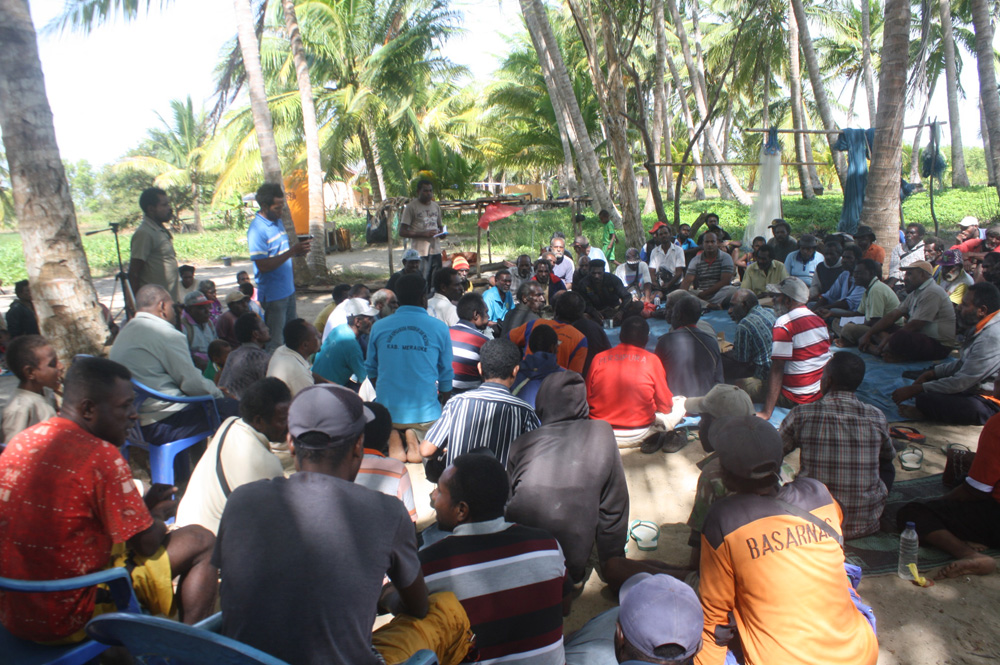
Then yesterday ( Sunday 11/8) the SSUMAWOMA forum organised a meeting and press conference in the Payum beach area of Merauke city. As tabloidjubi.com reported the discussion, there was heated argument between the people attending, but in the end all present were agreed on the need to oppose the two companies.
Aside from the intimidation experienced in Yowid, the discussion focussed on some of the other impacts that villagers are already experiencing as companies engage in the first phase of their plans, to survey the land and open negotiations with indigenous landowners. From Tabloid Jubi’s report:
A well-known Marind intellectual, Leonardus Moyuend, explained how villagers in the area were already feeling the pressure and can no longer sleep well. They also cannot go about their everyday activities as before, knowing about the companies’ plans to start operations around their villages. “To be honest, when the companies move in, it totally destroys the arrangement between one village and its neighbours,” he explained.
The problem, Leonardus continued, was that each village would make different claims about the boundaries of their land. “We never ad clear information from the government about this major program. If there is really a desire for companies to operate here, then all concerned parties such as the District Legislative Council, indigenous leaders from each village and other stakeholders should sit down with the government and investors and start discussions again from the beginning”, he said.
Instead what has been happening, he said, is that companies move in to the different villages on the quiet and then tell some of the people there that they are going to invest. “This is a really bad method the companies are using. It is the reason we have a strong commitment to resist the various areas of work they are focussing on”, he said.
He added that village elders had already given a mandate to local intellectuals to speak out and make interventions to oppose investment activities in their villages “We will never stay passive in the face of the companies’ efforts” he stated.
Meanwhile, an indigenous leader from kampung Wambi, Wilhelmus Bole Kaize said that he had already held meetings together with local indigenous people around ten times. The outcome was always that the people of that village opposed investment. The reason was because it would destroy the natural environment the people had taken care of through the years.
According to him, the area around Kampung Wambi should be used for tourism and culture. The outlook could be promising. In that way, there would be no more possibilities for corporate investors to move in. “We are completely agreed to resist the investors,” he said.
Three years after the MIFEE megaproject was launched, opening up Merauke Regency to plantation companies, initiatives by local people to organise to resist the companies appear to be on the increase. While the SSUMAWOMA forum is mostly concerned with the western part of the MIFEE area, a week ago on August 3rd another meeting brought together villagers from all over the central area of Merauke Regency. In that area companies such as Medco, Rajawali and Wilmar are operating and land is also being taken over for agriculture by transmigrants. That meeting also demanded that the government withdraw the permits for companies that are destroying the forest.
Johanes Mahuze, from Tanah Tinggi explained the predicament: “Real Marind people live with the land and the forest and wildlife are kept safe. We sit, we stand and we live from the land. We carry out our traditional rituals from the land and the forest, and the animals provide our food. If the land, forest and animals are all gone and we no longer own them, then the Marind Anim people are wiped out and become Plastic Marind, having to buy what we need for our traditions from the shops. We don’t want to become Plastic Marind”.
We will try to provide information on the outcome of the occupation action when we receive it.
Kampung Yowid, like other villages in Tubang and Ilwayab districts, has taken a determined and united stance against plantation companies, which have recently been moving in to the area. But now indigenous leaders in Kampung Yowid have been intimidated into signing a document from PT Mayora, one of Indonesia’s leading food brands, which is trying to take over their land for a sugar cane plantation. The people were accused of being OPM separatists by the police mobile brigade members the company employs as guards, who also accused them of storing weapons in their indigenous meeting house (adat house). Knowing that villagers were scared and thinking they might have to run to the forest, some community leaders felt they had no option but to sign the document. The contents of the document are unknown – villagers were never given a copy. Now, as before, the community states its clear opposition to Mayora’s plantation plan.
Merauke, like the rest of West Papua, is a militarized zone bearing the scars of fifty years of conflict. Now, as plantation companies continue to push their way in, it is not the first time that companies have been accused of using the ‘separatist’ stigma as a way to threaten indigenous people to give up their ancestral land. The people are quite reasonably afraid – they know that elsewhere security forces have unleashed violent repression countless times after labelling people as separatists.
This kind of link between military might and corporate ambition also has a clear parallel in Suharto’s New Order regime: plantation companies seized huge swathes of peasant farmers’ land in Sumatra in the 1970s and 1980s, threatening to kill people as communists if they resisted. Many communities are still trying to reclaim this land through land occupations and other forms of resistance.
The elders of Kampung Yowid who were forced to sign have now testified on video of how they were the victims of Mayora’s manipulation. Below, the Woyu Maklew sub-ethnic group Intellectual Forum and JPIC-MSC have also provided further background information on what happened.
Merauke, Friday (2 August 2013), the Woyu Maklew Sub-ethnic groupIntellectual Forum wishes to make clear that PT Mayora has violated the rights of the Marind Woyu Maklew indigenous people. The traditional (adat) chief and village head were forced to sign a document which PT Mayora presented to them, after the village was threatened with the stigma of being considered OPM members. A few villagers which supported the company were used to terrorise the others into accepting PT Mayora’s prescence in Yowid, Dokib, Wamal, Bibikem, Woboyu, Wanam and Dodalimvillages.
According to Ambrosius Laku Kaize, Kampung Yowid’s adat chief, he was forced to sign after pressure from PT Mayora’s staff. “I was forced to sign, because the villagers of Kampung Yowid had been accused of being OPM members”, he said. Mr Kaize went on to explain how he, theadministrative village head and the head of the Geb-Zami clan had all been similarly intimidated after PT Mayora made clear that the people of Kampung Yowid would be considered OPM if they didn’t sign the company’s letter.
The Woyu Maklew Sub-ethnic group Intellectual Forum’s monitoring hasrevealed that Marind people in the affected villages ( Yowid, Dokib, Wamal, Dodalim, Woboyu, Bibikem, Wanam and Uliuli) have not receivedreliable and truthful information about any policy for investment on their ancestral lands in general, and about PT Mayora’s presence in particular. This is an indication that the investment process is already violating the Marind indigenous people’s right to receive informationwithout compulsion and before investment activities commence. Aside from that, Marind people from the Woyu Maklew sub-ethnic group have already made clear that they oppose all investment on their ancestral land,because they do not have the skills required to get work with companies.
PT Mayora has already brought insecurity into the lives of local people,by going around villages in the area escorted by fully-armed Brimob from Merauke Police Station, and now by inciting individuals from the villages, the company has also created an unsafe situation by sowing fear. Further Background Information
On 21st May 2013, PT Mayora and PT Astra’s management met with Marind customary landowners in the Swiss-Bel Hotel on Jalan Raya Mandala in Merauke city. In this meeting, the people, through the Woyu Maklew Sub-ethnic group Intellectual Forum, expressed their opposition to the two companies. The reasons for this can be read in the forum’s letter here: https://awasmifee.potager.org/?p=352
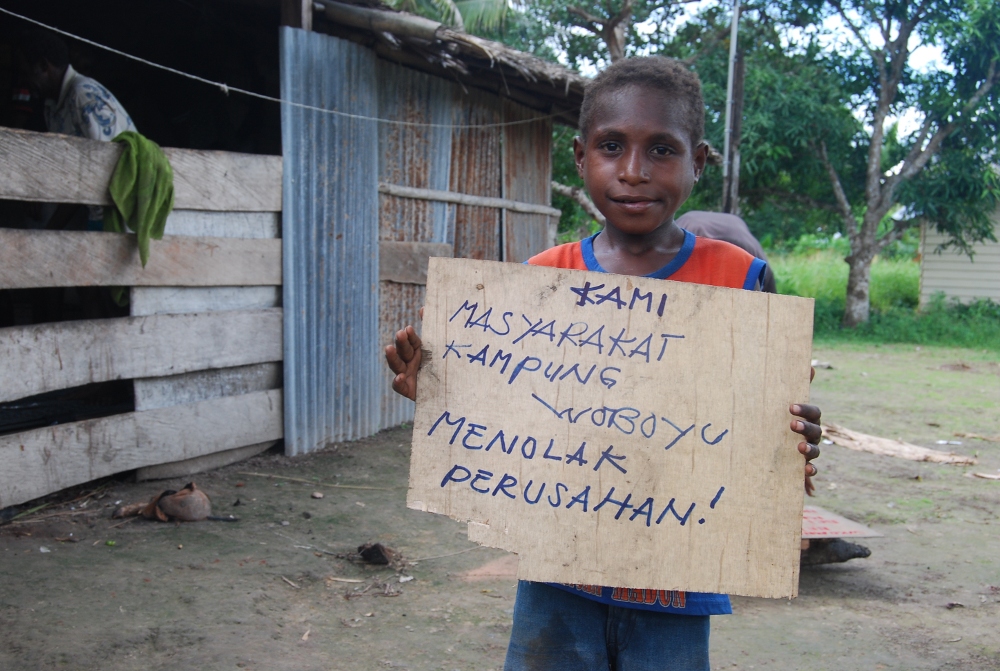
Villagers from Woboyu, Bibikem, Dadalim, Yowid, Wambi, Wanam, Wamal and Dokib villages have all made their opinion clear. In March and April this year each village has erected markers as a way to use customary law to prohibit the companies’ presence, also putting up signs with messages like “Oppose the companies, because we don’t have much land, and because we want to defend the Marind culture and our children and grandchildren’s future”.
While most of the people have maintained their strong stance against Mayora and Astra, two villagers from Yowid who had been won over by the company, together with one of PT Mayora’s Brimob guards and the company’s staff, got hold of a leaflet about human rights in Papua. The leaflet had been put together by the Merauke branch of the West Papua National Committee (KNPB) and was a summary of news from the mass media about the human rights situation. The deputy adat chief admitted that it was him who had distributed the leaflet so that people could read about the human rights situation. After all, they have the right to know.
However he was shocked to see how PT Mayora reacted towards the community after seeing this leaflet. As the adat chief explains in the video, PT Mayora started claiming that villagers were OPM separatists. The company also reportedly claimed that the adat house was used for storing weapons or OPM equipment.
During their monitoring from the last part of July to 4th August, JPIC MSC Indonesia and the Woyu Maklew Sub-ethnic group Intellectual Forum found that the people of Yowid had been severely frightened as a result of Mayora’s accusations that they were OPM separatists. There was a plan for the women and children to seek refuge in the forest. On 27th July, a meeting was held in the adat house (the local name is Sawiya) to discuss the fear they were living under. In that meeting village leaders told of how they had been forced to sign the document. Others didn’t sign, but their signatures were forged by the pro-Mayora villagers.
They never received a copy of the document they signed, and this made the community even more nervous. They were concerned that word would spread amongst neighbouring villages that they had given away their land to the company. All villages in the area had agreed some time ago that no-one should sell their land, and anyone who betrayed that agreement would be sure to face harsh repercussions.
On 27th July 2013, villagers wrote a letter to the Merauke Regency leader, Papuan Provincial Investment Board and Indonesian National Land Agency explaining that Kampung Yowid continues to oppose PT Mayora.
Photo shows the community in Yowid making their opposition to plantations clear earlier this year (Photo: AwasMIFEE)
.
-Mayora’s brands include Kopiko coffee and sweets, Energen cerealdrinks, Torabika coffee, Bengbeng chocolate wafers and Slai O’lai biscuits. They are mostly sold in Indonesia, but selected lines are exported to around 50 countries worldwide.





 West Papua Media Alerts