AJI Papua Presses Police About Lack of Progress Over Stabbing

Media information FYI

The Jakarta Globe
Sunday, March 27, 2011

AJI Papua Presses Police About Lack of Progress Over Stabbing

The Papua chapter of the Alliance of Independent Journalists has
expressed frustration with the sluggish pace of police investigations
into the stabbing of local journalist Banjir Ambarita.

“The investigation is taking too long, that is why we are monitoring
the case closely,” said Viktor Mambor, chairman of the Papuan branch
of the alliance also known as the AJI. “We are going to do something
to pressure the police, like hold a protest rally.”

“The new [Papua] police chief was once in Densus [the National
>Police’s counterterrorism unit], investigating a case like this should
be easier than capturing terrorists,” he said.

Banjir, a freelance reporter and contributor to the Jakarta Globe, was
attacked in Jayapura by two men on a motorcycle as he was riding his
own motorcycle home shortly after midnight on March 3.

The Jayapura Police’s detective unit questioned Banjir on Friday, more
than three weeks after the stabbing. “Because Banjar Ambarita’s
condition has improved, we formally asked him for information in
relation to the stabbing,” said First Adj. Insp. Widodo, an officer in
the unit. “A total of 37 questions were posed and were answered well.

“We have already questioned five witnesses, but we have yet to find a
lead,” he added.

Viktor said the AJI appreciated the police’s efforts but said: “Even
though they are working quite well in carrying out their job, this does not guarantee that they are taking the case seriously.”

Poengky Indarty, director of external relations at rights group Imparsial, said that as a defender of human rights in Papua, it was
vital that Banjir be protected.

“Until today, the perpetrators responsible for the violence have not
been identified,” she said. “We urge the Papuan Police to make every
effort to catch the offenders and legally process them.”

She said Banjir had provided police with information to make a sketch
of his attackers. “We want them to investigate based on this sketch
and look into police officers who may be involved in the case,” she
said.
Nurfika Osman

The Observatory: Indonesia: Brutal attack against journalist Banjir Ambarita

URGENT APPEAL- THE OBSERVATORY

IDN 001 / 0311 / OBS 049

Attack

Indonesia

March 25, 2011

The Observatory for the Protection of Human Rights Defenders, a joint
programme of the World Organisation Against Torture (OMCT) and the
International Federation for Human Rights (FIDH), has received new
information and requests your urgent intervention in the following
situation in Indonesia.

Description of the situation:

The Observatory has been informed by reliable sources of the brutal
attack against Mr. Banjir Ambarita, journalist, after the publication of several of his articles in the local newspaper Bintang Papua of Jayapura, Papua province, and in the Jakarta Globe, denouncing sexual abuses committed by police officers in Jayapura.

According to the information received, on March 3, 2011, Mr. Banjir
Ambarita was riding his motorcycle in front of the Jayapura Mayor?s
office, when two unknown men on a motorcycle reportedly approached him, stabbed him twice in the chest and stomach and fled. As he began to bleed, Mr. Banjir Ambarita drove to the nearby police station. Police officers took him to the Marthen Indey Hospital in Aryoko, Jayapura, where he underwent surgery. He has reportedly recovered since then.

The Papua Regional Police and the Jayapura Police have set up a joint
force to investigate the case, but to date, perpetrators remain unknown.

Mr. Banjir Ambarita had recently written articles in the Bintang Papua and in the Jakarta Globe about two alleged rape cases involving the police.

In the first article, he had written that four police officers and three
civilians allegedly raped and tortured a 15 year old girl in February
2011, in Biak, Papua province. The last article, dated February 27,
2011, covered a second case in which three police officers forced a
woman detainee to perform oral sex on them from November 2010 to January 2011 at the Jayapura Police Detention Centre in Papua province. The media coverage of this incident led to the resignation of the Jayapura’s Police Chief, Mr. Imam Setiawan, and to the sentencing to 21 days of jail for the officers involved.

The Observatory expresses its deepest concern about the attack on Mr. Banjir Ambarita, which seems to merely aim at sanctioning his
denunciation of human rights violations, and urges the authorities to
ensure his protection and to promptly investigate into the
above-mentioned facts.

Actions requested:

The Observatory urges the authorities of Indonesia to:

i. Guarantee in all circumstances the physical and psychological
integrity of Mr. Banjir Ambarita, as well as all human rights defenders
in Indonesia;

ii. Carry out a prompt, effective, thorough, independent and impartial
investigation into the above-mentioned events, the result of which must be made public, in order to prosecute and try the perpetrators of these violations before a competent, independent and impartial tribunal;

iii. Conform in all circumstances with the provisions of the Declaration
on Human Rights Defenders, adopted on December 9, 1998 by the United Nations General Assembly, in particular:

– Article 1, which states that ?Everyone has the right, individually or
in association with others, to promote the protection and realization of
human rights and fundamental freedoms at the national and international levels;

– Article 6, which provides that: “Everyone has the right, individually
and in association with others: (a) to know, seek, obtain, receive and
hold information about all human rights and fundamental freedoms (?);
(b) freely to publish, impart or disseminate to others views, information and knowledge on all human rights and fundamental freedoms”;
(c) to study, discuss, form and hold opinions on the observance, both in law and in practice, of all human rights and fundamental freedoms and, through these and other appropriate means, to draw public attention to those matters”,

– Article 12.2 which provides that “The State shall take all necessary
measures to ensure the protection by the competent authorities of
everyone, individually and in association with others, against any
violence, threats, retaliation, de facto or de jure adverse discrimination, pressure or any other arbitrary action as a consequence
of his or her legitimate exercise of the rights referred to in the present Declaration”;

iv. Ensure in all circumstances the respect for human rights and fundamental freedoms in accordance with the Universal Declaration of
Human Rights and with international and regional human rights
instruments ratified by Indonesia.

Addresses:

  • HE. Susilo Bambang Yudhoyono, President of the Republic of Indonesia, Presidential Palace, Istana Merdeka, Jakarta 10110, Indonesia; Fax: +6221 345 2685/526 8726
  • Mr. Gamawan Fauzi. Minister of Home Affairs, Jl. Medan Merdeka Utara No. 7, Jakarta Pusat, Indonesia, Fax +62 21 385 1193 / +62 21 384 6430, Email: pusdatinkomtel@depdagri.go.id⁢mailto:pusdatinkomtel@depdagri.go.id>
  • Mr. Patrialis Akbar, Minister for Justice and Human Rights, Department of Justice and Human Rights, Jl. H.R. Rasuna Said Kav No. 4-5, Kuningan – Jakarta Selatan 12950, Indonesia,
    Fax: + 62 21 525 3095/ 310 4149/ 522 5036,
    Email: rohumas@depkehham.go.id
  • Indonesian National Commission on Human Rights, Jl. Latuharhary No 4B, Menteng, Jakarta Pusat 10310, Indonesia, Fax : +62 21 392 5227, Email: info@komnasham.go.id
  • Permanent Mission of the Republic of Indonesia in Geneva, Rue de Saint-Jean 16, Case Postale 2271, 1211 Geneva 2, Suisse, Fax: +41 22 345 57 33, Email: mission.indonesia@ties.itu.int
  • Embassy of the Republic of Indonesia to the Kingdom of Belgium, Boulevard de la Woluwe 38, B-1200, Brussels, Belgium, Fax +32 27 72 82 10, Email: primebxl@skynet.be

Please also write to the diplomatic representations of Indonesia in your
respective countries.

***
Geneva-Paris, March 25, 2011

* *

Kindly inform us of any action undertaken quoting the code of this
appeal in your reply.

The Observatory, an OMCT and FIDH venture, is dedicated to the
protection of Human Rights Defenders and aims to offer them concrete
support in their time of need.

To contact the Observatory, call the emergency line:

· E-mail: Appeals@fidh-omct.org

· Tel and fax OMCT + 41 22 809 49 39 / + 41 22 809 49 29

· Tel and fax FIDH + 33 1 43 55 25 18 / +33 1 43 55 18 80

Broadcasting Papua’s Songs of Freedom: Why the international community must support West Papua’s citizen media development

FREE THE PEOPLE? FREE THE MEDIA!

by Nick Chesterfield

A Paper presented at the University of Sydney Centre for Peace and Conflict Studies “Comprehending Papua Conference”, February 22-23, 2011.    This paper will form a chapter of the forthcoming book “Comprehending Papua”, to be published in early 2011 by the University of Sydney Centre for Peace and Conflict Studies.

———

It is almost a cliché today that peoples wishing to free themselves from tyranny are turning in huge numbers to citizen journalism both to tell their stories to the outside world, and to put a formidable brake on the out of sight, out of mind mentality that allows state organs to conduct constant abuse with impunity. The rise of citizen media is giving mainstream journalism the kick it needs to remember its core business of giving voice to the voiceless.  In West Papua, the Voiceless are slowly discovering they can roar.

Just a few weeks ago an event occurred in Tunisia that was to be the spark for the pan-Arab awakening which has just seen yet another dictator ousted, now in Egypt.  After a local trader immolated himself in protest against the Tunisian regime, citizen media succeeded in viralizing the news of this event.  “We could protest for two years here, but without videos no one would take any notice of us,” said a relative of the martyred 25-year-old.

For media activists and journalists reporting Papua, this truth is self-evident, and its acceptance hopefully could ignite the spark of uprising in Papua.  The opportunities presented by the Pan-Arab (and other) awakenings are not being lost on the young generation in Papua.  Social media in Papua is buzzing, unafraid, with vibrant discussions of implications for Papua of the pan-Arabic revolutionary success.  The reality is that a spontaneous awakening and mass politicisation of ordinary Papuans is completely inevitable, and it is being ably assisted by switched-on local people developing their capacity to tell the story to the world.

In researching for several stories over the last few months, my sources have told me in no uncertain terms that they are all ready for a trigger to explode the situation.  The only thing holding back sustained mass action – revolution even – across occupied Papua is the constant bickering between exile groups, the actions of the collaborator elites, desperate to cling to the illusion that Jakarta is not there just to steal their land and send them to the moon, and for those who will put their own interests ahead of those surviving under occupation.

What is a mystery is how this mass consciousness will survive the elite and exile power games that are evident in most transitional polities throughout recent history (and is certainly present in West Papua today); whether those exiles will hijack the efforts of the young generation or listen to the actual wishes of their people; and if Jakarta can be trusted not to unleash the truly evil and deeply entrenched habitual brutality that is its only constant in becoming the new colonialists; or that they will claim their place amongst the civilised by not slaughtering those who want peace. History is a wise teacher, and its lesson is never trust the evil or greedy to reform of its own accord.

To keep these ugly realities in check, West Papua (and the international community) needs a determined, effective, vibrant and fearless citizen and professional media to deliver real-time accountability both internally and internationally.

Real time advocacy is vital for the international community to act to end Papua’s suffering.  Human Rights advocates conduct scientific research into abuses, but because this information does not get out easily, the problems in Papua are only now getting known to the world.

I need to ask you all today an honest question:  without the hard work of journalists in Papua and those outside assisting them to get their voice to international media, would Papua even be in people’s consciousness today?   So why is the international arena concerned with West Papua falling prey to the disease of factionalism and Big Man syndrome, and not in assisting WestPapuan people to get their stories into the living rooms of the world?

Many loud mouthed exiles claim significant legitimacy, but baulk and splutter when asked to prove it.   This has developed a culture of opacity across the exile movement.  A strong and diverse citizen based media across Papua can easily counter exile’s game playing and false claims by ensuring credibility and honesty in social movements. It benefits and strengthens social movements too by giving the skills and practice for sharpening their message, and creating a powerful argument for international support for their aims.  Strong domestic media also removes international government’s excuses for inaction, by seriously raising the credibility and verification bar.

If the international community is serious about improving the lives of Papuan people, it will help develop the capacity of the West Papuan media to tell the story of what is going on, and press Jakarta hard to allow immediate international media access.  After all, with full accountability, what is there to be afraid of?

Largely in response to years of wilful ignorance and self-censorship of the Indonesian created horrors in West Papua by international media, many sectors of Papuan society spontaneously and independently began a dramatic take-up of social media technology, exponentially increasing since 2008. Blogs, social networking and online media outlets are being utilized all over the country, by a young generation of Papuans impatient for real change.  Today’s mass Papuan movement is mainly urban, educated, innovative, nonviolence based, and embracing significantly the power of citizen and social media as a key plank of civil resistance strategy.

Very occasionally West Papua does get in the news, but only through the co-ordination between committed journalists and human rights workers working together and ear-bashing news editors.

Due to the ongoing ban by Indonesia on international media and humanitarian organisations having access to Papua, allegations of abuse are notoriously difficult to verify.  While this ban remains in place, only the most dedicated journalists make the effort to go in undercover.   West Papua Media has been proud to facilitate undercover trips into occupied territory to meet with many West Papuan people prepare to tell their own story. This is getting more difficult by the day so local people are working for a solution.

Live images, videos and online activism by Papuan people have already created tremendous momentum in action and awareness of Papua.  By creating their own media, and their own narrative, Papuan people are reclaiming self-determination denied for so long.

Reporting in West Papua is a highly risky business.   Journalists, Papuan and outsiders alike, are under constant threats for reporting West Papua, with four journalists dying in suspicious circumstance in 2010 alone.  Anywhere journalists report fearlessly they are targets, but most journalists in West Papua simply put up with it, they have no other option.  What can we do to lessen their risk?

Partly in response to this danger and partly to give local journalists a voice globally, West Papua Media (WPMA) (WestPapuaMedia.Info) was started. It aims to provide a professional service to international media covering West Papua, ensuring high quality, verifiable reporting gets into the international media, directly from the ground, and not from those who seek to distort the truth of daily experience in Papua.  By reporting Papuan campaigns to end human rights abuses and bringing these unreported Papuan issues to the front page, we hope to hold the abusers to account. With an ever growing stable of committed and disparate voices from citizen media to professional journalists, West Papua Media is proud and excited to be part of this movement.

Some of our real time work has assisted directly in the prevention of mass acts of violence by the Indonesian security forces, such as our coverage and media advocacy fixing of the July 8-9 Otsus Gagal demos and occupation of the Jayapura DPRP.

Less than ten minutes before the deadline for dispersal of the 2 day rally of over 45,000 people, Indonesian security forces were forced to back down after a BBC report aired, organised by WPMA, which brought international attention the explosively dangerous situation.  Extensive international diplomacy occurred in that 15 minutes and, together with the extreme discipline of the mass protest, enabled the protestors to peaceably leave the scene of the protest without violence.

WPMA has worked very hard raising the media profile of West Papua, with significant joint investigations with major media outlets breaking several key stories in 2010.  None of this would be possible without deep trust from the people of Papua in reporting their stories.  West Papuan citizen media, in conjunction with several colleagues here today, played a key role in alerting the world to deeply heinous cases of abuse.

One was the sourcing, verification and release of the deeply shocking leaked Kostrad torture videos of civilians in Puncak Jaya. The Kiwo incident neatly captures why the Indonesian military cannot be trusted to reform themselves from the inside, and why the role of a robust media is so critical in Papua.

The other was footage of Indonesian BRIMOB police taunting a former political prisoner Yawan Wayeni, having disembowelled him moments before for arguing with them. Both these videos showed the power of citizen media in activating international human rights networks to effectively raise the issue of Papua. Of course, there are many more videos in preparation for release.

A swarm movement cannot have a single media strategy, but media need to understand that it will get media out in its own way too.  The media that had wilfully ignored West Papua’s voice for so long really has no right to dictate how information disseminates, and if it wants to get the stories before others, then it just has to move faster.  Because it is new media techniques that have already, and will propel Papua onto the front page, to make people choke on their cornflakes.

Likewise, evidence dissemination also needs multiple, failsafe distribution routes: Single dissemination routes can easily be shut down or silenced.  West Papuans have tailored their mechanisms to this very effectively; yet this is significantly frustrating outside journalists.  According to many in mainstream media, West Papuans can be their own worst enemy when it comes to disseminating information.  People on the ground do need to get smarter about media distribution strategies, but the media also must adapt to a social and cultural reality.  West Papuan human rights and citizen media are not chaotic: they are maximising the potential audience  for their information.

It is important to understand that no one faction or sector in West Papua can claim dominance or leadership of this mass movement. This is not Congress in India and there is no single Gandhi figure. Rather, this is a movement with thousands of Gandhis.  The civil movement refuses to be based around a single leadership group, and instead features multitudes of groups and tribes all acting autonomously and independently (where everyone knows their role and works their hardest) but which is nevertheless unified under its collective goals.

Such a swarm structure can occasionally present difficulties for those who cannot think outside traditional top-down strategies for national change, which includes traditional media. Rather than being shut out of dialogue by the game playing of unaccountable elites, this type of structure encourages a longer lasting peace by enabling all actors to have their voices heard. It is also a natural strategy to employ in a nation where it is,  for the most part, illegal to congregate in groups.

Other barriers for West Papuan media are much more easily solved with a bit of training, and understanding the enemy (this time the enemy being the unreasonable expectations of media executives far removed from reality).

One issue is the lack of speed with which many West Papuan media activists work, and whilst improving, an event on a day has to be filmed, edited, packaged and disseminated as fast as possible. There are issues of journalistic discipline and professional journalistic practice in new media; safe information gathering, abuse documentation and investigative journalism methodology; information quality assurance; protection of sources, and more.

Effective citizen and professional media training is required to develop awareness of major current and future challenges to safe information dissemination – these are all programs that the West Papua Media network is currently engaged in and it needs help to increase its capacity.

All of this costs money, and requires the international community to understand that the development of indigenous journalism in West Papua is crucial to the protection of human security and peace across the entire Asia-Pacific region.  It requires international institutions in media and academia to get out of their cloisters and get muddy, to actually pool resources and help identify new sources of sustainable funding to start training journalists in innovative new media reportage techniques, and to support their work for the global human interest.  As I said before, West Papua Media already has training programs ready to go, we just need the funds to make them happen.

In West Papua, as across the world, accountability is always the simplest solution to combatting impunity. An aggressive culture of investigative journalism must be encouraged, and the skills to enable it must be developed, to deliver that accountability, be it in human rights, against military business mafias and corruption, human security, environmental protections, etcetera, and to cover (and protect) the desires of a population to determine their own future, in both the current occupation and in any situation for the future.  Both academia and international media must take a strong role in its development, to embed international protections to enable West Papua’s journalists and citizen media to report without fear, hindrance or threat, the stories that are important to West Papuan people and their freedom.

Our hope is that we have a really robust citizen media that can deliver accountability.  We want to stop people from being afraid of speaking out, and we want West Papua’s voice to be its weapon, to broadcast its songs for Freedom.

Nick Chesterfield, editor at westpapuamedia.info, is a human security journalist and activist with extensive experience of the Papua issue through refugee protection, human rights, environmental protection, and citizen media work and safety training. He has conducted many field investigations in the West Papuan region since 1999. Together with citizen media and human rights workers from inside Papua, Chesterfield helped set up West Papua Media in 2008, to counter the wilful lack of coverage of West Papua by the international press.
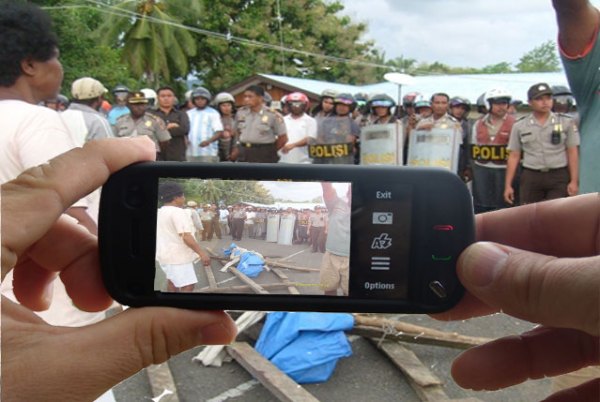
 

AI URGENT ACTION JOURNALIST STABBED IN INDONESIA

http://www.amnesty.org/en/library/asset/ASA21/004/2011/en/af581980-0b39-4576-bfe7-d7bc77734e0d/asa210042011en.html

DOCUMENT – INDONESIA: JOURNALIST STABBED IN INDONESIA: BANJIR AMBARITA

UA: 53/11 Index: ASA 21/004/2011 Indonesia Date: 03 March 2011


URGENT ACTION
JOURNALIST STABBED IN InDONESIA

In the early hours of 3 March, journalist Banjir Ambarita was stabbed in the Indonesian province of Papua. He is currently in intensive care, recovering after an operation. He is at risk of further attacks and intimidation.

Banjir Ambarita is a journalist with Bintang Papua, a local newspaper, based in Jayapura, Papua province. He was stabbed at about 1 am in the morning of 3 March 2011. Banjir Ambarita was on his motorcycle heading home when the attack occurred. Reliable sources told Amnesty International that when he was in front of the Jayapura Mayor’s office, two men on a motorcycle approached him, stabbed him twice in the chest and stomach and sped off. As he began to bleed, Banjir Ambarita rode his motorcycle to the nearby police station. Police officers took him to the Marthen Indey Hospital in Aryoko, Jayapura. He had an operation on 3 March 2011 and is recovering in hospital.

Banjir Ambarita has worked in Papua province for five years and is also a regular contributor to Vivanews and The Jakarta Globe. He had recently written about two alleged rape cases involving the police. In the first case, which occurred in February 2011, four police officers and three civilians allegedly raped and tortured a 15 year old girl in Biak, Papua province. In a second case, three police officers forced a woman detainee to perform oral sex on them over a three-month period from November 2010 to January 2011 at the Jayapura police detention centre in Papua province. The three officers were reportedly only given disciplinary punishments of 21 days’ detention and a delay of their promotions. The media coverage of the second incident led to the resignation of Jayapura Police Chief Adjunct Senior Commissioner Imam Setiawan on 1 March 2011, and a report on the incident filed by the woman’s husband to the Papua branch of the National Human Rights Commission (Komnas HAM).

International human rights observers, non-governmental organizations and journalists are severely restricted in their work in Papua amid ongoing reports of serious human rights violations by the police and military.

PLEASE WRITE IMMEDIATELY in Indonesian or your own language calling on authorities in Indonesia:
  • To immediately conduct a prompt, independent and impartial investigation into the attack against Banjir Ambarita and bring the perpetrators to justice in accordance with international fair trial standards;
  • To take immediate steps to provide appropriate protection to Banjir Ambarita, according to his wishes;
  • To initiate an independent investigation into the two reported rape cases highlighted by Banjir Ambarita, and ensure that, should the allegations be verified, those responsible be brought to justice in fair trials and victims receive reparations;
  • To ensure that all human rights defenders in Papua, including local journalists, can work freely, independently and with full protection from state authorities.
PLEASE SEND APPEALS BEFORE 14 APRIL 2011 TO:
Papua Police Chief
Inspektur Jenderal Bekto Suprapto
Papua Police Chief (Kapolda)
Jl. Samratulangi No. 8 Jayapura,
Papua,
Indonesia
Fax: +62 967 531717
Salutation: Dear Kapolda
Minister of Justice and Human Rights
Mr. Patrialis Akbar
Ministry of Justice and Human Rights
Jl. H.R. Rasuna Said Kav No. 4-5
Kuningan, Jakarta Selatan 12950 Indonesia
Fax: +62 21 525 3095
Salutation: Dear Minister
Chairperson National Human Rights Commission (Komnas HAM)
Mr. Ifdhal Kasim
Chairperson National Human Rights Commission (Komnas HAM)
Jl Latuharhary
No.4 Menteng Jakarta Pusat
10310
Indonesia
Fax: +62 21 39 25 227
Salutation: Dear Ifdhal Kasim
COPIES TO: diplomatic representatives of Indonesia accredited to your country. Please check with your section office if sending appeals after the above date.

URGENT ACTION

JOURNALIST STABBED IN INDONESIA

ADDITIONAL INFORMATION

In recent years, there have been a number of cases of intimidation and attacks against human rights defenders and journalists in Indonesia.

In July 2010, Tama Satrya Langkun, a Jakarta based anti-corruption activist, was severely beaten by unknown persons in an apparent move to silence him. That same month, Ardiansyah Matra, a journalist covering corruption and illegal logging in Papua, was found dead in the province. Despite police investigations, no one has yet been held accountable for these attacks.

Amnesty International has documented how victims and witnesses in Papua have little available legal remedies to make complaints about human rights violations. In a report published in June 2009, Amnesty International highlighted weaknesses in internal and external accountability mechanisms to deal with police abuse. To date, these mechanisms have yet to be reviewed.

Please refer to the following documents for more information:

Digest: Amnesty International Papua Digest, January 2011
Document: Open letter on unchecked police abuse in Nabire district, Papua, (Index ASA 21/024/2009), 30 November 2009.
Report: Unfinished business: Police accountability in Indonesia, (Index ASA 21/013/2009), 24 June 2009.
Report: Amnesty International’s briefing to the UN Committee Against Torture, (Index ASA 21/003/2008), 15 April 2008.

UA: 53/11 Index: ASA 21/004/2011 Issue Date: 3 March 2011


Indonesian Civil Society: Open letter to SBY Raising Concern and Offering Solution:: One-Year Human Rights Promotion in Papua 2010

OPEN LETTER

Raising Concern and Offer Solution::

One-Year Human Rights Promotion in Papua 2010

To the attention of

President Republic of Indonesia,

Susilo Bambang Yudhoyono

In Jakarta

Dear Mr. President,

We are writing this letter to you to raise our concern over human rights conditions in Papua. We are confirmed that lacking of protection and recognition of Papuans’ rights have led to abusive and violent practice against Papuans. This pratice has persistently cause death to Papuans and left trauma for them and their family. This practice clearly does not reflect the spirit of this country’s constitution to protect whole citizens.

We have recorded that there have been some big issues this year that attract public attention. The issues such as footage violent action against civilians by military in Tinggi Nambut Papua,[1] violence against civilians in Bolakme,[2] ethnic conflict between Papuan highlanders and Yoka people,[3] shooting civilians in Nafri[4], shooting against prisoners in Tanah Hitam,[5] civilians shot dead in Boroway,[6] arrest and detention of Filep Karma and  Buchtar Tabuni[7] and the rally of returning special autonomy. Other cases relating to social, economy and culture which potentially bring negative impact on Papuans and destroy Papuan values such as MIFEE in Merauke,[8] Dagewo case in Paniai[9],  the transfer of local land in Lereh for palm oil plantation, Freeport case,[10] and many illegal logging cases.

Bsaed on our observation and data collected, the problems mentioned above happen because of the following reasons:

First, government still stigmatisize any Papua groups and individual as separatist as they do resistance against government. Government uses ‘stigmatization of separatist” as powerful  strategy to silence Papuans demand and freedom of expression and weaken the critical thinking from Papuans who often criticise the govermnent policy. This strategy is partially successful as it silences resistant movement but in the other side it gives more energy and spirit for more resistance. Also, this unpopular strategy has planted the seeds of hostility and mistrust among Papuans against Indonesia.

Second, Jakarta still plays dominant role in the issue of any policies and their implementations in Papua. Jakarta, as the central power, is still unable to trust any process of development in Papua although Papua has been given special autonomy to manage themselves. MIFEE case, violence against civilians in Bolakme, Tingginambut-Puncak Jaya and Freeport cases are example on how central government still exercise their absolute authority which potentially destroy basic rights of Papua. Central govermnet just interest in investment without considering the basic rights of Papuans and their values

Third, Papua is still considered as conflict area. Therefore, security approach is dominant. Huge number of troops are deployed  every year to Papua to secure the border area and investor’s assets. Ironically, the security approach has caused fear and revive the past trauma. People in the border feel fear when they go to bush and forest to hunting, gardening as they might be arrested as being suspected as members of Papua freedom movement (OPM)/ National Freedom Army (TPN).

Fourth, The massive deployment of troops which is to secure investors’ assest has caused human right violations and fear. The rights of people are neglected and intimidation is done when the locals demand their rights and speak critically.

Fifth, Economic problems are still strongly perceived as the main problems in Papua. Therefore, huge amount of money and investment is needed to build Papua to improve their economy. RESPEK ( strategic plan for rural development) program is one example where the program emphasize infrastructure development rather than human resources development. Moreover, suspection among the locals is rising over the use and management of special autonomy fund used for RESPEK program. Also, no efective supervision has led to corruption

Sixth, the policy issued by govermnet and its implementation actually repair the impact not solve the basic problems which has been persisting so long. It is crucial that any policy has ‘solving-problems’ elements. If not, the problems will never be solved.

Based on the description above, we urge Mr. President to take immediate action by ordering central government and localgovernment to do the following:

First, hold peaceful dialog as an effective means to solve the problems in Papua. The dialog Jakarta-Papua which has been initiated by Papua Peace Network Team needs to be supported. The dialog should involved all elements: government, customary community, religious leaders, academics and civil groups.

Second, stop all stigmatization against Papuans and place them a citizens who have rights to be protected by the state. Constitutions guarantee freedom of expression and this should also be applied to Papuans. Some articles in state criminal law and government regulation No. 77 year 2007 about treason and subversion need to be amended as it limits the freedom of expression

Third, revise or redesign security approach to be human rights-based approach as it will recognise the rights of Papuans and protect Papuans from violent acts. The deployment of troops need to be adjusted to the need of the local area and real threat as to save state budget of defense

Fourth, police should exercise their professionalism in keeping the order and promote human rights. The professionalism is shown by giving protection so people feel secure and peaceful in doing their activities. This is important to bring back trust from the people.

Fifth, push the policy that promote human rights and provide justice to the victims of human rights abuses. Government has to take immediate action to establish human rights court and reconciliation and truth commission in Papua as mandated by special autonomy law

Sixth, central government needs to revise public-service related policy because the existing policy does not provide and touch the basic rights of Papuans. There are three public service issues that needs to taken into consideration: education, health and economy where these three areas are directed to empowernment, affirmative action and protection

Seventh, Policies issued for Papua need to have recognition of human rights elements. This is so because all existing policies basically emphasize on economic and welfare problems.

Eighth, governor, Papua legislative (DPRP) and Papua People’s Assembly (MRP) should build good coordination and reponsive to the problems of human rights abuses in Papua. Lack of initiatives and good will from these institutions show that they actually do not have commitment to promote human rights in Papua and potentially increase mistrust among Papuans.

We write this open letter with the hope that immediate action to be taken to solve the problems in Papua. Thanks

Jayapura, 05 January 2010

Institutions support this open letter

Papua Based Institution

Foker LSM Papua, ALDP, Elsham Papua, SKP-KPC, KPKC Sinode GKI Papua, LBH Jayapura, JAPH-HAM Wamena

Jakarta Based Institution

Imparsial, Kontras Jakarta, HRWG, PRAXIS

CC :

1.  Menkopulhukan RI

2.  Menkokesra RI

3.  Menteri Dalam Negeri RI

4.  Menteri Luar Negeri RI

5.  Menteri Pertahanan RI

6.  Panglima TNI

7.  Kapolri

8.  Jaksa Agung RI

9. Ketua DPR-RI

10. Anggota DPD Provinsi Papua

11.  Gubernur Provinsi Papua

12. Gubernur Provinsi Papua Barat

13. Ketua DPRP

14. Ketua MRP

15. Kedutaan Asing

16. lembaga Internasional

17. Jaringan kerja Papua


[1] This video was initially released by Hongkong Based Human Rights group, AHRC and made public through youtube. In the video, it shows that military tortures civilians suspected as members of Papua free movement group. But in fact, the victim is a reverend. Government then response to the incident immediately by forming fact-finding team. Ministry of politics, law and human rights finally acknowledges in the press release that it is true that military has done such a barbaric act. The perpetrators of the torture were finally on trial and sentenced respectively 5 months and 7 months. This very minimum sentence indicates a failure of states to provide justice to the victim

[2] An ambush against military in Yugam, Bolakme, Jayawijaya district on 1 december 2010. This incident has caused two civilians die

[3]This incident took place on 17 November 2010, 35 houses burned and 3 got injured. The highlanders damage the houses in Yoka as they are angered by a song composed by a Yoka man which insult the highlanders. It is also suspected that third party plays role in fueling the conflict. Local government has facilitated a dialog and they have agreed to cease their hostility. .

[4] Group of unknown men shoot civilians in Nafri, Abepura on 28 November 2010. One was dead and 4 seriously injured. The perpetrators are not identified yet.

[5]Friday on 3 December 2010 around 12.00, 4 prisoners and one detainee escape from prison. Miron Wetipo, one of the prisoners is shot dead when trying to escape. One of the prisoner is finally caught while the other three escape.

[6] Rahmat Faisal, an employee at mobile phone counter,  found dead by Oktafinaus Yerisitow. The victim was suspected being shot around 13.00 on 13 December 2010

[7] Filep Karma and Buchtar Tabuni were detained as they are suspected as the mastermind of riot in the prison after the death of Wiron Wetipo, a man shot dead while trying to escape from prison. Actually, Filep Karma and Buchtar Tabuni just ask head of law and human rights department about the reason why Wetipo was shot dead

[8]Merauke Integrated Food and Energy Estate (MIFEE) is a joint program between local and national government. This program will place Merauke as global agriculture industry. The program is promising which says that in 2030 Indonesia will have additional reserved food such as rice of 1.95 million ton, corn 2.02 ton, and many other food reservation. Also, Merauke will have income of IDR 124.2 million per capita per year in 2030. The program will bring more people from Java to work in the industry. Sadly, the program has taken people’s land.

[9]Illegal mining in Degowo has happened since 2001 where local do the mining without outside intervention. But since 2003, intervention comes and backed up by military and police. As more outsiders come and do the mining, the locals are moved out and can no longer do traditional mining as they used to do. They are even forced to release their land to investors who are interested in the gold mining. Moreover, prostitutes are brought by investors and military to Degowo to entertain the locals.

[10] Freeport case is the longest and massive exploitation of natural resources in Papua. Although there have been many efforts initiated by Freeport to bring back trust of Papua such as giving Cooperate Social Responsibility (CSR) but the problems and mistrust remain

Create a website or blog at WordPress.com

Up ↑
