West Papua: Road To Freedom – live streaming link from Oxford UK Conference

from the Free West Papua Campaign UK

The Road to Freedom conference will be streamed live online today from Oxford University, UK.

You can view a live stream of the event from 1400 GMT via the link below.

http://www.ustream.tv/channel/west-papua—road-to-freedom

Hope you will join us, wherever you are in the world for this historic day.

WEST PAPUA – INDON SECURITY FORCES FAIL TO BLOCK ACCESS FOR DEMONSTRATIONS ACROSS PAPUA, MILITIAS ON STREETS IN JAYAPURA

by Nick Chesterfield, westpapuamedia.info

Tuesday, August 2, 2011
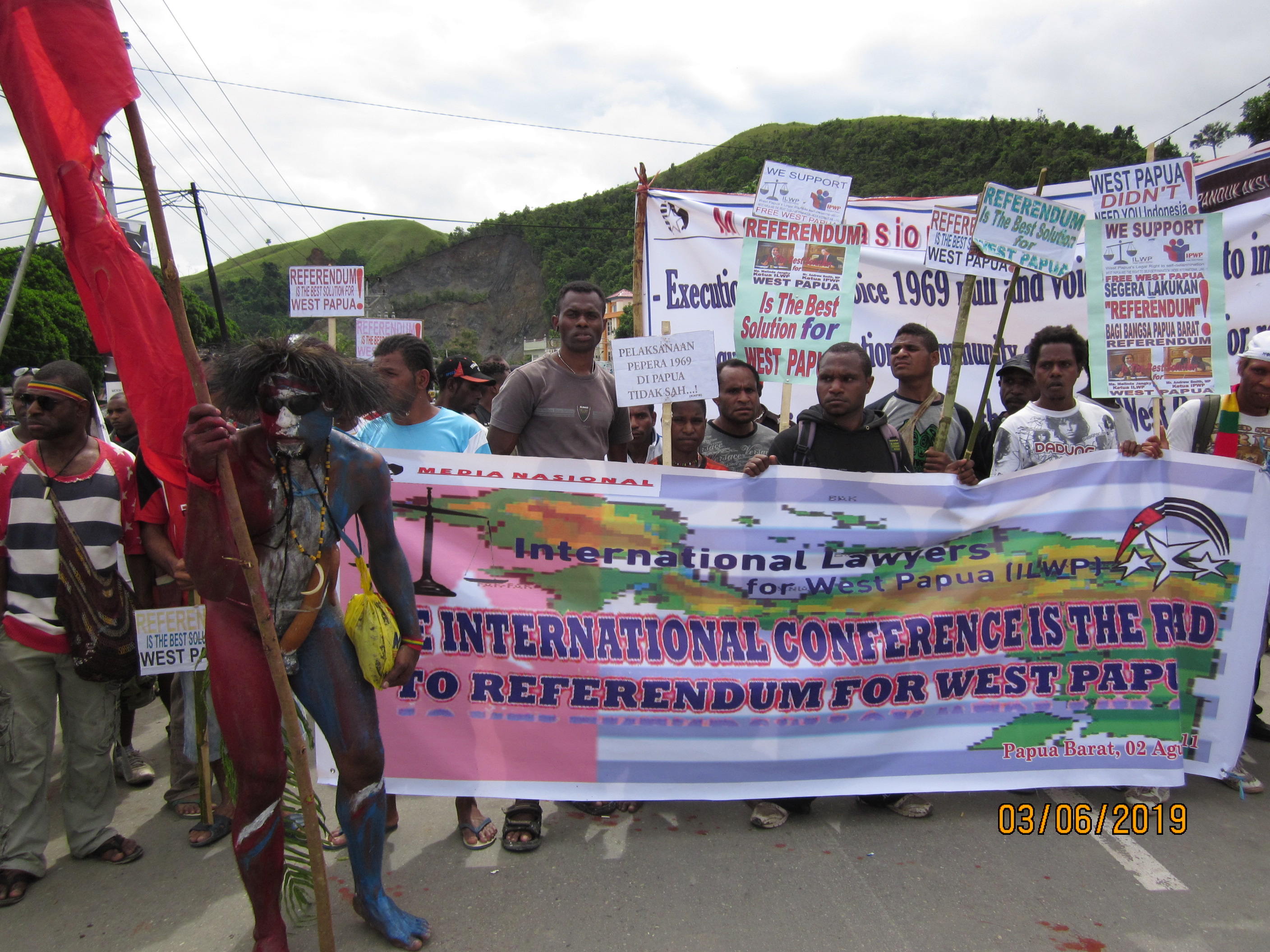
Jayapura, 1340: The streets of several centres across West Papua are being blockaded today by heavily armed Indonesian security forces in an attempt to prevent a planned gathering of tens of thousands of protestors who are demanding a Referendum on the future of the province.

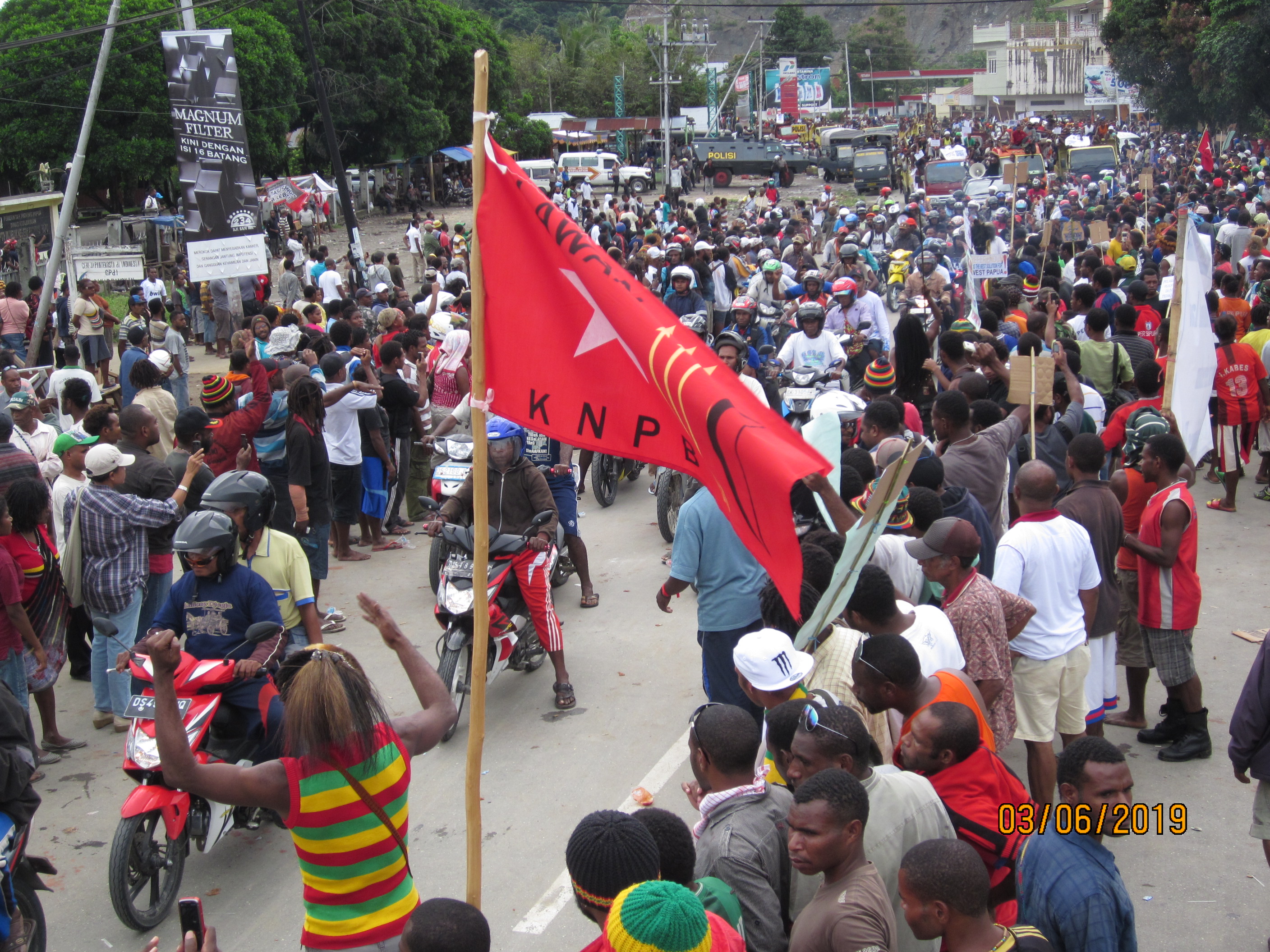
However, thousands of Papuans have reportedly ignored the strong military presence and are marching the streets of Jayapura, paralyzing the provincial capital with their huge numbers.

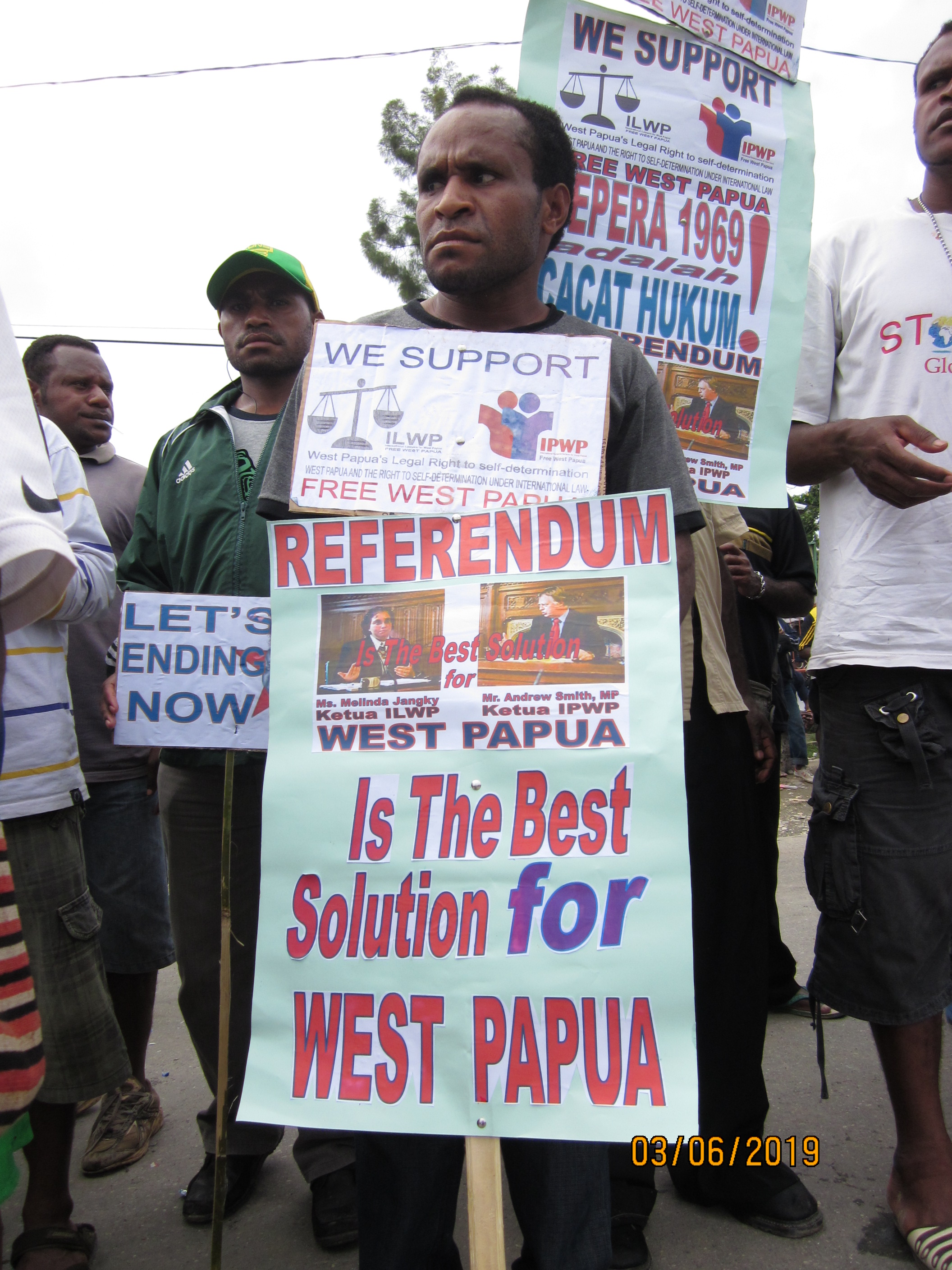
The protests, called by the West Papua National Committee (KNPB) and actively supported by the entirety of pro-independence movement, are being held to demonstrate both opposition to Indonesian rule and to the Indonesian-run dialogue process, in favour of legitimate internationally-mediated dialogue that takes into account the wishes of West Papuan people. The demonstrations are demanding a Referendum as the only lasting and credible solution to determine the future of Papua for Papuans.
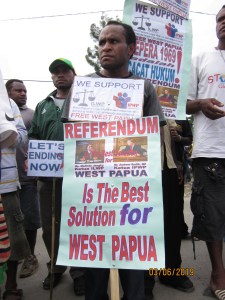
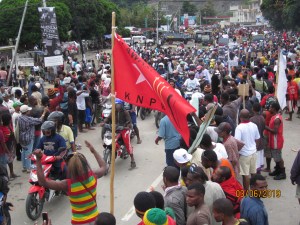
Outside Jayapura, protests are also being held in Wamena, Biak, Nabire, Manokwari, Paniai, and Timika.

West Papua Media stringers on the ground in Abepura are reporting that the demonstrations outside the main Post Office were being blocked by hundreds of heavily armed riot police and soldiers. This is despite official permits being issued by the Jayapura police for the demonstration to proceed without hindrance.

At 10am local time, three truckloads of soldiers and BRIMOB riot police then decamped and headed to Waena to intercept a long march of several thousand people who were attempting to join together with the Abepura march and then head to Jayapura, in information conveyed to West Papua Media by Daniel Wenda, Secretary General of KNPB. It is unknown at time of writing whether the march has pushed through the security force blockade or if any casualties or arrests have been sustained.

Local human rights sources have reported that a recent spate of violent acts may have succeeded in keeping away crowds of over 10,000 people, with one person stabbed and wounded by a militiaman at a pre-rally gathering in Angkasapura. However in news just to hand, organisers of the rally are reporting that security forces have relented and several thousand people have now successfully joined the demonstration, which is continuing to grow.

With tensions extremely high after the violence, the organisers of today’s rallies across Papua have been at pains to ensure that no symbolic traditional weapons be brought to the gatherings, and have worked with the Dewan Adat Papua to deploy hundreds of peacekeepers from the uniformed Community Security Force of Petapa, or The Guardians of the Land of Papua.

This slideshow requires JavaScript.

Telephone communication to Jayapura has been sporadic with many calls being cut off and SMS communication delayed, making confirmation of events difficult. It is unclear if the security forces are currently preventing West Papuan people from actively communicating to the outside world.

Reports are filtering through that other political actions are occuring throughout Papua simultaneously with the mass protests, with the KNPB suggesting that those who could not make it engage in innovative and non-violent economic disruption actions, such as strikes by ojek drivers, street vendors and bus drivers.

Independence activists are also reporting that members of two pro-Indonesian militias — Besar Merah Putih and Aswain (headed by Euricio Guterres) — have been deployed widely across the Jayapura area in conjunction with security forces.

Witnesses reported that late last night, a PELNI ship suspiciously landed 92 unfamiliar men at the main Jayapura dock, who are widely believed by activists to be members of Kopassus special forces in plain clothes. Activist surveillance of military facilities has indicated that special forces officers have not been seen at regular barracks for the past three days at least.

Suspicions have also been cast on unidentified forces responsible for a spate of violent incidents prior to the nonviolent mobilisations, who are believed to be connected to the Indonesian security forces, in what many observers see as an attempt by the security forces to spread fear, panic and division among the demonstrators to prevent the protests going ahead.

In the early hours of Tuesday morning, an arson attack on the Rectorate of the Cenderawasih University, Abepura, was foiled by Papuan students. The fire was detected before it took hold by alert from student security and was quickly extinguished.

After attacks yesterday by unknown assailants on Indonesian transmigrants in Nafri, Abepura, sources are reporting that one person has been killed and an unknown number injured in another attack in Koya, where SMS reports from credible local sources have described several incidents involving shootings and stabbings.

The Indonesian military has long had a policy of using civilian proxies and plain-clothes agents to carry out acts of violence to provoke civil resistance movements into self-defence. This has often been used as a pretext to engage in a security crackdown, which reinforces military dominance over the region.

Elsewhere in Papua, the mass rally also being held simultaneously in Manokwari was prohibited by security force, according to organisers from the KNPB. However negotiations succeeded in Indonesian security forces relenting, and the rally is currently ongoing with several thousand people participating. This rally marched from the office of Dewan Adat Papua, and is currently outside the Department of Information in Sanggeng. The atmosphere is described as relaxed.

West Papua Media is monitoring events closely, and will provided updates on the situation throughout the day.

MEDIA NOTE:  CONTACTS FOR SPOKESPEOPLE AND STRINGER ON THE GROUND ARE AVAILABLE.  PLEASE CONTACT +61450079106 or editor<@>westpapuamedia.info

Related articles

Breaking News: 4 shot dead in Nafri, West Papua

WestPapuaMedia.Info

Monday August 1, 2011

(UPDATED)

[Jayapura] Reports are emerging that four people have been shot dead on Monday morning in an incident in Nafri village,in Abepura, West Papua.

According to independent sources, 10 people received gunshot wounds at 5.30am whilst travelling to Arso from Jayapura on a passenger truck.  10 passengers were shot while on the truck, with 4 dead and 6 wounded.  The dead were taken to RS Bhayangkara (police hospital).

Ahmad Saud, 27; M. Saiun, 25; Budiono, 22 – all from Arso 9 – and Siti Amimah, 49; and Tarmuji, 49, both of East Koya; received serious gunshot wounds and are at UGD RS Abepura (emergency).  The victims were all transmigrants from outside of Papua.

Private Dominikus Kerap, a member of Company C 756 Infantry Battalion Senggi died at the scene.

Shootings have regularly occurred against Indonesian transmigrants in this area, which is infamous for its lack of cover.  After incidents in 2007, 2008 and 2009, police have so far failed to investigate the incidents and no perpetrators have ever been found.  Despite this, a local source has indicated that police have at the time of writing ‘found’ evidence at the site in Nafri, traditional weapons and a Morning Star flag, and they have communicated to West Papua Media that “blaming TPN seems to be in the works”.

However, sources have indicated that there is a great deal of tension around the Jayapura region in the lead up to mass pro-independence demonstrations across Papua tomorrow.

A stringer for West Papua Media has spoken with representatives of the TPN-OPM (National Liberation Army – Free Papua Organisation), who have emphatically denied that the shootings were the work of any Papuan assailants.  “We believe that these shootings are intended to cause fear to thwart the (mass nonviolent civil resistance) action tomorrow,” according the the spokesman, via SMS.

Activists have separately reported to West Papua Media that several sweeps by security forces against activists were occurring throughout the night early on Monday morning.

It is not known at this stage if the shootings are related to the recent stated policy of the Indonesian police to carry out extrajudicial executions on people they suspect of being engaged in petty street crime.  West Papuan people are often routinely harassed by Indonesian security forces and often falsely accused of petty crime..

More information as it comes to hand.

Indon Police say ‘shoot on sight’ for petty criminals

Bintang Papua, 26 July 2011Abridged in translation by TAPOL

Police chief says: ‘Shoot on sight’

Jayapura: The many cases of petty thefts and harassments directed mostly against women has led to the police deciding to take strong action. The chief of police in Jayapura, Imam Setiawan has issued an order to ‘shoot on sight’ (door ditempat) for people engaging in such activities in Jayapura. ‘I have told my men to deal with these people either with sharp weapons or other equipment.and they should not refrain from using their weapons.’

In the past three months, the police have received reports of 28 such cases; 99% of these cases were targeted  against people who were on their motorbikes . In some cases,weapons have been used. There was a stabbing which was almost fatal, and in another case, someone had grabbed the person’s bag  which led to her falling to the ground and suffering permanent damage to her face’ In another case, someone carrying a sharp weapon threatened the victim to hand over the motorbike.’

In view of these many cases, the police have set up a team  to handle these  crimes, including the many thefts of motorbikes which have become much more frequent recently.And many of the cases have occurred in the busy parts of town. Police reports show that the worst areas were North and South Jayapura. However there were no thefts of motorbikes in Abepura during the past three months. The police have warned women not to go out alone on motorbikes in the busy parts of town.

AFP: Languages of Papua Vanish Without a Whisper

(Comment from West Papua Media:  A very sad indictment of the policy of cultural genocide and Indonesianisation practiced in West Papua.  Deliberate refusal of allowing birth languages to be spoken at school, and persecution of people speaking traditional languages by security forces is contributing to this.  As any indigenous person knows, loss of language means loss of place, and is the last step of cruel dispossession.)

Agence France-Presse
July 21, 2011

Who will speak Iniai in 2050? Or Faiwol? Moskona? Wahgi? Probably no
one, as the languages of New Guinea — the world’s greatest linguistic
reservoir — are disappearing in a tide of indifference.

Yoseph Wally, an anthropologist at Cendrawasih University in Jayapura,
keeps his ears open when he visits villages to hear what language the
locals are speaking.

“It’s Indonesian more and more,” he said. “Only the oldest people
still speak in the local dialect.”

In some villages he visits, not a single person can understand a word
of the traditional language.

“Certain languages disappeared very quickly, like Muris, which was
spoken in an area near here until about 15 years ago,” he said.

New Guinea is home to more than 1,000 languages — around 800 in Papua
New Guinea and 200 in Indonesian Papua — but most have fewer than
1,000 speakers, often centered around a village or a few hamlets.

Some 80 percent of New Guinea’s people live in rural areas and many
tribes, especially in the isolated mountains, have little contact with
one another, let alone with the outside world.

The most widely-spoken language is Enga, with around 200,000 speakers
in the highlands of central PNG, followed by Melpa and Huli.

“Every time someone dies, a little part of the language dies too
because only the oldest people still use it,” said Nico, Cendrawasih
University’s museum curator.

“In towns but also eventually in the forest, Indonesian has become the
main language for people under 40. Traditional languages are reserved
for celebrations and festivals,” said Habel M. Suwae, the regent of
Jayapura district.

In PNG, under the influence of nearby Australia, English has spread,
though it has made little headway with some tribes, particularly those
in the isolated highlands.

The authorities are sometimes accused of inaction, or even of favoring
the official language to better integrate the population, particularly
in Indonesian Papua.

But according to Hari Untoro Dradjat, an adviser to the Indonesian
ministry of culture, “it is almost impossible to preserve a language
if it is no longer spoken in everyday life.”

Despite his pessimism about the future, anthropologist Wally believes
art and culture can stop Papuan languages being forgotten.

Papuans love to sing and celebrate and they must do these things in
their traditional languages, Wally says — this way, young people “will
want to discover the language to understand the meaning of the songs.”

Instead of saving languages on the way to extinction, some researchers
want to preserve a record of them — a difficult task when many are
exclusively oral.

Oxford University has launched a race against the clock to record
Emma, aged 85, Enos, 60, and Anna, also 60, who are the three last
Papuans to speak Dusner.

More than 200 languages have become extinct around the world over the
last three generations and 2,500 others are under threat, according to
a Unesco list of endangered languages, out of a total of 6,000 in the
world.

Create a website or blog at WordPress.com

Up ↑