Cabinet minister visits Merauke to promote the MIFEE project

JUBI: 27 June 2011

On his first visit to Merauke to see preparations for MIFEE, the Merauke Integrated Food and Energy Estate, Marie Pangestu, the Minister of Industry and Trade said that the customary rights of the local community should be dealt with first, by issuing certificates, in connection with the MIFEE project that is being developed in the district of Merauke. The land which will be used for planting must be suitable for whatever crops are to be grown there.

The minister was speaking to journalists after flying over the land that will be used for the MIFEE project.

‘I have been closely following the discussions and reports about this projects which have been taking place at the centre. And now, I have come to see things for myself at close range and I have come to the conclusion that the land is very suitable indeed for agricultural production. ‘

He also said that he had received a short account from the Merauke governmental chief about the plans being made for the project, as well as measures for its implementation and land usage. Companies planning to invest can now go ahead to acquire the necessary licences and start planting their crops.

He went on to say that it was now necessary to build the necessary infrastructure, in particular harbours to support the project once it gets underway. For instance, he said, investors who intend to establish palm oil plantations will need harbours of their own.

[COMMENT: The central government will clearly be investing huge sums of money to promote the interests of companies planning to invest in MIFEE. Not at all clear what is meant by issuing certificates to the local communities whose customary rights to the land will be sacrificed as investors are invited to grab their land with little regard for the loss of their livelihoods based on hunting and fishing. No mention either about whether the rightful owners of the land will be granted any compensation for the loss of their land and the destruction of their livelihoods. TAPOL]

Freeport: Workers warn management of strike action next week

JUBI, 25 June 2011
The local branch of the union of energy and mining workers at
Freeport-Indonesia announced on Friday 24 June that it had set a
deadline of 4 July for its decision to organise a strike at Freeport.

The intention to take strike action was announced by the chair of the
Freeport branch, Virgo Solossa.

‘We are keeping the door open for the management to recognise our
legitimate demand for talks but if the management makes no response, the
strike will go ahead.’

Since the weekend all the workers on the low-land and high-land company
premises have been wearing black arm bands as a sign of the death of
industrial partnership.which the company has until now praised.

The cause for the strike action is that a number of members of the union
are threatened with dismissal for allegedly being absent from work.

‘This is an act of discrimination and intimidation against our right as
leading members of the union. We have no intention of allowing this to
happen, and give the management until 3 July. If they fail to response,
then any question of industrial partnership will be regarded as
dead.,’said Virgo.

The action will involved the 8,000 workers at the company.

WHAT DO WE KNOW ABOUT HOW MUCH FREEPORT PRODUCES?

JUBI, 22 June, 2011
It is still very difficult for the Mimika district administration to get information about the quantity of gold and copper produced by Freeport-Indonesia and how much is exported via Portsite, Amamapare.
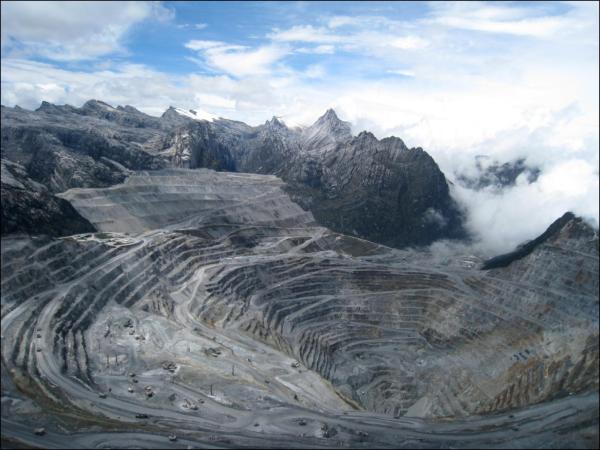
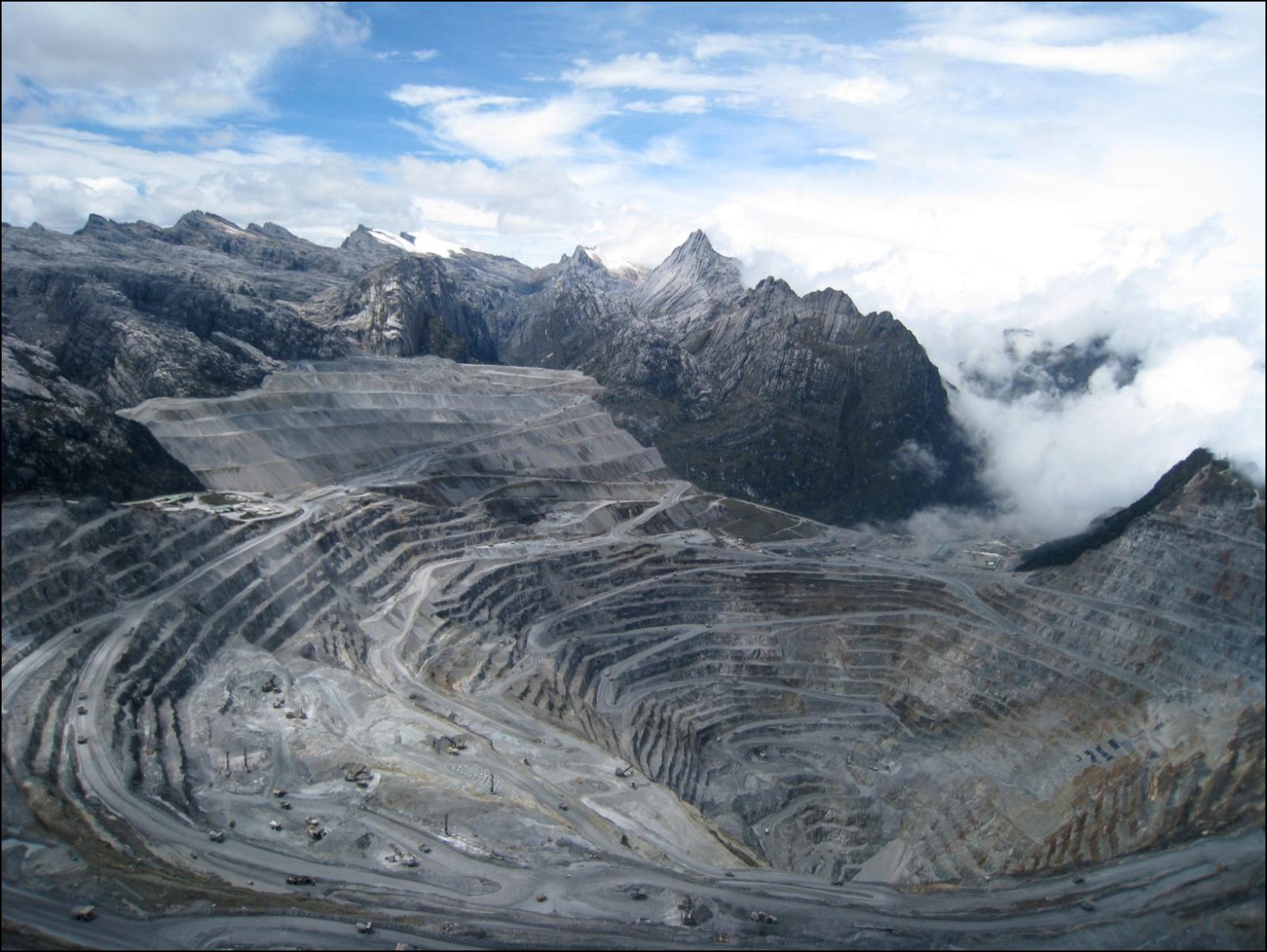
Freeport's Grasberg mine - Earth's biggest hole in the ground

The head  of the mining, energy and minerals department of the Mimika administration, said:

‘We don’t know anything about the quantity of gold, copper and other minerals produced daily by Freeport and this is because  we do not have free access to the company to be able to control the level of production every day.’

He said that the administration did once charge two of its employees to oversee export activity in Amamapare, but after we had given them the task, the two men were unfortunately shifted other posts.’  [Could this have been a deliberate action.]

This is a big problem. Anyone charged with scrutinising exports and imports  would have to be a specialist. They would need to have a special certificate for controlling goods and services for both exports and imports..

All this has an impact on obtaining clarification about the quantity of minerals produced every year. How can this possibly be synchronised with the information received by the authorities in Jakarta? It’s all just a game because the people at the centre get data about gold and copper production which comes directly from the company, PTFI.

The department of mines in Jakarta only gets information from one side. ‘This doesn’t lead to any accuracy. Anyone with bad intentions can easily manipulate the data.  Although lots of stuff is exported, they report a very low figure.’

So the question is: who else but the company can know anything about the quantity of material it produces every year? Only the PTFI.

[COMMENT: This once again highlights the extraordinary powers that the US company has been given to keep a tight control over how much it exploits of Papua’s abundant natural resources, with the  Papuan people not only left in the dark but also left living in poverty while Freeport makes a fortune from its investments in West Papua. TAPOL]

Magai: ‘Papuan officials are destroying Papua.’

JUBI, 19 June 2011The chairman of Commission A of DPRP. Ruben Magai has warned that the destruction of Papuan resources  is being intensified by the activities of a number of senior officials in the Land of Papua. Some of these officials are ‘playing games’, shielded by a variety of problems which continue to  play havoc with the lives of the  Papuan people. There is no question of these people taking sides with the  weakest people in society. All they are interested in is furthering their own interests.’

‘It is a public secret,’ he said, ‘that Jakarta is continuing to manipulate things, causing the continued destruction of  Papua. There is no space for democracy, the  policies being pursued  have nothing whatsoever to do with promoting the welfare of the Papuan people here.’

Ruben said that Papuan bureaucrats should be fighting to promote the interests of the people, but this is simply not happening. ‘Papuan officials are also contributing to the destruction of Papua,’ he said.

The general view here in Papua is that OTSUS, the special autonomy law, has failed  The government should be opening itself up, making an evaluation of the situation and providing space for these discussions. ‘But nothing of the kind is happening which means that the issue will continue to be raised in demonstrations, in seminars, in media reports and other forums.’

The Papuan people have for many years been raising their voices about the failed implementation of OTSUS, calling for OTSUS to be returned to Jakarta. At the very least, there should be some response. Last Thursday, dozens of people in the Coalition of People United  for Justice (KRPBK) expressed these views.

The Papuan people’s aspirations are regarded by the government as matters of no importance. The DPRP went to Jakarta to raise these issues but to no avail. ‘As representatives of the people, we feel extremely unhappy with this situation. All the efforts we have been making have led nowhere. On one occasion, we submitted  a concept to Commission A of the Indonesian parliament, the DPR,  which was accepted at the time, but there was no follow-up at all. This was a great disappointment,’ he said.

The Land of Papua continues to be turned upside down, with unpopular measures, with acts of violence, with human rights violations which are never resolved, with the abuse of freedom of expression, with the introduction of laws which are unacceptable, as a result of which the rights of civil society are never upheld.

‘This is the reality of the situation in Papua today,’ said Magai.

Kampung inhabitants need more medical personnel

JUBI, 22 February 2011

Kampung inhabitants need more medical personnel

People living in Mosso kampung, district of Muaratami have urged the
Health Service to increase the number of medical personnel available to kampung dwellers because it is very inadequate at present.

‘We need help from the medical service because we are getting complaints every day from patients about the lack of medical facilities,’ said Charle Wetapoa, an official.

He said that the lack of personnel had been a problem for years, with
the result that people living in the kampung are finding it difficult to
get the medical assistance they need. He said that there were only two people working at the clinic in the kampung

He said that they have called on the Health Service in Jayapura to
prioritise medical personnel for Mosso this year , which would help
improve the conditions of the people in the kampung, especially with
regard to their health.

The Mosso kampung is part of the administrative district of Jayapura
Municipality but is located at a great distance from other kampungs in
the same district, meaning that it is very difficult for the people to
get the service they need. There are altogether 45 people living in the
kampung.

[COMMENT: This is happening in a territory like Papua that is providing
revenues for the Indonesian state coffers from the hugely profitable
mining operations of Freeport copper-and-gold mine. TAPOL

Create a website or blog at WordPress.com

Up ↑