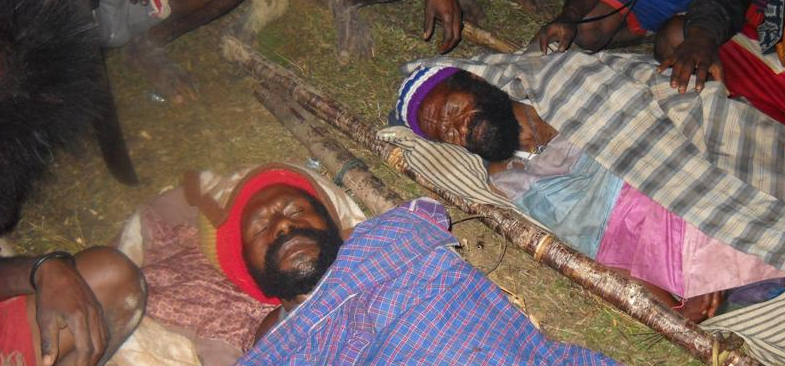
News Flash: 2 Papuan civilians shot dead in military raid on village in highlands

Two West Papuan civilians were shot dead during an independence day raid on their village by the Indonesian military.

The raid, at 1:30am this morning was on the village of Bolakme, Wamena. The same village was the target of burnings last year by the military.

The 2 civilians confirmed dead so far are Asli Wenda and Elius Tabuni. We understand some others have suffered life threatening injuries. All villagers from the surrounding areas have now fled to forests and remain in hiding.

More news on the situation as we get it.

9 people arrested for displaying West Papua flag face lengthy prison sentences

Article from AFP

Nine people have been arrested after displaying the West Papua flag in Indonesia’s remote Papua province.

Eight men and a woman unfurled the banned “Morning Star” flag on Saturday in a village in Jayawijaya district, local police chief I Gede Sumerta Jaya said.

“We arrested nine people and they’re being investigated. They had raised the Morning Star flag. We found the flag and a wooden pole,” he told AFP.

“They’re likely to be named suspects on charges of plotting against the state,” he added.

Anyone convicted of displaying separatist symbols faces possible life sentence in Indonesia, a sprawling archipelago with a history of secessionist rebellions.

Indonesia won sovereignty over Papua, a former Dutch colony on the western half of New Guinea island, in 1969 after a vote among a select group of Papuans widely seen as a sham.

Many Papuans accuse Indonesia’s military of violating human rights in the province and complain that the bulk of earnings from its rich natural resources flow to Jakarta.

Leaked files show that Kopassus, Indonesia’s Special Forces, targets Papuan Church leaders and Civilians

Jakarta, November 9, 2010.
Secret documents have leaked from inside Kopassus, Indonesia’s red berets, which say that Indonesia’s US-backed security forces engage in “murder [and] abduction” and show that Kopassus targets churches in West Papua and defines civilian dissidents as the “enemy.”

The documents include a Kopassus enemies list headed by Papua’s top Baptist minister and describe a covert network of surveillance, infiltration and disruption of Papuan institutions.

Kopassus is the most notorious unit of  Indonesia’s armed forces, TNI,  which along with POLRI, the  national police, have killed civilians by the hundreds of thousands.

The leaked cache of secret Kopassus documents includes operational,  intelligence and field reports as well as personnel records which list the names and details of Kopassus “agents.”
The documents are classified “SECRET” (“RAHASIA”) and include extensive background reports on  Kopassus  civilian targets  — reports that are apparently of uneven accuracy.

The authenticity of the documents has been verified by Kopassus personnel who have seen them and by external evidence regarding the authors and the internal characteristics of the documents.

Click on the links below to download reports (these are in PDF format)
The Kopassus “enemies” list — the “leaders” of the “separatist political movement” includes fifteen civic leaders.  In the order listed by Kopassus they are:
— Reverend Socrates Sofyan Yoman, chair of the Papua Baptist Synod
— Markus Haluk head of the Association of Indonesian Middle Mountains Students (AMPTI) and an outspoken critic of the security forces and the US mining giant Freeport McMoRan
— Buchtar Tabuni, an activist who, after appearing on the Kopassus list, was sentenced to three years prison for speech and for waving Papuan flags and was beaten bloody by three soldiers, a guard, and a policeman because he had a cell phone
— Aloysius Renwarin, a lawyer who heads a local human rights foundation
— Dr. Willy Mandowen, Mediator of PDP, the Papua Presidium Council, a broad group including local business people, former politcal prisoners, women’s and youth organizations, and Papuan traditional leaders.   His most prominent predecessor, Theys Eluay, had his throat slit by Kopassus in 2001.
— Yance Kayame, a committee chair in the Papuan provincial legislature
— Lodewyk Betawi
— Drs. Don Agustinus Lamaech Flassy of the Papua Presidium Council staff
— Drs. Agustinus Alue Alua, head of the MRP, the Papuan People’s Council, which formally represents Papuan traditional leaders and was convened and recognized by the Jakarta government
— Thaha Al Hamid, Secretary General of the Papua Presidium Council
— Sayid Fadal Al Hamid, head of the Papua Muslim Youth
— Drs. Frans Kapisa, head of Papua National Student Solidarity
— Leonard Jery Imbiri, public secretary of DAP, the Papuan Customary Council, which organizes an annual plenary of indigenous groups, has staged Papua’s largest peaceful demonstrations, and has seen its offices targeted for clandestine arson attacks
— Reverend Dr. Beny Giay, minister of the Protestant evangelical KINGMI Tent of Scripture church of Papua
— Selfius Bobby, student at the Fajar Timur School of Philosophy and Theology (LAPORAN TRIWULAN p. 6)

West Papua is Indonesia’s Palestine.

West Papua is Indonesia’s Palestine.

Opinion
August 16, 2010

John Ondawame is right. West Papua is on the verge of a “total intifada” (Ben Bohane, ‘West Papua warns of intifada against Jakarta’, Sydney Morning Herald, August 7 2010). Intifada means to “shake off” in Arabic. It has become a word used to describe the desire by Palestinians to free themselves from foreign occupation. The question is what kind of intifada is and will take place in West Papua? Will it be like the recent Palestinian intifada, led by a resurgent Hamas? An uprising of fury waged through political terror. Or will it be like the 1987 Palestinian intifada, a largely unarmed insurrection?

West Papua is the Indonesia’s Palestine. Papuans consider that their land has been occupied without their consent. Freedom of expression is prohibited, foreign journalists banned, migrants continue to pour into the country, and the police and military keep a repressive lid on boiling Papuan anger. It is also a modern day Avatar. Papuans are defending their land form the exploitative practices of resource extractive industries. For the Papuans theirs is a struggle for survival.

However, unlike Palestine and the film Avatar, resistance to the Indonesian government’s rule has overwhelmingly been through civilian based movements. Only last month, for instance, 20,000 plus people – students, women, young people, religious leaders, NGO activists, traditional chiefs, farmers and even members of the Majelis Rakyat Papua, West Papua’s indigenous senate – all converged on the capital and occupied the provincial parliament for two days to pressure the Papuan political elite to hand back Special Autonomy, a package or policy, finance, and legislation designed to give Papuans a measure of self-rule. After ten years of broken promises and still born hopes, Papuans concluded Special Autonomy had failed. It is a news story that should have been covered by every major media outlet. But here in Australia we heard next to nothing.

Now, as Bohane writes, Papuans are feeling abandoned by their Melanesian kin. At the recent Pacific Island Forum, Vanuatu tried to raise the West Papua issue but Papua New Guinea’s political leaders blocked the discussion. Again. The Australia and New Zealand governments also failed to raise their voice for on behalf of Papuan rights. Again.

Some Papuan leaders are now talking about making the territory ungovernable through mass civilian based non-cooperation with Jakarta. How long civil resistance continues depends not only on the tactical and strategic choices made by Papuan leaders. In part it also depends on whether solidarity movements in the region, including inside Indonesia, can raise the political and economic costs so that political leaders and foreign companies feel compelled to agree to what Papuans have been demanding for years: political dialogue with Jakarta and the international community about their grievances.

Will the international community support the Papuan’s right to rise up for freedom? Or will they send the same message they sent to the Kosovo Albanians? That international intervention and the goal of independence will only come about when there is armed struggle and mass violence. Surely we can all do better than that.

Jason MacLeod

(The writer lectures in political science at the University of Queensland.)

Create a website or blog at WordPress.com

Up ↑