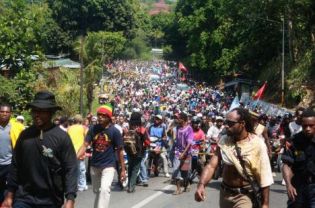
PARKOP LETTER TO PNG PM SOMARE: HALT TO POLICE OPERATION IN SANDAUN PROVINVCE.

Below is the full letter from PNG NCDC Governor Powes Parkop calling for Somare to immediately halt Operation Sunset Merona.  For bode fide media interview opportunities, and the copy of the original letter please contact West Papua Media at wpmedia_admin<at>riseup.net .

NATIONAL CAPITAL DISTRICT COMMISSION

Office of the Governor

Hon. Powes Parkop, MP

P.O. Box 7270, Boroko. NCD

CITY OF PORT MORESBY


Date        28th January 2011

Grand Chief Sir Michael T Somare GCL, GCMG, CF, CL, CH, KstJ

Prime Minister and Chairman of NEC,

Office of the Prime Minister,

Morauta House,

WAIGANI

National Capital District


Dear Prime Minister,


SUBJECT:    HALT TO POLICE OPERATION IN SANDAUN PROVINVCE.


I write to express my deepest concern and reservation against the on going Police Operation in the Sanduan or West Sepik Province otherwise known as Operation “Sunset Merona” .

Since the operation began, I have received many complaints from people in the Sanduan Province as to the conduct and focus of the operations. These Complaints have been received from ordinarily citizens in that Province but more particularly from West Papuan people who live in that Province either as refugees or traditional border crossers exercising their rights under the Border Agreement between the Independent State of Papua New Guinea and the Republic of Indonesia.


From the West Papuan people, I have received complaints of intimidations, harassment, houses being demolished and burnt, food gardens being destroyed and people being detained without being charged for a criminal or migration offence. Those arrested have included West Papuans who have comes to PNG as refuges and who have to fend for themselves due to lack of support from either the PNG Government or from the Office of the United Nation High Commissioner for Refugees.


From the evidence and reports I have received and the from the conduct of the operation it has become obvious that this operation is targeted against West Papuan people either as refugees or suspect activist of the West Papuan struggle for independence. In this respect, while I acknowledged that as an Independent State, we are obliged to prevent our borders from being using as a sanctuary for people planning and conducting violent acts against another State, we also risked allowing ourselves to become involved in a dispute that we formally recognized as being the domestic affairs of the Republic of Indonesia. Worst still we will allow ourselves to be used by the Republic of Indonesia to suppress and intimidate West Papuan people from pursuing their legitimate struggle for independence.


Based on these reports and evidence, I appeal to your highest Office to immediately stop the operations as it is becoming obvious that our Government and therefore police are being used by the  Indonesian Government to harass and suppress suspected West Papua activist campaigning for Independence of West Papua. This is morally and legally wrong.


While the Government may not support the struggle of West Papuans people to self determination and independence, we have no right to suppress them or deprive them from exercising that right. The right to self determination is universally recognized rights recognized under the Universal Declaration of Human Rights and under many United Nations Conventions. This right to self determination includes the right to bear arms and used armed struggle as a means to attain self determination. Many colonized people have used arms struggle as a means of exercising or realizing their rights to self determination where the colonial powers have denied them an opportunity to exercise that right peacefully. West Papuan people as a colonized people, deprived of peacefully exercising their right to self determination have the right to bear arms and used all other means to enable them to realize their rights to self determination.


There is no evidence to date to show that the West Papuan people are using our territory to conduct armed attack against the Republic of Indonesia.  The evidence to date shows that all armed attack conducted by West Papuan people has been conducted within the territory of the Republic of Indonesia. If its is an offence to peacefully advocate and support the rights of the people of West Papua to self determination and Independence, than I should be arrested too as I have been a long time advocate of West Papuan rights to self determination and independence. And there are thousands of Papua New Guineans who also support and advocate for the rights of West Papuans to self determination and independence.


I therefore urge you as Prime Minister and a person revered as a leader of Melanesian People and Pacific People to stop our police and security forces from being used as a tool of suppression at the behest of the Indonesian Government. I urge you to recommend to the Commission for Police to put an end to this operation and to release all West Papuan people who have been detained and to compensate those who have their houses and food gardens destroyed.


Further, Prime Minister, I urge you not to deport any West Papuan suspected of being involved in the independence struggle to the Republic of Indonesia. I draw in this respect the recent conviction of three members of the members of the Indonesian Military as a result of torturing of West Papuans. While there three men were convicted for a minor offence, the incident for which they charge was fully exposed in a video posted on the internet which was seen by the entirely international community. This incident confirms that while Indonesia is moving towards democratization, its armed forces are still involved in vicious acts of violence and torture against so called separatist. There is  no guarantee that any one deported to the Republic of Indonesia will safe or not subjected to torture or other forms of violence.


Due to public interest in this matter, I will be releasing copy of my letter to the public, including the media.


I look forward to you earliest reply.


Yours Sincerely


HON. POWES PARKOP LLB LLM MP

Governor and Member for NCD Provincial.


Buchtar Tabuni complains to police chief about his treatment

LETTER OF COMPLAINT FROM BUCHTAR TABUNI TO THE CHIEF OF POLICE IN PAPUA

Police Isolation Cell, 18 January, 2011

To:
Police-General Bekto Suprapto,

With respect,

With regard to my detention in a police isolation cell for almost two
months, I wish to raise the following problems with the Chief of Police
in Papua:

1. Will the police in Papua explain what my status is, whether I am a
detainee (tapol) or a convicted political prisoner (narapidana). If I am
being held as a detainee in connection with the riot that occurred in
Abepura Prison on 3 December 2010, I ask to be given an arrest warrant
by the police for the period that I have been held in a police isolation
cell . And whether what I myself did together with Filep Karma at the
time of the riot was not in fact an attempt to calm things down while
trying to be a link between the prison officers and the prisoners who
were involved in the riot. If my status is that of a narapidana, I
hereby ask to be transferred to Abepura Prison Class IIA. This is
because being held in an isolation cell by the police in Papua has had
the following very damaging consequences for me:

a) My father, Jen Tabuni, who was 54 years old, passed away on
Sunday, 9 January 2011 in Papani Kampung, in the Papuan interior. The
cause of death was that, after hearing that I had been taken from a
police cell and thinking that I had been kidnapped, he suffered a
stroke, fainted and died. This was because there was no information
about my whereabouts after I had been separated and placed in an
isolation cell by the Papuan police, without any clear reason being
given for this;

b) Ever since being separated and held in an isolation cell of the
Papuan Police, I have not received any edible food and on some
occasions, I have not been given any food and drink at all, as a result
of which I have been drinking the water in the tub in the bathroom. The
lack of decent food and drink has given me serious gastric problems;

c) My body is turning yellow and I often feel giddy when I stand up.
This is because of the lack of sunlight, the lack of vegetables and
because the vegetables I do eat are boiled as a result of which I am
anaemic as well as suffering from gastritis which means that my health
is deteriorating.

2. If the police here in Papua fail to respond speedily to my
complaints, I will go on hunger strike until my complaints are dealt with.

Letter of complaint from:

Buchtar Tabuni

Papuan political prisoner

Buchtar Tabuni

AFP: Papuans Rally for Independence from Indonesia

Thousands of Papuans march in a rally in Jayapura on July 8, 2010 to urge the provincial parliament to demand a referendum on self-determination, and reject the region's special autonomy within Indonesia. (AFP Photo/Banjir Ambarita)

Hundreds of Papuans have protested in Jayapura rejecting the region’s special autonomy within Indonesia and demanding a referendum on self-determination.

Carrying a wooden coffin covered with a black cloth which said “Special Autonomy is Dead in Papua,” more than 1000 activists, students and church leaders protested on Wednesday in front of the provincial parliament, witnesses said.

“Independence for Papua, reject special autonomy,” they shouted.

“Indonesia the coloniser, Indonesia the oppressor, Indonesia the robber.”

They also called for the upper house of tribal leaders called the Papua People’s Assembly (MRP) to be disbanded.

“The MRP had done nothing to improve the welfare of Papuans. Our people are poor in their own land,” protest coordinator Selpius Bobi said.

“We reject special autonomy as that is the Indonesian government’s policy which has never supported the natives. We want a referendum that will allow us to determine our own fate,” he added.

Papua’s special autonomy status, introduced in 2001 after the fall of former president Suharto’s military dictatorship, has seen powers including control of most tax revenue from natural resources devolved to the provincial government.

However many Papuans say it has failed to improve their rights and activists accuse the Indonesian military of acting with brutal impunity against the indigenous Melanesian majority in the far-eastern region.

A court martial jailed three Indonesian soldiers on Monday for up to 10 months for abuse and insubordination after graphic video footage showed them torturing civilians in Papua.

The sentences were criticised by the United States and rights campaigners as too lenient.

Foreign media and aid workers are not allowed into Papua and West Papua provinces to investigate allegations of human rights abuses against the indigenous people.

Papua has been the scene of a low-level insurgency for decades and despite Indonesia’s vast security presence in the region, Jakarta remains extremely sensitive about any sign of separatism.

Indonesia has sent mixed messages about its willingness to loosen its grip on Papua, offering talks with separatist rebels on the one hand while jailing and killing their leaders on the other.
© 2011 AFP

AFP: U.S. Slams Indonesia Sentences in Papua Torture Trial

WASHINGTON, Jan. 26 (AFP) — The United States on Tuesday
slammed as too lenient an Indonesian court martial for jailing three
soldiers for up to 10 months for abuse and insubordination after
they were shown torturing civilians.

The sentences “do not reflect the seriousness of the abuses of
two Papuan men depicted in 2010 video,” State Department
spokesman Philip Crowley said on the microblogging website
Twitter.

“Indonesia must hold its armed forces accountable for violations
of human rights. We are concerned and will continue to follow
this case,” Crowley added.

The relatively light sentences prompted anger among campaigners,
who accuse the Indonesian military of acting with impunity
against the indigenous Melanesian majority in the far-eastern
province of Papua.

The military tribunal found the trio guilty of abuse and
disobeying orders, and sentenced Second Sergeant Irwan
Rizkiyanto to 10 months in jail, First Private Yakson Agu to
nine months, and First Private Tamrin Mahan Giri to eight months.

In footage posted on YouTube last year, the soldiers were seen
applying a burning stick to the genitals of an unarmed man and
threatening another with a knife as they interrogated them about
the location of a weapons cache.

HRW: Indonesia: Hold Abusers From Military Accountable

Human Rights Watch logo
Image via Wikipedia

Human Rights Watch (New York)

January 25, 2011

For Immediate Release

Indonesia: Hold Abusers From Military Accountable

More Than 100 Political Prisoners Held for Protesting Peacefully

(New York, January 25, 2011) – The Indonesian government should ensure
that soldiers responsible for abuses are appropriately prosecuted and
punished, Human Rights Watch said today in its World Report 2011. The
January 24, 2011 verdict in a Papua military tribunal of eight to ten
months imprisonment for soldiers who engaged in torture was woefully
inadequate, Human Rights Watch said.

The 649-page report, Human Rights Watch’s 21st annual review of human
rights practices around the globe, summarizes major human rights
trends in more than 90 countries and territories worldwide. Over the
past 12 years, Indonesia, the report says, has made great strides in
becoming a stable, democratic country with a strong civil society and
independent media, but serious human rights concerns remain.

“Senior officials must both talk the talk and walk the walk on human
rights,” said Elaine Pearson, deputy Asia director at Human Rights
Watch. “The military should stop shielding its officers from
prosecution, and the government needs to hold abusers accountable.”

In July 2010, the US government lifted its ban on military assistance
to Kopassus, Indonesia’s elite special forces, despite continuing
concerns about its human rights record. Strong evidence of security
force involvement in torture emerged in 2010. Defense Minister Purnomo
Yusgiantoro pledged to suspend soldiers credibly accused of serious
human rights abuses, to discharge those convicted of abuse, and to
cooperate with their prosecution. But only a handful of cases made it
to military tribunals, and the charges did not reflect the gravity of
the abuses committed.

In October, a 10-minute cell phone video came to light that showed
Indonesian soldiers interrogating and brutally torturing two Papuan
men, Tunaliwor Kiwo and Telangga Gire. In the video, Kiwo screams as a
piece of burning wood is repeatedly jabbed at his genitals. After
pressure from foreign governments, the military finally held a
tribunal in Jayapura, Papua, in January. But it is only tried three of
six soldiers in the video – Second Sgt. Irwan Rizkiyanto, First Pvt.
Jackson Agu, and First Pvt. Thamrin Mahamiri of the Army’s Strategic
and Reserve Command (Kostrad) 753rd battalion – on military
discipline charges, rather than for torture. The three were sentenced
to ten months, nine months, and eight months respectively. Military
prosecutors only sought sentences of up to 12 months rather than the
maximum 30 months as allowed under the military criminal code.

Another torture case captured on video in 2010 involved several
soldiers kicking and beating villagers in Papua. Four soldiers from
the same Kostrad 753rd battalion were tried on military disciplinary
grounds and were sentenced only to five to seven months in prison. The
convictions are on appeal before the Surabaya high military tribunal.

These two cases were unusual in that the ill-treatment was captured on
video, but for years Human Rights Watch has documented serious human
rights violations in Papua for which soldiers have never been held to
account. Human Rights Watch called on the US to publicly clarify its
relationship with the Kostrad 753rd battalion and the individuals
involved in this incident, in order to ensure compliance with the
Leahy law.

“Rather than cooperating with civilian authorities and suspending the
soldiers involved as soon as the video appeared, the Indonesian
government has dragged its feet and reluctantly done the bare minimum
to try and make this go away,” said Pearson. “This is not the new and
improved army that the defense minister promised, but the same old
military impunity we’ve seen for decades in Indonesia.”

The government did little to curb attacks and discrimination against
religious, sexual, and ethnic minorities during 2010. On several
occasions, militant Islamic groups mobilized large groups of private
citizens and attacked places of worship of religious minorities.
Police frequently failed to arrest the perpetrators of the violence.

While Indonesia has vibrant media, throughout 2010 Indonesian
authorities invoked harsh laws to prosecute individuals who raised
controversial issues, chilling peaceful expression. Indonesia’s
criminal libel, slander, and “insult” laws prohibit deliberately
“insulting” a public official and intentionally publicizing statements
that harm another person’s reputation, even if those statements are
true. For instance, in early 2010, Tukijo, a farmer from Yogyakarta,
was sentenced to six months’ probation and a three-month suspended
prison sentence for criminal defamation after he argued with a local
official regarding a land assessment.

The government has imprisoned more than 100 activists from the
Moluccas and Papua for rebellion for peacefully voicing political
views, holding demonstrations, and raising separatist flags. In
August, the authorities arrested 21 Southern Moluccas activists in
Ambon and Saparua and charged them with treason for planning to fly
balloons and Southern Moluccas Republic flags during a visit by
President Susilo Bambang Yudhoyono.

The country’s political prisoners include Filep Karma, 51, a Papuan
civil servant imprisoned for organizing a Papuan independence rally on
December 1, 2004, and Buchtar Tabuni, 31, a leader of the West Papua
National Committee, a Papuan independence organization that has grown
more radical since his imprisonment.

Government restrictions on access to Papua by foreign human rights
monitors and journalists imposed when Indonesia took over Papua in
1969 remained in place in 2010.

“By keeping the foreign media and rights organizations out of Papua,
the Indonesian government is all but admitting that serious abuses
persist,” Pearson said. “Ending those restrictions would be a first
step in reversing Papua’s downward spiral.”

To read Human Rights Watch’s World Report 2011 chapter on Indonesia,
please visit:
http://www.hrw.org/en/world-report-2011/indonesia

To read the Human Rights Watch World Report 2011, please visit:
http://www.hrw.org/en/world-report-2011

For more information, please contact:
In Perth, Elaine Pearson (English): +61-415-489-428 (mobile)
In Washington, DC, Sophie Richardson (English, Mandarin):
+1-917-721-7473 (mobile)
In Jakarta, Andreas Harsono (English, Bahasa Indonesia):
+62-815-950-9000 (mobile)

Create a website or blog at WordPress.com

Up ↑