There is much that is strange in the process of the trial over the killing of Pastor Fredrika Metalmeti (38) on November 21st 2012 in Boven Digoel, Papua. The conduct of Military Tribunal III-19 Jayapura gives the impression of protecting the shooter. What is this process? Read below.
On November 21st 2012, a dark history began for the big Metalmeti and Imogoti families in Boven Digoel province and Merauke province, Papua, Pastor Frederika Metalmeti (38), first child of George Metalmeti (68) and Ida Imogoti, was found horribly killed on the Trans Asiki road, Boven Digoel, Papua.
Unscrupulous members of the military, Defendant Sergeant Irfan (right) is wearing a hat (Photo: Oktovianus Pogau / SP)
Initially, at around 6:00am, the Head of Komba District, Manyu Waremba (46) together with his wife and child came to the scene of the crime, and found the victim’s body lying in bushes, near the Trans Asiki Road.
“My house is about 200 metres from the scene, early in the morning around 3:30am I heard someone calling for help accompanied by the sound of gunfire. Because I was scared, I intended to investigate in the morning together with my family” said Waremba, in Military Tribunal testimony Dock 5, Jayapura, 11th February 2013.
Waremba immediately reported his discovery of the corpse to three police officers on guard at the police post not far from the location of the body. The three police officers together with local residents eventually came to the scene. Indeed, the body of the woman lay bloody, motionless and stiff.
“After this I called the police station and together with local people we went to the scene, and we found the victim sprawled in bushes with much blood on her body” said Manggaprouw, member of Boven Digoel Police, in their testimony at the Military Tribunal, Jayapura.
Then, the Boven Digoel Police Chief immediately arrived at the scene, accompanied dozens of his men. When attending the crime scene, police found three pieces of ammunition, type FN 45, that were still active.
A pink helmet, belonging to the victim, was also found, as were jeans (denim) shorts. The victim’s shirt was opened to cover her face, which was a men’s shirt reading ‘Kwarcab Digoel District Scouts’.
At approximately 8:00am, police took the body to the Regional General Hospital for autopsy.
Before this, several nuns were asked to bath the victim who later became known to be Frederika Metalmeti, Pastor of the Bethel Church of Indonesia (GBI), Boven Digoel.
The nuns who bathed the corpse claimed to find three gunshot wounds on the victim’s body. The first of these shots on the side right of the head, the second on the left of the chest, and the third on the victim’s right arm.
According to the nuns, the face and back of the victim’s head had been shattered by a blow from a blunt object. Allegedly, the accused wanted to erase the remains of the gunshot wound on the victim’s head.
To determine the perpetrators of the shooting, the police summoned parties believed to have been close to the victim for questioning. There were seven witnesses from the Metalmeti family that were interrogated by Boven Digoel police.
One witness that was summoned was the victim’s younger sister, Helen Metalmeti (30). In testimony to the investigator, Helen told of all she know of the victim whilst she lived, including whom the victim was close to.
“Mr Lieutenant Colonal Eko Supriyanto, former commander of 1711/Boven Digoel, who now serves as the Head of Korem 174/ATW Merauke, was the person most close to the victim. We know that my sister was dating him, and Mr Eko had come to our home to announce it,” said Helen, when meeting with suarapapua.com recently in Jayapura, Papua.
According to Helen, the relationship between the former Commander of 1711/Boven Digoel and the victim could be said to be very close, as there was an intention to hold a wedding in Malang, East Java, the home region of the former commander.
Whilst the Boven Digoel police were investigating the case which scandalised the residents of Boven Digoel, the Indonesian Military (TNI) in District Military Command 1171/Boven Digoel also conducted an investigation into several of their men.
In Boven Digoel district, no entity, including the Police and the Special Forces Task Force, has arms of type FN 45, except for members of the TNI Intelligence Unit, District Military Command 1711/Boven Digoel.
“After the Boven Digoel Police Chief Commander called the Dandim (Regional Military Commander), I together with several members also visited the scene to see the victim’s body, but because it had already been closed off by police, we could not enter,” said Captain Riki Pelani of District Military Command 1171/Boven Digoel Intelligence unit, when giving a testimony to the Military Tribunal on 19th February 2013.
According to Captain Riki, after knowing of the discovery of ammunition type FN 45, all men of the District Military Command 1171/Boven Digoel Intelligence Unit, totalling 12 people, were gathered to investigate each weapon.
Because, he says, if one has just recently been used to shoot with, then when smelt there will be the smell of smoke at the end of the weapon.
“I ordered First Sergeant (Sgt) Sumarlianto to gather all of our men’s guns, and after this I, together with (the) Dandim, investigated all of their guns in the room. Only the gun of Sgt Irfan was very clean and shiny because it had been cleaned with oil,” said Captain Riki.
According to Captain Riki, since then both himself and Dandim suspected Sgt Irfan as the culprit, as it also became known that Sgt Irfan was close with the victim for the past few months.
“We also received news that indeed Irfan was close with the victim. Dandim ordered us to hold Irfan, and First Sgt Marlianto and I were ordered to investigate Sgt Irfan,” asserted Captain Riki.
Then on November 22nd 2012, at 8:00am after morning assembly, Sgt Irfan was detained in the intelligence room and examined until 6:00pm that afternoon.
“Sgt Irfan did not confess during the questioning. At a meeting with Dandim at 7:00pm that evening, we received a report that Sgt Irfan had escaped.” said Captain Riki.
The escape strengthened the Dandim’s and his suspicions that the person who shot Frederika was Sgt Irfan, so he spread his men to several places to arrest Sgt Irfan.
During two days of searching, the members did not find Sgt Irfan. On the third day, 25th November 2012, he received news that the culprit was hiding in transit, in the Sudirman family home.
“Together with Dandim, several men and I immediately headed to the hiding place of the accused, and we immediately arrested him, and then took him to Korem 174/ATW Meruake for further investigation,” said Captain Riki.
Later, on his way to Korem 174/AWT Merauke. Sgtt Irfan confessed to the shooting of Pastor Frederika Metalmeti, on 21st November 2012.
How is the investigation of the accused progressing with the Police/Military in Merauke? Are the families being informed of the latest of the case investigation? Why did Sgt Irfan recklessly kill Pastor Frederika so sadistically?
Part 2 of this investigation will soon be presented.
Oktavianus Pogau is an independent Papuan journalist and founder of indigenous media outlet SuaraPapua.com.
27 February 2013Jayapura: Following the arrest earlier this week of two members of the OPM (Organisasi Papua Merdeka), a spokesperson for the police has stated that the two men, identified by the initials, AG and PG who were arrested in Kampung Ayaigo, sub-district of Kebo, District of Paniai will face charges in court.
The police officer stated that the men were in possession of explosive materials and ammunition in violation of Emergency Law 12/1951 which allows a sentence, if convicted, of twenty years or life imprisonment.
The spokesperson, I Gede Sumerta Jaya, head of public relations of the Paniai chief of police, also said that the police were engaged in operations to find other persons on the ‘wanted list’ (DPO) for a series of actions such as shootings and other acts of violence that have been occurring in the area. These other persons were identified by the initials JY, SY and DY.
The men are alleged to have been involved in shootings in Paniai,including the shooting of an ojek driver and holding nine employees of a contractor company as hostages who were building a school in Kampung Ukawo, District of Siriwo, Paniai. The men were also alleged to have assaulted women and demanded material goods from local people a short while ago.
”We do not know what the motives for the shootings and violence are because we are still interrogating the men,’ the spokesperson said.
Asked about the security situation following the arrest of the two OPM members, the spokesperson described it as ‘conducive’, following an armed skirmish between the TNI/Polri and the OPM.
The two men are currently undergoing intensive questioning at police command headquarters in Paniai. The two men were caught during sweeping operations by the TNI/Polri after having engaged in an act of terror against the command post of the Paniai Police.
They were said to have in their possession one unit of HT (?), one bullet calibre 7.56 , a hand-phone, personal identifications tabs and Morning Star flags.
Major Reprisals begin with house to house searches, village and church burnings in Tingginambut by Indonesian Security Forces after TPN shoot dead 8 Indonesian special forces soldiers.
from the West Papua Media investigative team*
February 28, 2013
EXCLUSIVE: Special Investigative Report
Local communities around Sinak, Gurage, Mulia and Tingginambut in Puncak Jaya regency have felt the first effects of Indonesian military reprisals, after West Papuan independence guerrillas under General Goliat Tabuni confirmed that they had killed eight Indonesian special forces soldiers and four non-Papuan civilians on February 21 in two separate incidents.
The shootings were carried out after Kopassus officers continued to build military posts on a local sacred burial site, despite being requested not to by both community representatives and emissaries from the West Papua National Liberation Army (Tentara Pembebasan Nasional Papua Barat – TPN-PB) under Tabuni. TPN spokespeople have said that the shootings were done “to assert West Papuan sovereignty against Indonesian colonial occupation”, and to assert West Papuan cultural rights to defend their customary practices against ongoing military brutality.
A spokesman for the Goliat Tabuni’s TPN-OPM command, Nikolas Tabuni, told West Papua Media in a statement that the killings were not without cause.
“Prior to the incident TNI had wanted to make a military post in the region of Tingginambut and the TPN OPM had sent a letter to the TNI asking them not to’ go ahead with the military post construction at Tingginambut. As that is an area of which the land is formally claimed to be owned by the TPN OPM, and as it is also a sacred area under indigenous customary law of the indigenous community of that area. However TNI disregarded the request (in principle) and continued with the construction. As a result TPN OPM carried out the shooting on 21 February,” the statement read.
Nikolas Tabuni also denied statements from the Indonesian President and Police that the shootings were connected with Indonesian election campaigns in Papua. “This shooting had absolutely nothing to do with the election of the Bupati (Regency leader) for the region of Ilaga in the Regency of Puncak Jaya in the Province of Papua, and had nothing to do with the general election of the Provincial Governor. The shooting was purely concerned with Papuan independence and the activities of the TNI in West Papua.”
Evidence of collective punishment emerges
Despite an effective information blockade imposed by thousands of Indonesian army (TNI) troops and Police, and unchallenged by a compliant Jakarta-based colonial media, detailed reports are beginning to filter through from independent sources in the area of the military offensive, painting a vastly different picture to that reported by Indonesian and international media since the shooting of the Kopassus soldiers.
At least 1000 members of various Indonesian security forces are currently occupying and laying siege to entire communities around Puncak Jaya, with thousands more troops being sent in from other centres in Papua, according to local church, human rights, and sources in contact with West Papua Media stringers across the conflict area.
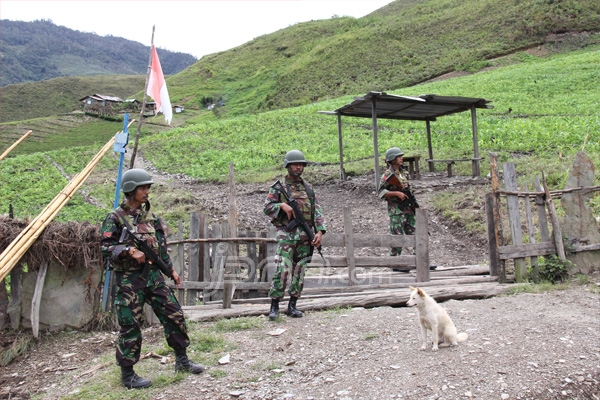
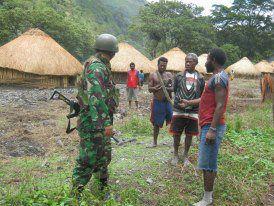
TNI 753 Btn interrogating locals in Sinak (photo: Malanesia.com)
According to these sources, the villages of Tingginambut, Trugi and Nelekom have been occupied by TNI forces since Sunday February 24, with villagers being forced to give all their food and houses to soldiers, and being subject to arbitrary and harsh interrogations. TPN sources have also stated that troops are using the villages as strategic hamlets to prepare for a hunt and destroy mission to flush out the forces of Tabuni, who have claimed they are well prepared for guerrilla defence.
In Nambut and Gurake (Gurage) villages in Sinak District, security forces began to carry out house to house sweeping operations on February 26, and in villages in Tingginambut, Puncak Jaya. According to our sources, the TNI Commander in the area has commanded “that the sweeping operation is to be continued until the culprits from last Thursdays killings are arrested”. The TNI have stated to local people they “need to see 11 persons sentenced,” according to the reliable source.
Two civilians were said to be arrested on February 27, according to Indonesian military reports, however independent sources could not confirm if any other civilians have been arrested.
As of February 26, at least 18 houses have been burned to the ground, 5 GIDI churches razed, 2 schools and a library have been destroyed by the combined Police/TNI forces in Tingginambut, according to reliable church sources who have safely relayed data from witnesses to West Papua Media stringers. Witnesses have also reported that soldiers are deliberately burning and destroying food gardens and shooting livestock, including over one hundred pigs. There are fears of a major humanitarian disaster unfolding with the reports of the destruction of food gardens and livestock, an act of collective punishment on a civilian population.
Thousands of people from the surrounding villages have fled to the high mountains and according to church sources, the entire community populations have fled throughout the area of Gurake, Sinak, Tinggi Neri, Trugi and Nelekom. Exact numbers are not currently known but local sources indicate that several thousand people, mainly subsistence farmers, live in the area.
Human rights workers have also reported from Mulia in Puncak Jaya that townspeople are greeting news of the offensive with panic and preparing to flee.
Reports are difficult to verify as the only media personnel allowed into the operations area are those with approval from the Indonesian army, and very few of these journalist have actually ventured into the area. Stringers for West Papua Media in Puncak Jaya and the Baliem Valley have reported that independent journalists and human rights workers have been prevented from travelling into the area by a de facto Military Operations Area being applied across the entire highlands, including the regional centre of Wamena.
Civilians are staying off the streets as reliable local sources report a massive combat army and police show of force, including house to house searches. On the morning of February 28, witnesses have reported to West Papua Media stringers that 8 Brimob trucks have left
Troops patrolling Wamena – February 25 (photo: supplied)
Wamena heading to Puncak Jaya this morning, with large numbers of troops patrolling the streets across Wamena also..
Thousands more troops flooding in to attempt to destroy Tabuni’s TPN.
Thousands of heavily armed combat soldiers from Battalions 751 (Jayapura), 753 (Nabire) , and supported by the Wamena 756 Batallion, are reportedly being flown into Tingginambut over the next few days from several centres across Papua. They are joining together with over 1000 extra Brimob paramilitary police (in addition to the at least 1000 Polda Papua police already in the highlands), and allegedly several units of the notorious Australian-funded Detachment 88 anti-terror commando, to hunt for Tabuni’s forces. Several media reports in Indonesia are also claiming a Kostrad (Strategic Reserve) battalion is being deployed from outside Papua, though this has not been independently confirmed.
Local sources have reported that each TNI platoon is accompanied by a platoon of police, as the operation is officially under control of the Police as a “law enforcement” operation. However, the witnesses have reported that the TNI are clearly in command. TNI spokespeople in Jakarta have told Indonesian media outlets that there is no plan to increase non-organic troop presence in the area, but local sources are reporting a vastly different story.
West Papua Media sources in Wamena observing the airport have confirmed that two TNI Puma Helicopters are involved in the operation constantly ferrying troops between Wamena and Tingginambut, and stopping only for refuelling and crew changes. Three Hercules c130H aircraft have each made 3 drops to Wamena then the troops have entered by road from Wamena. Observers in Nabire have also noted daily departures of three trucks of troops from the notorious Battalion 753 Nabire, to the west of the highlands to reinforce the offensive in Tingginambut.
Human rights and church sources in Puncak Jaya and internationally have expressed deep concern about the potential for heavy civilian casualties to occur with the intensified military campaign, given extra impetus after the Indonesian President, General Susilo Bambang Yudoyhono, called for firm action on Tabuni.
Multiple narratives from Jakarta
The exact circumstances of the deaths of the eight Kopassus special forces soldiers are now mired in claim and counter-claim, with soldiers’ personal accounts of the attack conflicting with the official narrative picked up by Jakarta media. What is confirmed is that the eight commandos – Sertu (Chief Sergeant) Udine, Sertu Frans, Sertu Romadhon, Pratu (Private 1st class) Mustofa, Sertu Edy, Praka (Chief Private) Jojon, Praka Wempi and Sertu Mudin – were killed by a cascading attack led by guerrillas of Goliat Tabuni’s TPN group as they went to the Sinak airstrip to collect cellular monitoring equipment designed to track international phone communications in the area.
However, one survivor of the attack testified in the Jakarta Post that his group was attacked by men, women and children all carrying spears, machetes and knives. According to the TNI survivors as relayed to JP, the platoon of Kopassus was unarmed at the time of the attack, which happened as the soldiers were installing and moving communications monitoring equipment.
Troops in Tingginambut after being shot at in helicopter by TPN, Feb 21 (Photo: TNI)
TPN forces also opened fire on a Puma helicopter that was evacuating the wounded commandos, lightly injuring three helicopter crew.
West Papua Media sources have provided a highly credible and technical but unconfirmed report that two “very large weapons” that were being moved into Sinak, and went missing during the raid by TPN. According to our sources, there is “extreme concern from the TNI around this particular issue.”
“Apparently they have been trying to find out the whereabouts of these weapons, which suggests they might be too heavy to quickly and easily move,” explained the source. Further investigation is still required, but credible observers in the area believe that these heavy weapons may be artillery pieces – the presence of which in Puncak Jaya represents a serious and dangerous escalation of TNI hardware to be used against civilians. West Papua Media believes any confirmed presence of artillery is connected with the TNI’s stated aim to destroy Goliat Tabuni’s group, but any use of these weapons will place a large number of civilians at risk. It is not the first time the TNI have used artillery against West Papuan civilians: the Bloody Wamena massacres of 2000 and 2003, as well as the aerial bombardment campaigns in the 1977 and 1984.
Indonesian outrage fuels civil society questions on Papuan motivations for resistance
The killings of the soldiers have generated outrage in Jakarta, with nationalist politicians calling for cordon and destroy missions in what human rights observers have said amount to collective civilian punishment by an occupying force.
Sjafrie Sjamsoeddin – indicted as a war criminal
Indonesian Deputy Defence Minister Lieutenant-General (LG) (Rtd) Sjafrie Sjamsoeddin – indicted as a war criminal by the UN for his role in East Timor – on Friday ordered the TNI to conduct heavy “tactical actions” in order to prevent the shooting from occurring again. “The tactical action includes to chase, apprehend and destroy,” the deputy minister said here on Friday. He said the latest shootings by the separatist rebels did not affect TNI`s strategic policies in Papua. TNI so far did not have a plan to send more troops to Papua, he added.
However SBY also claimed in an interview with MetroTV that “no violence” would be used to solve the situation. The situation on the ground has illustrated that security forces have no interest in making SBY’s words truthful.
Despite the nationalist rhetoric, there are many in Indonesia who are seeing this as a wake up call to end Jakarta’s use of state violence against civilians in Papua as it default policy.
The Indonesian Regional Representatives Council, or DPD, called for a necessary cessation of military operations to end the prolonged violence in Indonesia’s easternmost provinces, according to a report in the Jakarta Post on Wednesday.
The presence of the non-organic personnel from TNI special forces cause animosity among Papuan groups, who have launched attacks against them, according to the report. “If Jakarta wants to end violence, the militaristic approach has to stop, and all non-garrison troops from the military elite forces must be withdrawn from the two provinces because their presence and their irregular operations have triggered attacks on garrison troops and innocent civilians,” DPD deputy chairman Laode Ida said on Tuesday.
A coalition of Papuan human rights groups urged the National Commission on Human Rights (Komnas HAM) to conduct a thorough investigation into the soldiers’ killings, saying the presence of Komnas HAM could prevent human rights violations that occurred during TNI sweep operations after shooting incidents, according to a report in the Jakarta Globe.
“We encourage law enforcers to be professional in carrying out their tasks. They must ensure that their attempts to find the perpetrators do not turn into seeking revenge against all Papuans,” Ferry Marisan from the Institute for Policy Research and Advocacy (Elsam) said in Jayapura on Monday.
“One has to remember that soldiers who were shot were Kopassus special forces who have been involved in ongoing human rights abuses right across Puncak Jaya, including village burnings, collective arrests and punishment, burning of villages, and acts of torture. Many observers suspect these soldiers were part of units involved in conducting many OTK (Unknown persons) shootings blamed on West Papuans,” a long time human rights worker in the highlands told West Papua Media by email. “These are not innocence, nor babes in the woods; Kopassus are the original wolves in the forest.”
Still, other observers believe the actions point to an assertion of tribal identity, as a complex motivator behind the declaration of Papuan sovereignty inherent in the armed resistance against Indonesia’s militarist policy in the highlands. An Australian church worker who worked for many years with highland communities in Puncak Jaya made the observation to West Papua Media that this was not simply an act of resistance to Indonesian colonisation, but an assertion of traditional and indigenous Papuan law and cultural survival against the onslaught of an occupying colonial army.
“This must be looked at from another perspective that is relevant. As many indigenous communities including Australian Aboriginal Peoples and traditional highland Papuan people, observe around the world, if outsiders came into their sacred lands, they would also feel compelled at whatever cost to themselves to spear the outsider to compensate (violations of) their traditional law if they belonged to the clan that was legally responsible (under customary law) to guard that site,” she explained.
“Indigenous Law is simply not negotiable on things like that. Things have only changed in Australia because non-Indigenous systems have for years now in Australia been locking up those indigenous peoples who have acted to maintain their law,” the former church worker explained.
“As I understand the TNI despite warnings were acting in a way that broke the Papuans’ traditional laws regarding adat (Customary law), and as the TPN are still holding strong to their traditional laws, so they acted in accordance with the laws they are living by. I can’t see any difference at that level as Melanesian peoples separated historically but only a short distance of water. The difference is that the TPN OPM represent groups that have not yet been overcome by the laws of a colonising power whereas RI does not recognise the traditional Papuan customary laws,” she said
A prominent Papuan human rights activist, Yasons Sambon, has reported that the killings are causing many military families to reconsider their support for the Indonesian colonial occupation of Papua. In an interview with the wife of one of the eight soldiers killed at Sinak, recorded on February 23 after the soldiers funeral in a car by the old market in Sentani, the widow called for Indonesia to abandon its occupation of Papua.
Funeral of Sentani based Kopassus officer killed in SInak incident, Feb 24. (supplied)
The wife of an Indonesian soldier from Sentani said in a regretful tone, “SBY would be better off giving independence to the people of Papua if it meant our husbands wouldn’t become victims. Our husbands have been murdered. What will be my fate, and the fate of my children, now that my husband has been murdered? We want to hold onto our husbands but they also have a duty to the country. They are murdered and it’s the women and children who become victims, because if they aren’t at work, then what will we eat?”
“It’s better if independence is given to the people of Papua so that we can be safe,” she said.
*from the West Papua Media Editorial team, with additional reporting from stringers in Wamena, Tingginambut, Jayapura, Nabire and sources in Jakarta.
AMNESTY INTERNATIONAL URGENT ACTION
Two Indonesian men now arbitrarily detained in Jayapura, Papua province, are believed to have been tortured or otherwise ill-treated by police.
Daniel Gobay and Matan Klembiap are currently detained at the Jayapura district police station in Papua province. Police officers allegedly tortured or other otherwise ill-treated them and five other men while interrogating them about the whereabouts of two pro-independence activists. They have not received medical treatment and they have not had access to a lawyer since their arrest.
According to credible sources, plainclothes police officers arbitrarily arrested Daniel Gobay and two other men on the morning of 15 February 2013 in Depapre, Papua province. The three men were first forced to crawl on their stomachs to the Depapre sub-district police station approximately 30 metres away and then moved to the Jayapura district police station an hour later. There they were then forced to
strip, were kicked in the face, head and back, and beaten with rattan sticks. Police officers allegedly pressed the barrels of their guns to their heads, mouth and ears. They were interrogated until late at night and in the morning of the following day.
Matan Klembiap and three other men were arbitrarily arrested separately by plainclothes police officers on the morning of 15 February in Depapre and taken to the Jayapura district police station.
The four men were also forced to strip and were kicked and beaten with rattan sticks and wooden blocks by police officers. One of the men has testified on video that police gave him electric shocks.
On 16 February, five of the men were released without charge but Daniel Gobay and Matan Klembiap remain in police custody and are reportedly to be charged with “possession of a sharp weapon” under the Emergency Regulation 12/1951.
Amnesty International has asked that readers “Please write immediately in English, Indonesian or your own language calling on authorities in Indonesia” to take the following urgent action:
To ensure that Daniel Gobay and Matan Klembiap are not tortured or otherwise ill-treated;
To ensure that the two men have access to medical treatment, and to lawyers of their choosing; and
To immediately order an effective and independent investigation into the allegations of torture and other ill-treatment of the seven men by police officers. Suspected criminal offences involving human rights violations must be dealt with through the criminal justice system, rather than only internally and as disciplinary breaches to ensure that all those responsible for torture and other ill-treatment, including persons with chain of command responsibility, are brought to justice in fair trials, and that victims are provided reparations. Particular attention must be paid to the protection of victims, witnesses and their families.
Edmund McWilliams is a retired U.S. Foreign Service Officer who served as the Political Counselor at the U.S. Embassy in Jakarta 1996-1999. He received the American Foreign Service Association’s Christian Herter Award for creative dissent by a senior foreign service official. He is a member of the West Papua Advocacy Team and a consultant with the East Timor and Indonesia Action Network (ETAN).
In a December 5, 2012 lecture at Stanford University’s International Policy Studies program ( revised January 22, 2013), the respected Southeast Asia analyst Sidney Jones discussed the Indonesian government’s unwillingness, thus far, to categorize the Papuan “ethno-nationalists/separatists” as “terrorists.” Jones identifies these Papuan “ethno-nationalists” and “separatists” as the armed Papuan opposition, Operasi Papua Merdeka (OPM) and what she describes as “an extremist faction of KNPB, the West Papua National Committee, a militant pro-independence organization.” Jones cites various incidents of violence in West Papua that she claims were committed by these “ethno-nationalists and separatists.”
The authors of violence in the Indonesian archipelago, especially violence with complex motives, are never so clear cut as her lecture implies. This is especially true of West Papua where police-military rivalries over access to resources and sources of extortion monies is well known.
Her analysis focuses on the different approaches employed against the West Papuan “ethno-nationalists/separatists” and against Islamic militants (“jihadists”) by prosecutors and the security forces (police, military and Detachment 88). Jones contends that “the discrepancy between the way the two groups are treated by the legal system is untenable.” She considers two alternatives: One would be to employ anti-terrorism law in West Papua, and the other would entail moving away from the use of anti-terror law against “jihadists.” She argues extensively against the latter approach of “pulling back from the use of the anti-terror law.”
Jones contends that pressure for use of the anti-terror law against “ethno-nationalists/separatists” is growing among Islamic observers. In particular, she cites Harits Abu Ulya, director of the Community of Ideological Islamic Analysts (CIIA): “If the government is consistent, then it should acknowledge that attacks motivated by ethno-nationalism and separatism be considered terrorism because they are carried out by an organization with a political vision that uses terrorism to influence the security environment and challenge(s) the sovereignty of the state. Why aren’t we seeing forces being sent en masse to cleanse Papua of separatism?”
Jones’ argument warrants a more detailed critique than space here allows, but even a brief review reveals a number of problems.
Jones summarily credits recent violent acts in West Papua to the “ethno-nationalists and separatists.” This is surprising insofar as Jones is a highly regarded observer of the Indonesian political scene with a deep human rights background. She knows, or should know, that the authors of violence in the Indonesian archipelago — especially violence with complex motives — are never so clear cut as her lecture implies. This is especially true of West Papua where police-military rivalries over access to resources and sources of extortion monies is well known. Jones should know also that military, police and intelligence agencies, have long played the role of provocateur, orchestrating acts of violence which advance agendas that are invariably obscure.
Jones cites what she claims is recent “ethno-nationalist” pressure on the giant Freeport McMoRan mining operation. She ignores the reality that such pressure in the past has frequently been orchestrated by the military, specifically the Indonesian Special Forces (Kopassus). To be fair, Jones alludes to this complexity but largely dismisses it. Her analysis similarly ignores the reality that the Indonesian state has long blocked international monitoring of such security force skullduggery and manipulation of the security environment in West Papua by restricting travel by international journalists, human rights researchers and others to and within the region.
Jones also fails to acknowledge the reality, widely noted in international and local human rights circles, that the Indonesian government has long sought to smear peaceful dissent in West Papua as “separatist.” Jakarta, through the aegis of a corrupt court system and often criminal state security forces, has repeatedly employed the “separatist” label to arrest and prosecute or detain peaceful political dissenters, such as those who display the Papuan morning star flag. Courts regularly resort to charges of treason that date to the Dutch colonial era and widely used by the Suharto dictatorship to intimidate dissidents. Jones’ call for Indonesia to define “separatism” as “terrorism” would deepen Jakarta’s targeting of peaceful dissent and the intimidation of Papuans generally. Use of the anti-terror law would enable the police to detain “separatist” suspects, including those engaging in peaceful protest, for a week rather than 48 hours. The law also empowers the police to employ electronic surveillance. Ongoing efforts would strengthen the anti-terror law to give the police even broader powers to limit the freedom of speech and assembly.
The argument to employ the “terrorist” label against “ethno-nationalist and separatist” groups and individuals in West Papua could have direct legal implications for international solidarity movements.
Jones claim that the West Papua Nationalist Committee (KNPB) is a “extremist,” is without substantiation. Criminal activity by some alleged members of the KNPB is generally not well corroborated and usually reflects efforts by the State to undermine the organization. The KNPB, and many other Papuan organizations and individuals are indeed ever more strongly pressing for Papuan rights, importantly including the long-denied Papuan right to self determination. But these efforts are largely nonviolent.
In recent years, this struggle has found growing support within the international community. Employing the “terrorist” label against “ethno-nationalist and separatist” groups and individuals in West Papua could have direct legal implications for international solidarity movements. In the U.S., groups or individuals who advocate on behalf of groups designated by the U.S. government as “terrorists” are subject to criminal prosecution. Given the close relations among governments, including those of the U.S. and Australia and Indonesia’s security forces, Indonesian government labeling dissidents in West Papua as “terrorist” could have dire implications for the solidarity network. How long would it be before the U.S. and other governments themselves begin to label various Papuan groups and individuals as ‘”terrorist.” U.S. and other international groups acting in solidarity with Papuans seeking to attain their rights could be criminally targeted and charged.
In sum, the Jones analysis is hobbled by the very term “terrorism” which is so poorly defined international law and procedure as to threaten and intimidate even those groups and individuals engaged in peaceful dissent.
In a final note, Sidney Jones, who was the Asia Director for Human Rights Watch from 1989 to 2002, should at a minimum explicitly reject the call by Harits Abu Ulya that she cites in her lecture for the Indonesian government “to cleanse Papua of separatism.” Such rhetoric gives license to the kind of atrocities already visited on the people of the Indonesian archipelago, including Timor-Leste, for far too long.





 West Papua Media Alerts