Doubts grow of OPM responsibility for Puncak Jaya aircraft shooting

Special Report by Nick Chesterfield at West Papua Media

Monday, April 9, 2012

Concern is mounting in Puncak Jaya that an Indonesian military unit of “unknown persons” seeking to create a security crisis in Puncak Jaya may be behind the April 8 shooting attack on a Trigana Air Twin Otter aircraft in which a Papua Post journalist was killed.

Civil Society representatives, media sources and representatives from the rebel TPN (Tentara Pembebasan Nasional or National Liberation Army) have all cast significant doubt on the Indonesian military claim that Papuan guerrillas were responsible for opening fire on the aircraft. The aircraft came under accurate small arms fire as it was approaching from the Noble airfield in Mulia, Puncak Jaya, forcing the plane to make an emergency landing.

Leiron Kogoya, 35, the Puncak Jaya correspondent covering local elections for the Nabire-based Papua Post, was fatally injured by a gunshot to his neck.

During the landing the injured pilot panicked, according to local media sources, and crashed the plane into the terminal building (shed). Four people sustained injuries from bullet fragments. A child, Pako Korwa, was wounded in the left finger, Jackie Korwa (mother) was wounded in the right shoulder; Dedy or Beby (pilot), was hit in the left ankle, and Willy Resubun (copilot) injured his right hand and fingers.

Papua Police’s public relations head, Commander Yohanes Nugroho Wicaksono, told Tempointeractif.com that the shooters were hiding in the hills 50 metres from the airport. Police had been unable to identify the perpetrators or the guns used in the incident. Yohanes guessed the shooter had used a M-16 or SS1 – the standard issue weapon for the TNI. “We’re still studying what particular type of gun was used,” he said.

Djoko Suyanto, the Coordinating Minister for Political, Justice and Security Affairs condemned the attack and demanded security forces immediately capture the perpetrators, but admitted that the case would likely remain unsolved. “Their actions must be stopped although it is difficult to do this because of the hills and dense forests,” Suyanto said.

A joint team of the Australian-created Detachment 88 counter-terrorism unit,

Australian funded Detachment 88/ Brimob unit near shooting site, Mulia, 2010 (West Papua Media sources)

Brimob snipers and members of the notorious Nabire-based Indonesian army (TNI) Battalion 753 AVT gave chase to the shooters – according to the police statement – but failed to locate the shooters. Perpetrators for “unknown persons” shootings are rarely located by Police in Papua, despite significant intelligence resources and funding provided to the counter-terror units by the Australian Government.

Australian funded Detachment 88/ Brimob unit near shooting site, Mulia, 2010 (West Papua Media sources)

A West Papua rights activist and former political prisoner Sebby Sambon has told Tabloid Jubi that the work is not that of the TPN, and was far from the areas of operation for troops of TPN leader Goliat Tabuni. “If it occurred near the TPN-OPM headquarters in Tingginambut, then accusations (that TPN may be  involved) may make sense,” he said.

However, according to Sambon, TPN/OPM will not shoot civilians. “TPN / OPM (is there) to fight for the people. Period. It is not possible to shoot people.”

Sambon, who is in regular contact through the underground network with Tabuni’s men, said there is a group that was playing at Mulia. “There is a play, therefore, forged evidence. TPN / OPM has made no orders to shoot civilian aircraft, Sambon explained.

Police have accused TPN of involvement without any evidence, according to Sambon. “Is it the TPN / OPM purely firing, or other parties who deliberately do this to create a “project” in Papua?”

“For every event at Mulia, legal facts have never been substantiated,” said Sambon.

Indonesian press outlets are reporting that Indonesian police have conceded that the shooting is the work of “Unknown persons”, Polri Public Information Bureau chief Brigadier-General M Taufik told Vivanews.com that the police could not confirm whether the shooting was carried out by the Free Papua Movement (OPM). “So far we have not been able to ascertain whether or not they are the OPM, and we suspect they are a bunch of strangers,” he told Vivanews.com.

Yet a senior media source told West Papua Media on condition of anonymity, that both Police and military intelligence officers have been sending contradictory SMS messages about the shooting to journalists across Papua. “Two SMS messages about Trigana shooting were received from ASINTEL (Assistant Intelligence Commander of the Cenderawasih military district) and two from Kadivhumas (Public Affairs) Police.”

“Asintel told me that the shooter is OPM, but Kadivhumas Police told me that the shooter were “unknown persons”. This is a common habit known among journalists in Papua. TNI (Indonesian military) will send SMS to journalists to told them that the shooter is OPM. But the police already know who actually did the shooting in the Puncak Jaya and Freeport area. You know, TNI also has many groups that conducted operations in Papua,” the source told West Papua Media.

In a statement obtained by West Papua Media, Indonesian human rights organisation Imparsial suggested that the shootings were carried out as an “outrageous act” by elements that want to destabilize the security situation in Puncak Jaya and take advantage of the chaos. “Shoot civilian aircraft on the holy day of Easter, there are casualties. I guess there is a deliberate manufacture of the situation in Mulia, (so the area) seems to be harbuoring terrorists,” said the Executive Director of Imparsial, Poengki Indarti.

Indarti says that serious investigation must occur into events surrounding the shootings in Puncak Jaya. “I hope the government and security forces act seriously, because Papuans don’t want to dirty their hands with blood of others on Easter Sunday,” she said. “This act was orchestrated to make Mulia a (place) of terrorists, but it is not at all, “said Indarti again. Imparsial urged the police to immediately identify the imposters with sophisticated intelligence sent to Puncak Jaya.

The Alliance of Independent Journalists Papua Branch has also called for Kogoya’s death to be properly investigated by police, and for them not to fall back on the usual defence of “unknown persons”.

In a statement, the Chairman of the Alliance of Independent Journalists Jayapura, Victor Mambor said “The incident is very regrettable. Leiron Kogoya was confirmed as the journalist for Pacific and Papua Post Nabire, and was commissioned by the editors to cover the phase of the elections in Puncak Jaya district.”

“It is clear that Leiron Kogoya was killed while on journalistic assignment, because he flew on the plane ordered by the editors to cover the phases of elections in Puncak Jaya,” said Mambor. According to AJI Jayapura, the police are supposed to ensure the safety of civilians, including journalists carrying out their journalistic duty.

“To his fellow journalists in Papua, (this is a renewed warning) to always be alert and careful in carrying out journalistic duties, since the recent intimidation and violence against journalists in Papua is increasing in intensity.” said Mambor. Victor Mambor is also is editor in chief of tabloidjubi.com.

Journalists in Papua are regularly subjected to violence and intimidation by Indonesian security forces, including direct monitoring by intelligence officers in newsrooms. The Pacific Media Freedom Report 2011 documented cases where at least two journalists have been killed in West Papua, five abducted and 18 assaulted in 2011.

westpapuamedia

Unconfirmed Reports of 3 Foreigners arrested in Fak-fak, West Papua

from West Papua Media and local sources
March 24, 2012
Unconfirmed reports are circulating that three foreigners have been arrested by Indonesian police in the west coast town of Fak-fak, West Papua, for taking photographs at a demonstration on MArch 19.
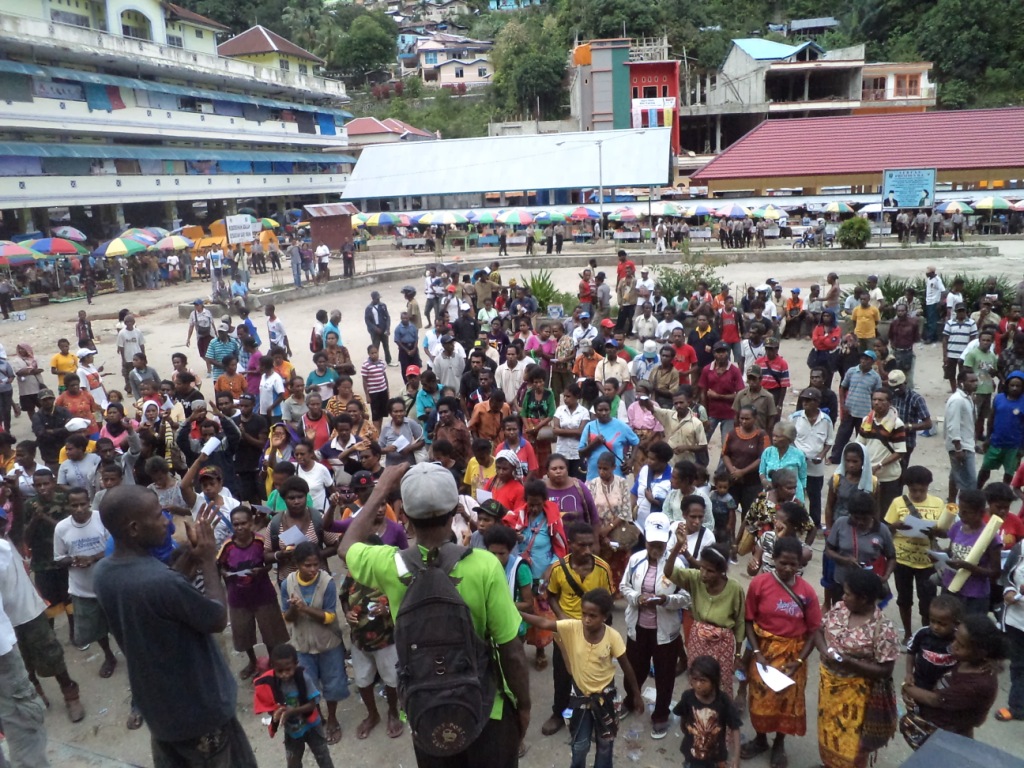
Rally in Fak-Fak, March 19, 2012
The rallies, which were held across West Papua and Indonesia, were calling on United Nations Secretary general Ban ki-Moon  to advocate for West Papua and pressure Indonesia to end human rights abuses in West Papua.  The UNSG was visiting Jakarta to speak at a Defence Policy expo and hold bilateral meetings with General Susilo Bambang Yudhoyono, the President of Indonesia.
The three men, identified as two British and one Canadian citizens, were taken by police to be interrogated after they were observed by intelligence officers taking photographs at the rally on Monday.
According to local sources, local police have claimed that the arrested men did not have a permit to enter West Papua,  are “part of a foreign interference”.
Foreigners must apply for a Surat Jalan (travel permit) to visit West Papua, and must report to a local police station or military post either daily or weekly.  Foreign journalists and human rights observers are banned by Jakarta from entering the Indonesian colony.  Due to this restriction, any non-Indonesian foreigner with a camera is subjected to surveillance.
Local police in Fak-Fak have not been available for comment.


New Matilda: Australia’s Money Helps Kill, Intimidate And Torture

from our good friends at

New Matilda.com

NM INVESTIGATES

23 Mar 2012

Our Money Helps Kill, Intimidate And Torture

By Marni Cordell

Bob Carr and Stephen Smith

Australia plays a key role in training and funding elite Indonesian counter-terror unit Detachment 88 – but wants to distance itself from the unit’s violent reputation, reports Marni Cordell

Bob Carr and Stephen Smith with

their Indonesian counterparts.

There’s been a terror threat in Jakarta. A group of hardliners claim they intend to bomb the city’s transport system, just days before the UK prime minister is scheduled to arrive for a state visit. Indonesia’s counter terror agencies scramble to respond to the critical incident as the population goes into lockdown.

I’m sitting in the Control Room at the Jakarta Centre for Law Enforcement Co-operation (JCLEC) alongside international police trainers Bob Milton and David Gray.

On the screens in front of us, Indonesian police are acting out roles in this imagined terrorism scenario — and Milton and Gray are the puppet-masters.

Inside the JCLEC Control Room. Photo: Marni Cordell

“Basically the scenario develops into a more and more complicated problem,” explains Milton, a former Metropolitan Police commander from the UK.

“We try to make it as real as possible. We’ll have things such as pictures, audio, taped phone conversations, anything that we can try and get the information to them in a more interesting way.”

“We then challenge the students and ask for quite a lot of detail about how they are going to respond, and how they are going to deal with it.”

Fake terror scenarios like this one are a regular part of the immersive training that goes on at the Australian-funded police training centre.

JCLEC was set up in 2004 as a result of a bilateral agreement between Indonesia and Australia to strengthen Indonesia’s counter-terror effort in the wake of the Bali Bombings.

I visited the centre last week as part of an investigation into Australia’s funding and training of Indonesia’s crack anti-terror squad, Detachment 88 — the unit responsible for capturing or killing most of Indonesia’s terrorism kingpins since the 2002 Bali attack.

Detachment 88 employs a controversial brand of policing in which suspects are shot dead rather than arrested — like a soldier would shoot an enemy combatant. The high profile counter-terror raid in Bali last Sunday, in which five suspected terrorists were killed and the police were hailed internationally as heroes, was just the latest in a long line of lethal operations.

The unit is funded and trained by Australia and while the Australian Government might not endorse their paramilitary-style tactics, it’s been willing to turn a blind eye because Detachment 88 has been extremely effective at disrupting Indonesia’s extensive terror network.

JCLEC itself is deep within the grounds of the Indonesian National Police Academy, in the city of Semarang in Central Java. When I arrive at the centre I’m met by AFP federal agent Brian Thomson, a friendly, middle-aged cop from Canberra who is nine months into a two-year stint here. I’m the first Australian journalist he has hosted in that time.

JCLEC is touted as an international police training centre but in fact its students are over 90 per cent Indonesian — 9 per cent of whom are Detachment 88. The centre hosts trainers from Indonesia and across the globe, predominantly from Australia, Europe, and the UK.

Students undertake computer-based training courses – this one tests their knowledge of the difference between intelligence and information. Photo: Marni Cordell

Its core funding for more than 130 staff on six hectares of well maintained grounds comes directly from the Australian Federal Police’s own budget.

The self-contained centre — complete with student accommodation, lap pool and gym — couldn’t stand in greater contrast to stories that abound in Jakarta about Detachment 88’s operations.

JCLEC’s shtick is about “learning and understanding through shared experience” — and teaching best practice terror investigation techniques and proper use of the judicial process. Detachment 88, an elite and highly skilled unit with unique powers of surveillance in Indonesia, seems to operate above the law.

As I reported earlier this month, there is growing evidence to suggest what was once solely a counter-terror unit is now moving into counter-separatist operations. Activists in West Papua claim the squad is being deployed to hunt down civilians aligned with the independence movement in a growing campaign of intimidation.

According to Eric Sonindemi, a participant in last October’s Third Papuan People’s Congress, says Detachment 88 personnel were involved in the deadly attack on Congress in which six people were killed and many others wounded.

“Most of the security forces were in plain clothes, but they weren’t really concealing their weapons — they were sort of showing off,” Sonindemi told me when I met with him in Jakarta. “Detachment 88 was there,” he said, explaining that he “saw their equipment and riot shields”.

“Hundreds of people were detained [by police] that night and many of them were beaten in detention,” Sonindemi said. “I spoke to one person who had a gash in his head, a broken nose and bruises on his face. He had been beaten with the butt of a rifle by a policeman.”

“He was subsequently released and never charged with any crime.”

So exactly how closely does Australia work with the deadly unit?

According to a Jakarta-based security analyst who asked not to be named, “There was a big push after the first Bali Bombing, to the point where Detachment 88 actually had Australians with them on [counter-terror] operations.”

“It’s been a long time since that’s happened,” the analyst continued. “The AFP says that sometimes Detachment 88 doesn’t even share information with them any longer. There’s a real pride in doing things themselves now without relying on the Australians.”

But a diplomatic source in Jakarta confirmed that the relationship remains extremely close — and that the AFP continues to work with the Indonesian National Police, of which Detachment 88 is a part, at head office in Jakarta.

Australian Federal Police agent Brian Thomson at JCLEC, with an Indonesian colleague. Photo: Marni Cordell

Details on our financial support for the unit are harder to come by. The Australian government committed $36.8 million over the first four years of JCLEC. Now Thomson tells me the Australia’s support for JCLEC comes out of the AFP budget, which continues to provide “roughly the same amount” of funding to the centre. We also assist the unit directly — although just what that assistance entails is a closely guarded secret.

“I’ve pursued that question through senate estimates, through questions on notice, I’ve had DFAT briefings, and I can’t get any clarity about the role of Australian support of the Indonesian military and police and specifically whether our contribution benefits Detachment 88,” Greens senator and spokesperson on West Papua Richard Di Natale told NM.

“And it’s very clear that Detachment 88 has been involved in some of the violence that has occurred in the region.”

Details from the Indonesian side are just as shady.

Although some of Detachment 88’s terror raids have been simulcast on television in Indonesia, scratch below the surface and it’s difficult to get any real detail on the unit, says Usman Hamid, advisor to the International Center for Transitional Justice.

“The accountability of Detachment 88 is very low,” Hamid tells me when I meet him in a hotel lobby in Jakarta where he is meeting with other experts to prepare a response to the draft national security bill.

“Detachment 88 has special allocation of the budget and international funding — which has never been explained to the Indonesian public clearly, or even to the parliament for that matter.”

“We hear vague amounts but it’s not under the state budget.”

“It should be accounted appropriately,” Hamid told NM. “To the Indonesian parliament, to the Indonesian public, and of course to the Australian parliament and public … to make sure that the budget Australia gave is really being used for the right purpose.”

As Brian Thomson walks me through the official JCLEC Power Point presentation, I ask how Australia can be sure that the training taught at the centre is also being “used for the right purpose” — how do we know it isn’t being used to crack down on civilian dissent?

He’s silent for some time before asking me to repeat the question, and then ultimately refusing to answer it — handballing to his Indonesian counterpart, Dwi Priyatno, who refers me to the Indonesian law on terrorism, and back to the public affairs branch of the Indonesian police.

I also ask specifically about separatism in Indonesia and whether techniques to quash independence movements are ever discussed at the Australian-funded centre. Thomson again gets nervous.

“I can’t really answer that because my job here as an executive director is to be involved in running the centre, so what’s actually discussed in the classroom, I can’t give full [details],” he says.

“Although separatism…

“Yeah…

“No…

“Not separatism.

“When you say separatism, in what regard are you referring to it?”

Back in Australia my inquiries about Detachment 88’s operations in Papua and their move toward policing separatism have been met with an almost uniform response. Here’s what I received from the AFP head office in Canberra: Australia has no mandate to tell the Indonesian Police how to run their business. And yes, we will continue to provide “capacity building assistance”.

Meanwhile, Eric Sonindemi says he remains traumatised by the police and military attack on the Third Papuan People’s Congress. He clearly remembers the sound of gunfire, he tells me, and now jumps when he hears loud noises. He is sure he is being monitored by the police. “I’ve been threatened by the police before,” he says, “but this is the first time I’ve feared for my life.”

Other Papuans I met in Jakarta told similar stories — of constant surveillance by the security forces, phone tapping and intimidation. They told me that fear is part of their daily lives.

Australian officials may well seek to disclaim any responsibility for the behaviour of the Indonesian police and particularly from the activities of Detachment 88. Given the close relationship between the AFP and the unit, however, it’s hard not to conclude that Australia is directly contributing to this climate of oppression.

This is the second article in an NM investigation of Detachment 88 and Australia’s role in the Indonesian counter-terror effort. Read the first article here.

New Matilda: Australia Is Policing Separatism

from our friends at NewMatilda.com

NM INVESTIGATES

5 Mar 2012

By Marni Cordell

densus

Indonesia’s counter-terror unit Detachment 88 is funded and trained by Australia. Why are we so involved with a unit whose work includes counter-separatist activities? Marni Cordell reports from Jakarta

When politicians in Australia hail the success of Indonesia’s counter-terror forces in catching, charging — and often killing — the country’s top terror operatives, it’s Detachment 88’s work they are talking about.

Detachment 88 is an elite counter-terror unit within the Indonesian National Police that was formed in the aftermath of the 2002 Bali Bombings. It is funded and trained by Australia, and enjoys close co-operation with the Australian Federal Police.

Noordin Top, Dulmatin, Abu Bakar Bashir, Umar Patek have all been apprehended since the force became operational in 2003. Jakarta-based terror expert Sidney Jones calls them “the top of the top” — and Australia’s training and money have been instrumental in their success in disarming Indonesia’s significant terror network. According to DFAT, Indonesian authorities have convicted over 470 terrorists and their accomplices since 2000.

But there are growing concerns about what else they are using that deadly efficiency for — and although we train and fund them, we exercise little control over their operations.

When Detachment 88 was accused in 2010 of torturing independence activists in the Indonesian province of Maluku, the AFP and Australian Government said they were concerned about the allegations but had “no mandate to investigate the conduct of foreign police within another country”.

But the incident was not an isolated one — now, activists in West Papua claim Detachment 88 is being deployed to hunt down not only armed resistance fighters, but also civilians with ties to the independence movement, in what appears to be a growing campaign of intimidation.

I met Eric Sonindemi, a participant in last October’s Third Papuan People’s Congress, in a cafe in Jakarta. He told me that soon after their arrival from Jakarta, a surge of Detachment 88 personnel was involved in the deadly attack on Congress, in which six people were killed and many others wounded.

“Most of the security forces were in plain clothes, but they weren’t really concealing their weapons — they were sort of showing off,” Sonindemi told NM. “Detachment 88 was there,” he said, explaining that he “saw their equipment and riots shields”.

On the last day of Congress, Sonindemi was as surprised as other participants when the police and military opened fire because the gathering had been peaceful. “Everyone thought it was going to be safe because the event ended peacefully and [Congress leader] Forkorus Yaboisembut thanked the police and Indonesia for their support. People went home thinking they were safe,” he said.

But then security forces began firing indiscriminately into the dwindling crowd.

“I was in a nearby monastery when the shooting started — which wasn’t until about 30-45 minutes after the Congress had ended,” Sonindemi said.

“I hid in one of the brothers’ rooms and put on one of his robes, pretending to be a student. Soon the fully armed police and military arrived. They used tear gas and threatened to ransack the place before taking away a number of people, who were all told to squat and crawl toward the sports field.”

“Hundreds of people were detained that night and many of them were beaten in detention. I spoke to one person who had a gash in his head, a broken nose and bruises on his face. He had been beaten with the butt of a rifle by a policeman.”

“He was subsequently released and never charged with any crime.”

Sonindemi explains that the security situation in Papua has “really been heating up” since August last year. “Before August, the police and military would not come in big numbers if there was a public rally. That has changed now,” he told New Matilda.

According to Jakarta Globe journalist Nivell Rayda, who has been investigating Detachment 88, there has been a marked shift by the force in recent months toward policing “separatism” — rather than terrorism.

When I spoke to Rayda last week in the Jakarta Globe newsroom he said he believes this is because Indonesia has not had a major terror attack since the second JW Marriott bombing in 2009 — and says he noticed a similar trend between 2005 and 2009, when there was also a period of relative calm.

“Detachment 88 being somewhat of an elite unit, being funded and trained by foreign countries… they just lay dormant — their resources, their equipment and their tactical abilities, and investigation techniques just laying dormant for years,” he told NM. It was during this period that the unit was involved in the torture of local independence activists in Maluku.

“In 2009 we had another major attack, but since then we’ve arrested nearly all the major players and terrorism suspects … there haven’t really been any major terrorism events taking shape, and it looks like the pattern seems to repeat itself: Detachment 88 has been engaging once more in non-terrorism issues, including [counter] separatism,” he said.

Rayda agrees that Detachment 88 is not only pursuing armed resistance fighters, and cites a case in August last year in Nafri, Papua, in which two young girls were detained among a group of 15 people after a fatal shooting attack on a public minivan.

The OPM was blamed but denied involvement and Detachment 88 was dispatched to help local police with the investigation. Nivell told New Matilda, “After Detachment 88 stepped in, they arrested 15 people — including a 7- and an 8-year-old girl. These 15 people were beaten, they were tortured, they were arbitrarily detained and treated inhumanely.

“But the following day, they released 13 of them. So only two of them were responsible for the shooting, and the other 13 were innocent — but they were beaten as well.”

Eric Sonindemi said mass arrests are a common tactic used by police in Papua to intimidate people and weed out the perpetrators.

A Jakarta-based security analyst who asked not to be named admitted when I met with them last week that they held concerns about Detachment 88’s loose definition of terrorism — but claimed the force was “moving away from [policing separatism] now”.

“Detachment 88 has been sent to Papua in certain cases where the local police don’t have investigative skills, but it’s more to help in the investigations than to engage in raids,” the analyst told NM.

“The exception to that was the… death of [OPM leader] Kelly Kwalik in December 2010, which did involve Detachment 88.”

But Rayda disagrees. In fact when he asked the Indonesian National Police why Detachment 88 were involved in raids against OPM members that displaced thousands of villagers in Papua’s Paniai in December last year, he says the police were quite up front about the fact that they believe “terrorism is not only limited to bombings and militants and stuff like that. It also extends to separatism”.

An Australian funded and trained elite counter-separatist force? This was not the Australian government’s intention when it began pouring millions of dollars into the Indonesian counter-terror effort after the Bali bombings. Both the 2002 MoU with Indonesia on combating international terrorism, and the MoU on police co-operation between our two countries, focus firmly on transnational, not local, crime — and the AFP says Detachment 88 has not sought assistance from Australia in any investigations or operations to counter internal separatist movements.

However, the Australians do admit to working very closely with the Indonesian National Police at Jakarta headquarters, where Detachment 88 is now controlled.

New Matilda asked the AFP how much they know about Detachment 88’s operations before they take place. We also asked the minister for Home Affairs, Jason Clare, whether Australia condoned a definition of terrorism that included peaceful expressions of dissent.

We did not receive a response by the time of publication.

Detachment 88 has a distinctive owl logo but Nivell Rayda say locals recognise their presence because, unlike the local police, they carry foreign-made weapons and wear balaclava-like masks. Curiously, Detachment 88 officers are commonly issued with Steyr assault rifles — an unusual rifle to be used by Indonesian forces. The Steyr is standard issue to Australian troops and is manufactured by Australian Defence Industries in Lithgow NSW.

Rayda has spoken to a number of activists in Papua and Indonesia’s other trouble spots who have noticed officers from the elite unit at rallies and during raids.

Sonindemi agreed when I met with him that, “The understanding that Detachment 88 are in Papua now is quite widespread”, and told me he was deeply concerned about the situation.

“Usually in Papua conflicts emerge because of increased troop deployment. It’s usually the source of the problem.”

This is the first article in an ongoing NM investigation of Detachment 88 and Australia’s role in the Indonesian counter-terror effort.

Arrests in Fak-Fak as demos support IPWP, reject UP4B

from West Papua Media and local sources

Confirmed reports have emerged from Fak-Fak, on the west coast of West Papua, that at least ten demonstrators were arrested by Indonesian police on March 1.

The demonstrations were being held to reject a new body – U4PB (or Program to Accelerate Development of Papua and West Papua) – appointed by Indonesia to re-implement the failed Special Autonomy package that was to give Papuans a greater share of their own wealth.  Regular protests from Papuan civil society have rejected this new body due to its refusal to consider Papuan demands, and  recognise the failure of the existing package.

Those arrested were identified as the following:

  1. Siswanto Tigtigweria
  2. Lukas Hegemur
  3. Quartus Ndoratndorat
  4. Modestus Komber
  5. Yeheskal Hegemur
  6. Nikson Hindom
  7. Pazco Hindom
  8. Samuel Rohrohmana
  9. Amos Wagab
  10. Renol Hegemur

The protest was also held to support the February 28 launch in Canberra, Australia, of a new regional chapter of the International Parliamentarians for West Papua.  This meeting attracted Members of Parliament from Vanuatu, New Zealand, and several parties in Australia, including MPs from the Australian Government.  Demonstrations in support of IPWP were held across ten centres in West Papua.

Neither Police or local human rights sources have been able to identity the exact nature of charges against the ten detainees.  However Indonesian police historically have laid Makar (Treason) charges against Papuans attending demonstrations in support of the right of self-determination.

West Papua Media was unsuccessful in seeking comment from Police.

This is a developing story.

westpapuamedia.info

Create a website or blog at WordPress.com

Up ↑