West Papua: Senator Richard Di Natale questions Foreign Minister Carr

Video of Question Time in the Australian Senate on Tuesday March 20, 2012, where Senator Di Natale questioned Foreign Minister Carr about his meeting with the Indonesian Foreign Minister.

He asked Senator Carr whether he had raised West Papua in this meeting, and if not, when the Government planned to do so.

The video includes Senator Carr’s response.

[youtube http://youtu.be/v-MD9ak3ORg]

Federal parliament yesterday (Australia)

http://parlinfo.aph.gov.au/parlInfo/search/display/display.w3p;query=Id%3A%22chamber%2Fhansards%2Febe16d5f-1452-4285-9104-171295b6d0c4%2F0029%22

THE SENATE
PROOF
QUESTIONS WITHOUT NOTICE
West Papua
QUESTION
Tuesday, 20 March 2012
BY AUTHORITY OF THE SENATE

PDF: http://parlinfo.aph.gov.au/parlInfo/genpdf/chamber/hansards/ebe16d5f-1452-4285-9104-171295b6d0c4/0029/hansard_frag.pdf;fileType=application%2Fpdf


Senator DI NATALE (Victoria) (14:52): Mr President, my question is to the Minister for Foreign Affairs, Senator Bob Carr. Minister, last week you met with your counterpart from Indonesia.

Honourable senators interjecting—

The PRESIDENT: Order!

Senator Bob Brown: I rise on a point of order. As you know, it is impossible to hear Senator Di Natale up this end of the chamber. I am sure that the minister cannot hear the question, so he will not be able to answer.

The PRESIDENT: Senator Brown, that is a valid point of order. I had called for order. I had called, in particular, two members of the Senate to order so that Senator Di Natale can be heard.

Senator DI NATALE: I might begin again. My question is for the Minister for Foreign Affairs, Senator Bob Carr. Minister, last week you met with your counterpart from Indonesia, Marty Natalegawa, and the defence ministers of both nations. Can you inform the Senate as to whether the issue of West Papua was raised as part of those discussions? If not, when do you plan to raise the issue of West Papua with the Indonesian government?

Senator BOB CARR (New South Wales—Minister for Foreign Affairs) (14:53): Mr President, it was raised. First of all it was raised by me, when I assured the Indonesian foreign minister that Australia—both sides of Australian politics—fully recognised Indonesian sovereignty over the Papuan provinces. I reminded him that that was recognised in the Lombok treaty, signed by the Howard government with Indonesia in 2006. I underlined that I understood the case that all the governments of the world recognise Indonesian sovereignty. It would be a reckless Australian indeed who wanted to associate himself with a small separatist group which threatens the territorial integrity of Indonesia and that would produce a reaction among Indonesians towards this country. It would be reckless indeed.

I can say this: the Indonesian foreign minister nominated to me the responsiveness of the Indonesian government to oft-expressed Australian concerns about human rights in Papua. Before I could raise the subject, as I was fully intending to, the Indonesian foreign minister nominated that they have a clear responsibility to see that their sovereignty is upheld in respect of human rights standards. I was impressed by that. It reflects the fact that the previous Australian governments—I know it is the case with this Labor government and I assume it is the case with a coalition government—have raised these concerns with Indonesians, and it reflects the fact that Indonesians have listened.

I again would warn any member of the Senate against foolishly talking up references to separatism in respect of the Papuan provinces. That is reckless and it is not in Australia’s interests.

Senator DI NATALE (Victoria) (14:55): Mr President, I ask a supplementary question. It does relate to the Lombok treaty and I need to remind the foreign minister—I understand he is new in his role—that the Joint Standing Committee on Treaties report of 6 December made a bipartisan recommendation:

The Committee recommends that the Australian Government encourage the Indonesian Government to allow greater access for the media and human rights monitors in Papua.

If this is still the government’s position, what has Senator Carr done to further this aim?

Senator BOB CARR (New South Wales—Minister for Foreign Affairs) (14:56): I can assure the Senate that the Australian embassy in Jakarta will continue to raise matters of human rights in respect of the Papuan provinces, and will do so in respect of the recent sentencing of five men in Papua province to three years imprisonment for subversion. Australia has a strong and consistent record of upholding the right of persons peacefully to express their political views freely. Australian officials in Jakarta will raise our concerns over these sentences. But we will do so as a friend of Indonesia, absolutely explicit and unabashed about asserting Indonesian sovereignty over the Papuan provinces. The Lombok treaty—I refer again to the fact that the Lombok treaty was signed in November 2006, coming into force in 2008—is based on such a recognition: support for the sovereignty, territorial integrity, national unity and political independence of each other. Similar language is used in the preamble.

Senator DI NATALE (Victoria) (14:57): Mr President, I ask a further supplementary question, which also relates to the JSCOT report, which I remind the foreign minister is about what the Australian government, not the Indonesian government, has agreed to do. Recommendation 2 says:

… increase transparency in defence cooperation agreements to provide assurance that Australian resources do not directly or indirectly support human rights abuses in Indonesia.

Again I ask the foreign minister: what steps will you take in your role as foreign minister to ensure this recommendation is applied and that transparency of Australia’s role— (Time expired)

Senator BOB CARR (New South Wales—Minister for Foreign Affairs) (14:58): In those full and frank exchanges last Thursday with our Indonesian counterparts, the defence minister and I canvassed Papua and the Indonesian foreign minister referred again to the progress being made by Indonesia in shifting responsibility for law and order in the Papuan provinces from the military to the police. President Yudhoyono—a great friend of Australia’s, by the way—has committed his government to raising the living standards of the people of Papua and reinvigorating special autonomy. Australia believes that this is the best path—the best means—to achieving a safe and prosperous future for the Papuan people. We will give support through our aid programs. We are the biggest aid donor to Indonesia, and a recognition of that is reflected in the Lowy Institute poll, which I recommend members of the Senate read, which says that Australia is held in high standing by the people of Indonesia. We will continue to work on these great tasks.

HRW: Five Papuans Convicted for Peaceful Protest

English: Human Rights Watch logo Русский: Лого...
Image via Wikipedia

For Immediate Release

From HUMAN RIGHTS WATCH

Indonesia: Five Papuans Convicted for Peaceful Protest
Amend Treason Law to Uphold Free Speech

(New York, March 16, 2012) – The Indonesian government should drop the politically motivated treason charges against five Papuan activists who were convicted on March 16, 2012, and order their release, Human Rights Watch said today.

The district court in Jayapura, the Papuan provincial capital, convicted the five men and sentenced them to three years in prison for statements made at a Papuan People’s Congress in October 2011. The demonstration was brutally suppressed by the authorities, leaving at least three people dead. The five men convicted on March 16 are Selpius Bobii, a social media activist, August Sananay Kraar, a civil servant, Dominikus Sorabut, a filmmaker, Edison Waromi, a former political prisoner, and Forkorus Yaboisembut, a Papuan tribal leader.

“If the Indonesian government wants to make an example out of these people, then it should free them as a symbol of its commitment to free expression,” said Elaine Pearson, deputy Asia director at Human Rights Watch. “Instead, the legacy of the Papuan Congress crackdown will be five unjust convictions, while those responsible for the violence go unpunished.”

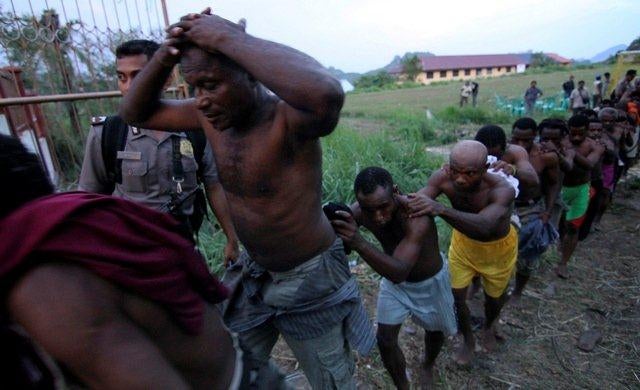
On October 19, 2011, in Jayapura, Indonesian security forces used excessive force to break up a three-day People’s Congress demonstration supporting independence for Papua, Human Rights Watch said. After Yaboisembut, one of the leaders, read aloud the 1961 Papua Declaration of Independence, police and the army fired warning shots to disperse the approximately 1,000 Papuans gathered. The security forces then used batons and in some instances firearms against the demonstrators, killing at least three and injuring more than 90 others. Witnesses said that demonstrators had been struck on the head and several suffered gunshot wounds.

Following the incident, 17 police officers, including the Jayapura police chief, Imam Setiawan and seven of his subordinates, were given written warnings for committing a disciplinary infraction by not giving priority to the protection of civilians. However, no other action was taken against police or military personnel for possible misuse of force.

The trial of the five activists raised serious due process concerns, Human Rights Watch said. During the trial, the defense told the court that police questioned their clients in the first 24 hours of arrest without the presence of lawyers. The defense also alleged that the men were beaten by police while in custody. Police allegedly kicked Yaboisembut in the chest and beat his head with a rifle butt. Sorabut testified that the police beat him on his head with a pistol and struck his body repeatedly with an M-16 assault rifle. Kraar said he was hit by police twice on the head with a pistol.

Human Rights Watch renewed its call for the Indonesian government to release all political prisoners and allow human rights organizations and foreign journalists unimpeded access to Papua.

The Indonesian Criminal Code should be amended to ensure that no one is prosecuted for treason for exercising their rights to peaceful protest protected under the Indonesian constitution and international law, Human Rights Watch said. The constitution, in article 28(e), states, “Every person shall have the right to the freedom of association and expression of opinion.” Article 28(f) provides, “Every person shall have the right to communicate and obtain information for the development of his/her personal life and his/her social environment, and shall have the right to seek, acquire, possess, keep, process, and convey information by using all available channels.” The International Covenant on Civil and Political Rights, which Indonesia ratified in 2006, similarly protects the rights to free expression and peaceful assembly.

Human Rights Watch takes no position on claims to self-determination in Papua. Consistent with international law, however, Human Rights Watch supports the right of everyone, including independence supporters, to express their political views peacefully without fear of arrest or other forms of reprisal.

“Throwing activists in prison on charges of treason will just reinforce Papuans’ beliefs that the Indonesian government uses the law for political purposes,” Pearson said. “And while the government is busy prosecuting peaceful protesters, it seems to have had no time to investigate adequately the violence against them.”

To read the October 28, 2011 Human Rights Watch news release, “Indonesia: Independent Investigation Needed Into Papua Violence,” please visit:
http://www.hrw.org/news/2011/10/28/indonesia-independent-investigation-needed-papua-violence

To read Human Rights Watch’s report on political prisoners in Indonesia, please visit:
http://www.hrw.org/reports/2010/06/23/prosecuting-political-aspiration-0

For more Human Rights Watch reporting on Indonesia, please visit:
http://www.hrw.org/asia/indonesia


Amnesty Calls for Release of Forkorus and colleagues

Bintang Papua, 8 March 2012Jayapura: Amnesty International has called on the Indonesian Government to release Forkorus and his colleagues. This follows the demand made in court by the prosecutor for the five men to be sentenced to five years.

‘On 5 March, the prosecutor demanded that Forkrus Yaboisembut, Selfius Bobii, Dominikus Sorabut, Edison Waromi and Agust Sananay Kraar be sentenced to five years imprisonment. Amnesty believes that the men were arrested and have been detained simply for exercising their human rights peacefully, in particular their rights to freedom of expression and freedom of assembly,’ said Josep Roy Benedict, member of Amnesty’s team which campaigns for Indonesia and Timor Leste.

Amnesty declared that the five men are ‘prisoners of conscience’ and called for their immediate and unconditional release.

‘Amnesty is also concerned about the lack of progress being made by the Indonesian Government in response to the meeting of Indonesia’s National Commission for Human Rights which stated that abuses of human rights  had been committed by the Indonesian security forces at the time of the Third Papuan Congress on 19 October 2011, whcih resulted in the deaths of three persons and the maltreatment of dozens of participants,’ he said. The five men should be tried in a court that conforms with international standards of justice. In a number of recent internal disciplinary sessions, government officials have only been subjected to administrative sanctions.

He went on to say that the government must repeal or revise all laws that are being used to criminalise freedom of expression, in particular Article 106 of the Criminal Code.

Meanwhile, according to the Prosecutor, his demand for a five-year sentence for Forkorus and the other four is appropriate. He was responding to the views that have been expressed in some circles pointing out that in previous makar cases, the sentences have been higher that five years, even as high as twenty years or life imprisonment.

The Prosecutor Julius D Teuf said  that anyone who has followed the court hearings  will understand that the five defendants were guilty of making certain attempts. ‘Their intention was to establish a new state but they were not successful  because of the actions by the security forces and this is why we think that our demand for the five men is adequate.’

The next hearing of the trial of Forkorus and his colleagues is due to take place on Friday, 9 March.

‘Saying that there are no political prisoners in Papua is a Lie’

Bintang Papua, 7 March 2012Following a statement that has just been made by Amir Syamsuddin, the Minister for Law and Human Rights claiming that there are no political prisoners (tapol/napol) in Papua, various human rights groups as well as Mama Yosepha, the Director of  the Human Rights and Anti-Violence Foundation, and Markus Haluk, a well-known Papuan human rights activist, have responded.

Mama Yosepha and Markus Haluk said: ‘This statement by the Minister for Law and Human Rights shows the extent of the lies being made in public, which came after the dialogue organised by Amnesty International  last November. The Minister said that there were no political prisoners in Papua, only criminal prisoners. This is in line with the racist policies that are used against the Papuan people,’ said Markus Haluk.

Mama Yosepha and Markus Haluk said: ‘We are well aware of the denials and lies continually being spread by the Indonesian government through the Minister for Law and Human Rights. This is happening systematically in relation to the true facts that are known to the Papuan people. Since late 2011, five political prisoners have been on trial, Forkorus and his four colleagues, who are facing the charge of makar – treason – in connection with the declaration made by the Federal Republic of West Papua in October 2011 on Zakheus Square, Jayapura. In addition, from 2008 – 2010, sixteen political prisoners have been in custody in Manokwari while in Fak-Fak there are as many as sixteen prisoners, as well as fifteen in Nabire, four in Mamberamo Raya, one in Biak who is being held in  Abepura prison, and of all these, four are convicted prisoners, plus another six in Timika , which means that from 2008 to the present there have been 67 political prisoners.’

Markus went on to say that there are around ten political prisoners being held in connection with the assault on the ammunition dump in Wamena in 2003 who are now in  custody in Nabire and Biak prisons,while Filep Karma has been in custody since 2004, having been sentenced to fifteen years  and is being held in Abepura Prison, which brings the total since 2008 to seventy-two tapols and napols (tapol refers to detainees, while napol refers to convicted prisoners).

The fact that there are political prisoners in  Papua  was officially acknowledged by the head of  the Papua office of the Ministry of Law and Human Rights, Drs Daniel Biantong in 2010, when he produced a list of 25 persons registered as tapol and napol throughout Papua.

‘The demands for sentencing have varied from eleven months to life imprisonment. This can be broken down as follows: one person for eleven months, two persons for three years, three persons for five years, one person for six years, one person for ten years and one person for fourteen years, as well as three persons who  were sentenced to fifteen years, five who were sentenced to seventeen years, four to twenty years, while two were given life sentences. In all these cases, the prisoners were charged with makar under Article 106 of the Criminal Code,’ he said.

If we go farther back, said Markus,  following the dialogue held on 26 February 1999 during the presidency of B.J.Habibie , all political prisoners who were then being held in Papua were released. However, one year later, in 2000, many Papuan leaders  and ordinary Papuans were arrested and put on trial for makar, and this has been going on up to the present day.

Mama Yosepha,  said: ‘We human rights activists in Papua  have been firmly insisting that there are tapols and napols in Papua, and they are not criminal prisoners. We urge on the Indonesian government to stop spreading lies  and making racist remarks, like talking about murders, arrests and detentions with regard to Papuan leaders and ordinary Papuans here in the Land of Papua. Instead they should release Papuan leaders such as Forkorus Yaboisembut and Edison Waromi as well as the three others with them and lift the makar charges that are being made against all five of them.’

She went on to say: ‘Bearing in mind the statement made by the Minister for Law and Human Rights last  year and then on 5 March 2012, and bearing in mind too that Indonesia is now a Democratic State,what should happen is that the Indonesian government should release all the political prisoners who are now being held throughout Papua  as well as outside Papua.’

She went on to add: ‘We urge the Indonesian government to allow complete access for diplomats, journalists, human rights workers, members of Senates and congresses [around the world] to visit Papua.’

HRW:: Indonesia – Drop Charges Against Papuan Activists

English: Human Rights Watch logo Русский: Лого...

Free Political Prisoners, Amend Treason Law to Uphold Free Speech

JANUARY 29, 2012
  • Police arrest attendees of the Third Papuan People
    Congress in Jayapura, Indonesia‘s Papua province on
     October 19, 2011.  © 2011 Reuters
The Indonesian government should show its commitment to peaceful expression by dropping the charges against these five Papuan activists. It’s appalling that a modern democratic nation like Indonesia continues to lock up people for organizing a demonstration and expressing controversial views.
Elaine Pearson, deputy Asia director

(New York) – The Indonesian government should drop charges against five Papuan activists who are being prosecuted for peacefully expressing their political views, Human Rights Watch said today. On January 30, 2012, the district court in Jayapura, the Papua provincial capital, will begin the treason (makar) trial of five leaders of the Papuan People’s Congress, which the authorities forcibly dispersed last October.

“The Indonesian government should show its commitment to peaceful expression by dropping the charges against these five Papuan activists,” said Elaine Pearson, deputy Asia director at Human Rights Watch. “It’s appalling that a modern democratic nation like Indonesia continues to lock up people for organizing a demonstration and expressing controversial views.”

On October 19, 2011, Indonesian security forces, using excessive force, broke up a three-day Papuan People’s Congress gathering in Jayapura, Human Rights Watch said. After one of the leaders read the 1961 Papua Declaration of Independence out loud, police and the army fired warning shots to disperse the approximately 1,000 Papuans gathered for the peaceful demonstration supporting independence for Papua. The security forces then used batons and in some instances firearms against the demonstrators, killing at least three and injuring more than 90 others. Witnesses said that demonstrators had been struck on the head and several suffered gunshot wounds.

Following the incident, eight police officers, including the Jayapura police chief, Imam Setiawan, were given written warnings for committing a disciplinary infraction by not giving priority to the protection of civilians. However, no other action was taken against police or military personnel for possible misuse of force.

Five of the activists– Forkorus Yaboisembut, Edison Waromi, August Makbrowen Senay, Dominikus Sorabut, and Selpius Bobii – were charged with treason under article 106 of the Indonesian Criminal Code and have been held in police detention since October 19. Another Papuan, Gat Wenda, a member of the Penjaga Tanah Papua, orPepta (Papua Land Guard), which provided security at the Congress, will be tried separately on charges of possessing a sharp weapon.

At least 15 Papuans have been convicted of treason for peaceful political activities. They include Filep Karma, a civil servant who has been imprisoned since December 2004. About 60 other people throughout Indonesia, mostly activists from the Moluccas Islands, are also imprisoned on charges related to peaceful acts of free expression. Human Rights Watch renewed its call for the Indonesian government to release all political prisoners and allow human rights organizations and foreign journalists unimpeded access to visit Papua.

The Indonesian Criminal Code should be amended to ensure that no one is prosecuted for treason for exercising their rights to peaceful protest protected under the Indonesian constitution and international law, Human Rights Watch said. The constitution in article 28(e) states, “Every person shall have the right to the freedom of association and expression of opinion.” Article 28(f) provides, “Every person shall have the right to communicate and obtain information for the development of his/her personal life and his/her social environment, and shall have the right to seek, acquire, possess, keep, process, and convey information by using all available channels.” The International Covenant on Civil and Political Rights, which Indonesia ratified in 2006, similarly protects the rights to free expression and peaceful assembly.

Human Rights Watch takes no position on claims to self-determination in Indonesia. Consistent with international law, however, Human Rights Watch supports the right of everyone, including independence supporters, to express their political views peacefully without fear of arrest or other forms of reprisal.

“The Indonesian government should be prosecuting the people responsible for the ugly and unnecessary crackdown that left three Papuans dead, not those who read out a 1961 independence statement,” Pearson said. “Pursuing this trial will only deepen the resentment that many Papuans feel against the government.”

Create a website or blog at WordPress.com

Up ↑