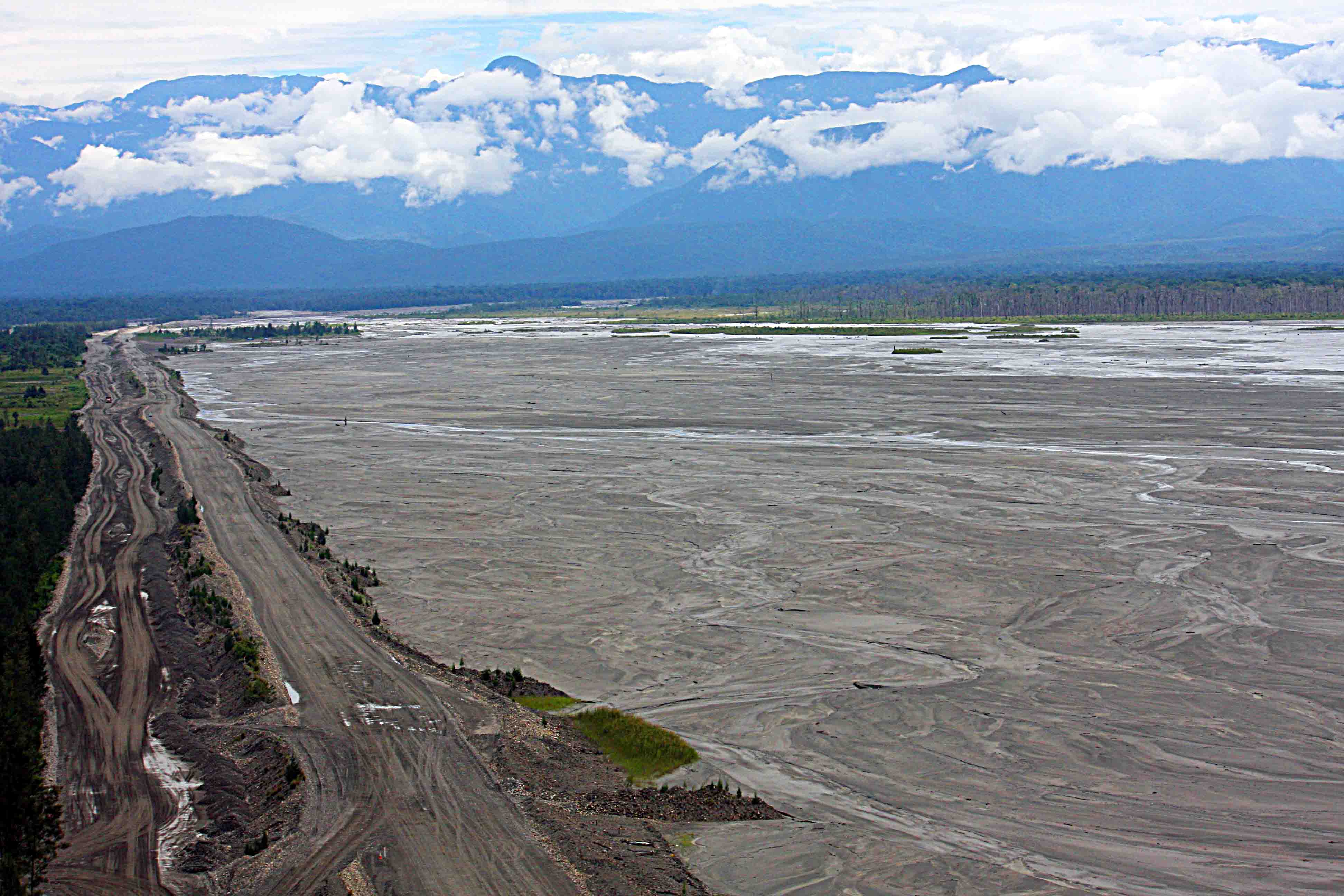
West Papua was taken over by Indonesia in 1969, and a legacy of oppression and environmental devastation has followed.
”]
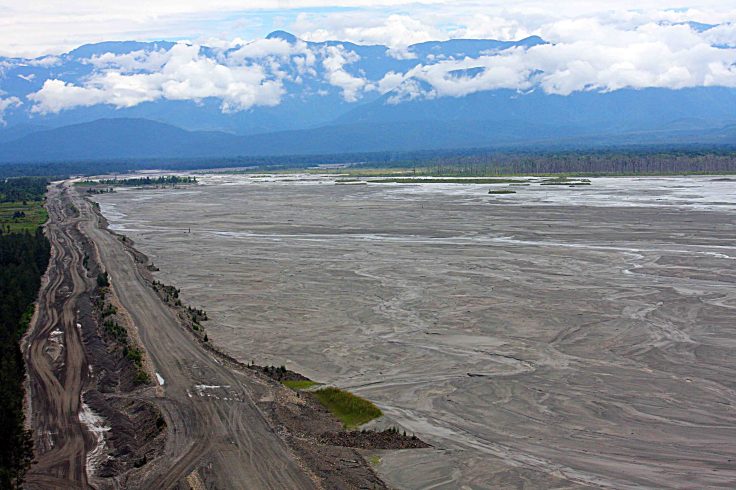
The Grasberg mine has damaged surrounding river systems, such as the Ajikwa river above [West Papua Media]
Investing in conflict-affected and high-risk areas is a growing concern for responsible businesses and investors. Companies based in developed countries often operate in lesser-developed foreign markets, where governance standards are lax, corruption is high and business practices are poor.
These pieces focus on one specific Anglo-Australian company and their American partner that jointly operate a mine in West Papua, one of the poorest provinces of Indonesia. The risks for the company include the potential to contribute to environmental and social damage in a foreign market. The risks for investors include financing a company that does not get its risk management right.
This is the second chapter of a four-part essay that examines how the Norwegian Pension Fund came to blacklist the mining giant Rio Tinto. The first part can be found here.
Part 2: A history of exploitation
New Guinea, geographically as well as historically, is Australia’s closest relative. Separated from the mainland during the last glacial period, the waters filled in what now separates them: about 152km of the Torres Strait.
While Australia and New Guinea both have enviable mineral stores, economic and political exploitation has left the latter as home to many of the poorest people on Earth. New Guinea is also an island of two histories.
The eastern half forms the independent state of Papua New Guinea – a status it has enjoyed since breaking from Australia in 1975. With its natural resources of oil and industrial metals, Papua New Guinea has long been exploited for its minerals at places like Ok Tedi and Bougainville.
Both projects ended in social and environmental disaster. The environmental impact of Ok Tedi was so great that, in 1999, Paul Anderson, then chief executive of Australian mining company BHP, conceded that the mine was “not compatible with our environmental values”. But it did serve the company’s pursuit of profit. It was not until the Ok Tedi environmental disaster three years later that the true impact of BHP’s mining practices came to the attention of the global public. BHP subsequently sold its interest, established a fund to restore the sustainable development of the affected people, and received immunity from further prosecution.
The western half of New Guinea has had a lesser-known but equally tragic history centred around the Jayawijaya Mountain, home to the Amungme, and farther downstream, the Kamoro people. As with much of East Asia, the indigenes were under Dutch rule when a geological expedition in 1936 located a significant ertsberg (ore mountain) deep in the southwestern highlands. World War II intervened, and the Japanese claimed Indonesia and some of the western parts of New Guinea.Following defeat in the war, the Japanese were marshalled back to their home territory, and Dutch colonialism resumed. Importantly, when Indonesian independence was obtained from the Dutch in 1949, few knew of the ertsberg (mineral ore) hidden deep in West Papua’s wilderness.The Dutch began a ten-year Papuanisation programme in 1957 that would see West Papua handed back to the indigenes, and would create the independent state of West Papua around 1972.Despite multiple territorial claims, the ore mountain lay dormant for over 20 years.On March 6, 1959, the New York Times reported the presence of alluvial gold in the Arafura Sea just off the coast of West Papua. Reminded of their earlier discovery, Dutch geologists were said to be returning to the ore mountain, now simply known as Ertsberg.Independence deniedThe indigenes, meanwhile, as part of their programme toward independence, established a Papuan National Council and provisional government as well as their own military, police force, currency, national anthem, and flag. At the time, West Papua’s independence was due before the United Nations Decolonisation Commission, and representatives took part in various cultural and political activities throughout the region. By December 1, 1961, the West Papuan “Morning Star” flag had been raised alongside the Dutch for the first time. Many assumed that independence was imminent.Unbeknown to both the indigenes and the Dutch, US mining company Freeport-McMoRan Copper and Gold was negotiating directly with Suharto – at the time an Indonesian army general – for a small group of its experts to prospect this ore mountain. The path into West Papua through Suharto promised to be fruitful for Freeport, since its board was stacked with the Rockefeller’s Indonesian oil interests who already were versed in the general’s way of doing business. An exploration agreement was reached, and soon after a geologist from Freeport was forging his way through the wilderness toward Ertsberg.West Papua was about to change hands again.Armed with Chinese and Soviet weapons, as well as an increasingly public friendship with the communists, Indonesia declared war on the Netherlands. To protect Western interests from the threat of communism, on August 15, 1962, the United Nations and the United States orchestrated a meeting between Dutch and Indonesian officials during which interim control of West Papua was signed over to Indonesia.Six years of UN interregnum followed, after which a plebiscite would decide whether to form a separate nation or integrate into Indonesia. All 815,000 West Papuans were to vote in an Act of Free Choice.To ensure a favourable outcome, the Indonesians worked to suppress Papuan identity. Raising the West Papuan flag and singing of the national anthem were banned, and all political activities were deemed subversive. Indonesia ruled through force, for self-interest. Alarmed by ongoing media reports, on April 5, 1967, in the British House of Lords, Lord Ogmore called for a UN investigation. By early 1968, with Suharto having assumed the presidency of Indonesia, a US consular visit almost unanimously agreed that “Indonesia could not win an open election” in West Papua.West Papua still wanted its independence.In a desperate attempt to secure West Papua’s right to self-determination, two junior politicians crossed the border into Australian-administered Papua and New Guinea on May 29, 1969. They carried damning evidence of Indonesian repression; the hopes of a yet-unformed nation rested on the politicians reaching the UN. As Australia and its allies were amenable to Indonesian control of West Papua, the two were imprisoned upon crossing the border until after the referendum. Their brave plea was silenced.Between July and August 1969, less than a quarter of one per cent of the population – some 1,026 West Papuans – signed the country’s freedom over to Indonesia. The election, held under the aegis of the UN, was far from an act of free choice. The following day West Papua was declared a military operation zone, the local people’s movement was restricted, and expression of their national identity banned under Indonesian law.Poor, neglected West Papua.Selling West PapuaControl of West Papua proved a lucrative business deal for the Indonesians. Two years prior to the Act of Free Choice – coincidentally on the same day the plight of Papua was raised in the House of Lords – Freeport signed a contract of work with the Suharto government entitling a jointly owned company, PT Freeport Indonesia (Freeport-Indonesia), full rights to the Ertsberg mine. In return, Indonesia would derive significant tax revenues and fees as well as a minority 9.36 per cent shareholding. Without the authority to do so, Indonesia nevertheless cut itself into a deal that sold large tracts of West Papua to the US company, intent on sifting it for copper and gold.Although Ertsberg fulfilled its promise, as production slowed in the mid-1980s, Freeport-Indonesia began to explore surrounding mountains and ridges for other reserves. As is often the case, the best place to establish a new mine is next to another. Sure enough, significant copper and gold reserves were located at Grasberg only a couple of miles southwest of Ertsberg.Grasberg has the largest recoverable reserves of copper and gold in the world. It’s also Indonesia’s economic beachhead.Observing the Grasberg mine via Google Earth, one sees a scar like no other: Located about 13,000 feet (4,000 meters) above sea level, open-pit (above ground) mining has bored a hole through the top of the mountain more than half a mile (1 km) wide. What they’re digging for is more than $40bn worth of copper and gold. Every day the operation discharges 230,000 tons of tailings (waste rock) into the Aghawagon River. This process is expected to continue for up to six more years, at which point exploration will go underground until there’s no value left. Freeport estimates that will occur by 2041.The operation is so large that it has shifted the borders of the adjacent Lorenz National Park. Listed as a World Heritage site by the UN’s Educational, Scientific, and Cultural Organisation (UNESCO) in 1999, the park is “the only protected area in the world to incorporate a continuous, intact transect from snowcap to tropical marine environment, including extensive lowland wetlands”. For the Amungme and Kamoro indigenes, corporate imperialism had replaced European colonialism.The ramifications are both environmental and social.‘Slow-motion genocide’The social and economic condition of the indigenous Amungme and Kamoro poses fundamental human rights concerns. Although Freeport-Indonesia directly or indirectly employs a large number of West Papuans and is regularly Indonesia’s biggest taxpayer, in 2005, the World Bank found that Papua remained the poorest province in Indonesia. With a marked rise in military personnel and foreign staff has come a number of social issues, including alcohol abuse and prostitution such that Papua now has the highest rate of HIV/AIDS in Indonesia.Indonesian control of West Papua has been characterised by the ongoing and disproportionate repression of largely peaceful opposition. Few sustained violent interactions have occurred; however, in one major conflict in 1977, more than 1,000 civilian men, women, and children were killed by the Indonesian military in Operasi Tumpas (“Operation Annihilation”) after a slurry pipe was severed and partially closed the Ertsberg mine.More recently, in 1995, the Australian Council for Overseas Aid reported that the Indonesian army and security forces killed 37 people involved in protests over the mine in the preceding seven-month period. While the level of violence is difficult to establish, academics at the Centre for Peace and Conflict Studies at the University of Sydney maintain that up to 100,000 West Papuans may have been killed since Indonesian occupation. They call what’s happening to West Papua “slow-motion genocide”.There are also two primary environmental concerns over Grasberg. The first is that the mine discharges 230,000 tons of waste rock a day into surrounding waterways; given the escalating rate of processing, this rate is arguably above that allowed by national law. Secondly, acid rock drainage – the outflow of acidic water – has resulted from the disposal of a further 360,000 to 510,000 tons a day of overburden and waste rock in two adjacent valleys covering 4 miles (6.5 km), up to 975 feet (300 metres) deep. The mine operators dispute both claims.Riverine methods of waste disposal are banned in every developed country on Earth. The World Bank no longer funds projects that operate this way, due to the irreversible ecological devastation, and the International Finance Corporation requires that rock be treated prior to disposal, which is not a practice carried out at Grasberg. Since the mid-1990s, a number of independent environmental assessments have found unacceptably high levels of toxicity and sediment as far as 140 miles away.Freeport and Rio Tinto maintain that riverine tailings disposal is the best solution, given the difficult terrain, the threat of earthquakes, and heavy rainfall.Grasberg’s reserves are so vast that extracting them is expected to create 6 billion tons of industrial waste.President Suharto, who is now recognised as one of the most corrupt and tyrannical leaders in history, renewed Freeport-Indonesia’s exclusive mining rights in 1991 for a further 30 years with an option of two 10-year extensions. The license included an option to prospect another 6.5 million acres (2.6 million hectares), as far as the Papua New Guinea border. “The potential is only limited by the imagination,” Freeport’s chairman, James Moffett, remarked to shareholders in March 1995. “Every other mining company wants to get into Irian Jaya [West Papua]. Bougainville and Ok Tedi don’t hold a candle to Grasberg.”Part 3 to follow next week.This is an extract of a chapter from the book, Evolutions in Sustainable Investing: Strategies, Funds and Thought Leadership, to be published by Wiley in December 2011. NAJ Taylor is a PhD candidate in the School of Political Science and International Studies at the University of Queensland, and casual lecturer in the Faculty of Law and Management at La Trobe University.Follow NAJ Taylor on Twitter: @najtaylordotcomThe views expressed in this article are the author’s own and do not necessarily reflect Al Jazeera’s editorial policy.Related articles
 |
| BHP Billiton acknowledged that its mine at Ok Tedi was ‘not compatible with our environmental values’ [GALLO/GETTY] |
| “Grasberg’s reserves are so vast that extracting them is expected to create 6 billion tons of industrial waste.” |