Journalists and foreign NGOs banned from visiting Papua

JUBI, 22nd April 2012

During the course of 2010 – 2011, the Indonesian Government has restricted the number of foreign journalists who are given access to enter Papua and report on the situation there.  As well as journalists, a number of foreign NGOs have been prevented from functioning in West Papua.

All this was said in a report issued by the Faith-Based Network on West Papua, Franciscan International, Papua Land of Peace and the Asian Human Rights Commission which was launched at the P3W Aula in Padang Bulan on 21 April. The report states that in January 2011, Peace Brigades International (PBI) closed its operations in Papua and left Indonesia.

After working in the province for six years,  the lack of legality for its work and visa problems were among the factors that made it impossible for the PBI to offer protection for human rights defenders who were under threat. Two years earlier, in 2008, the International Committee of the Red Cross was ordered by the Indonesian Government to close its offices in Papua and Aceh..

The report also states that even though some foreign journalists were granted permits to vist many parts of Indonesia, access to Papua was restricted. Journalists who were granted access were followed and restricted in their activities. In May, 2010, the French journalist Baudouin Koenig was arrested by the Indonesian police because he was taking photos of a peaceful demonstration in the city of Jayapura. even though he was in possession of a journalist’s visa that permitted him to write  reports about all parts of Indonesia, including the provinces of Papua and West Papua.

Kristina Naubauer, the co-ordinator of the Faith-Based Network on Papua, said that up to this day, the world at large knows nothing about Papua because the Indonesian Government refuses to grant access to foreign journalists, to human rights activists and to other observers from outside Indonesia.

‘Up to this day, when we people from outside Indonesia give talks about Papua, no-one knows anything about Papua. People ask us, ‘Where is Papua?’  she said during the launch of the report about human rights in Papua in 2010 – 2011.

[Translated by TAPOL]

28th anniversary of the death of Arnold Ap to be commemorated

JUBI, 24 April 2012

SKPHP plans to commemorate the 28th anniversary of the death of Arnold Ap

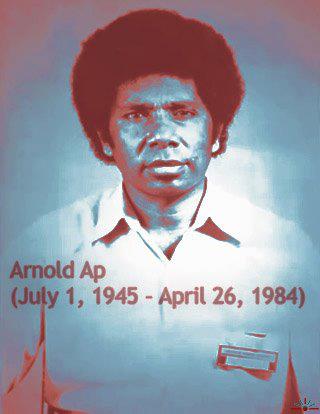
Jayapura: The chairperson of Solidaritas Korban Pelanggaran HAM Papua (SKPHP)- Solidarity for Papuan Victims of Human Rights Violations,  Lokbere Peneas has announced that they will be commemorating the 28th anniversary of the death  of Arnold Clemens Ap, the Papuan human rights leader who is thought to have been murdered by the Indonesian Government.

‘We wish to inform the general public in the city of Jayapura and its environs that SKPHP will commemorate the 28th anniversary of the death of Arnold Clemens Ap who is believed to have been  murdered by the Indonesian government. During the anniversary we will organise a number of actions, ‘ Peneas. told JUBI.

He said that the agenda of the anniversary would include campaigning as well as the performance of Mambesak music in various places in Jayapura and throughout the district of Sentani. Prayers will be said at the grave of Arnold Ap and there will be a press conference, as well as speeches being delivered in front of the UNCEN (Cenderawasih University) Museum.

Arnold Ap (1 July 1945 – 26 April 1964) was a Papuan leader, a cultural worker, anthropologist and musician. Arnold Ap was the leader of the Mambesak group and Curator of the Museum of the Cenderawasih University . He also performed Papuan music during weekly programmes on the radio.

In November 1983, Ap was arrested by a Kopasus unit, imprisoned and tortured. He died from a shot in the chest in the month of April. The security forces said at the time that  he had made an attempt to escape, but it is clear that he was  executed by Kopassus.

To this day, Arnold Ap and his Mambesak music are very popular throughout West Papua and his creations are  regarded as symbols of Papuan  identity.

[Translated by TAPOL]

Unconfirmed reports of mass arrests and sweeping in Serui

Mass flying of banned Morning Star flags, Serui, April 20, 2012

1300 West Papua Time – April 23, 2012

West Papua Media – MEDIA ADVISORY

Reports from credible West Papua Media sources have surfaced from Serui, on Yapen Island, West Papua, this morning (23/ April) that a major sweep by Indonesian security forces in currently underway against people involved in a massive demonstration against Indonesian rule last Friday, April 20.  see https://westpapuamedia.info/2012/04/21/photo-report-scores-of-morning-star-flags-flown-in-serui-demo-despite-police-objections/

According to sources, armed Indonesian police and military have conducted rolling raids on motorbikes across villages including Mantembu and surrounding hamlets outside of Serui town, seeking to arrest all those who were involved in the mass flying of the banned Morning Star independence flag.  It is not known if the troops belong to the Australian trained anti-terrorist Detachment 88 or POLRI Gegana (Motorbike anti-terror commando) units,  but those being targeted were simply engaging in peaceful acts of free expression – guaranteed under Indonesian Law.

All contact with local sources has been lost, and West Papua Media is concerned for the safety of our stringers.

This information is unconfirmed to West Papua Media’s normal standard of confirmation, however we believe the information is credible.

This is a developing situation.  Please stay tuned.  More information as soon as we receive and verify it.

Photo Report: Scores of Morning Star flags flown in Serui demo, despite police objections

from Tabloid JUBI and West Papua Media
20 April, 2012
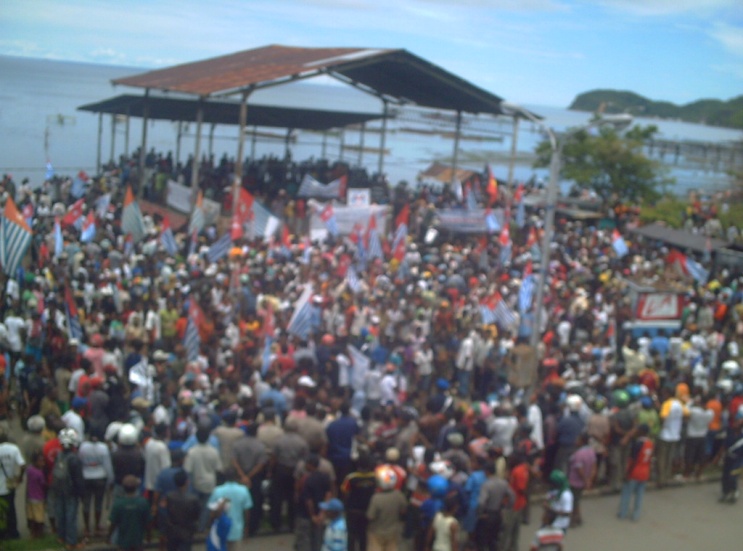
Over 400 Bintang Kejora (Morning Star) flags were flown by scores of people on a demonstration in Tanggal, Serui, West Papua.  According to media sources, they were demonstrating to  express support for launching of a US branch of International Lawyers for West Papua (ILWP) – this is spelt out as the International Parliamentarians, not Lawyers – in the United States.  However sources on the ground confirmed to West Papua Media that the demo was carried out by over 5000 people in support of the Federal Republic of West Papua, and demanded full international legal recognition of Papuan’s desire for independence and to uphold the universal right to self-determination.

Confirming the event, Aston Situmorang of the NGO Working Forum of Cenderawasih Bay said that thousands of people had gathered to take part in the demonstration from all parts of the district of Serui. The participants first gathered  in three places and then converged on the location of the demonstration.  After they had made their way to Tanggul, a number of speeches were delivered in support of the ILWP.

When the local chief of  police was contacted regarding this demonstration, he denied that anyone had flown the kejora flag. ‘No such thing happened,’ he said. ‘It’s a lie.’ He said that  people marched together but no flags were flown. The demonstrators had only carried banners expressing support for the establishment of the ILWP in the US.

This slideshow requires JavaScript.

Pictures from the mass flaying of banned Morning Star flags, Serui, 20 April 2012.  According to Indonesian police: “No such thing happened… It’s a lie.” 

Organisers of the demonstration contradicted the police version of events, claiming several groups of up to 470 flags (in each group) were flown, after Police and military attempted to blockade the rally with force.  However given the sheer number of flags, security forces did not attempt to intervene and allowed flags to be flown, an act which carries severe prison terms under the provisions of makar (treason).

A successful tactic employed by rally participants was  mass body painting of the Morning Star flag, an act that although challenging makar provisions remains unenforceable under Indonesian Law.

According to another report about the demonstration in JUBI on the same day, the local police chief in Serui had allowed fifty flags to be flown at the demonstration. According to the organisers, the majority  of the participants were waving flags.

[A photo illustrating the article shows a large number of people, certainly more than fifty, and in this section of the crowd, I was able to count about twenty flags. Translator.]

It was reported that the local police had refused to allow people at the demonstration to take photos. According to the organisers, ‘As we were marching along the road, the police prohibited the use of cameras, but after the people arrived  at the location (Tanggul), the police then allowed photos to be taken.’

Aston Situmorang said  that demonstrators had come from all parts of the district; some were arrested in several places in the town centre, but they were not held for long and after being released, they were able to rejoin the demonstration. As they arrived at the location of the demo, a number of people made speeches..

Many of the participants had walked a long distance from Mantembu, with the whole march proceeding peacefully. After the speeches had been made, they dispersed.

The local chief of police, Yohannes Nugroho Wicakasono, said that the demonstration had been organised by the West Papuan National Authority (WPNA) and had proceeded peacefully, lasting from 9am till 1.30pm. He said that kejora flags had been flown, but after they had been given warnings, the flags  were taken down, collected and put away.

A more senior police chief in the town of Seruis, Daniel Prio Dwiatmoko denied that kejora flags had been flown, saying that the demonstrators had only carried banners   expressing support for the  ILWP which has just been set up in the US.

with West Papua Media, and translated by Tapol (UK)

Forkorus’ eye problems not properly dealt with

JUBI, 18 April, 2012
Forkorus Yaboisembut, one of five Papuan activists who was recently sentenced to three years for his participation in the Papuan People’s Congress held last October, is now known to be suffering from eye problems.This was stated by Olga Hamadi, a member of the team of lawyers who have been defending Forkorus and his four co-defendants.

‘Forkorus complained about his eye problems  when we paid him a visit last week,’ said Olga Hamadi, and added that he was not getting proper treatment for the problem. ‘I was taken to the polyclinic but the treatment I had there was not satisfactory,’ Forkorus told his lawyer.

The Dewan Adat Papua – Papuan Customary Council of which Forkorus is the chairperson said that they too have reported the problem to the authorities at the Abepura Prison where Forkorus is being held. Forkorus has also sent a letter about the problem to  the High Court in Jayapura.’ His lawyer said that Forkorus had asked for their help to submit his letter to the High Court.

According to Olga Hamadi, the eye problem is not too severe and Forkorus is otherwise in good health.

Create a website or blog at WordPress.com

Up ↑