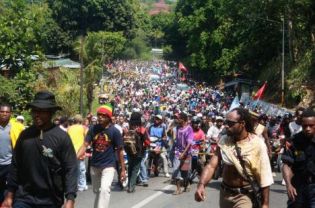
Thousands of Papuans march in a rally in Jayapura on July 8, 2010 to urge the provincial parliament to demand a referendum on self-determination, and reject the region's special autonomy within Indonesia. (AFP Photo/Banjir Ambarita)
Hundreds of Papuans have protested in Jayapura rejecting the region’s special autonomy within Indonesia and demanding a referendum on self-determination.
Carrying a wooden coffin covered with a black cloth which said “Special Autonomy is Dead in Papua,” more than 1000 activists, students and church leaders protested on Wednesday in front of the provincial parliament, witnesses said.
“Independence for Papua, reject special autonomy,” they shouted.
“Indonesia the coloniser, Indonesia the oppressor, Indonesia the robber.”
They also called for the upper house of tribal leaders called the Papua People’s Assembly (MRP) to be disbanded.
“The MRP had done nothing to improve the welfare of Papuans. Our people are poor in their own land,” protest coordinator Selpius Bobi said.
“We reject special autonomy as that is the Indonesian government’s policy which has never supported the natives. We want a referendum that will allow us to determine our own fate,” he added.
Papua’s special autonomy status, introduced in 2001 after the fall of former president Suharto’s military dictatorship, has seen powers including control of most tax revenue from natural resources devolved to the provincial government.
However many Papuans say it has failed to improve their rights and activists accuse the Indonesian military of acting with brutal impunity against the indigenous Melanesian majority in the far-eastern region.
A court martial jailed three Indonesian soldiers on Monday for up to 10 months for abuse and insubordination after graphic video footage showed them torturing civilians in Papua.
The sentences were criticised by the United States and rights campaigners as too lenient.
Foreign media and aid workers are not allowed into Papua and West Papua provinces to investigate allegations of human rights abuses against the indigenous people.
Papua has been the scene of a low-level insurgency for decades and despite Indonesia’s vast security presence in the region, Jakarta remains extremely sensitive about any sign of separatism.
More Than 100 Political Prisoners Held for Protesting Peacefully
(New York, January 25, 2011) – The Indonesian government should ensure
that soldiers responsible for abuses are appropriately prosecuted and
punished, Human Rights Watch said today in its World Report 2011. The
January 24, 2011 verdict in a Papua military tribunal of eight to ten
months imprisonment for soldiers who engaged in torture was woefully
inadequate, Human Rights Watch said.
The 649-page report, Human Rights Watch’s 21st annual review of human
rights practices around the globe, summarizes major human rights
trends in more than 90 countries and territories worldwide. Over the
past 12 years, Indonesia, the report says, has made great strides in
becoming a stable, democratic country with a strong civil society and
independent media, but serious human rights concerns remain.
“Senior officials must both talk the talk and walk the walk on human
rights,” said Elaine Pearson, deputy Asia director at Human Rights
Watch. “The military should stop shielding its officers from
prosecution, and the government needs to hold abusers accountable.”
In July 2010, the US government lifted its ban on military assistance
to Kopassus, Indonesia’s elite special forces, despite continuing
concerns about its human rights record. Strong evidence of security
force involvement in torture emerged in 2010. Defense Minister Purnomo
Yusgiantoro pledged to suspend soldiers credibly accused of serious
human rights abuses, to discharge those convicted of abuse, and to
cooperate with their prosecution. But only a handful of cases made it
to military tribunals, and the charges did not reflect the gravity of
the abuses committed.
In October, a 10-minute cell phone video came to light that showed
Indonesian soldiers interrogating and brutally torturing two Papuan
men, Tunaliwor Kiwo and Telangga Gire. In the video, Kiwo screams as a
piece of burning wood is repeatedly jabbed at his genitals. After
pressure from foreign governments, the military finally held a
tribunal in Jayapura, Papua, in January. But it is only tried three of
six soldiers in the video – Second Sgt. Irwan Rizkiyanto, First Pvt.
Jackson Agu, and First Pvt. Thamrin Mahamiri of the Army’s Strategic
and Reserve Command (Kostrad) 753rd battalion – on military
discipline charges, rather than for torture. The three were sentenced
to ten months, nine months, and eight months respectively. Military
prosecutors only sought sentences of up to 12 months rather than the
maximum 30 months as allowed under the military criminal code.
Another torture case captured on video in 2010 involved several
soldiers kicking and beating villagers in Papua. Four soldiers from
the same Kostrad 753rd battalion were tried on military disciplinary
grounds and were sentenced only to five to seven months in prison. The
convictions are on appeal before the Surabaya high military tribunal.
These two cases were unusual in that the ill-treatment was captured on
video, but for years Human Rights Watch has documented serious human
rights violations in Papua for which soldiers have never been held to
account. Human Rights Watch called on the US to publicly clarify its
relationship with the Kostrad 753rd battalion and the individuals
involved in this incident, in order to ensure compliance with the
Leahy law.
“Rather than cooperating with civilian authorities and suspending the
soldiers involved as soon as the video appeared, the Indonesian
government has dragged its feet and reluctantly done the bare minimum
to try and make this go away,” said Pearson. “This is not the new and
improved army that the defense minister promised, but the same old
military impunity we’ve seen for decades in Indonesia.”
The government did little to curb attacks and discrimination against
religious, sexual, and ethnic minorities during 2010. On several
occasions, militant Islamic groups mobilized large groups of private
citizens and attacked places of worship of religious minorities.
Police frequently failed to arrest the perpetrators of the violence.
While Indonesia has vibrant media, throughout 2010 Indonesian
authorities invoked harsh laws to prosecute individuals who raised
controversial issues, chilling peaceful expression. Indonesia’s
criminal libel, slander, and “insult” laws prohibit deliberately
“insulting” a public official and intentionally publicizing statements
that harm another person’s reputation, even if those statements are
true. For instance, in early 2010, Tukijo, a farmer from Yogyakarta,
was sentenced to six months’ probation and a three-month suspended
prison sentence for criminal defamation after he argued with a local
official regarding a land assessment.
The government has imprisoned more than 100 activists from the
Moluccas and Papua for rebellion for peacefully voicing political
views, holding demonstrations, and raising separatist flags. In
August, the authorities arrested 21 Southern Moluccas activists in
Ambon and Saparua and charged them with treason for planning to fly
balloons and Southern Moluccas Republic flags during a visit by
President Susilo Bambang Yudhoyono.
The country’s political prisoners include Filep Karma, 51, a Papuan
civil servant imprisoned for organizing a Papuan independence rally on
December 1, 2004, and Buchtar Tabuni, 31, a leader of the West Papua
National Committee, a Papuan independence organization that has grown
more radical since his imprisonment.
Government restrictions on access to Papua by foreign human rights
monitors and journalists imposed when Indonesia took over Papua in
1969 remained in place in 2010.
“By keeping the foreign media and rights organizations out of Papua,
the Indonesian government is all but admitting that serious abuses
persist,” Pearson said. “Ending those restrictions would be a first
step in reversing Papua’s downward spiral.”
For more information, please contact:
In Perth, Elaine Pearson (English): +61-415-489-428 (mobile)
In Washington, DC, Sophie Richardson (English, Mandarin):
+1-917-721-7473 (mobile)
In Jakarta, Andreas Harsono (English, Bahasa Indonesia):
+62-815-950-9000 (mobile)
The Australian Greens have called for the Government to cut all military
ties with Indonesia in response to light jail terms handed down
yesterday to Indonesian soldiers who tortured two Papuan men.
Greens legal affairs spokesperson Senator Scott Ludlam said the conduct
of the Indonesian government and the farcical trial of the three
soldiers involved showed a “total lack of respect for human rights”.
“What we have here is an open and shut case of severe torture, with
video evidence, and the soldiers responsible will spend, at most, 10
months in prison and then continue their careers in the Indonesian army
– they won’t even be discharged. It is a disgrace – an absolute
disgrace,” said Senator Ludlam.
“There is no ambiguity here. A video of the torture shows the soldiers
burn one man’s genitals, suffocate him with a plastic bag and hold a
knife to his throat. One of the victims said he was beaten for two days,
held over a fire and had chillies rubbed into his wounds,” he said.
“First the Indonesian authorities claimed their soldiers were not
responsible, and then charged them with ‘disobeying orders’. It was a
pathetic response from a government that couldn’t care less about the
human rights of the Papuan people.”
Senator Ludlam said the Australian Government must cut military and
para-military ties with Indonesia.
“Why are we helping to train and arm these soldiers? Why do we fund the Indonesian National Police when its Detachment 88, a so-called
counter-terrorism unit, has been linked to a series of human rights
abuses?” said Senator Ludlam. “While human rights abuses, while torture
continues in Papua and Maluku, we can not fund and train the people
responsible.”
Amnesty Urges Torture Charges On Indonesia Soldiers
Jan 14 (AFP) — Indonesian soldiers on trial for the alleged brutal
abuse of two Papuans should be charged with torture rather than the
minor offence of disobeying orders, Amnesty International said
Saturday.
The three soldiers appeared Thursday before a military tribunal, after
the online broadcast of a video showing the torture of unarmed men
sparked an outcry.
But they were charged with disobedience to orders rather than more
serious crimes such as illegal detention and abuse.
In the video, posted on YouTube last year, soldiers place a burning
stick to the genitals of an unarmed man and threaten another with a
knife as part of an interrogation about the location of weapons.
“Amnesty International urges the Indonesian authorities to ensure that
the three soldiers… (are) tried in full criminal procedures for
torture or similar crimes,” Amnesty’s Asia-Pacific Deputy Director
Donna Guest said.
Military prosecutors have said they lacked evidence of torture because
the victims would not testify, despite the existence of a CD of the
video and detailed statements given by the victims to human rights
groups.
According to the National Human Rights Commission, the victims would
like to testify but were terrified of military reprisals, and had not
received adequate safety guarantees.
“Amnesty International believes that the civilian courts are much more
likely to ensure both prosecution for the crimes involving human
rights violations and protection for witnesses than the military
system,” Guest said in a statement received by AFP.
Indonesia had pledged to rein in military abuses in regions such as
Papua and the Maluku islands in return for renewed US military
exchanges. The soldiers face a maximum sentence of two and half years
in jail.
Daily Press Briefing
Washington, DC
January 13, 2011
INDONESIA Trial of Three Indonesian troops
Indonesia must hold Security Forces to High Human Rights Standards
U.S. Closely Monitoring Cases
Indonesian Commitment to additional Human rights training for Police
Indonesia’s performance Very Important in to U.S. Cooperation
…
QUESTION: A question on Indonesia. Three Indonesian troops have just gone on trial at a military tribunal. They are accused of the torture of two Papuan separatists. But apparently, they’re only facing charges of a disciplinary infraction. Do you have any comment on that and whether it casts any doubt over the sincerity of Indonesia to reform its security forces?
MR. CROWLEY: Well, it’s vitally important for Indonesia to reform its security forces and hold those forces to high standards in terms of individual conduct and human rights. We have called upon Indonesia to aggressively investigate evidence of wrongdoing in violation of human rights, and we will be closely monitoring these cases.
QUESTION: Does – can I have one follow-up on that? Is there additional concern because last year, the United States reinstated military ties with the commando unit in Kopassus?
MR. CROWLEY: Right. And at the time, we obtained a commitment from Indonesia that it would undertake additional training and police its security forces and make sure that they were held to a high standard, and where there was concerns about a violation of human rights, that they would be fully investigated and, where necessary, face legal action. We’re going to hold Indonesia to those commitments.
QUESTION: So if there were continued signs of abuse such as this —
MR. CROWLEY: Again, we are —
QUESTION: — and (inaudible), those ties could be —
MR. CROWLEY: Trust me, we are closely monitoring Indonesia’s performance, and that will be very important in terms of the cooperation. And remind that we’ve undertaken limited cooperation, but we’re – this is still an area that we are closely watching.




 West Papua Media Alerts