Differing responses to ILWP meeting on 2 August

Bintang Papua, 27 July, 2011

Abridged in translation by TAPOL

Jayapura:  The news that the International Lawyers for West Papua is to hold a meeting in the UK on 2 August has led to a variety of responses.On the one hand, there are those who think this  will be of no positive benefit for Papua.

The Central Presidium of the  National Struggle of the Papuan People  regards this as nothing more than ‘romanticism of history’. This was the view of  the organisation’s chairman, Arkilaus Baho, speaking at a press conference. He was of the opinion that it would be more useful  to have talks between the Indonesian government  and the TPN/OPM like the talks that were held some time ago held with GAM about Aceh. He expressed the view that both the TPN (the armed wing of the OPM) and the Indonesian government would be prepared to hold talks. ”These talks could be held before the end of 2011,’ he said.

But Usama Usman Jogobi , speaking at another press conference together with his colleagues, said that he enthusiastically supports the holding of this conference.Usama is the co-ordinator of SDHRP, Democratic Solidarity and Human Rights of the Papuan people. He hoped very much that all sections of the Papuan people would support this meeting. ‘We support it whole-heartedly,’ he said.’We very much hope that the decisions taken at the conference will contribute towards resolving the continuing conflicts in Papua,’

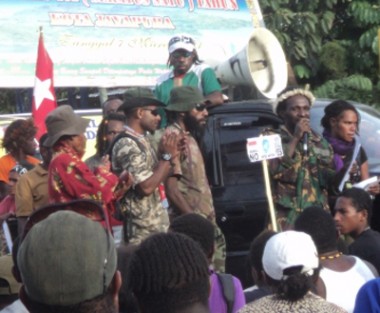
Mako Tabuni, chairman  of the National Committee of West Papua (KNPB) also expressed support for the event. He went further, saying that his organisation was planning to organise  a peaceful demonstration outside the DPRP head office on 2 August. ‘I have received an acknowledgement (to my request) from the police about this event. ‘I am quite  quite certain that this peaceful demonstration will take place,’ he said.

House of Lords question on West Papua

[TRANSCRIPT]
House of Lords, Oral Question, 19 July 2011

Indonesia: West Papua

Question

2.36 pm

Asked By Lord Harries of Pentregarth

To ask Her Majesty’s Government what steps they are taking to encourage
the government of Indonesia to enter into dialogue with representative
leaders of the West Papuan opposition.

The Minister of State, Foreign and Commonwealth Office (Lord Howell of
Guildford): My Lords, the United Kingdom has long encouraged the use of
constructive dialogue to resolve differences between the Government of
Indonesia and the credible representatives of the Papuan and West Papuan
people. We welcome the Papuan peace conference held in Jayapura from 5
to 7 July, which included discussions between Indonesian government
Ministers and Papuan community leaders addressing political differences
over regional governance and possible avenues for further dialogue.

Lord Harries of Pentregarth: I thank the Minister for his reply. I am
particularly glad that he has drawn the attention of the House to the
recent peace conference, when more than 500 representatives of different
aspects of West Papuan society gathered in order to call for serious
negotiations with the Indonesian Government and to appoint five people
to negotiate on behalf of the West Papuan people. Will the Minister ask
the Indonesian Government to respond to this initiative?

Lord Howell of Guildford: I am grateful to the noble and right reverend
Lord for his question. We are discussing these matters with the
Indonesian Government. We know they are committed to trying to carry
this process forward. It is a matter of them putting their money where
their mouth is because Papua and West Papua receive by far the largest
chunk of the regional funds from the central government. They want to
carry this forward. I think the message of the noble

19 July 2011 : Column 1192

and right reverend Lord is the correct one and we shall continue to
encourage a constructive dialogue, as I have described.

Lord Avebury: Considering that, after many years of struggle and
destruction of the economic potential, the Government of Indonesia came
to an agreement with the people of Aceh on devolution, will the Foreign
Office ask Jakarta to refrain from arresting and imprisoning dozens of
people in West Papua for so-called subversion and at least have
discussions with the OPM to see how the benefits of mineral
exploitation, including BP’s LNG project in Bintuni Bay, could be more
widely shared with the people?

Lord Howell of Guildford: On my noble friend’s final point, my
understanding is that not only BP but Rio Tinto and other major
investors are determined to work out ways in which the benefits can
indeed be shared more widely with the people. My noble friend is
absolutely right about that. We have raised queries about some of the
arrests-there was one over displaying the wrong flag or something like
that-and the size of the sentences seemed disproportionate. We are aware
of these worries and we shall continue to raise them with the Government.

Lord Hannay of Chiswick: My Lords, does the Minister not agree that
Indonesian policy in West Papua and Papua-I declare an interest as a
regular business visitor there for eight years between 2001 and 2009-is
a rather disturbing mixture of generosity-as the noble Lord has
explained, those provinces are the biggest aid recipients of transfers
of resources within Indonesia-and repression? It must surely be in the
interest of the Indonesian Government to strengthen that generous strand
and to reduce the repression and, above all, to allow the international
press free access to Papua and West Papua so that they can see what is
really going on.

Lord Howell of Guildford: The noble Lord is absolutely right: it is not
only in the interests of Indonesia-wherever there is repression, it is
not the right way forward-but in our national interest as well. It may
seem far away, but the reality is that we are talking about an area
mid-way between the Pacific rim and the Indian Ocean, where all the
world’s growth, dynamism and accumulation of wealth and influence will
be. It is very important that we are constructively and helpfully
involved there.

The matter of journalists’ access to Papua and West Papua was discussed
at the EU human rights partnership meeting with the Indonesians in
Indonesia on 5 May. It is one that we continue to raise, because clearly
access for balanced reporting would be of benefit to the situation.

Lord Anderson of Swansea: My Lords, in terms of human rights, it is
normally best for representations to be made on behalf of the European
Union as a whole so that individual countries are not picked off. What
is the position here? Have there been representations by the European
Union? Are we fully behind them?

19 July 2011 : Column 1193

Lord Howell of Guildford: Yes. I described in my answer to the previous
question that on 5 May there was an EU meeting that discussed a number
of aspects of repression, including a matter that the noble Lord, Lord
Avebury, quite often and rightly raises-the question of the apparent
persecution of, and violence against, the Ahmadiyya community and other
Christian communities. All these matters are indeed discussed and were
discussed at that very helpful forum between the European Union and the
Indonesian Government on 5 May.

Lord Liddle: The whole House will welcome the progress-uneven
progress-being made on human rights in West Papua, and on human rights
in the rest of Indonesia, and will welcome Indonesia’s joining of the UN
Human Rights Council, but what positive progress is being made under the
EU-Indonesia dialogue? What active support are the British Government
giving, particularly in terms of ministerial visits such as that of Mr
Jeremy Browne last year to Indonesia? How do the Government balance
their proper concern for human rights with their present emphasis on
expanding UK trade in emerging markets such as Indonesia?

Lord Howell of Guildford: The answer to the noble Lord’s general
question is that we do balance. In many cases, one would argue that the
two go together. If we can get expanded commercial and economic
activity, effective inward investment and the expansion of trade, this
will pave the way for a more open society and a more effective policing
of human rights.

Results are a bit difficult to measure. All that can be said is that
there is a human rights dialogue between the European Union and
Indonesia. We support it fully. Our evidence in this increasingly
transparent world is: first, that it is getting more difficult for any
country that wishes to oppose and repress human rights to do so;
secondly, that we intend to try to make it more difficult for them to do
so; and thirdly, that the Indonesian state, whose territorial integrity
we fully support, is anxious to carry forward and sensibly settle this
and other human rights issues in a good and constructive way.

‘West Papua – The Road to Freedom’ conference, Oxford, UK, Aug 2

from International Lawyers for West Papua

Next Tuesday 2nd August, international lawyers, politicians, tribal leaders, a UN committee member & a witness to the 1969 Act of Free Choice will gather for the Road To Freedom conference in Oxford, UK.

Chaired by British MP Andrew Smith, the conference will present the strongest case to date that the people of West Papua have the right to self-determination under international law.

People across West Papua will be following the conference and will use its outcomes to further their campaign for freedom.

List of speakers include:

  • Andrew Smith – British politician
  • Jennifer Robinson – International human rights lawyer
  • Powes Parkop – Governor of Port Moresby and the National Capital District, PNG
  • Benny Wenda – West Papua independence leader, UK
  • Frances Raday – Expert Member of the UN Committee for the Elimination of Discrimination Against Women
  • John Saltford –  Expert on the 1969 Act of Free Choice
  • Clement Ronawery – Witness to the 1969 Act of Free Choice
  • Ralph Regenvanu – Vanuatu Justice Minister
  • Charles Foster – co-founder of the International Lawyers for West Papua

As a sign of support for the conference and in solidarity with the Papuan peoples struggle for freedom, the Mayor of Oxford has agreed to fly the Morning Star flag above Oxford Town Hall on the day of the conference.

The conference is taking place at Oxford University’s East School of the Examination Schools, 75-81 High Street, Oxford, OX1 4BG. It will commence at 2pm

Those wishing to attend are required to register by emailing conference@ilwp.org

The hope for Papua’s freedom: ‘Go International’

image

Apologies for delay in posting

Tuesday, 03 May 2011 19:58

Editor : Markus

Tabloid JUBI — The struggle of the native people of Papua for freedom from all the evils they have suffered since their annexation into the Unitary Republic of Indonesia on 3rd May 1963, still echo to this day, not only on the local and national scene, but already internationally.

“At this time, our hopes for freedom for the People of West Papua depend on the support of the world. Privately and through our own organisations we are struggling, but now we have the help and sympathy of all the countries of the world,” said the Head of the National Committee of West Papua, Mako Tabuni, on Tuesday 3rd May 2011.

Support from the international world is growing and becoming stronger,for example from Israel.  This is a long campaign, and this is the way to do it – by gaining friends. “The problems of West Papua are also world problems, and Indonesia has to open itself up to recognise the truths of its history, of what happened some decades ago,” said Mako.

The formation of  two  bodies called International Lawyers for West Papua (ILWP) and International Parliamentarians for West Papua (IPWP), said Mako, came about as a result of the world’s notice and support for West Papua. ‘We are being well supported by the ILWP and the IPWP, which are fighting for the fate of West Papua.”

He said this as on the day after Monday 2nd May, when thousands of people had marched peacefully to assemble at the Post Office in Abepura, Jayapura.

The KNPB (National Committee) had emphasised several important points which are tied to our history, status and the sad fate of the people of Papua.

Firstly, the people of West Papua have not, did not nor ever will give their consent to join the Unitary Republic of Indonesia (NKRI) to become a part of their republic, West Papua.

Secondly, the process of making West Papua part of the NKRI, beginning in 1963 and finishing in 1969, organised jointly by Indonesia, United States of America, the Netherlands and the United Nations, was engineered as a false process, not following the Principles of international justice. The owners of the area of West  Papua were never involved in the process, and the international talks and arrangements took no account of their wishes.

Thirdly, the agreement called “The New York Agreement” was not supervised by the whole of the United Nations, resulting in the “referendum” of 1969, where the people of West Papua were not given their political right to vote on the basis of “one person, one vote”; this “vote” consisted of only 1025 people chosen by Indonesia to “represent” West Papua. This is a violation against the political rights of the people of West Papua.

Fourthly, NKRI has killed and destroyed many of the native citizens of West Papua since they began their DOM (Local Military Operation) to take up possession of the land of West Papua in 1963.

Fifthly, NKRI has pursued, intimidated, terrorised and killed many of the citizens of WP since this operation began.

Sixthly, Special Autonomy was offered as a solution to these problems. This policy was never really implemented as promised and published as policy by Indonesia.

Seventh, the only thing which is supporting Special Autonomy, which is the one thing the NKRI is offering, is part of their colonisation of Papua which nullifies the political rights of the native people of Papua, because the foremost problem for them is their right to determine their own future for themselves, which has been suppressed and undermined by the unilateral annexation of Papua through the so-called Act of Free Choice of 1969.

“We do not recognise the right of the Government of Indonesia, and all the institutions of that country, to stand in the nation of West Papua,” said Mako Tabuni, reading from a petition which had been signed by the whole assembly which had attended the march.

What we, the KNPB, are demanding is, firstly: that Indonesia stop all political manoeuvres using the Special Autonomy, formation of the MRP and the UP$B program in the land of West Papua.

Secondly, Indonesia and West Papua be the subject of an international legal process so that the political status of West Papua can be brought to the table at the International Cpurt, to determine a just policy about the validity of Indonesia’s annexation of the land of West Papua, and a justice for the people of West Papua.

Thirdly, in order to determine the will of the people of West Papua, a Referendum be held in a democratic way by the United Nations, to find a final solution to the political conflict in West Papua.

To find a framework to support this process to end the problems in West Papua via an international legal and political process, the KNPB puts forward the name of  Ms. Melinda Janki as Head of the ILWP, Mr. Charles Foster and all the members of the ILWP.

Also,  Mr. Andrew Smith as Head of the IPWP, Mr. Caroline Lucas together with all members of the IPWP to support the political process to bring the matter before an  internasional forum, together with the support of a free Papua. Also, the Government of the Republic of Vanuatu, as a member of the United Nations, also gives a similar mandate  to determine the legal status of West Papua through an international legal process at the International Court of Justice.

At the same time, the Spokesperson of the International KNPB, Victor Yeimo, can be a representative and coordinator to express the hopes and expectations of the people of West Papua. For this to happen, we need to form a representative body: a National Council of West Papua.

“It is not just anyone, it is the people of Papua alone who can bring about freedom. So, let us, the people of this land, come together and work and struggle,” said Yeimo.

About twenty Papuan representatives who addressed the assembly signed a petition before the demonstration ended at about 6 pm.

 (Markus)

West Papua is Indonesia’s Palestine.

West Papua is Indonesia’s Palestine.

Opinion
August 16, 2010

John Ondawame is right. West Papua is on the verge of a “total intifada” (Ben Bohane, ‘West Papua warns of intifada against Jakarta’, Sydney Morning Herald, August 7 2010). Intifada means to “shake off” in Arabic. It has become a word used to describe the desire by Palestinians to free themselves from foreign occupation. The question is what kind of intifada is and will take place in West Papua? Will it be like the recent Palestinian intifada, led by a resurgent Hamas? An uprising of fury waged through political terror. Or will it be like the 1987 Palestinian intifada, a largely unarmed insurrection?

West Papua is the Indonesia’s Palestine. Papuans consider that their land has been occupied without their consent. Freedom of expression is prohibited, foreign journalists banned, migrants continue to pour into the country, and the police and military keep a repressive lid on boiling Papuan anger. It is also a modern day Avatar. Papuans are defending their land form the exploitative practices of resource extractive industries. For the Papuans theirs is a struggle for survival.

However, unlike Palestine and the film Avatar, resistance to the Indonesian government’s rule has overwhelmingly been through civilian based movements. Only last month, for instance, 20,000 plus people – students, women, young people, religious leaders, NGO activists, traditional chiefs, farmers and even members of the Majelis Rakyat Papua, West Papua’s indigenous senate – all converged on the capital and occupied the provincial parliament for two days to pressure the Papuan political elite to hand back Special Autonomy, a package or policy, finance, and legislation designed to give Papuans a measure of self-rule. After ten years of broken promises and still born hopes, Papuans concluded Special Autonomy had failed. It is a news story that should have been covered by every major media outlet. But here in Australia we heard next to nothing.

Now, as Bohane writes, Papuans are feeling abandoned by their Melanesian kin. At the recent Pacific Island Forum, Vanuatu tried to raise the West Papua issue but Papua New Guinea’s political leaders blocked the discussion. Again. The Australia and New Zealand governments also failed to raise their voice for on behalf of Papuan rights. Again.

Some Papuan leaders are now talking about making the territory ungovernable through mass civilian based non-cooperation with Jakarta. How long civil resistance continues depends not only on the tactical and strategic choices made by Papuan leaders. In part it also depends on whether solidarity movements in the region, including inside Indonesia, can raise the political and economic costs so that political leaders and foreign companies feel compelled to agree to what Papuans have been demanding for years: political dialogue with Jakarta and the international community about their grievances.

Will the international community support the Papuan’s right to rise up for freedom? Or will they send the same message they sent to the Kosovo Albanians? That international intervention and the goal of independence will only come about when there is armed struggle and mass violence. Surely we can all do better than that.

Jason MacLeod

(The writer lectures in political science at the University of Queensland.)

Create a website or blog at WordPress.com

Up ↑
