Reports of shooting in Paniai

JUBI, 17 August 2011

On 17 August, at 1.55 am, there was the sound of gunfire in Pagepota and
Uwibutu, two kampungs that are not far from Madi, the capital of the
district of Paniai. There were no reports of any casualties, however.

From another source in Paniai, it was reported that at 5am, armed
civilian groups believed to be part of the TPN/OPM were using two
locations in the vicinity of Madi as their base from which to attack the
Indonesian army and police based in Madi. This is near the building in
which the DPRD Paniai has its office.

As a result of the fact that the areas are now under the control of
armed civilian groups, people living in Madi are unable to travel
anywhere because it is through these areas that people travel back and
forth from Madi to Enaro and Bibida.

The gunfire stopped for a while but was heard again between 5am and 7am,
then at 9.30am and then later in Enarotali.

Two days earlier, spokesmen for the Synod of the KINGMI Church and the
Catholic Church in Paniai said that they were very worried about the
security situation in Paniai during the past few days. They said that
reports of armed conflict between the TPN/OPM and the security forces
have worried the population and some people have even decided to leave
their homes in search of somewhere safer.

Acts of violence are damaging the Papuan people, says DPD member

Bintang Papua, 8 August. 2011

Sofia Popy Maipauw, a member of the DPD, the Council of Regional
Representatives, said that the recent upsurge in acts of violence that
have been occurring in the Land of Papua can be very damaging for the
Papuan people and called on those who are responsible for all this
violence to stop.

She said she doesn’t want to mention any names but insists that all
those involved in violence should stop. The incident in Ilaga, district
of Puncak Jaya and the Nafri incident in Jayapura have been very
harmful for indigenous Papuan people. These incidents have had damaging
consequences for the economy. People living in the kampungs are afraid
to come to the markets to sell their products, which can result in an
increase in the price of these products, she told journalists in Jayapura.

She went on to say that the indigenous Papuan people are much weaker
economically than other people in the province which means that these
acts of violence can be very burdensome for them.

‘I would like to know what the state intelligence agency, BIN, has been
doing all this time. The recent shootings in Papua are not the first
time such things have happened. They keep on happening but no action has
been taken against those responsible,’ she said.

She said that in November last year, a similar incident occurred in
Nafri but no one has been arrested and held to account for this
incident. Incidents like this, she said, give the Papuan people a very
bad reputation. Such stigmas must end so that Papuans can feel
comfortable as part of Indonesia.

She went on to say that SBY, the president, should not keep silent about
problems in Papua but should take action to prevent these incidents from
occurring and ensure that these incidents are dealt with seriously. She
said that this was a huge challenge for the new chief of police who
should take action regardless of who is involved. ‘The acting governor
of Papua should take responsibility for safeguarding the forthcoming
local elections. He should cooperate with the Elections Commission (KPU)
of the province of Papua to deal with any violations that occur during
the elections,’ she said.

BBC: US Firm Freeport Struggles To Escape Its Past In Papua

August 8, 2011By Karishma Vaswani BBC News, JakartaThe US mining firm Freeport McMoRan has been accused of everything from polluting the environment to funding repression in its four decades working in the Indonesian province of Papua. A recent spate of strikes by workers has brought all those uncomfortable allegations back to the surface.

“Ask any Papuan on the street what they think of Freeport, and they will tell you that the firm is a thief,” said Neles Tebay, a Papuan pastor and co-ordinator of the Papua Peace Network which campaigns for more rights for local people.

“It is in the interests of the Indonesian government that Freeport stays in Papua because it pays so much money to the state.”

For decades, a small number of Papuans have fought an armed struggle for independence from Indonesia.

But Neles Tebay believes the US mining firm plays a crucial role in that struggle: “Papua will never become independent as long as Freeport is in Papua.”

Yet Freeport says it provides vital jobs and wealth to the people of Papua. It is a decades-old row.

Massive profits

In the mid-1960s, Indonesia was undergoing a political transformation – and facing potential economic collapse. The government led by General Suharto was desperate to gain legitimacy with the international investment community – a hard task when Indonesia was seen as a risky market.

Suharto got the legitimacy he was looking for in 1967 – when Freeport became the first foreign company to sign a contract with the new government. In exchange, Freeport got access to exploration and mining rights for one of the most resource rich areas in the world.

In 1988, Freeport literally struck gold, finding one of the largest known deposits of gold and copper in the world at Grasberg in Papua.

Today, Freeport is one of Indonesia’s biggest tax-payers. In the last five years the firm says it has paid about $8bn (£5bn) in taxes, dividends and royalties to the Indonesian government. In the second quarter of this year alone, the company saw its profits double to $1.4bn.

But all of that money has yet to buy Freeport the reputation it needs in Papua. Thousands of Papuan workers walked out last month complaining about their wages, which they say are a fraction of what their international counterparts get.

Most Papuans believe that a contract Freeport signed with the Indonesian government in 1967 is invalid, because it was signed two years before Papua was officially incorporated into Indonesia by a controversial referendum.

The company says it signed a new 30-year contract with the Indonesian government in 1991, with provisions for two 10-year extensions.

But Papuans dispute the length of the deal, and the number of extensions Freeport has been able to get from the Indonesian government. Critics say Suharto wrote a blank cheque for Freeport, allowing the company to operate in any way it chose with little regard for consequences.

“The initial contract started in 1967, and was meant to end in 1997,” said Singgih Wigado, director of the Indonesian Coal Society.

“But in 1991, Suharto’s government renewed it – and then extended it for another 30 years, so now it ends in 2021. But Freeport is also entitled to two extensions during this period – of 10 years each. So Freeport’s contract really only ends in 2041.”

‘Law unto themselves’

By then, environmentalists allege that Freeport will have not only ripped all of the mineral wealth from Papua’s soil but it will also have destroyed the local waterways and killed off the marine life in the rivers nearest to the mine.

The lobby group Indonesian Forum for the Environment accuses Freeport of dumping hazardous waste into rivers.

“We’ve seen no improvements in their operations. The local communities are suffering because of Freeport’s presence in Papua,” said the group’s Pius Ginting.

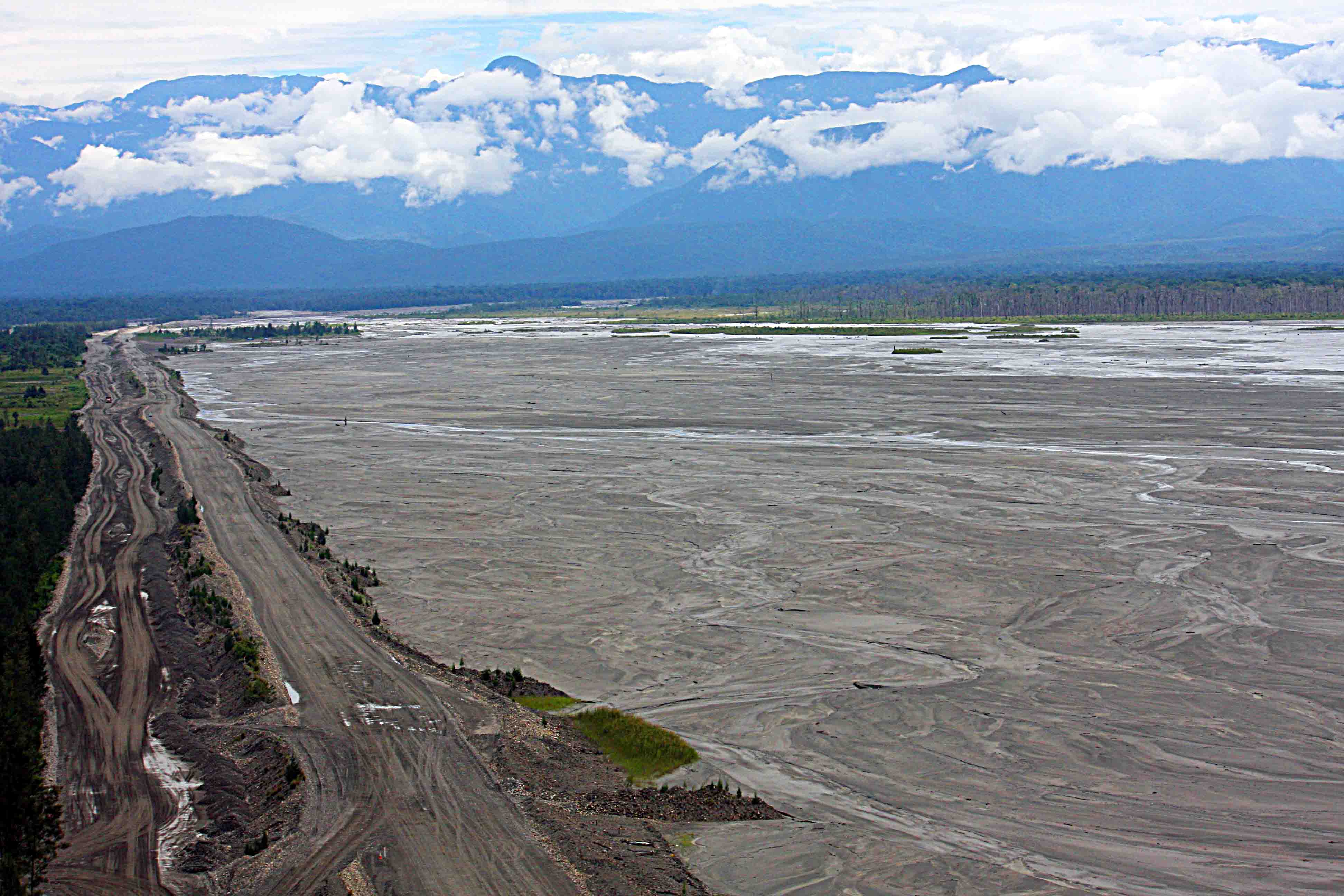
But Freeport disputes the claims, saying that it uses a river near the mine to transport waste and natural sediments to a large deposition area. This method, the company says, was chosen because studies showed it was the most feasible way of disposing of the waste, and the environmental impact caused by its waste material is reversible.

In a statement, the company argued that the current arrangement with the government was fair, and has resulted in significant benefits.

Some of those significant benefits include providing employment to scores of Indonesian police who are mandated by Indonesian law to protect the Grasberg mine. This used to be the job of the Indonesian military, who are still sometimes asked to provide extra support for the mine by the police.

Freeport estimates that it spent $14m on security-related expenses in 2010.

But human rights groups say Freeport is effectively financing the Indonesian military in Papua, and is turning a blind eye to the soldiers’ alleged human rights abuses in the province.

Andreas Harsono of Human Rights Watch says there are about 3,000 troops in the area, some of whom “tend to act as a law unto themselves”.

“They sometimes go beyond their duties of providing security to Freeport – and are also believed to be involved in illegal alcohol sales and prostitution,” he says.

The Indonesian military has consistently denied any wrongdoing in Papua.

Freeport defends its use of police and soldiers to guard the Grasberg mine, saying it is mandated under Indonesian law. Freeport has never been implicated in any human rights abuses allegedly committed by the Indonesian military in Papua.

Nevertheless, the company remains hugely controversial in the restive province.

“Freeport is a symbol of everything that is wrong with Papua,” said pastor Neles Tebay.

“Indigenous Papuans want to feel like they have control over their own future – and that means a right to safeguard their natural wealth.”

The BBC has requested to travel to Papua and visit the Grasberg mine, but access has so far been denied by Freeport.

Empty promises whitewash Freeport’s rights, responsibility record

 http://etanaction.blogspot.com/2011/08/empty-promises-whitewash-freeports.html

Special for ETAN‘s  Blog

by David Webster

What does a mining company need to do to get a top score for “corporate social responsibility”?

Freeport's contribution to Papua's welfare - Riverine tailings pollution

To judge by the recent “100 Best Corporate Citizens List”, all it takes to finesse a long and controversial record of human rights abuses is to come up with a piece of high-minded rhetoric, then carry on as usual.

Human rights advocates and those who have studied the record of Freeport McMoran in West Papua were startled to learn that Corporate Responsibility Magazine had named Freeport as the 24th-best corporate citizen in America (click for the full list). More startling still, the company scored well based mainly on a sixth-place ranking in the human rights category.

How is this possible? Well, the survey’s methodology seems to pay no heed to human rights performance. Only human rights rhetoric matters. And in that, Freeport excels. A strong written policy on human rights declares: “Freeport-McMoRan does not tolerate human rights transgressions.” It points to rights risks in West Papua, Peru, and the Democratic Republic of Congo, and adds that PT Freeport Indonesia policy is to “notify the direct commanders of the perpetrators” in cases where human rights allegations are made against Indonesian security forces. Since reputable human rights groups suggest that the top ranks of the security forces are implicated in widespread human rights violations in West Papua, this is hardly striking at the root of the problem.

As local people have pointed out, and researchers have confirmed, Freeport’s performance is a far cry from the written policies. The main trouble is intimate ties to Indonesian security forces.

Security forces may be implicated in the murder of American citizens near the Freeportmine, as Eben Kirksey and Andreas Harsono have reported.

Violence around the mine is used by security forces to target and scapegoat local people. In 2005, the New York Times revealed thatFreeport paid the security forces more than $10 million in 2001 and 2002. Payments are now made “in-kind” rather than in cash. The local Amugme people have long protestedFreeport seizure of their lands. Pictures of Freeport’s Grasberg mine from space (left) show the scale and environmental impact in the mountains that are home to the Amungme.

And lest all of this be hailed as “old news,” the Amungme filed a lawsuit last year sayingFreeport had taken their lands illegally. Meanwhile, the Indonesian army’s presence around Freeport, and the company’s close ties to Indonesian security forces, were reinforced this year. The continuing alliance between Freeport Indonesia and the Indonesian security forces is likely to exacerbate, rather than improve, the human rights situation.

None of these reports are taken in to account in the “100 Best Corporate Citizens List.” All the human rights indicators measure “human rights disclosure” and the sole source, according to the methodology details, comes from “Company public disclosures” – a corporation’s own information about itself.

The methodology, in other words, measures promises, not performance. There are parallels to the debate over whether companies accused of operating sweatshops overseas can be trusted to police themselves, or should accept independent monitoring. Thus the list cites the voluntary “Sullivan principles” first created under the Reagan administration and welcomed by companies resisting demands to divest from apartheid South Africa. AndFreeport boasts of adherence to the Voluntary Principles on Security and Human Rights, launched by the British and American governments in 2000.

The key word here is “voluntary.” As with the mining industry globally and with businesses jumping on the corporate social responsibility (CSR) bandwagon more generally, companies are happy to promise good performance, as long as no one will be looking over their shoulders.

So perhaps it’s no surprise to learn that Corporate Responsibility Magazine is in fact published on behalf of the Corporate Responsibility Officers Association, a body made up of many of the companies being judged, and steered by such firms as Domtar and KPMG.Freeport is listed as a “recent member” of the CROA. It’s advanced in the listings – it was ranked 83rd in 2010.

The problem here isn’t just the “corporate social responsibility” methodology, but the entire concept of “CSR”. It can all too often be used by companies to buy their way out of “corporate social irresponsibility.”

Freeport is no champion of the best values of corporate citizenship: For human rights activists, it’s long been a poster child for corporate irresponsibility. A list of good corporate citizens with Freeport winning laurels demonstrates more than flaws in the study. As George Monbiot has written of climate change credits, the lists offer corporations a new form of medieval European Catholic “indulgences,” forgiveness for any form of offence. Jeff Ballinger recently pointed out on this blog that companies like Nike are wrapping themselves in the CSR garment to burnish their corporate images, despite continuing disregard for many labor rights. Freeport, too, is now having itself measured for a fine CSR wardrobe.

—-

David Webster is an assistant professor of International Studies at the University of Regina inSaskatchewan, Canada. He is a former coordinator with the East Timor Alert Network/Canada.

see also

West Papua Report (monthly)

ETAN/WPAT: Statement on the operations of the Freeport McMoran Mine in West Papua, to the U.S. Senate hearing on Extracting Natural Resources: Corporate Responsibility and the Rule of Law

JUBI: Conditions in Keerom very bad

JUBI, 1 August 2011

Conditions in Keerom are very bad

The Coalition for Justice, the Rule of Law, Human Rights and Public Service (K2PH2P2) has expressed its concern about conditions in the district of Keerom during the first months of this year.

It said that the governing body is far from being capable, responsive and accommodative. Government workers are largely incapable and unresponsive and lacking in discipline in their work. In a press release issued on 1 August in Abepura, a group of leaders including church leaders, civil society leaders and human rights activists expressed their fear that development in the district which was intended for transmigrants is stagnant.

‘Discipline in the civil service is very bad. They live in Jayapura, arrive in their offices at 9am and go home soon afterwards, which means that the service they provide is very bad,’ said Bonefasius A. Muenda of the Keerom Social Institution. Most of them live in Jayapura and arrive in their offices quite late in the morning. Even worse, some of the civil servants only go to their offices twice or three times a week. For the rest of the time, they stay at home.

But there are other problems as well, according to the Coalition. In education for example, Pastor John Jonga, a leader of the Catholic Church in Keerom, said that hundreds of children receive no attention at all because there are no teachers. He said this was more likely to be thousands of children, not hundreds. Ironically, billions of rupiahs are allocated to education but the children are waiting for their teachers.

‘In Towe Hitam, 36 members of the armed forces are paid for by the government but there are no teachers. This is a crime,’ said Pastor Jonga who is a recipient of the Yap Thien (Hien) award.

But that is not all. Medical facilities are worryingly poor in this new district that was set up just a few years ago. Another pastor, Eddy Togotly was of the opinion that there is no serious intention on the part of the government to develop Keerom. ‘People dont come to Keerom to help with development. On the contrary.’

Meanwhile, the chairman of commission A of the provincial legislative assembly, Yosep Turot, said that some officials are so far from adequate that they should be sacked from their jobs. He said that there are a number of reasons for this, including the purchase and sale of certificates among officials which has an impact on the performance of the government.

In view of all this, the Coalition is calling for the appointment of a new local government chief who should be credible, intelligent, creative and concerned about the conditions of the people.   And they say that the new chief should pay full attention to the performance of his staff so as to ensure that they work for the development of Keerom and not for their personal interests.’

Create a website or blog at WordPress.com

Up ↑