Key Findings of the Biak Massacre Citizens Tribunal

http://www.biak-tribunal.orgBiak Massacre Citizens Tribunal

WaterTowerCrop1

December 16, 2013

Key Findings

  1. 1.      The massacre followed a flag-raising led by Filep Karma, an Amnesty International Prisoner of Conscience

Filep Karma testified at the tribunal via prerecorded video since he is currently in prison.  He told the tribunal: “In my oratory [at the flag-raising] I said that Papuans must fight peacefully.” “The flag appeared on the top of the tower on July 2, 1998, at about 5:00 a.m. Some seventy-five people gathered beneath it, shouting freedom slogans, singing songs and dancing traditional dances” (Human Rights Watch 1998: 6).

At 2:30 in the afternoon of July 2 “a joint police and military operation attempted to disperse the crowd at the base of the water tower.  They launched canisters of tear gas into the crowd with no apparent effect.  When a low-ranking police officer, a second-class sergeant, beat an elderly demonstrator named Thonci Wabiser, the crowd spontaneously retaliated, demolishing a truck belonging to Indonesian security forces” (Kirksey 2012: 44).  A standoff ensued for days.


  1. 2.      Local and regional officials were involved in the planning of the attack

Tineke Rumakabu testified that two officers of the Indonesian security forces were at the water tower on July 3rd.  These commanders—namely Colonel Agus Hedyanto, who was Biak Military Commander (Dandim) and Colonel Johnny Rori, the Biak Police Commander (Kapolres)—negotiated with the crowd and asked that the flag be lowered.  These same commanders were later involved in planning the attack.  “At 1:00 a.m. on July 4, the local military brought nine village heads together to discuss a strategy for attack, and both the subdistrict head (camat) and the subdistrict military commander told the village heads that each man was responsible for bringing thirty men into the city.” (Human Rights Watch 1998: 8).

Octovianus Mote, former Bureau Chief of the Kompas daily newspaper, gave testimony based on his interviews of regional military and police commanders in July 1998.  Major General Amir Sembiring, the Regional Military Commander (Pangdam Trikora), was in a direct command and control position during the attack.  According to direct evidence tendered by Mr. Mote to the Tribunal, Sembiring “gave permission to conduct the attack.”  Mr. Mote also corroborated reports that Colonel Agus Hedyanto, who was associated with the Special Forces and who served in East Timor, was the key local official involved in Biak.  “This was a very well-organized military attack, you know police, navy, and armed forces.  All of them organized the attacking of civilians,” continued Mr. Mote.  Brigadier General Hotman Siagian, the Regional Police Commander (Kapolda IrJa), was quoted by Antara news agency as saying “the police had ‘tolerated’ the actions of the Biak group since July 2 and finally had to order a crackdown” on July 6th (Prakarsa 1998).  Vice Admiral Freddy Numberi, who was then Governor and is currently Indonesia’s Minister of Transportation and Communications, described the victims a members of a “separatist movement that is headed towards treason” (Suara Pembaruan Daily, 8 July 1998).  General Wiranto, Commander of Indonesia’s Armed Forces, told reporters when asked about the massacre: “If there is a power that raises a flag, and it is not the Red and White flag [of Indonesia], then this is a betrayal of the military and of the entire nation.  This constitutes a betrayal and this is what we must stop!” (Suara Pembaruan Daily, 7 July 1998, punctuation in original).

  1. 3.      Scores of unarmed civilians were killed, buried in mass graves, and dumped at sea

A video testimony, by a woman named “Sarah”, described how the security forces initially surrounded the protestors in a giant letter U.  “The military and the police were lined up from the police compound around to the Inpress market.  The mobile brigade police (Brimob) that had flown in from Ambon were stationed at the petrol station.  Navy troops were down at the harbor.”  She describes how they were all shooting, “from four directions,” including the sea.

One woman, who testified to the Tribunal on condition of anonymity, described the first moments of the attack at dawn on July 6th: “The army and police were everywhere.  Bullets were raining down.  The sky was on fire.  We could hear them shooting people at the tower.”

Another witness, who testified under the pseudonym Raymond, described how he rushed to the water tower along with scores of other civilians as the shooting began.  After watching as many women and men were gunned down, Raymond was herded with other survivors towards the harbor.  He described how he was forced to stare at the sun, kneel in gravel for hours, along with dozens of others.

Sarah gave corroborating testimony: “My family and others were directed down to the harbor…We followed the other families with our hands up over our heads.  You could feel the bullets starting to fly over our heads…I could see so many children who had been killed.  They were shot on the wharf.  They died right there.”  Shortly after she arrived at the wharf, she overheard a Sergeant shouting out to the commander of a navy vessel: “Dock the ship!  Dock the ship!  Carry these people!”  She also overheard the reply from the captain: “I cannot dock, the ship is full of bodies.”  Sarah said that two ships then went out to sea.  “They were there at the harbor in the morning, there to take the bodies away.”  Later on “in front of the wharf a blue truck pulled up and took 28 bodies away,” Sarah said.  “I was sitting and counting, silently.  People who they had shot, they threw their bodies on the truck.  Later another container truck came in and took more bodies away.  We don’t know where they were taken.”

Ferry Marisan, Director of the human rights organization ELS-HAM Papua, investigated the killings in the weeks after the massacre and was a lead author of the subsequent report, “Names Without Graves, Graves Without Names.”  Mr. Marisan described how a fisherman first encountered dead bodies in the sea, off shore of Biak, on July 10th, four days after the massacre: “The fishermen discovered four bodies floating, but these fishermen were scared to take the bodies on shore…The bodies were mutilated, some of them lost their legs or their genitals were not there.  They were broken bodies. These bodies were found in the eastern part of Biak, but also in the western part of Biak people found other bodies.”  Mr. Marisan also gave direct testimony about a body he helped recover: “Near Biak city, just around the park, we found a female body without a head and genitals that was badly bruised and broken, damaged.  Another body we found was just a boy from junior high in his uniform.  Most bodies we found were badly damaged.  Either they lost their legs, the heads or their genitals.”

  1. 4.      People were beaten, tortured, arbitrarily detained, sexually abused, and executed

Raymond presented testimony about indiscriminate beatings by police at the harbor.  He was taken with six truckloads of people to the regional police station (POLRES).  Fourteen people were crammed with Raymond into a cell.  Raymond was detained for two weeks and in the middle of the night guards routinely doused him with water during his detention.

Statements from Tineke Rumakabu, describe graphic scenes of sexual violence and torture after she was detained by Indonesian forces.  Mrs. Rumakabu described how she was tossed into a yellow truck on the morning of July 6, on top of people who were already dead or seriously wounded.  She was then taken to the military compound (KODIM).  Mrs. Rumakabu showed the Tribunal scars on her arms and described what was done to her while she was blindfolded and cuffed: “They cut my arm with a sharp bayonet and then they poured acid. When I screamed they burnt me with cigarettes.”

The blindfold was later removed and she was stripped naked in a room with twelve other women and girls.  “Then I saw a man [a soldier] showing me a little knife, the one that you use to shave, and he said ‘We are going to use this to cut off your vaginas, from above and below, and from the left to the right.’”  “I saw a little girl and they raped her and she died,” Mrs. Rumakabu told the Tribunal. “All over the place it was blood everywhere because women, their vaginas and clitoris’ had been cut out, and they had been raped many, many times.”  One of the women in detention, Marta Dimara was a friend of Mrs. Rumakabu.  “Martha said, ‘I would rather be killed than you rape me.’ They put a bayonet in her neck and then her vagina and also cut off her breasts and beheaded her.”  Mrs. Rumakabu told the Tribunal: “I was also tortured, a lit candle was penetrated inside me, they cut off my clitoris and they raped me.”  Out of the twelve women in detention with her, she reported: “Eight women were killed and four of us stayed alive.”


  1. 5.      Weaponry and equipment from international donors was used

At least two Navy ships were involved in the attack:

KRI Teluk Berau (534), Type 108. Source: Human Rights Watch Report, page 9 and corroborated by Eben Kirksey in a 2003 interview with an eyewitness. This ship belonged to the former German Democratic Republic (East Germany) and was manufactured in 1977 by VEB Peenewerft in Wolgast.  It was purchased, along with 12 other units of the same type, by the Indonesian Navy and transferred on August 25th 1993.  Formerly named the GDR Eberswalde-Finow (634), this ship was 90.7 meters long and weighed 1,900 tons.  It was used as an amphibious landing ship by the Indonesian marines (Marinir TNI AL).  The KRI Teluk Berau was armed with “a double barrel cannon with a caliber of 37 millimeters, a Bofors 40mm anti-aircraft gun and multipurpose autocannon, and two double barrel cannons with a caliber of 25 millimeters.”  (Source: Koramatim 2012)[i]

KRI Kakap (811), Source: Eben Kirksey’s photograph from July 6th, 1998.

The KRI Kakap-811 is a Fast Patrol Boat that was manufactured by PT. Pal Indonesia and has been in service since 1988.  It is armed with a Bofors 40mm and 20mm anti-aircraft guns and multipurpose autocannons as well as 12.7 mm machine guns.  This ship can carry one helicopter (Source: Koramatim 2013).

Sources Cited

Human Rights Watch (1998) “Indonesia: Human Rights and Pro-Independence Actions in Irian Jaya” Vol 10, No. 8 (C)

Kirksey, Eben (2013) Freedom in Entangled Worlds: West Papua and the Global Architecture of Power (Durham: Duke University Press).

Koarmatim (2012) “KRI Teluk Berau-534 Mengakhiri Pengabdiannya,” Available on-line: http://koarmatim.tnial.mil.id.  Updated: 28 September, 2012, 11:34.  Accessed: 12 November, 2013, 12:53

Koarmatim (2013) “KRI Kakap-811 Siap Amankan Perairan Perbatasan RI-Philipina,” Available on-line: http://koarmatim.tnial.mil.id.  Updated: 11 November, 2013, 13:51.  Accessed: 25 November, 2013, 23:18.

Prakarsa, Patrisia (1998) “Indonesian Troops Wound 24 in Irian Jaya Shooting” Agence France Presse, July 6.

Suara Pembaruan Daily (1998) “Menhankam/Pangab Jenderal TNI Wiranto: Pengibaran Bendera Bukan Merah-Putih Tindakan Makar” Suara Pembaruan Daily, 7 July.

Suara Pembaruan Daily (1998) “Akibat Kerusuhan di Irja” Suara Pembaruan Daily, 8 July.

POLICE ACCUSED OF USING OTHER PRISONERS FOR THE ILL-TREATMENT OF YASON NGELIA

From our partners at Tabloid Jubi

by Benny Mawel

December 15, 2013


Aksi Pengalangan Dana Pegobatan Yazon
Raising money for treatment for Yazon Ngelia (Photo:Jubi/Mawel)


Jayapura,15/11— The Student Representation Council of the Politics and Civil Faculty at Cenderawasih University (DPM-FISIP-UNCEN) harshly condemns the parties responsiblefor  the imprisonment of Yason Ngelia, Chairman of the Executive Student Body (BEM) of the FISIP department, in Jayapura. Yason’s current condition brings a flood of disappointment as he is not in a good (physical) state as a result of the imprisonment.

The parties responsible for the imprisonment of Yason are the Papuan Governor and the Papua People Assembly.  The Cenderawasih University, with the involvement of 29 lecturers, have written an academic draft of the Special Autonomy Plus for Papua (or called for a Special Autonomy Papuan Government (for Papuans to run the provincial government). However, an individual student has reported he was physically abused by Yason which led to his arrest.

The recognition of the abuse against the student is the reason police have detained Yason, which led to the refusal of the students’ draft Otsus Plus.  Yason’s struggles to protect Papuan People from murder is systematically criminalised by the government through the acts of the police.

“The rector does not yet appear to be handling this problem,” said Septi Medoga, the head of the Student Representation Council of FISIP at Cenderawasih University to a reporter in front of the university gate in Waena-Abepura in Jayapura. (12/12)

The individual who claimed to be a victim of abuse from Yason, according to Septi, has never wanted to meet with members of BEM FISIP who want to solve this problem internally. “The student doesn’t want to meet with us.” He said.

Until today, according to Septi, Yason’s physical condition is declining rapidly as a result of his incarceration. “The police are using three other prisoners to beat Yason. His right temple has ruptured, his cheeks are bruised, his bones are broken and his back has been kicked hard,” said Septi, who spoke with Yason when he visited him in jail. This beating occurred on 20th November 2013 in the detention room of the police station in Jayapura.

Yason’s condition is rapidly deteriorating and he has not yet received any medical treatment. “We assess this to be neglect from the police, the e university, and of those who claim to be a victim of abuse from Yason, those who have dragged him behind bars” said Septi.

Because of this situation, Septi has taken the initiative to lead his friends to raise funds for the medical treatment Yason needs. “We will give the funds raised to Yason to give him the medical treatment he needs.” Early demonstrations occurred in front of the Cenderawasih University gates on Thursday. (12/12)

The fundraising will go from Monday (16/12) and will be placed at various central locations, like Expo taxi terminal, Abe Circle, and other universities in Jayapura.

The right to medical treatment is a fundamental human right for Yason, regardless of his status as a suspect. Septi is urging the Papua Emergency Health Unit (UP2KP) to take a step towards helping Yason. “We ask for Dr Alo Giyai to lend a hand to check Yason’s condition” he said.

When we asked about Yason’s release, Septi claims the head of BEM FISIP should be freed today, but the reason why not is still unclear. “The power of the law to send a letter of suspending the detention on 24th November, then until today there is still no reply from the police” he said.

Meanwhile, Pontius, the coordinator of fundraising for Yason’s medical treatment, hopes his activist friends from GEMPAR will stop demonstrations demanding for Yason’s freedom by blocking the gates of the universities, because this will slow down the process for his release. “Friends, please demonstrate without blocking the gates to campus, if they are kept shut, Yason’s release will take longer” he said.

This is definitely an internal problem that only the rector has no intention of solving a problem as trivial as this. “I am amazed with us having this institution. This institution has the authority to solve this problem alone, however the rector is hiding from it” said Pontius.

Editor : Victor Mambor

Translated by West Papua Media Translation team

A Tale of a Flag

Opinion/Analysis
by Sri Lestari Wahyuningroem
1 December 2013
This is a tale about a flag named Bintang Kejora, or Morning Star.

As with other flags ever created, it symbolises identity and conveys particular messages the creator would like other people who see it to understand.

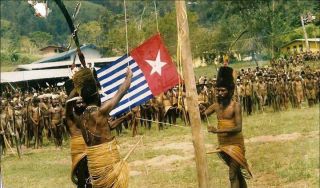
Morning Star flag being raised by Yali tribesman (supplied)

But unlike other flags, the Morning Star flag is different. Its creation rendered the power outside of it to repress the identity and message it wants to convey. It conversed sovereignty into sufferings, as more and more human bodies, the West Papuans, have to be ill-treated or persecuted of being accused of committing wrong to the Indonesia state.

What is right, human rights, then turned out to be very wrong for the power that rule the territory. Unlike other flags ever raised in other areas in Indonesia, such as the Yogyakarta Kraton flag, the raising of Morning Star is subversive to the very fundamental base of Indonesia’s territorial unitary state, or Negara Kesatuan Republik Indonesia (NKRI).

December the 1st, each year, marked the conversion of the flag. Fifty three years ago, the Dutch who colonized the territory called Dutch New Guinea gave the recognition to the flag to raise together with the Netherlands’ national flag, and marked the commitment for the Dutch to prepare the transition for independence. The flag raised high to the sky but only lasted for two years, before Indonesia state banned it. And so it has never been up again, to tell the world about peace and sovereignty. Every West Papuan who tried to raise it will bear the consequences of loosing his lives either in prison or in grave. Or perhaps in none of those places when both life and body are unknown their whereabouts such as tens to hundreds of West Papuans that went missing after military tanks and personnel crushed a gathering of the flag raising led by Filep Karma in Biak, 1998.

It was a Papuan named Thom Beanal, with ninety-nine other Papuans, who loudly state that the day when the flag was first raised, 1st of December, is the day of West Papuan independence. He said it in front of Habibie, Soeharto’s  successor as the President of the Republic of Indonesia. A scholar, Richard Chauvel, notes that the perception of the flag’s raising on that particular date in the then new political transition in Indonesia gave a new meaning for a nationalist identity of the West Papuans, and convey a message for a new hope for independence (Chauvel, 2005).

In 2001, the then President Abdurrahman Wahid, allowed the flag to rise again that year. The Papuans were overwhelmed with joy and new hopes, despite of the facts of their self-proclaimed leader Theys Eluay were jailed by Indonesia’s authority (which then released and murdered in the same year).

The next story is again dark and dishearten.  The Bintang Kejora has again conversed from a symbol for sovereignty any human need to continue his/her life, into a symbol of the oppressed body, the body full of sins of being itself and thus eligible to be destroyed by the power that rule over it. Every body and soul, who wish to see this piece of cloth with a picture of morning star perform its symbol of sovereignty, will add to more stories of grievances. At the same time, this flag has become more and more strongly wave up in every Papuan’s heart, as hopes for sovereign souls and nation becomes stronger each day.

At the flip side of the coin, the flag is more and more threatening for Indonesian authority. Every years before and during 1st December the central government overly reacted to their own insecurity by deploying thousands of military and police personnel to Papua. It’s for the sake of the security of the Indonesian power, indeed, not for the West Papuans, by showing off power and brutally suppresses anyone who has the intention to raise the flag.  Anyone.

This year, since the last few weeks before 1st of December, already 33 activists members of Komite Nasional Papua Barat (KNPB or National Committee for West Papua) has been arrested and local media Tabloid Jubi reported intimidation against four of its journalists. Amnesty International reported the strong indication of torture and other forms of ill-treatment they have in detention, and extrajudicial killing against some of the activists (Amnesty International, 2013). The last few days when I’m writing this, already several shootings were reported in some areas in Papua.

No willingness for any peace dialogue by the Indonesian government has ever expressed. Instead, the choice is always by force and new promises. But no beautiful promises from the central government can ever compensate every injured and destroyed body of the West Papuans who gave their lives to see the flag up in the sky all these times. Not even a promise of a new special autonomy scheme called ‘Otsus Plus’, nor the recent decision by Indonesian parliament to dissolve Papua into another 33 districts and three new provinces. A small numbers of local elites, unfortunately, would trade their souls with such promises, abandoning justice and dignity the rest of the West Papuan people have been struggled and sacrifice all these time.

Justice, dignity, and sovereignty. These are the message every soul in Papua wish to convey through the recognition of the Morning Star flag.

Sri Lestari Wahyuningroem is a Political Scientist and ANU PhD candidate, and has been a teacher and researcher at University of Indonesia, and has been involved in social activism for issues on gender, democracy, human rights and post conflict.  She is also currently a researcher in transitional justice in Indonesian democratisation.


Shootings, killings, beatings, arrests as Hundreds flee to jungle after Indon Police open fire on peaceful KNPB demo

From the entire West Papua Media team in PNG and West Papua

November 28, 2013

WPM apologises for the delay in posting due to the remote location of the WPM team, and the delays in finding independent witnesses to help in cross-checking of this extreme situation.  This situation is developing and will be updated as more information comes to hand.

Key developments:

  • Indonesian police open fire on peaceful protesters in Jayapura, with at least four gunshot wounds and one death;
  • West Papuan activists and families forced to flee to the jungle for safety;
  • Indonesian security forces conduct scores of raids, sweeps and offensives against West Papuan civilians;
  • Attacks happen during visit of National Police Chief General Sutarman
  • over 200 people arrested across West Papua;
  • Journalists attacked by Indonesian police;

This slideshow requires JavaScript.

Images from the crackdown in Jayapura (Credit:West Papua Media/MS); Images from Arrests in Timika (Credit: KNPBNews.com); and Wamena (Credit: WestPapuaMedia/KNPBNews.com).

Indonesian forces have again opened fire on a peaceful Jayapura gathering of about 500 people held by the West Papua National Committee (KNPB), with the shooting of at least 4 demonstrators, and the confirmed death of at least one, on November 26.  A total of 15 people are still in serious condition in hospitals around Jayapura with a range of wounds sustained during the live fire dispersal by Indonesian police.

In the worst single act of Indonesian state violence since the October 19 2011 crackdown on the Third Papuan Peoples Congress, ongoing sweeps and arrests have been continuing in the time since, causing most members of the KNPB fleeing with their families into the relative safety of the jungle.  Unconfirmed reports have also surface that the police have called in the Indonesian Army (TNI) to hunt for KNPB members.

Correspondents have also reported to West Papua Media that Indonesian radio stations in Papua have been broadcasting repeated messages from the Indonesian police against all pro-independence forces, starting with the KNPB.  “We will use force to break apart the KNPB,” a senior Indonesian Police figure in Papua was heard to say on all Jayapura radio stations early on Wednesday morning.  Unconfirmed reports have said that these broadcasts have been repeated hourly across West Papua, with the National Police Chief also issuing warnings that separatism will not be accepted any more.

The rally was part of a nationwide day of mobilisations in solidarity with the opening of the Free West Papua Campaign office in Papua New Guinea on November 28.  31 people were arrested by Police in Timika, and 3 arrested in Sorong as KNPB chapters there also organised rallies and prayers to support the opening of the PNG office, which is being held with the involvement of thousands of people throughout Papua New Guinea, including senior members of the PNG Parliament.

A rally in Wamena drew several thousand enthusiastic and cheering supporters wearing traditional dress (many bedecked in the banned Morning Star flag) on a long march mass action, led by KNPB Wamena region Chairman, Simion Dabi  This was the only rally where police were vastly outnumbered by participants, and police blockaded several points along the route but did not attempt to prevent the rally from going ahead.

Jayapura
The Jayapura shooting victim, KNPB activist Matthius Tengget from near Oksibil in the Star Mountains, died of his wounds in custody.  However, his body was not retrieved until Wednesday evening after it was dumped into the lake, allegedly by those members of the Brimob paramilitary police units who shot him as they were conducting the dispersal.  At time of writing, his family were conducting his funeral in Sentani.

According to a statement from KNPB General Chairman Victor Yeimo, currently in Abepura prison, “KNPB and family members of the victims are also looking for four (4) other KNPB members that are missing: their whereabouts are unknown or their bodies have not yet been found. Three of the victims carry the Mul surname and the fourth Lambe. We strongly suspect that the police shot them and disposed of their bodies.”

“Until now we are still looking for possible victims of yesterday’s mass action who were most presumably shot and disappeared: in their attempt to disperse yesterday’s demonstration, the Police and the Mobile Brigade fired a lot of shots and they chased many demonstrators towards Buper, the Housing Complex III, Ekspo, until Iyoka and all the way to the edge of Sentani Lake,” said Yeimo.

Up to 15 people were hospitalised from both gunshots and beatings, including a group of three young women from the Yahukimo dormitory who were savagely beaten by police during their arrests.  More reports have also been given that scores of female activists were rounded up and severely beaten by Indonesian police and military officers.

The shootings were under the operational field command of the notorious hardliner Deputy Jayapura Police Chief Kiki Kurnia, Abepura area POlice commander Deky Hursepunny, together with Jayapura Police Chief Alfred Papare, with the Deputy Papua
Police Chief Paulus Waterpauw and Papua Police Chief Tito Karnavian allegedly sighted monitoring the situation from their private Kijang vehicles.

Police have predictably launched a propaganda offensive across its tame colonial media networks in West Papua, accusing the KNPB of conducting a riot.  However, stringers for West Papua Media, independent witnesses in the busy Waena shopping area, and KNPB spokespeople have all vehemently denied riotous behaviour by the protesters, instead describing how a peaceful sit-in was brutally dispersed under the orders of a cohort of four senior police officers, who have been personally responsible for ordering significant and ongoing human rights abuses against KNPB members.

Direct Witness to Brutality
A survivor of Tuesday’s violence fled to Papua New Guinea immediately after the shooting, was directly interviewed by West Papua Media  – unidentified for their own safety – and has described how police opened fire without targeting, instead firing indiscriminately into the crowd.

Before the shooting, a mass of people had gathered in the field outside the Expo Waena bus terminal and market in front of the Museum, mainly sitting and chatting while listening to speeches.  According to the witness, police surrounded the gathering on three sides, and the protest leader Buchtar Tabuni attempted to negotiate with senior police present, including the Alfred Papare, Kiki Kurnia and Deky Hursepunny. As it became clear that police were refusing to negotiate with Tabuni, demonstrators agreed to maintain the peaceful action.

According to the witness, Senior police then yelled to the crowd, ordering them to disperse.  However, almost immediately, and without further warning of escalation of the threat, Police commanders ordered the front ranks of police in front of the bus terminal to open fire.

“When the the shooting started, as I was running, I saw the KapolSek Deky Hursepunny and Kapolresta Alfred Papare standing at the gate, directing his police where to fire,” the witness said.

Upon questioning, the witness testified that police initially fired tear gas, but switched very quickly to automatic weapons.   The witness also confirmed that instead of individually targeting demonstrators, police seemed to be firing wildly into the crowd, firing indiscriminately.

Both the order to open fire without warning, and the subsequent excessive use of firearms against civilians are direct violations of both Indonesian and international law.  International Lawyer Jennifer Robinson, Convener of the International Lawyers for West Papua and currently meeting in PNG, told West Papua Media that “This use of excessive force against KNPB members is in breach of international law and Indonesia’s own police regulations on the use of force”.

“This latest incident falls within a repeated pattern of the use of excessive and lethal force by Indonesian police against peaceful activists in West Papua which is indicative of a broader state policy. Continued impunity for the police involved is unacceptable and the failure to punish gives rise to command and state responsibility,” Robinson said.

Many beatings were meted out on KNPB members by Police during the arrests, with allegations that rifle butts were repeatedly used – a standard practice for the Indonesian police against peaceful demonstrators in Papua.

Plain clothes police special forces, described by the witness as “Polisi Preman” (Police gangsters), then continued two days of terror against West Papuan civilians, some in no way connected with the civil resistance movement.  This campaign, at time of writing, shows no sign of lessening.

“We were running across Waena.  Police used many rental cars and were driving around in balaclavas like terrorists, pointing automatic weapons outside their vehicles, and shooting now around Perumnas 1, causing all who could see it to hide in their houses.  At the same time a black Avanza stopped in front of us, followed by white and red Avanzas, pointing weapons at all Papuans present. We ran, because we knew we were about to be shot – we had to seek safety with Indonesian transmigrants, who were unaware of the situation,” the witness told West Papua Media wearily.

“After police shoot the demonstrators, participants fled to the forest.  Police then conducted a brutal sweep, targeting anyone who was wearing dreadlocks, beard, or even wearing sunglasses, and arresting them all,” the witness said.  Civilians have fled in panic, and the witness described Waena as deserted when they fled.  Families of those at the demonstrations have fled to the jungle.  It is not known of normal social functions are continuing, due to the difficulty in getting direct contact with sources in Jayapura.

Our witness reported that two days prior to the demonstration, Indonesian army helicopters were searching extensively around the hills in areas that would be the the first point of refuge for civilian after any shooting.

The witness survivor believes that this indicated that the shootings by police were premeditated and planned, although West Papua Media has been unable to independently confirm this.  However the attacks on protesters occurred just prior to the arrival at Sentani airport of National Police Chief General Sutarman, who has exploited the lack of honest reportage by colonial media to issue more threats against any Papuans who dare dream they can freely express themselves.

“We will take firm action against groups or individuals wanting to separate Papua from Indonesia because Papua is part of Indonesia,” State media Antara quoted Sutarman telling the colonial press in Jayapura.

Tabloid Jubi reported that the Papua Deputy Police Chief Waterpauw has denied KNPB the right to freedom of expression, permanently. ” I made it clear to the group West Papua National Committee ( KNPB ), immediately stop the steps that are likely to violence . Whatever the form of their intention and desire to perform activities in public hearings, (it) will never be given permission or recommendation to implement it , because we know the purpose of the organisation and their desire is clear , (they) want to form a state , split off and so on , “said Waterpauw on Tuesday ( 26/11 ) evening in Jayapura City police headquarters.

An independent international observer in Jayapura contacted by West Papua Media just prior to publication, speaking on condition of anonymity, went even further than the witness now in PNG, stating unequivocally that the crackdown was a “premeditated, highly engineered manufacturing of consent of the type that Tito Karnavian is such a master of, just like his OTK killings.”

“It beggars belief that Karnavian, hoping to please his boss – or more to the point those who would seek to replace the boss with Karnavian – would not be the engine of of a textbook counterinsurgency operation to smash a pesky bunch of separatists.  The only problem is, those separatists are unarmed and were conducting a peaceful gathering.  It looks like the whole thing was organised for a long time.  It is well beyond time those gangsters were held to account,” the observer said, naming Karnavian, Kurnia, Papare and Waterpauw as the perpetrators of massive human rights abuses against Papuan civilians.

The observer added that they saw the gathering just prior to its dispersal and can vouch for the gathering’s peaceful conduct, but was disturbed at the large number of security forces that were surrounding Waena.  “There were at least ten platoons of Brimob, and hundreds of swanggi (ghosts) everywhere, surrounding on three sides the KNPB sitting in a park,” the observer said – confirming maps drawn by the survivor witness.  “They were itching for brutality.  How is this Policing?”

A total of twenty eight people were arrested, but were released by Wednesday night.  KNPB national spokesperson Wim Rocky Medlama told SuaraPapua.com that they are fed up with the police’s actions, which are arrogant and excessive. “This is too excessive. And I think that the police have much to learn. So that they undertake their duties in accordance with the orders”, as quoted in SuaraPapua.com.

Olga Hamadi, the coordinator of the Commission for Missing Persons and Victims of Violence (KontraS) Papua, also told SuaraPapua that the police’s actions were excessive and the pattern of arrests should stop.

“I’ve only just heard this information. I think that the police are too excessive. Patters of arrests such as this should no longer be necessary. This is included under the rights of each person to express themselves. Moreover this is a democratic country right”, she said in an SMS message sent to Suara Papua, adding that people expressing their views should not be attacked and arrested. “They should be given space. The issue of expressing views in public should not be responded to with arrests and law enforcement. If [the police] are going to be like this it won’t solve the Papuan problem”, said Hamadi.

More arrests
Earlier on Tuesday morning at 8:13 local time. KNPB Secretary-General Ones Suhun was arrested with 6 members of the KNPB (Assa Asso, Okram Wanimbo, Sam Lokobal, Meminda (Mendenas) Sol, Konoru Wenda, and Bonsan Mirin) by Indonesian Police outside the Student dormitories at Putaran Perumnas 3, Waena, Jayapura.  They had just begun to hand out leaflets about the afternoon’s peaceful rally calling for the respect of West Papua’s right to self-determination. Most were released by Wednesday night.

Reports received by West Papua Media overnight from distressed sources fleeing through the jungle have confirmed that a further series of brutal sweeps and raids had occurred all afternoon and evening on Tuesday and continuing through Wednesday, with unconfirmed reports of Puma helicopters being used to find activists.  Hundreds of heavily armed Police were used to raid the offices of the KNPB Secretariat on Tuesday afternoon, also confiscating  all the contents and destroying what was left.

At least thirty more people were reportedly arrested overnight on the 26th, although this has not been independently verified by West Papua Media, however Buchtar Tabuni was moved by his supporters to a safe location.

Across Papua
In Sorong, the KNPB rally was also forcibly broken up by Police, and Marthinus Yohame (regional Chairman of KNPB), Kantius Heselo (Vice chair KNPB Sorong), Natalis Surabut Gebby Mambrasar, Nius Loho and Welem Surabut, were arrested for holding the rally, but were released overnight.

In TImika,  31 people were arrested by a Joint Police and TNI taskforce at Kelly Kwalik’s Cemetery Park at about 8.15 in the morning as they began to gather for their demonstration.  Police also arrested The Chairman of KNPB Region Timika, Steven Itlay and the chair of Mimika’s Parliament, Abihut Degey  while leading peaceful rally in demand the right of Self-determination in West Papua and are being held still at the Police Post, Mile 32. Their names are:
1. Steven Itlay
2. Abihud Degey
3. Billy Hagawal
4. Dony Mote
5. Petrus Bobii
6. Bony Bora
7. Yulianus Edoway
8. Paulus Doo
9. Martinus Pekey
10. Paulina Pakage
11. Agustin Pekey
12. Sony Ukago
13. Daniel Kotouki
14. Seprianus Edoway
15. Argenes Pigay
16. Menase Dimi
17. Timotius Kossay
18. Welius Kogoya
19. Demianus Kogoya
20. Kasianus Kamke
21. Aduart Suruan
22. Melianus Gobay
23. Pais Nasia
24. Makson Kotouki
25. Maria Piligain
26. Markus Entama
27. Yustinus Pigome
28. Sior Heselo
29. Semuel Edoway
30. Agus Itlay
31. Yakonias Womsiwor

Biak also saw its KNPB rally broken up police, with several arrests reported and injuries sustained.  KNPB Biak Chairman Apollos Sroyer reported to West Papua Media that the actions of police were again excessive in preventing a prayer session from going ahead, using scores of police and troops to blockade access to the church.  Police dispersed the crowd later in the afternoon.

In Manokwari, KNPB members were also banned from holding any events in solidarity with the PNG office opening, but were able to negotiate with the hundreds of riot police, and the rally went ahead with several hundred participants, dispersing peacefully after a prayer in the late afternoon.

In remote Yahukimo in the highlands, an action supported by KNPB Yakuhimo in support of the IPWP/ILWP meeting at Parliament Haus in PNG on Nov 27, and FWPPNG office opening in PNG was held in front of the Ruko Putra store.  The action was carried out in face of threats from Brimob officers and a platoon of fully armed TNI of Kodim Wamena 1702 (Battalion 752), and also 15 Kopassus special forces brought in from Jakarta.  They were backed up by a large but unknown number of police from from POLRES Dekei Yahukimo under the command of the local Polresta Eliakin Ap.

The forces presence was was requested by Ones Pahabol, the Yahukimo Bupati (District Head). Ones Pahabol is also the local head of the Committee of the 17th District of the GIDI (Indonesian Evangelical Church), who is considered extremely pro-Indonesian.  According to KNPB sources in Yahukimo, Pahabol’s reason for requesting military support was to break up any KNPB demonstration, and he ordered the dispersal of the KNPB activists because he was prohibiting the expression of the KNPB in public.

However the KNPB reported that even though the local government, police and local church committee refused to give permission for the rally to go ahead, the district head of gidi church did give them permission. However the KNPB commented that it was “as if the church were giving permission to the military to kill their parishioners.  Despite this military threat we give our full support to the IPWP meetings happening in PNG on the 27th – 29th.” said a KNPB spokesperson from Yahukimo.

Media Attacks
Several Journalists were also attacked by police during the Waena dispersal, forcing an apology from the Jayapura police chief Alfred Papare.   Police officers reportedly beat and threatened the journalists at a scene behind the administrative court offices , Waena , Jayapura.  According to a report in SuaraPapua.com, the three West Papuan journalists that suffered intimidation from police, were Aprila Wayar ( tabloidjubi.com ) , Micelle Gobay ( SKH torch Papua ) , and Arnold Belau ( suarapapua.com ), Hengky Yeimo (MajalahSelangkah) as well as a national reporter , Alvarez Oru Maga ( Reuters )

In addition, independent media website Suara Papua has been subjected to a denial of service attack, after they published accounts conflicting from the official police version of the story.  It is believed by many season observers on cyber conflict in Indonesia, that this is the work of a shadowy  cyber- division of the Indonesian police trained and funded by the Australian government, despite the fake outrage generated by the Canberra-Jakarta spy scandal.

In news to hand just before publication, two more bodies have been recovered from around Jayapura suffering gunshot wounds, though it is unconfirmed whether they were victims of the November 26 shootings, or further murders by security forces.

A highly credible source reported to West Papua Media that on November 27 at 3.30pm, a Papuan youth named Ottis Membilang (17), was shot by two TNI soldiers.  According to witnesses, Membilang was standing on the side of the road in front if his home near the Mega store at Waena when 2 TNI members arrived in an unidentified vehicle and shot and killed him for no apparent reason.  This is within metres of the area that West Papua Media’s witnessing survivor of November 26’s violence described troops and police  driving around in Avanzas, wearing balaclavas and threatening to shoot all nearby Papuans.

At the time that the first victim Mathius Tengget was being buried by his family, another body was found at Koya Barat (West Koya), at Wlara Tami near Skouw. KNPB sources have yet to confirmed if the body belongs to one of those missing since Tuesday’s brutality. The Tami River has long been a notorious dumping ground for victims of the Indonesian security forces’ Ninjas, as the river after rain sweeps all bodies far out into the Pacific Ocean into shark infested waters.

More to Come.

West Papua Media

Thousands of students rally to reject Otsus Plus and provincial division

By West Papua Media editors, with local stringers

November 5, 2013

Thousands of Papuan university and high school students led demonstrations in Jayapura on November 4, firmly rejecting attempts by Jakarta to impose the revived “new, improved” version of the failed Special Autonomy package, named “Otsus Plus”.

A coalition of student organizations, collectively known as ‘Students, Youth and People’s Movement’ (Gerakan Mahasiswa, Pemuda dan Rakyat Papua (GempaR Papua) –  the acronym GempaR literally translates as “Unarmed Insurrection” or “Uproar”), also called the actions to reject Jakarta’s latest plans to divide Papua into 33 districts and three further provinces.  The movement has been started by students from seven different high schools, technical colleges and universities in Jayapura, including Cenderawasih University, UMEL MANDIRI, STIKOM, STT GKI I.S.KIJNE and the opposition to the imposition of Special Autonomy Plus.  The rally was subject to several threats of violence from Indonesian security forces, who routinely deem all gatherings on peaceful Papuan aspirations as subversive and treasonous, according to rally sources.

This slideshow requires JavaScript.

The planned administrative divisions of Papuan land and districts under Otsus Plus have been widely interpreted as a colonial act by most Papuan civil society groups, according to Papuan observers, and seen as a covert method of further increasing the massive militarisation of Papua.  Each new district automatically gains its own military and policy company (150 men for each), and each further province each gains their own battalions of Military (1500 men) and Police (1200 men), further adding to the estimated 45,000 troops in Papua, the most militarised area under Indonesian occupation.

“Special Autonomy ‘Plus’ will not change (the mind of) Papuans.  Special Autonomy Plus is not a solution for indigenous Papuans. We firmly reject the plan for Autonomy Plus in Papua and West Papua, we reject it, Autonomy Plus and the New Re-districting are the same (still) killing Papuan people, not the solution to prosperity ” said Hendrik Koroto, Demonstration Coordinator and student at the Faculty of Engineering.

As is standard with any demonstration in Papua, the Indonesian police attempted at least twice to violently prevent the students from peacefully continuing on the march, shadowing the gathering with several hundred heavily armed security personnel.  The notoriously hardline Jayapura Deputy Police Chief Kiki Kurnia, again confronted the marchers in an effort to disperse them, threatening the use of heavy force on the students with a display of hardware including heavily armed police, water cannon and Barrucuda armoured assault vehicles. Intense negotiations took place for almost 15-20 minutes between organisers and Senior Police However, Jayapura Police Chief Alfred Papare agreed to allow marchers to continue their march using one lane to allow traffic to pass.

Whilst one group was negotiating with police, a large number of students unexpectedly took to the road, and several waves of students began to march on the Governor’s office, holding hands and neighbours with a tight protective formation.    Police dragged barbed wire in front of the Governor’s office and blocked the main entrance with 5 police trucks, and several other vehicles, The student and civil society gathering then occupied the forecourt of the Governor’s office for over two hours, during which time Governor Enembe agreed to meet a delegation from the student representatives.  No arrests were reported but threats were allegedly made against keynote speakers and rally organisers, according to witnesses who spoke with West Papua Media stringers.

WestPapuaMedia


Create a website or blog at WordPress.com

Up ↑