Historic united front in Papua defies police dispersals, supporting Vanuatu PM call on UNHRC in Geneva to address West Papua issue

News wrap-up

March 4 2014

from the West Papua Media correspondents in Jayapura and Geneva, with local sources

A broad united front of disparate Papuan civil resistance groups has come together to hold Peaceful gatherings across West Papua, in support of  Vanuatu Prime Minister Moana Carcasses’ call for international action on West Papua at the United Nations Human Rights Council in Geneva today.

PM Carcasses used his ten minute address at the High Level segment of the 25th Session of the UNHRC to reiterate a call made at the UN General Assembly last September, for the UN to establish a specific Country Mandate on the situation of human rights in West Papua and to revisit honestly its role in the fraudulent Act of Free Choice of 1969.

The Vanuatu PM, long a champion for his fellow Melanesian’s right to self-determination in West Papua, used an impassioned speech to highlight “grave injustices facing West Papuan people” and to demand the international community take concrete action to end the suffering.

“In a world so closely connected with innovative technology, there should be no excuses about the lack of information on human rights violations that have plagued the Papuan people for over 45 years.  Search the Internet and research papers by academic institutions and international NGOs, and you will find raw facts portraying the brutal abbuse of the rights of Melanesian people in Papua,” Carcasses noted.

The Prime Minster beseeched the Human RIghts council.  “But why are we not discussing it here in this Council?  Why are we turning a blind eye to them and closing our ears to the lone voices of the Papuan people, many of who have shed innocent blood because they want justice and freedom.  Many are the martyrs that have been persecuted and brutally murdered because they carry the unspoken fears of the millions now living in fear in the valleys and lofty mountains of Papua.  They are demanding recognition and equality and a respect for their human rights and to live in peace.  Will this August council hear their cries and now go forward to protect their human rights and put right all the wrongs of the past?”

Carcasses told the UNHRC that “The mandate should include the investigation of the alleged human rights violations in West Papua and to provide recommendations on a peaceful political solution in West Papua.”

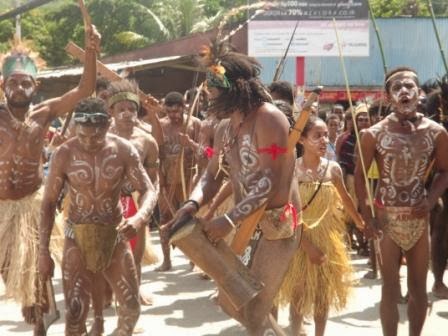
Earlier on Tuesday in West Papua, the vibrant gatherings  – organised by university students and supported by a broad coalition of civil society and pro-independence groups – were predictably dispersed forcefully by Indonesian occupation forces, however organisers claimed success in expressing their aspirations peacefully and without bloodshed.

This slideshow requires JavaScript.

Significantly for the struggle for self-determination in West Papua, the participant groups included the widest range of Papuan resistance components seen together for over ten years, with the united front coalition pulling together previously opposing groups under a common banner of supporting the Vanuatu Prime Minster’s efforts to get West Papua on the international agenda. Activists and leaders from the West Papua National Authority, National Federated Republic of West Papua, West Papua National Committee, the Papuan Women’s Movement, Papuan Traditional Council (DAP), West Papua National Coalition for Liberation, GaRDA-Papua , FRONT PEPERA , The Street Parliament (PARJAL), Papuan Student Movement (GEMPAR or “Uproar”), AMPTPI (Association of Central Highland Papuan Students), KMPB (Coalition of Papuan students Rise!), Papuan Students Alliance (AMP), Christian Youth Solidarity Papua (SKK-P), Papuan People’s solidarity for Democracy and Human Rights (SHDRP), all agreed to support the UNHRC support action being coordinated by the Student Executive council at Cenderawasih University in Abepura.

Led by University and high school members of the Movement of Papuan Students (GEMPAR or “UPROAR”), the mass gathered early on Tuesday morning in front of the the Cenderawasih University (Uncen) campuses at Waena and Abepura, erecting a large banner that read “The people of West Papua nation, support the Government of Vanuatu pursuing violations of human rights committed by the Government of Indonesia in West Papua”.  Speeches were made outside the campus entrance until 1025am local time, when Indonesian police from Jayapura station attempted to forcibly disperse the protesters listening to speeches.

According to witnesses, over a hundred Police in 6 trucks, 1 Panzer and 1 Police Bus were on standby, and were heavily armed.  However as the  group of students passed towards Waena, Police from Sentani and Jayapura amassed at the field of They Eluay’s tomb with a full unit of motorcycle commando police (Gegana), eight trucks and three armoured cars.  A platoon of heavily armed Brimob police at Post 7 Sentani completed the kettling of students to keep them confined.

Every place throughout the Waena, Sentani and downtown Jayapura  was guarded by several platoons of heavily armed Brimob police to prevent students and protestors from gathering.  An organiser told West Papua Media’s stringer, “This is a police action in Papua that prohibits students to express their opinions, through peaceful demonstration.”

Students then all gathered to rally silently at the UNCEN yard fence and spread a large banner, displaying  photographic evidence of Indonesian Security force’s violence against Papuan People.

An academic at UNCEN, Seth Wambrau, told the gathering, “These police officers, silencing democracy in Papua, this is the example that there is no freedom for students to express opinions freely, it is proving colonialism in Papua is happening.. Special autonomy is specific to the officials of Papua, not the Papuan people!”

The events were ended by Gempar peacefully in the afternoon with no arrests.

Further manifestations occurred in Fak-Fak on the west coast, Merauke on the south coast, and in Manokwari, according  to local reports.  The Fak-Fak gathering included a deeply sacred traditional pre-Islamic indigenous thanksgiving prayer and coffee ritual for the UNHRC plea for international attention to West Papua by Vanuatu Prime Minister Moana Carcasses Kalosil.  Members of the West Papua National Committee (KNPB) and Regional People’s Parliament (Parlemen Rakyat Daerah, PRD) provided a security cordon to enable traditional elders and chiefs in Mamur village,  Kramomongga district to hold ceremony in support of the Vanuatu delegation’s efforts to bring the world’s attention to West Papua.

According to a description from KNPB participants of the ceremony, the elders then rejected wholly the powers of darkness and evil of all the Indonesia’s power system in West Papua. “After all this ritual is done, then the placenta from the Child returned to the Land, the mother land West Papua, who gave birth to all things, and all life is God’s nation of West Papua. Then all the evil forces of the Republic of Indonesia in Papua were symbolically collected by Mr. Haji Idris Papua Patiran, and were discarded by KNPB security, at least 100 meters from where the activity was taking place in Mamur,” the witnesses described. A procession then occured with a ritual washing of all gathered with the “water of life, in order to reconcile all the people with nature and clean the whole self of any desire to be children of the mutually hostile land.” a sacred representation of the West Papuan desire for independence. The ceremony was finished by the ritual serving of coffee.

The new West Papuan People’s movement (WPM’s term due to lack of official name) united front released a joint statement detailing the litany of suffering of West Papuan people, and demanded:

1 . People of West Papua are demanding to exercise the right of Self-Determination as recognised by the United Nations Declaration of Human Rights
2 . The UN must immediately take responsibility for the violations of human rights that have occurred in West Papua.
3 . People of West Papua ask the UN Human Rights Council to immediately form a special team to investigate all human rights violations in West Papua
4 . People of West Papua urged MSG member countries, specifically Vanuatu, to send a special team to examine and investigate cases of human rights violations that occurred in the region of West Papua.
5 . People of West Papua urge UN member States to immediately urge the Indonesian government to open up democratic space in West Papua.
6 . People of West Papua are asking the UN for the legal protection, over the application of the Wanted Persons List (DPO) to Buchtar Tabuni (chairman PNWP) and Wim Rocky Medlama (Spokesman KNPB), and all West Papuan independence activists.
7 . People of West Papua thank the People and the State Government of Vanuatu for the willingness to bring issues of human rights violations to the UN Human Rights Council in Geneva.

Below: Videos from today’s gathering in Abepura. Credit KNPB/Nesta Gimbal)


westpapuamedia

STOP DANCING ATOP OF SUFFERING OF THE PAPUAN COMMUNITY!

Opinion

By Rufinus Madai

February 28, 2013

For 13 years now  government officials in Papua have been enjoying the benefits of the millions of Indonesian rupiah that has come its way thanks to the Special Autonomy package given by the Indonesian Government; and it’s undeniable that government officials at the provincial level as well as at the regency (local) level of the bureaucracy have allowed themselves to be ‘bought’ by this money.

They have allowed themselves to be bought in the way they think, at the level of their conscience and in regards to their sensitivity to the reality of what’s going on around them.  As a result of their ‘selling-out’, in every instance it’s the Papuan community that ends up suffering the consequences, suffering the loss.  The little people.

One can’t help wondering why in this era of Special Autonomy with all the money it brings into Papua, are we still seeing the constant suffering of the indigenous Papuan community.  Why are there still the constant injustices, the mistruths, the inequalities of the legal system and the destructive conflict that’s dragging on forever?  In fact one starts to ask the question whether the Special Autonomy is actually playing a role in creating that suffering.

Strange that in this ‘Special Autonomy’ era and with all the money that flows through that program, that the government bureaucrats are sucking the life from the Papuan community by selling off the resources of the land on which the people totally depend for survival, and meanwhile they stand idly by watching  the endless violations of the indigenous Papuan’s human rights.

The people are repressed, treated with inhumane cruelty, objectified, detained, chased, labeled separatists and even killed.   In receiving  such wealth for their ‘services’ they have become like purchased puppets of the Indonesian government.   Is it any wonder with these realities so obvious that the Papuan community time and again shows its distrust of the bureaucrats of the Indonesian government in Papua?

Whilst they enjoy the luxuries that millions of rupiah from Special Autonomy bring, the basic rights of the people are not even being considered and their sufferings go on and on without end.  We are not referring here to one remote corner of Papua but rather this is going on throughout the entire land of Papua.

The systems, policies and laws which have been created together with the Central Government to date have not only failed to bring benefit, but in fact have brought great loss to the indigenous Papuan community.   Such loss, that the  community has become convinced that the laws and policies created  for application in Papua are intended to repress and eventually annihilate the indigenous Papuan community from the land.

The government bureaucrats at the Papuan level are involved up to their necks! It’s as if they have become enchained to the big money Special Autonomy brings and they can’t break free.  Bought by the system.  No matter what they do or what decision they make under these circumstances whether regarding laws, policies or other, that will always be determined according to these ties.  Their decisions and actions are not based on good conscience made to address the needs of the people. The consequence being that the little people become the victims.

Until this time there have been no positive changes whatsoever brought about by the development programs as implemented by the government in Papua.  How could there be as the reality is that these programs in whatever form they may be, are not based on a recognition of the basic rights of the Papuan indigenous community!

They are not programs that help with poor education, or which address structural poverty or people’s basic human rights.  The Papuan community is well aware of this and believes that programs being implemented in Papua are simply those intended to support the vision , goals and programs of the National Indonesian Government.  Programs which increasingly marginalize the Papuan indigenous population, creating colonial domination, structural poverty, overpowering of the local community and ultimately leading to the death of the Papuan indigenous community.

The Papuan community is also well aware  of the way the two Provincial Papuan Governments to date have been operating,  acting  always in ways that prioritises their own tax revenue income whilst trampling on the land of the little people. Yet at the same time taking no actions in those areas where the community needs social laws to protect the people such as regarding the abuse of alcohol and the provision of sexual services.

The Indonesian Government knows it has ‘bought’ these government officials and that they are now tied tightly to and dependent on the National Indonesian Government.  Money speaks and in the same way money effectively silences voices concerning the constant human rights violations that are taking place right across the land of Papua.

However in spite of their having allowed themselves to be bought by the Indonesian government, nevertheless the Papuan community continues to hope that those Papuan  Government officials referred to will turn back to the people. That in so doing that they will  stop ‘selling out on’  the little people  of Papua, stop dividing the land further which in so doing divides the people,  stop making decisions in the interests of their own power and wealth and  stop acting in ways that support the vision and programs of the National Government and extending the conflict in Papua yet further.

The Papuan community continues to hope that the Papuan Government leaders will reject Special Autonomy so that they may not be dependent and tied in such ways to Jakarta. Continues to hope that these leaders finally may have the courage to themselves assert what policies and concepts of development are needed that truly support and are able to bring about improvements in the welfare of the ordinary people.

Such that the Papuan community might determine its own future on its own land.  Such that the paradigm of Papuans as being primitive, ignorant people who need others to organize them may come to an end. The little people of Papua have waited faithfully so long and yet still the tears flow without ceasing.

“May they who have ears to hear listen, may they who have eyes see,  and may they who have hearts and minds consider carefully and arrive at those  decisions that are right and that is acceptable to all persons.”
The Writer is a post graduate student at the Catholic Seminary in Abepura, Papua.

Blasius Sumaghai beaten by Indonesian Navy Officers in Bade, Mappi

February 20, 2014

from our partners AwasMifee, Majalah Selangkah,plus trusted sources in Mappi interviewed by both AwasMifee and West Papua Media

Mappi, Majalah Selangah – Blasius Sumaghai (23 years old), a resident of Bade village, Edera District, Mappi, Papua has been beaten by members of the Indonesian Navy. The reasons for the beating were not clear.

According to information compiled by majalahselangkah.com, Blasius
Sumaghai, the son of the late Abraham Sumaghai who was an Awyu community leader, was beaten by several Navy officers on the 26th January 2014. The beating meant that Blasius Sumaghai was unable to walk for four days. He is still in a fairly serious state of trauma.

This slideshow requires JavaScript.

The incident reportedly started as Blasius Sumaghai was seated outside a kiosk on Jalan Duyumu in Bade Village. Suddenly two Navy officers who were stationed at the Bade Navy outpost showed up. They showed no initial courtesy, just directly started striking the victim on his back and chest using the butts of their rifles

After the beating, our source said that the victim was brought to the
Navy outpost on a motorbike. On arrival at the outpost, he was beaten
over his whole body using rifle butts and hosepipes.  He suffered serious injuries.

It is reported that Blasius Sumaghai is not the only person to have suffered violent harrassment at the hands of the Navy.  Yustinus Akabagaimu, the 27-year-old son of local teacher Xaverius  Akabagaimu, has also been beaten up without any clear reason.

Yustinus is currently unable to walk as a result of the beating he
received. Several victims of harassment are unable to bring a case
against the perpetrators either because of fear or because they don’t
know to whom they should bring their complaint.

Majalah Selangkah‘s credible informant has said that that members of the security forces have often carried out beatings of young men in Bade when residents have reported that the men have done something wrong.

“But that’s what the police are for. What is Bade Police station doing?
The police are clearly tasked with maintaining law and order. The Navy’s role is to fight wars against other countries. Why should the navy take over the Police’s job right in front of their face? It’s very strange”, said the aforementioned source, sounding surprised.

The police in the Bade Police Station reportedly cannot be counted upon to maintain law and order in the area. As the community were celebrating Christmas 2009, the festive season which should be full of happiness was tainted by the murder of a young local man, Stefanus Silooy (38). He was killed by three police officers. This incident ended up with the community destroying the local police station.

In fact, a naval outpost in Bade is not strategic for national defence, because Bade is located on the shore of the Digoel River, and not on the coast. The town should really be guarded by a water-borne police unit.

So why is the Indonesian Navy present in Bade? Actually they are there to demand tribute from plywood and palm oil companies:  the Korindo group in Asiki which has been operating since the nineties and PT MAM* which has recently commenced operations near Bade.

Bade is a strategic port town, because all the plywood and Crude Palm Oil produced by PT Korindo in Asiki can only be transported by one route, the Digoel River. Bade represents the entrance and exit to this river system.

Source: Majalah Selangkah

[awasMIFEE / WPM note: a source (also in contact with WPM directly)  in Mappi has interviewed the victim and passed on these photos of his injuries, and also a letter from Blasius Sumaghai and his family addresses to the Governor of Papua Province, reproduced below in English. WPM has translated it despite the content being very similar to the Majalah Selangkah article above, and it is worth highlighting that the family request action be taken against the perpetrator and to close down the Navy Outpost.

*The article mentions a company named PT MAM, but this is slightly erroneous. MAM is the name of the location where another Korindo subsidiary PT Dongin Prabhawa has an oil palm plantation. Bade is on the Mappi side of the Digoel river, but lies close to the border with Merauke Regency – PT Dongin Prabhawa’s plantation is also just a few kilometres away.]

Open Letter: And so the Inhumane Cruelty of Indonesian Armed Forces Against Papuans Continues…..

By SOURCE in Bade, Mappi Regency in West Papua

15 February 2014

It seems the bitterly cruel treatment of the Papuan indigenous community by the Indonesian armed forces will never come to an end. This time their cruelty has been unleashed on a young 23 year old man by the name of Blasius Sumaghai from Bade in the regency of Mappi in the far southern region of Papua. The incident involved use of brutal unrestrained violence against Blasius by two members of the Indonesian Marine Corps on 26 January 2014. Blasius is the son of a well known figure from the Awyu Tribe called Abraham Sumagahai and had done no wrong whatsoever that could have given reason for the ruthless attack by the marines. The attack on Blasius left him severely traumatized and unable to even walk for four days following the incident.

The incident occurred when Blasius was sitting in front of a kiosk (at Duyumu Road in Bade) at around 1945 hours on 26 January. Two members of the Marine Corps working at the Bade Post approached him without clear reason and started viciously beating him, striking him across his back and chest with their rifle butts. They then forced him into their vehicle and took him to their military post. They continued to strike him over his entire body with their rifle butts and a hose, leaving wounds over his entire body.

Blasius is by no means the first victim of such cruel tyranny by the Indonesian Marines in Bade. There have been numerous young people from the Bade Papuan indigenous community who had suffered seriously at the hands of the Marines in Bade but whose names cannot be mentioned due to their fears of retaliation. Many have no idea to whom they could possibly safely report things that have happened. To name just one, another 27 year old man Yustinus Akabagaimu (son of the local school teacher Xaverius Akabagaimu) was beaten so mercilessly by the Indonesian Marines in 2013that he is no longer able to walk to this date.

A trustworthy source stated that the brutal treatment of local Papuan youth by the Marines usually occurs due to a citizen having made a report to the Military Post that a certain youth has done something wrong, following which the Marines immediately find and arrest the youth, beating them far beyond the limits of what is humanitarian.

To understand what’s really going on behind these regular incidents of unwarranted violence against citizens, once must question the very existence of a prime Indonesian Military post in Bade. It’s hardly needed for national defense reasons, as Bade is located on the edge of the Digul River. It’s not as if it’s a strategic location bordering with another nation or the like. So why should the second largest base for the Indonesian Marine Corps in the entire southern region of Papua be located on the edge of a river in Bade? The answer lies in the fact that the location enables the forces to demand ‘tribute’ from the nearby multinational plywood and oil-palm company Korindo (in Assiki) and also from a second company which has recently been opened at a location also close to Bade. In terms of Indonesian economics Bade is a key location for these companies as their products are shipped out only along the River Digul. There is not only an Indonesian Marine Corps Post at Bade but also a Police Post, a Regular Military Post (TNI), an Indonesian Army Shore Unit (TNI-AD).

The community leaders of the Papuan community of Bade in response to the frequent violence by the Marine Corps against the indigenous Papuan community, call on the Governor of Papua Lukas Enembe :

i) To immediately take stern disciplinary action against those members of the Marine Corps in Bade who have been unleashing brutal cruelty against the indigenous people of Bade.
ii) To close the Indonesian Marine Corps Post in Bade
iii) To carry out an investigation as to the reasons for the existence of the Marine Corps Post located at Bade on the banks of the Digul River.

Footnote :

Bade is located in the south of Papua in the district of Edera in the Mappi Regency which borders the region of Merauke.

Papuan cultural parade blockaded then broken up by Jayapura Police

From KNPB and West Papua Media sources in Jayapura

February 20, 2014

https://westpapuamedia.info/wp-content/uploads/2014/02/565e1-dscf2364.jpg
Traditional Cultural Action, Jayapura, 17 February 2014

A cultural parade organised by university students in Jayapura was blockaded and then dispersed with force by Indonesian police on February 17, after Indonesian police refused to recognise West Papuan cultural expression.

The demonstration of culture, music, art and dance from across Papua’s indigenous tribes, in which several hundred students in two groups marched wearing traditional Papuan dress, was to highlight the demand of “Save the Papuan Culture”.  The manifestation was organised by the Youth Coalition for the Rise of Students (Koalisi Pemuda mahasiswa bangkit or KPMB) and the Cenderawasih University’s (Uncen) Student Executive Body (Badan Eksekutif Mahasiswa or BEM).

This slideshow requires JavaScript.

Speakers, songs and dances were performed from 8-10am local time in two locations, outside the Uncen Waena Housing Complex (Perumnas III) and in front of the post office in the town of Abepura, and at 10am, the Perumnas III mass began to march and dance their way to Abepura.

However Police blockaded the mass action once the crowd reached the Waena traffic lights.  Despite having previously notified police of their intention to hold the parade, field coordinators of the action were forced to negotiate with the police, pointing to the KPMB’s intention to hold a peaceful action that day in the form of Papuan cultural art.

However, in an outburst witnessed by a West Papua Media stringer, the Deputy Commander of the Jayapura District Police, the notorious hardliner Kiki Kurnia refused to let the gathering continue, warning the crowd that he would not tolerate “introducing some culture from an unknown place”.  “There is no such culture such as that in Indonesia,” Kurnia asserted, dismissing over 45,000 years of Papuan language, culture and art.

Kurnia then prohibited the students from displaying any form of Papuan culture, and further stated that the crowd “was prohibited from carrying out any action of any form whatsoever as the Governor had prohibited all forms of actions,”. according to independent sources and verified by WPM.  Just after 10am local time, ordered several platoons of heavily armed police to blockade and disperse the cultural gathering.  Several injuries were reported but unconfirmed.

After being forcefully dispersed,  a much larger mass returned and gathered in front of UNCEN’s main entrance, lighting a bonfire on the road in response.  According to witnesses, this crowd was spread out as far as Perumnas III in Waena, a distance of several kilometres.

According to the cultural event organisers, the crowd outside UNCEN was angrily voicing their objections to the continued silencing of the democratic space throughout all of Papua by the Police, with speakers expressing outrage at the betrayal of the culture of Papua.

“That the police had been obstructing the mass action stating ‘Where are you bringing this culture from? We don’t have any culture like that in Indonesia’ angered us all, as it is seen as a denial of the Papuan culture,” an organiser told West Papua National Committee (KNPB) media workers.

Members of the gathering clearly spoke out that if the police continued to betray and deny Papuan culture in such a way, that Papuans would mount an even larger scale action asserting the Papuan culture, and that they would boycott the 2014 presidential election, according to reports from the KNPB.  The action Coordinator Beny Wetipo then called upon the Papuan community and all parties to save the Papuan culture from being replaced by a foreign culture that was threatening the existence of the Papuan race.

Bobii: HAVING REACHED THE EDGE …….THE MSG COMMITMENT

January 12, 2014

Opinion/ Analysis

By Selpius Bobii

 The Melanesian Spearhead Group (MSG) is an official forum to develop friendship, harmony and the sense of family between Melanesian nations, with a mind to develop peace and prosperity in the region.

The MSG Forum is in truth not only something of those Melanesian nations which already have independence, but rather it is also something of those Melanesian nations that have not yet had their sovereign independence recognised and which continue to struggle to that end.

Accordingly there exists an obligation by the members of the MSG to be ready to receive as members those Melanesian nations (peoples) that have not in the past not had that opportunity; and secondly an obligation to defend the call for independence for those Melanesian peoples struggling for recognition of their sovereignty.

This critical role of the MSG lies within the framework of upholding the commission of the Universal Declaration of Human Rights together with other international laws including the International Covenant on Civil and Political Rights, the International Covenant on Economic, Social and Cultural Rights and the United Nations (UN) Declaration on the Rights of Indigenous Peoples. In the opening sections of each of these covenants and declarations, the right to self-determination of all indigenous peoples of the world is referred to.

The preamble of the Constitution of the MSG states the obligation of the MSG member states  to defend the right to self-determination of all Melanesian peoples which have not yet received full independence.  International legal determinations together with the MSG’s legal foundation, together give legitimacy to the MSG forum to defend Melanesian peoples (nations) that are struggling for full independence.  Such legal determinations can on occasion however give rise to divisions within the MSG itself due to differing opinions of members and can even threaten to divide the MSG. This may arise when a non-Melanesian nation’s control and colonial domination over a certain Melanesian people is perceived to be at risk and that nation reacts accordingly, resulting in different responses from respective Melanesian nations.

There is of course a code of ethics for international association between nations (for instance the respect of another nation’s sovereignty), however notwithstanding there also needs to be a greater awareness worldwide that independence is the right of all nations of peoples on this earth. That is stated both at international law and within the very law that applies to the MSG and these laws create a legal obligation to that end.  How much more important in the case of  peoples whose very continued existence is threatened by the colonial power!  Such is the case for the people of Papua where colonial domination by the Republic of Indonesia is leading to annihilation of the indigenous people of the land.

In the interests of mutual rights, justice and human dignity, MSG and other nations of the earth together with UN have both the legal and moral obligation to give an opportunity to those  peoples (nations) in the world that have not yet received independence to have their sovereignty legally recognised. It is really urgent that the MSG, UN and other nations of the world act on this obligation such that the position of all nations of the world may be on a level plane with no one nation able to continue to colonise and dominate another. This is absolutely critical in enabling progress towards the end goal of peace and prosperity for all peoples in the world and not just for a privileged few.

It was on the basis of this international commitment and the preamble to the Constitution of the MSG, that the MSG leadership at its 19th Summit in Noumea from 17-21 June 2013 made a decision that was all important in terms of the political and humanitarian status of Papua. Their commitment in regards to the indigenous people of Papua was clearly stated in points 20/21 of the Communiqué of the MSG, which is itself a valid and legal document. That decision was binding on all members of the MSG without exception and it is the obligation of all members of the MSG to respect and act in accordance with that decision. It will give great hope and joy to not only the people of Papua but also countless others, if every leader of the MSG is able to maintain their attitude and actions such that they are in accordance with this decision of the MSG.  In-keeping with that decision, to defend Papua’s sovereignty through official channels of the UN, by mediation between Papua and Indonesia and through dialogue regarding the political and legal status of Papua together with other problems.

The commitment of the MSG leadership is so closely tied to the issue of Papua and is now at the very edge and being seriously tested. The realities seen to date are that:

  1. There are certain members of the MSG that have not wholeheartedly respected and implemented the decision of the MSG leadership on 21 June 2013.
  1. There has been observed a lack of consistence of certain members of the MSG in regards to their commitment to the decision in Noumea and in fact there has been observed since that date an increase in the extent to which those particular MSG members have been working together in partnership with the State of Indonesia.
  1. The state of (1-2) above are a direct result  of Indonesia playing its ‘two-way’ political games; of continuing to carry out a range of operations aimed at suppressing the movement and activities of the Papuan Independence Movement, whilst at the same time increasing its level of campaigning and diplomacy towards certain members of the MSG.  (With Indonesia’s efforts in diplomacy have also been supported by a range of other ‘attractive offers’).
  1. Indonesia has also requested support of governments of other nations in this regard including both Australia and New Zealand, appealing to them to influence members of the MSG against supporting Papua’s application to the MSG.
  1.  Indonesia did not facilitate the agreed-on visit to Jakarta and Papua by an MSG delegation of Foreign Ministers within the 6 months time deadline from 21 June 2013 in accordance with the MSG decision.
  1. With the 6 months limit requirement of the MSG decision now passed, Indonesia has now on 11 January 2014 facilitated the visit of a MSG foreign minister delegation to Jakarta.
  1. Efforts have been made by Indonesia to prevent this MSG Delegation from visiting Papua during its visit to Indonesia.
  1. If it eventuates that the MSG Delegation is finally allowed to visit Papua during this present visit, then it’s highly likely that the Delegation will be prevented by Indonesia from meeting with key Papuan leaders and the leaders of the different components of the Papuan Liberation Movement.
  1.  All of the Indonesia Government’s efforts referred to above, have been made with the aim of causing Papua’s application to the MSG to fail.

At this time all peoples throughout Melanesia together with those in international solidarity, are keenly watching to see what steps and political direction will be taken by the MSG. Will the MSG maintain its earlier commitment and attitude on the Papuan issue or back down? Will Indonesia allow the Delegation to visit Papua at this time and allow them access to the key figures of the Papuan Independence Struggle including those currently imprisoned or will Indonesia block that access? Why be afraid?  Is not God with us?

This article has been written from behind prison bars for the purpose of strengthening our hearts and our faith in regards to the MSG Forum.  Let us remain strong and perseverant faced with this test.

Selpius Bobii is the  General Chairperson of Front PEPERA & Papuan Freedom Political Detainee held in  Abepura Prison, Jayapura

Create a website or blog at WordPress.com

Up ↑