Launch of Papuansbehindbars.org website for Papuan political prisoners

Website launch: www.papuansbehindbars.org

Jayapura, Tuesday 16 April 2013 

Today the Civil Society Coalition for the Upholding of Law and Human Rights in the Land of Papua, working together with a number of human rights NGOs in Jakarta and internationally will formally launch the Papuans Behind Bars website www.papuansbehindbars.org, or in Indonesian, ‘Orang Papua Dibalik Jeruji. The website is intended to support advocacy for the rights of the political prisoners who are currently languishing in jails across Papua. Based on the data collected by the Civil Society Coalition for the Upholding of Law and Human Rights in the Land of Papua, at the end of March 2013 there were at least 40 political detainees being held in Papuan jails.This website shows the existence of political prisoners today and the history of Papuan political prisoners who have been subjected to torture, denied access to lawyers, forced to confess and suffered all manner of other human rights violations. The existence of political prisoners cannot be denied despite statements to the contrary by Indonesia’s Coordinating Minister for Legal, Political and Security Affairs, Djoko Suyanto., that those in custody in Papua are criminals who are undergoing rehabilitation. The website will also provide updates on the situation in the prisons.

It’s important to respect the rights of detainees in police detention when they are being detained or interrogated on suspicion of treason, as well as those who are serving sentences having been found guilty of treason. This is because there have been a number of stories of human rights violations such as torture which begin from the moment of arrest and interrogation and continue while people are serving sentences.

Despite the fact that Indonesia has already ratified the International Covenant On Civil and Political Rights via Law 12/2005 and the Convention Against Torture and Other Cruel, Inhuman or Degrading Treatment of Punishment via Law 5/1998, treason cases tried in the Papua state courts continue to be tried under politically-motivated charges of Article 106 of the Indonesian Criminal Code and Emergency Law 12/1951. Treason suspects and convicts are treated like any other criminals such as thieves and rapists. So it’s unsurprising that with the brutal attitude of the security forces at the moment of arrest, detention and even while serving their sentences, they experience human rights violations which should not be allowed to take place.

With the www.papuansbehindbars.org website, the Civil Society Coalition for the Upholding of Law and Human Rights in the Land of Papua will work together with various other human rights groups in monitoring those political prisoners who continue to languish behind bars, both those under interrogation and those who are serving sentences in Papuan jails, in order to ensure that their human rights are protected.

Taking into account Indonesia’s ratification of the International Covenant on Civil and Political Rights by Law Number 12 of 2005, and the Convention against Torture and Other Cruel, Inhuman or Degrading Treatment or Punishment through Law 5 of 1998, we make following recommendations to the Government of Indonesia:

1. Release all political prisoners in Papuan prisons in Papua and immediately begin a peace dialogue with the Papuan people.

2. Guarantee the rights of political prisoners, including access to health care and legal services.

3. Especially the Coordinating Minister for Legal, Political and Security Affairs, to meet with political prisoners who are languishing in various Papuan jails to get fact for their situation and existence.

*******************

The Civil Society Coalition for the Upholding of Law and Human Rights in the Land of Papua consists of the following organisations:

Within Papua: Foker LSM, KontraS, ALDP, ElsHAM Papua, LBH Papua, KPKC Sinode GKI, TIKI, AJI Papua, Baptis Voices, Sinode Kingmi Papua, Sinode Baptis Papua, BUK, SKPKC FP, Sinode GIDI, Septer Manufandu, Gustaf Kawer, Cs, Yan Christian Warinussy.

Jakarta: KontraS dan Nasional Papua Solidarity (Napas)

International: Tapol, Asian Human Rights Commission, East Timor and Indonesia Action Network, West Papua Network, Faith-based Network on West Papua

Coordinator: Septer Manufandu (Mobile: +62 (0) 8124876321/email: septer_manufandu@yahoo.com)

FROM TAPOL

Selpius Bobii: The Annihilation of Indigenous West Papuans: A Challenge and a Hope

(Apologies for the delay in posting due to significant funding shortfall and time over-commitments from WPM team)

Opinion

By Selpius Bobii

Abepura, 25 March 2013

This article presents a challenge to all who have a heart for, and who are working without reward, to save the ethnic people of West Papua which are now heading towards annihilation. This article in particular considers the question as to whether there is truly annihilation occurring of the indigenous West Papuan people. (The term Papua or West Papua below are taken to include both the Papuan and West Papuan Provinces).

Are Ethnic West Papuans really being annihilated?

The indigenous community of West Papua is currently made up of 248 tribes (according to works of a Research Team published in 2008) inhabiting the land of West Papua.  Whilst east Papua is the well known nation of Papua New Guinea (PNG).  There have been findings that some tribes of Papua have already become extinct whilst others that are still surviving are now heading towards extinction.  The most disturbing finding (references below) from researchers at both Yale University in USA and Sydney University, Australia, have concluded that what is occurring in Papua is in fact genocide, with the primary actors being the Indonesian military (TNI) and Police (POLRI).

Military Operations

The main means of annihilation are overt and covert military operations carried out by the Republic of Indonesia (NKRI) continually since the military invasion in 1962 – an invasion that was intended to actualise the declaration of TRIKORA (being to dismantle the State of Papua), by the then President Sukarno.

There have been three major stages of military operations applied in Papua. The first was preceded by the sending of military troops illegally to Papua in 1962, at a time when Papua was still under administration of the Dutch Government – events Papuans state to have been a military invasion. The first stage of ongoing military operations occurred following the surrender of the administration of Papua from the Dutch to NKRI in 1963, and continued until 1969.  NKRI used a number of names for this stage of their military operations including ‘Operation Annihilation, Operation Ox I (using the name for wild ox of Java ‘banteng’),Operation Ox II, Operation Red Eagle, Operation White Eagle, Operation Wolf and Operation Dragon.

After NKRI had successfully invaded Papua, it continued its military operations with strategies and tactics that were to become most decisive in this stage of history.  This second stage of military operations were known as (as translated) Operation Authority (1970-1974), Operation Erode (1977), Operation Aware(1979), Operation Sweep Clean (1981-1984). (See article ‘ The Existence of TNI and Military Violence in Papua from 1963-2005’)).  Officially (Papua was designated as a ) Military Operations Area (referred to as Daerah Operasi Militer ‘DOM’) was in effect from 1978 to 5 October 1998.  Withdrawal of this status in Papua was encouraged by the Reformation (Reformasi movement) in 1998, with DOM status legally withdrawn on 5 October 1998, however there was a continuation of ‘de-facto’ DOM status which has continued until today.

The third stage which started with the Reformation in 1998 and which has continued to run concurrently with the second stage until this date, has involved a number of specific operations that have been carried out. These have become known as:

  • Bloody Biak (06 July 1998),
  • Bloody Nabire (2000),
  • Bloody Abepura (6-7 December 2000),
  • Bloody Wamena (6 October 2002),
  • Waspier (13 June 2001),
  • Bloody Kiama
  • Bloody Padang Bullen (20 October 2011).

At the date of writing military operations are continuing in Puncak Jaya, Puncak, Wamena and Paniai together with other covert operations throughout the land of Papua.

Numbers of deaths resulting from Military Operations

According to scientific research carried out by Yale University in the USA, it has been estimated that between 1963 and 1969 that more than 10,000 indigenous Papuans were slaughtered by the TNI and/or Indonesian Police.  From 1971, and throughout the period with which the Military Operations Area was officially in effect (1978-1998), the extent of the large numbers of indigenous Papuans killed (can never) accurately be known,  as the processes (and) numbers killed were not recorded by the armed forces. Whilst the community to date has never been allowed ‘the space’ to be able to gather and publish the data (ie space from intimidation and fear of “known ramifications” or military retribution).  Military operations during this time have included bombings, shootings, kidnapping, murder, forced disappearances, detention and imprisonment, torture, rape, theft and killing of domestic livestock, destruction of crops/vegetable gardens (which are peoples’ source of survival), burning of homes to the ground, burning of churches, killing by poisoning of food and water, and others.

There have been killings carried out in sadistic ways such as on victims whilst still alive, having their body parts chopped off with a short machete/chopping knife or axe; or victims being sliced up with razors or knives then then the open flesh being filled with chilly water; males and females being forced to have sex before their torturers then the males genitals being cut off and the their wives forced to eat them, following which they are both killed; being killed by being suspended (strung up) until dead; being thrown alive into deep chasms where there is no way out; being tied up and placed alive into a sack then thrown into the sea, a lake or river; being buried in the earth alive; iron bars being heated in a fire then inserted into the anus, the mouth, or into the female internally through the genitals.

Introduced diseases

Diseases that have been taken to Papua by unmedicated new settlers has also played a role in accelerating the rate of death of Papuans since the annexation of Papua into NKRI. Those introduced diseases include TB, Tapeworm infections, Typhoid, Cholera, Hepatitis, venereal diseases, HIV/AIDS and others. In the previous era prior to new settlers arriving these diseases were unknown by our ancestors. These types of infections / diseases spread quickly after infected persons arrive due to inadequate health services and the absence of availability of health equipment and infrastructure in the Papuan villages. Even when there is health equipment in the remote villages so often the staff are half-hearted about health services for Papuans and health problems arising from the spread of these introduced diseases are not properly attended to. If newcomers are not treated immediately on arrival these diseases spread ferociously amongst the indigenous population that has not had time to develop resistance to them, and in this environment of poor health services that frequently leads to death.

Alcohol related deaths

Consumption of alcohol is also playing a role in the annihilation of indigenous Papuans. The Writer once noticed on a carton in a shop the notice (as translated) “This stock especially for Papuans”. Why is there separate alcohol stock for Papuans? Many indigenous Papuans have died as an immediate result of alcohol consumption. Is there something mixed into the alcohol that which can cause quick death? Is it in fact ethanol (100% alcohol) that is being sold for Papuans’ consumption? Apart from many deaths related to alcohol, many social problems are also being created within families as a result of excessive drinking and many alcohol related crimes have occurred. The national government has on a number of occasions run campaigns to prohibit the excessive consumption of alcohol but at the same time they’ve been giving permits to proprietors to import and sell alcohol in shops and bars (with no limits imposed). Clearly there is tax income generated from these sales for the government. However the tax made by the government on these unregulated sales is far outweighed by the costs of the impact of excessive alcohol consumption on the community. This can destroy young peoples’ futures, quite apart from the sudden deaths it often causes. There is a locally made type of alcohol that is known as ‘Milo’ that could if regulated well by working with the local community, have much less destructive effects on our people. However as the government really doesn’t have a heart to break this chain of excessive production and distribution of alcohol, so this is yet another instance – though be it indirect – of the government contributing to the increased death rate of the indigenous Papuan race.

Government ‘Family Planning’ Programs

Another factor effecting the population growth of ethnic Papuans is the government’s Family Planning Program.  As Papuans have now become a minority in the land of our ancestors and our numbers are known to be decreasing, what then is the purpose of the government restricting the birth rate of indigenous Papuan families? Their family planning program teaches that ‘2 children is better’ but to Papuans this is absolutely not acceptable. Why should indigenous Papuans that have such a wide expanse of land and so much natural wealth yet be forced to join this program? We believe this is but another aspect of NKRI’s attempts though indirect, to bring about the decline of the Papuan indigenous population.

Loss of lands and natural resources

A further factor contributing to the decrease in the population of indigenous West Papuans is that of welfare as related to lost access to land and natural resources. Indeed financial problems of ethnic groups living in urban areas are a very real determining factor contributing to the annihilation of some ethnic West Papuan tribes.  This is the result of their land and natural resources being taken over by new immigrants, and whether by means of sale or theft, the end result is the same: being that people from those urban areas become without land and without natural resources, the two factors which have throughout time been their source of life.  Indeed this can cause depression, stress, deep psychological problems, poor nutrition, sickness and finally death. At the time of writing there are indigenous tribes from two regions in particular considered to be at high risk in this regard as they have sold the lands of their ancestors to newcomers. These are in Jayapura city and the wider the Jayapura local government area and secondly in the Merauke city area. Their children and grandchildren will have no lands of their own and this will have really serious consequences for the continued existence of these tribes.

Transmigration effects

The fourth category of determining factors contributing to the annihilation of the indigenous West Papuan race is transmigration. The previous Governor of the Papuan Province in 2010 stated that the total of migration to Papua was already high enough, but it nevertheless continued to grow at 5% each year whilst according to him the ‘normal’ rate of increase should have been 1% p.a.. Based on the provincial government’s figures from their Statistics Centre (BPS) as published in early 2011 for the entire Province of West Papua, the total indigenous Papuan population was 51.67% of the total population, numbering 760,000 in the whole of Papua. (See: www.kompas.com, Tuesday 11/01/2011). Jim Elmslie in his book ‘West Papua Demographic Transition and the 2010 Indonesia Census: Slow motion genocide or not? (Centre for Peace and Conflict Studies, Sydney University) found:

  • that the indigenous population had grown from 887,000 in 1971 to 1,505,405 in the year 2000 (an average rate of 1.84% increase p.a).;
  • Whilst the non-indigenous population in Papua had grown from 36.000 in 1971 to 708,425 (with an increase rate of 10.82% p.a.).
  • By 2010 the indigenous Papuan population was 1,730,336 (47.89%) whilst the population of non-indigenous Papuans was 1,882,517   (52.10%), a total population of 3,612,853.

In his book Elmslie estimated that by the year 2020 that the total population in Papua will reach 7,287,463 comprised of indigenous Papuans at 2,112,681 (28%) and non-indigenous Papuans at 5,174,782 (71.01%). According to Elmslie the variance of the rate of increase in indigenous Papuans compared to non-indigenous persons , is the result of firstly human rights violations and secondly and more primarily, the effect of transmigration. (See www.majalahselangkah.com/old/papua-30-persen-pendatang-70-persen-mari-refleksi/) original:(www.sydney.edu.au/arts/peaceconflict/docs/workingpapers/westpapuademographicsin2010/census.pdf).
The jump from 36,000 persons in 1971 to 708,425 in 2000, then to 1,852,297 is truly startling. This current level of migration flow can be attributed to the attraction of the Special Autonomy program in Papua, together with the continually increasing divisions of Papua into more provinces, regencies (which creates new major towns as administrative centres), districts and grouped villages.  As long as the government continues to create more divisions of the land, the massive flow of migrants into Papua will continue to increase.

We need to at the same time look closely at the indigenous Papuan figures which from 887,000 persons in 1971 to 1,505,405 in 2000 and 1.760.557 in 2010, show an increase of a mere 255,152 in the 10 year period 2000 to 2010. On the basis of these numbers researchers have calculated that indigenous Papuans are becoming an increasing minority, and at this rate by the year 2030 indigenous Papuans as a race will have become died out.

It needs to be emphasized that these are conservative estimates of the rate of annihilation of indigenous Papuans. The accuracy of the Centre of Statistics (BPS) figures really can’t be taken as certain from the Writer’s perspective.  To date there has been no news that the heads of all the villages throughout Papua have indeed worked together with the Heads of their Districts to ensure names provided are in fact correct, to ensure names of those already deceased have been treated correctly, and to ensure no names have been fictitiously created to get some financial assistance, or rice under a poverty program, or other assistance under the (Australian funded) Village Development program (called ‘Respek’); or perhaps for reasons related to the choice of regional leaders in the elections. The Writer is absolutely certain that if there had been carried out a credible population census that was honest and accurate, that the total of indigenous Papuans in 2010 would surely be less that that provided by the Centre for Statistics (BPS), and conversely the total of non-indigenous would should even greater numbers. As virtually every time, every week there are passenger ships land or planes land in Papua, there are yet more new migrants arriving in the land of Papua. In his book ‘ The Papuan Way : Latent Conflict Dynamics and Reflections of 10 years of Special Autonomy in Papua’, Antonius Ayorbaba stated that the rate of migration to Papua was actually 6.39% and that the population census data for Papua was in truth 30% indigenous Papuans and 70% migrants (See: tabloidjubi.com, 12 January 2012). These figures are starkly different to that data reported by the government.

If we compare the even perhaps overstated BPS figures of the indigenous Papuan population with that of Papua New Guinea (PNG) we see that in 1971 the numbers on PNG at roughly 900,000 weren’t much different to West Papua at 887,000. Whilst by 2010 the PNG indigenous population had soared to 6.7 million compared to Papua’s 1,760,557.  Whether from being killed or having died of ill health, or not able to be born due to the living conditions that Papuans are under, based on the fact that in 1971 their relative numbers were so close, Papuans take this massive relative difference of some 4 million in 2010 to indicate the number of souls lost through the process of annihilation happening in West Papua over that 10 year period.

Conclusion

The Writer is of no doubt that there indeed is occurring a slow but certain process of annihilation of indigenous Papuans in the land of West Papua.

On 15 August 1962 the United Nations mediated the ‘New York Agreement’ between Indonesia and the Dutch in New York bringing about the annexation of Papua into NKRI,  an annexation which was fully supported by the USA and U.N due to their own economic interests.  The people of Papua were not a party to the agreement nor even was there a single Papuan present at the time that agreement was signed.  This was followed by the morally and legally flawed ‘Act of Free Choice’ where a mere 1025 Papuans were required to choose on behalf of the entire Papuan population whether to remain part of Indonesia or not, a process that involved threats to their families and extreme intimidation by NKRI.

For the last 50 years NKRI has tried to divide and conquer Papua following their five Principle Ideology of ‘Pancasila’.  Meanwhile the people of Papua have continued to struggle against NKRI to regain their sovereignty, and have applied an entirely different ideology referred to as the ‘Mambruk’ Ideology {after Mambruk (lit. trans “Bird Of Peace”, the Victoria Crown Pigeon which is a symbol of the Free Papua Movement – WPM}.  Even the very ideologies of the Indonesians and Papuans are at conflict. The end result of this problematic history has been the present consequence occurring in Papua which is a human-made humanitarian disaster. A humanitarian emergency that is horrifying indeed though hidden from the world and not yet acknowledged by the world as even serious.

To act and save the indigenous Papuan race in West Papua from being totally annihilated, the organisation ‘Front PEPERA WEST PAPUA’ stresses that the following needs to occur as a matter of urgency:

1). U.N or another third neutral party needs to immediately mediate consultations on an equal basis between NKRI and the nation (the community) of Papua and to do so without conditions and with the goal of looking for a solution.

2). The International Community whether as individuals, organisations, government or non-government, need to encourage the U.N to mediate in these consultations between NKRI and the Papuan indigenous people.

3) The International Community and the U.N need to pressure NKRI to be involved in dialogue/consultations with the people of Papua as mediated by UN or another third neutral party and in accordance with international standards.

For actioning by all parties involved in this humanitarian crisis.

‘Unity without Limits, Struggle until Victorious!’

By Selpius A. Bobii


Selpius Bobii is the General Chairperson of Front Pepera (The United Front of the Struggle of the People of Papua)  and is currently one of the “Jayapura Five”, Political Prisoners held in Abepura Prison, Jayapura, West Papua.  The five (Bobii, Forkorus Yaboisembut, Edison Waromi, Dominikus Sorabut and Agus Kraar) were found guilty in an opaque and predetermined trial of  Treason (Makar) charges, laid after the violent Indonesian security force crackdown on the Third Papuan People’s Congress  in October 2011.

(EDITED BY WPM FOR CLARITY)


STATE VIOLENCE WHICH PARALYSES COMMUNITIES IS INTENSIFYING IN THE LAND OF PAPUA: Press Release by KINGMI Church and Papuan Alliance of Baptist Churches

PRESS RELEASE

LEADERSHIP WORKING FORUM OF PAPUAN CHURCHES

STATE VIOLENCE WHICH PARALYSES COMMUNITIES IS INTENSIFYING IN THE LAND OF PAPUA

As leaders of churches in the Land of Papua, we are deeply concerned about the state violence which is occurring in our  sacred motherland. This is clear proof of the fact that the government and the security forces  have failed to provide protection for the indigenous Papua people. These concerns of ours have already  been conveyed by our communities in the following statements:

(a)    The eleven recommendations made by the Consultation of the Papuan People’s Council (MRP) and the Indigenous Papuan Communities on 9-10 June 2010;

(b)   The Joint Communique of Church Leaders on 10 January 2011;

(c)    The Theological Declaration of Church Leaders  on 26 January 2011, and

(d)   The Prophetic Message by Papuan Church Leaders to the President of Indonesia on 16 December 2011, in Cikeas, Jakarta.

Similar concerns have been expressed by member countries of the United Nations (the USA, the United Kingdom, Switzerland, Canada, Norway, South Korea, Japan, France, Germany, Mexico, New Zealand, Australia Spain and Italy) on the occasion of the 23 May 2012 session  of the Human Rights Council (UPR) in Geneva, Switzerland.

Based on the above facts, we believe that the Indonesian Government and the security forces  are part of the problem of violence which has been created by the State, preserved by the state and allowed to continue in order to legitimise yet more acts of violence in the Land of Papua and to take advantage thereof in order to strengthen the security forces.

We regard these developments as a reflection of [Generative Politics] which was described in an article by Nugroho published by The Jakarta Post on 10 July, 2012. According to Nugroho, generative politics are political views and considerations which have paralysed and worsened the situation of Papuan communities and which have been pursued  in accordance with the policies  of the Indonesian Government for the past fifty years.

Herewith is a list of several incidents of violence that have systematically and structurally been perpetrated as a reflection of the generative politics mentioned above:

  1. On 2 March 2013, a priest named Yunus Gobay (male, 55 years old) was tortured and mal-treated and after being released, he paid ransom money to the police forces in the Police Command Post in the town of Enarotali, Paniai.
  2. The shooting incident in Sinak, District of Paniai, Tinginambut, Puncak Jaya on 21 February 2013 and the shooting incident  in Udaugi on the border of the District  of Delyai on 31 January 2013 when a number of civilians and members of the security forces were killed, which in our opinion happened  because of the neglect of the unlawful sale of weapons.
  3. On 15 February 2013, Dago Ronald Gobay (male, 30 years  old) was arrested  in Depepre, district of Jayapura by the police and while being interrogated was tortured in the office of police intelligence in Jayapura.
  4. The attempt by the government and the security forces to forcibly disband a religious ceremony which was being held on the 4th anniversary of National Committee of West Papua (KNPB) on 19 November, 2012 in the STAKIN ASSEMBLY HALL, Sentani, on which occasion the security forces were under the command of the Police Chief of Jayapura, AKBP Roycke Harry Langgie and the deputy of the District Head (Bupati) of the District of Jayapura, Robert Djoenso D, SH.
  5. The unlawful murder of Mako Musa Tabuni, first chairman of the NKPB on 14 July 2012 in Perumnas, Jayapura.
  6. The murder of TPN/OPM General  Kelly Kwalik by police from Densus 88 and a member of the Indonesian army (TNI) on 16 December 2009 in the town of Timika, and on the same day and month in 2012  another Papuan Hubertus Mabel was murdered  by police of Densus 88 in Kuruku, the town of Wamena.
  7. Ferdinand Pakage was tortured in Abepura Prison by Herbert Toam, a warder at Abepura Prison, on 22 September 2008, as a result of which he was permanently blinded in the right eye.
  8. The torture and murder of Yawan Wayeni on 13 August 2009 by the police chief in Serui, AKBP Imam Setiawan.
  9. Two incidents of gross violations of human rights  in Wasior in 2001 and in Wamena on 4 April  2003, the latter of which is related to the assault on an ammunitions dump; this incident has been investigated by Komnas HAM (National Commission of Human Rights), but the results of which have not been forwarded by the Attorney General to the Human Rights Court for a verdict.

These are just a few of the cases which are evidence of crimes which have been perpetrated by the Indonesian state and the security forces in a systematic, well-structured, widely-based  and prolonged way and which are reflective of the generative politics (paralysis, destructive, eliminating) which, according to Nugroho in his Jakarta Post article of  10 July 2012, have been perpetrated by the Unitary State of the Republic of Indonesia in the Land of Papua for the past fifty years, since 1961.

Bearing in mind all the very disturbing facts given above and the living experiences of the indigenous Papuan people, we church leaders in the Land of Papua, make the following recommendations:

Firstly, the Indonesian Government and the security forces should return to the original aspirations of this country by investigating and  putting an end to  the unlawful sale of weapons and ammunition which is happening in the Land of Papua.

Secondly, the Indonesian Government should speedily take cognisance of the prophetic messages from the Church, the eleven recommendations of the MRP on 9-10 June 2010 and the Appeal by members of the UN Human Rights Commission at its session  23 May 2012.

Thirdly, we believe that the Indonesian Government is responding in a very discriminatory way to the aspirations of the Papuan people for peaceful dialogue.  We therefore press the Indonesian Government to enter unconditionally into a dialogue based on the principle of equality between Indonesia and West Papua, with mediation by a neutral party, which is what happened in the dialogue between GAM (Gerakan Aceh Merdeka – the Aceh Liberation Movement) in Aceh.

Fourthly, the Indonesian Government should unconditionally release all political prisoners in Papua and should allow  a visit to Papua by the Special Rapporteur  of the United Nations, as well as by foreign journalists and human rights defenders. And it should forthwith end all its efforts to criminalise the political struggle of the Papuan people for self-determination.

Fifthly, the shooting to death of members of the TNI as well as civilians which occurred in the district of  Sinak, Puncak Jaya and in the district of Tingginambut, Puncak Jaya on 21 February 2013 should be regarded  as a separate incident. It was in no way connected to the election of the bupati (district chief) of the district of Puncak. This violent incident  is part and parcel of  state policy to build the necessary infrastructure for the TNI and Polri (the police) in the mountainous interior in order to establish the Puncak Jaya 1714 military command, to increase the budget for the security forces and  to criminalise the peaceful struggle of the Papuan people at the international level.

Sixthly, the Chief of Police in Papua, Inspector-General (pol) Drs M  Tito Karnavian, MA, has failed to investigate who it was who perpetrated acts of violence in the Land of Papua and has created the impression that he is allowing the illegal sale of weapons to go ahead. We urge the chief of police in Papua to implement the statement made by the chief of police, Inspector-General Bekto Suprapto in December 2010 that those who are responsible for the entry into West Papua of illegal weapons will be investigated.

Seventhly. we call on all Papuan communities and all components in society to study the laws in force regarding the TNI and Polri, in order to be able to control criminal actions as well as the policy of the Indonesian government and security forces  in the Land of Papua.

Port Numbay (Jayapura), 6 March 2013

Chairman of the Synod of KINGMI Church, Papua:

The Rev. Dr Benny Giay.

Chairman of the Executive Board of the Alliances of Baptist Churches in Papua:

Socratez Sofyan Yoman

End of translation by TAPOL


Jared Diamond: Don’t assist the Indonesian occupation

by Jason Mcleod

February 21, 2013

Opinion/Review

Diamond’s observations, made in his recent book The World until Yesterday,  that West Papuans are ‘warlike’ and that the state and development are forces for good need to be chucked in the academic dustbin. They don’t stack up against the evidence and in the case of West Papua help perpetuate ideas that are used to justify the ongoing Indonesian occupation.

Take his claim that Indigenous Papuans like those from the Dani nation are warlike, locked in perpetual combat with their neighbours, and bereft of role models, structures or processes that help pull them out of cycles of violent retribution. In reality Dani leaders like Benny Wenda, Sofyan Yoman, Dominikus Surabut, and Fanny Kogoya are at the forefront of a nationwide nonviolent rebellion against Indonesian occupation. This is not a recent phenomenon. Papuans from Biak, for instance, were engaging in acts of peaceful defiance as early as 1910, twenty years before Gandhi launched his salt satyagraha against British rule. They defied bans against traditional singing and dancing, organised collective tax resistance and initiated labour strikes in protest of Dutch colonialism. Alliances like KNPB, the West Papua National Committee also continue determined nonviolent resistance even as the Indonesian military tries to wipe them out, killing 22 KNPB activists in 2012 alone.

As for not cooperating across tribal boundaries, people like Dominikus Surabut, currently imprisoned by the Indonesian state for peacefully declaring independence from Indonesia, are part of a Pan-Papuan tribal confederacy, the Dewan Adat Papua (DAP) and the Federal Republic of West Papua. If you visit the DAP leader and FRWP president elect, Forkorus’s Yaboisembut’s home on the coast, you will see a Dani gate gracing the front entrance. While Papuans from different highland and island tribes will greet you and make you feel welcome you won’t be able to meet Mr Yaboisembut because like Mr Surabut he is also in jail for leading a nonviolent insurrection.

But you won’t find any of this in The World until Yesterday. Diamond fails to mention the occupation and fails to mention the fact that the West Papuan struggle for freedom is the largest nonviolent movement in the Pacific. We are not just talking about a handful of activists, but tens of thousands of Papuans who have gone on strike, occupied parliament, set up parallel government structures and are using the latest digital technology to demolish the Indonesian government’s refusal to give the international media free reign to report on what is happening.

Diamond’s other suggestion that the twin forces of industrialization and states are helping bringing development and peace to societies once isolated and trapped in a perpetual cycle of inter-tribal war has been labeled by Survival International, an indigenous human rights organisation, as “dangerous nonsense”. In West Papua large scale development like the giant Freeport/Rio Tinto gold and copper mine has displaced the local landowners the Amungme and Kamoro. Far from bringing development the company’s theft of land and resources has impoverished them. Freeport’s policy of paying the Indonesian military and police to provide security has led to a mounting death toll that numbers in at least the hundreds. Demands for independent forensic human rights investigations are repeatedly ignored by the Indonesian government and Freeport. Despite this Papuans from groups like Tongoi Papua, an independent Papuan labour union of Freeport mine workers who in 2006 won a 100% wage increase though collective nonviolent action, are working together, across tribal boundaries, to press for the freedom to organise and greater rights.

As for the Indonesian government bringing peace to West Papua; that is laughable. The Indonesian government has occupied West Papua since 1963. They maintain their rule through brutal force, ably assisted I might add, by foreign governments like Australia, the U.S and others. Rev. Sofyan Yoman from the Baptist Church, and other Papuans, call it “slow-motion genocide”. But again, don’t expect to read that in Diamond’s book.

Diamond’s observations about our collective past are often insightful but in the case of West Papua his ossified ideas about warlike Papuans and his praise of the state and development are at best, highly contested.

They also assist the Indonesian occupation.

Dr J MacLeod, University of Queensland


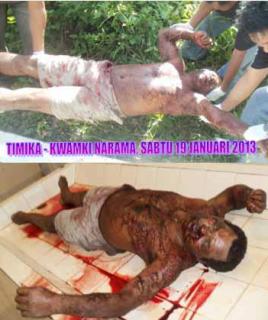
Ex Freeport worker murdered, mutilated in Timika OTK killing

by West Papua Media

January 23, 2013

The body of Henok Rumansara where found in Kwamki Narama (Photo: Kobawes Kores / Fb)

Papuan civilians around Timika have again been made wary of military provocations that may potentially revive a bloody horizontal conflict, after a former Freeport mine worker’s mutilated body was found in a roadside trench on January 19.

Villagers from Kwamki Narama, just outside Timika, found the badly mutilated body of Hanok Rumansara, 40, from Biak, in a roadside ditch in front of the village.  The autopsy on his body found Rumansara was riddled with over 23 stab wounds, plus a number of injuries cause by blunt objects, according to his human rights observers.

A human rights worker with Komnas Ham, going by the pseudonym Kobewas Kores, posted information on social media that Rumansara had been picked up by a motorcycle taxi (ojek) rider to take him to Kwamki Narama.  Whilst on the road, a group of unknown persons (orang tak kenal or OTK) set up a road block, and was not seen again until his body was found, according to witnesses interviewed by human rights workers.

Indonesian police have claimed that though there is little information to work on, they are pursuing the culprits, according to citizen media website malanesia.com.  Police have also claimed they have interviewed several witnesses and have secured arrows, bow, an axe and wood.  However, Indonesian police have rarely showed a willingness to properly investigate OTK cases, which most credible observers in Papua laying the blame squarely on Indonesian special forces from either Kopassus or Densus 88.

A former worker at the contentious Freeport-McMoRan run giant Grasberg gold and Copper mine, Rumansara had reportedly been active in the ongoing Freeport industrial dispute, according to initial information.  It is unclear why Rumansara had lost his job at the mine, but he was amongst hundreds of workers who failed to regain their jobs after the record-breaking seven month strike ended in December 2011.

Many Papuan ex-Freeport workers have been reportedly stranded from their home regions after not receiving any or enough severance pay from the management of the most lucrative gold mine on the planet.  West Papua Media has no information at this stage to indicate that he was targeted in relation to his involvement at Freeport, or in the strike.  If this were the case, it would represent a major escalation that would backfire significantly on the perpetrators, given the high political organisation of Freeport workers who are already tense given the recent gassing deaths of several workers.

However, Local human rights observers have questioned if the latest OTK killing – the first since community-led peace building put an end to a bloody military-fostered inter-tribal war from 20 May to 5 October 2012 – was a deliberate act of provocation to upset the current fragile peace.  The 2012 horizontal conflict claimed over 2o lives in numerous OTK killings, as well as direct tribal violence, while police and Indonesian military conducted operations deliberately designed to incite violence.

‘Kobewas Kores’ believes that indeed there was an OTK killing, but they got their targeting wrong and killed a man from another part of Papua.

“Is it possible that the killing was deliberately done to give birth to a conflict breaking out in Kwamki Narama village? I think the scenario actually missed the target of an indigenous person to Kwamki Narama.   In this case there are specially trained parties, the Indonesian military is trying to sow confusion in Timika and Papua in general,” Kobewas said.

West Papua Media

Related articles

Create a website or blog at WordPress.com

Up ↑