
URGENT APPEALS PROGRAMME
Urgent Appeal Case: AHRC-UAC-204-2011
11 October 2011
———————————————————————
INDONESIA: Police in Timika kill one union protester and injure others at Freeport
ISSUES: Extrajudicial killing; right to life; police violence; freedom of expression; indigenous people; labour rights
———————————————————————
Dear friends,
 The Asian Human Rights Commission (AHRC) has received information regarding the extrajudicial killing of trade union member Peter W. Ayamiseba and the injury of several persons in police shootings during a union protest on October 10, 2011 at PT Freeport Indonesia in West Papua. The workers were protesting against the illegal termination of their contracts following their earlier union strike for wage increases. The police appear to have used lethal ammunition against the protesters. (right: Peter W. Ayamiseba/photo source:Chemical Energy Mining Union-All Indonesia Workers Union)
CASE NARRATIVE:
According to the Chemical Energy Mining Union-All Indonesia Workers Union (Serikat Pekerja Kimia Energi Pertambangan-Serikat Pekerja Seluruh Indonesia) in Timika, West Papua, since September 15, 2011, PT Freeport Indonesia (PTFI) employees were on strike demanding wage adjustments. PT Freeport Indonesia is running controversial mining activities in Indonesia’s resource rich province of West Papua. The company in the past has paid military and police to run security operations for them. The majority of striking workers were indigenous Papuans. Based on the wages of up to USD 15 per hour provided to workers by the Freeport-McMoRan Copper & Gold group in other countries, the West Papuan workers demanded their USD 1.5/hr wage to be increased to USD 3/hr. The employees sought negotiations with the management of the company, but were not given opportunities for a serious dialogue; instead, they faced direct intimidation from the management or through the police.
According to article 144 of Indonesia’s law No 13/2003 concerning Manpower, protesting workers are protected from any termination of their employment:
Article 144
In the event of a strike performed in observance of what is stipulated under Article 140, the entrepreneur is prohibited from:
a. Replacing striking workers/ labourers with other workers/ labourers from outside of the enterprise; or
b. Imposing sanctions on or taking retaliatory actions in whatever form against striking workers/labourers and union officials during and after the strike is performed
In violation of this law however, PTFI fired the striking workers and employed new personnel as their replacement.
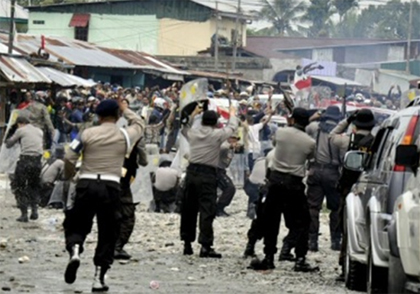
On October 10, the employees returned to their work location to protest against their termination and demanded their jobs back. At 9:30am, protesting employees from seven indigenous tribes that customarily hold the land of the Tembagapura mining location, and around 1000 employees from other areas walked to the entrance gate of the Gorong-gorong company bus transportation terminal (from where the PTFI run a bus to take the workers back to their dormitories). The police from Timika District Police (POLRES) had placed guards in front of the terminal, and refused to let the protesters enter, despite negotiation attempts by Mr. Anis Natkime (chief of the seven involved indigenous tribes).
The police then fired warning shots at the protesters causing those in the front rows to leave. When the protesters in subsequent rows tried to make their way forward to the gate, the police started shooting into the crowd, resulting in panic. Peter W. Ayamiseba, Freeport employee in the catering division, was shot in the shoulder and died at the scene. At least nine more persons were injured. The then enraged crowd responded by throwing stones at the police.
The police in turn fired several random shots at the protesters. While some reports claim that the police were merely using rubber bullets, the deadly wounds and the ammunition cartridges found at the scene indicate otherwise. Despite the police’s use of tear gas, the situation escalated further, resulting in the police withdrawing inside the gate they were trying to defend.

(right: Hand of Chary Suripto/photo source:Chemical Energy Mining Union-All Indonesia Workers Union)
Mr. Ayamiseba’s corpse was then brought directly to the Timika Regional General Hospital (RSUD), where the cause of his death was confirmed to have resulted from metal bullets. Nine other injured protesters (male) were also brought to the same hospital: Leo Wandagau and Melkias Rumbiak were wounded in the back by rubber bullets; Alius Komba was hit with a rifle in his stomach; Philiton Kogoya was hit by a rifle in his head; Ahmad Mustofa was wounded in the head and back by rubber bullets; Yunus Ngur W was shot in the stomach by police and operated upon in the hospital; Yusuf Kurni was wounded in his left hand by rubber bullets; Emeleanus Beanal was wounded in his right hand and left leg by rubber bullets and had bruises in his stomach caused by hits with a shotgun; and Chary Suripto was wounded in his left hand by the explosion of a tear gas unit.
The hospital did not provide the victims with any medical records however, and their requests for obtaining such reports were denied without providing any reason. This is in violation of regulation no. 269/2008 from the Indonesian Ministry of Health, which states that information about the patient’s identity, diagnosis and medical history can be provided at the request and consent of the patient (article 10.2b) and that the content of the medical records belongs to the patient and can be provided to persons authorized by the patient or the patient’s family (article 12.1).

(left: lethal ammunition used/photo source:Chemical Energy Mining Union-All Indonesia Workers Union)
A tenth and so far unidentified person (non-indigenous Papuan) among the protesters was also injured. Since he carried no identity documents and was not known to any of the other workers, he is suspected to have conducted intelligence activities for the police or the company during the protests, and to have been injured by accident.
On September 10, the workers laid Mr. Ayamiseba’s corpse at the entrance gate of the Timika office of the Papuan Regional Autonomy Parliament (Dewan Perwakilan Rakyat Daerah – DPRD) expecting Mr. James R. Moffett, chairman of PT Freeport Indonesia to come and take up his responsibility in the case and to ensure that both company management and police are held accountable. Until September 12 Mr. Moffet had not appeared, and the body of victim was then taken to the the Timika Regional General Hospital (RSUD) for an autopsy.
ADDITIONAL INFORMATION:
West Papua, Indonesia’s resource rich province, which also has the highest poverty levels in the country, suffers from extensive mining operations by multinational corporations and illegal activities by security forces. Many years of mining and export of its valuable resources have yet to result in an improvement of the living conditions of indigenous Papuans (including improvement in unemployment, education, health care). The illegal payments made to the police and military to maintain security for the mining activities indirectly creates incentives for the security forces to prolong security risks that require their intervention. Excessive force continues to be largely ignored, and perpetrators are not held accountable. The disproportional influence of PT Freeport Indonesia in public institutions in the wider Timika area, including institutions of justice, remains a serious concern. This contributes to prolonging the conflict between authorities, mining companies and the large indigenous population.
SUGGESTED ACTION:
Please write letters to the authorities listed below asking them to investigate into this case immediately, and to prosecute the responsible police officers for using illegal force. In particular, it is essential that this case is not buried or ignored as most cases regarding PT Freeport Indonesia are.
Please be informed that the AHRC is sending letters on this case to the UN Special Rapporteur on extrajudicial, summary or arbitrary executions, the Special Rapporteur on the rights of indigenous people and the Special Rapporteur on the promotion and protection of the right to freedom of opinion and expression, calling for their strong interventions.
SAMPLE LETTER:
Dear ___________,
INDONESIA: Police in Timika kill one union protester and injure others at Freeport
Name of victims: Peter W. Ayamiseba, Leo Wandagau, Melkias Rumbiak, Alius Komba, Philiton Kogoya Ahmad Mustofa, Yunus Ngur W, Yusuf Kurni, Emeleanus Beanal and Chary Suripto (members of Serikat Pekerja Kimia Energi Pertambangan-Serikat Pekerja Seluruh Indonesia/ Chemical Energy Mining Union-All Indonesia Workers Union)
Names of alleged perpetrators: members of Timika Dictrict Police
Date of incident: 10 October 2011
Place of incident: The entrance gate of the Gorong-gorong company bus transportation terminal
I am writing to voice my deep concern regarding the killing of Peter Ayamiseba, an employee of PT Freeport Indonesia on 10 October 2011 by members of Timika District Police (POLRES), when PT Freeport Indonesia employees were on strike demanding wage adjustments. Nine other protesters were also injured by the police.
According to the information I have received from the Asian Human Rights Commission, since September 15, 2011 PT Freeport Indonesia (PTFI) employees were on strike demanding wage adjustments. PT Freeport Indonesia is running controversial mining activities in West Papua, Indonesia’s resource rich province. The company had in the past paid military and police for running security operations for them. The majority of striking workers were indigenous Papuans. Based on the wages of up to USD 15 per hour provided to workers by the Freeport-McMoRan Copper & Gold group in other countries, the West Papuan workers demanded their USD 1.5/hr wage to be increased to USD 3/hr. The employees sought negotiations with the management of the company, but were not given opportunities for a serious dialogue; instead, they faced direct intimidation from the management or through the police.
According to article 144 of Indonesia’s law No 13/2003 concerning Manpower, protesting workers are protected from any termination of their employment:
Article 144
In the event of a strike performed in observance of what is stipulated under Article 140, the entrepreneur is prohibited from:
a. Replacing striking workers/ labourers with other workers/ labourers from outside of the enterprise; or
b. Imposing sanctions on or taking retaliatory actions in whatever form against striking workers/labourers and union officials during and after the strike is performed
In violation of this law however, PTFI fired the striking workers and employed new personnel as their replacement.
I am informed that on October 10, the employees returned to their work location to protest against their termination and demanded their jobs back. At 9:30am, protesting employees from seven indigenous tribes that customarily hold the land of the Tembagapura mining location, and around 1000 employees from other areas walked to the entrance gate of the Gorong-gorong company bus transportation terminal (from where the PTFI run a bus to take the workers back to their dormitories). The police had placed guards in front of the terminal, and refused to let the protesters enter, despite negotiation attempts by Mr. Anis Natkime (chief of the seven involved indigenous tribes).
I am disturbed to learn that the police then fired warning shots at the protesters, causing those in the front rows to leave. When the protesters in subsequent rows tried to make their way forward to the gate, the police started shooting into the crowd, resulting in panic. Peter W. Ayamiseba, Freeport employee in the catering division, was shot in the shoulder and died at the scene. At least nine more persons were injured. The then enraged crowd responded by throwing stones at the police.
The police in turn fired several random shots at the protesters. While some reports claim that the police were merely using rubber bullets, it has come to my attention that the deadly wounds and the ammunition cartridges found at the scene indicate otherwise. Despite the police’s use of tear gas, the situation escalated further, resulting in the police withdrawing inside the gate they were trying to defend.
Mr. Ayamiseba’s corpse was then brought directly to the Timika Regional General Hospital (RSUD), where the cause of his death was confirmed to have resulted from metal bullets. Nine other injured protesters (male) were also brought to the same hospital: Leo Wandagau and Melkias Rumbiak were wounded in the back by rubber bullets; Alius Komba was hit with a rifle in his stomach; Philiton Kogoya was hit by a rifle in his head; Ahmad Mustofa was wounded in the head and back by rubber bullets; Yunus Ngur W was shot in the stomach by police and operated upon in the hospital; Yusuf Kurni was wounded in his left hand by rubber bullets; Emeleanus Beanal was wounded in his right hand and left leg by rubber bullets and had bruises in his stomach caused by hits with a shotgun; and Chary Suripto was wounded in his left hand by the explosion of a tear gas unit.
The hospital did not provide the victims with any medical records however, and their requests for obtaining such reports were denied without providing any reason. This is in violation of regulation no. 269/2008 from the Indonesian Ministry of Health, which states that information about the patient’s identity, diagnosis and medical history can be provided at the request and consent of the patient (article 10.2b) and that the content of the medical records belongs to the patient and can be provided to persons authorized by the patient or the patient’s family (article 12.1).
A tenth and so far unidentified person (non-indigenous Papuan) among the protesters was also injured. Since he carried no identity documents and was not known to any of the other workers, he is suspected to have conducted intelligence activities for the police or the company during the protests, and to have been injured by accident.
On September 10, the workers laid Mr. Ayamiseba’s corpse at the entrance gate of the Timika office of the Papuan Regional Autonomy Parliament (Dewan Perwakilan Rakyat Daerah – DPRD) expecting Mr. James R. Moffett, chairman of PT Freeport Indonesia to come and take up his responsibility in the case and to ensure that both company management and police are held accountable. Until September 12 Mr. Moffet had not appeared, and the body of victim was then taken to the Timika Regional General Hospital (RSUD) for an autopsy.
In light of the above information I am of the opinion that the killing of Peter W. Ayamiseba and the violation of the rights of several workers who were threatened by the police with regard to their freedom of speech and expression is in contravention of Indonesia’s constitution.
I am therefore urging you to take immediate action in this case, and to ensure that it is not buried or ignored, as happens to most cases involving PT Freeport Indonesia. An impartial criminal investigation must be conducted by a professional investigation team for police officers who were using lethal ammunition which resulted in the killing and injury of several workers. An independent investigation team should also subsequently conduct an investigation into the allegation of corruption based on the payments made by the company to the police. All those found guilty must be prosecuted according to the law.
I also urge you to ensure that PT Freeport Indonesia takes responsibility for the outcome of the conflict, for which they share responsibility and ensure that there are no more violations of labour rights.
I am looking forward to your intervention in this case.
Yours sincerely,
—————-
PLEASE SEND YOUR LETTERS TO:
1. Mr. Susilo Bambang Yudhoyono
The President of Indonesia
Jl. Veteran No. 16
Jakarta Pusat
INDONESIA
Tel.: +62 21 3863777, 3503088.
Fax: +62 21 3442223
2. The Minister of Manpower and Transmigration
Jl. Jend. Gatot Subroto Kav. 51 Jakarta 12950
INDONESIA
Tel.: +62 21 5229285, 7989924
Fax: +62 21 7974488
3. Head of Indonesian Police
Markas Besar Kepolisian Indonesia
Jl. Trunojoyo No. 3
Kebayoran Baru
South Jakarta 12110
INDONESIA
Tel. +62 21 3848537 / 7260306 / 7218010
Fax: +62 21 7220669
E-mail: info@polri.go.id
4. Head of Division of Profession and Security of Indonesian Police
Markas Besar Kepolisian Indonesia
Jl. Trunojoyo No. 3
Kebayoran Baru
South Jakarta 12110
INDONESIA
Tel.: +62 21 3848537, 7260306 / 7218010
Fax: +62 21 7220669
E-mail: info@polri.go.id
5. Chairman of the National Police Commission (Kompolnas)
Jl. Tirtayasa VII No. 20 Komplek PTIK Jakarta Selatan
INDONESIA
Tel.: +62 21 739 2352
Fax: +62 21 739 2317
6. Head of Papua Regional Police
Jl. Samratulangi No. 8 Jayapura
INDONESIA
Tel.: + 62 967 531014
Fax: +62 967 533763
7. Head of Division of Profession and Security of Papua Regional Police
Jl. Dr. Sam Ratulangi No. 8
Jayapura
INDONESIA
Tel.: + 62 967 531834
8. Head of Timika District Police
Jl. Agimuga No. 03, Mike 32
Timika Papua
INDONESIA
Tel.: +62 901 301974
9. Office of The Anti Judicial Mafia Task Force (Satgas)
PO Box 9949
Jakarta 10 000
INDONESIA
Contact on website: http://www.satgas-pmh.go.id/?q=node/157
10. Head of National Commission on Human Rights of Indonesia
Jalan Latuharhary No.4-B,
Jakarta 10310
INDONESIA
Tel.: +62 21 392 5227-30
Fax: +62 21 392 5227
E-mail: info@komnas.go.id
Thank you.
Urgent Appeals Programme
Asian Human Rights Commission (ua@ahrc.asia)
Related articles
- State is obliged to protect striking PT Freeport Indonesia workers (westpapuamedia.info)
- Strike pressures PT Freeport Indonesia into serious negotiations (westpapuamedia.info)
- Indonesian security forces open fire on West Papuan striking miners – kill one (westpapuamedia.info)
- Freeport Mine Managers turn rabid on Indonesian Grasberg Strikers (westpapuamedia.info)
- Reports of Securicor being used to break the Freeport strike (westpapuamedia.info)




 West Papua Media Alerts