A history of violence at Indonesia mine/AJE

Rio Tinto has cosy ties with the Indonesian military, who have a long history of human rights abuses.
Freeport’s James Moffett has said ‘there is no alternative’ to the company’s reliance on the Indonesian military [EPA]


Investing in conflict-affected and high-risk areas is a growing concern for responsible businesses and investors. Companies based in developed countries often operate in lesser-developed foreign markets, where governance standards are lax, corruption is high and business practices are poor.

These pieces focus on one specific Anglo-Australian company and their American partner that jointly operate a mine in West Papua, one of the poorest provinces of Indonesia. The risks for the company include the potential to contribute to environmental and social damage in a foreign market. The risks for investors include financing a company that does not get its risk management right.

This is the third chapter of a four-part essay that examines how the Norwegian Pension Fund came to blacklist the mining giant Rio Tinto. The first part can be found here, and the second part can be found here.

In February 1995, Anglo-Australian mining giant Rio Tinto announced three deals that secured access into Grasberg, a massive gold and copper mine in the Indonesian province of West Papua.

First, Rio Tinto agreed to invest $500m of new capital in Arizona-based mining corporation Freeport for a 12 per cent stake in the US business. Second, Rio Tinto agreed to finance a $184m expansion of the Grasberg mine. In return, it received 40 per cent of post-1995 production revenue that exceeded certain output targets and, from 2021, a 40 per cent stake in all production. Finally, Rio Tinto would receive 40 per cent of all production from new excavations elsewhere within West Papua.

Rio Tinto was effectively doing business with Indonesian dictator Suharto, too.

In response, Freeport told shareholders that Rio Tinto would “contribute substantial operating and management expertise” through proportional representation on the board – as well as on various Grasberg operating and technical committees, from which the “policies established by the [board] will be implemented and operation will be conducted”.

Speaking of the “exceptional potential” of the deal, Rio Tinto’s then chief executive, Robert Wilson, agreed that“given [Rio Tinto’s] experience in other major open-pit copper ore bodies such as Bingham Canyon, Palabora and Escondida, we anticipate considerable mutual benefit”.

Rio Tinto obviously liked how Freeport-Indonesia did business, especially at Grasberg.

US government: Grasberg contravenes the Foreign Assistance Act

By October 1995, an independent US government agency had cancelled Freeport’s international political risk insurance. The insurer, the Overseas Private Investment Corporation (OPIC), specifically cited the Grasberg mine operation as contravening the Foreign Assistance Act of 1961, which required that “overseas investment projects do not pose unreasonable or major environmental hazards or cause the degradation of tropical forests”. Freeport was the first policyholder to be terminated by the OPIC for ethical violations, despite President Suharto and Freeport director Henry Kissinger heavily lobbying the US government to reinstate the policy. Following OPIC’s decision, the company did not disclose the environmental performance of the mine again until 2003 – it no longer had to.

For a brief time in 2000 and 2001, a particularly sympathetic Indonesian environment minister, Sonny Keraf, pursued numerous avenues to impose penalties and fines on Grasberg, including an unsuccessful attempt to invoke the criminal section of the 1997 Environmental Law to cease Freeport-Indonesia’s riverine method of tailings disposal, by which the corporation fed the mine’s waste product into nearby rivers. Under pressure for his pursuit of the part-Indonesian-owned Freeport, Keraf was replaced following the 2001 election.

As Suharto’s reign came to an end, an increasing number of West Papuans also began to campaign against the environmental and social impact of Grasberg. Papuan leaders brought the matter before the US Federal District Court in April 1996 and before the Subcommittee on International Operations and Human Rights of the US House of Representatives in May 1999. Many more attempts, including one to address shareholders at Rio Tinto’s 1998 annual general meeting in London, were foiled by Indonesian authorities.

Building on restrictions introduced in 1991, the US government banned arms transfers to Indonesia for widespread human rights violations in East Timor in 1999. Consequently, Freeport’s payments to the Indonesian military and security forces were more closely scrutinised. The Wall Street Journal found that, between 1991 and 1997, Freeport guaranteed more than $500m in loans so that Suharto’s family and allies could purchase a stake in the mine – a great portion of which was written off by Freeport in 2003.

An outspoken Australian academic, Lesley McCulloch, also found that the 1996 Timika riots adjacent to the Grasberg mine led to a spike in monetary demands by the Indonesian military, resulting in the funding of a $35m army base. Freeport and Rio Tinto refused to disclose details of the payments.

A history of violence

Then in August 2002, two US teachers and an Indonesian employee of Freeport-Indonesia were murdered at the Grasberg mine complex. Following one rebel’s admission that he was a business partner of the Indonesian military, several New York City pension (superannuation) funds formally requested that Freeport disclose the nature of its Indonesian “security” payments. The shareholders were concerned that such payments violated the Foreign Corrupt Practices Act.

Although Freeport was not required to put the proposal to shareholders, the company did begin to disclose its security-related payments. Filings with the US Securities and Exchange Commission since 2001 have confirmed annual payments reaching an average $5m each year for government-provided security of the Grasberg complex and its staff – and fluctuating annual costs reaching $12m for unarmed, in-house security costs. A spokesman for the company later told the Jakarta Post that these payments had been taking place since the 1970s.

Sporadic accounts began to surface – in the Sydney Morning HeraldJakarta Post, and New York Times – quoting internal sources that confirmed that the Indonesian had masterminded the killings to extort monies from the Grasberg operators. “Not surprisingly, the Indonesian military has exonerated itself,” US Congressmen Joel Hefley and Tom Tancredo said in June 2003. “American investigative teams, including the FBI, have not been able to complete their investigations mainly due to the Indonesian military’s refusal to co-operate and tampering of evidence.”

Freeport remained steadfastly opposed to later demands by New York City pension fund investors to cease all payments to the Indonesians until they complied with official US investigations into the August 2002 murders. At the 2004 annual general meeting, president and chief executive Richard Adkerson advised shareholders: “The management and Board believe that the stockholder proposal mischaracterises the company’s relationships with Indonesian security institutions and suggests actions that would undermine the company’s relationship with the Indonesian government and the security of the company’s operations.”

Despite the ongoing human rights and corruption concerns in West Papua – including a report by the World Bank and a letter by US senators to then UN Secretary General Kofi Annan calling for the appointment of a special representative to Indonesia – after a vote by shareholders, the resolution was not passed.

On March 23, 2004, Rio Tinto announced it had sold its 11.9 per cent shareholding in Freeport. Rio Tinto made a $518m profit. Citing no environmental or social reasons, Rio Tinto’s then-chief executive Leigh Clifford reassured shareholders that “the sale of [Freeport] does not affect the terms of the joint venture nor the management of the Grasberg mine” and that through “our significant direct interest in Grasberg, we will continue to benefit from our relationship with Freeport”.

Rio Tinto remained committed to the mining of Grasberg and would continue overseeing its management through various operating and technical committees.

Sensational claims that illegal payments to individual soldiers, units, and policemen had been routinely made to secure the Grasberg complex and its staff came to light in 2005. A report by Global Witness revealed that an additional $10m had been paid directly to individual military and police commanders between 1998 and 2004. This included $247,000 between May 2001 and March 2003 to General Mahidin Simbolon, former head of the 1999 East Timor massacre, and monthly payments throughout 2003 to the police Mobile Brigade – a group cited by the US State Department as having “continued to commit numerous serious human rights violations, including extrajudicial killings, torture, rape, and arbitrary detention”.

With the US arms trade embargo still in place, Rio Tinto had reassured the market that payments to the Indonesian military were “legally required and legitimate” only months before the news broke. Now Rio Tinto and Freeport-Indonesia came under even greater public pressure. At Rio Tinto’s next shareholder meeting, after several West Papuans refugees made statements to the board on Grasberg, shareholder activist Stephen Mayne suggested that “the most appropriate thing for Rio Tinto to do would be to exit”. After confirming that Rio Tinto’s contractual obligations would permit such a move, then-chairman Sir Rod Eddington informed shareholders that they “make a considerable effort to ensure that the best that Rio Tinto can offer to Freeport in the management of that venture is available to them”.

An Indonesian ministerial decree in 2007 demanded that the security of “vital national objects” – such as Grasberg – be handed over to the police within six months. Evidence obtained by world news service AFP suggests this is not happening. In a filing to the US Securities and Exchange Commission, Freeport disclosed additional direct payments of “less than” $1.6m in 2008 to 1,850 soldiers, despite the fact that 447 policemen make up the official number of personnel responsible for security at the Grasberg complex.

Unrepentant

The company’s 2008 Sustainable Development report confirms that Freeport-Indonesia makes contributions to “security institutions (including both police and military)”. Alarmingly, according to Amnesty International, as recently as 2008 there have been fundamental human rights violations such as the “torture, excessive use of force and unlawful killings by police and security forces” – reports that have subsequently been confirmed by the UN Special Representative of the Secretary General on Human Rights Defenders and the United Nations Committee against Torture.

“There is no alternative to our reliance on the Indonesian military and police,” Freeport chairman James Moffett said to the New York Times in 2005. “The need for this security, the support provided for such security, and the procedures governing such support, as well as decisions regarding our relationships with the Indonesian government and its security institutions, are ordinary business activities.”

Part 4 to follow next week.

This is an extract of a chapter from the book, Evolutions in Sustainable Investing: Strategies, Funds and Thought Leadership, to be published by Wiley in December 2011.

NAJ Taylor is a PhD candidate in the School of Political Science and International Studies at the University of Queensland, and casual lecturer in the Faculty of Law and Management at La Trobe University.

Follow NAJ Taylor on Twitter: @najtaylordotcom

Freeport Mine Managers turn rabid on Indonesian Grasberg Strikers

Grasberg mine
Image via Wikipedia

PT Freeport Mine Managers Turn Rabid on Indonesian Grasberg Strikers
26 September 2011

ICEM InBrief

Government-mediated talks broke off last week and labour relations further soured between Freeport-McMoRan and 8,000 striking Indonesian miners of ICEM affiliate FSP-KEP (SPSI), the Trade Union of Chemical, Energy, and Mine Workers (CEMWU). The PT Freeport Indonesia Workers’ Union this week meets the halfway mark of its 30-day strike that now could be prolonged at the world’s largest gold and third largest copper mining complex – Freeport McMoRan’s Grasberg mine in eastern Papua Province, New Guinea Island.

Management spite was apparent at the strike’s start on 15 September and it worsened following the breakdown of three days of talks with the Manpower Ministry in Jakarta on 22 September. PT Freeport managers relieved 138 union shop stewards of their job duties on Friday. The union responded by stating the strike likely will be extended beyond 15 October.

Since the wage, pension, and community funds strike started, managers have coerced workers to return to work with threats of dismissal, they have pressed contractors’ employees into production, and now they try to decimate the union by sacking union stewards and isolating the branch union’s other leaders.

PT Freeport management has attempted to coerce workers to sign a statement saying they will return to work or face getting fired. But despite this, only 500 workers are manning operations and many are staff of contractors. (See a list of contractorshere.)

Freeport-McMoRan last week issued a statement last week saying it was losing three million pounds of copper production daily, and 5,000 ounces of lost gold output daily. To increase pressure on miners to abandon the strike, the company also warned of lost revenues to the Indonesian government and to the seven native groups around Timika, Papua, that Freeport-McMoRan is obliged to support.

The opening salvo came at the strike’s outset when Managing Director Armando Mahler announced a “no-work, no-pay” policy. After last week’s mediation failure, union and government sources said “complete distrust” exists between Mahler and his team and the union.

Thus, PT Freeport Indonesia Workers’ Union asked that US-based Freeport-McMoRan Chairman James Moffett enter discussions. Mine union leaders remember Moffett’s visit a few years ago when he encouraged workplace leaders to engage in “win-win” principles of labour relations.

At last week’s mediation, PT Freeport, 91% owned by Freeport-McMoRan and 9% by Indonesia’s government, said it would not budge from a wage offer of 11% in each year of a two-year accord. (The bi-annual contract comes due on 1 October.) The average miner’s wage rate at Grasberg is US$1.50-per-hour. The union was seeking a doubling of that to US$3-an-hour but in mediation last week, the FSP-KEP miners’ branch union offered a compromise and proposed a 65% increase. The company would not move from 11%.

It has offered slight increases in education and housing support and in shift pay, but has said it would not deviate from wage increments that other foreign investors pay in Indonesia. It also refuses to base a pension scheme – 50% paid into by workers – on multiplied years of service, or hear the union’s demands for enhanced development and opportunities for the indigenous people of Papua.

Grasberg is Freeport-McMoRan’s biggest revenue maker and a year ago, the company’s chief financial officer called it “very low cost and a high cash flow generating asset with a very long life.” The company’s revenues this year from Grasberg are expected to be lower because it is mining lower-grade sections of the open pit mine. But Freeport-McMoRan is bullish on the future; it is developing a deep underground mine adjacent to Grasberg that contains high grades of copper and gold in the same ore body.

The ICEM has intervened in this dispute and through its Indonesian Affiliates’ Union Chairman, D. Patombong Sjaiful of FSP-KEP’s CEMWU, is giving direct aid and support to the Grasberg strikers. They need the solidarity and support of all miners and all trade unions in mining and other industrial sectors. Please send a short message in your own words to the PT Freeport Indonesia Workers’ Union.

In ICEM outreach to the union, when asked to characterise the strike, one officer responded by saying, “determination. That’s the one word that describes workers. We’re determined to change our future through the work we do for this company.”

Union makes move to end Freeport strike

JUBI, 23 September 2011

Trade union SPSI writes to Moffet in a move to end the strike

SPSI, the trade union of Freeport workers, has finally decided to write to the top executive of Freeport-McMoran in the US via the intermediary of Silas Natkime (who is referred to as the ‘bugnagel’ which means the ‘host’) after realising that there is not likely to be any settlement of the strike at the Freeport mine because the management of PT Freeport Indonesia has not shown any goodwill to resolve the problem.

Chairman of organisational affairs of the union, Virgo Solossa, said that the decision to write to the top management was taken at a meeting with the bugnegal at the Nemangkawi Institute of Mining in Kuala Kencana today.

‘We have drafted the letter and given it to the bugnegel to be forwarded to Moffet for negotiations to take place. Until we get a reply from Moffet, we will not return to work. This is our final move and we hope that this will bring about an end to the strike,’ he said.

Solossa said that this did not mean that they were handing the issue over to the bugnegel. Everything would be handled jointly, but this was because it is only the bugnegel whose help could be sought to resolve the dispute.

The request to the bugnegel is for Moffet to make recommendations as soon as possible. When approached, the bugnegel expressed his willingness to help facilitate a resolution to the strike with the FI management.

With regard to reports that a number of employees working for the contractor at Mill Operation and Underground as well as at Grasberg have gone back to work, Solossa said the union had decided to hold a peaceful demonstration. ‘We plan to approach the police and the labour service about this plan for a demonstration. This is mainly in connection with our criticism of actions taken that do not comply with the laws in force in this country. This is particularly with regard to some remarks made by a foreign member of staff which we regard as not complying with the laws in force in this country.’

According to Solossa, the actions taken by the management since the start of the strike have failed to respect the laws of this country. But Solossa was not in a position to say when this demonstration would take place. According to Solossa, ‘the demonstration will be held together with other components in society, such as the youth, students and school-children.

The news from Tembagapura is that workers at the Mill Operation and Underground factory as well as at Grasberg went back to work last night. These are workers on contract with PT Buma, Intinaker, Inamco, Visvires and PT Trakindo.

‘Production at the Mill Operation has been going on since last night, but the products cannot be sent to Portsite because they are not of the correct density,’ according to a JUBI source who works at Mill Operation. The same source at Grasberg said: ‘There is some production by contract workers of PT Trakindo, Buma and Grasberg.’

West Papua: A history of exploitation -Opinion – Al Jazeera English

West Papua was taken over by Indonesia in 1969, and a legacy of oppression and environmental devastation has followed.
Listen to this page using ReadSpeaker
”]

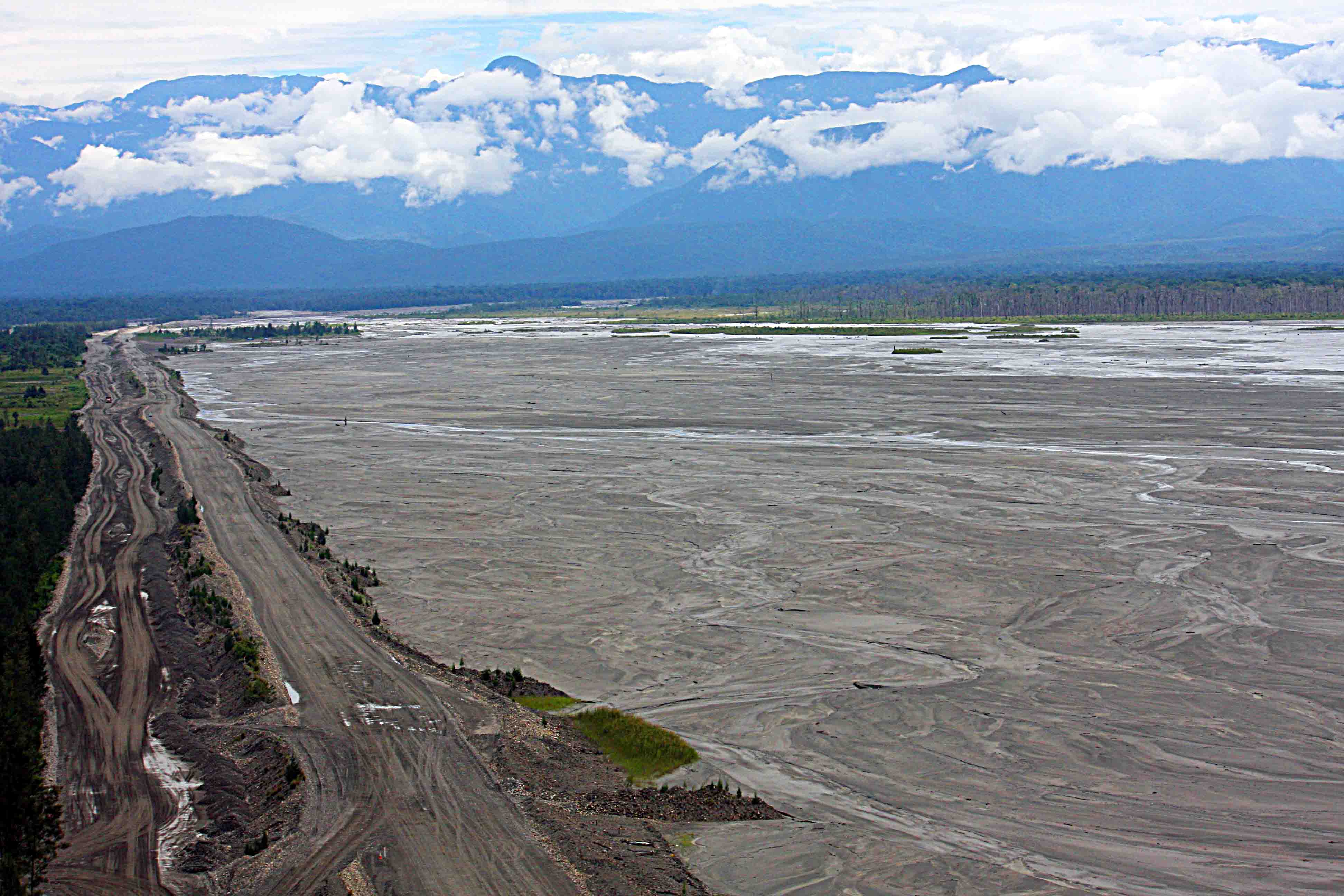
The Grasberg mine has damaged surrounding river systems, such as the Ajikwa river above [West Papua Media]

Investing in conflict-affected and high-risk areas is a growing concern for responsible businesses and investors. Companies based in developed countries often operate in lesser-developed foreign markets, where governance standards are lax, corruption is high and business practices are poor.

These pieces focus on one specific Anglo-Australian company and their American partner that jointly operate a mine in West Papua, one of the poorest provinces of Indonesia. The risks for the company include the potential to contribute to environmental and social damage in a foreign market. The risks for investors include financing a company that does not get its risk management right.

This is the second chapter of a four-part essay that examines how the Norwegian Pension Fund came to blacklist the mining giant Rio Tinto. The first part can be found here.

Part 2: A history of exploitation

New Guinea, geographically as well as historically, is Australia’s closest relative. Separated from the mainland during the last glacial period, the waters filled in what now separates them: about 152km of the Torres Strait.

While Australia and New Guinea both have enviable mineral stores, economic and political exploitation has left the latter as home to many of the poorest people on Earth. New Guinea is also an island of two histories.

The eastern half forms the independent state of Papua New Guinea – a status it has enjoyed since breaking from Australia in 1975. With its natural resources of oil and industrial metals, Papua New Guinea has long been exploited for its minerals at places like Ok Tedi and Bougainville.

Both projects ended in social and environmental disaster. The environmental impact of Ok Tedi was so great that, in 1999, Paul Anderson, then chief executive of Australian mining company BHP, conceded that the mine was “not compatible with our environmental values”. But it did serve the company’s pursuit of profit. It was not until the Ok Tedi environmental disaster three years later that the true impact of BHP’s mining practices came to the attention of the global public. BHP subsequently sold its interest, established a fund to restore the sustainable development of the affected people, and received immunity from further prosecution.

The western half of New Guinea has had a lesser-known but equally tragic history centred around the Jayawijaya Mountain, home to the Amungme, and farther downstream, the Kamoro people. As with much of East Asia, the indigenes were under Dutch rule when a geological expedition in 1936 located a significant ertsberg (ore mountain) deep in the southwestern highlands. World War II intervened, and the Japanese claimed Indonesia and some of the western parts of New Guinea.Following defeat in the war, the Japanese were marshalled back to their home territory, and Dutch colonialism resumed. Importantly, when Indonesian independence was obtained from the Dutch in 1949, few knew of the ertsberg (mineral ore) hidden deep in West Papua’s wilderness.The Dutch began a ten-year Papuanisation programme in 1957 that would see West Papua handed back to the indigenes, and would create the independent state of West Papua around 1972.Despite multiple territorial claims, the ore mountain lay dormant for over 20 years.On March 6, 1959, the New York Times reported the presence of alluvial gold in the Arafura Sea just off the coast of West Papua. Reminded of their earlier discovery, Dutch geologists were said to be returning to the ore mountain, now simply known as Ertsberg.Independence deniedThe indigenes, meanwhile, as part of their programme toward independence, established a Papuan National Council and provisional government as well as their own military, police force, currency, national anthem, and flag. At the time, West Papua’s independence was due before the United Nations Decolonisation Commission, and representatives took part in various cultural and political activities throughout the region. By December 1, 1961, the West Papuan “Morning Star” flag had been raised alongside the Dutch for the first time. Many assumed that independence was imminent.Unbeknown to both the indigenes and the Dutch, US mining company Freeport-McMoRan Copper and Gold was negotiating directly with Suharto – at the time an Indonesian army general – for a small group of its experts to prospect this ore mountain. The path into West Papua through Suharto promised to be fruitful for Freeport, since its board was stacked with the Rockefeller’s Indonesian oil interests who already were versed in the general’s way of doing business. An exploration agreement was reached, and soon after a geologist from Freeport was forging his way through the wilderness toward Ertsberg.West Papua was about to change hands again.Armed with Chinese and Soviet weapons, as well as an increasingly public friendship with the communists, Indonesia declared war on the Netherlands. To protect Western interests from the threat of communism, on August 15, 1962, the United Nations and the United States orchestrated a meeting between Dutch and Indonesian officials during which interim control of West Papua was signed over to Indonesia.Six years of UN interregnum followed, after which a plebiscite would decide whether to form a separate nation or integrate into Indonesia. All 815,000 West Papuans were to vote in an Act of Free Choice.To ensure a favourable outcome, the Indonesians worked to suppress Papuan identity. Raising the West Papuan flag and singing of the national anthem were banned, and all political activities were deemed subversive. Indonesia ruled through force, for self-interest. Alarmed by ongoing media reports, on April 5, 1967, in the British House of Lords, Lord Ogmore called for a UN investigation. By early 1968, with Suharto having assumed the presidency of Indonesia, a US consular visit almost unanimously agreed that “Indonesia could not win an open election” in West Papua.West Papua still wanted its independence.In a desperate attempt to secure West Papua’s right to self-determination, two junior politicians crossed the border into Australian-administered Papua and New Guinea on May 29, 1969. They carried damning evidence of Indonesian repression; the hopes of a yet-unformed nation rested on the politicians reaching the UN. As Australia and its allies were amenable to Indonesian control of West Papua, the two were imprisoned upon crossing the border until after the referendum. Their brave plea was silenced.Between July and August 1969, less than a quarter of one per cent of the population – some 1,026 West Papuans – signed the country’s freedom over to Indonesia. The election, held under the aegis of the UN, was far from an act of free choice. The following day West Papua was declared a military operation zone, the local people’s movement was restricted, and expression of their national identity banned under Indonesian law.Poor, neglected West Papua.Selling West PapuaControl of West Papua proved a lucrative business deal for the Indonesians. Two years prior to the Act of Free Choice – coincidentally on the same day the plight of Papua was raised in the House of Lords – Freeport signed a contract of work with the Suharto government entitling a jointly owned company, PT Freeport Indonesia (Freeport-Indonesia), full rights to the Ertsberg mine. In return, Indonesia would derive significant tax revenues and fees as well as a minority 9.36 per cent shareholding. Without the authority to do so, Indonesia nevertheless cut itself into a deal that sold large tracts of West Papua to the US company, intent on sifting it for copper and gold.Although Ertsberg fulfilled its promise, as production slowed in the mid-1980s, Freeport-Indonesia began to explore surrounding mountains and ridges for other reserves. As is often the case, the best place to establish a new mine is next to another. Sure enough, significant copper and gold reserves were located at Grasberg only a couple of miles southwest of Ertsberg.Grasberg has the largest recoverable reserves of copper and gold in the world. It’s also Indonesia’s economic beachhead.Observing the Grasberg mine via Google Earth, one sees a scar like no other: Located about 13,000 feet (4,000 meters) above sea level, open-pit (above ground) mining has bored a hole through the top of the mountain more than half a mile (1 km) wide. What they’re digging for is more than $40bn worth of copper and gold. Every day the operation discharges 230,000 tons of tailings (waste rock) into the Aghawagon River. This process is expected to continue for up to six more years, at which point exploration will go underground until there’s no value left. Freeport estimates that will occur by 2041.The operation is so large that it has shifted the borders of the adjacent Lorenz National Park. Listed as a World Heritage site by the UN’s Educational, Scientific, and Cultural Organisation (UNESCO) in 1999, the park is “the only protected area in the world to incorporate a continuous, intact transect from snowcap to tropical marine environment, including extensive lowland wetlands”. For the Amungme and Kamoro indigenes, corporate imperialism had replaced European colonialism.The ramifications are both environmental and social.‘Slow-motion genocide’The social and economic condition of the indigenous Amungme and Kamoro poses fundamental human rights concerns. Although Freeport-Indonesia directly or indirectly employs a large number of West Papuans and is regularly Indonesia’s biggest taxpayer, in 2005, the World Bank found that Papua remained the poorest province in Indonesia. With a marked rise in military personnel and foreign staff has come a number of social issues, including alcohol abuse and prostitution such that Papua now has the highest rate of HIV/AIDS in Indonesia.Indonesian control of West Papua has been characterised by the ongoing and disproportionate repression of largely peaceful opposition. Few sustained violent interactions have occurred; however, in one major conflict in 1977, more than 1,000 civilian men, women, and children were killed by the Indonesian military in Operasi Tumpas (“Operation Annihilation”) after a slurry pipe was severed and partially closed the Ertsberg mine.More recently, in 1995, the Australian Council for Overseas Aid reported that the Indonesian army and security forces killed 37 people involved in protests over the mine in the preceding seven-month period. While the level of violence is difficult to establish, academics at the Centre for Peace and Conflict Studies at the University of Sydney maintain that up to 100,000 West Papuans may have been killed since Indonesian occupation. They call what’s happening to West Papua “slow-motion genocide”.There are also two primary environmental concerns over Grasberg. The first is that the mine discharges 230,000 tons of waste rock a day into surrounding waterways; given the escalating rate of processing, this rate is arguably above that allowed by national law. Secondly, acid rock drainage – the outflow of acidic water – has resulted from the disposal of a further 360,000 to 510,000 tons a day of overburden and waste rock in two adjacent valleys covering 4 miles (6.5 km), up to 975 feet (300 metres) deep. The mine operators dispute both claims.Riverine methods of waste disposal are banned in every developed country on Earth. The World Bank no longer funds projects that operate this way, due to the irreversible ecological devastation, and the International Finance Corporation requires that rock be treated prior to disposal, which is not a practice carried out at Grasberg. Since the mid-1990s, a number of independent environmental assessments have found unacceptably high levels of toxicity and sediment as far as 140 miles away.Freeport and Rio Tinto maintain that riverine tailings disposal is the best solution, given the difficult terrain, the threat of earthquakes, and heavy rainfall.Grasberg’s reserves are so vast that extracting them is expected to create 6 billion tons of industrial waste.President Suharto, who is now recognised as one of the most corrupt and tyrannical leaders in history, renewed Freeport-Indonesia’s exclusive mining rights in 1991 for a further 30 years with an option of two 10-year extensions. The license included an option to prospect another 6.5 million acres (2.6 million hectares), as far as the Papua New Guinea border. “The potential is only limited by the imagination,” Freeport’s chairman, James Moffett, remarked to shareholders in March 1995. “Every other mining company wants to get into Irian Jaya [West Papua]. Bougainville and Ok Tedi don’t hold a candle to Grasberg.”Part 3 to follow next week.This is an extract of a chapter from the book, Evolutions in Sustainable Investing: Strategies, Funds and Thought Leadership, to be published by Wiley in December 2011. NAJ Taylor is a PhD candidate in the School of Political Science and International Studies at the University of Queensland, and casual lecturer in the Faculty of Law and Management at La Trobe University.Follow NAJ Taylor on Twitter: @najtaylordotcomThe views expressed in this article are the author’s own and do not necessarily reflect Al Jazeera’s editorial policy.Related articles

BHP Billiton acknowledged that its mine at Ok Tedi was ‘not compatible with our environmental values’ [GALLO/GETTY]
“Grasberg’s reserves are so vast that extracting them is expected to create 6 billion tons of industrial waste.”

The blacklisting of Rio Tinto – Opinion – Al Jazeera English

Grasberg mine
Image via Wikipedia

The blacklisting of Rio Tinto – Opinion – Al Jazeera English.

Too many invest in companies – such as Australia’s Rio Tinto – without any consideration of the ethics of doing so.
Listen to this page using ReadSpeaker
Papuans protest against Freeport and Rio Tinto’s Grasberg mine outside of Freeport’s office in Jakarta [EPA]

[This is the first of four pieces examining Rio Tinto and mining in Indonesia’s West Papua province]

Investing in conflict-affected and high-risk areas is a growing concern for responsible businesses and investors. Often times companies based in developed countries operate in lesser-developed, foreign markets, where governance standards are lax, corruption is high and business practices are poor.

These pieces focus on one specific Anglo-Australian company that operates in West Papua, one of the poorest provinces of Indonesia. The risks for the company include the potential to contribute to environmental and social damage in a foreign market. The risks for investors include financing a company that does not get its risk management right. This is the story of how the Norwegian Pension Fund blacklisted Rio Tinto.

An ancient copper mine located near Huelva in southernmost Spain changed hands in 1873. A group of opportunistic Anglo-German investors, equipped with modern techniques that favored mining aboveground, acquired it from the Spanish government. The mine’s copper had stained the surrounding water to such an extent that the indigenes named the river Rio Tinto – literally meaning “red river”.

The mine at Rio Tinto had supplied the Phoenicians, ancient Greeks, Carthaginians, and the Roman Empire. Its copper had paid for Carthage’s numerous wars on Rome and had been held by both Scipio and Hannibal. We can only assume that these investors, aware of such indelible marks on the environment and history, missed the irony, because they named their company Rio Tinto.

However, the red river has since flowed a long way from home. The company has expanded its operations through Australia, North and South America, Asia, Europe, and southern Africa – across coal, aluminum, copper, diamonds, uranium, gold, industrial minerals, and iron ore. Rio Tinto is now so large that its dual listing on the Australian and London stock exchanges commands a value of over $100bn.

What’s left behind near the Spanish town of Huelva is a 58-mile-long river flowing through one of the world’s largest deposits of pyrite, or fool’s gold. Because of the mine, the river has a pH reading similar to that of automobile battery acid and contains virtually no oxygen in its lower depths. In the late 1980s, temporary flooding dissolved a power substation, a mandibular crusher, and several hundred yards of transport belts.

More recently, NASA astrobiologists used the conditions of the river to replicate the conditions of Mars. “If you remove the green,” one of them remarked, “it looks like Mars”. The thinking goes that if something could live in such an acidic river, then there is likely to be life on Mars too.

Every Australian – through public monies invested by elected governments, or their choice of superannuation fund, insurer, and bank – is funding this red river now too. Rio Tinto is so large and so profitable that, for the average Australian, investment in it is very near unavoidable.

Blacklisted

On September 9, 2008, amid the turmoil of the global financial crisis, the Norwegian government announced that it had liquidated its entire $1bn investment in Rio Tinto for “grossly unethical conduct”. Operating the second largest fund in the world, the Norwegians’ decision focused solely on the Grasberg mine in West Papua on New Guinea, which it believed posed the “unacceptable risk” of contributing to “severe environmental damage” if it were to continue funding the Anglo-Australian mining giant.

Rio Tinto had been blacklisted.

The following day, Rio Tinto’s official statement relayed that the company was “surprised and disappointed”, given both its recognised leadership in environmental sustainability and its noncontrolling interest in the Grasberg mine. As with most claims of sustainability, the truth is otherwise.

Rio Tinto should not have been surprised by the Norwegian stance on Grasberg. Records show that there had been months – in fact, years – of dialogue with the Norwegians about Grasberg’s inadequate environmental and social performance. Rio Tinto had faced a litany of signposts indicating that multinational and Indonesian involvement in West Papua was not meeting various standards, laws, and norms: Institutions such as the World Bank, the Australian Council for Overseas Aid, the International Finance Corporation, the Overseas Private Investment Commission, the United Nations Committee against Torture, the US State Department, and the Indonesian Environment Ministry, as well as many US and European politicians, independent environmental assessments, international media, Papuan leaders, civil society groups, and shareholders had brought the problems to Rio Tinto’s attention.

That an institutional investor should act on environmental, social, and corporate governance considerations is a newly evolving development within the global investment industry, and one in which many Australian institutional investors and service providers have been quick to claim leadership. However, the blacklisting of Rio Tinto by the Norwegian government was uniquely public, transparent, and forward-thinking. Yet this wholesale dumping of one of Australia’s blue-chip stocks received only syndicated coverage in the local media.

Behind the headlines of the global financial crisis is a deeper, more systemic fault line that rewards rampant capitalism. Too many invest in and operate mines such as Grasberg without any consideration of the ethics of so doing.

Part 2 to follow next week.

This is an extract of a chapter from the book, Evolutions in Sustainable Investing: Strategies, Funds and Thought Leadership, to be published by Wiley in December 2011.

Follow NAJ Taylor on Twitter: @najtaylordotcom

Create a website or blog at WordPress.com

Up ↑