Military commander denies current military operations in Papua and rejects legitimacy of the IIIrd KRP

JUBI, 23 March 2012The commander of the district military command in Jayapura denied that any military operations are taking place in Papua. Lieut-Colonel Rano Tilaar was speaking to journalists after taking part in a Joint Forum of the SKPD (?) and the start of a Consultation on Development in Jayapura.

‘There are no military operations under way in Papua, but only Security Operations Along the Border. We have to realise that although the situation in general is calm and orderly, there are conflicts going on, vertical conflicts as well as a horizontal conflicts,’ he said.

The vertical conflict is related to various problems between the government and those wanting independence – or separatism – while horizontal conflicts are those that occur between groups within the community where there are differences between the native population and the newcomers.

‘We need to be conscious of what is meant by nation and state. What is the meaning of the legacy inherited from our ancestors and the natural resources which offer great potential if they are not exploited jointly in the interests of the nation and the state.’

According to Rano, in the present political situation in Papua, the TNI – Indonesian Army – regards the group which pursues the ideology of  M – merdeka – as our brothers. The difference between us, he said, is they have not yet accepted the ideology of NKRI – the Unitary State of the Republic of Indonesia.

When asked his opinion about the  the Third Papuan Peace Congress [held last October], he said that this meeting was not representative of the Papuan people because according to information he has received from local customary leaders and religious leaders, there was no legitimacy for the creation of a state and the appointment of the president and the prime minister of that state, because others felt that they had not been consulted  and they were not willing to legitimise the congress as being representative of the Papuan people.

‘It only represented a group of people and it was correct to apply the charge of makar – treason – from the point of view of the law because that was a treasonous act.’

(This article unfortunately does not report the contradictions in this story, and fails to mention the fact that significant sweeps against civilians are ongoing throughout the Highlands in Tingginambut and Mulia – against Free Papua guerillas led by Goliat Tabuni – as well as major operations across the entire border region, including allegations of village clearances.  West Papua Media)

Rallies calling on Ban Ki-Moon to protect Papuans to be held across Papua and Australia, on March 19

Reprinting Press Release 19 March 2012 from FRWP spokesperson

 
RALLY:  Federated Republic of West Papua
TUESDAY, 19 MARCH 2012, 11:30am-1:30pm
State Library, 328 Swanston St (cnr Swanston and La Trobe Sts), MELBOURNE
complementing rallies in Jayapura, Sorong, Biak, Yapen-Waropen, Manokwari, and Fak Fak
West Papuan independence advocates are questioning the UN Secretar
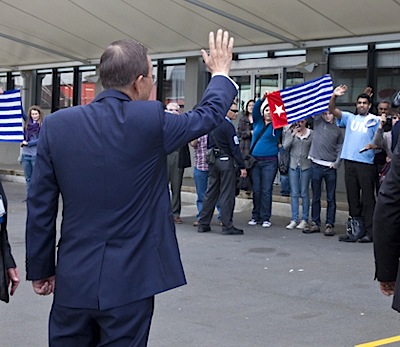
Ban Ki-moon waves to protestors for West Papua, PIF NZ Sept 2011
y-General’s presence—as a keynote speaker—at The Jakarta International Defence Dialogue, hosted by the Indonesian Ministry of Defence on 21 March 2012.
“We would like Mr Ban Ki-moon to attend to our defence while he’s in Jakarta” said Herman Wainggai, the West Papuan independence advocate based in the United States.
“The Indonesian government brands us as separatists, and then hosts international fora to escalate support for what it says are ‘non-war military operations’ against us”.
Forkorus Yaboisembut, President of the Federated Republic of West Papua, currently incarcerated, requests the Secretary-General to recognise the leadership of the Federated Republic of West Papua elected at the Congress in October in 2011.
“The United Nations recognizes West Papua’s right to self-determination, and is therefore responsible for organising properly constituted peace talks, with itself mediating between the Federated Republic of West Papua and the Indonesian government.”
Edison Waromi, Prime Minister of the Federated Republic of West Papua, also incarcerated last week for another three years (he was also a political prisoner 1989—1999, 2001, 2002, 2003-2004) says the Secretary-General must actively insert himself into the West Papuan issue.
“The 564,126 missing Papuans since 1962, more than half-a-million people, should galvanize UN intervention.  And I believe the Secretary-General should also, while visiting Jakarta’s new Peacekeeping Centre this week, negotiate the release of all political prisoners in Indonesia.”
Many international observers believe that Indonesian political fears, that their republic will dissemble in the face of West Papuan self-determination, is misplaced.
“Holland didn’t fall over when Indonesia became independent, and neither will Indonesia when we do” said Wainggai. “Bali principles, Lombok treaties, Peace centres in West Java….these are all meaningless while Indonesia continues to escalate its troops and its judiciaries against us”.
Media Inquiries and Interviews
Please contact West Papua Media for direct contacts on the ground in the follwoing locations:
MELBOURNE, SORONG, BIAK, YAPEN WAROPEN, MANOKWARI, JAYAPURA , and FAK FAK.
PLEASE NOTE: RALLIES TO ALSO BE HELD BY WEST PAPUA NATIONAL COMMITTEE (KNPB) ACROSS PAPUA AND INDONESIA: DETAILS FORTHCOMING

24 Feb Update on Forkorus trial: Testimony from witness

Bintang  Papua, 24 February 2012 

One of the witnesses to appear in the trial, Eliezer Awom told the court that the declaration of establishment of the Federal Republic of West  Papua had come about as a result of pressure from the Papuan people, as had been expressed during the Third Papuan Congress which was held in October last year.

Eliezer Awom was the only one of nine witnesses who were due to testify at the hearing. The other witnesses did not turn up.

Awom reminded the court that the Third Papuan Congress had been attended by around four thousand people.

The witness described the decision that was taken at the conclusion of the Congress and the subsequent arrest of Forkorus, along with a number of other people, including the witness himself. He insisted that the Congress was a manifestation of the wishes of the Papuan people and said that the Congress which had taken place and had been given official permission to take place. He said that the Congress had agreed to the establishment of the Federal Republic of West Papua and had elected Forkorus Yaboisembut as the President of the Federal Republic, along with Edison Waromi as its prime minister.

He described how Forkorus made his statement very public through loudspeakers and that two hours later, the security forces had started shooting the participants  in order to force them to disperse. He described the banners that had been unfurled at the Congress and insisted that they were simply restoring the Federal Republic of West Papua, and that West Papua belongs to the West Papua people.

Around 400 people were taken into custody at the time, many of whom were subjected to maltreatment such as kicks and punches by the security forces.

Forkorus and the other four Papuans who are on trial with him confirmed that what the witness said in court was true.

He said that the declaration should be sent to the United Nations in order for the Federal Republic of West Papua to obtain formal recognition from the international community.

As with previous hearings, security forces were out in force around the courthouse.

Concerns of JPIC in Papua regarding the situation in Papua

(Reflections on the situation in 2011)

From 13 to 16 February 2012, the secretariats of the Justice, Peace and Integrity of Creation (JPIC) in Papua (Franciscans JPIC in Papua, JPIC Archdiocese of Merauke, JPIC Agats Diocese, JPIC of Timika Diocese and JPIC of Sorong Diocese) held an annual meeting in Sentani. The outcome of this meeting is summed up in the following reflections on the situation in Papua with some recommendations.

The secretariats of JPICs in Papua confirm that the pro-investment policy of the Government of Indonesia and the torture and cruel treatment by the security forces have undermined law and the dignity of the indigenous Papuans, marginalising and threatening their right to life.

Situation in Papua in 2011

The indigenous Papuans have suffered from different investment policies of the Government in Papua. We found that the development policies on investment have caused the Papuans to lose their customary lands, identity, culture, livelihood, and they threaten the right to life. They have also become the source of horizontal conflict, as shown in the MIEFFE programme in Merauke, the palm oil plantation of PT. Merdeka Plantation Indonesia, PT. Merdeka Tapare Timber, PT Freeport Indonesia in Mimika, PT. Sawita Tandan Papua and PTPN 2 in Kerom.

The indigenous Papuans live in fear. The security forces use violence, torture, cruel and inhuman treatment against the Papuans which they justify with claims that their victims are supporters of the Free Papua Movement (Organisasi Papua Merdeka – OPM), as shown in the case of violence and torture against civilians during the 3rd Papuan Congress, the case of Tingginambut, the armed conflict in Puncak Jaya and Paniai and the conflict during the regional elections.

The indigenous Papuans are confused by the attitude of the Provincial Government which is not critical but rather tends to support the policy of the Central Government, as demonstrated in the case of the adoption of the policy on the Special Unit for the Acceleration of Development for Papua and West Papua (UP4B). This situation has put the future of the indigenous Papuans at risk. They are confronted with the difficulty to fight for their basic rights. The Papuan People’s Assembly (Majelis Rakyat Papua – MRP) and the Provincial Legislative Assembly of Papua (Dewan Perwakilan Rakyat Papua – DPRP) have been made powerless. MRP and DPRP only execute the orders of the Central Government and do not defend the interest of the Papuans.

The composition of the indigenous and non-indigenous Papuans is not in balance. The population census of the Indonesian Statistical Bureau (BPS) shows that the population of indigenous Papuans in the Provinces of Papua and West Papua is 1.760.557 or 48.73% of the total population, while the non-indigenous population is 1.852.297 or 51.27% of the total population of 3.612.854. It shows that the indigenous Papuans are a minority group in their own land while four decades ago they were the majority (96.09%).

Recommendations:

1. The Government of Indonesia should stop all investment that harms the right to life and the livelihood of the Papuan and conduct an independent evaluation of the companies investing in Papua. The Government of Indonesia should foster community-based development policies.

2. The Indonesian Military and the Indonesian Police should resolve the problems in Papua without using violence and they should bring to justice all perpetrators of the conflict in the area of PT. Freeport Indonesia.

3. In dealing with political demonstrations in Papua, the Government of Indonesia and the Police/Military should respect the right to freedom of expression of the Papuan people.

4. The Papuan People’s Assembly and the Provincial Legislative Assembly of Papua should genuinely represent the aspirations of the Papuans especially in addressing the issues that are causing the Papuans to become a minority in their own land.

These are our reflections and recommendations based on our wish to improve the future of Papua and to respect the human rights of the indigenous Papuans.

Abepura, 16 February 2012

P. Emanuel Tenau, Pr (Director of JPIC Diocese of Sorong) Br. Edy M. Rosaryanto, OFM (Director of Franciscans JPIC Papua). Ms. Veronika Tri Kanem (Program Manager of JPIC Merauke Archdiocese) Fr. Saul Wanimbo, Pr (Director of JPIC Timika Diocese) Fr. Hendrik Hada, Pr (Director of Agats Diocese)

AHRC: Military officers arbitrarily arrest and torture civilians based on false claims of rebel activity

ASIAN HUMAN RIGHTS COMMISSION – URGENT APPEALS PROGRAMME
Urgent Appeal Case: AHRC-UAC-005-2012
26 January 2012
———————————————————————
INDONESIA: Military officers arbitrarily arrest and torture civilians based on false claims of rebel activity
ISSUES: Freedom of assembly; indigenous people; torture; military violence; police negligence
———————————————————————
Dear friends,
The Asian Human Rights Commission (AHRC) has learnt that on 2 November 2011, seven commanding officers of the Kurulu military sub-district command (danramil Kurulu), arrested and ill-treated three local activists and nine Umpagalo villagers in Kurulu, Papua. This incident occurred without any command letter of authorization, following allegations of rebel activities. The AHRC noted that in Papua, people are frequently victimised based on arbitrary allegations of rebellion, and subsequently tortured. (photo: Kurulu victim)
CASE NARRATIVE:
A Kurulu villager named Alex, who reportedly drank and gambled with members of the pro-Jakarta militia Barisan Merah Putih, provoked Indonesian national military (TNI) officers by claiming there was a meeting between the Free Papua Movement (OPM) and the villagers at Umpagalo on the night of 2 November 2011, at Umpagalo village, Kurulu sub-district, Jayawijaya, Papua without specific evidence. Responding to this vague information, seven armed officers of the Kurulu military sub-district command (danramil Kurulu) prepared to handle the situation without any command letter of authorization (surat izin komando).
After the armed officers came to Umpagalo at around 11pm, they beat three local activists, Melianus Wantik, Edo Doga and Markus Walilo, as well as nine villagers, Pilipus Wantik, Wilem Kosy, Elius Dabi, Lamber Dabi, Othi Logo, Nilik Hiluka, Hukum Logo, Martinus Mabel and Saulus Logo, then stabbed them with bayonets for two hours, forced them to crawl and doused them with water for one hour. The officers also humiliated, beat with big wood sticks, kicked and stepped on them with their boots, pointed their guns and threatened that they would cut their heads, and shot at them four times. After that, the officers brought all the victims to the 176/ Kurulu military headquarters of Wim Anesili Wamena battalion branch (Pos TNI Batalyon 756 kurulu cabang Batalion Wim Anesili Wamena) and allegedly examined them for two hours. The victims were then released without clear reason. Too scared to go to the hospital located around 50 meters from the military post for medical treatment, they made do with traditional remedies. (photo: wounds of beatings and stabbing)
The victims’ colleagues complained to the Kurulu sector police following the incident, but the police refused to process the complaint since there is no substantial evidence to prove the allegations and the military officers are beyond their jurisdiction based on law no. 31 of 1997 regarding military court.
Meanwhile, the head of the military district command (Korem) 172/PWY Ibnu Tri Widodo acknowledged the violence. He stated that the seven soldiers who mistreated the civilians were now held in custody of the Wamena Military Police. They would be brought to the military court. Following the mistreatment, all soldiers on duty in the Kurulu sub-district had been transferred. He further promised that the military would no longer act “arrogantly” towards civilians. However, in many cases of military trials, which are not open to the public, the sentences are merely a light punishment, such as a transfer, which is inadequate given the seriousness of the human rights violations committed. Therefore, the TNI jointly with the National Human Rights Commission (Komnas HAM) should send an independent investigation team to transparently resolve this case, as well as ensuring the adequate punishment of those responsible. The military court law should be reviewed to ensure that members of the military are brought exclusively before a competent, objective and impartial civilian court that is compliant with the internationally-accepted standards of fair trial, including public access to the process, in cases of human rights abuses by members of the military against civilians. (photo: Kurulu victim)
ADDITIONAL INFORMATION:Torture is used in a widespread way by the police and military against indigenous Papuans, notably on persons suspected of supporting independence movements. Such suspicions are often leveled arbitrarily against members of the indigenous community and result in stigmatisation. This case is a clear example of this pattern.
Furthermore, according to the law on military courts, members of the military that commit crimes against civilians, such as extrajudicial killings or torture, can only be held accountable by military justice systems. Military courts are not open to the public, are notorious for only giving lenient punishments, and show a clear lack of impartiality.
for details of Appeals and to take action, please visit

Create a website or blog at WordPress.com

Up ↑
