MIFEE project violates human rights: Joint press release

Joint Press Release,

14 August 2011

Walhi, Pusaka, Sajogyo Institute, Sorpatom, Papuan NGOs Working Group, Sawit Watch, Aman, Huma,  JKPP, KPA, Kontras, Green Peace Indonesia, DtE

MIFEE Project Violates Human Rights

[Translated by TAPOL]

One year after the MIFEE (Merauke Integrated Food and Energy Estate) Project was launched by the central government, the situation of the people in Merauke  has become a matter of grave concern.  The indigenous Malind  people and the inhabitants in Merauke in general have been threatened and marginalised as a result of the conversion of their land and their ancestral forests by the MIFEE Project.

Research undertaken by Pusaka, called  ‘MIFEE does not reflect the aspirations of the Malind people’ drew the conclusion that the MIFEE Project was launched as the illegitimate offspring of the global food crisis for Food, Feed, Fuel and Climate Change (3F and 2C).  MIFEE is called the ‘illegitimate offspring’ because it is not a solution that serves the interests of the majority of the people but is the result of a conspiracy between capitalists and the government in search of economic rent side by side with cramped living conditions for the majority of the people. In the words of Emillianus Ola Kleden, a researcher for Pusaka Foundation, the MIFEE programme will have a number of negative impacts on the social and cultural fabric, the demographics, the social and economic conditions and the environment of the people. These negative impacts  will also worsen the living conditions of many groups living in the areas affected by the project.

Laksmi A Savitri, a researcher for the Sajogyo Institute, came across facts showing that MIFEE is a development model which makes no provision for improving the living standards  of the indigenous people in Merauke and is only focussed on the accumulation of corporate profits. There are three reasons for this, according to Laksmi:  firstly, it fails to respect the concept of land and identity  which is inseparable from the identity and dignity of the Malind people; secondly, it fails to understand the close links between the Malind people’s system of living and the natural resources and the forests, and assumes that the loss of forestry resources will be replaced by opportunities to work as day labourers for the companies; and thirdly, it pays no attention to the process of meaningful social transformation for the Malind people towards a better life in ways and forms that are defined by the Malind people themselves.

According to Billy Metemko, chairman of Sorpatom Merauke, the Merauke Project  has already caused significant damage  to  the social structure of the customary groups who have lost land where they are able to look for food and fulfil their social  needs, like what has happened in Zanegi Kampung in the operational area of PT Medco or Domande Kampung in the operational area of PT Rajawali and Nakias Kampung in the operational area of PT Dongin Prabhawa.  The destruction of these forests has resulted in the destruction of traditional symbols, the source of their livelihood, while in the longer term, it will lead to the wholesale destruction and extermination of traditional communities in Merauke.

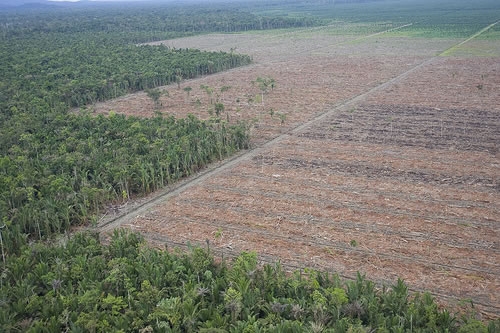
Since 2010, Sawit Watch and the Justice and Peace Commission of the Diocese of Merauke (SKP-Merauke) have held a number of meetings in kampungs along the border region between Indonesia and Papua New Guinea in South Papua and have discovered that land has been allocated for palm oil plantations on a massive scale. In the district of Merauke, at least 380,887 hectares have been allocated to ten companies, and 320,000 hectares in the district of Boven Digoel where licences have been issued to eight palm oil plantation companies. Opening up the land to palm oil plantations  on such a large scale has resulted in forest areas in the south of Papua having been turned into mono-cultural  plantations  leading to ecological destruction and the permanent and irreversible loss of its vitally important diversity. The presence of traditional communities  and indigenous Papuan people whose lives still depend on the forests will eventually be uprooted and marginalised as a consequence of development schemes that fail to take account of local wisdom and culture.

Bearing these conditions in mind, civil society in Indonesia has warned the Indonesian government and parliament, the DPR RI, that this project is more harmful than beneficial. Nevertheless the government  seems to have refused to listen to reports about the destruction of the environment, the food culture of the traditional communities and their life spaces and the destruction of Merauke’s forests. Sorpatom (Solidarity of Papuan People Rejecting MIFEE) has on numerous occasions organised activities to reject the  presence of MIFEE. Komali (the Community of Traditional Communities) wrote to the Indonesian president last year expressing the same views about MIFEE.

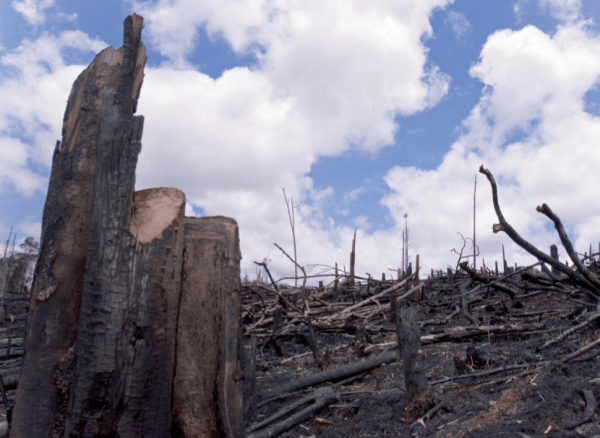
A field visit to Merauke by the environmental NGO WALHI in June 2011 discovered that during the course of the past year, at least one hundred thousand hectares of natural forest in Merauke have been cleared, including sago hamlets which protected food security  at all times, regardless of the season, and are very adaptable to changes in the climate. The marshlands are threatened  by drought, as a result of which  fish, birds  and deer  that have provided the local people with their source of protein will find it increasingly difficult to enjoy the necessary living space. Eventually, the Economic, Social and Cultural (ECOSOC)  rights will become ever more inaccessible to protection and provision by the state. Berry N. Forqan, the national executive director of WALHI, has stated that it is reasonable to say that the Indonesian government should be regarded as having caused the violation of basic human rights with the MIFEE Project.

Sinal Blegur, a member of the Working Group of NGOs in Papua, said that the violation of these ECOSOC rights will ultimately lead to the violation of  civil and political rights because MIFEE could potentially pave the way for the security forces  to enter the region on a massive scale to protect the operations of the companies.

In view of the above, dozens of local, national and international NGOs  have in the past month jointly produced a report to be submitted  to the Special Rapporteur of the UN on the Right to Food, drawing attention to threats to the right to food  of the traditional communities in Merauke. According to Abet Nego Tarigan, executive director of Sawit Watch, 22 NGOs  have so far signed  this document, representing the traditional communities in Merauke who are the victims or potential victims of the MIFEE Project The report has also been sent to the Committee on the Elimination of Racial Discrimination at the Office of the UN High Commissioner for Human Rights, and the Committee on Economic, Social and Cultural Rights  of the Human Rights Treaties Division.

This means that all civil society organisations which are concerned with the rights and living space for indigenous Papuan people should call on the government to immediately halt all MIFEE activities and Food Estates in general  in Indonesia that are  damaging the environment and forcing the  removal of traditional communities from their traditional land  and areas which they manage. The national, provincial and district governments must stop granting location licences  to companies and hold an inclusive dialogue, in which the Malind people are central, to discuss the allocation of land, the provision of space and development capital for agriculture, in conformity with social transformation that can bring the Malind people self-reliance and dignity.

All this is intended to ensure that similar operations that have resulted in the massive destruction of the environment which have occurred in Sumatra, Java, Kalimantan and Sulawesi  should not be repeated in Papua.

Contacts:

Islah, Manager   of the Water and Food Campaign, WALHI;

Frangky Samperante, Director of Psaka;

A Karlo Nainggolan, staff member of Advocacy, Policy and Legal Defence, Sawit Watch;

Laksmi Savitri, Sajogyo Institute;

Sinal Blegur, member of the Working Group of NGOs in Papua.

AlertNet: Indonesia re-thinks Papua food project – report

http://www.trust.org/alertnet/blogs/alertnet-news-blog/indonesia-re-thinks-papua-food-project-report

By Thin Lei Win

A member of the Koroway tribe walks up a ladder to his house at a forest near Merauke city in Indonesia's Papua province in this May 18, 2010 handout photo.A member of the Koroway tribe walks up a ladder to his house at a forest near Merauke city in Indonesia’s Papua province in this May 18, 2010 handout photo.

BANGKOK (AlertNet) –Indonesia’s government is considering moving its controversial food security project from Merauke, on the island of Papua, to East Kalimantan province, on Borneo island, due to lack of progress in the past two years, the Jakarta Globe reported.

Under MIFEE (Merauke Integrated Food and Energy Estate) plans, 1.63 million hectares of forest which form the basis of life for some 200,000 indigenous people in the Merauke area would be used to grow rice, palm oil, soya bean and corn among other crops.

Earlier this month, AlertNet reported criticism from rights activists that MIFEE threatens indigenous people and the forests and ecosystems in the area.

They also said the government has failed to sufficiently consult the native residents over the impact, which will include losing their customary lands, an influx of migrants from the rest of Indonesia and decreased quality of the ecosystems which people rely on for food and for their livelihood.

The minister of agriculture, Suswono, said on Monday that 200,000 hectares of land available in East Kalimantan could be used for agriculture, according to the Globe.

“The principle of the food estate is finding enough land for an agricultural zone. It doesn’t have to be in Papua,” the Globe quoted the minister as saying.

“[The East Kalimantan site] may not as big as Merauke, but it is more feasible. It has been two years since we floated the plan, but there has been no progress at all.”

Indonesia annually imports 2 million tonnes each of rice and soybean, and the nation needs to be able to feed its people without importing food, he added

Tempo: Papua MIFEE Project Faces Criticism

http://www.tempointeractive.com/hg/nasional/2011/08/15/brk,20110815-351921,uk.html

TEMPO InteractiveJakarta:The Merauke Integrated Food and Energy Estate (MIFEE) Program has been accused of disenfranchising local farmers in Papua. Berry N. Furqon, director of the Indonesian Forum for the Environment (Walhi), said that more than 100,000 ha of forest had been cut down for the project, including the sago forest on which the locals depend upon.

Abet Nego Tarigan, executive director of Sawit Watch, called on the United Nations to cancel the project. Abet said the MIFEE could endanger Indonesia as it allows companies rather than farmers to control the food supply.

The MIFEE project was inaugurated by Agriculture Minister Suswono on August 11 last year. The program sees plantations in Merauke managed by companies that also manage the local farmers. One million ha, divided in five clusters, has been allocated for the program.

As many as 32 companies have obtained principle licenses and will operate in a range of plantation sectors, namely palm oil, sugar cane and corn among others. Companies that have invested in the program include Wilmar, Sinarmas, Bakrie Sumatera Plantation, Medco, Bangun Cipta Sarana and Artha Graha.

NUR ROCHMI

————————————–

2) Indonesia Turns Back on Papua Food Bowl Plan
Faisal Maliki Baskoro | August 15, 2011

After two years with little progress, the government is considering shifting the location of its planned food estate to East Kalimantan from Papua because of the availability of land.

Suswono, the agriculture minister, on Monday said there was 200,000 hectares of land in East Kalimantan that could be used as an agriculture cluster. Under its plan, the Merauke Food Industrial Estate would have about 2 million hectares.

“The principle of the food estate is finding enough land for an agricultural zone. It doesn’t have to be in Papua,” he said. “[The East Kalimantan site] may not as big as Merauke, but it is more feasible. It has been two years since we floated the plan, but there has been no progress at all.”

Suswono said land clearance regulations were partly to blame for the slow progress.

“The construction of the Merauke food estate was obstructed by lack of regulation to clear necessary land,’’ Suswono said.

The government annually imports 2 million tons each of rice and soybean, and the nation needs to be able to feed its people without importing food, he said.

He said the government and potential investors would seek suitable areas for producing the two crops.

“The land in East Kalimantan is good for planting rice,” he said. To grow soybean, the ministry would need at least 500,000 hectares, and the government was still looking for land in Kalimantan.

While East Kalimantan has 200,000 hectares of land free, the West Kalimantan administration said it could provide 100,000 hectares of land, he said.

Suswono said farmland would not interfere with the preservation of forests. “We will be using open land, and probably convert production forests to farms. We will also empower local people to get involved in the program.”

Ecosystem in Merauke must be preserved, says agricultural expert


JUBI, 11 August 2011
The District of Merauke has a very rich ecosystem  which needs to be  preserved and protected. The problem is that when forests are cleared, this damages much of the ecosystem and virtually destroys it.
Drs Sudirman, an agricultural expert at the provincial administration of Merauke district, speaking during a technical guidance event  in Wasur, said that as the  population increases, land will be cleared everywhere  which will have a very damaging impact on the ecosystem in forested regions.
‘One example: When forests were cleared to make way for the MIFEE (Merauke Integrated Food and Energy Estate) project, recently, a significant part of the ecosystem was lost and much of is it already dead. It is the responsibility of everyone concerned  to think about the best way to deal with this problem so as to ensure that the ecosystem is not damaged.’ he said.
He said that the TH Wasur region in particular has a large number of species which means that it is the responsibility of everyone, including the original inhabitants of the district, to play their part in preserving  the ecosystem.

Empty promises whitewash Freeport’s rights, responsibility record

 http://etanaction.blogspot.com/2011/08/empty-promises-whitewash-freeports.html

Special for ETAN‘s  Blog

by David Webster

What does a mining company need to do to get a top score for “corporate social responsibility”?

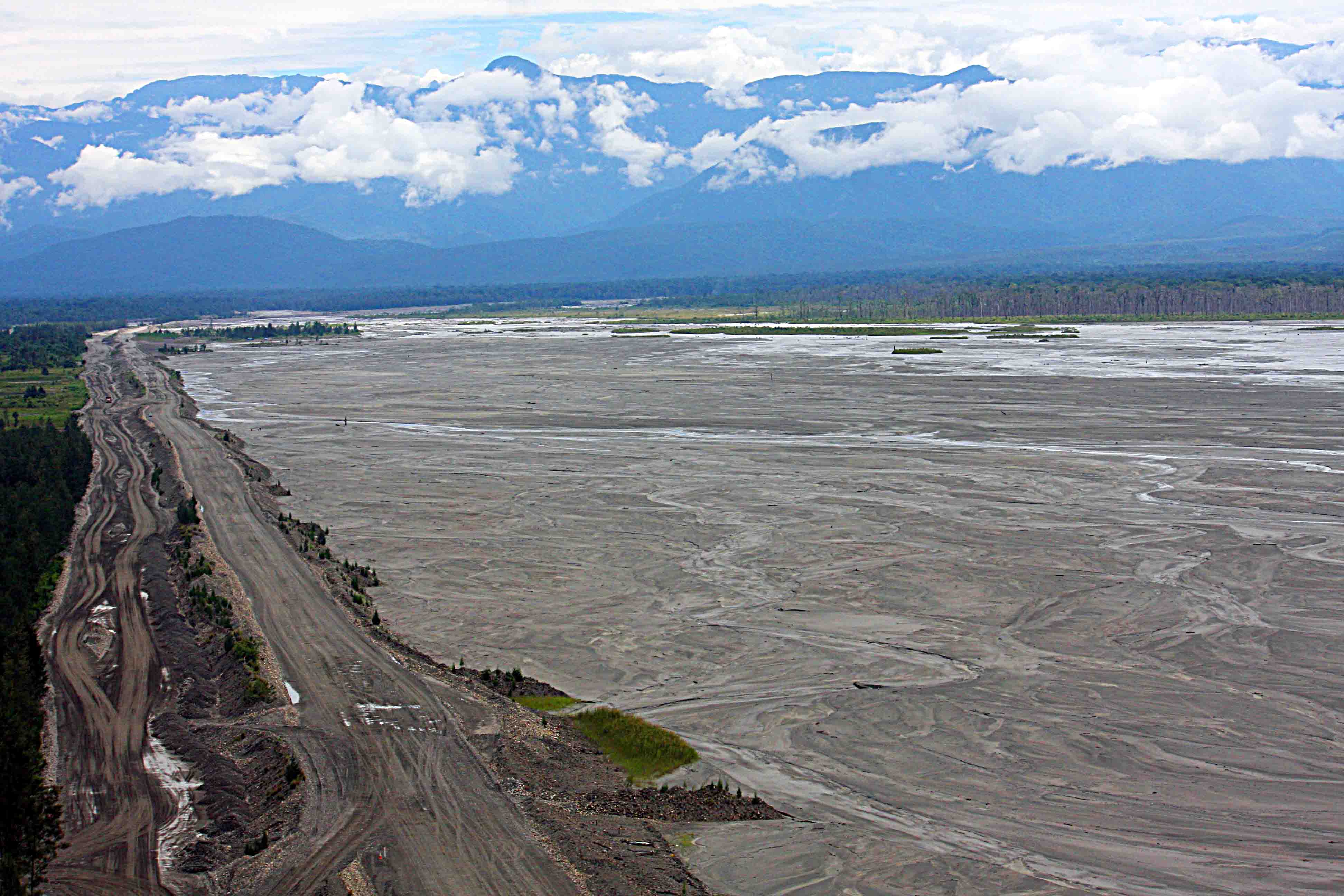
Freeport's contribution to Papua's welfare - Riverine tailings pollution

To judge by the recent “100 Best Corporate Citizens List”, all it takes to finesse a long and controversial record of human rights abuses is to come up with a piece of high-minded rhetoric, then carry on as usual.

Human rights advocates and those who have studied the record of Freeport McMoran in West Papua were startled to learn that Corporate Responsibility Magazine had named Freeport as the 24th-best corporate citizen in America (click for the full list). More startling still, the company scored well based mainly on a sixth-place ranking in the human rights category.

How is this possible? Well, the survey’s methodology seems to pay no heed to human rights performance. Only human rights rhetoric matters. And in that, Freeport excels. A strong written policy on human rights declares: “Freeport-McMoRan does not tolerate human rights transgressions.” It points to rights risks in West Papua, Peru, and the Democratic Republic of Congo, and adds that PT Freeport Indonesia policy is to “notify the direct commanders of the perpetrators” in cases where human rights allegations are made against Indonesian security forces. Since reputable human rights groups suggest that the top ranks of the security forces are implicated in widespread human rights violations in West Papua, this is hardly striking at the root of the problem.

As local people have pointed out, and researchers have confirmed, Freeport’s performance is a far cry from the written policies. The main trouble is intimate ties to Indonesian security forces.

Security forces may be implicated in the murder of American citizens near the Freeportmine, as Eben Kirksey and Andreas Harsono have reported.

Violence around the mine is used by security forces to target and scapegoat local people. In 2005, the New York Times revealed thatFreeport paid the security forces more than $10 million in 2001 and 2002. Payments are now made “in-kind” rather than in cash. The local Amugme people have long protestedFreeport seizure of their lands. Pictures of Freeport’s Grasberg mine from space (left) show the scale and environmental impact in the mountains that are home to the Amungme.

And lest all of this be hailed as “old news,” the Amungme filed a lawsuit last year sayingFreeport had taken their lands illegally. Meanwhile, the Indonesian army’s presence around Freeport, and the company’s close ties to Indonesian security forces, were reinforced this year. The continuing alliance between Freeport Indonesia and the Indonesian security forces is likely to exacerbate, rather than improve, the human rights situation.

None of these reports are taken in to account in the “100 Best Corporate Citizens List.” All the human rights indicators measure “human rights disclosure” and the sole source, according to the methodology details, comes from “Company public disclosures” – a corporation’s own information about itself.

The methodology, in other words, measures promises, not performance. There are parallels to the debate over whether companies accused of operating sweatshops overseas can be trusted to police themselves, or should accept independent monitoring. Thus the list cites the voluntary “Sullivan principles” first created under the Reagan administration and welcomed by companies resisting demands to divest from apartheid South Africa. AndFreeport boasts of adherence to the Voluntary Principles on Security and Human Rights, launched by the British and American governments in 2000.

The key word here is “voluntary.” As with the mining industry globally and with businesses jumping on the corporate social responsibility (CSR) bandwagon more generally, companies are happy to promise good performance, as long as no one will be looking over their shoulders.

So perhaps it’s no surprise to learn that Corporate Responsibility Magazine is in fact published on behalf of the Corporate Responsibility Officers Association, a body made up of many of the companies being judged, and steered by such firms as Domtar and KPMG.Freeport is listed as a “recent member” of the CROA. It’s advanced in the listings – it was ranked 83rd in 2010.

The problem here isn’t just the “corporate social responsibility” methodology, but the entire concept of “CSR”. It can all too often be used by companies to buy their way out of “corporate social irresponsibility.”

Freeport is no champion of the best values of corporate citizenship: For human rights activists, it’s long been a poster child for corporate irresponsibility. A list of good corporate citizens with Freeport winning laurels demonstrates more than flaws in the study. As George Monbiot has written of climate change credits, the lists offer corporations a new form of medieval European Catholic “indulgences,” forgiveness for any form of offence. Jeff Ballinger recently pointed out on this blog that companies like Nike are wrapping themselves in the CSR garment to burnish their corporate images, despite continuing disregard for many labor rights. Freeport, too, is now having itself measured for a fine CSR wardrobe.

—-

David Webster is an assistant professor of International Studies at the University of Regina inSaskatchewan, Canada. He is a former coordinator with the East Timor Alert Network/Canada.

see also

West Papua Report (monthly)

ETAN/WPAT: Statement on the operations of the Freeport McMoran Mine in West Papua, to the U.S. Senate hearing on Extracting Natural Resources: Corporate Responsibility and the Rule of Law

Create a website or blog at WordPress.com

Up ↑